flat tire AUDI Q7 2011 Owner´s Manual
[x] Cancel search | Manufacturer: AUDI, Model Year: 2011, Model line: Q7, Model: AUDI Q7 2011Pages: 392, PDF Size: 93.29 MB
Page 339 of 392

________________________________________________ T_i_re _ s_ a _ n_d_ w_ h_ e_ e_l_s __ ,n
• After any impact, immediately inspect your tires or have them
inspected by the nearest authorized Audi dealer. Replace a damaged
tire as soon as possible.
• Inspect your tires every 2,000 miles (3,000 km) for damage and
wear . Damage is not always easy to see . Damage can lead to loss of
air and underinflation, wh ich could eventually cause tire failure. If
you believe that a tire may have been damaged, replace the tire as
soon as possible.
• These tires may wear more quickly than others .
• Please also remember that, while these tires deliver responsive
handling, they may ride less comfortably and make more noise than
other choices.
Reduced performance in winter/cold season
conditions
All tires are designed for certain purposes. The low aspect ratio, ultra high performance tires originally installed on your vehicle are
intended for maximum dry and wet road performance and handling.
Th ey are not su itable for cold, snowy or icy weather conditions. If you
drive under those circumstances, you should equip your vehicle with
all -season or winter tires, which offer better traction under those
conditions. We suggest you use the recommended snow or all-season
tires specified for your vehicle, or their equiva lent.
Refer to~
page 334 for more detailed i nformat ion regard ing w inter
tires. •
Tire pressure monitoring system
General notes I)
Each tire, including the spare (if prov ided), should be checked
month ly when cold and inflated to the inflation pressure recom
mended by the vehicle manufacturer on the vehicle placard or tire
inf lation pressure label. (If your vehicle has tires of a different size
than the size ind icated o n the vehicle p lacard o r tire inflation pressure
Safety first
label, you should determine the proper tire inflation pressure for
t hose tires.)
As an added safety feature, your vehicle has been equipped with a t ire
pressure monitoring system ( TPMS) that illuminates a low tire pres
s ur e telltale when one or more of your tires is significantly under
inflated. According ly, when the low tire pressure te lltale illuminates,
you should stop and check your tires as soon as possible, and inflate
them to the proper pressure. Driving on a sign ificantly under- inflated
tire causes the tire to overheat and can lead to tire failure. Unde r
inflation also reduces fuel efficiency and tire tread life, and may
affect the vehicle's handling and stopping ability.
Please note that the TPMS is not a substitute for proper t ire ma inte
nance, and it is the driver's responsibility to maintain correct tire
pressure, even if unde r-inflation has not reached the level to trigge r
illumination of the TPMS low tire pressure telltale.
Your vehicle has also been eq uipped with a TPMS mal function indi
cator to indicate when the system is not operating properly . The
TPM S malfunction indicator is combined with the low tire pressure
telltale . When the system detects a ma lfunct ion, the telltale will
flash for approximately one minute and then remain continuously
illuminated . T his sequence will continue upon subsequent vehicle
start-ups as long as the malfunction exists.
When the malfunction indica tor is illum inated, the system may not
be able to detect or signal low tire pressure as intended. TPMS
ma lfunctions may occur fo r a variety of reasons, including the instal
lat ion of replacement or alternate tires or wheels on the veh icle that
prevent the TPMS from functioning properly. Always check the TPMS
malfunction telltale after replac ing one or more tires or wheels on
your vehicle to ensure that the rep lacement or a lternate tires and
wheels allow the TPMS to continue to function properly .•
Vehicle care Technical data
Page 340 of 392

___ T_ i_ r_e _s_ a_ n_ d _ w _h _e_e_ l_ s _______________________________________________ _
Tire pressure indicator appears
The tire pressure indicator in the instrument cluster
informs you if the ti re pressure is too low or if there is a
system malfunction.
Fig. 2 46 Disp la y:
u nd erinfl ation
warni ng
Fi g. 2 47 Dis play:
Syst em m alf un ction
Us ing the ABS sensors, the tire pressure monitoring system compares
t he t ire tread c ircumference and vibrat ion characte rist ics o f the indi
vidual tires. If the pressure decreases in one or more tires, this is indi
cated in the ins trument cl uste r wi th a warning symbol
1 and a
message=> fig. 246 . The dr iver message in the display goes o ut after
5 seconds . T he driver message can be disp layed again by p ressing the
[ CHECK ] button. If only one t ire is affected , the display will ind icate
its position . The tire press
ure monitoring must be reset via MMI each time the
pressu res are adju sted (e.g. when sw itching between partial and full
load pressure) or after chang ing or replacing a t ire on your veh icle
=>
page 339. You can find the recommended tire pressures fo r your
vehicle on the label o n the dr iver's door pillar=>
page 322.
Ti re tread circumference and v ibration characterist ics can change and
c ause a tire p ress ure warning if:
• the tire pressure in one or more tires is too low,
• t he ti re has s tructur al damage,
• the t ire pressure was changed, wheels rotated or rep laced but the
T PM S w as no t rese t=>
page 339.
Warning symbols
' ' Loss of press ure in at least one tir e=> .&. Chec k the t ire or t ires
and rep lace or repair if necessary. The indicator light in the instru-
me nt cluster a lso illumina tes=>
page 14. C heck/co rrect t he p res
sures of all four ti res and reset TPMS via MMI.
( T ire Pressure Monitor ing System)
Tire pre ssure! System
malfunction .
If appears afte r sw itch ing the ignition o n or while
dr iv ing =>
page 338, fig. 2 47 and the indicator ligh t in the ins tru
me nt clus ter blinks for approx imately one minu te and then s tays on,
there is a system ma lfunction . See your a uthorized Audi dealer as
soon as poss ible.
& WARNING
• If the tire pressure indicator appear s in the instrument cluster
display, one or more of your tires is significantly under-inflated.
Reduce your speed imm ediately and avoid any hard steering or
brak ing maneuvers . Stop as soon as possible and check the tires
and their pres sures. Inflate the tire pre ssure to the proper pres
s u re as indicated on the vehicle 's tire pressure label=>
page 322.
Driving on a significantly under-inflated tire cau ses the tire to
overheat and can lead to tire failure . Under-inflat ion also is l ikely
to impair the vehicle 's handling and stopping ability .
~
Page 341 of 392

________________________________________________ T_i_re _ s_ a _ n_d_ w_ h_ e_ e_l_s __ _
& WARNING (co ntinued )
• The driver is responsible for maintaining the correct tire pres
sure s. You must check the tire pressures regularly.
• Under certain conditions (such as a sport y driving style , winter
cond ition s or unpaved roads) , the pre ssure monitor indicator may
be delayed.
• Ask your authorized Audi dealer if run-flat t ires may be used on
your vehicle. Your vehicle registration becomes invalid if you use
the se tires when not permitted. Damage to your vehicle or acci
dents could al so result.
[ i ] Tips
• Th e tire pressure monito ring system stops wo rking when there is
an ESP/ABS ma lf u nct ion.
• Using snow cha ins may res ult in a sys tem malfunction.
• The tire press ure mon itor ing system on your Audi was calibrated
u sing t ires wi th the "AO" or "RO" identifi cat ion . W e recommend
using these tires. •
Reset tire pressure monitoring system
If the tire pres sur e is adjuste d, wheels ore ro tated o r
change d, th e TP MS mus t be rese t via MMI .
- Tur n on th e ig nit ion.
- Select : Func tion button [C AR]> Systems* > Tire pressure
monitoring > Store now .
[I) Tips
Before resetti ng the T PMS, the curr ent pr essures of all fo ur tires
must co rrespond to the specif ied values. Adjust the tire pressure and
Safety first
reset the pressure in the t ire p ressure mo nitoring system acco rd in g
t o the loa d you are carry ing ::::>
page 322. •
Vehicle care Technical data
Page 342 of 392
.,.,___W __ h_a_ t_ d_ o_ I_ d_o_ n_ o_w _ ? _____________________________________________ _
What do I do now?
Jack, tools and inflatable spare tire
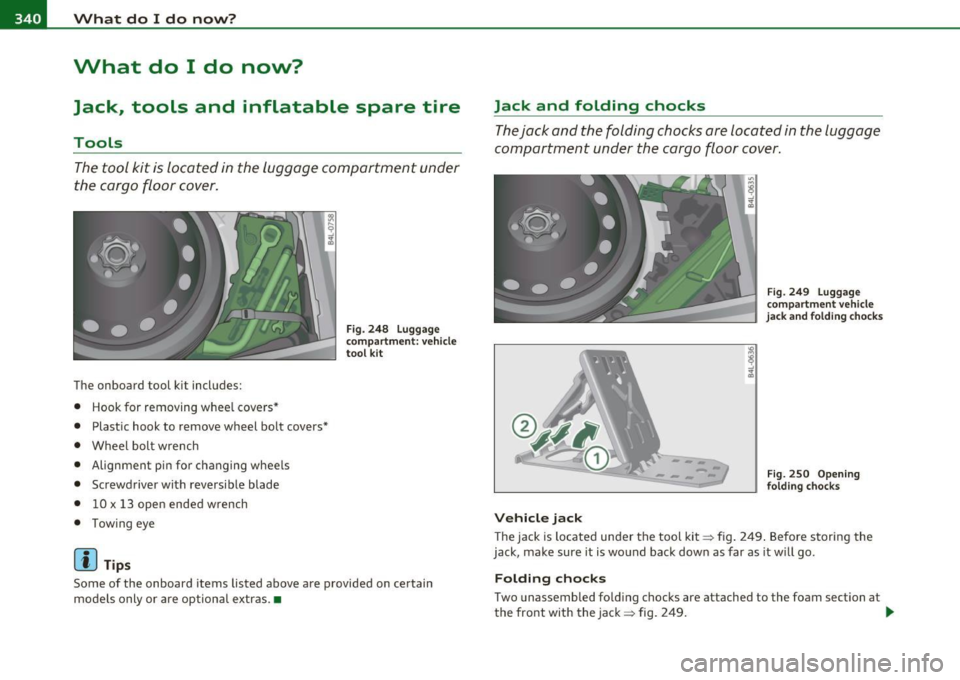
Tools
The tool kit is located in the luggage compartment under
the cargo floor cover .
The onboard tool kit includes:
• Hook for removing whee l cove rs *
• Plastic hook to remove w heel bolt covers*
• Wheel bol t wrench
• Alignm ent pin for changing whee ls
• Screwdriver with reversib le blade
• 1 0 x 13 open ended wrench
• Towing eye
[ i J Tips
F ig . 24 8 L uggag e
c om part ment : ve hicle
to ol k it
Some of the onboard items listed above are provided on certain
mode ls only or are optiona l extras. •
Jack and folding chock s
The jack and the folding chocks are located in the luggage
compartment under the cargo floor cover.
---
----~ -
Vehicle jack
Fi g. 24 9 Lug gag e
com partme nt vehicl e
jack an d foldin g c hocks
Fig . 25 0 Opening
f o lding cho cks
T he jack is located under the tool kit=> fig . 249 . Before storing the
jack, make sure it is wo und back down as far as it w ill go .
Folding chock s
Two unassembled fo lding chocks are a ttached to the foam section at
the front with the jack=> fig. 249.
~
Page 343 of 392

_______________________________________________ W __ h_a _t_ d_o_ I_ d_o_ n_ o_ w_ ? _ __._
Release the two hook-and-loop fasteners, and remove the two
chocks . To use the chocks, you first have to raise the support plate
=>
page 340, fig . 250 (D and then insert the locking plate with the
two "tabs" into the elongated holes in the base plate @=>& .
& WARNING
• The chock cannot fulfil its function and may lose its stability if
the "tabs" on the support plate are not inserted correctly into the
elo ngated holes in the base plate. If this happens, the vehicle may
start to move while a wheel is being changed.
• Never use the folding chocks if they are damaged or if they
have not been assembled correctly.
& WARNING
Improper use of the vehicle jack can cause serious personal inju
ries.
• Never use the jack supplied with your Audi on another vehicle,
particularly on a heavier one. The jack is only suitable for use on
the vehicle it came with.
• Using a bumper jack to raise the vehicle will damage the
bumper system. The jack may slip, causing injury.
• Never support your vehicle on cinder blocks, bricks or other
objects . These may not be able to support the load and could cause
injury when they fail.
• Never start or run the engine while the vehicle is supported by
the jack.
• If you must work under the vehicle, always use safety stands
specifically designed for this purpose.
• Always make sure the inflatable spare tire and even a flat tire
are secured in place and not loose, otherwise they could fly
forward, causing personal injury to passengers in the vehicle in an
accident or sudden maneuver. •
Vehicle OP-eration
Applies to vehicles : with bass box
Removing bass box
Before the inflatable spare tire can be taken out, the bass
box must be removed.
Fig. 251 Spare wheel
well: Bass box
Removing bass box
-Squeeze the locking tabs=> fig. 251 (D of the connector.
- Disconnect the connector @ and place the lead to one
side.
- Turn the large screw counter-clockwise.
- Carefully remove the bass box.
Installing bass box
-Carefully place the bass box in the wheel. The inscription
"FRONT" on the bass box must face forward.
- Reconnect the connector that was removed.
- Secure the bass box with the large screw. •
Vehicle care Do-it-yourself service iTechnical data
Page 344 of 392
lffll.,___W_ h_ a_t _ d_ o_ I_d_ o_ n_o _w_ ? ___________________________________________ _
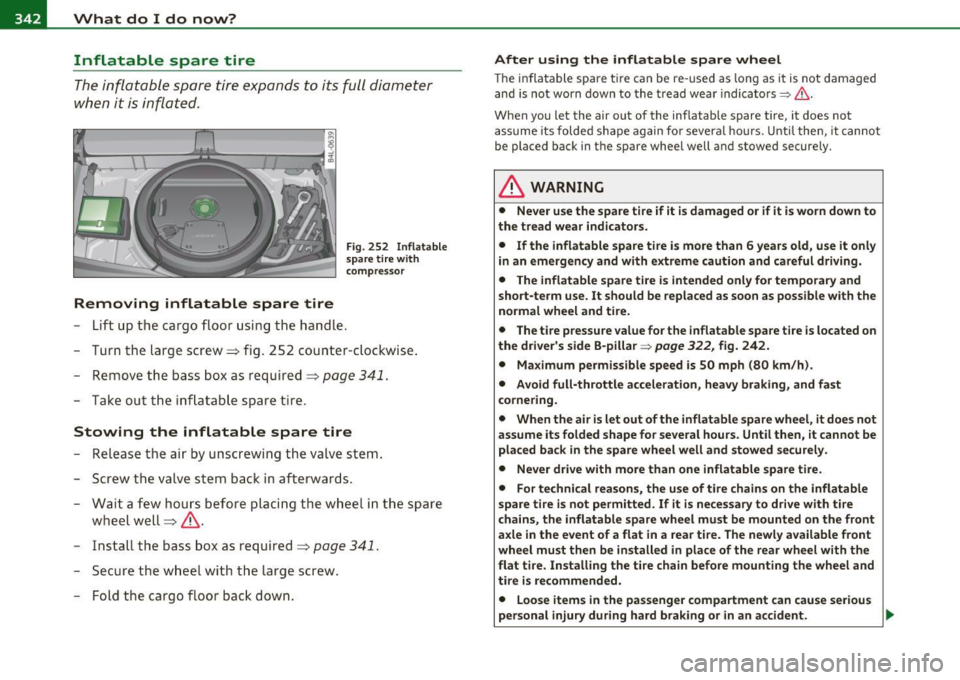
Inflatable spare tire
The inflatable spare tire expands to its full diameter
when it is infl ated.
Removing inflatable spare tire
Fig. 252 I nfl ata ble
sp are tir e wi th
c ompr essor
- Lift up the cargo floor using the handle.
- Turn the large screw=> fig. 252 counter -clockwise .
- Remove the bass box as required==>
page 341.
Take out the in flatab le spare tire .
Stowing the inflatable spare tire
- Release the air by unscrewing the valve stem .
- Screw the valve stem back in afterwards.
- Wa it a few hou rs before placing the w hee l in the spare
wheel well=>
&-
- Install the bass box as required=> page 341.
- Secure the whee l with the large screw .
- Fold the cargo floor bac k down .
After using the inflatable spare wheel
The inflatable spare t ire can be re -used as long as it is not damaged
and is not worn down to the tread wear indica tors=>
& -
When you let the air out of the inflatab le spare tire, it does not
assume its folded shape again for severa l hours. Until then, it cannot
be placed back in t he spare wheel well and stowed secure ly.
& WARNING
• Never use the spare tire if it is d amaged or if it is worn down to
the tread wear indicators.
• If the infl atable spare tire is more than 6 years old , use it only
in an emergency and with extreme caution and careful driving.
• The inflatable spa re tire is intended only for temporary and
short-term use. It should be replaced a s soon as possible with the
n o rmal wheel and tire .
• The tire pressure value for the inflatable spare t ire is located on
the dri ver' s s ide B-pillar
=> page 322, fig. 242.
• Ma ximum permiss ible speed is SO mph (80 km /h ).
• Avo id full-throttle a cceleration, heavy braking, and fast
corne ring .
• When the air is let out of the inflatable spare wheel, it d oes not
assume its folded shape for se veral hours . Until then , it cannot be
pla ced back in the spare wheel w ell and stowed securel y.
• Never drive with more than one inflatable spare tire.
• For technical re asons , the use of tir e chains on the inflatabl e
spare tire i s not permitted. If it i s necessary to dri ve with tire
c ha in s, the inflatabl e spare whe el must be mounted on the front
axle in the event of a flat in a rea r tire. The newly a vailable front
whee l mu st then be installed in place of the re ar wheel with the
flat tire. Ins talling the tire chain before mounting the wheel and
tir e is recomm ended.
• Loo se items in the passenger compartment can cause serious
per sonal injury during hard braking or in an accident . .,,.
Page 345 of 392

_____________________________________________ W __ h_a_ t_ d_o_ I_ d_o _ n_ o_ w _ ? __ _
& WARNING (continued)
-Never store the inflatable spare tire or jack and tools in the
passenger compartment.
- Always store all jacking equipment, tools, and the inflatable
spare tire in the luggage compartment.
- Tighten the knurled retaining screw for the inflatable spare
tire securely.
0 Note
• The inflatable spare tire has been developed specifically for this
vehicle model. It must not be exchanged or used for other vehicle
models . Similarly, inflatable tires from other vehicle models must
not be used.
• Normal summer or winter tires must not be installed on the inflat
able tire rim. •
Inflating inflatable spare tire
-Remove the compressor from the luggage compartment
~ page 342, fig. 252.
- Unscrew the valve stem from the spare tire.
- Screw the tire filler hose from the compressor firmly onto
the valve of the spare tire.
- Insert the plug from the compressor into a socket of the
vehicle ~
page 106.
- Switch the compressor on .
- Let the compressor run until the value specified on the tire
pressure label is reached=>
page 322, fig. 242. Switch the
compressor off after running for 12 minutes at the most -
danger of overheating!
Safety first
& WARNING
The compressor and the tire filler hose can become extremely hot
while they are running · danger of burns!
0 Note
Switch the compressor off after running for 12 minutes at the most
danger of overheating! Allow the compressor to cool down for a few
minutes before you use it again.
[ i] Tips
The compressor must not be connected to the cigarette lighter
socket, as this socket does not provide the required power.•
Changing a wheel
Before changing a wheel
Observe the following precautions for your own and your
passenger's safety when changing a wheel.
- After you experience a tire failure, pull the car well away
from moving traffic and try to reach
level ground before
you stop => & .
- All passengers should
leave the car and move to a safe
location (for instance, behind the guardrail)=> &.
- Engage the
parking brake to prevent your vehicle from
rolling unintentionally~ &.
- Move
selector lever to position P ~ & .
- If you are tow ing a trailer: unhitch the trailer from your
vehicle. ..,_
Vehicle care Do-it-yourself service Technical data
Page 346 of 392
1111.___W_ h_ a_t _ d_ o_ I_d_ o_ n_o _w_ ? ____________________________________________ _
-Block the diagonally opposite wheel with the folding
chocks or other objects.
- Take the
jack and the inflatable spare tire out of the
luggage compartment =>
page 340.
& WARNING
You or your passengers could be injured while changing a wheel if
you do not follow these safety precautions:
• If you have a flat tire, move a safe distance off the road. Turn
off the engine, turn the emergency flashers on and use other
warning devices to alert other motorists.
• Make sure that passengers wait
in a safe place away from the
vehicle and well away from the road and traffic.
• To help prevent the vehicle from moving suddenly and possibly
slipping off the jack, always fully set the parking brake and block
the wheel diagonally opposite the wheel being changed with the
folding chocks or other objects. When one front wheel is lifted off
the ground, placing the Automatic Transmission in "P" (Park) will
not prevent the vehicle from moving.
• Before you change a wheel, be sure the ground is level and
firm. If necessary, use a sturdy board under the jack.
• After installing the inflatable spare tire, make sure that you
replace the flat tire/wheel in its storage area properly and tighten
the knurled retaining screw securely. •
Changing a wheel
When you change a wheel, follow the sequence described
below step-by-step and in exactly that order .
1. Activate the vehicle jack mode (only vehicles with Adaptive
Air Suspension) =>
page 182.
2. Remove the decorative wheel cover*. For more details see
also =>
page 345, "Decorative wheel covers" or
=>
page 345, "Wheels with wheel bolt caps".
3. Loosen the
wheel bolts=> page 346.
4. Locate the proper mounting point for the jack and align
the jack below that point=>
page 346.
5. Lift the car with the jack=> page 346.
6. Remove the wheel with the flat tire and then install the
inflatable spare tire=> page 348.
7. Tighten all wheel bolts lightly.
8.
Lower the veh icle with the jack .
9. Use the wheel bolt wrench and
firmly tighten all wheel
bolts =>
page 346.
10. Replace the decorative wheel cover*.
11. Deactivate the vehicle jack mode (only vehicles with
Adaptive Air Suspension)=>
page 182.
& WARNING
Always read and follow all WARNINGS and information:::::, & in
"Raising the vehicle" on
page 346 and => page 349. •
After changing a wheel
A wheel change is not complete without the doing the
following.
- Store and secure the wh eel you replaced in the spare
wheel well.
- Replace the tools and the jack in their proper location .
Page 347 of 392
_____________________________________________ W __ h_a _ t_ d_o_ I_ d _ o_ n_o_ w_ ? _ ___.lftll
- As soon as poss ible, have the tig htening torqu es on all
wheel bolts checked with a torque wrench . The correct
tightening torque is 120 ft lb (160 Nm).
- Have the flat tire
rep laced as soon as possible.
(I] Tips
• If you notice that the wheel bolts are corroded and difficult to turn
while chang ing a tire, they should be replaced before you check the
tightening torque.
• Drive at reduced speed until you have the t ightening torques
checked. •
Applies to ve hicl es: w ith dec orative wheel covers
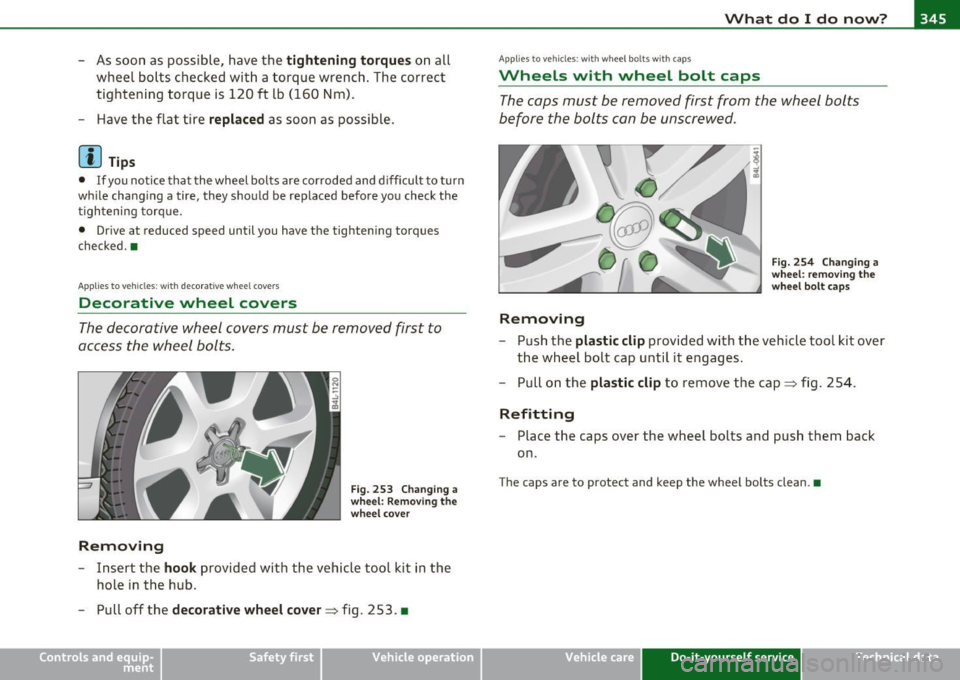
Decorative wheel covers
The decorative wheel covers must be removed first to
access the wheel bolts.
Removing
Fig . 253 Changing a
wheel: Remov ing the
wheel cover
- Insert the hook provided with the vehicle tool k it in the
hole in the hub .
- Pull off the
deco rative whe el co ver => fig . 253 . •
Vehicle OP-eration
Applies to vehicles : w ith wheel bolts w ith caps
Wheels with wheel bolt caps
The caps must be removed first from the wheel bolts
before the bolts can be unscrewed.
Removing
F ig. 254 Ch angi ng a
wheel : removing the
wheel bolt c aps
- Push the plastic clip provided with the veh icle tool kit over
the wheel bolt cap until it engages .
Pull on the
plastic cli p to remove the cap=> fig . 254.
Refitting
- Place the caps over the wheel bolts and push them back
on .
The caps are to pr otect and keep the wheel bolts clean .•
Vehicle care Do-it-yourself service iTechnical data
Page 349 of 392

_____________________________________________ W __ h_a _ t_ d_o_ I_ d _ o_ n_o_ w_ ? _ ___.1111
Fig. 257 Close-up:
proper positioning of
jack
-Activate the vehicle jack mode* (only vehicles with Adap
tive Air Suspension) =>
page 182.
- Engage the parking brake to prevent your vehicle from
rolling unintentionally
- Move the
selector lever to position P.
- Position the jack below the door sill under the mounting
point
that is closest to the wheel to be changed
=>
page 346 , fig. 256.
- Extend the
jack under the lifting point on the door sill until
its arm is positioned directly under the lifting point=>&.
- Align the jack so that its arm©=>
page 347, fig. 257
engages in the designated lifting point in the door sill and
the movable base® lies flat on the ground. The base ®
must be
vertical under the lifting point@.
- Wind the jack up further until the flat tire comes off the
ground =>& .
The jack must be installed only at the places indicated=> page 346,
fig. 256. There is exactly one location for each wheel. The jack must
not be positioned at any other location=>& .
Vehicle OP-eration An
unstable surface under
the jack can cause the vehicle to slip off
the jack . Always provide a firm base for the jack on the ground. If
necessary place a sturdy board or similar support under the jack . On
hard, slippery surfaces (such as tiles) use a rubber mat or similar to
prevent the jack from slipping=>&.
& WARNING
• You or your passengers could be injured while changing a
wheel if you do not follow these safety precautions:
- Positioning the jack under the vehicle at any other place than
those indicated above may damage the vehicle or may result in
personal injuries.
- A soft or unstable surface under the jack may cause the
vehicle to slip off the jack. Always provide a firm base for the
jack on the ground. If necessary, use a sturdy board under the
jack.
- On hard, slippery surface (such as tiles) use a rubber mat or
similar to prevent the jack from slipping.
• To help prevent injury to yourself and your passengers: -Do not raise the vehicle until you are sure the jack is securely
engaged.
- Passengers must not remain in the vehicle when it is jacked
up.
- Make sure that passengers wait in a safe place away from the
vehicle and well away from the road and traffic.
- Make sure jack position is correct, adjust as necessary and
then continue to raise the jack. •
Vehicle care Do-it-yourself service iTechnical data