seat adjustment AUDI Q7 2011 Owner´s Manual
[x] Cancel search | Manufacturer: AUDI, Model Year: 2011, Model line: Q7, Model: AUDI Q7 2011Pages: 392, PDF Size: 93.29 MB
Page 126 of 392
1111..__0_ n_ t_h _e_ r_o _ a_ d _________________________________________________ _
On the road
Steering
Applies to vehicles: w ith man uall y ad justable steering whee l
Manually adjustable steering wheel
The heig ht and r ea ch of t he steering wheel c an be
adjusted.
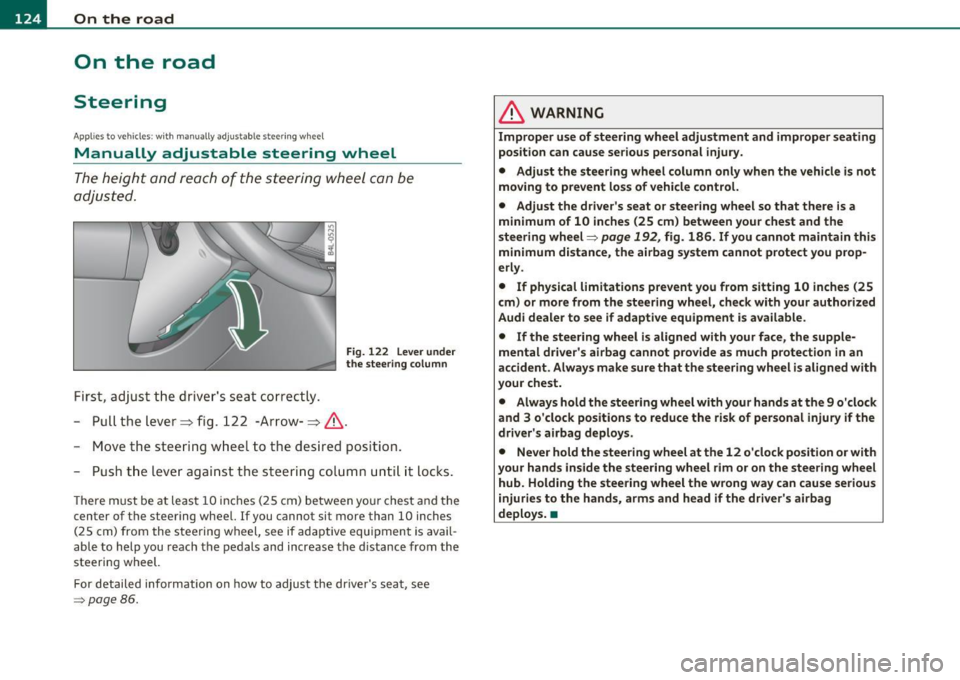
Firs t, adjust t he driv er's s eat corre ctly.
Fig. 122 Le ver un der
the stee ring colu mn
-Pull t he le ve r~ fig . 122 -Arrow-~ & -
- Move the stee ring w hee l to t he des ired pos ition.
- Push t he leve r agai nst t he steeri ng col umn until i t loc ks.
T he re m ust be at le ast 1 0 inc hes (25 cm) be tween you r che st and the
center of the steering whee l. If you cannot sit more than 10 inches
( 2 5 cm) from the s teering wheel, see if ada ptive equipmen t is avai l
able to help you reach the pedals and increase the d istance from the
steeri ng wheel.
For detailed info rmation on how to adju st the dr ive r's seat, see
=> page 86 .
& WARNING
Improper use of steering wheel adjustment and improper seating
position can cause serious personal injury.
• Adjust the steering wheel column only when the vehicle is not
moving to prevent loss of vehicle control.
• Adjust the driver's seat or steering wheel so that there is a
minimum of 10 inches (25 cm ) between your chest and the
s teering wheel=>
page 192, fig. 186. If you cannot maintain this
minimum distance , the airbag system cannot protect you prop
erly .
• If physical limitations prevent you from sitting 10 inches (25
cm ) or more from the steering wheel, check with your authorized
Audi dealer to see if adaptive equipment is available.
• If the steering wheel is aligned with your face , the supple
mental driver's airbag cannot provide as much protection in an
accident. Always make sure that the steering wheel i s al igned with
your chest.
• Always hold the ste ering wheel with your hands at the 9 o'clock
and 3 o'clock positions to reduce the risk of personal injury if the
driver' s airbag deploys .
• Never hold the steering wheel at the 12 o 'clock position or with
your hands inside the steering wheel rim or on the steering whe el
hub. Holding the steering wheel the wrong way can cause serious
injuries to the hands, arms and head if the driver's airbag
deploys .•
Page 127 of 392

On the road Ill _______________ __.
Applies to veh icles : w ith electrically adju stab le steer ing wheel
Electrically adjustable steering wheel
The height and reach of the stee ring wheel ca n be ele ctri
c ally adj usted to sui t th e d river.
Firs t, a djust t he dr iver's se at correct ly.
Height adjustment
Fig . 123 Sw itch for
s teering whee l ad ju st
ment
- Push t he s witch © up or down=> fig. 12 3. The st ee ring
w he el heig ht chang es f or as long as you press t he swi tch .
Reach adjustment
- Push t he switc h© forward or backward=> fig . 123 . T he
ste ering w hee l reac h changes for as long as you press the
swi tch .
The re m ust be at least 10 inches (25 cm) between you r chest and the
cen ter of the steering whee l. If you cannot sit more than 10 inches
(25 cm) from the steer ing wheel, see if adapt ive equ ipment is ava il
able to h elp you reach the pedals and increase the distance from the
steeri ng wheel.
For detailed information on how to adjust the dr iver 's seat , see
~ page 86.
Con tro ls a nd e quip
m en t Vehicle
OP-eration
The steering wheel ca n be adjusted even when the ign ition is turned
O ff. For veh icles with sea t memory, the individu al pos it io ns for the
steer ing wheel can be sto red along with t he seat pos it ion.
& WARNING
Improper use of steering wheel adjustment and imprope r seating
position can cau se seriou s per sonal injury.
• Adjust the steering wheel column only when the vehicle i s not
moving to prevent loss of vehicle control.
• Adjust the driver 's seat or steering wheel so that there is a
minimum of 10 in ches (25 cm) between your chest and the
steering wheel~
page 192, fig. 186. If you cannot maintain this
minimum distance , the airbag system cannot prote ct you prop
erly.
• If phy sical limitations prevent you from sitting 10 inches (25
cm ) or more from the steering wheel, check with you r authorized
Audi dealer to see if adaptive equipment is available .
• If the steering wheel is aligned with your face , the supple·
mental driver 's airbag cannot provide as much protection in an
accident. Always make sure that the steering wheel is aligned with
your che st.
• Always hold the steering wheel with your hands at the 9 o'clock
and 3 o'clock po sition s to reduce the risk of personal injury if the
drive r's airbag deploys.
• Never hold the steering wheel at the 12 o'clock po sition or with
your hands inside the steering wheel rim or on the steering wheel
hub. Holding the steering wheel the wrong way can cause serious
injuries to the hands, arms and head if the driver's airbag
deploy s.•
Vehicle care Do-it-yourselt service iTechnical data
Page 196 of 392
111....__D_ r_iv _i_ n_, g=-- S_ a _ f_e _,Ly _ ______________________________________________ _
& WARNING (continued)
• Children must always ride in child safety seats=> page 233.
Special precautions apply when installing a child safety seat on
the front passenger seat=>
page 211. •
Proper seating positions for passengers in
rear seats
Rear seat passengers must sit upright with both feet on
the floor consistent with their physical size and be prop
erly restrained whenever the vehicle is in use.
To reduce the risk of injury caused by an incorrect seating
position in the event of a sudden braking maneuver or an
accident, your passengers on the rear bench seat must
always observe the following :
- If there are passengers in the rear seat, fold the head
restraints up on the occupied seats or slide the center
head restraint upward at least to the next notch
~ page 93.
Make sure that the seatback is securely latched in the
upright position ~
page 96.
-Keep both feet flat in the footwell in front of the rear seat.
- Fasten and wear safety belts properly~
page 205.
- Make sure that children are always properly restrained in a
child restraint that is appropriate for their size and age
~ page 233.
& WARNING
Passengers who are improperly seated on the rear seat can be seri
ously injured in a crash.
• Each passenger must always sit on a seat of their own and
properly fasten and wear the safety belt belonging to that seat.
• Safety belts only offer maximum protection when the seatback
is securely latched in the upright position and the safety belts are
properly positioned on the body. By not sitting upright, a rear seat
passenger increases the risk of personal injury from improperly
positioned safety belts!
• Always adjust the head restraint properly so that it can give
maximum protection. •
Proper adjustment of head restraints
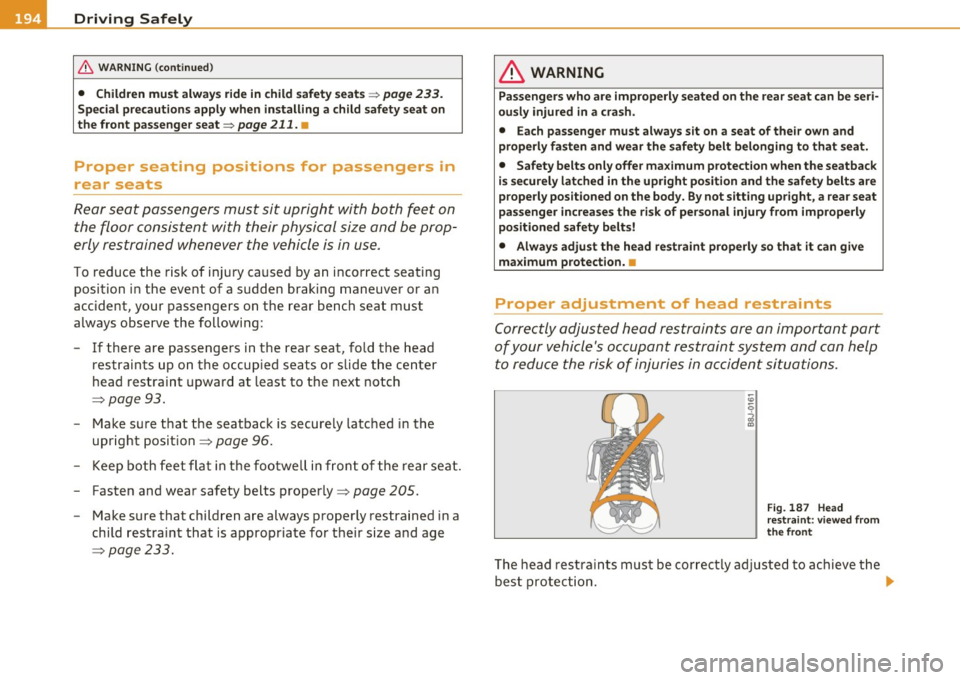
Correctly adjusted head restraints are an important part
of your vehicle's occupant restraint system and can help
to reduce the risk of injuries in accident situations .
Fig. 187 Head
restraint: viewed from
the front
The head restraints must be correctly adjusted to achieve the
best protection.
~
Page 208 of 392
___ s_ a_ f_ e_ t_ y~ b_ e_ lt_s _____________________________________________ _
- Insert t he tongue into the correct buck le of your seat until
you hear it latch secure ly==> fig. 195 .
- Pull on the be lt to make sure tha t it is secure ly la tched in
the buck le.
Automatic safety belt retractors
Every safety be lt is equipped with an automatic be lt retractor on the
shoulder be lt. This feat ure locks the be lt whe n the belt is pulled out
fast, during hard braking and in an acc ident. The belt may also lock
w hen you dr ive up or dow n a steep hill or throug h a sharp curve.
Dur ing normal driv ing the belt lets you move freely.
Safety belt pretensioners
The safety belts are equipped w ith a belt pretensioner that helps to
t ighten the safety be lt and remove sla ck when the p re tensioner is
act ivated. The function of the pretensioner is monitored by a warn ing
light =>
page 17.
Switchable locking feature
Every sa fety be lt ex ce pt t he one on the driver sea t is eq uipped wi th a
switchab le locking feature that
must be used when the safety belt is
used to at tach a child safety seat. Be s ure to read t he importa nt info r
mation about this feature=>
page 243.
& WARNING
Imp roperly positioned safety belts can c au se se rious injury in a n
accident =>
page 206, "Safety b elt po sition ".
• Safety belts offer optimum protection only when the seatback
i s upr ight and belts are properly positioned on the body .
• Always make sure th at the rear seat backre st to which the
center rear safety belt is attached i s secur ely latched when ever the
rear cente r sa fety belt is be ing u sed . If the ba ckre st is not securely
latched, the pas senger will move forward with th e backre st during
sudde n braking, in a sudden maneuve r and especiall y in a crash .
& WARNING (continued )
• Never attach the safety belt to the buckle fo r another seat .
Attaching the belt to the wrong buckle will reduce safety belt
effectiveness and can cause ser ious personal injury.
• A pass enger who i s not properly restrained can be seriou sly
i njured by the safety belt itself when it mo ves from the stronger
part s of the body into critical area s like the abdomen.
• Alway s loc k the convertible locking retractor when you a re
securing a child safety seat in the vehicle=>
page 245. •
Safety belt position
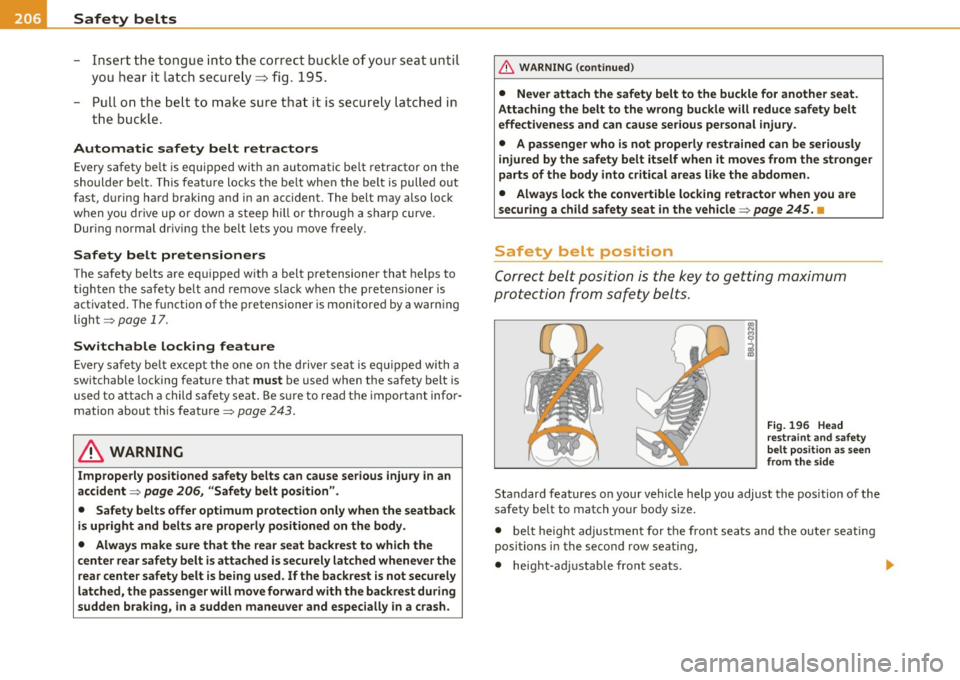
Correct belt position is the key to getting maximum
pro tection from safety belts .
Fig. 196 Hea d
r e str aint a nd safet y
belt po sit ion a s seen
from the side
Standard features on your vehicle help you adjust the position of the
safety belt to match your bo dy size.
• belt h eigh t adjustment for the front seats and the oute r seat ing
positions in the second row seating,
• height-ad justable front seats. .,
Page 210 of 392
•--=S..:a :..:f..:e :..:t:= Y :....:: b:....:e:..: l:..: t :..::s _____________________________________________ _
& WARNING
Improperly positioned safety belts can cause serious personal
injury in an accident.
• Expectant mothers must always wear the lap portion of the
safety belt as low as possible across the pelvis and below the
rounding of the abdomen.
• Always read and heed all WARNINGS and other important
information ~
& in "Fastening safety belts" on page 205. •
Unfastening safety belts
Unbuckle the safety belt with the red release button only
after the vehicle has stopped.
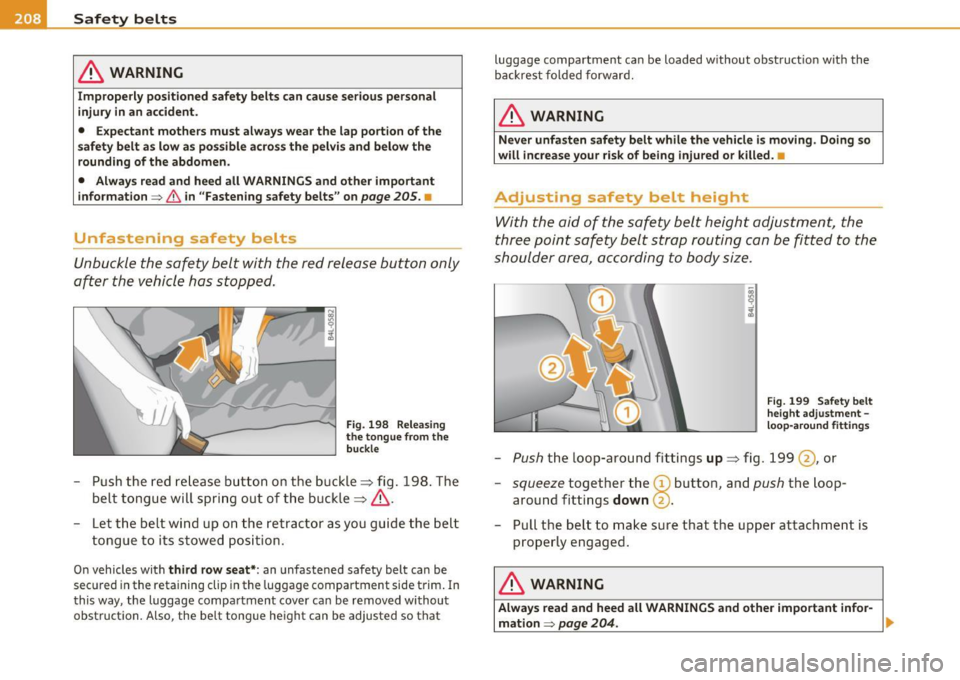
Fig. 198 Releasing
the tongue from the
buckle
- Push the red release button on the buckle=> fig. 198. The
belt tongue will spring out of the buckle=>& .
- Let the belt wind up on the retractor as you guide the belt
tongue to its stowed position.
On vehicles with third row seat* : an unfastened safety belt can be
secured in the retaining clip in the luggage compartment side trim. In
this way, the luggage compartment cover can be removed without
obstruction. Also, the belt tongue height can be adjusted so that luggage compartment can be loaded without obstruction with the
backrest folded
forward.
& WARNING
Never unfasten safety belt while the vehicle is moving. Doing so
will increase your risk of being injured or killed.•
Adjusting safety belt height
With the aid of the safety belt height adjustment, the
three point safety belt strap routing can be fitted to the
shoulder area, according to body size .
Fig. 199 Safety belt
height adjustment -
loop-around fittings
-Push the loop-around fittings up => fig. 199 @ , or
- squeeze together the© button, and push the loop-
around fittings
down @.
- Pull the belt to make sure that the upper attachment is
properly engaged.
& WARNING
Always read and heed all WARNINGS and other important infor- mation :::;:,
page 204. .,
Page 211 of 392

_____________________________________________ S_a _f _e _t _y _b_ e_lt _ s __ _
[I) Tips
• T he shoulder belt part shou ld route approximate ly over the
middle of your shoulder -under no circumstances shou ld it route over
you r neck a nd throat area~
& in "Safety belt position" on page 206 .
• With the front seats, the height adjustment of the seat can also
be used to adjust the position of the safety belts. •
Improperly worn safety belts
Incorrectly positioned safety belts can cause severe inju
nes.
Wearing safety belts improperly can cause serious injury or
death. Safety belts can only work when they are correctly
positioned on the body . Improper seating positions reduce
the effectiveness of safety belts and will even increase the
ris k of injury and death by moving the safety belt to critical
areas of the body . Improper seating positions also increase
the risk of serious injury and death when an airbag deploys
and str ikes an occupant who is not in the correct seating posi
tion. A driver is responsible for the safety of all vehicle occu pants and especially for children. Therefore:
- Never permit anyone to assume an incorrect sitting posi
tion in the vehicle while traveling
~ & .
& WARNING
Impr ope rly w orn safet y belts inc re a se the ris k of se rious pe rsonal
injur y and de ath when ever a vehi cle i s bei ng u sed.
• Alw ay s m ake sure th at all vehicle occup ants are corre ctl y
r es trained an d stay in a correct seating po sition wh enever the
ve hicle is being used.
Controls and equip ment Safety first Vehicle operation
& WA
RNING (continu ed)
• Alw ays re ad and heed all WARNINGS and o ther imp ort ant
information ~
page 204. •
Safety belt pretensioners
How safety belt pretensioners work
In front, side and rear -end collisions above a particular
severity and in a rollover, safety belts ore tensioned auto matically.
The safety belts are equ ipped with safety belt pretensioners. The
system is activated by sensors in front, side and rear-end collisions of
great sever ity and in a rollove r. This tightens the belt and takes up
belt slack ~
& in "Service and disposal of safety belt pretens ioner"
on
page 210. Ta king up the slack helps to reduce forward occupant
movement during a collision.
0 Note
Never let the belt rema in over a rear seatback that has been folded
forward .
[ i ] Tips
Th e safety belt pretensioner can only be activated once .
• In m inor fronta l and side collisions, in rear-end coll isions and in
acc idents involving very little impact force, the safety belt preten
sioner are not activated.
• Whe n the safety belt p retensioners are activated, a fine dust is
re leased. This is normal and is not caused by a fire in the vehicle.
• T he relevant safety requirements must be observed when the
vehicle or components of the system are s crapped. An authori zed
Vehicle care Do-it-yourself service Technical data
Page 213 of 392
Airbag system -----------------=--=---
Airbag system
Important things to know
Importance of wearing safety belts and
sitting properly
Airbags are only supplemental restraints. For airbags to
do their job, occupants must always properly wear their
safety belts and be in a proper seating position.
For your safety and the safety of your passengers, before
driving off, always:
- Adjust the driver's seat and steering wheel properly
=>
page 192,
- Adjust the front passenger's seat properly=> page 86,
-Wear safety belts properly=> page 204,
-Always properly use the proper child restraint to protect
children=>
page 233.
In a collision, airbags must inflate within the blink of an eye and with
considerable force. The supplemental airbags can cause injuries if the
driver or the front seat passenger is not seated properly. Therefore in
order to help the airbag to do its job, it is important, both as a driver
and as a passenger to sit properly at all times.
By keeping room between your body and the steering wheel and the
front of the passenger compartment, the airbag can inflate fully and
completely and provide supplemental protection in certain frontal
collisions =:,
page 192, "Proper occupant seating positions" . For
details on the operation of the seat adjustment controls=>
page 86.
It's especially important that children are properly restrained
=:,
page 233.
Controls and equip ment Safety first Vehicle operation
There
is a lot that the driver and the passengers can and must do to
help the individual safety features installed in your Audi work
together as a system .
Proper seating position is important so that the front airbag on the
driver side can do its job. If you have a physical impairment or condi
tion that prevents you from sitting properly on the driver seat with
the safety belt properly fastened and reaching the pedals, or if you
have concerns with regard to the function or operation of the
Advanced Airbag System, please contact your authorized Audi dealer
or qualified workshop, or call Audi Customer CARE at 1-800-822-
2834 for possible modifications to your vehicle.
When the airbag system deploys, a gas generator will fill the airbags,
break open the padded covers, and inflate between the steering
wheel and the driver and between the instrument panel and the front
passenger . The airbags will deflate immediately after deployment so
that the front occupants can see through the windshield again
without interruption.
All of this takes place in the blink of an eye, so fast that many people don't even realize that the airbags have deployed . The airbags also
inflate with a great deal of force and nothing should be in their way
when they deploy . Front airbags in combination with properly worn
safety belts slow down and limit the occupant's forward movement .
Together they help to prevent the driver and front seat passenger
from hitting parts of the inside of the vehicle while reducing the
forces acting on the occupant during the crash. In this way they help to reduce the risk of injury to the head and upper body in the crash .
Airbags do not protect the arms or the lower parts of the body.
Both front airbags will not inflate in all frontal collisions . The trig
gering of the airbag system depends on the vehicle deceleration rate
caused by the collision and registered by the electronic control unit.
If this rate is below the reference value programmed into the control
unit, the airbags will not be triggered, even though the car may be
badly damaged as a result of the collision . Vehicle damage, repair
9J),
Vehicle care Do-it-yourself service Technical data
Page 216 of 392
........ _A_ ir_ b_ a-=g :..- s.:o.y _s _t _e_ m _______________________________________________ _
defined in the elect ronic contro l unit~ page 223, "PASSE NGER AIR
BA G OFF l ight ".
Always r emembe r, a c hild safety seat o r infa nt ca rr ie r i nsta lled on th e
fro nt seat may be struc k and k noc ke d out of position by t he ra pidly
i nflat ing pass enge r's air ba g in a fr ontal c oll ision. Th e airba g could
g reat ly re duce the effectiveness o f th e ch ild restraint an d even seri
ousl y injur e th e child d uring inf lation .
For this r easo n, and b eca use the back seat is th e sa fest plac e for chil
dre n -whe n pro per ly restra ined acc ordin g to their age and size -we
s tr ong ly r ecommen d that childr en a lways sit in the back s eat
~ pa ge 233, "Child S afety".
& WARNING
A child in a rearward -facing child safety seat installed on the front
passenger seat will be seriously injured and can be killed if the
front airbag inflates - even with an Advanced Airbag System.
• The inflating airbag will hit the child safety seat or infant
carrier with great force and will smash the child safety seat and
child against the backrest, center armrest, door or roof .
• Always install rear-facing child safety seats on the rear seat.
• If you must install a rearward facing child safety seat on the
front passenger seat because of exceptional circumstances and
the PASSENGER AIR BAG OFF light does not come on and stay on,
immediately install the rear-facing child safety seat in a rear
seating position and have the airbag system inspected by your
authorized Audi dealer.
• Forward-facing child safety seats installed on the front
passenger's seat may interfere with the deployment of the airbag
and cause serious personal injury to the child.
& WARNING
If , in exceptional circumstances , you must install a forward-facing
child restraint on the front passenger's seat:
& WARNING (continued)
• Always make sure the forward-facing seat has been designed
and certified by its manufacturer for use on a front seat with a
passenger front and side airbag.
• Never put the forward-facing child restraint up against or very
near the instrument panel.
• Always move the passenger seat into its rearmost position in
the seat's fore and aft adjustment range, as far away from the
airbag as possible before installing the forward-facing child
restraint. The backrest must be adjusted to an upright position.
• Make sure that the PASSENGER AIR BAG OFF light comes on
and stays on all the time whenever the ignition is switched on.
& WARNING
To reduce the risk of serious injury, make sure that the PASSENGER AIR BAG OFF light will be displayed whenever a child
restraint is installed on the front passenger seat and the ignition
is switched on .
• If the PASSENGER AIR BAG OFF light does not stay on, perform
the checks described
~ page 222, " Monitoring the Advanced
Airbag System ".
• Take the child restraint off the front passenger seat and install
it properly at one of the rear seat positions if the PASSENGER AIR
BAG OFF light does not stay on .
• Have the airbag system inspected by your authorized Audi
dealer immediately.
• Always carefully follow instructions from child restraint manu
facturers when installing child restraints.
& WARNING
If , in exceptional circumstances , you must install a forward or
rearward-facing child restraint on the front passenger 's seat:
Page 220 of 392
........ _A_ i_rb _ a_,g,:;._ s_, y'- s_ t_e _m ________________________________________________ _
& WARNING (conti nued)
the PASSENGER AIR BAG OFF light does not come on and stay on,
immediately ins tall the rear-facing child safety seat in a rear
seating position and have the airbag system inspected by your
authorized Audi dealer .
& WARNING
If, in exceptional circumstances, you must install a forward-facing
child restraint on the front passenger 's seat:
• Always make sure the forward-facing seat has been designed
and certified by its manufacturer for use on a front seat with a
passenger front and side airbag.
• Never put the forward-facing child restraint up against or very
near the instrument panel.
• Always move the passenger seat into its rearmost position in
the seat 's fore and aft adjustment range, as far away from the
airbag as possible, before installing the forward-facing child
restraint. The backrest must be adjusted to an upright position.
• Make sure that the PASSENGER AIR BAG OFF light come s on
and stays on all the time whenever the ignit ion is switched on .•
Advanced Airbag System components
T he front passenger seat in your veh icle has a lot of very important
parts o f the Advanced A irba g System in it. These parts incl ude t he
we igh t-sens ing ma t, sensors, wiring, brackets, and more. The func
t ion o f th e sys tem in the fron t passenger sea t is chec ked by the elec
tron ic control unit w hen the ignit ion is on . The contro l u ni t mo nitors
the Advanced Airbag System and tu rns the airbag indicator light on
w hen a malfunct ion in t he system components is de tected. The func
tion of the a irbag indicator light is descr ibed in greater detail below.
Be cau se the fr ont p assenge r se at con tain s im po rt an t p arts of th e
Advanced Airbag System, you m ust take care to prevent it from being damaged. Damage to the seat may prevent the Advanced A
irbag for
t he fro nt passenge r se at from do ing its job in a cr ash.
The front Advanced Airbag System consists of the
following:
• Cras h sensors in the front of t he veh icle that measure vehicle
a cc ele ra tion/de ce le ra tion to prov ide i nform ation to the Adv ance d
Airbag System about the severity of the crash .
• An e lec tron ic contro l uni t, w it h in tegr ate d cr ash sensor s fo r fron t
and side impacts. T he control unit "dec ides" w het her to fire the front
a irbags based on the info rm at ion rece ive d fr om t he c rash se nso rs.
The contro l unit also "decides" whether the safety be lt prete nsione rs
shoul d be activa ted .
• An Advanced Airbag with gas generator for the driver inside the
s t eeri ng wheel hub.
• An Advanced Airbag with gas generator inside the inst rument
p an el f or the front p assenge r.
• A weight-sensin g mat under the upho lstery padd ing of the front
passe nge r seat c ushion t hat measu res the tota l we ight on the sea t.
T he informat io n registered is sent cont inuously to the elect ronic
con trol uni t to reg ula te deploymen t of t he fr ont Adv anced A irbag o n
the passenger side.
• An airbag mo nitoring syste m and indi cator light in the inst ru m ent
cl uster ~
page 222.
• Th e PASSENGER AIR BAG OFF light com es on an d stays on in t he
center of the instr ument pane l=>
page 223, fig . 203 a nd tells you
w hen the fron t Advan ced A irbag on t he passe nger side has been
turned off.
• A senso r below t he saf ety belt la tc h for the front s eat p ass enge r
to meas ure the tens ion on the safety be lt . The tension on the safety
be lt a nd the we igh t regis tere d by the weig ht-sensing mat help t he
cont rol un it "dec ide" w hethe r th e front airbag fo r th e front
p assenge r seat should be turned o ff or not~
page 213, "Ch ild
restraints on the front seat -some important th ings to know" . ._
Page 236 of 392
-Child Safety ------ ~---------------------------------
& WA RNING (conti nued)
• Always install rear-facing child safet y seat s on the rear seat.
• If you must install a rearward facing child safety seat on the
front passenger seat in exceptional circumstances and the
PASSENGER AIR BAG OFF light do es not come on and stay on,
immediately in stall the rear-facing child safety seat in a rea r
seating position and have the airbag system inspected immedi
ately by you r Audi deale r.
& WARNING
If, in exceptional circumstances , you must in stall a forward-facing
child restraint on the front passenger' s seat:
• Always make sure the forward-facing seat has been designed
and certified by its manufacturer for use on a front seat with a
pa ssenger front and side airbag.
• Always follow the manufacturer 's instructions p rovided with
the child safety seat or carrier.
• Always move the passenger seat into its rearmost position in
the seat's fore and aft adjustment range, as far away from the
airbag as possible before install ing the child restra int . The back
re st must be adju sted to an upright position .
• Always make sure that the PASSENGER AIR BAG OFF light
c omes on and stays on all the time whenever the ignition i s
switched on .•
Advanced front airbag system and children
Your vehicle is equipped with an "Advanced Airbag System" in compli
ance wi th Uni ted St ates Federa l Mo to r Vehicle Safety St andar d
(FMVSS) 208 as applicable at the time your veh icle was manufac
tu red . The Advanced A
irbag system in yo ur vehicle has been certif ied to
mee t the "low -r is k" requiremen ts fo r 3-and 6-ye ar old ch ildre n on
t he passenger side and small adults on the dr iver side . The low risk
dep loyment criteria are inten ded to reduce the risk of injury through
interaction with the a irbag t hat can occur, for example, by being too
close to the stee ring wheel an d instr ument panel when the airbag
inflates. In addi tion, the sy stem has been certified to comp ly with t he
"suppression" requirements of the Safety Standa rd, to t urn off the
fron t air bag for infan ts u p to 1 2 months who a re res tra ined on the
front passenger seat in child restrai nts that are listed in the Stan
d ar d.
Even thoug h your vehicle is equipped with an Advanced Airbag
system , a ll ch ildren, especially those 12 years and yo unger, should
always r ide in t he back seat p roperly restrained for t heir ag e and si ze .
Th e ai rbag on the passenge r si de makes the front seat a potentia lly
dange rous p lace for a child to r ide. Th e front seat is not th e safest
place fo r a child in a forward- facing c hild safety seat. It can be a very
d an ge rous p lace for a n infan t or a large r chil d i n a re arwa rd-facing
seat. •
Advanced Airbags and the weight-sensing
mat in the front seat
Th e Advanced A irbag System i n your ve hicle de tects t he p resence o f
an infa nt o r ch ild in a child rest rai nt on the fro nt passenger sea t using
the we ight-sens ing mat in the seat cushion and the senso r be low the
saf ety belt la tch o n th e front passenge r seat tha t measur es t he
tension on the safety belt.
Th e weigh t-sens ing ma t me asures tot al we ight of the child and the
child safety seat and a child blanket on the fro nt passe nger seat . The
we ight on the fro nt passenger se at is re late d t o the desi gn of the
child res traint and i ts "footpri nt", the size and shape of t he bottom
of the ch ild restraint as it sits o n the seat . The weight of a child
restrain t an d its "foo tpr int" vary for differe nt kinds of child res tra ints .,_