tire pressure AUDI Q7 2011 Owner´s Manual
[x] Cancel search | Manufacturer: AUDI, Model Year: 2011, Model line: Q7, Model: AUDI Q7 2011Pages: 392, PDF Size: 93.29 MB
Page 276 of 392

Trailer towing
~-----------------------------------------
& WARNING (cont inued)
• The Gro ss Vehicle Weight Rating for your Audi Q7 vehicle,
found on the safety compliance label on the driver's side B-pillar, must never be exceeded under any circumstances . Exceeding the
Gross Vehicle Weight Rating of your vehicle is likely to damage
your vehicle, and such damage will not be covered by your Limited
New Vehicle Warranty. Exceeding the Gross Vehicle Weight
Rating will also change the performance and handling character
istics of your vehicle, whi ch could cause a crash resulting in serious
injury or death.
• The Gro ss Vehicle Weight Rating for your Audi Q7 would be
exceeded if your vehicle is simultaneously equipped with
Panoramic sliding sunroof; third-row seating ; trailer towing
equipment (factory or dealer-installed ), and running boards
(dealer-installed) . UNDER NO CIRCUMSTANCES MAY ALL SUCH
ITEMS BE INSTALLED ON THE SAME VEHICLE .•
Operating instructions
M AX 6 .9"
MA X
175mm
Trailer towing weights
Fig. 223 Permitted
ball position of the
tra iler hit ch
With a factory -installed tra ile r hi tch, the maximum pe rmissib le
t ra iler weig ht is 6,615 lbs (3,000 kg). The maximum pe rmissib le
unbraked trailer we igh t is 1,650 lbs (750 kg) . With an
aftermarket
trail er hi tch, the m axi mum permissibl e traile r weig ht i s 5,5 12 lbs (2,500
kg) . These specifications app ly when driv ing on roads havi ng
an in cline o f less t han 12%.
Permissible tongue load
For best ve hicle handl ing un der t hese ch ange d co ndition s, adju st the
tra ile r l oad so that the tongue load is at the maxim um a llowab le or
sligh tly lower. You can get an app roxim atio n of the tongue load w it h
a bat hroom scale or you ca n measure the load at a t ruc king company
or we ighing st ation.
W it h a
factory-installed trailer h itch, the max imum pe rmissible load
on t he ba ll hitc h may not exceed 662 lbs (300 kg). W it h an
after
market
tra ile r hi tc h, t he ma ximum pe rm issi ble loa d on the b all hi tch
may not exceed 551 lbs (250 kg). It is recommended to use the
maxim um permi ssible loa d.
Trailer load distribution
Be su re the load in t he tra ile r i s held se curely in p lace to p revent it
from shi fting forward, backwa rd or sideways.
Never allow a passenger to ride in a trailer=> & in "Dr ivin g in struc
t ions" on
page 275.
Ball mount
The tra ile r hitch may on ly be used w ith suitable ball mount and ball
=> fi g. 223 . Ins tallat ion of the hi tch b all mus t be c arrie d out in acco r
dance with the manufacturer's instructions . At the height d imension
of 1. 5 in (38 .5 mm) a toler ance of+/- 0.5 in ( 12. 7 mm ) is per miss ible
Engine cooling system
Towing a trailer makes t he eng ine work harder. It is impo rtant that
t he cooling system 's performan ce is up to the addi tional loa d. Mak e
sure that the coo ling system has enough fluid .
Tire pressure
When towing a trailer, inf late the tires ofyourvehicle to the cold tire
pre ssure listed unde r "Full lo ad" on t he tire pre ssu re lab el. Th e tire ...
Page 282 of 392

-~_C_ le_ a_n_ i_ n_ g=- a_ n_d__. p_ ro_ t_e _c_ t_ i_o _n ___________________________________________ _
Use a separate sponge for cleaning the w heels, door sills and ot her
reg ions exposed to road dirt. I n th is way, yo u w ill not scr atch the
paint w ith coarse part icles imbedded in the sponge the next t ime you
wash the car.
& WARNING
• Do not clean the under side of the chass is, fende rs, wheel
co ve rs, or other hard to reach parts without p rotecting your hands
and arm s. You m ay cut yourself on sharp -edged metal part s.
• Always read and heed all WARNINGS and other information
=;, page
278.
0 Note
• Never try to remove dirt, mud o r dust if the s urface of the vehicle
is dry . Never use a dry cloth or sponge, s ince this could scratch your
vehicle's paint or windows .
• Never was h your car in bright sunlight. Drops of water act as
m agnifying lenses and may dam age your p aint.
• When you wash yo ur car in the winter: if you rinse your vehicle w ith
a hose, be c are ful no t to aim the s tream of w ate r d ir ect ly at locks, or
at door or hatch openings - they can freeze shut.
• Never use s ponges des igned to remove inse cts, o r any ki tchen
sco uring sponges or similar prod ucts. They can damage your paint
fi ni sh .
• You shou ld remove debris (s uch as insects) from the head light
lenses o n a regu lar bas is, for examp le w hen refue ling your veh icle.
Never use a dry cloth or sponge to clean the headlights. On ly use wet
clot hs or sponges to preven t scr atches.
It is be st to use so apy water.
'00' For the sake of the environment
In the in terest of t he env ironme nt, the ve hicl e shoul d onl y be wa shed
in special wash bays. •
Washing your vehicle with a power washer
Cleaning the ex terior of your c ar with a high-pressure
po wer washer is safe as long as y ou obser ve a few sim ple
rules.
- Before using the power washer, make su re you have read
and unders tood the WA RNINGS=>
& in "General info r
ma tion" on
page 2 78.
- Always fo llow t he operat ing inst ructions fo r the powe r
washer.
- Make sure t hat the jet o n the spray hose produces a "fa n
shaped spray".
- Do
not hold the spr ay nozz le too close t o soft ma ter ials .
When cleani ng the vehicle wi th a p owe r w ashe r always follow the
operat ing instruct ions . T his applies part icu larly to the
operating
pressure
and the spraying distance. M ain tain a suffic ien t distan ce to
so ft mater ia ls such as rubber hoses and sound/vibration deaden ing
materials (particularly on the unde rside o f the engine hood). Do no t
use a jet wh ic h sprays water in a
direct stream or o ne that has a
rotating jet.
W ate r temperatu re s hou ld not ex ceed 140
°F (6 0 °().
& WARNING
Never wash tires with a jet that sprays water in a direct stream .
This could cause invisible damage to the tires and weaken them ,
even if the spray i s from a relatively long distance and for a short
time . Damaged and weakened tires can fail and c ause accidents
and personal injury .
~
Page 306 of 392

lffll __ C_ h_e _c_ k_ i_ n _ g_ a_ n _ d_ f_il _l _in ____ g ___________________________________________ _
Applies to vehicles with diesel engine only : Only if the level of t he
oil is a t or be low the m inimum m ark o n the o il d ipstick -and no o il
that express ly conforms to A udi o il standard VW 507 00 spec ifica
tions is available -may you top off with a high q ua lity engine oil , that
meets ACEA C3 o r API CF spec ifications, but even then, on ly in
viscosity gra des SAE 5W- 40, SAE SW -30, or SAE OW -40 . However,
dur ing t he e ntire time between o il change i nte rvals, neve r top off
w ith more than a tota l of 0.5 qt/liter engine oil that does not
c onfor m to Audi o il specification VW 5 07 00.
For more information about eng ine oi l th at has been approved for
your vehicle, please con tact either your au thorized A udi dea le r or
Aud i Customer Relations at 1 (800) 822 -2834 or vis it our web site at
www.aud iusa .com or www .aud icanada.ca . He re yo u w ill also find a
cu rrent list of oils (manufactu rers, brand names e tc.) that co nform to
Audi oil standard VW 502 00 (vehicles with gaso line e ngine) or VW
507 00 (vehicles w it h die sel eng ine).
Changing the engine oil
The eng ine oil and oil fi lter mus t be changed according to the mileage
(kilome ters) and t ime intervals specified i n your vehicle 's Warranty &
Ma intenance booklet . Do not exceed these interva ls - harmful
deposi ts from o ld engi ne oil can reduce engine pe rfo rmance and ca n
lead to expensive engine repa irs.
C hangi ng the oil at the recommende d interva ls is so very imp ortant
because the lubricating properties of o il decrease gradually during
normal ve hicl e use. If yo u ar e not sure w hen you have yo ur oil
changed, ask your author ized Audi Service Adv isor .
Under some circumstances the eng ine o il should even be changed
more fr eq uent ly. Chang e oil mor e of ten if you d rive mostly short
distances, operate the veh icle in d usty areas or mostly under stop
and -go t raff ic condi tion s, or when you use yo ur vehicle where tempe r
atures stay be low free zing po int for long periods.
De tergen t ad dit ives in the o il wi ll m ake fres h oil look dark a fter the
eng ine has bee n ru nning for a short t ime . This is normal and is not a
reason to ch ang e the oil mo re of ten t han re commended.
Damage or malfunctions due to lack of maintenance
It is essentia l that you change your o il at the recommended intervals
using only en gine oil th at com plies wi th A udi o il st and ard VW 502 0 0
(vehicles w ith gasoline eng ine) o r VW 507 00 (vehicles with d iesel
eng ine) . Your Limited New Vehicle Wa rranty does not cover damage
or ma lfunct ions due to fa ilure to follow recomm ended maintena nce
and use requirements as set forth in t he Au di Owner's Man ua l and
W arranty
& M aintenance boo klet. Y ou r deale r will have to deny
wa rranty coverage unless yo u present to the dealer proof i n th e form
of Se rvice o r Rep air O rders tha t al l sche dul ed main tena nce was
performed in a time ly ma nner. •
Engine oil consumption
To provide effective lubr ication a nd cooling for interna l eng ine parts,
a ll in ter na l c omb ustion e ngines use some oil. Oil cons umption v aries
from engine to engine and may change over the life of the eng ine .
E ngines te nd to use m ore oi l dur ing the b re a k-i n period t han t hey do
after ward, when oil consumption has stab ilized. Depending on t he
way the vehicle is driven and the operatin g cond itions, oi l cons ump
tion ca n be up to 1 qua rt pe r 1,200 m iles
(I liter per 2 ,000 km).
Consumption may be higher withi n th e first 3,0 00 miles (5,00 0 km).
Under nor mal co ndi tions, the rate o f oi l consu mptio n depe nds o n oil
quality as well as viscosity, engine speed ( rpm), o utside tempe rature,
roa d condi tion s, the amou nt of o il d ilution caused by co nde nsed
water or fu el residue, and oxidation of the oil. O il cons umption may
increase wi th en gine we ar ove r time, un til repl aceme nt of worn
eng ine pa rts may become necessa ry.
Because of all these var ia bles, there is no standa rd o r "norma l" rate
of oil consumption .
We urge you to check the engine oil level at
regular intervals, preferably every time you fill the fuel tank, and
always before a long trip .
The oil pressure warning light
~ is not an indicator of low eng ine
oil level. If the warning light does not go out after starting, or
flashes while driving (above 1500 rpm), a buzzer will sound . It
indicates that the oil pressure is too low. Stop the engine immedi- _.,,
Page 321 of 392
________________________________________________ T_i_re _ s_ a _ n_d_ w_ h_ e_ e_l_s __ _
& WARNING (co ntinued )
• Tires age even if they are not be ing used and can fail suddenly ,
e specially at high speeds . Tires that are more than 6 year s old can
only be used in an emergency and then with special care and at low
s peed .
Glossary of tire and loading terminology
Accessory weight
means the combined weigh t (in excess of those sta ndard items wh ich
may be replaced) of automatic transmission, power steer ing, power
bra kes, powe r win dows, power sea ts, radio, and heate r, to the exte nt
that these items are available as factory-insta lled equipment
(whet her i ns ta lled or no t).
Aspect ratio
means the r atio of t he he ight to t he widt h of the t ire in percent.
N umbers of 55 or lower indicate a low sidewa ll for improved steer ing
res ponse and bet ter over all h andling on dry p avemen t.
Bead
means the part of the t ire that is made of stee l wi res, w rapped or
re in forced by ply cords and that is shaped to fit the rim.
Bead separation
means a brea kdown of the bond between components in the bead.
Cord
means the st rands forming the plies in the ti re.
Safety first
& W ARNING (co ntinued )
• Never mount u sed tires on your vehicle if you are not sure of
their "previous history ." Old u sed tires may have been damaged
eventhoughthedamagecannotbeseenthatcanleadtosudden
tire failure and loss of vehicle control.
• If you notice unusual vibr ation or if the vehicle pulls to one side
when driving, always stop as soon as it is safe to do so and check
the wheels and tires for damage. •
Cold tire inflation pressure
means the t ire pressu re recom mended by the vehicle manufa ctu rer
for a tire of a desig nate d size that has not been driven for more than
a couple of m iles ( kilomete rs) a t low speeds in the t hree hour per io d
before the tire pressu re is measured or adjusted.
Curb weight
means the weight of a moto r vehicle wit h standard equipment
incl uding the max imum ca pac it y of fue l, o il, and coo lan t, air condi
tioning and additiona l weig ht of optional eq uipment.
Extra load tire
means a tire design to operate at higher loads and at higher inflat ion
pressures than t he co rresponding sta ndard t ire. Extra load tires may
be identif ied as "XL", "xl", "EXTRA LOAD", or "RF" on the sidewa ll.
Gross Axle Weight Rating ( "GAWR ")
means the loa d-carrying capac ity of a sing le ax le system, measure d at
the t ire-grou nd interfaces.
Gross Vehicle Weight Rating ("GVWR")
mea ns the maximum tota l loaded we ig ht of the vehicle .
Vehicle care Technical data
Page 322 of 392
-~_T_ i_ re _ s_ a_n _ d_ w_ h _e_ e_ ls _________________________________________________ _
Groove
means the space between two adjacent tread ribs.
Load rating (code)
means the maximum load that a tire is rated to carry for a given infla
tion pressure. You may not find this information on all tires because
it is not required by law.
Maximum load rating
means the load rating fo r a tir e at the maximum permissible inflation
pressure for that tire.
Maximum loaded vehicle weight
means the sum of:
(a) Curb weight
(b) Accessory weight
(c) Vehicle capacity weight, and
(d) Production options weight
Maximum (permissible) inflation pressure
means the maximum cold inflation pressure to which a tire may be
inflated. Also called "maximum inflation pressure."
Normal occupant weight
means 150 lbs. (68 kilograms) times the number of occupants seated
in the vehicle up to the total seating capacity of your vehicle.
Occupant distribution
means distr ibution of occupants in a vehicle .
Outer diameter
means the overall diameter of an inflated new tire.
Overall width
means the linear distance between the exteriors of the sidewalls of
an inflated tire, including elevations due to labeling, decorations, or
protective bands or ribs.
Ply
means a layer of rubber -coated paralle l cords.
Production options weight
means the combined weight of those installed regular production
options weigh ing over 5 lbs. (2.3 kg) in excess of those standard
items which they replace, not previously considered in curb weight or
accessory weight, including heavy duty brakes, ride levelers, roof
rack, heavy duty battery, and special trim.
Radial ply tire
means a pneumatic tire in which the ply cords that extend to the
beads are laid at substantially 90 degrees to the centerline of the
tread .
Recommended inflation pressure
see=> page 319, "Cold tire inflation pressure".
Reinforced tire
means a tire design to operate at higher loads and at higher inflation
pressures than the corresponding standard tire. Reinforced t ires may
be identified as "XL ", "x l", "EXTRA LOAD", or "RF" on the sidewall.
Rim
means a metal support for a tire or a tire and tube assembly upon
wh ich the tire beads are seated .
Rim diameter
means nominal diameter of the bead seat . If you change your wheel
size, you w ill have to purchase new tires to match the new rim diam
eter .
Rim size designation
means rim diameter and width.
Rim width
means nom inal distance between rim flanges.
Page 323 of 392

Tires and wheels Ill
----------------
Sidewall
means that portion of a tire between the tread and bead.
Speed rating (letter code)
means the speed at which a tire is designed to be driven for extended
periods of time. The ratings range from 93 mph (150 km/h) to 186
mph (298 km/h)=>
page 331. You may not find this information on
all tires because it is not required by law .
The speed rating letter code, where applicable, is molded on the tire
sidewall and indicates the max imum permissible road speeds=>
& in
"Winter tires" on
page 334.
Tire pressure monitoring system
means a system that detects when one or more of a vehicle's tires are
underinflated and illuminates a low tire pressure warning telltale.
Tread
means that portion of a tire that comes into contact with the road.
Tread separation
means pulling away of the tread from the tire carcass .
Treadwear indicators (TWI)
means the projections within the principal grooves designed to give a
visual indication of the degrees of wear of the tread. See=>
page 328,
"Tread Wear Ind icator (TWI)" for more information on measuring
tire wear.
Uniform Tire Quality Grading
is a tir e information system developed by the United States National
Highway Traffic Safety Administration (NHTSA) that is designed to
help buyers make relative comparisons among tires. The UTQG is not
a safety rating and not a guarantee that a tire will last for a prescribed
number of miles (kilometers) or perform in a certain way. It simp ly
gives tire buyers additional information to combine with other
considerations, such as price, brand loyalty and dealer recommenda
tions. Under UTQG, tires are graded by the tire manufacturers in three
Safety first
areas: treadwear, traction, and temperature resistance . The UTQG
information on the tires, molded into the sidewalls.
U.S. DOT Tire Identification Number (TIN)
This is the tire's "serial number" It begins with the letters "DO T" and
indicates that the tire meets all federal standards. The next two
numbers or letters indicate the plant where it was manufac tured, and
the last four numbers represent the week and year of manufacture.
For example,
DOT ... 2210 ...
means that the tire was produced in the 22nd week of 2010. The
other numbers are ma rket ing codes that may or may not be used by
the tire manufacturer . Th is information is used to contact consumers
if a tire defect requires a recall.
Vehicle capacity weight
means the rated cargo and luggage load plus 150 lbs. (68 kilograms)
times the vehicle's total seating capacity as listed on the label located
on the driver's side B-pillar.
Vehicle maximum load on the tire
means that load on an individua l tire that is determined by distrib
uting to each axle its share of the maximum loaded vehicle weight
and dividing by two.
Vehicle normal load on the tire
means that load on an individua l tire that is de term ined by distrib
uting to each axle its share of the curb weight, accessory weight, and
normal occ upant weight (distr ibuted in accordance with table below
=> page 322) and dividing by two. ..,_
Vehicle care Technical data
Page 324 of 392
-Tires and wheels PRf _______________ _
Occ up ant loading and distribution for vehi cle normal load for various d esignated seating capacit ies
Designated seating capacity, num- Vehicle normal load, number of Occupant distribution in a nor
mally loaded vehicle
ber of occupants occupants
5/6*/7*
3 2 in front, 1 in second seat
Cold tire inflation pressure
Tire pressure affects the overall handling, performance and safety of a vehicle .
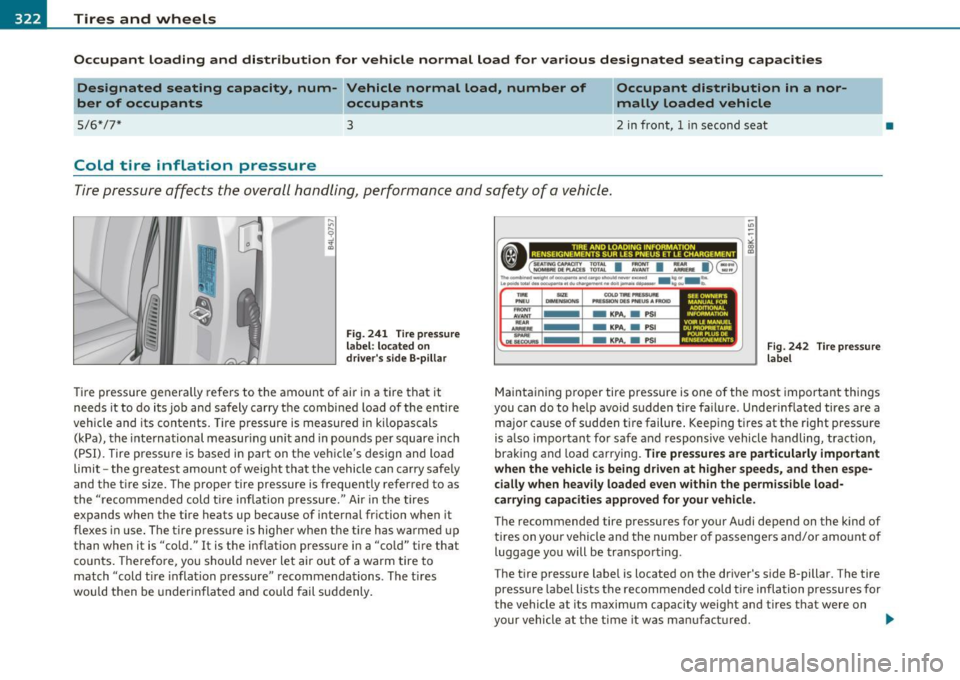
Fig. 24 1 Tire pre ssure
la bel: loc ate d on
d river 's si de B ·pillar
Tire pressure generally refers to the amount of air in a t ire that it
needs it to do its job and safely carry the combined load of the entire
vehicle and its contents . Tire pressure is measured in kilopascals
(kPa), the inte rnational measur ing un it and in pounds per square i nch
(PSI). Tire press ure is based in part on t he vehicle 's design and load
limit -the greatest amount of weight tha t the vehicle can carry safe ly
and the t ire si ze. The proper tire pressure is frequently referred to as
the "recommended cold t ire inflation pressure. " Air in t he tires
expands when the tire heats up because of internal friction when it
flexes in use . The tire p ress ure is highe r when the t ire has wa rmed up
than when it is "cold." It is the inflation pressure in a "cold" tire that c o unts . Therefo re, you should never let air ou t of a wa rm tire to
match "cold tire inflation pressure " recommendations . The t ires
wou ld then be underin flated and could fail suddenly .
SIZf COlD fflE PRESSUAf DIME NSION'S MfSSK)N DE$ l"NEV$ A fFIOiD
- KPA , . PSI
- KPA,. PSI
- KPA,. PSI
Fig. 242 Tir e pre ssure
label
Maintaining proper tire pressure is one of the most important things
you can do to he lp avoid sudden tire failure . Underinflated tires are a
ma jo r cause of sudden tire failure . Keep ing t ires at the right pressure
is a lso important fo r safe and responsive vehicle handling, t ract ion,
braking and load carrying.
Tire p ressures are particularl y important
when the vehicle i s being driven at higher speed s, and then e spe
cially when heavily loaded even with in the permissible load
carrying capacitie s approved for your v ehicle .
The recommended tire pressures for your Audi depend on the kind o f
t ires on you r vehicle and the number o f passengers and/or amo unt of
luggage you will be transport ing .
The tire pressure label is located on the driver 's side 8-pillar . T he tire
pressure labe l lists the recommended cold t ire inflation p ressures for
the vehicle at its maximum capacity weig ht and tires that were on
•
your vehicle at the time it was m anufactured. .,
Page 325 of 392
Tires and wheels -________________ f!ffl
If you wish to improve comfort when operating the vehicle at
normal load (up to 3 occupant s), you can adjust tire pres sures to
those specified for normal vehicle load . Before operating the
vehicle at maximum lo ad, you must increase the tire p res sures to
those specified for maximum vehicle load=>& .
Bear in mind that the tire press ure monitor ing system can only
mon itor the t ire pressu re s you h ave sto red . T he sys tem does no t
recogn ize the load cond it ion of your vehicle.
Th e effectiveness of t he tire pressu re monitoring system will be
impa ired if you store normal load pressu res but then operate the
vehicle at its maxim um loa d=> & . See the
illustration=> fig. 241 for the location of the label on driver's
side B- pillar (colo r of the act ual la bel and ex act l ocation on the
vehicle will vary slig htly).
N ote that the fo llow ing tab le is accurate at the time of going to press
and is subjec t to change. I n the even t of discrepancies , the tire pres
sure label located on the dr iver's side B-pi llar a lways takes prece
dence .
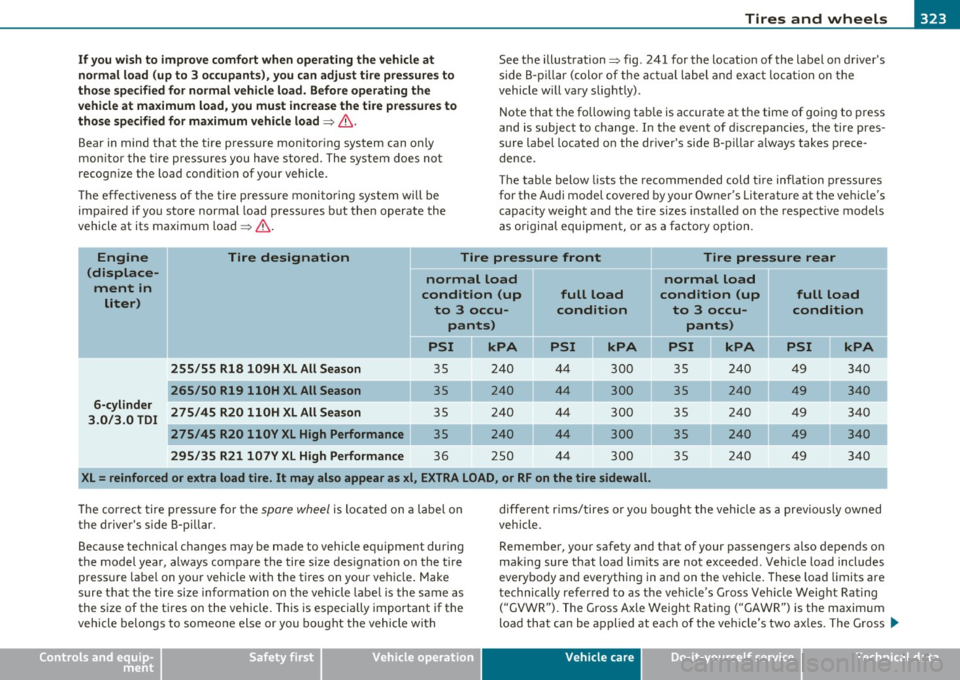
T he table below lists the recommended cold t ire inflation pressures
for the Audi model covered by your Owne r's Literature at t he ve hicle's
capac ity weight and the tire sizes insta lled on the respective models
as original equipment, or as a factory option .
Engine Tire designation Tire pressure front Tire pressure rear
(displace- normal load normal load
ment in
liter) condition
(up
full load condition (up
full load
to
3 occu- condition to 3 occu- condition
pants) pants)
PSI kPA PSI PSI kPA PSI kPA
255/55 R18 109H XL All Season
35 240 44 300
35 240 49 340
265
/50 R19 110H XL All Season 35 240 44
300 35 240 49 340
6-cylinder 275/45 R20 110H XL All Season 35 24 0 44 3 00 35 240 4 9 340
3.0/3.0 TDI
275 /45 R20 llOY XL High Performance 35 240
44 300
35 240 49 340
295
/35 R2110 7Y XL High Performance 36 250 44
300 35 240 49 340
XL= reinforced or extra load tire
. It may also appear as xl , EXTRA LOAD, or RF on the tire sidewall .
The correct tire p ress ure for t he spare wheel is loca ted on a labe l o n
the driver 's s ide B-pillar.
Beca use technical c hanges may be made to vehicle equipment dur ing
the model year, always compare the tire size des ignation on the t ire
pressu re labe l on yo ur vehicle with the t ires on your vehicle. Make
sure that the tire size informat ion on t he v ehicle labe l is the same as
the size of the t ires o n the vehicle. This is especially important if the
vehicle belo ngs to so meone else or you bo ug ht the vehicle with
Safety first
differe nt r im s/ tires or you bo ugh t the vehicle as a prev iously owned
vehicle.
Remember, yo ur safety and t hat of your passengers also depends o n
making sure that load limits are not exceeded. Vehicle load includes
everybody and everything in an d on the vehi cle. These load limits are
t e chnically refer red to as the veh icle's G ross Veh icle Weig ht Rating
("GVW R"). The Gross Axle Weight Rati ng ("GAWR") is the maximum
load tha t can be applied at ea ch of the ve hicle's two ax les . T he G ross ..
Vehicle care Technical data
Page 326 of 392
-~_T_ ir_e_ s_ a_ n_ d_ w_ h_e_ e_ ls _______________________________________________ _
Vehicle Weight Rating and the G ross Ax le We ig ht Rating a re listed on
t he sa fe ty co mplianc e stick er la bel lo ca ted on t he dr ive r's side B
pillar. The tire press ure label on your Aud i lists the max imum
combine d weight of a ll of t he occ upants an d lugga ge or other cargo
that the veh icle can car ry . For the locat io n of the t ire pressure label
~ pa ge 32 2, fig . 241.
& WARNING
Overloading a vehicle can cause los s of vehicle control , a crash or
other accident, serious personal injury, and even death.
• Carrying more weight than your vehicle wa s designed to carry
will prevent the vehicle from handling properly and increase the
risk of a loss of vehicle control.
• The b rakes on a vehicle that has been overloaded may not be
able to stop the vehicle within a safe distan ce.
• Tires on a vehicle that has been overloaded can fail suddenly
causing loss of control and a crash.
• Always make sure that the total load being transported -
including the weight of a trailer hitch and the tongue weight of a
loaded trailer -does not make the vehicle heavier than the
vehicle 's Gro ss Vehicle Weight Rating.
& WARNING
• Incorrect tire pressures and /or underinflation can lead to a
serious or fatal accident.
• Incorrect tire pressures and /or underinflation cause increased
tire wear and can affect the handling of the vehicle.
• Incorrect tire pressures and/or underinflation can also lead to
sudden tire failure , including a blowout and sudden deflation,
c ausing loss of vehicle control. •
Checking tire pressure
The c orrec t t ire pre ssur e fo r th e tires origina lly insta lled
o n yo ur veh icle is listed on th e tir e p res su re l abe l lo cat ed
on driv er's side 8-pi llar.
Th e recommended tire pressures are on the tire p ress ure labe l an d in
t he table~
page 322, "Cold tire infla tion pressure" .This means that
the pressure m ust be chec ked an d adj usted w hen the tire has not
bee n driven for more tha n a co uple of m iles (kil om ete rs) at low
speeds dur ing the prev io us three hours . A ir in the tires expan ds when
t he tire heats up as a res ult of in ter nal fric tion as it flexes in use. The
t ire pressure is higher w hen the tire has warmed up than whe n it is
" ld "
c o .
It is the inflation pressu re in a "cold" tire that counts. Therefore, yo u
should never let air out of a wa rm tire to match "Col d tire inflat ion
pressu re" recomme ndat ions~
pag e 322. The t ir e s would t hen be
unde rinflated and co uld fail sudden ly .
Th e tire p ress ure label on your Aud i list s th e recommended co ld t ire
inflation pressures at maximum capacity fo r the new, o rigina l equip
ment tires tha t were on yo ur vehicle at the t ime it was man ufactu red.
For the location of the label~
page 322, fig. 241.
M ost tires lose a ir nat urally ove r time. They can a lso lose some a ir if
you drive over a potho le or hit a curb while pa rking.
It is usually not
possible to see whether the rad ia l tires used today are underinflated
jus t by loo king at them.
T herefore, be sure to check t ire pressures at least once a month and
always before going o n a long tri p. M ake sure to take the num be r of
peop le and the amount of luggage i nto account whe n ad justi ng tire
press ure for a t rip -even one tha t you would no t conside r to be
" lo ng." See~
pag e 326, "Tires and vehicle load lim its" for mo re
impo rtant i nformat ion.
Alw ays use an a ccu rat e t ire pres sure g auge whe n checki ng a nd
ad justing i nflat io n pressures. Check all of the tires and be sure not to
f o rge t the s pare tire. If the pre ssu re in any tir e is too h igh when the
t ir e is "co ld," let air out of t he tire slowly with t he edge of the ti re ..,_
Page 327 of 392
Tires and wheels -_____________ --=-=--=.:..:......:..::....:.=----Vf'II
gauge and keep chec king the press ure until you reach t he press ure
th at i s cor rect fo r t he lo ad ( pass en ge rs and l uggage) and kind of
dr iving you plan to do .
If the press ure i n any t ire is too low, note the difference betwee n th e
pressu re in t he cold tire a nd the pressure you need and add the air
that you need to reach the correct pressure for t he ve hicle load
( pass enge rs and lugg age) f or th e tires on yo ur vehicle as l ist ed on t he
on your vehicle and in this manua l and the kind of driving you p lan to
do.
Never exceed the maximum inflation pressure listed on the tire
sidewall for any reason.
Remember that the ve hicle m anufac tur er, no t the tire manufa cture r,
determines t he correct tire press ure for the t ires on your veh icle.
It is important to check the tire pressure when the t ires a re co ld .
• Read the requ ired t ire pr essure from t he t ire pr essure lab el. T he
tire pressure labe l is locate d on t he driver's side 8- pillar. Th e tire pres
s u re labe l lists t he re com men ded col d tire inflat io n pr essures fo r the
vehicle at its maxim um capac ity we ight and the t ires t hat were on
yo ur vehicle at the t ime it was ma nufact ured. For r ecom mende d tire
pressures fo r norma l load cond it ions, please see chapter
=> page 322.
• Turn the valve stem cap co unter -clockw ise to remove it from the
t ire v alve.
• Place the air press ure gauge on the valve.
• The tire p ressures sho uld on ly be checked and adjusted wh en the
tires are cold. The slightly raised press ures of wa rm tires must not be
re du ced.
• Adjust the tire p ress ure to the loa d you are ca rry ing.
• Reinstall the valve stem cap o n the valve .
When should I check the tire pressure?
The correct tire press ure is especially important at high speeds. The
pressu re shoul d there fore be c hec ke d at least once a mo nth a nd
Safety first
always before start ing a journey . Do not forget to check t he t ire pres
s u re for the spare w heel.
When should I adjust the tire pressures?
Adju st the tir e pre ssure to the load y ou ar e carry ing. A fter ch anging a
wheel
or replac ing wheels you have to adjust t he t ire p ressures on all
w heels. I n addition , you m ust th en s tore the new tire press ures i n the
t ir e pressu re monitoring system=>
page 339.
& WARNING
Incorrect tire pressures and/or underinflation can lead sudden tire
failure, loss of control, collision, serious pers onal injury or even
death.
• When the warning symbol appears in the instrument
cluster, stop and inspect the tires.
• Incorrect tire pressure and/or underinflation can cause
increased tire wear and can affect the handling of the vehicle and
stopping ability.
• Incorrect tire pressure s and/or underinflation can also lead to
sudden tire failure, including a blowout and sudden deflation,
causing loss of vehicle control.
• The driver is responsible for the correct tire pressures for all
tires on the vehicle. The applicable pressure values are located on a sticker on the driver's side B-pillar.
• Only when all tires on the vehicle are filled to the correct pres
sure, the tire pressure monitoring system can work correctly.
• The use of incorrect tire pressure values can lead to accidents or
other damage. Therefore it is essential that the driver observe the
specified tire pressure values for the tire s and the correct pres
sures for the function of the tire pressure monitoring system.
• Always inflate tires to the recommended and correct tire pres-
sure before driving off. .,_
Vehicle care Technical data