tire pressure AUDI Q7 2011 Owner´s Manual
[x] Cancel search | Manufacturer: AUDI, Model Year: 2011, Model line: Q7, Model: AUDI Q7 2011Pages: 392, PDF Size: 93.29 MB
Page 5 of 392
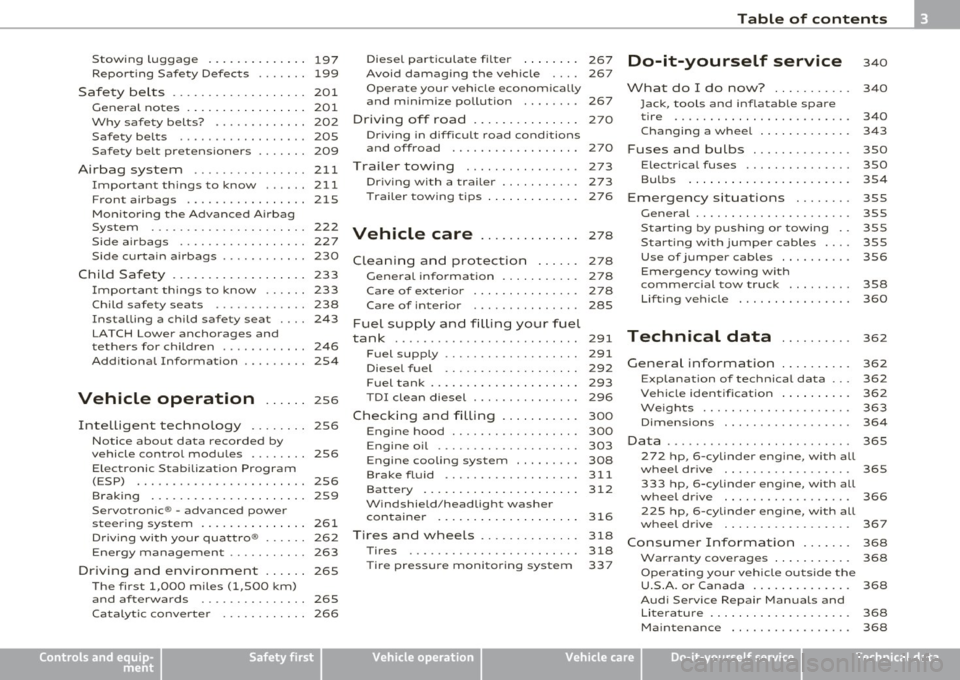
Stowing Luggage ........... ... 197
Repo rting Safe ty Defects ....... 199
Safety be lts ................... 201
General no tes ........ ......... 201
Why safety belts? . . . . . . . . . . . . . 202
Safety belts . . . . . . . . . . . . . . . . . . 205
Safety belt pretensioners . . . . . . . 209
Airbag system ................ 211
Important th ings to know ...... 211
Front airbags ................. 215
Mon ito ring the Advanced A irbag
System ...................... 222
Side airbags .................. 227
Side curtain a irbags . . . . . . . . . . . . 230
Child Safety . . . . . . . . . . . . . . . . . . . 233
Impor tant th ings to know . . . . . . 233
Child safety seats . . . . . . . . . . . . . 238
Installing a child safety seat . . . . 243
LATCH Lowe r ancho rages and
tethers for children . . . . . . . . . . . . 246
Addit ional Information 254
Vehicle operation ...... 2s6
Intelligent techno logy ........ 256
Notice abou t data recorded by
vehicle control modules . . . . . . . . 256
E lectronic S tab ili z ati on Program
(ESP) ........................ 256
Braking . . . . . . . . . . . . . . . . . . . . . . 259
Se rvo tron ic ® -advanced power
steer ing system ....... ........ 261
Dr iving wi th your qua ttro ® . . . . . . 262
Energy management . . . . . . . . . . . 263
Driving and environment . ..... 265
The firs t 1,000 miles (1,500 km)
and af terwards . . . . . . . . . . . . . . . 265
Ca talytic conve rte r . . . . . . . . . . . . 266
Controls and equip
ment Safety first
Diesel pa
rticulate filter . . . . . . . . 267
Avoid damaging the veh icle 267
Operate your vehicle economically
and minimize pollution . . . . . . . . 267
Driving of f road ....... ........ 270
Dr ivi ng in diffic ult road cond itions
and offroad ................. .
Trailer towing
Driving with a trailer .......... .
Trailer tow ing t ips ......... ... . 270
273
273
276
Vehicle care
.............. 278
Clean ing and protection ...... 278
General informa tion . . . . . . . . . . . 278
Care of exterior . . . . . . . . . . . . . . . 278
Care of interior . . . . . . . . . . . . . . . 285
Fuel supply and filling your fuel
tank . . . . . . . . . . . . . . . . . . . . . . . . . . 291
Fuel supply . . . . . . . . . . . . . . . . . . . 291
Diesel fuel . . . . . . . . . . . . . . . . . . . 292
F u el tank . . . . . . . . . . . . . . . . . . . . . 293
T DI clean diesel . . . . . . . . . . . . . . . 296
Checking and filling . . . . . . . . . . . 300
Engine hood . . . . . . . . . . . . . . . . . . 300
Engine oil . . . . . . . . . . . . . . . . . . . . 303
Engine cooling system . . . . . . . . . 308
Brake fluid ................... 311
Bat tery ......... .... ......... 312
W indshie ld/head ligh t washer
containe r ....... .... ......... 316
Tires and wheels . . . . . . . . . . . . . . 318
Tires 318
Ti re pressure monitor ing system 337
Table of contents
Do-it-yourself service
What do I do now? .......... .
Jack, tools and infla table spare
tire ........................ .
Changing a wheel .... ........ .
Fuses and bulbs ............. .
Electrical fuses .............. .
Bulbs ......... ............ . .
Emergency situations ....... .
General ..................... .
S tarting by pushing or towing ..
Starting with jumper cables ... .
Use of jumper cables ......... .
Emergency towing with
commercial tow truck ........ .
Lifting vehicle ............... .
Technical data
General information
340
340
340
34 3
350
350
354
355
3SS
3SS
355
356
358
360
362
362
Explana tion of technical da ta . . . 362
Veh icle iden tification ......... .
We ig hts .................... .
Dimensions ................. .
Data .... ....... ........ ...... .
272 hp, 6 -cylinder engine, with all
whee l d rive ................. .
333 hp, 6-cylinder engine, with all
whee l dr ive ................. .
225 hp, 6 -cylinder engine, with all
wheel dr ive ................. .
Consumer Information ...... .
Warranty cove rages ......... . .
Ope rating your vehicle o utside the
U.S .A. or Canada ......... .... .
Aud i Se rvice Repair Ma nuals and
Li terature . .................. . 362
363
364
365
365
366
367
368
368
368
368
Ma intenance . . . . . . . . . . . . . . . . . 368
Vehicle operation Vehicle care Do-it-yourself service Technical data
Page 17 of 392
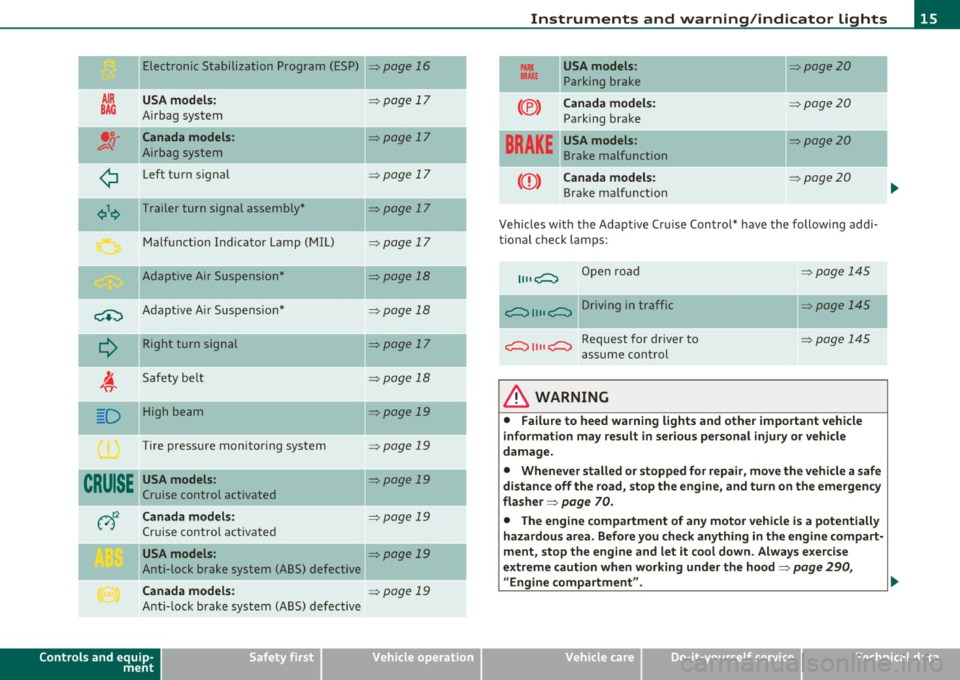
Electronic Stabilization Program (ESP)
AIR USA model s:
BAG A irbag system
•;;-Canada models :
v-'I Airbag system
¢ Left t urn signal
¢\~ Trailer turn signal assembly *
M alfunct io n Indicator Lamp (MIL)
Adaptive Air Suspension*
-
C+:) A dap tive A ir Suspe nsio n*
Q
R ight turn sign al
I. 'fi'
Safety bel t
-.
D High beam
Tire pressure monitoring system
CRUISE USA models :
Cruise control activated
v)t:2 Canada models:
Cruise contro l act ivated
USA models :
Anti-lock brake system (ABS) defective
Canada models :
Anti-lock b rake system (ABS) defective
Controls and equip
ment Safety first
=>page
16
=> page 17
=> page 17
=> page 17
=> page 17
=> page 17
=>page 18
=> page 18
=>page 17
=> page 18
=> page 19
=> page 19
=> page 19
=> page 19
=> page 19
=> page 19
-
-
Instruments and warning /indicator lights
PARX USA models : =>page20 BRAKE Parking br ake
--
(®) Canada model s: :::>page 20
Parking brake
-- -
BRAKE
USA models: =>page20
Brake malfunction
CCD) Canada models: => page20
Bra ke m alfu ncti on
Vehicles with the A dapt ive Cr uise Control* have the following ad di
tional check lam ps:
11, ,C::, Open road
c::, 1111 c::, Driving in traffic
c::, 1111 c::, Request for dr iver to
a ssume con tro l
& WARNING
=:>page 145
=> page 145
~page 145
• Failure to heed warning lights and other important vehicle
information may result in serious personal injury or vehicle
damage.
• Whenever stalled or stopped for repair , move the vehicle a safe
distance off the road, stop the engine, and turn on the emergency
fla sher =>
page 70.
• The engine compartment of any motor vehicle is a potentially
hazardous area . Before you check anything in the engine compart
ment, stop the engine and let it cool down . Always e xercise
extreme caution when working under the hood=>
page 290,
" Engine compartment ". .,,
Vehicle care Technical data
Page 21 of 392
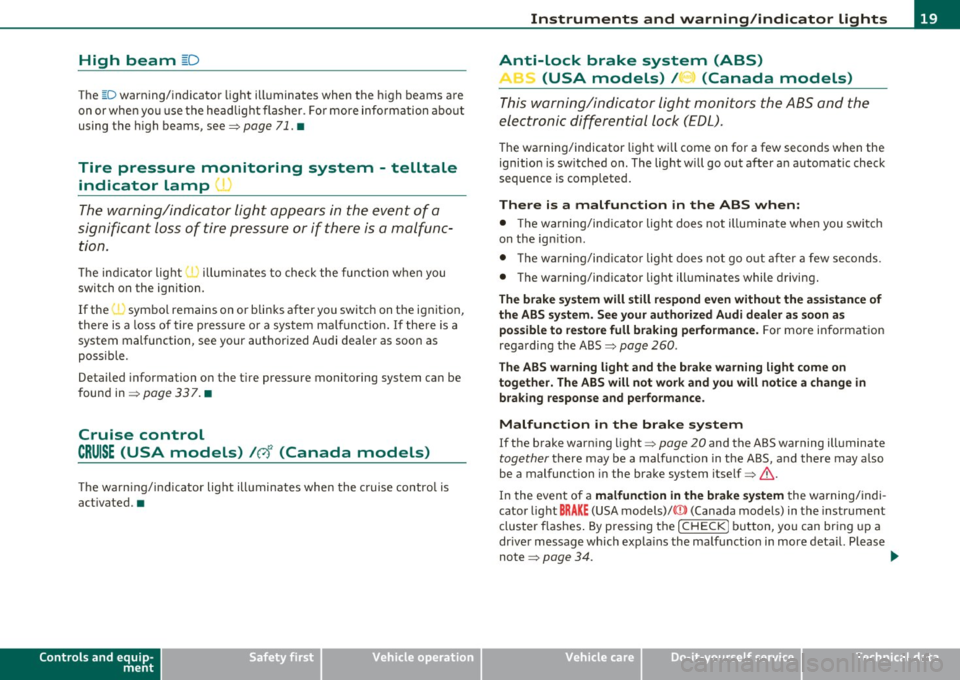
High beam ~D
The ~D warning/indicator light illuminates when the high beams are
on or when you use the headlight flasher. For more information about
using the high beams, see~
page 71. •
Tire pressure monitoring system - telltale
indicator lamp(.,
The warning/indicator light appears in the event of a
significant loss of tire pressure or if there is a malfunc
tion.
The indicator light 1.., illuminates to check the function when you
switch on the ignition.
If the
'll symbol remains on or blinks after you switch on the ignition,
there is a loss of tire pressure or a system malfunction. If there is a
system malfunction, see your authorized Audi dealer as soon as
possible.
Detailed information on the tire pressure monitoring system can be
found in~
page 337. •
Cruise control
CRUISE (USA models) /r,J' (Canada models)
The warning/indicator light illuminates when the cruise control is
activated. •
Controls and equip
ment Safety first
Instruments and warning/indicator lights
Anti-lock brake system (ABS)
A
.:> (USA models) / .... (Canada models)
This warning/indicator light monitors the ABS and the
electronic differential lock
(EDL).
The warning/indicator light will come on for a few seconds when the
ignition is switched on. The light will go out after an automatic check
sequence is completed.
There is a malfunction in the ABS when: • The warning/indicator light does not illuminate when you switch
on the ignition.
• The warning/indicator light does not go out after a few seconds .
• The warning/indicator light illuminates while driving.
The brake system will still respond even without the assistance of
the ABS system. See your authorized Audi dealer as soon as
possible to restore full braking performance.
For more information
regarding the ABS~
page 260.
The ABS warning light and the brake warning light come on
together. The ABS will not work and you will notice a change in
braking response and performance.
Malfunction in the brake system
If the brake warning light~ page 20 and the ABS warning illuminate
together there may be a malfunction in the ABS, and there may also
be a malfunction in the brake system itself~& .
In the event of a
malfunction in the brake system the warning/indi
cator light
BRAKE (USA models)/ ((D) (Canada models) in the instrument
cluster flashes. By pressing the [
CHECK! button, you can bring up a
driver message which explains the malfunction in more detail. Please
note
~ page 34. .,,_
Vehicle care Technical data
Page 24 of 392
Driver information display
Driver information display
Introduction
General notes
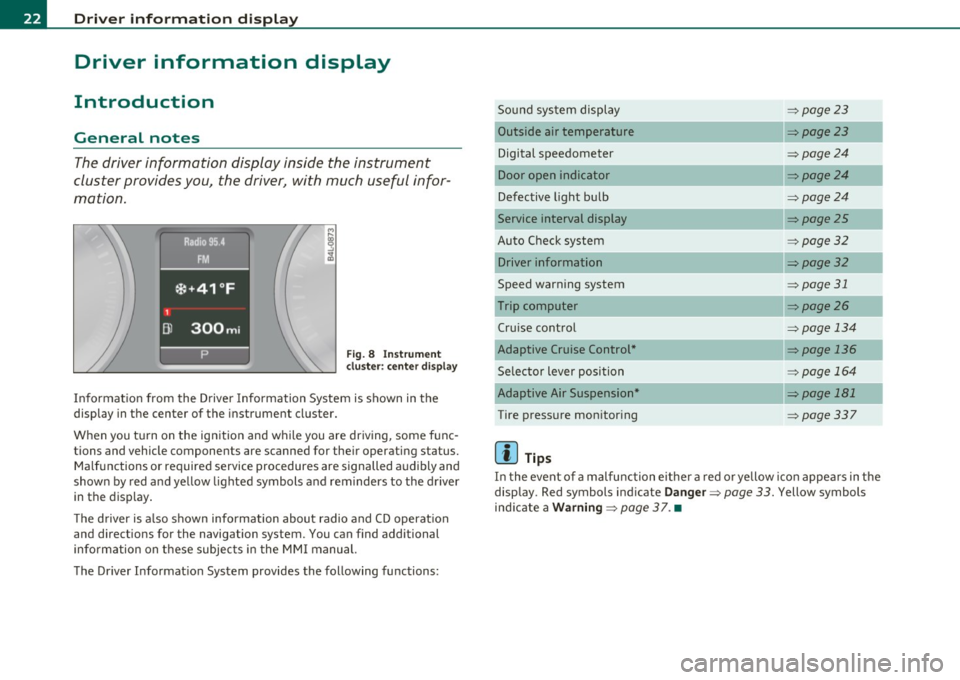
The driver information display inside the instrument
cluster provides you, the driver, with much useful infor
mation .
Fig. 8 Instrument
cl uste r: center display
Informat ion from the Driver Information System is shown in the
display in the center of the instrument cluster.
When you tu rn on the ig nition and while you are driving, some func
tions and vehicle components are scanned for their operating status. Malfunctions or required service procedures are signalled audibly and
shown by red and yellow lighted symbols and reminders to the driver
in the display.
Th e d river is also shown information about radio and CD operat ion
and directions for the navigation system. You can find additional
information on these subjects in the MMI manual.
The Driver Informat ion System provides the following functions: Sound system display
=>
page23
Outside air temperature =>page23
Digital speedometer =>page24
Door open indicator =>page24
Defective light bulb =>page24
Service interval display =>page25
Auto Check system => page 32
Driver information =>page32
Speed warning system => page 31
Trip computer => page26
Cru ise control => page 134
Adaptive Cruise Control* => page 136
Selector lever position => page 164
Adaptive Air Suspension* => page 181
Tire pressure monitoring =>page337
[ i ] Tips
In the event of a malfunction either a red or yellow icon appea rs in the
display. Red symbols indicate
Danger => page 33. Yellow symbols
ind icate a
Warning => page 37. •
Page 40 of 392
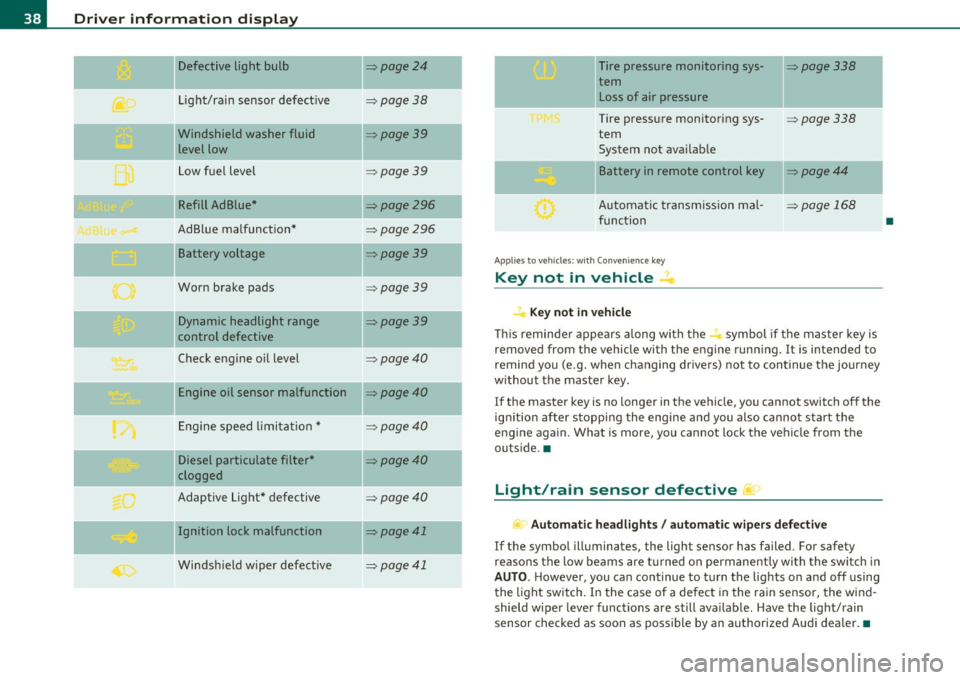
Driver information display
Defective light bulb ::::>page24
._ -
Light/rain sensor defective :::>page 38
-Windshield washer fluid =>page39
level low
Low fuel level
::::>page39
Refill Ad Blue* ::::>page296
AdBlue malfunction* =>page 296
-Battery voltage ::::>page39
Worn brake pads ::::>page39
Dynamic headlight range ::::>page39
control defective
-
Check engine oil level ::::>page40
Engine oil sensor malfunction =>page40
Engine speed limitation* ::::>page40
Diesel particulate filter* ::::>page40
clogged
Adaptive Light* defective
=>page40
Ignition lock malfunction ::::>page41
--
Windshield wiper defective => page 41
-
-
-
-
-
-
Tire pressure monitoring sys-::::>page338
tern Loss of air pressure
Tire pressure monitoring sys-=> page338
tern
System not available
- -
11
sattery in remote control key ::::>page44
Automatic transmission mal-=> page 168
function
Applies to veh icles: with Conven ience key
Key not in vehicle ..Z..
Key not in vehicle
This reminder appears along with the -i. symbol if the master key is
removed from the vehicle with the engine running. It is intended to
remind you (e.g. when changing drivers) not to continue the journey
without the master key.
If the master key is no longer in the vehicle, you cannot switch off the
ignition after stopping the engine and you also cannot start the
engine again. What is more, you cannot lock the vehicle from the
outside. •
Light/rain sensor defective ~'j.
Automatic headlights/ automatic wipers defective
If the symbol illuminates, the light sensor has failed. For safety
reasons the low beams are turned on permanently with the switch in
AUTO. However, you can continue to turn the lights on and off using
the light switch. In the case of a defect in the rain sensor, the wind
shield wiper lever functions are still available. Have the light/rain
sensor checked as soon as possible by an authorized Audi dealer. •
•
Page 193 of 392
________________________________________________ D_ r_ i_ v _i_n ""'g "-- S_a_ f_ e_ l _,,y'-- __
Important things to do before driving
Safety is everybody's job! Vehicle and occupant safety always depends on the informed and careful driver.
For your safety and the safety of your passengers, before
driving always:
- Make sure that all lights and signals are operating
correctly.
- Make sure that the tire pressure is correct.
- Make sure that all windows are clean and afford good visi-
bility to the outside.
- Secure all luggage and other items carefully::::>
page 107.
-Make sure that nothing can interfere with the pedals.
- Adjust front seat, head restraint and mirrors correctly for your height .
- Instruct passengers to adjust the head restraints according to their height.
- Make sure to use the right child restraint correctly to
protect children ::::,
page 233, "Child Safety".
- Sit properly in your seat and make sure that your passen gers do the same::::,
page 85, "General recommenda
tions".
- Fasten your safety belt and wear it properly. Also instruct
your passengers to fasten their safety belts properly
=:> page 201. •
Controls and equip
ment Safety first Vehicle operation
What impairs driving safety?
Safe driving is directly related to the condition of the
vehicle, the driver as well as the driver's ability to concen
trate on the road without being distracted .
The driver is responsible for the safety of the vehicle and all
of its occupants. If your ability to drive is impaired, safety
risks for everybody in the vehicle increase and you also
become a hazard to everyone else on the road::::,,& . There
fore:
Do not let yourself be distracted by passengers or by using
a cellular telephone.
NEVER drive when your driving ability is impaired (by
medications, alcohol, drugs, etc.).
- Observe all traffic laws, rules of the road and speed limits
and plain common sense .
- ALWAYS adjust your speed to road, traffic and weather
conditions.
- Take frequent breaks on long trips. Do not drive for more than two hours at a stretch.
- Do NOT drive when you are tired, under pressure or when
you are stressed .
& WARNING
Impaired driving safety increases the risk of serious personal
injury and death whenever a vehicle is being used.•
Vehicle care Do-it-yourself service Technical data
Page 200 of 392
• ....__D_ r_iv _i_ n_, g=-- S_ a _ f_e _,Ly _ ______________________________________________ _
& WARNING (conti nu ed )
• Pleas e obse rve information on s afe driving => page 190.
& WARNING
To help prevent poi sonous exhau st ga s from being drawn into the
vehicle, always keep the rear lid closed while driving.
• Never transport object s larger than tho se fitting completely
into the luggage area because the rear lid cannot be fully closed.
• If you ab solutely must drive with the rear lid open, observe the
following notes to reduce the ris k of po isoning:
- Close all windows,
- Close the Pano ramic sliding sunroof*,
- Open all air outlets in the instrument panel,
- Swit ch off the air recirculation,
- Set the fresh air fan to the h ighest speed.
& WARNING
Alway s make sure that the doors, all windows, the Panorami c
sliding sunroof* and the rear lid are secur ely closed and locked to
reduce the risk of injury when the vehicle is not being used.
• After closing the rear lid, always make sure that it is properly
clo sed and locked .
• Never leave your vehicle unattended especially with the rear lid
left open . A child could crawl into th e vehicle through the luggage
compartment and close the rear lid becoming trapped and unable
to get out . Being trapped in a vehicle can lead to serious personal
injury.
• Never let children play in or around the vehicle.
• Never let passengers ride in the luggage compartment. Vehicle
occupants must alway s be properly restrained in one of the
vehicle 's seating positions.
W Tips
• Air circulation helps to reduce window fogging. Sta le air escapes
to the outside th rough vents in the trim panel. Be sure to keep these
slo ts free and open.
• Th e tire pressure m ust correspond to the load . The tire pressure is
shown o n th e t ire pressu re label. The tire pressure label is located o n
the driver's side 8-pillar . The tire p ress ure label lists the recom
me nded co ld tire inflation pressures fo r th e ve hicle at its max imum
capacity weight and the tires that were on your vehicle at t he time it
was manufactured. For recommended t ire pressu re s for normal loa d
conditions, p lease see chapter=>
page 322. •
Tie-downs
The lug gage c omp artm ent is equ ipped with fo ur tie
do wns to secur e luggag e and oth er items .
Use the t ie-downs to sec ure yo ur cargo properly => page 197,
"Load ing the l uggage comp artmen t".
In a co llision , the laws of physics mean that even smaller items that
are loose in the vehicle will become heavy m issi les t hat can ca use
ser ious injury. Items in the vehicle possess energy which va ry with
veh icle speed and the weight of the item . Vehicle speed is the most
sign ifi cant factor .
For example, in a frontal coll is ion at a speed of 30 mp h (48 km/h),
the forces a cting on a 1 0-lb (4.5 kg) o bje ct are about 20 times the
normal weight of the item. This means that the weight of the item
wou ld sudden ly be abo ut 200 l bs. (9 0 kg). You can imagine the inju
r ies that a 200 lbs. (90 kg) item flying freely through the passenger
compar tment cou ld cause in a collision like this .
liJ,
Page 259 of 392

_________________________________________ I_ n_ t_ e_ ll_,igent technology ,__E~-
fore-and-aft and lateral directions, the brake pressure and the
steering angle are all measured.
The direction in which the driver wishes to travel is determined with
the aid of the steering angle and vehicle speed and is continually
compared with the actual behavior of the vehicle. If the two do not
match, for example, when the vehicle starts hydroplaning on a wet
road, ESP will automatically brake the appropriate whee l to correct
the problem.
The vehicle is then stabi lized by the forces acting on the whee l during
braking. If the vehicle is
oversteering (rear tends to skid out of the
turn), the brakes are main ly applied on the wheel that is on the
outs ide of the curve. In the case of a vehicle that is
understeering
(tendency to slide out of the curve), the brakes are applied as needed
on the wheel that is on the inside of the curve or additionally on the
other wheels. An acoustic s ignal indicates when ESP brake application
cuts in=> &.
The system operates across the entire speed range in combination
with the ABS system ~
page 260 . If the Anti -Lock Brake System
(ABS) ma lfunctions, the ESP wi ll be out of action as well.
Activating
When you turn on the engine, ESP will automatically be activated and
wi ll perform a self-test. As soon as the test is comp leted, the system
is in normal operating mode .
Offroad mode
ESP should normally be operated in normal mode because this
ensures maximum vehicle stability. If necessary, you can activate the
ESP offroad mode by pressing the button=>
page 256, fig. 222 to
obtain maximum traction and braking ability when driving off paved
roads at low speeds. In ESP offroad mode, the indicator light illu
minates and the message
ESP Offroad Caution! Limited driving
stability
appears briefly in the d isp lay.
The ESP offroad mode can be useful in the following exceptiona l situ
ations when slip or a highly effe ctive different ial loc king funct ion is
desirable. Examples:
Controls and equip ment Safety first Vehicle operation
•
when driving w ith tire chains,
• when driving in deep snow or on loose ground,
• when driving on uneven surfaces with the wheels severely
unloaded (articulation), and
• when rocking the vehicle loose a fter it has become stuck.
When the unusual situation is past, you should sh ift back to the
normal ESP operating mode by pushing the button again. The
message
ESP/ ASR on then appears briefly in the display.
Hill descent control
The hill descent control is switched on in ESP offroad mode. When
slowly descending steep gradients on loose ground or when the axles
are art iculated, hill descent control provides assistance by automati
cally applying the brakes to keep vehicle speed constant. The vehicle
is also rende red easier to steer by select ive distribution of braking
force. Hill descent control intervenes when:
• the accelerator pedal is not pressed,
• the vehicle is travelling less than 12 mph (20 km/h),
• a steep gradient is detected,
• wheel behavior indicates loose ground or conditions with poor
adhesion (e.g. also axle articulat ion).
Hill descent control operates both dr iving forward and in reverse.
Active hi ll descent control is deactivated by pressing the accelerator
pedal until the conditions for activation already listed are met aga in.
& WARNING
• The Electronic Stabilization Program is nevertheless subject to
the laws of physics . It is particularly important to pay attention to
this fact on wet and slippery roads. It is therefore important that
you always adapt your driving to the condition of the road and
traffic conditions. Do not allow the increased safety provided by
the Electronic Stabilization Program system to lull you into
accepting additional safety risks. ..
Vehicle care Do-it-yourself service Technical data
Page 262 of 392
Intelligent technology
'-----------------------------------------------
in. WARNING
• You should perform braking maneuvers for the purpose of
cleaning the brake system only if road condition s permit. Other
road u sers must not b e put at r isk - you may cau se an ac cident!
• Before d esc ending a steep gr ade , redu ce speed and shift tran s
mission into a lower gear or lower driving range. Do not ride the
brakes or hold the pedal down too long or too often . This could
cause the brake s to get hot and diminish braking efficiency.
• Do not "ride the brakes " by re sting your foot on the pedal when
you do not intend to brake. Thi s may caus e the brakes to overheat ,
premature wear and increa sed stopping di stance.
• Under certain climatic and operating conditions such as
pas sing through water, driving in heavy rain or after washing the
vehicle, the effectiveness of the brake s can be reduced . In winter,
ice can accumulate on the brake pads , linings , disc s and drums .
Carefully apply brakes for a test. Brake s will dry and ice coatings
will be cleaned off after a few careful brake applications.
• Driving for an extended period of time on salt -cov ered roads
without using your brakes can al so affect braking efficiency. Clean
off accumulated salt coating from brake d iscs and pads with a few
careful brake applications.
• If you damage the front spoiler , or if you install a different
s poiler , be sure the air flow to the front brakes is not obstructed.
Otherwise the brake system could overheat reducing the effective
ness of the entire brake system.
• Failure of one brake circuit will impair the braking capability
resulting in an increased stopping distance. Avoid driving the
vehicle and have it towed to the nearest authorized Audi dealer or
qualified wo rkshop. •
Brake booster
The brake booster adds e xtra brakin g pow er .
The brake booster works with vacuum pressure which is created only
w hen the en gine is ru nning =>& .
in. WARNING
• Never let the vehicle roll to a stop with the engine shut off .
• If the brake booster i s not working , for example when towing
your vehicle , or because the brake booster has somehow been
damaged , the brake pedal must be p ressed considerably harder to
make up for the lack of booster assistan ce.
Functioning of Anti-Lock Brake System
(ABS)
AB S prevents the wheels from locki ng up under braking.
T he ABS co ntribu tes effectively to vehicle co ntrol s ince it prevents t he
w hee ls from
locking when the b rakes are a pplied. This means t hat t he
veh icle rema ins steerable and is less likely to s kid .
W ith ABS you do not need to
pump the brake. Just hold the brake
pedal down .
However, do not expect the ABS to shorten braking distance u nder
oil
circums tances. When driving on grave l or on newly fa llen snow on top
of icy su rfaces, braking dis tance may be even longer, therefore, under
these c irc umstances, it is especially important that you dr ive slowly
and w it h great care .
How the ABS system works
An automatic check is made when a speed of about 12 mph (20 km/h)
is reached . Whe n this happens, a p umping noise can be hea rd. ._
Page 272 of 392

Driving off road
Driving off road
Driving in difficult road conditions
and offroad
General information
T he ope ra ti on of the Ele ctro nic Stabilization P rogr am ( ESP ) is
expanded for operation away from paved roads. In s ituations where
slip or a different ia l lock in g f unct io n is requ ired, t he ESP offroa d
mode can be activated~
page 256. Hill descent control is also avail
able in the ESP offro ad mode, wh ich a utomatically bra kes the vehicle
and thereby keeps speed consta nt when d ifferent whee l speeds are
de te cted when descend ing a hill~
page 257. Your Audi also has
permanent all-wheel drive in add ition.
However , your Audi is not a pure offroad ve hicle.
It was not bui lt for
dr iv ing un der extreme cond it ions, e.g. for t rips that ar e in th e natur e
of an exped it io n.
Drive only on road s and offroad sections which match the design of
your vehicle and your abilities as a driver. Never take risks!
Before driving offroad
• Check the eng ine oi l level, tire pressure, coolant level, and the
fluid level in the w indshiel d wa sher rese rvoir.
• Stow luggage items and other objects in the luggage compart
me nt, and sec ure t hem agains t slid ing ar ound.
After driving offroad
• After tr ips offroad, remove a ny tw igs and other foreign objects
from the gr ill, the underbody an d the whee ls. Pay special attention to
fore ign obje cts (sto nes) wh ich have be come lodge d in the tire tr ead.
• Clean the body and the vehicle unde rside, and ins pect t he vehicle
for possib le dam age. •
Clean dirty w indows, headlamp lenses, rear lights, and lic ense
plates.
• Perform a bra ke check (pa rticul arly afte r travell ing t hrough
wate r).
& WARNING
• Drive especially attentively and plan ahead in difficult road
condit ions and when offroad. E xcessive speed or incorrect maneu
vers can cau se injurie s and damage to the vehicle .
• Always adapt your speed and driving style to road, offroad,
traffic, and weather condition s. Drive especially slowl y offroad
when your view is restricted.
• Please be aware that in ESP offroad mode, particularly on a
smooth and slippery road, the wheels may have an increased
tendency to spin and the vehicle may break away - danger of skid ding!
• Stability i s limited in the ESP offroad mode.
[ i ] Tips
O nly drive where i t is permi tted and st ay on mar ke d roads an d
paths .
Explanation of some technical terms
The follow ing data refer to ideal conditions. Depending on vehicle
load and g round condi tions a nd the enviro nment, t he num bers may ...