seats AUDI Q7 2012 Owner´s Manual
[x] Cancel search | Manufacturer: AUDI, Model Year: 2012, Model line: Q7, Model: AUDI Q7 2012Pages: 342, PDF Size: 86.42 MB
Page 92 of 342
90 Seats and storage
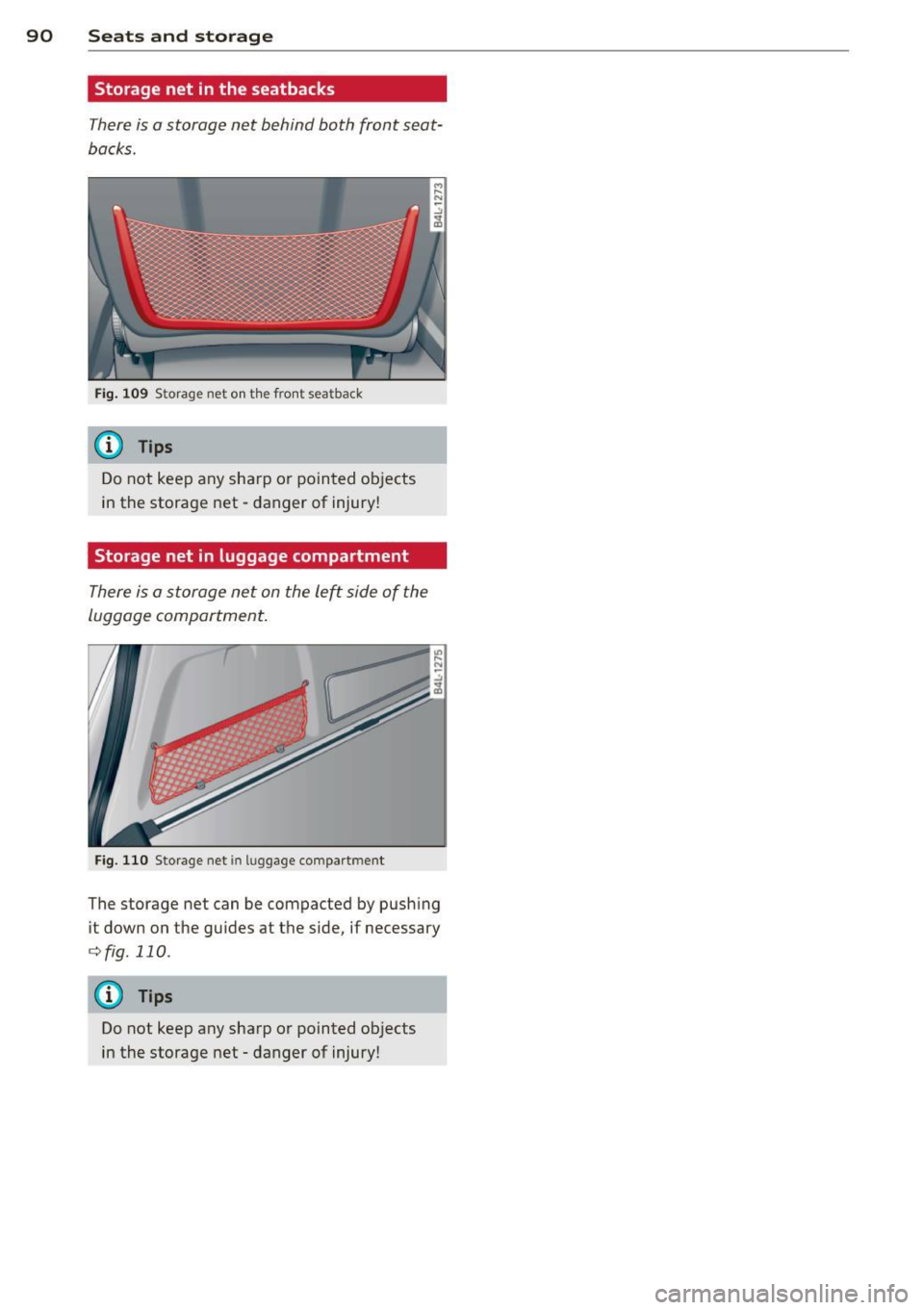
Storage net in the seatbacks
There is a storage net behind both front seat
backs.
Fi g. 10 9 Storage net on th e front seatback
@ Tips
Do not keep any sha rp o r pointed objects
in the storage net -danger of injury!
Storage net in luggage compartment
There is a storage net on the le~ side of the
luggage compartment.
F ig. 1 10 Storage net in luggage compartment
The storage net can be compacted by pushing
it down on the guides at the side, if necessary
¢fig.110 .
(D Tips
Do not keep any sharp or pointed objects
in the storage net -danger of injury!
Page 95 of 342
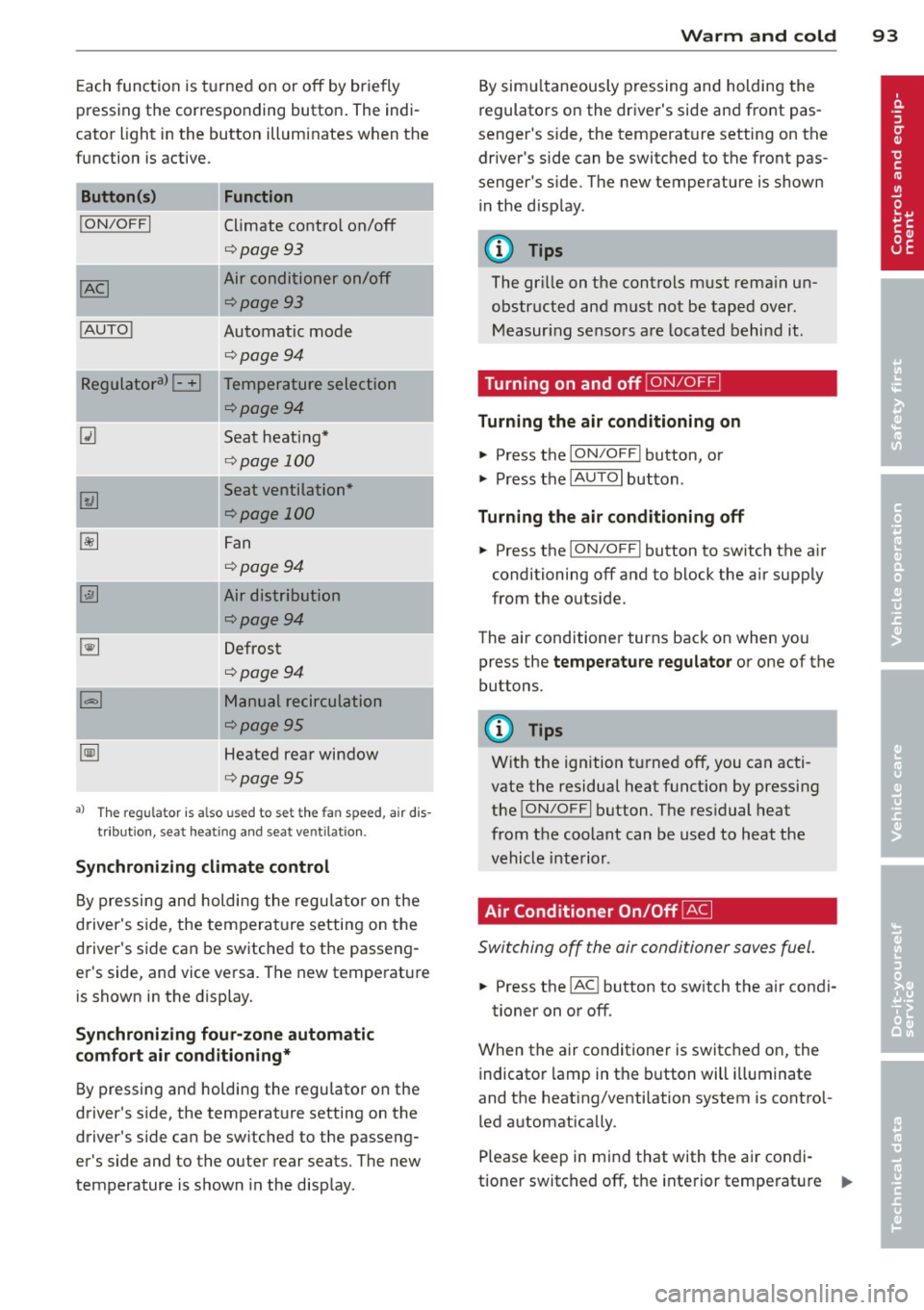
Each function is turned on or off by briefly
pr essing the corresponding button . The indi
cator light in the button illuminates when the
func tion is ac tive.
Button (s )
!ON/OFFI
! AUTO !
Function
Climate control on/off
<=>page 93
Air conditioner on/off
<=>page 93
Automatic mode
<=>page94
-~~~,--
Regulatora) G Temperature selection
~
I
<=>page94
Seat heating*
<=> page 100
Seat ventilation*
<=>page 100
Fan
<=> page94
Air distribution
<=>page94
Defrost
<=>page94
Manual recirculation
¢page95
Heated rear window
<=>page95
al Th e regulat or is also used to set t he fa n speed, air dis
tributio n, seat he ating and sea t ve ntilat io n.
Synchronizing climate control
By pressing and holding the regu lator on the
d river's side , the tempera ture setting on the
d river's side can be switched to the passeng
er's side, and vice versa . The new temperature
is shown in the display.
Synchroniz ing fou r-zone automatic
comf ort air c ond iti oning*
By pressing and holding the regu lator on the
drive r's side, the temperature setting on the
drive r's s ide can be sw itched to the passeng
er's side and to the ou ter rear seats. The new
temperature is shown in the display .
Warm and c old 93
By sim ultaneously pressing and holding the
regulators on the driver 's s ide and front pas
senger 's s ide, the temperat ure setting on the
driver's side can be switched to the front pas
senge r's s ide. T he new temperature is shown
in the d isp lay .
@ Tips
The gr ille on the controls must rema in un
obstructed and must not be taped over.
Measur ing senso rs are located behind it .
Turning on and off~
Turning the air conditioning on
"' Press the ION/O FF! button, or
"' Press the
IAUTO I button.
Turning the air conditioning off
"' Press the ION/O FF! button to sw itch the a ir
conditioning off and to block the air supply
from the ou tside.
The air conditioner turns back on when yo u
press the
temper atu re regulator or one of the
buttons.
(D Tips
Wit h the ignition t urned off, you can acti
vate the residual heat funct ion by pressing
the
! ON/O FF I button . The res idual heat
from the coolant can be used to heat the
vehicle interior .
Air Conditioner On/Off~
Switching off the air condi tioner saves fuel .
"' Press the IAC ! button to sw itch the a ir condi-
tioner on or off .
When the air conditioner is switc hed on, the
indicator lamp in the b utton will illuminate
and the heat ing/venti lation system is control
led automatically .
Please keep in mind that with the air condi
tione r switc hed off, the interior temperat ure
1JJ>
Page 98 of 342
96 Warm and cold
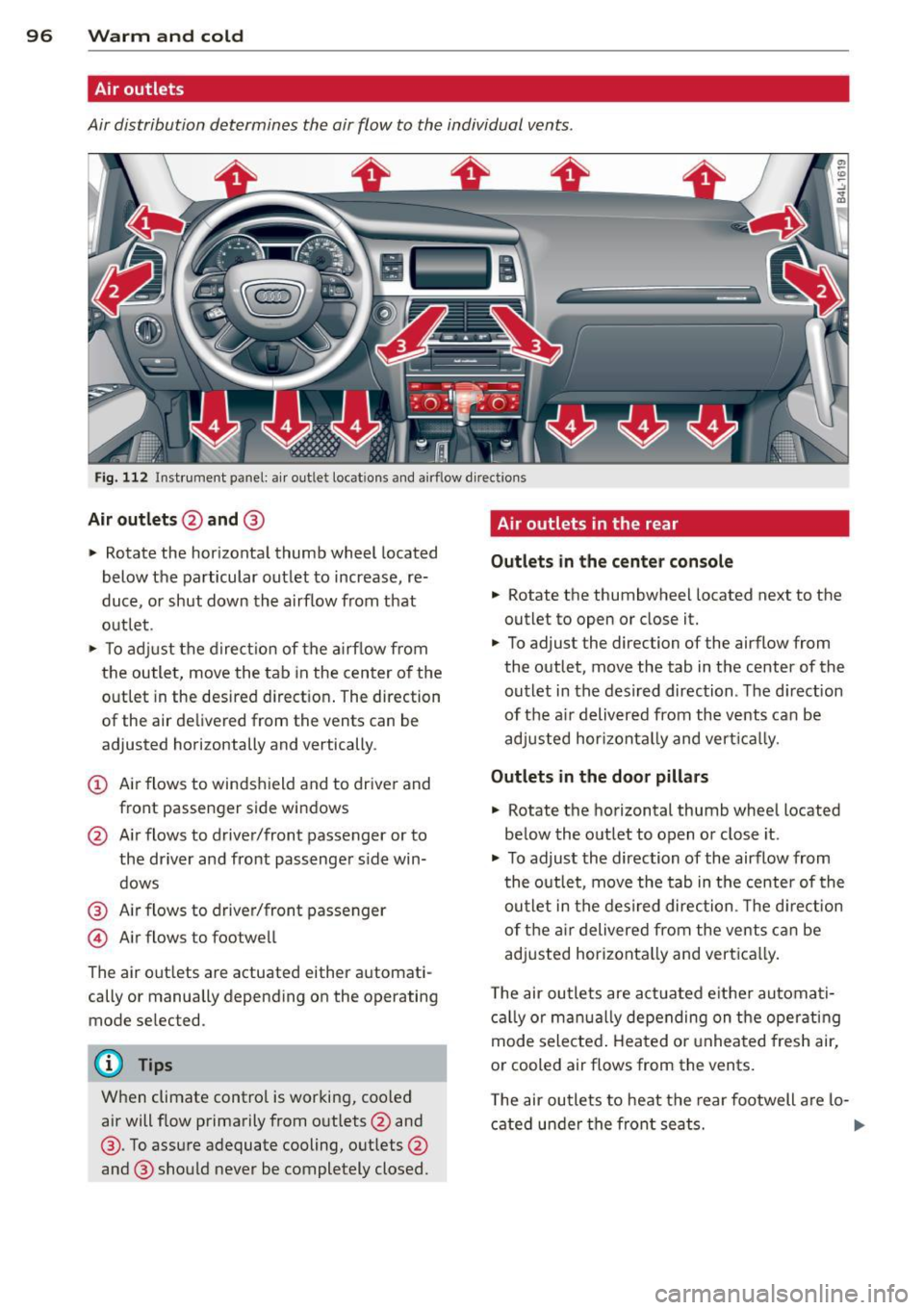
Air outlets
Air distribution determines the air flow to the individual vents .
Fig. 112 Instrument panel: a ir outlet locat ions and airf low d irections
Air outlets @and @
" Rotate the horizontal thumb wheel located
below the particular outlet to increase, re
duce, or shut down the a irflow from that
out let .
" To ad just the direc tion of the a irf low from
the outle t, move the tab in the center o f the
outlet in the desired d irect ion . The direction
of the air de livered from the vents can be
adjusted horizontally and vertically .
(D Air flows to windshield and to drive r and
front passenger side windows
@ Air flows to driver/front passenger or to
the driver and front passenger s ide win
dows
@ Air flows to driver/front passenger
© Air flows to footwell
The air out lets are actuated either automati
cally or manually depending on the operating
mode selected .
@ Tips
When climate control is working, coo led
air will f low primarily from outlets @and
@ . To assure adequate cooling, outlets @
and @ should never be completely closed.
Air outlets in the rear
Outlet s in the center con sol e
.. Rotate the thumbwheel located next to the
outlet to open or close it.
" To adjust the direction of the airflow from
the outlet, move the tab in the center of the
outlet in the desired direction . The d irection
of the a ir deliv ered from the vents can be
adj usted hor izontal ly and vert ica lly.
Outlets in the door pill ars
" Rotate the horizontal thumb wheel located
be low the outlet to open o r close it .
.. To adjust the direction of the airflow from
t he outlet, move the tab in the center of the
outlet in the desired direction . Th e d irect ion
of t he ai r delivered from the vents can be
adjusted horizonta lly and vert ica lly.
T he air ou tle ts are act uated e ither automati
c a lly or man ua lly depending on the operating
mode selected . Heated o r unheated fresh air,
or cooled air flows from the vents.
T he air ou tle ts to heat the rear footwell a re lo-
cated under the front seats.
1J11>
Page 101 of 342

Rear air distribution ~
Applies to vehicles: with four-zone automatic comfort air
conditioning
The automatically controlled air distribution
con be changed manually.
.. Press the Gil button.
.. Rotate the regu lator to the desired setting .
You can adj ust the air circulation so that air
flows from specific vents .
- In position
:J, all air flows from the vents in
the center console and the outlets to the
door pilla rs.
- In position
:0, air flows from the outlets in
the door p illars.
- In position
!,8, air flows from the outlets un-
der the front seats.
There are additional combinations available to
adjust air d istr ibut io n as needed.
To regulate air distribution automatically,
sw itch to
IAU TO I.
Basic settings
General
The basic climate control settings con be ad
justed in the MMI.
.,. Select: Funct io n button ICAR I > Control but
ton
AC . Or
.,. Se lect: Funct ion button
ICAR I > Control but-
ton
Car sy stem s* > AC.
The follow ing funct ions can be selected :
- Auto recirculation
c> page 99
- Synchronization c> page 99
-Supplementary heater * ¢page 100
-Rear opera tion* c> poge 100
Warm and c old 99
Automatic recirculation mode
An air quality sensor detects increased con
centrations of pollutants in the outside air
and automatically switches to recirculation
mode .
We recommend that you always keep auto
matic a ir recirculation ON to p revent polluted
outside air from enteri ng the veh icle inter ior.
If the
a ir qu ality sensor l ocated in the air con
ditioning system detects polluted outs ide a ir,
the sensor dec ides whether the air pollut ion
can be reduced by the facto ry-installed pollu
ta nt fi lter or whethe r it is necessary to switc h
to air recirc ulation. With heavy conce ntra ti ons
of pollu tants, the a ir condit ion ing system is
switched automatica lly to recirc ulation mode
and the supp ly of outside air is blocked . As
soon as the concentration of pollutants in the
outside air drops, fresh air is supplied to the
vehicle interior aga in.
In the event that the windows fog up during
automat ic air rec irculat ion, you must press
the® button immediately.
Under certa in ope rating cond itions, a utomatic
air recirculation is switched off automatica lly.
With outside temperatures be low about 50 °F
(+10 °C), automatic air rec irculat ion is limited
to 30 seconds. W it h outside temperatures be
low about 30 °F ( -1 °C) a nd with the air condi
tione r switched off, the a utomatic air recircu
l ation is limited to 15 seconds.
Synchronization
One climate control setting for the driver and
front passenger seats .
With synchro nization active, the driver's set
tings a re adopted for the passenger o r vice
versa . All the othe r setti ngs that were made
are t ransferred to t he other seat . This in
cl udes all the cl ima te co ntro l settings, excep t
for the se at heating/ven tilat ion* .
If a different setting is selected at a
"synchron ized seat ", synchronization is can
c e lled.
Page 102 of 342

100 Warm and cold
Synchronization
Applies to vehicles: with four -zone automat ic comfort a ir
co ndit io ning
One climate control setting for all seats .
With synchronizat ion active, the driver's set
tings are adopted for the front passenger and
the rear left and right seats. A ll the other set
tings that were made are transferred to the
other seats. This includes all the climate con
trol settings, except for the seat heat ing/ven
tilation* .
If a different setting is se lected at a
"synchroni zed seat", synchron iz ation is can
celled.
Supplementary heater
App lies to vehicles: with d iesel eng ine
" Select : Funct ion button ICARI > Control but
ton
AC > SuppL heater. Or
" Select : Funct ion button
~IC_A_R~I > Control but-
ton
Car systems* > AC > SuppL heater.
Vehicles with diesel engines are equipped
with a supp lementary heater to warm the in
ter ior of the vehicle more quickly. The supp le
men tary heater switches itself on and off au
tomatically when the outside temperature is
be low SO °F (10 °C) and the engine is running,
depending on the coolant temperature, interi
or temperature and the se lected temperature.
Rear operation
Applies to vehicles: with four -zone automat ic comfo rt a ir
co nd it io nin g
The air conditioning in the rear of the vehicle
con be controlled from the cockpit .
" Se lect: Funct ion button ICARI > Contro l but
ton
AC > Rear operation . Or
" Select : Funct ion button
ICARI > Control but
ton
Car systems*> AC> Rear cabin set
tings.
The driver or front passenger can control the
air conditioning in the rear of the vehicle us
ing
his/her own controls.
Heated Seats
Heated front seats~
Applies to veh icles: w it h electrically heated fro nt seats
The sea t cushion and the seotbock of the
front seats con be heated electrically.
" Press the Ill button.
" Rotate the regulator to the des ired setting.
In position O the heating for the seats is
turned off. The range of adjustment is be
tween 1 and 6 .
The heater for the front seats can be turned on when the weight of the particular seat's oc
cupant is detected. However, the front seats
can be pre-heated for about 10 m inutes using
the activated seat heater. After th is time has
elapsed, the seat heater automatically turns
off if it does not detect an occupant's we ight
for the particular seat.
_&. WARNING
Individuals with reduced sensitiv ity to pain
or temperature could develop burns when
using the seat heating function . To reduce
the r isk of injury , these ind ividuals should
not use seat heating .
(D Note
To avoid damage to the heating elements
i n the seats, do not kneel on the seats or
place heavy loads on a small area of the
seat.
(D Tips
Please note that the weight of objects
placed on the seat wi ll also be detected.
This weight may be enough to cause the
seat heater to turn on.
Front seat ventilation ~
Applies to veh icles: w it h front seat ve ntil at ion
The seat cushion and the seatback on the
front seats con be ventilated .
" Press the~ button.
" Rotate the regulator to the desired setting .
ll-
Page 103 of 342
When the regulator is in the O position, the
seat ventilation is switched off. The range of
adjustment is between 1 and 6.
Heated rear seats~
Applies to vehicles: with heated rear seats
The seat cushions and seatbacks of the two
outer rear seats can be heated electrically.
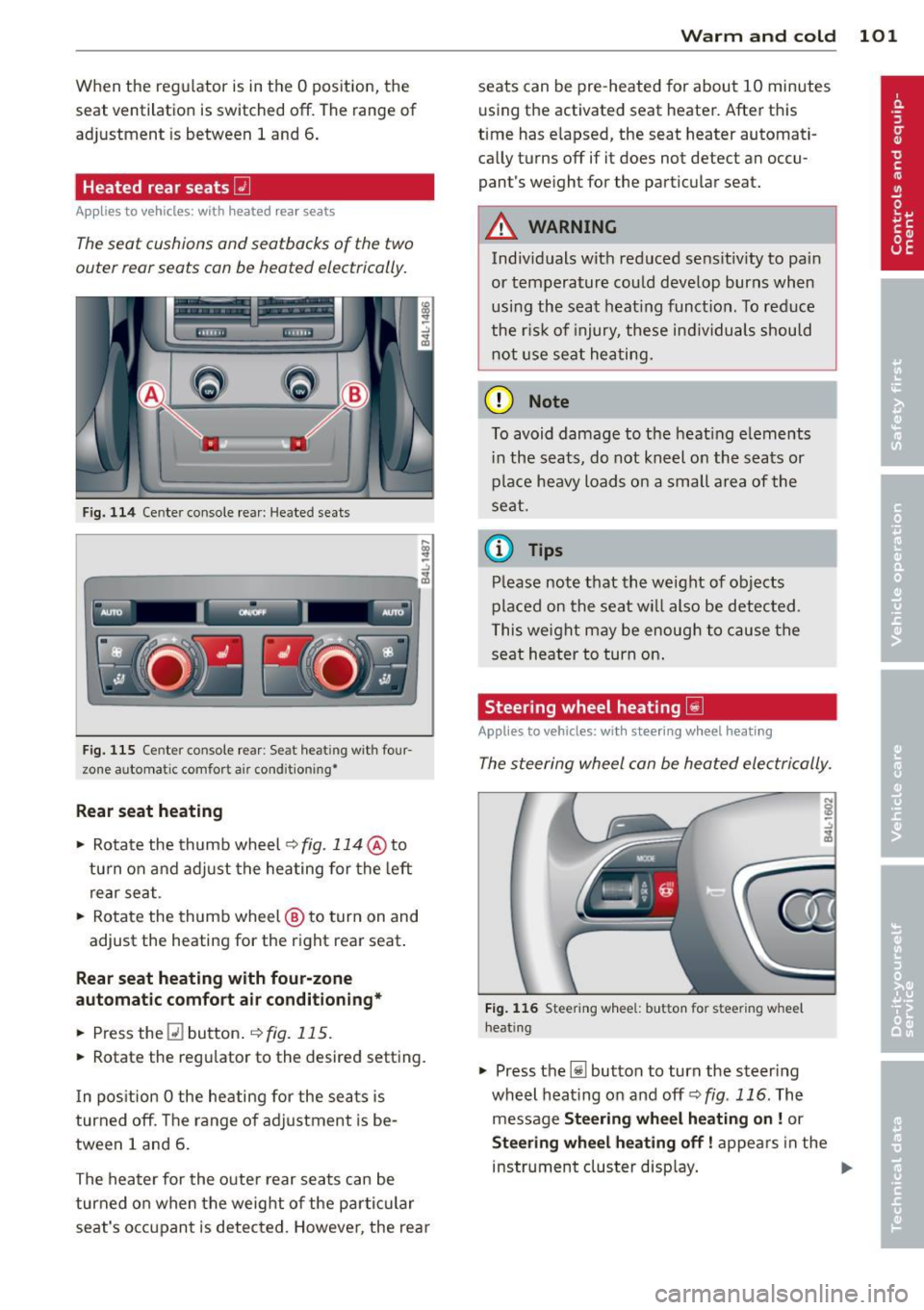
F ig. 114 Ce nter console rea r: Heated sea ts
i
-..:,
---------------<%
F ig. 1 15 Ce nter console rear : Se at heat ing with four
zone automat ic comfort a ir cond it ion ing•
Rear seat he ating
• Rotate the thumb wheel ~fig. 114 @to
turn on and adjust the heating for the left
rear seat .
• Rotate the thumb wheel @ to turn on and
adjust the heating for the right rear seat.
Rear seat heating w ith four-zone
automatic comfo rt air conditioning *
• Press the Q] button . ~ fig. 115.
• Rotate the regu lator to the desired setting .
I n pos ition O the heating for the seats is
turned off . T he range of ad justment is be
tween 1 and 6 .
The heater for the outer rear seats can be
turned on when the weight of the parti cular
seat's occ upant is detected. Howeve r, the rea r
Warm and cold 101
seats can be pre-heated for about 10 minutes
using the activated seat heater. After this
time has e lapsed, the seat heater automati
ca lly turns off if it does not detect an occu
pant's weight for the particular seat.
A WARNING
Individuals wit h reduced se ns itiv ity to pa in
or temperature could develop burns when
usi ng the seat heat ing funct ion . To reduce
the r isk of injury, these ind ividuals shou ld
not use se at hea ting.
(D Note
To avoid damage to the heat ing e lements
i n the seats, do not kneel on the seats or
place heavy loads o n a sma ll a rea of the
seat.
© Tips
P lease not e that the weight of objects
placed on the seat wi ll also be detected .
This weight may be enough to cause the
seat heater to turn on .
Steering wheel heating~
Applies to vehicles: with steering wheel heating
The steering wheel can be heated electrically.
F ig . 1 16 Steer ing wheel: button for steering whee l
heat ing
• Press the [j] button to turn the steer ing
whe el heat ing on and
off <=>fig . 116. The
message
Steering wheel h eating on! or
Steering wheel heating off! appears in the
instrument cluster disp lay. ..,.
Page 162 of 342
160 Driving Safel y
Driving Safely
General notes
Safe driving habits
Please remember -safety first!
This chapter contains important information,
tips, instructions and warnings that you need
to read and observe for your own safety, the
safety of your passengers and others . We have
summarized here what you need to know
about safety belts, a irbags, ch ild restra ints as
well as child safety. Your safety is for us
priori
ty number 1.
Always observe the info rmat ion
and warn ings in th is sect ion -fo r yo ur own
safety as well as that of your passengers .
The information in this se ction app lies to all
model ve rsions of your veh icle . Some of the
feat ures desc ribed in this sec tions may be
standard equipment on some models, or may be optional equipment on others . If you are
not sure, ask your authorized Aud i dealer.
A WARNING
- Always make sure that you follow the in
struct ions and heed the WARNINGS in
this Manual. It is in your interest and in
the inte rest of you r passengers.
- Always keep the complete Owner's Liter
ature in your Audi when you lend or sell
yo ur vehicle so that this important info r
mation will always be ava ilable to the
dr iver and passengers.
- Always keep the Owner's literature handy
so that you can find i t eas ily if you have
ques tions.
Safety equipment
The safety features are part of the occupant
restraint system and work together to help
redu ce the risk of injury in a wide variety of
accident situations.
Your safety and the safety of your passenge rs
should not be left to chance. Advances in
technology have made a varie ty o f fea tures
avai la bl e to he lp re duce the risk of inj ury in an accident
. The following is a list of just a few of
the safety features in your Audi:
- sophis tic ated s afety be lts for d rive r and a ll
passenger sea ting pos it ions,
- be lt te nsione rs fo r th e fro nt sea ts a nd the
ou ter sea ting posit ions in the second row
seating,
- be lt h eight adjustment fo r th e front sea ts
an d the o ute r seat ing pos itions in the sec
ond row seating,
- he ad restra ints for e ach sea ting pos ition,
- front airbags,
- side airbags in the fro nt seats and the outer
seating positions in the second row seat ing*,
- side curta in ai rbags,
- specia l LATCH anchorages for child re-
st raints,
- ad justab le steering colum n.
These individual safety features, can work to gether as a system to he lp protect you and
your passengers in a wide range of accidents .
These features cannot work as a system if
they are not always correctly adjusted and cor rectly used .
Safety is everybody's responsibil ity!
Important things to do before driving
Safety is everybody 's job! Vehicle and occu
pant safety always depends on the informed
and careful driver.
For yo ur safety and the safety of your passen
gers,
before driving always:
.. Make s ure that all lights and signa ls a re op
erati ng correctly .
.. Ma ke s ure that the tire pressure is correct .
.. Make s ure that all windows are clean and
afford good v is ibility to the o utside.
.. Secure a ll luggage a nd other items carefu lly
¢ page 87.
.. Make su re that nothing can in terfe re with
the peda ls.
.. Adjust fron t se at, head restraint and mir
rors co rrec tly for you r heigh t.
Page 164 of 342
162 Driving Safely
• Always keep both feet in the footwell so
that you are in control of the vehicle at all
times.
For detailed information on how to adjust the
driver's seat, see
¢ page 72.
A WARNING
Drivers who are unbelted, out of position
or too close to the airbag can be seriously
injured by an airbag as it unfolds. To help
reduce the risk of serious personal injury:
- Always adjust the driver's seat and the
steering wheel so that there are at least
10 inches (25 cm) between your breast
bone and the steering wheel.
- Always hold the steering wheel on the
outside of the steering wheel rim with
your hands at the 9 o'clock and 3 o'clock positions to help reduce the risk of per
sonal injury if the driver's airbag inflates.
- Never hold the steering wheel at the
12 o'clock position or with your hands at
other positions inside the steering wheel
rim or on the steering wheel hub. Hold
ing the steering wheel the wrong way
can cause serious injuries to the hands,
arms and head if the driver's airbag de
ploys.
- Pointing the steering wheel toward your
face decreases the ability of the supple
mental driver 's airbag to protect you in a
collision .
- Always sit in an upright position and nev
er lean against or place any part of your
body too close to the area where the air
bags are located.
- Before driving, always adjust the front
seats and head restraints properly and
make sure that all passengers are prop
erly restrained.
- Never adjust the seats while the vehicle
is moving . Your seat may move unexpect
edly and you could lose control of the ve
hicle.
- Never drive with the backrest reclined or
tilted far back! The farther the backrests
are tilted back, the greater the risk of in- jury due to incorrect positioning of the
safety belt and improper seating posi
tion.
- Children must always ride in child safety
seats ¢
page 200. Special precautions
apply when installing a child safety seat
on the front passenger seat¢
page 179 .
Proper seating position for the front
passenger
The proper front passenger seating position
is important for safe, relaxed driving .
For your own safety and to reduce the risk of
injury in the event of an accident, we recom
mend that you adjust the seat for the front
passenger to the following position :
• Adjust the angle of the seatback so that it is
in an upright position and your back comes
in full contact with it whenever the vehicle is
moving .
• Adjust the head restraint so the upper edge
is as even as possible with the top of your
head. If that is not possible, try to adjust
the head restraint so that it is as close to
this position as possible ¢
page 163.
• Keep both feet flat on the floor in front of
the front passenger seat .
• Fasten and wear safety belts correct
ly ¢
page 174 .
For detailed information on how to adjust the
front passenger's seat, see ¢
page 71.
A WARNING
-Front seat passengers who are unbelted,
out of position or too close to the airbag
can be seriously injured or killed by the air
bag as it unfolds. To help reduce the risk of
serious personal injury:
- Passengers must always sit in an upright
position and never lean against or place
any part of their body too close to the
area where the airbags are located.
- Passengers who are unbelted, out of po
sition or too close to the airbag can be
seriously injured by an airbag as it
Page 165 of 342

unfolds with great force in the blink of
an eye .
- Always make sure that there are at least
10 inches (25 cm) between the front
passenger 's breastbone and the instru
ment panel.
- Each passenger must always sit on a seat of the ir own and properly fasten and
wear the safety belt be longing to that
seat .
- Before driving, always adjust the front
passenger seat and head restra int prop
erly .
- Always keep your feet on the f loor in
front of the seat. Never rest them on the
seat, instrument panel, out of the win dow, etc. The airbag system and safety
belt w il l not be ab le to protec t you prop
er ly and can even increase the risk of in
jury in a crash .
- Never drive with the backrest reclined o r
ti lted far back! The farther the backrests
are ti lted back , the greater the risk of in
jury due to incorrect positioning of the
safety belt and improper seating posi
t ion.
- Children must always ride in child safety
seats
c> page 200 . Special precautions
apply when installing a child safety seat
on the front passenger seat
c> page 179 .
Proper seating positions for passengers
in rear seats
Rear seat passengers must sit upright with
both feet on the floor consistent with their
physical size and be properly restrained whenever the vehicle is in use .
To reduce the risk of injury caused by an incor
rect seat ing pos ition in the event of a sudden
brak ing maneuve r or an acc ident , your pas
se ngers on the rea r bench seat must always
observe the fo llow ing :
~ If there are passengers in the rear seat, fold
the head rest ra ints up on the occupied seats
or slide the center head restrain t upward at
least to the next notch
c> page 77 .
Dr ivin g Sa fely 163
~ Make s ure that the seatback is secure ly
latch ed in the upright posi tion
c> page 79.
~ Keep both feet flat in the footwell in front
of the rear seat.
~ F asten and wear safety be lt s properly
<=> page 174 .
~ Make sure that children are always properly
restrained in a child restraint that is appro
pria te fo r the ir s ize and age ¢
page 200.
A WARNING
Passengers who are imp roperly seated on
the rear seat can be se riously inj ured in a
crash .
- Each passenger must always si t on a seat
of their own and properly fasten and
wear the safety belt belonging to that
seat .
- Safety belts only offer maximum protec
tion when the seatback is sec urely latch
ed in the upright position and the safety
be lt s are properly posit ioned on the
body . By not s itting up right, a rear seat
passenger increases the risk of personal
in jury from improperly positioned safety
be lts!
- Always adjust the head restraint p roperly
so that it can give maximum protection .
Proper adjustment of head restraints
Correctly adjusted head restraints are an im
portant port of your vehicle's occupant re
straint system and can help to reduce the risk
of injuries in accident situations .
Fig. 1 83 Head restr ain t: v ie wed from th e front
The head restraints must be correct ly adjust-
ed to achieve the best protectio n. ..,.
Page 166 of 342
164 Driving Safel y
• Adjust the head restraints so the upper
edge is as even as possible with the top of
your head. If that is not possib le, try to ad
just the head restraint so that it is as close
to this position as possible
q fig. 183.
• If there are passengers in rear seat, fold the
head restraints up on the occupied seats or
s lide the center head restra int upward at
least to the next notch.
Adjusting head restraints
q page 76 .
A WARNING
-
Driv ing without head restraints or w ith
head restra ints that are not properly ad
justed increases the risk of serious o r fatal
neck injury dramatically. To help reduce
t he risk of injury:
- Always drive with the head restraints in
place and properly adjusted.
- E very pe rson in the veh icle must have a
properly ad justed head restra int.
- Always make su re each pe rson in the ve
hicle properly adjusts the ir head re
straint. Ad just the head restraints so the
upper edge is as even as possib le with
the top of your head. If that is not possi
ble, try to adjust the head restraint so
that it is as close to this position as pos
sible.
- Never attempt to adjust head restraint
wh ile driving. If you have driven
off and
must adjust the driver headrest for any
reason, first stop the vehicle safe ly be
fore attempting to adjust the head re
st rain t.
- Children must always be properly re
strained in a ch ild restraint that is appro
pr iate for their age a nd s ize
q page 200.
Examples of improper seating positions
The occupant restraint system can only re
duce the risk of injury if vehicle occupants are
properly seated.
Improper seating positions can cause serious
injury or death. Safety belts can only work
when they a re p roperly positioned on the body. Improper seating positions reduce the
effectiveness
of safety belts and will even in
c rease the risk o f injury and death by moving
the safety belt to crit ica l areas of the body.
Improper seating positions also increase the
risk of serious injury and death when an air
bag deploys and str ikes an occupant w ho is
not in the proper s eating position. A dr iver is
responsible for the safety of all veh icle o ccu
pants and espec ially for child ren. The re fo re:
• Never allow anyone to assume an incorrect
seating position when the vehicle is being
used
Q & .
The following bulletins list o nly some sample
pos itions tha t w ill increase the r isk of serious
i njury and dea th. O ur hope is that t hese exam
ples will ma ke yo u more aware o f seat ing po
s itions tha t a re dangerous.
Th erefore , whenever the vehicle is
moving:
- neve r sta nd up i n the vehicle
- neve r stand on the seats
- never kneel on the seats
- never ride wit h the seatback reclined
- never lie down on the rear seat
- never lean up against the instrument panel
- neve r sit on the e dge of the seat
- neve r sit sideways
- neve r lean out the window
- never put your feet out the window
- never put your feet on the instrument panel
- never rest your feet on the seat cushion or
back of the seat
- neve r ride in the footwell
- never ride in the cargo a rea
A WARNING
Imp roper seating positions increase the
risk of ser ious persona l injury and death
whenever a vehicle is being used.
- Always make sure that all vehicle occ u-
pants stay in a proper seating position
and are properly restrained whenever the
veh icle is being used.