tire pressure AUDI Q7 2012 Owner´s Manual
[x] Cancel search | Manufacturer: AUDI, Model Year: 2012, Model line: Q7, Model: AUDI Q7 2012Pages: 342, PDF Size: 86.42 MB
Page 286 of 342
284 Tires and wheels
Tire service life
The service life of tires depends on a lot of
different things including proper installation
and balancing, correct tire pressure and driv
ing style.
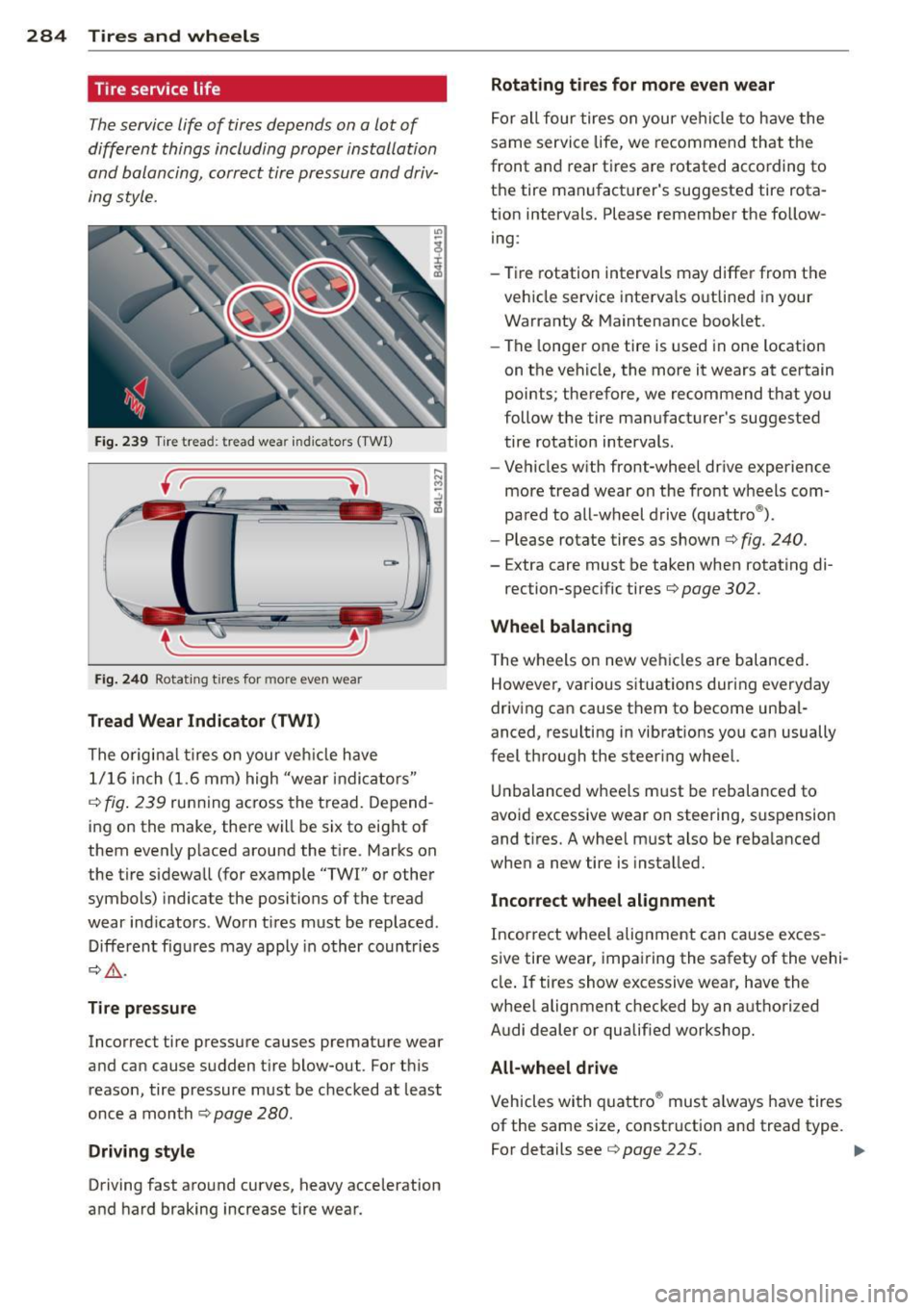
Fi g. 2 39 Tire tread: tre ad wea r ind icators (TWI)
F ig. 240 Rotat ing t ires for more ev en wea r
Tread Wear Indicator (TWI)
The o rigi na l tires on your veh icle have
1/16 inch (1.6 mm) high "wear indicators"
.... N M
c::> fig . 239 running across the tread. Depend
i ng on the make, there will be six to eight of
them evenly p laced around the t ire. Marks on
the tire sidewa ll (for example "TWI" or other
symbols) indicate the positions of the tread
wear ind icators . Worn t ires must be replaced .
Different fig ures may apply in o ther countries
c::> & .
Tire p res sure
Incorrect tire pressure causes premature wear
a nd can cause sudden t ire blow-out. For th is
reason, tire pressure must be checked at least
once a month
c::> page 280.
Driving style
Driving fast aro und curves, heavy acce leration
and hard braking increase tire wear.
Rotating tires for more even wear
F or all four tires on your ve hicl e to h ave the
same service life, we recommend that the
front and rear t ires are rotated according to
the tire manufacturer's suggested tire rota
tion intervals. Please remember the follow
ing :
- Tire rotation intervals may differ from the
vehicle service inte rva ls o utlined in your
Warranty
& Maintenance booklet .
- The longer one tire is used in one location
on the vehicle, the more it wears at certain
points; therefore, we recommend that you
follow the tire manufact urer's suggested
tire rotation intervals .
- Vehi cles w ith front-wheel dr ive experience
more tread wear on the front wheels com
pa red to all-wheel drive (quattro ®).
- Please rotate tires as shown
c::> fig. 240.
-Extra care must be taken when rotating di-
rection-specific tires
c::> page 302 .
Wheel balancing
The wheels on new ve hicles are balanced .
However, various situations during everyday
driving can cause them to become unbal
anced, re sulting in vibrat ions you can usually
feel through the steer ing wheel.
Un balanced whee ls must be rebalanced to
avoid excessive wear on steering, suspension
and t ires. A whee l must also be reba lanced
when a new tire is insta lled.
Incorrect wheel alignment
Incor rect wheel alig nment can cause exces
sive tire wear, impairing the safety of the veh i
cle . If tires show excessive wear, have the
whee l alignment checked by an authori zed
Audi dealer or qualif ied workshop .
All-wheel driv e
Vehicles with q uattro ® mus t always have tires
of the same size, construction and tread type .
For details see
c::> page 225. ..,.
Page 288 of 342

286 Tires and wheels
contribution to good road ho lding and safe
handling when in good condition and properly
inflated
¢ ,& .
We recommend that all work on tires and
wheels be performed by an authorized Audi
dealer. They are familiar with recommended
procedures and have the necessary spec ial
too ls and spare parts as well as the proper fa
cilities for disposing of the old tires.
Authorized Audi dealers have the necessary information about technical requ irements for
installing or changing tires and r ims.
Replacing tires and wheels
Tires should be rep laced at least in pairs and
not individually (for example both front tires
or both rear tires together).
Be sure to read and heed the information to
the tire pressure monitoring system
¢pa ge 292.
Always buy rep lacement radial tires that have
the same specifications as the tires approved
for your vehicle by Audi. Replacement t ires
must always have the same load rating speci
fication as the original equipment or approved
optional tires listed in the table
c:> page 2 78.
Aud i-approved specification ti res are specially
matched to your vehicle and its load limits,
and can contribute to the important road hold
ing, driving characteristics, and safety of the
vehicle. The table
(c:> page 2 78) lists specifica
tions of the tires approved for the Audi mod
els covered by your Owner's Literature .
The tire pressure label located on the driver's
side B-pillar
c:> page 2 78, fig. 238 lists the
specifications of the original equipment tires
installed on your vehicle at the time it was
manufactured.
Federal law requires tire manufacturers to
place standard ized information on the s ide
wall of all tires
c:> fig. 241 . This information
identifies and describes the fundamental
characterist ics, the quality grade of the tire
and also provides a tire ident ificat ion number f
or sa fety standard certification and in case of
a reca ll.
Tire specifications
Knowledge of tire specificat ions makes it eas
ier to choose the correct tires. Radial tires
have the tire specifications marked on the
sidewa ll, for examp le:
P255 / 55 R 18 109 H XL
This conta ins the following information:
P Indicates the tire is for passenger cars
(where app licab le)
255 Nominal tire width in mm of the tire
from sidewall edge to sidewall edge. In
general, the larger the number, the wider
t he tire
55 Height/width ratio in percent (aspect ra-
t io)
R Tire construction: Radial
18 Rim diameter code (in inches)
109 Load rating code
H Speed rat ing letter code
XL (or "xl", "EXTRA LOAD", or "RF" Indicates
that the tir e is a"Re inforced" or an "Extra
Load " tir e
M+S (or "M/S") Indicates that the tire has
some mud and snow capability
The tires could also have the information of
direction of rotat ion
c:> page 274 .
Tire manufacturing date
The manufacturing date is also indicated on
the tire sidewall (possibly on ly on the
inner
side of the wheel):
"DOT ... 2211. .. " means, for examp le, that
the tire was produced in the 22nd week of
2011.
Speed rating (letter code)
The speed rating letter code on the whee ls in
dicates the maximum permissible road speeds
c:> & in Winter tires on page 290 .
P up to 93 mph (150 km/h)
Q up to 99 mph (158 km/h)
R up to 106 mph ( 170 km/h)
Page 289 of 342
S up to 110 mph (180 km/h)
T up to 118 mph (190 km/ h)
U up to 124 mph (200 km/ h)
H up to 130 mph (210 km/h)
V up to 149 mph (240 km/h)
1
)
Z over 149 mph (240 km/h)1
)
W up to 168 mph (270 km/h)1
)
Y up to 186 mph (298 km/h)1>
Your vehicle is no rma lly facto ry equipped with
tires , which possess excellent driving cha rac
ter istics and give yo ur Audi opt imum driving
comfort . An e lectronic speed limiter
¢ page 28 wi ll normally prevent your vehicle
from going faster than the tire speed rating
¢ A .
U.S. DOT Tir e Identification Numbe r (TIN )
a nd tir e m anufactur e date
T his is the t ire's "serial number". It begins
with the letters "DOT" and indicates that the
t ire meets all federal s tandards. The next two
numbers or letters indicate the plant where it
was manufactured, and the last four numbers
represent the week and year of manufacture .
F or example, the numbers 2211 mean that
the t ire was produced in the 22nd wee k of
20 11. The othe r numbe rs a re mar ke ting co
des that may or may not be used by the tire
manufacturer . This informat ion is used to con
tact consumers if a tire defect requi res a re
call.
Audi Original tir e
Tires with the identi fication "AO" or "RO" have
been specia lly matched w ith your Audi . We
recommend using only t hese tires because
they meet the highest standards rega rd ing
safety and driving character istics when used
correctly . You r authorized Audi dealer will
g lad ly provide you with more information .
Tire ply composition and materi als used
The number of plies indicates the n umber of
l ayers of rubber-coated fabric in the t ire. In
ll Fo r tires wit h a m ax im um s pee d ca pabil ity over 149
mph (2 4 0 k m/h) , tire ma nufa cturers some times use
t h e l ett ers " ZR."
Tire s an d wheel s 287
genera l, the greater the number of plies, the
more weight a tire can support . Tire manufac
turers also must indicate the materials in the
tire, which include steel, nylon, po lye ster, and
others.
Maximum Load Rating
This number indicates the maximum load in
ki lograms and pounds that can be carr ied by
the tire.
Tir e quality grading for treadwear ,
tract ion, and temp eratu re resis tance
T read wear, t raction and temperat ure grades
¢ page 288.
Ma ximum Permissible Inflation Pressure
This number is the g reatest amount of a ir
pressure that should ever be put in the tire
u nder normal driving conditions.
A WARNING ~
- Using incorrect or unmatched tires and/
or wheels or improper tire and wheel
comb inat ions can lead to loss of control,
col lis ion and serious personal injury.
-Always use t ires, rims and whee l bolts
that meet the specif ications of original
factory- installed tires or other combina
tions that have been specifically ap
proved by the vehicle manufacture r.
- T ires age even if they are not being used
and can fai l sudden ly, especially at high
speeds . Tir es that are more than 6 yea rs
old can only be used in an emergency
an d then w ith speci al care and at lower
speeds.
- Never mo unt used tires on your veh icle if
you are not sure of the ir "previous histo
ry." O ld used tires may have been dam
aged even thoug h the damage cannot be
seen that can lead to sudden tire fai lure
and loss of vehicle control.
•
•
Page 293 of 342
driving a few yards and correct if neces
sary . Follow the instructions from the
snow cha in manufacturer when doing so.
- If the Adaptive Air Suspension* should
malfunction, do not mount or use snow
chains beca use the vehicle will be ex
tremely low. If you do drive with snow
chains on while the vehicle is at this lev el, the snow chains might severe ly dam
age the wheelhouse and other parts of
the veh icle.
(0 Tips
W here snow cha ins are mandatory oncer
tain roads, this normally also applies to ve
hicles with all-wheel drive.
Wheel bolts
Wheel bolts must always be tightened to the
correct torque .
The design of whee l bolts is matched to the
factory installed r ims. If different rims are fit
ted, the cor rect wheel bolts wit h the right
lengt h and correctly s haped bolt heads must
be used. This ens ures t hat w heels a re fitted
secure ly an d that the brake system f unctions
correctly.
I n ce rtain circumstances, you may not use
wheel bo lts from a d ifferent vehicle -even if it
is the s ame mode l~
page 3 21.
& WARNING
Improperly tig htened or maintained whee l
bolts can become loose ca using loss of
cont ro l, a co llision and serious persona l in
jury.
- Always keep the w heel bolts and the
threads in the wheel hubs clean so the
wheel bolts can turn easily and be prop erly t ightened.
- Never grease or oil the wheel bolts and the threads in the wheel hubs. They can
become loose w hile driving if greased or
o iled, even if tig hte ned to the specified
torq ue.
Tire s an d wheel s 2 91
-On ly use whee l bolts that be long to the
rim being installed.
- Never use different wheels bolts on yo ur
veh icle.
- Always maintain the correct t ightening
torque for the whee l bolts to reduce t he
risk o f a wheel loss. If the tightening tor
que of t he wheel bolts is too low, they
can loosen and come out when t he vehi
cle is mov ing.
If the tig hte ning torque is
too high, the wheel bolts and threads can be damaged and the whee l can be
come loose.
(D Note
The specified torque for the whee l bolts is
120
ft l b ( 160 Nm) with a to le rance of
± 7, 4
ft lb( ± 10 Nm). Torque w heel bo lts
d iagon ally . After changi ng a w heel, the
torque m ust be chec ke d as soon as poss i
b le with a to rque wrench -preferab ly by an
a uthorized Audi dea ler or q ua lified work
shop .
Low aspect ratio tires
Your Audi is factory-equ ipped with tow aspect
ratio tires. These tires have been thoroughly
tested and been se lected specifically for your
model for their superb perfo rmance, road feel
and handli ng under a var iety of drivi ng condi
tions. As k your au thori zed A udi dealer for
more de tails.
The low asp ect ratio of these tires is ind icated
by a nu mera l of
55 or l ess in the tire's s ize
designation. The n ume ra l rep resen ts the ra tio
of the tire's sidew all height in rel ation to its
tread width exp ressed in percentage . Conven
tiona l tires have a he ight/width ratio of 60 or
more.
The performance of low-aspect-ratio tire s is
particularly sensitive to improper inflation
pre ssure. It is therefore important th at low
aspect ratio tires are inflated to the specified pressure and that the inflation pressure is
regularly checked and mainta ined. Tire pres-
sures should be checked at least once a .,..
•
•
Page 294 of 342
292 Tires and wheels
month and alway s before a long trip
~ page 280, Checking tire pressure.
What you can do to avoid tire and rim
damage
L ow aspect ratio tires can be damaged more
eas ily by impact with potho les, curbs, gu llies
or ridges on the road, particularly if the tire is
underinflated.
I n order to minimize the occu rrence o f impact
damage to the tires of your vehicle, we recom
mend that you observe the following precau
tions:
- Always maintain recommended inflation pressures. Check your tire pressure every
2,000 miles (3,000 km) and add a ir if neces
sary.
- Drive carefu lly on roads with potholes, deep
gullies or ridges. The impact from driving
through or over such obstacles can damage
your t ires. Impact with a curb may also
cause damage to your tires.
- After any impact, immediately inspect your
tir es or have them inspected by the nearest
authorized Aud i dealer . Replace a damaged
t ir e as soon as possible .
- Inspect your t ires every 2,000 miles (3,000
km) for damage and wear . Damage is not al
ways easy to see. Damage can lead to loss of
air and unde rinflation, wh ich could eventu
ally cause tire failure. If yo u be lieve that a
tire may have been damaged, replace the
tire as soon as possible.
- T hese tires may wear more quickly than oth
ers.
- Please also remember that, while these tir es
deliver responsive handling, they may ride
l ess comfortably and make more noise than
other choices.
Reduced performance in winter/cold
season conditions
All tires are designed for certain purposes .
The low aspect ratio, ultra high performance
tires originally installed on your vehicle are in
tended for maximum dry and wet road per
formance and handling . They are not suitable
for cold, snowy or icy weather condit ions . If you drive
under those circumstances, you
shou ld equip your vehicle with all-season or
winter tires , which offer better traction under
those conditions. We suggest you use the rec ommended snow or all-season t ires specified
for your vehicle, or their equivalent .
Refer to~
page 289 for more detailed infor
mation regarding winter tires.
Tire pressure
monitoring system
General notes ill
Each tire, including the spare (if provided),
should be checked monthly when cold and in
flated to the inflation pressure recommended by the vehicle manufacturer on the vehicle
placard or tire inflation pressure label. (If your
vehicle has tires of a different size than the
s iz e indicated on the vehicle placard or tire in
flat ion press ure la bel, you should determine
the proper tire inflation pressure for those
ti res.)
As an added safety feature, your ve hicle has
been equipped with a tire pressure monitoring
system ( TPMS) that illuminates a low tire
pressure telltale when one or more of your
tires is significantly under-inflated. According
l y, when the low tire pressure te lltale illumi
nates, you should stop and check your tires as
soon as possible, and inflate them to the
proper pressure . Driving on a sign ificantly un
der- inflated t ire causes the tire to overheat
and can lead to tire fa ilure. Under-inflation al
so reduces fuel efficiency and tire tread life,
and may affect the vehicle's hand ling and
stopping ability .
Please note that the TPMS is not a substitute
for proper tire ma intenance, and it is the driv
er's responsibility to maintain correct tire
pressure, even if under-inflation has not
reached the leve l to trigger illuminat ion of the
T PMS low tire pressure tellta le .
Your vehicle has also been equipped with a
T PMS ma lfunction indicator to indicate when
the system is not operating properly. The
ll>
Page 295 of 342

TPMS malfunction indicator is combined with
the low tire pressure tellta le . When the sys·
tern detects a malfunction, the telltale will
flash for approximately one minute and then
remain continuously illuminated. This se·
quence will continue upon subsequent vehicle
start-ups as long as the malfunction ex ists .
When the malfunc tion indicator is illuminat·
ed, the system may not be able to detect or
signal low tire pressure as intended. TPMS
malfunct ions may occur for a variety of rea·
sons, including the installation of replace·
mentor alternate tires or wheels on the vehi·
cle that prevent the TPMS from functioning
properly. Always check the TPMS malfunction
telltale after replacing one or more tires or
wheels on your vehicle to ensure that the re
p lacement or alternate tires and wheels allow
the TPMS to continue to function properly.
Tire pressure indicator appears
The tire pressure indicator in the instrument
cluster informs you if the tire pressure is too
low or if there is a system malfunction.
-
-
;g
Fig. 242 Display: underinflat io n warning
Fig. 243 Display: Syste m ma lfunct io n
Using the ABS sensors , the tire pressure moni·
toring system compares the tire tread circum·
Tires and wheels 293
ference and vibration characteristics of the in
dividual tires. If the pressure decreases in one
or more tires, this is indicated in the instru
ment cluster with a warning symbol
[I] and a
message
c;, fig. 242 . The driver message in the
display goes out after S seconds . The driver
message can be displayed again by pressing
the
ICHECKI button . If only one tire is affect·
ed, the disp lay wi ll indicate its posit ion.
The tire pressure monitoring must be reset via
MMI each time the pressures are adjusted (e.
g. when switching between part ial and fu ll
load pressu re) o r after changing or replacing a
tire on your vehicle
c;, page 294. You can find
the recommended tire pressures for your vehi ·
cle on the label on the driver's door pillar
c;,page 278.
Tire tread circumference and vibration charac·
teristics can change and cause a tire pressure
warning if:
- the tire pressure in one or more tires is too
low,
- the tir e has structural damage ,
- the tir e pressure was changed, wheels rotat-
ed or replaced but the TPMS was not reset
c;,page294 .
Warning symbols
[I] loss of pressure in at least one tire c;, .&, .
Check the tire or tires and replace or repair if
necessary . The indicator light
[I] in the instru·
ment cluster also illum inates
c;, page 14.
Check/correct the pressures of all four tires
and reset TPMS via MMI.
IIQ§S, (Tir e Pressure Monitoring System) Tire
pressure! System malfunction . If llQ§f:1 ap·
pears after switching the ignition on or while
driv ing
c;, fig. 243 and the indicator light [I] in
the instr ument cluster blinks for approxi
mately one minute and then stays on, there is
a system malfunction . See your authorized
Audi dealer as soon as possible.
Page 296 of 342

29 4 T ire s and wheel s
,8. WARNING
-If the t ire pressure indicator appears in
the instrument cluster display, one or
more of your tires is s ignificantly under
inflated. Reduce your speed immediately
and avoid any hard steering or bra king
maneuvers. Stop as soon as possible and
check the tires and their pressures. In
flate the tire pressure to the proper pres sure as indicated on the vehicle 's tire
pressure label
c> page 2 78. Driving on a
significantly under-inflated tire causes
the tire to overheat and can lead to tire
failure. Under-inflation also is likely to impair the vehicle's handling and stop
ping ab ility.
- The driver is responsible for ma inta ining
the correct tire pressures. You must check the t ire pressures regularly.
- Under certain cond itions (such as a spor
ty driving style, winter condit ions or un
paved roads), the pressure mon itor ind i
cator may be de layed.
- Ask your author ized Audi dealer if run
flat tires may be used on your veh icle.
Your vehicle registrat ion becomes inval id
if you use these tires when not permit
ted. Damage to your vehicle or accidents
cou ld also resu lt.
(D Tips
- The tire pressure monitoring system
stops working when there is an ESC/ABS
malfunction.
- Using snow chains may result in a system
malfunction.
- The tire pressure monitoring system on
you r A udi was ca lib rated using tires with
the "AO" or "RO" identification. We rec
ommend using these tires .
Reset tire pressure monitoring system
If the tire pressure is adjusted, wheels are ro
tated or changed, the TPMS must be reset via
MMI .
.. Turn on the ignition. ..
Select: Function b utton
I CAR !> Control but
ton
S ys tem s* > Tire p re ss ure mo nitoring >
Sto re no w. Or
.. Select: Function button
I CAR !> Control but
ton
Ca r systems * > Servi cing & checks >
Tire pre ss ure mon itoring > Stor e tire pr es
s ure s.
(D Tips
Before resetting the TPMS, the current
pressures of all four tires must correspond
to the specified values. Adjust the tire pressure and reset the pressure in the t ire
pressure monitoring system acco rding to
the load you are car ry ing
.:>page 278.
Page 299 of 342
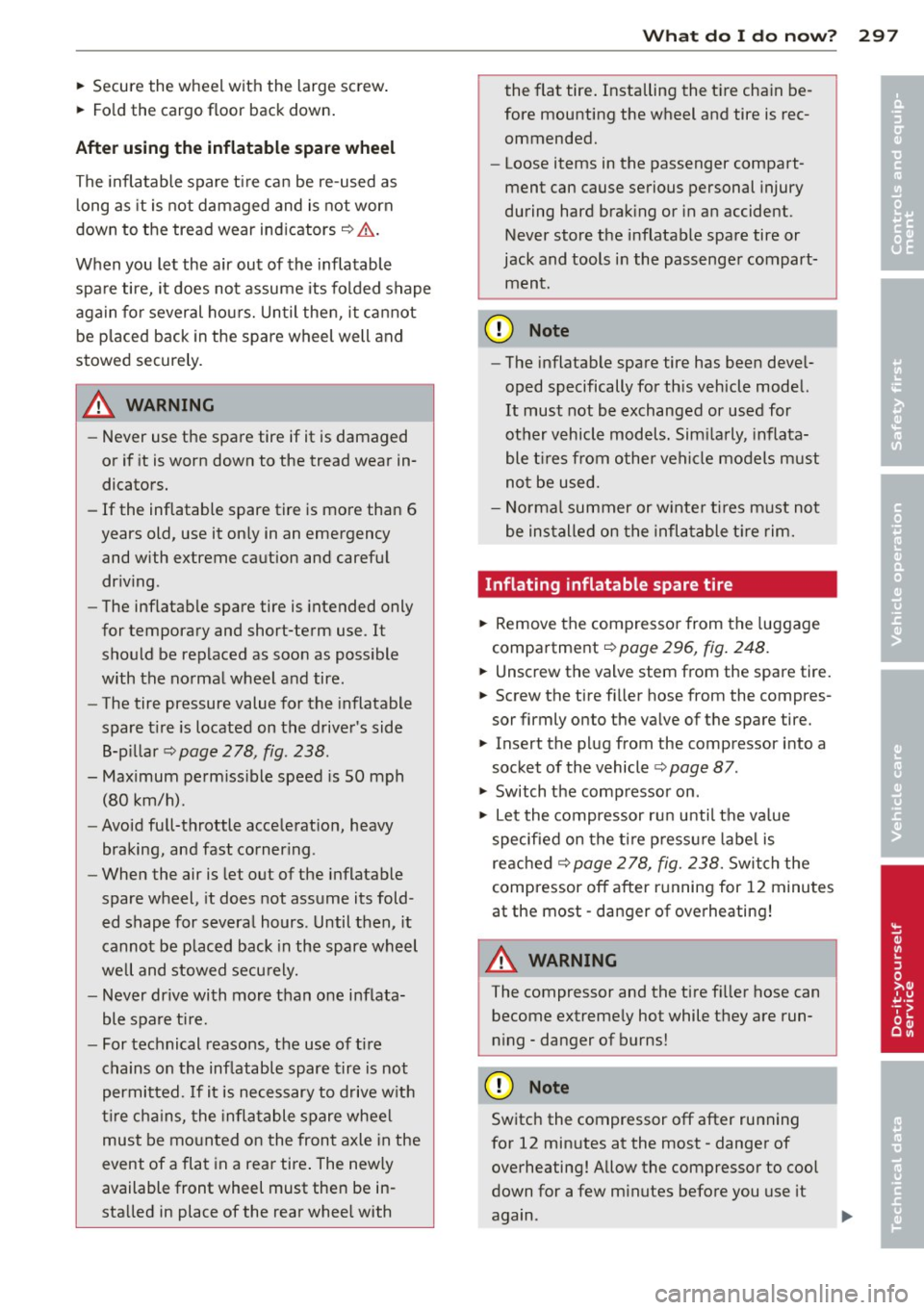
• Secure the wheel with the large screw.
• Fold the cargo floor back down.
After using the inflatable spare wheel
The inflatable spare tire can be re-used as
long as it is not damaged and is not worn
down to the tread wear indicators~.&. .
When you let the air out of the inflatable
spare tire, it does not assume its folded shape
again for several hours. Until then, it cannot
be placed back in the spare wheel well and
stowed securely.
A WARNING
- Never use the spare tire if it is damaged
or if it is worn down to the tread wear in
dicators.
- If the inflatable spare tire is more than 6
years old, use it only in an emergency
and with extreme caution and careful
driving .
- The inflatable spare tire is intended only
for temporary and short-term use .
It
should be replaced as soon as possible
with the normal wheel and tire.
- The tire pressure value for the inflatable
spare tire is located on the driver's side
8-pillar
~ page 2 78, fig . 238.
-Maximum permissible speed is 50 mph
(80 km/h).
- Avoid full-throttle acceleration, heavy
braking, and fast cornering.
- When the air is let out of the inflatable
spare wheel, it does not assume its fold
ed shape for several hours . Until then, it
cannot be placed back in the spare wheel
well and stowed securely.
- Never drive with more than one inflata
ble spare tire.
- For technical reasons, the use of tire
chains on the inflatable spare tire is not
permitted. If it is necessary to drive with
tire chains, the inflatable spare wheel
must be mounted on the front axle in the
event of a flat in a rear tire. The newly
available front wheel must then be in
stalled in place of the rear wheel with
What do I do now? 297
the flat tire. Installing the tire chain be
fore mounting the wheel and tire is rec
ommended.
- Loose items in the passenger compart
ment can cause serious personal injury
during hard braking or in an accident.
Never store the inflatable spare tire or
jack and tools in the passenger compart
ment.
(D Note
- The inflatable spare tire has been devel
oped specifically for this vehicle model.
It must not be exchanged or used for
other vehicle models. Similarly, inflata
ble tires from other vehicle models must
not be used.
- Normal summer or winter tires must not
be installed on the inflatable tire rim.
Inflating inflatable spare tire
• Remove the compressor from the luggage
compartment
~ page 296, fig. 248.
• Unscrew the valve stem from the spare tire.
• Screw the tire filler hose from the compres
sor firmly onto the valve of the spare tire.
• Insert the plug from the compressor into a
socket of the vehicle
~ page 87 .
• Switch the compressor on.
• Let the compressor run until the value
specified on the tire pressure label is
reached
~ page 2 78, fig. 238. Switch the
compressor off after running for 12 minutes
at the most -danger of overheating!
A WARNING
-
The compressor and the tire filler hose can
become extremely hot while they are run
ning -danger of burns!
(D Note
Switch the compressor off after running
for 12 minutes at the most -danger of
overheating! Allow the compressor to cool
down for a few minutes before you use it
again .
•
•
Page 304 of 342
302 What do I do now?
When removing or installing the wheel,
the rim could hit the brake rotor and dam
age the rotor. Work carefully and have a
second person help you.
- When mounting tires with
unid irectional
tread design
make sure the tread pat
tern is pointed the right way
¢ page 302.
-The wheel bolts should be clean and easy
to turn. Check for d irt and corrosion on
the mat ing surfaces of both the wheel
and the hub. Remove all dirt from these
su rfaces before remount ing the wheel.
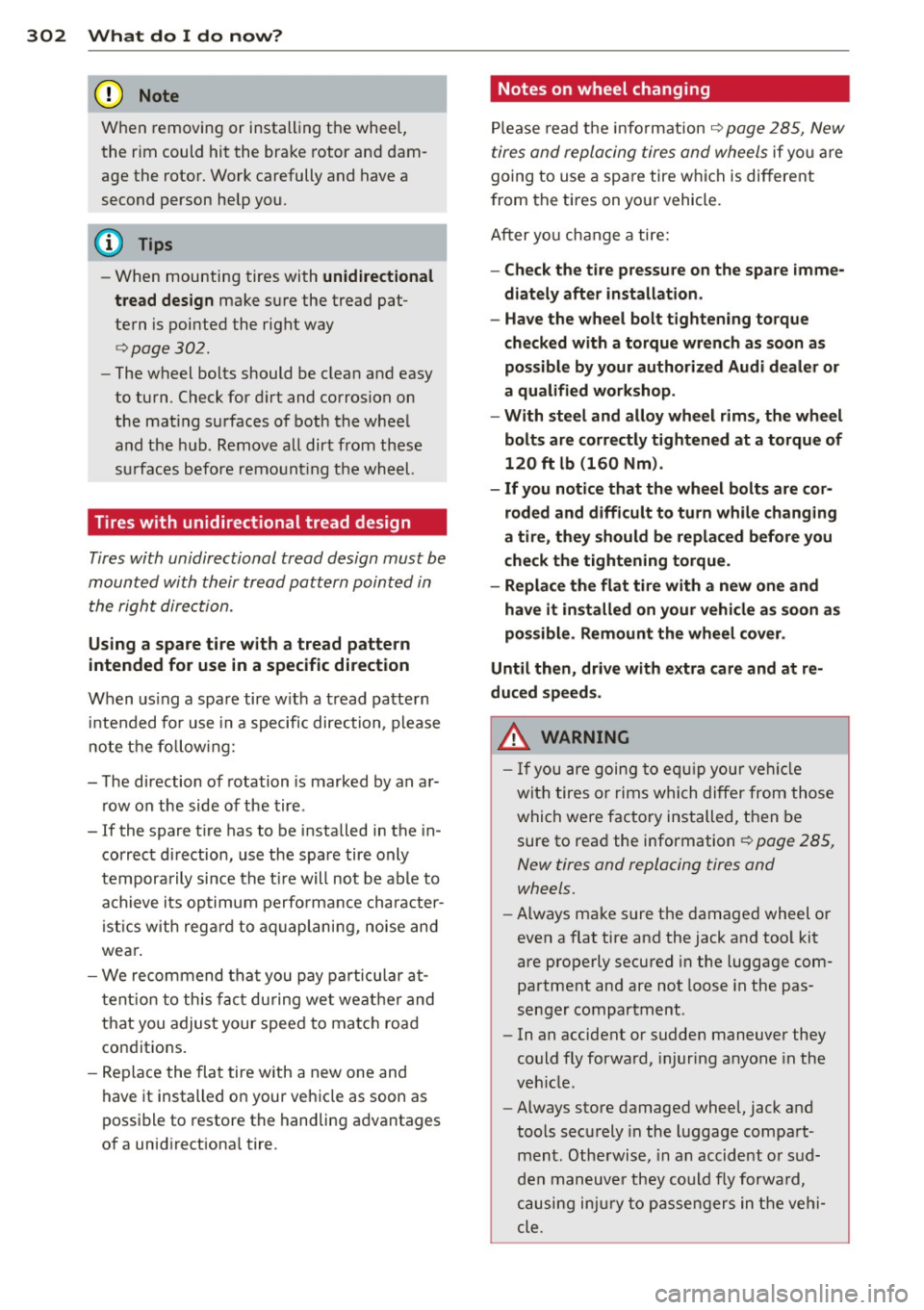
Tires with unidirectional tread design
Tires with unidirectional tread design must be
mounted with their tread pattern pointed in
the right direction.
Using a spare t ire w ith a tread pattern
int ended fo r use in a specific direct ion
When us ing a spa re tire w ith a t read patte rn
i n te nded for use in a specific direction, p lease
note the fo llowing:
- The direction of rotation is marked by an ar
row on the side of the tire .
- If the spare tire has to be installed in the in
correct d irection, use the spare tire only
temporarily since the t ire will not be able to
a chieve its optimum perfo rma nce character
ist ics w ith reg ard to aquapl ani ng, noise and
wea r.
- We recommend tha t you pay pa rticular at
tent ion to this fact du ring wet weather and
that you adjust your speed to ma tch road
con ditions.
- Replace the fla t tire w ith a new one and
have it installed on your veh icle as soon as
poss ible to restore the handling advantages
of a unid irect iona l tire.
Notes on wheel changing
Please read t he i nfo rmat ion Q page 285, New
tires and replacing tires and wheels
if yo u are
go ing to use a spa re tire which is different
from the tires on yo ur vehicle.
After you change a tire:
- Check the tire pressure on the spar e imm e
diately after installation .
- Ha ve the wheel bolt tightening torque
ch ecked with a torque wr ench as soon a s
po ssible by your authorized Audi deal er or
a qua lifi ed workshop.
- With steel and alloy wheel rim s, the wheel
bolt s are corre ctly tightened at a torque of
120 ft lb (160 Nm) .
- If you notice that the wheel bolts ar e cor
roded and difficult to turn while changing
a tire, they should be repla ced before y ou
c heck the tightening torque .
- Re pla ce the flat tire wi th a new on e and
have it in stalled on y our vehi cle a s soon a s
po ssible. Remount the wheel cover.
Until th en , dr ive with extra car e and at re
duc ed speed s.
&_ WARNING
-
- If you a re going to eq uip you r vehi cle
with tires or rims which differ from those
which were factory installed, then be
sure to read the information
Q page 285,
New tires and replacing tires and
wheels.
- Always make s ure the damaged wheel o r
even a flat tire and the jack and tool kit
are property secured in the luggage com
partment and are not loose in the pas
senger compartment .
- In an accident or sudden maneuver they
could fly forwa rd, injuring anyone in the
ve hicle.
- Always store damaged wheel, jack and
too ls securely in the luggage compa rt
ment. Othe rwise, in a n accident o r sud
den maneuve r they could f ly forwa rd,
causing inj ury to passengers in the ve hi
cle.
Page 306 of 342
304 Fuses and bulb s
.
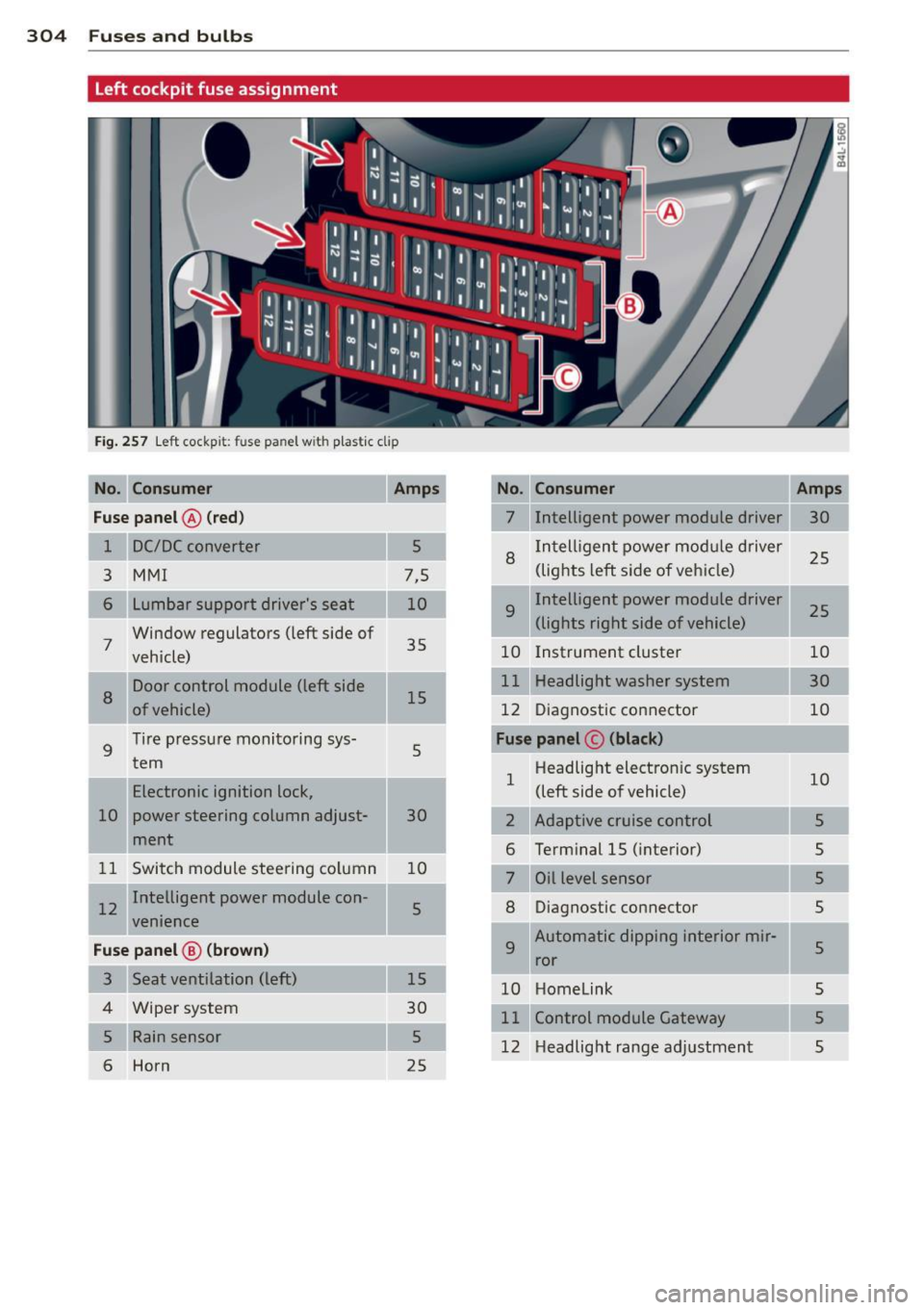
Left cockpit fuse assignment
Fig. 257 Left cockpi t: fu se pa nel w ith plas tic cl ip
Fu se pa nel @ (red )
1
3 MMI
6
7
8
9 Lumbar support driver's seat
Window regulators (left side of
vehicle) Door control module (left side
of vehicle)
Tire pressure monitoring sys
tem Electronic ignition lock,
10 power steering column adjust-
I ment
11 Switch module steering co lumn
Intelligent power module con
venience
F u se pa nel @ (b ro wn)
3
6 Horn
5
7,5
35
15
5
30
10
5
5
25
No .
7
8
9
Consumer
Intelligent power module driver
I ntell igent power mod ule driver
(lights left side of vehicle)
Intelligent power module driver (lights right side of vehicle)
10 Instrument cluster
11 Headlight washer system
12 Diagnostic connector
Fuse pane l c (black )
1 Headlight electron
ic system
(left side of vehicle)
Adaptive cruise control
Terminal 15 (interior)
Diagnostic connector
9 Automatic dipping interior mir-
ror
10 Homelink
11 Control module Gateway
12 Headlight range adjustment
-Amps
30
25
25
10
30
10
10
5
5
5 5
5
5