weight AUDI Q7 2012 Owner´s Manual
[x] Cancel search | Manufacturer: AUDI, Model Year: 2012, Model line: Q7, Model: AUDI Q7 2012Pages: 342, PDF Size: 86.42 MB
Page 289 of 342
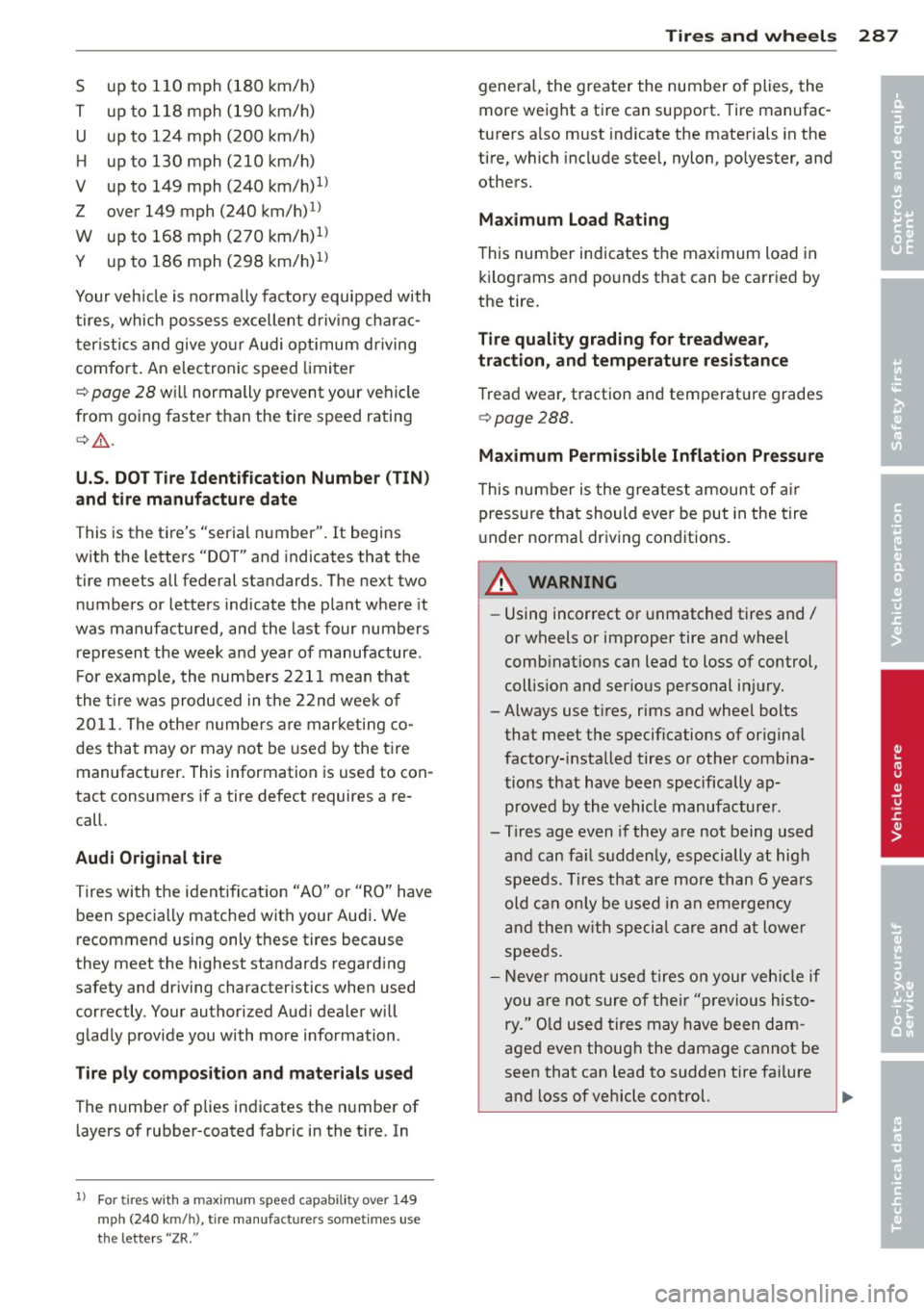
S up to 110 mph (180 km/h)
T up to 118 mph (190 km/ h)
U up to 124 mph (200 km/ h)
H up to 130 mph (210 km/h)
V up to 149 mph (240 km/h)
1
)
Z over 149 mph (240 km/h)1
)
W up to 168 mph (270 km/h)1
)
Y up to 186 mph (298 km/h)1>
Your vehicle is no rma lly facto ry equipped with
tires , which possess excellent driving cha rac
ter istics and give yo ur Audi opt imum driving
comfort . An e lectronic speed limiter
¢ page 28 wi ll normally prevent your vehicle
from going faster than the tire speed rating
¢ A .
U.S. DOT Tir e Identification Numbe r (TIN )
a nd tir e m anufactur e date
T his is the t ire's "serial number". It begins
with the letters "DOT" and indicates that the
t ire meets all federal s tandards. The next two
numbers or letters indicate the plant where it
was manufactured, and the last four numbers
represent the week and year of manufacture .
F or example, the numbers 2211 mean that
the t ire was produced in the 22nd wee k of
20 11. The othe r numbe rs a re mar ke ting co
des that may or may not be used by the tire
manufacturer . This informat ion is used to con
tact consumers if a tire defect requi res a re
call.
Audi Original tir e
Tires with the identi fication "AO" or "RO" have
been specia lly matched w ith your Audi . We
recommend using only t hese tires because
they meet the highest standards rega rd ing
safety and driving character istics when used
correctly . You r authorized Audi dealer will
g lad ly provide you with more information .
Tire ply composition and materi als used
The number of plies indicates the n umber of
l ayers of rubber-coated fabric in the t ire. In
ll Fo r tires wit h a m ax im um s pee d ca pabil ity over 149
mph (2 4 0 k m/h) , tire ma nufa cturers some times use
t h e l ett ers " ZR."
Tire s an d wheel s 287
genera l, the greater the number of plies, the
more weight a tire can support . Tire manufac
turers also must indicate the materials in the
tire, which include steel, nylon, po lye ster, and
others.
Maximum Load Rating
This number indicates the maximum load in
ki lograms and pounds that can be carr ied by
the tire.
Tir e quality grading for treadwear ,
tract ion, and temp eratu re resis tance
T read wear, t raction and temperat ure grades
¢ page 288.
Ma ximum Permissible Inflation Pressure
This number is the g reatest amount of a ir
pressure that should ever be put in the tire
u nder normal driving conditions.
A WARNING ~
- Using incorrect or unmatched tires and/
or wheels or improper tire and wheel
comb inat ions can lead to loss of control,
col lis ion and serious personal injury.
-Always use t ires, rims and whee l bolts
that meet the specif ications of original
factory- installed tires or other combina
tions that have been specifically ap
proved by the vehicle manufacture r.
- T ires age even if they are not being used
and can fai l sudden ly, especially at high
speeds . Tir es that are more than 6 yea rs
old can only be used in an emergency
an d then w ith speci al care and at lower
speeds.
- Never mo unt used tires on your veh icle if
you are not sure of the ir "previous histo
ry." O ld used tires may have been dam
aged even thoug h the damage cannot be
seen that can lead to sudden tire fai lure
and loss of vehicle control.
•
•
Page 315 of 342

fall f rom a lift if the re is a change in ve
h icle we ight d istr ibut ion and balance.
This might happen, for examp le, when
heavy components such as the engi ne
b lock or transmiss io n are removed .
- Whe n removing heavy components like
these, ancho r vehicle to ho ist o r add cor
respond ing weig hts to ma inta in the cen
te r of g ravity . Othe rwise, the vehicl e
m ig ht tilt o r slip off th e hois t, causi ng
s erious perso nal inju ry.
(D Note
- Be awa re of the fo llowing po in ts befo re
li fting t he vehi cle:
- The vehicle should never be lifted or
jacked up from underneath the engine oil pan, the transmission housing, the
front or rear axle or the body side
members. This could lead to serious
damage .
- To avoid damage to the underbody or
chassis frame, a rubber pad must be
inserted between the floor jack and
the lift points.
- Before driving over a workshop hoist,
check that the vehicle weight does not
exceed the permissible lifting capacity
of the hoist.
- Before driving over a workshop hoist,
ensure that there is sufficient clear ance between the hoist and low parts
of the vehicle .
Emergency situations 313
•
•
Page 316 of 342

314 General information
General information Explanation of
technical data
Some of the technical data listed in this man
ual requires further explanation .
The technical data for your vehicle is listed in
the charts starting on
r:::>page 316. This sec
tion provides general information, notes and restrictions which apply to this data .
Vehicle identification
The key data is given on the vehicle identifica
tion number (VIN) plate and the vehicle data
sticker.
Fig. 269 Veh icle Ide ntific atio n Number (VlN) p late: lo
cation on driver 's sid e das h panel
Fig. 270 The vehicle identi fication label -inside the
luggage co mpa rtmen t
The Vehicle Identification Number (VIN)
is located on the driver's side so that it is visi
b le from the outside through the windshield
r:::> fig . 269. You can also display the Vehicle
Identification Number of your vehicle in the
MMI. Select function button
!CAR l > control
button
Systems* > Vehicle ID number (VIN)
or ICARI > control button Car systems*> Serv
icing
& checks> VIN number . The
vehicle identification label
is located in the luggage compartment under
the cargo floor cover.
The label¢
fig. 2 70 shows the following vehi
cle data :
(D Production control No.
@ Vehicle identification No.
® Type code number
@ Type designation/engine output in Kilo-
watts
® Engine and transmission code letter
@ Paint No./Interior
(f) Optional equipment No.'s
Vehicle data 2 to 7 are also found in your War
ranty
& Maintenance booklet.
The safety compliance sticker
is you r assurance that your new vehicle com
plies with all applicable Federal Motor Vehicle
Safety Standards which were in effect at the
t ime the vehicle was manufactured . You can
find this sticker on the left door jamb .
It
shows the month and year of production and
the vehicle ident ification number of your vehi
cle (perforation) as well as the Gross Vehicle
Weight Rating (GVWR) and the Gross Axle
Weight Rating (GAWR) .
The high voltage warning label
is located on the lock carrier.
The spark ignition system complies with
the Canadian standard ICES-002.
Weights
Gross Vehicle Weight Rating
The Gross Vehicle Weight Rating (GVWR), and
the Gross Axle Weight Rating (GAWR) for
front and rear are listed on a sticker on the
left door jamb.
The Gross Vehicle Weight Rating includes the
weight of the basic vehicle plus fu ll fuel tank,
oi l and coolant, plus maximum load , which in
cludes passenger weight (150 lbs/68 kg per
Ill>
Page 317 of 342

designated seating position) and luggage
weight~&. .
Gros s Axle W eight Rating
The G ross Axle Weight Rating is the maximum
l oad that can be applied at each axle of the
vehicle
q .&. .
Vehicle capacit y weight
The vehicle capac ity we ight (max. load) is list
ed on the driver 's side B-p illar.
Roof weight
The maximum permissible roof weight is 220
lb (100 kg ).
The roof weight is made up of
the we ight of the roof rack system and the
weight of the object be ing transported
q page 84, Loading the roof rack.
..&, WARNING
- The Gross Vehicle Weight Rat ing for yo ur
Audi Q7 vehicle, found on the safety compliance label on the driver's side B
pillar, must never be exceeded under any
circumstances. Exceed ing the Gross Vehi
cle Weight Rating of your vehicle is like ly
to damage your vehicle, and such dam
age will not be covered by your Limited
New Vehicle Warranty . Exceeding the
Gross Vehicle We ight Rating will also
change the performance and handling
characteristics of your vehicle, which
cou ld cause a crash result ing in serious
injury o r death.
- The Gross Vehicle Weight Rat ing for your
Audi Q7 wo uld be exceeded if your vehi
cle is s imultaneously equ ipped with Pan
oramic sliding sunroof; third-row seat
ing; trailer towing equipment (factory or
dealer-installed), and running boards
(dealer-installed). UNDER NO CIRCUM
STANCES MAY ALL SUCH ITEMS BE IN
STALLED ON T HE SAME VEHICLE .
- The actual Gross Axle Weight Rat ing at
the front and rear axles should not ex
ceed the perm iss ible weights, and their
c ombination must not exceed the Gross
Vehicle Weight Rat ing.
G ene ral in formation 315
-Exceeding perm iss ible weight ratings can
result in veh icle damage, acc idents and
personal injury.
([) Note
-The ve hicle capacity weight figures apply
when the load is d istr ibuted evenly in the
vehicle (passengers and luggage). When
transport ing a heavy load in the luggage
compartment, carry the load as near to
the rear axle as poss ible so that the vehi
cle's handling is not impaired.
- Do not exceed the maximum permissible
axle loads or the maximum gross veh icle
we ight. Always remember that the vehi
cle's handling w ill be affected by the ex
tra load. Therefore, ad just yo ur speed ac
co rding ly.
- Always observe local regulat ions .
Dimensions
T he specifications refer to the basic model.
D ifferences may occur depending on the mod
el type and op tions ordered, fo r example, tire
sizes .
Q) Note
When dr iv ing up steep ramps, on rough
r oads, over c urbs, etc. it is important to re
member that some parts of your vehicle,
such as spoi lers or exhaust system compo
nents, may be close to the ground. Be
careful not to damage them.
•
•
I
Page 326 of 342

324 Index
A
Accessories
Adaptive Air Suspension ....... .. .... .
Cargo mode in the MMI .... .. .. .. .. .
Controls .
..................... .. .
321
150
155
150
D .. escnpt1on ... ........... .. .. .... . 150
High level .................. ...... 150
Highway level ................ .... . 150
Instrument cluster display . . . . . . . . . . 153
Jacking mode when changing a flat tire 154
Low level ................ .... ..... 150
Normal level ............. .... .... . 150
Segment display ........... .. .. ... 152
Setting the driving modes .. .. .. .... . 152
Trailer towing mode ....... .... .... . 154
Using switch for cargo mode ...... ... 155
Warning/indicator lights ..... .. .... .. 17
Adaptive cruise control .......... .. .. . 113
Changing speed . . . . . . . . . . . . . . . . . . . 117
Driver information
Driver intervention prompt ..... .... .
Driving in traffic .......... .. .. .. .. .
Driving program .................. .
Error messages .................. .
Open road . ................. ..... .
Override
. .. ............. .. .. .. .. .
Request for driver to assume control . .
Save speed . ... ....... ... .... .. .. .
Setting distance . ............... .. .
Settings ... ... .... ...... .. .. .... .
Setting time interval ........ .. .. .. .
Special driving situations .. .... .... .
Status messages ......... .. .. .... .
Switching on and off ......... ..... .
System limits .................... .
120
124
114
124
122
114
114
114
116
118
124
118
125
122
116
125
Temporarily turning off . . . . . . . . . . . . . 118
warning/indicator lights ..... .. .. .. . 121
Adaptive light ... .......... .. .. .. .. .. 59
defective ................... ..... .. 37
AdBlue .. .. .. ..... ........... ... .. . 255
Filling ... .. ............. ........ . 256
Messages in the instrument cluster dis-
play ... .. .. ............. .. .. .. .. .
255
Adding
Engine coolant .............. ... ...
267
Engine oil .. ... .. ..... ... .. .. .. .. . 264
Windshield washer fluid ... .. .. .... . 273
Additional accessories
Additives
Engine oil ....... ............. ... .
Adjusting 321
264
Instrument cluster illumination .. .. .. . 13
Steering column electrically ...... ... 103
Steering column manually .......... 103
Adjusting front seats . . . . . . . . . . . . . . . . . 71
Airbag
Warning/indicator lights .............
16
Airbag system . . . . . . . . . . . . . . . . . 179, 196
Advanced Airbag System ........... . 183
Advanced Airbag System components . 186
Care ...... .... .. .. ........... .... 193
Children .. .. .... ................ . 201
Child restraints ... ............. .... 202
Components (front airbags) ......... 186
Danger of fitting a child safety seat on
the front passenger seat ........ ....
181
Disposal .. ...... ............. .... 193
Front airbags . . . . . . . . . . . . . . . . 183, 184
How do the front airbags work? .. .. .. 188
How many airbags does my vehicle
have? ........ ...................
186
How the Advanced Airbag System com-
ponents work together .............
187
Important things to know ....... .. .. 179
Indicator light ... ................ . 190
Monitoring .... .. ............. .... 190
PASSENGER AIR BAG OFF light ... .... 190
Repairs ... .... .. ............. .... 193
Safety instructions ................. 192
Side airbags ... .. ....... ...... .. .. 194
Side curtain airbags ............ .. .. 197
Weight-sensing mat ............. .. 201
When must the system be inspected? . 190
Air conditioning
refer to Climate controls ..... ... .. .. . 91
Air distribution
Climate controls .. ... .......... .... .
94
Four-zone automatic comfort air condi-
tioning ....... .. .. ... ....... ... .. .
99
Air pollutants filter
Climate controls .. ............. .... .
91
All-wheel drive .. .. ............. .... 225
Winter tires
Alloy wheels 289
243
Page 332 of 342
330 Index
For the sake of the environment
Gasoline fumes and the environment .. 253
Lett ing your engine warm up ... .. .. . 106
Reducing engine noise by early upshift-
ing .. .. .. .... ............. .. .... .. 10
Refueling .. ................ ... ... 253
Saving fuel by early upshift ing .. .. .. . . 10
Using the rear window defogger . . . . . . . 95
Four- zone automatic comfort air cond i-
tioning .. .. .. ............... .. .... .. 97
Automatic mode in rear . . . . . . . . . . . . . . 98
H eated rear seats .. ....... .. .. .. .. . 10 1
Rear a ir distribution ........... .. .... 99
Rear controls . . . . . . . . . . . . . . . . . . . . . . 97
Rear fan . .. ............. .. .. .. .. .. 98
Rear operat ion . ... ...... ... .. .... . 100
Rear temperature . ..... ... .. .. .... .. 98
Synchronization .. ..... ... .. .. .... . 100
Turn ing on/off ..................... 98
F ront airbags
Descr ipt ion ............ .. .. .. .. .. . 183
How they work . .. ..... ... .. .. .... . 188
Fronta l co llisions and the laws of physics 17 1
Front fog lights . . . . . . . . . . . . . . . . . . . . . . 58
Fr ont seats . . . . . . . . . . . . . . . . . . . . . . . . . 71
Ad justing . .... .. ..... ... .. .. .... . 162
Child restraints in the front seat ..... . 181
Fue l
Addit ives . .... ........... .... .... . 250
Blended gasoline .................. 250
Consumption . . . . . . . . . . . . . . . . . . . . . . 24
F ill er neck . .... . ...... ... ... ..... . 252
F ue l gauge .. .. .. ..... ... .. .. .... .. 12
Gasoline . .. ............. .. .. .. ... 250
Gasoline additives .......... .. .... . 251
Low fuel level . . . . . . . . . . . . . . . . . . 12, 35
Octane rating ................. .... 250
Recommendation ... ...... .. .. .. .. . 250
Refue lling ..... ......... ... .. .. .. . 253
Reserve .. .... ........... .... .... .. 12
Tank capacity ............ .. .. .... . 316
Un locking the fuel f iller flap by hand .. 255
Fuel economy messages (eff iciency pro-
gram) . .. .. ... ....... ........ ..... .. 27
Fuse arrangement ......... .... .... . 303 G
Garage doo r opener ( Homelink ®) . . . . . . 156
Gas discha rge lamps ..... ....... ... .. 306
Gauges Engine coolant temperature . . . . . . . . . . 10
Fuel gauge . . . . . . . . . . . . . . . . . . . . . . . . 12
Speedometer .. .................... 12
T achometer . . . . . . . . . . . . . . . . . . . . . . . 11
T rip odometer . .. ................ .. 12
General illustration Instruments and controls ............. 8
General rules and driving tips ... .. .. .. 232
Before driving offroad .. ..... ... .. .. 232
Driving offroad ... .. .... .... ... .. .. 232
G lossary of tire and loading terminology 275
G love compartment .................. 88
Cooling box . . . . . . . . . . . . . . . . . . . . . . . . 88
Valet key funct ion ..... ....... ... .. . 41
G love compartment -emergency unlock-
ing ................................ 88
G low p lug system
Ind icator light ... .. ... ..... ... .. .. . 15
Gradient angle ..................... 232
Gross Vehicle Weight Rating (GVWR) ... 314
G ro u nd clearance 232
H
Headlights . .. .. .. ............. .. .. . 57
Adaptive light . . . . . . . . . . . . . . . . . . . . . . 59
Defec tive . . . . . . . . . . . . . . . . . . . . . . . . . 23
F ront fog lights . . . . . . . . . . . . . . . . . . . . 58
Headlight range control ... ... ... . .. . 36
Switching off .... ... .. ..... ... .. .. . 57
Switching on . . . . . . . . . . . . . . . . . . . . . . . 57
Washer system . . . . . . . . . . . . . . . . . . . . . 66
Xenon headlights ................. .. 57
Head light washer reservoir .. ... .. .. .. 273
Head restra ints .. .. ............. .... 163
Adjusting . . . . . . . . . . . . . . . . . . . . . . . . 163
Front se ats . . . . . . . . . . . . . . . . . . . . . . . . 76
Rear seats . . . . . . . . . . . . . . . . . . . . . . . . . 77
Heated Exterior mirrors . . . . . . . . . . . . . . . . . . . . 68
Fron t seats .. .. .. ... .......... .... 100
Rear seats . .. .. .. ............. .. .. 101