light AUDI Q7 2013 Owner´s Manual
[x] Cancel search | Manufacturer: AUDI, Model Year: 2013, Model line: Q7, Model: AUDI Q7 2013Pages: 348, PDF Size: 87.72 MB
Page 306 of 348
304 What do I do now?
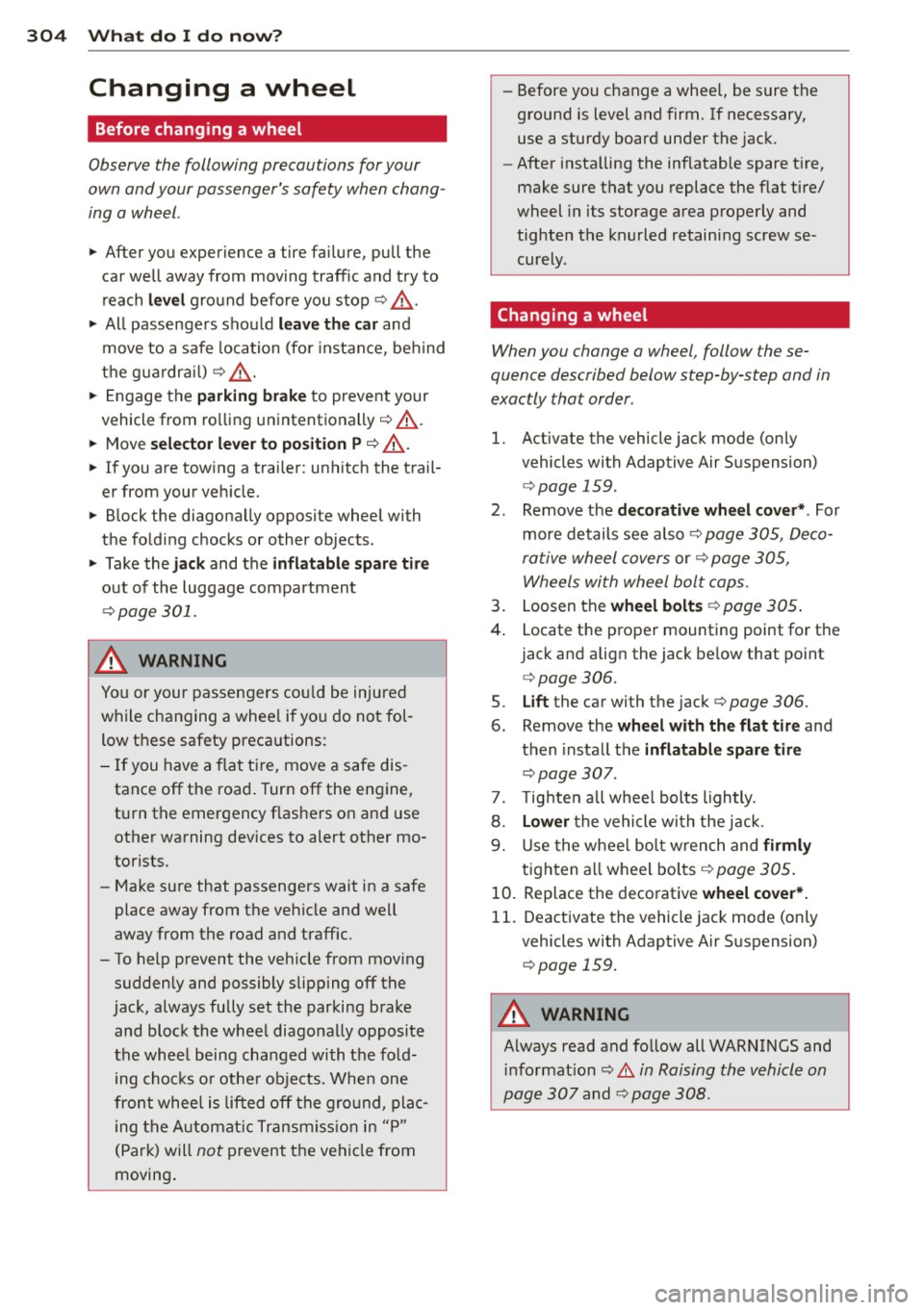
Changing a wheel
Before changing a wheel
Observe the following precautions for your
own and your passenger's safety when chang
ing a wheel .
• After you experience a tire failure, pull the
car well away from moving traffic and try to
reach
level ground before you stop ¢,& .
• All passengers should
leave the car and
move to a safe location (for instance, behind
the guardrail) ¢
A-
.. Engage the parking brake to prevent your
vehicle from rolling unintentionally ¢,& .
• Move
selector lever to position P <=> ,&.
• If you are towing a trailer: unhitch the trail
er from your vehicle.
• Block the diagonally opposite wheel wi th
the folding chocks or other objects.
• Take the
jack and the inflatable spare tire
out of the luggage compartment
¢page 301.
11. WARNING
=
You or your passengers could be injured
while changing a whee l if you do not fol
low these safety precautions :
- If you have a f lat tire,
move a safe dis
tance off the road . Turn off the engine,
turn the emergency flashers on and use
other warning devices to alert other mo
torists .
- Make sure that passengers wait in a safe
place away from the vehicle and well
away from the road and traff ic.
- To help prevent the vehicle from moving
suddenly and possibly slipping off the
jack, always fully set the parking brake
and block the wheel diagonally opposite
the wheel being changed with the fold
ing chocks or other objects. When one
front whee l is lifted off the ground, plac
ing the Auto mat ic Transmission in "P"
(Park) will
not prevent the vehicle from
moving .
-
-Before you change a wheel, be sure the
ground is level and firm. If necessary,
use a sturdy board under the jack.
- After installing the inflatable spare tire,
make sure that you replace the flat tire/
wheel in its storage area properly and
tighten the knurled retaining screw se
curely .
' Changing a wheel
When you change a wheel , follow the se
quence described below step-by-step and in
exactly that order .
l. Activate the vehicle jack mode (only
vehicles with Adaptive Air Suspension)
¢ page 159.
2. Remove the decorative wheel cover* . For
more details see also ¢
page 305, Deco
rative wheel covers
or ¢ page 305,
Wheels with wheel bolt caps.
3. Loosen the wheel bolts¢ page 305.
4. Locate the proper mounting point for the
jack and align the jack be low that point
¢ page 306.
5. Lift the car with the jack¢ page 306.
6. Remove the wheel with the flat tire and
then install the
inflatable spare tire
¢page 307 .
7. Tighten all whee l bolts lightly.
8.
Lower the vehicle with the jack .
9. Use the wheel bolt wrench and
firmly
tighten all wheel bolts¢ page 305.
10. Rep lace the decorative wheel cover*.
11. Deactivate the vehicle jack mode (only
vehicles with Adaptive Air Suspension)
¢page 159.
A WARNING
Always read and follow all WARNINGS and
inf ormat ion¢ .&.
in Raising the vehicle on
page
307 and ¢page 308.
Page 309 of 348

_& WARNING
-You or your passengers could be injured
while changing a wheel if you do not
follow these safety precautions:
- Position the jack only at the designated
lifting points and align the jack. Other
wise, the jack could slip and cause an
injury if it does not have sufficient hold
on the vehicle.
- A soft or unstable surface under the
jack may cause the vehicle to slip off the jack. Always provide a firm base for
the jack on the ground. If necessary,
use a sturdy board under the jack.
- On hard, slippery surface (such as tiles)
use a rubber mat or similar to prevent
the jack from slipping .
- To help prevent injury to yourself and
your passengers:
- Do not raise the vehicle until you are
sure the jack is securely engaged.
- Passengers must not remain in the ve
hicle when it is jacked up.
- Make sure that passengers wait in a
safe place away from the vehicle and
well away from the road and traffic.
- Make sure jack position is correct, ad
just as necessary and then continue to
raise the jack.
(D Note
Do not lift the vehicle by the sill. Position
the jack only at the designated lifting
points on the sill. Otherwise, your vehicle
will be damaged.
What do I do now? 307
Taking the wheel off/installing the inflatable spare tire
Follow these instructions step-by-step for
changing the wheel
Fig. 267 Chan gin g a w hee l: alignment p in inside the
to p ho le
After you have loosened all wheel bolts and
raised the vehicle off the ground, remove and
replace the wheel as follows :
Removing the wheel
.. Remove the topmost wheel bolt completely
and set it aside on a
clean surface.
.. Screw the threaded end of the
alignment
pin from the tool kit hand-tight into the
empty bolt hole
~ fig . 267.
.. Th en remove the other wheel bolts as de
scribed above.
.. Take off the wheel leaving the alignment
pin in the bolt hole
~ 0.
Putting on the inflatable spare tire
.. Inflate the inflatable spare tire ~ page 303
and push the wheel over the alignment pin.
.,. Screw in and tighten all wheel bolts
slight
ly.
.. Remove the alignment pin and insert and
tighten the remaining wheel bolt slightly
like the rest .
.. Turn the jack handle counter-clockwise to
lower the vehicle until the jack is fully re
leased .
.,. Use the wheel bolt wrench to tighten all
wheel bolts firmly ~
page 305. Tighten
them
crosswise, from one bolt to the (ap
proximately) opposite one, to keep the
wheel centered.
Page 312 of 348
310 Fuses and bulb s
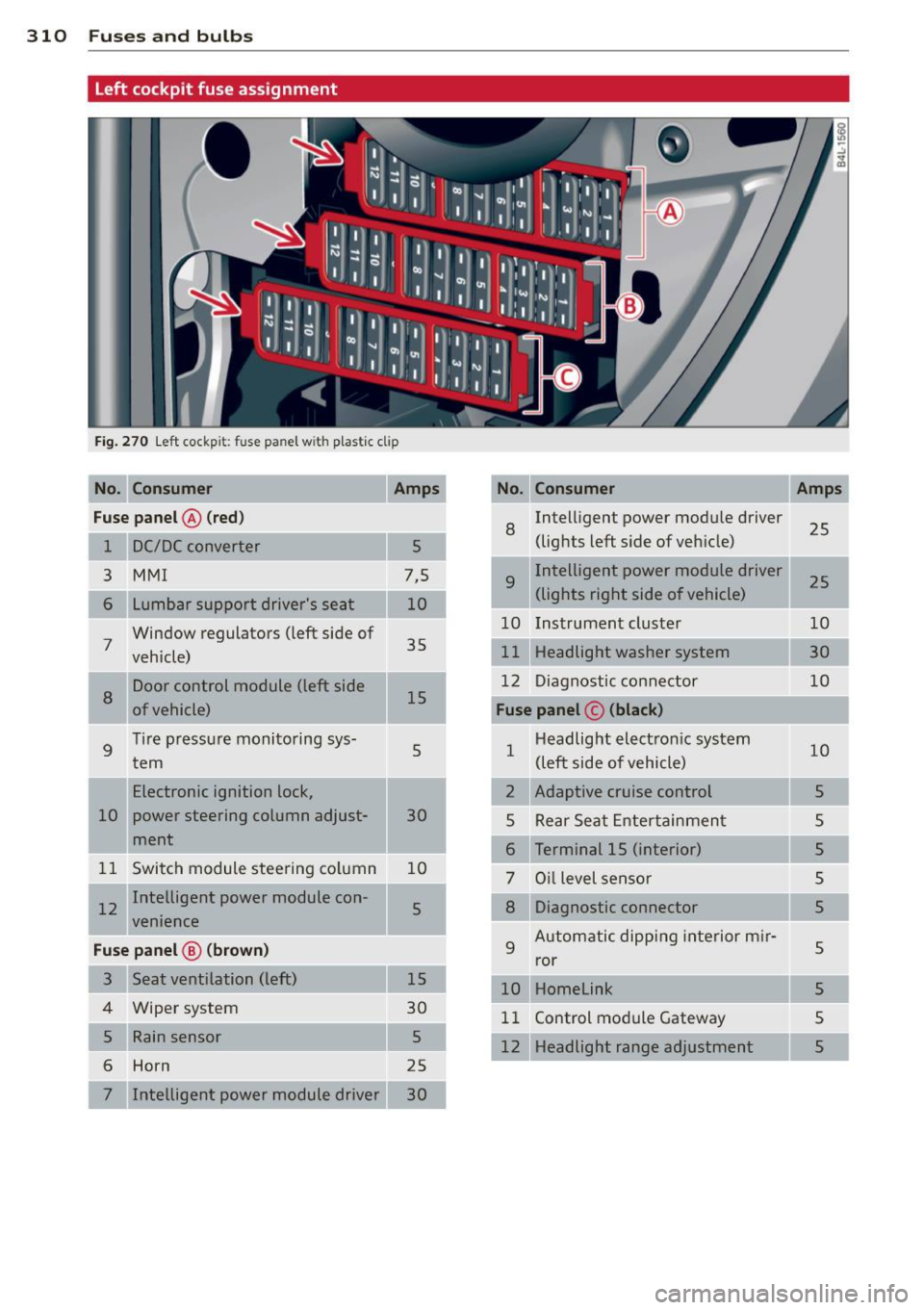
Left cockpit fuse assignment
Fig. 270 Left cockpit: fuse panel w ith p lastic clip
No. Consumer
Fu se pa nel @ (red )
8 Intelligent power modu le driver
25
1 5 (lights left s
ide of veh icle)
3
MMI 7,5 9 Intelligent power module driver 25
6 Lumbar support driver's seat
(lights right side of vehicle)
Window regulators (left side of 10 Instrument cluster
10
7 vehicle) 35
11 Headlight
washer system
Door control module (left side 12 Diagnostic connector
10
8 of vehicle) 15 Fu
se panel © (black )
9 Tire pressure monitoring sys-
5 1 Headlight electron
ic system
10
tern (left side of vehicle)
.
Electronic ignition lock,
2 Adaptive cruise control
5
10 power steering column adjust-
30
5 Rear Seat Ente rtainment
s
I ment 6 Terminal 15 (interior)
5
11 Switch module steering co lumn 10
7 Oil level sensor 5
I 12 Intelligent power module con-5 8 Diagnostic connector
5
venience
F u se pa nel @ (b ro wn) 9 Automatic dipping
interior m ir-5 ror
3 10 Homelink
5
4 Wiper system 11 Control module Gateway 5
5 5
12 Headlight range adjustment 5
6 Horn
25
7 Intelligent power module driver 30
Page 313 of 348
Fuse s and bulb s 311
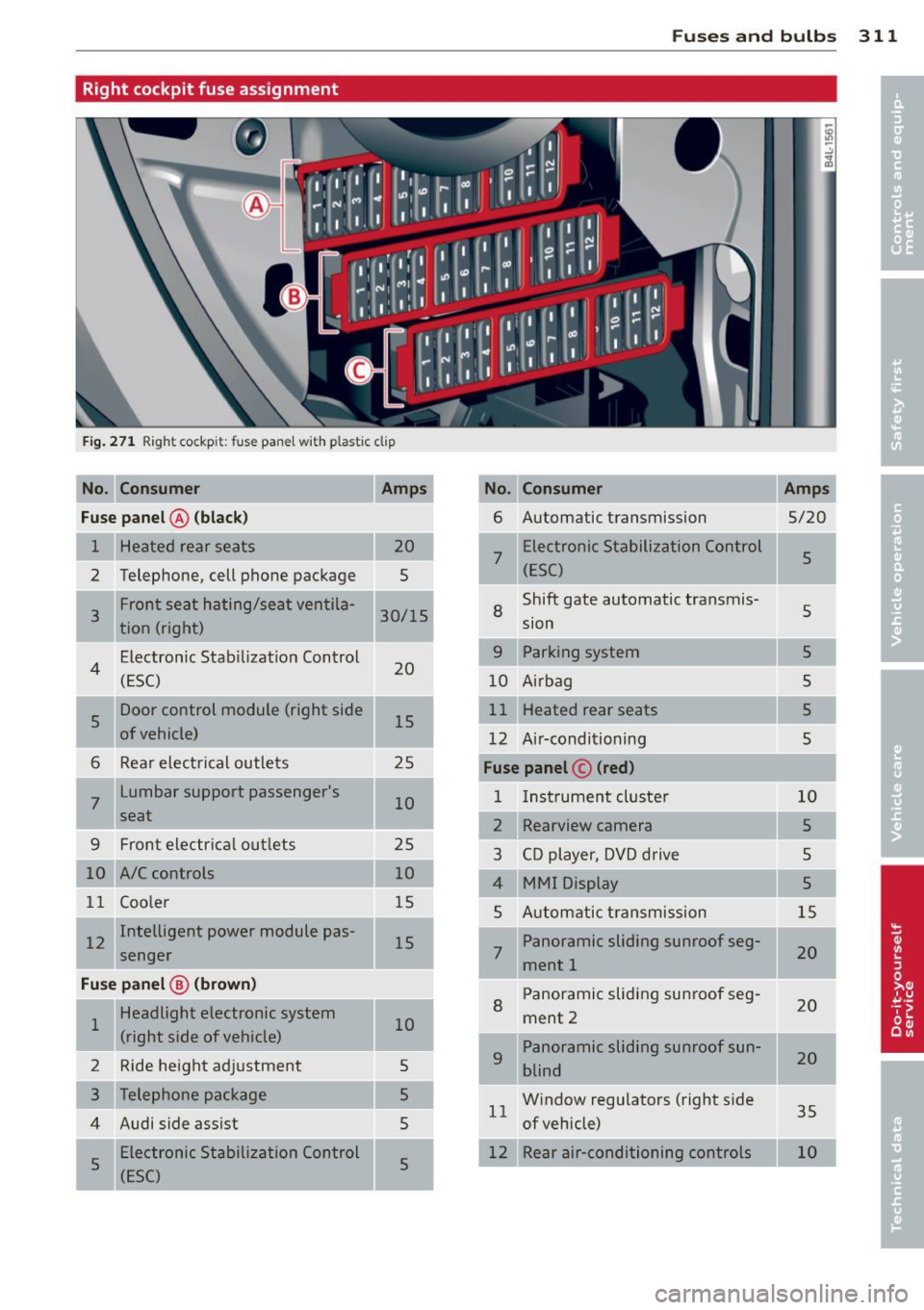
Right cockpit fuse assignment
Fig . 27 1 Righ t cockp it: f use pane l w ith pla stic clip
No. Con sumer Amps No. Consumer Amps
Fu se pa nel@ (bla ck )
6 Automatic transmission
5/20
1 Heated rear seats
7
Electronic Stabilization Control 5
2 Telephone, cell phone package (ESC)
--Shift gate automatic transmis-
Front seat hating/seat ventila-
8 s 3 30/15
tion (right) sion
Electron ic Stab ilizat ion Control
9 Parking system 5
4 (ESC) 20
10 Airbag s
s
Door control module (right side 15 Heated rear seats
5
of vehicle) 12 Ai r·conditioning 5
6 Rear electrical outlets 25 Fuse panel © (red )
7
Lumbar support passenger's
10 1
Instrument cluste r 10
seat 2 Rearview camera 5
9 Front electrical outlets 25
3 CD player, DVD drive s
10 A/C controls 10
MMI Display 5
11 Coo ler 15
5 Automatic transmission 15
I 12 Intelligent power module pas-
15 Panoramic sliding sunroof seg-
senger 7 ment 1 20
Fu
se p anel@ (b rown ) Panoramic sliding sunroof seg-
Headlight electronic system
8 ment 2 20
1 10
(right side of vehicle) Panoramic sliding sunroof sun-
2 Ride height adjustment 5
9 blind 20
5 Window regulators (right side
1 1 35
4 Audi side assist
5 of vehicle)
5 Electronic Stabili
zation Control
5 12 Rear air-conditioning controls
(ESC)
Page 314 of 348
312 Fuses and bulb s
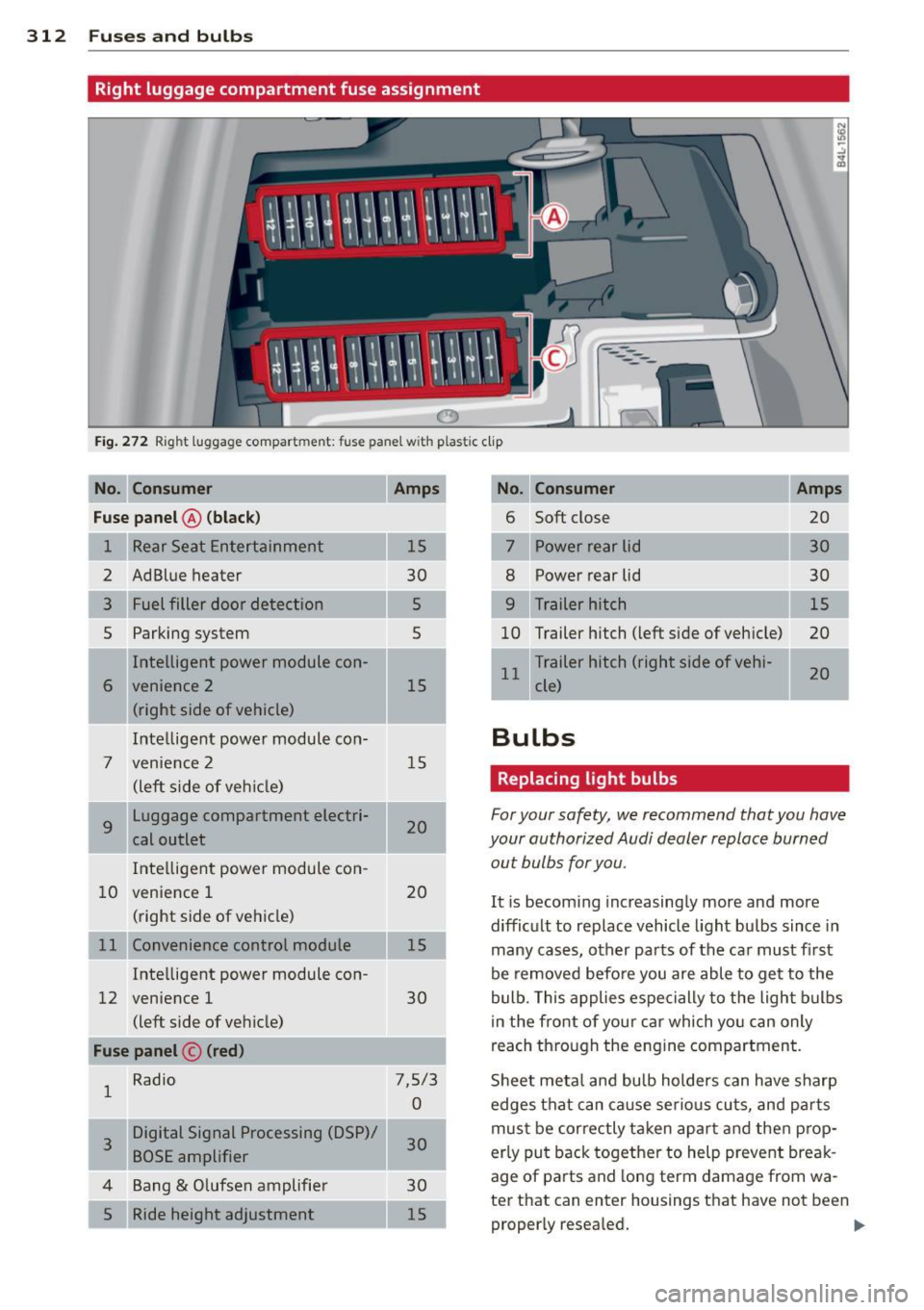
Right luggage compartment fuse assignment
0
Fig. 272 Rig ht luggage compartment: fuse panel with plastic clip
Fus e pa nel @ (bl ac k)
1 15
2 AdBlue heater 30
3 Fuel filler door detection
5 Parking system
Intelligent power module con-
6 venience 2
15
(right side of vehicle)
Inte lligent power module con-
7 venience 2 15
(left side of vehicle)
1 9
Luggage compartment electri-
20
cal outlet
Inte lligent power module con-
10 venience 1 20
(right side of vehicle)
11 Convenience control module 15 Intelligent power module con-
12 venience 1
30
(left side of vehicle)
Fuse pa nel © (red )
1 Radio
7,5/3
0
3 Digital Signal Processing (DSP)/
30
BOSE amplifier
4 Bang & O lufsen amplifier 30
5 Ride height adjustment
15
No. Consumer
6 Soft close
7 Power rear lid
8 Power rear lid
9 Trailer hitch
10 Trailer hitch (left side of vehicle)
-
11 Trailer hitch (right side of vehi-
20
cle)
I
Bulbs
Replacing light bulbs
For your safety, we recommend that you have
your authorized Audi dealer replace burned out bulbs for you .
It is becoming increasingly more and more
difficult to replace vehicle light bulbs since in
many cases, other parts of the car must first
be removed befo re you are able to get to the
bulb. This applies especially to the light bulbs
in the front of your car which yo u can only
reach through the engine compartment.
Sheet metal and bu lb holders can have sharp
edges that can cause se rious cuts, and pa rts
must be correctly taken apart and then prop
erly put back together to help prevent break
age of parts and long term damage from wa
ter that can enter housings that have not been
properly re sea led.
Ill-
Page 315 of 348
For your safety, we recommend that you have
your authorized Audi dealer replace any bulbs for you, s ince your dealer has the proper tools,
the correct bu lbs and the expertise.
G as discharg e lamps (Xenon li ght s)*:
Due to the high elect rical voltage, have the
bu lbs rep laced by a qualified technician.
H eadlights with Xenon light can be identified
by the high voltage sticker .
~ WARNING
Contact with high-voltage components of
the electrical system and improper re
placement of gas discharge (Xenon) head
light bulbs can cause serious personal in
jury and death .
- Xenon bulbs are pressurized and can ex
plode when be ing changed.
- Chang ing Xenon lamps requires the spe
c ial train ing, instructions and equip
ment.
- Only an authorized Aud i dea ler or other
qualified workshop should change the
bulbs in gas discharge lamps.
A WARNING
There are parts with sharp edges on the
openings and on the bulb holde rs that can
cause se rious cuts.
- If you are uncertain about what to do,
have the work performed by an author
ized Audi dea le r or other qua lified work
shop. Serious persona l injury m ay result
from improperly performed work .
@ Tips
-If you must rep lace the light bu lbs your
se lf, always remembe r that the engine
compartmen t of any vehicle is a hazard
ous area to work in . Always read and
heed all WARNINGS
~ page 255, Engine
comportment ¢.& .
-It is best to ask your authorized A udi
dealer whenever you need to change a
bulb.
Fu ses and bulb s 313
•
•
Page 316 of 348
314 Emergency situations
Emergency situations
General
This chapter is intended for trained emer
gency crews and working personnel who
have the necessary tools and equipment to perform these operations.
Starting by pushing or
towing
Q;) Note
Your vehicle is equipped with an automatic
transmission. Consequently, the engine
cannot be started by pushing or towing.
Starting with jumper
cables
If necessary, the engine can be started by
connecting it to the battery of another vehi
cle.
If the engine should fail to start because of a
discharged or weak battery, the battery can be
connected to the battery of
another vehicle,
using a
pair of jumper cables to start the en
gine .
Jumper cables
Use only jumper cables of sufficiently large
cross section to carry the starter current safe
ly. Refer to the manufacturer's specifications.
Use only jumper cables with
insulated termi
nal clamps which are distinctly marked:
plus(+) cable in most cases colored red
minus(-) cable
in most cases colored black .
A WARNING
Batteries contain electricity, acid, and gas.
Any of these can cause very serious or fatal
injury. Follow the instructions below for
safe handling of your vehicle's battery.
- Always shield your eyes and avoid lean
ing over the battery whenever possible. -
A discharged battery can freeze at tem
peratures just below 32 °F (0 °C). Before
connecting a jumper cable, you must
thaw the frozen battery completely, oth
erwise it could explode.
- Do not allow battery acid to contact eyes
or skin . Flush any contacted area with
water immediately .
- Improper use of a booster battery to
start a vehicle may cause an explosion.
- Vehicle batteries generate explosive gas
es . Keep sparks, flame and lighted ciga
rettes away from batteries.
- Do not try to jump start any vehicle with
a low acid level in the battery .
- The voltage of the booster battery must
also have a 12-Volt rating. The capacity
(Ah) of the booster battery should not be
lower than that of the discharged bat
tery . Use of batteries of different voltage
or substantially different "Ah" rating
may cause an explosion and personal in
jury.
- Never charge a frozen battery. Gas trap
ped in the ice may cause an explosion.
- Never charge or use a battery that has
been frozen. The battery case may have
be weakened.
- Use of batteries of different voltage or
substantially different capacity (Ah) rat
ing may cause an explosion and injury.
The capacity (Ah) of the booster battery
should not be lower than that of the dis
charged battery.
- Before you check anything in the engine
compartment, always read and heed all
WARNINGS¢
page 255, Engine com
partment.
@ Note
- Applying a higher voltage booster bat
tery will cause expensive damage to sen
sitive electronic components, such as
control units, relays, radio, etc.
- There must be no electrical contact be
tween the vehicles as otherwise current
could already start to flow as soon as the
positive(+) terminals are connected. ..,.
Page 317 of 348
@ Tips
-The discharged battery must be properly
connected to the vehicle's electrical sys
tem. When jump start ing or charging the
battery, never connect the negative
ground cable to the battery negative
post because the battery manager sys
tem must be able to detect the battery's
state of cha rge. A lways connect the neg
ative g round cab le to the negative
gro und post o f the battery manage r con
trol uni t.
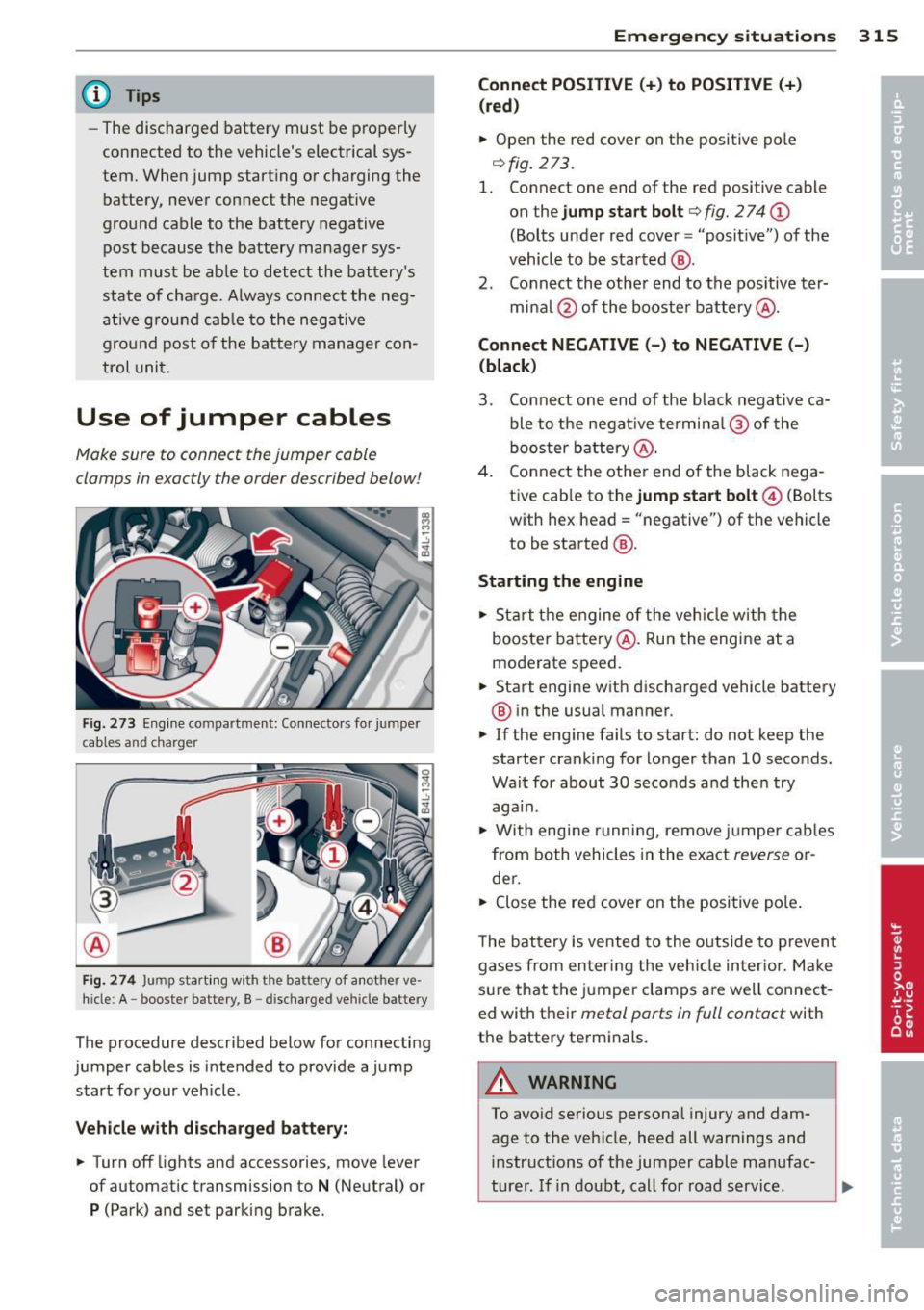
Use of jumper cables
Make sure to connect the jumper coble
clomps in exactly the order described below!
Fig. 273 Engine compartment: Con nectors fo r jumper
cables and charger
Fi g. 27 4 Jump start ing with the battery of another ve
hicle:
A-booster battery, B -discha rged vehicle battery
The procedure described below for connecting
jumper cables is intended to provide a jump
start for your veh icle .
Vehicle with discharged batter y:
.. Turn off lights and accessories, move lever
of automatic transmission to
N (Neutral) or
P (Park) and set parking brake.
Emergenc y situ ation s 315
Connect POSI TIVE(+ ) to POSITIVE (+ )
(red )
.. Open the red cover on the positive pole
¢fig. 273.
1. Connect one end of the red positive cable
on the
jump sta rt bolt ¢ fig. 2 7 4 (D
(Bolts under red cover = "posit ive") of the
vehicle to be started ®·
2. Co nnect th e other end to the pos itive ter-
mina l@ of the booster battery @.
Connect NEGATIVE( -) to NEGATIVE(-)
( black )
3. Connect one end of the black negative ca
ble to the negat ive termina l@ of the
booster b attery @.
4 . Connect the othe r end of the black nega
tive cable to the
jump start bolt@ (Bolts
with hex head= "negative") of the vehicle
to be started @.
Sta rting the engine
.,. Sta rt the e ngine of the veh icle with the
booster ba tte ry @ . Ru n the engine at a
moderate speed .
.. Start engine with discharged vehicle battery
® in the usual manner.
.. If the engine fails to start: do not keep the
starter crank ing fo r longer than 10 seconds.
Wa it for about 30 seconds a nd the n try
again .
.,. With engine runni ng, remove jumper cab les
from both vehicles in the exa ct
reverse or
de r .
.. Close the red cover on the posi tive po le .
T he battery is vented to the outside to p reven t
gases from en ter ing the veh icle inter ior. Make
s ur e that the jumper clamps a re well connect
ed with their
metal ports in full contact with
the battery term inals.
.&_ WARNING
-To avoid serious personal injury and dam
age to the ve hicle, heed all warnings and
i n structions of the jumper cable manufac-
-
turer . If in doubt, call for road service . IIJ>
Page 324 of 348
322 Data
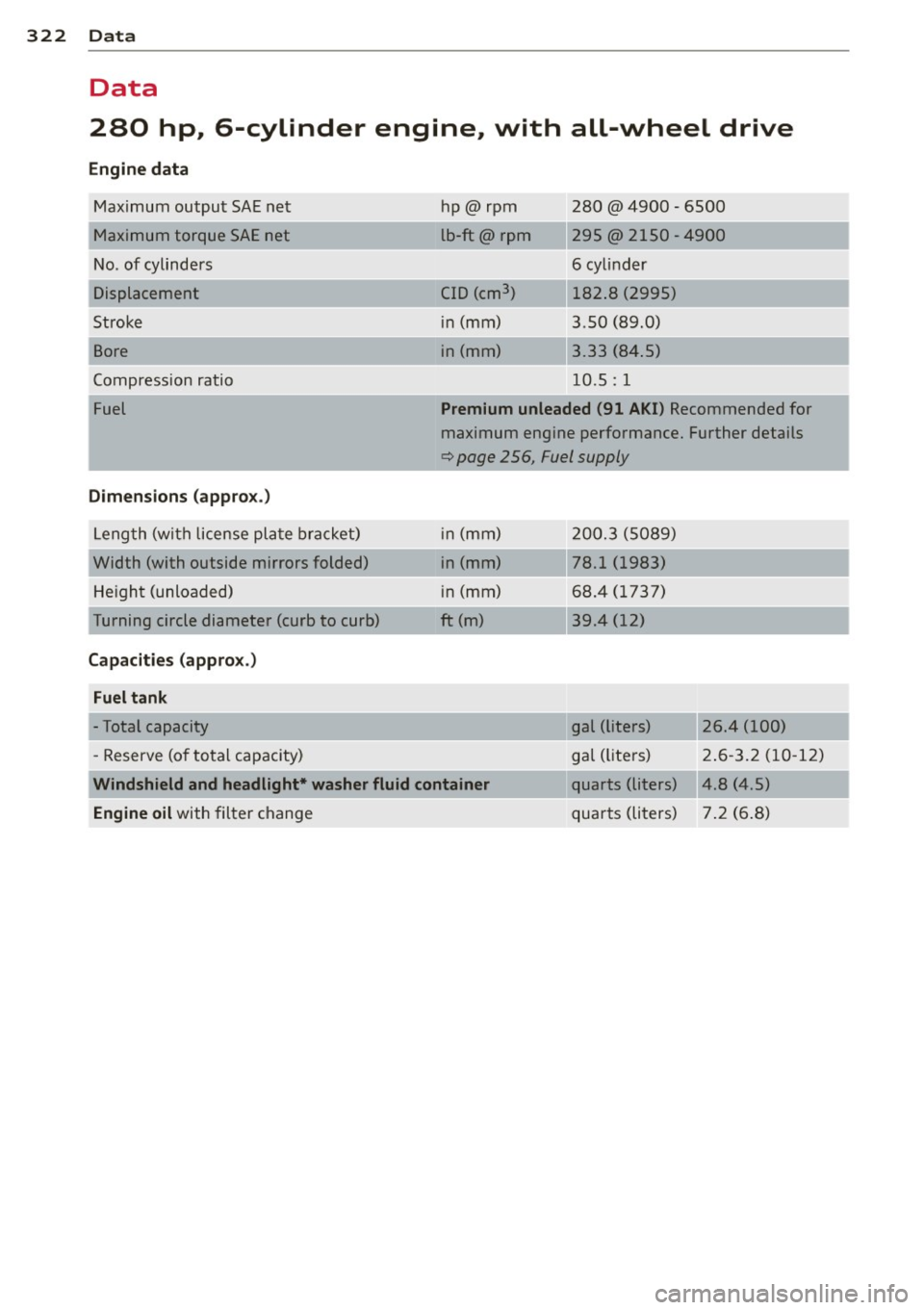
Data
280 hp, 6-cylinder engine, with all-wheel drive
Engine data Maximum output SAE net
Maximum torque SAE net
No . of cylinders
Displacement
Stroke
Bore
Compression ratio
Fuel
Dimensions (approx .)
Length (with license plate bracket)
Width (with outside mirrors folded) Height (unloaded)
Turning circle diameter (curb to curb)
Capacities (approx .)
Fuel tank
- Total capacity
- Reserve (of total capacity) hp@ rpm
lb-ft@ rpm
CID (cm
3 )
in (mm)
in (mm) 280@ 4900
-6500
-·--295@ 2150 -4900
6 cylinder
-·~-182 .8 (2995)
3 .50 (89.0)
3 .33 (84 .5)
--· 10.5 : 1
Premium unleaded (91 AKI) Recommended for
maximum engine performance. Further details
¢page 256, Fuel supply
in (mm) 200.3 (5089)
in (mm) 78.1 (1983)
in (mm) 68.4 (1737)
ft (m) 39 .4 (12)
gal (liters) 26.4 (100)
gal (liters) 2.6-3.2 (10 -12)
Windshield and headlight* washer fluid container quarts (liters) 4.8 (4 .5)
Engine oil with filter change quarts (liters) 7.2 (6.8)
Page 325 of 348
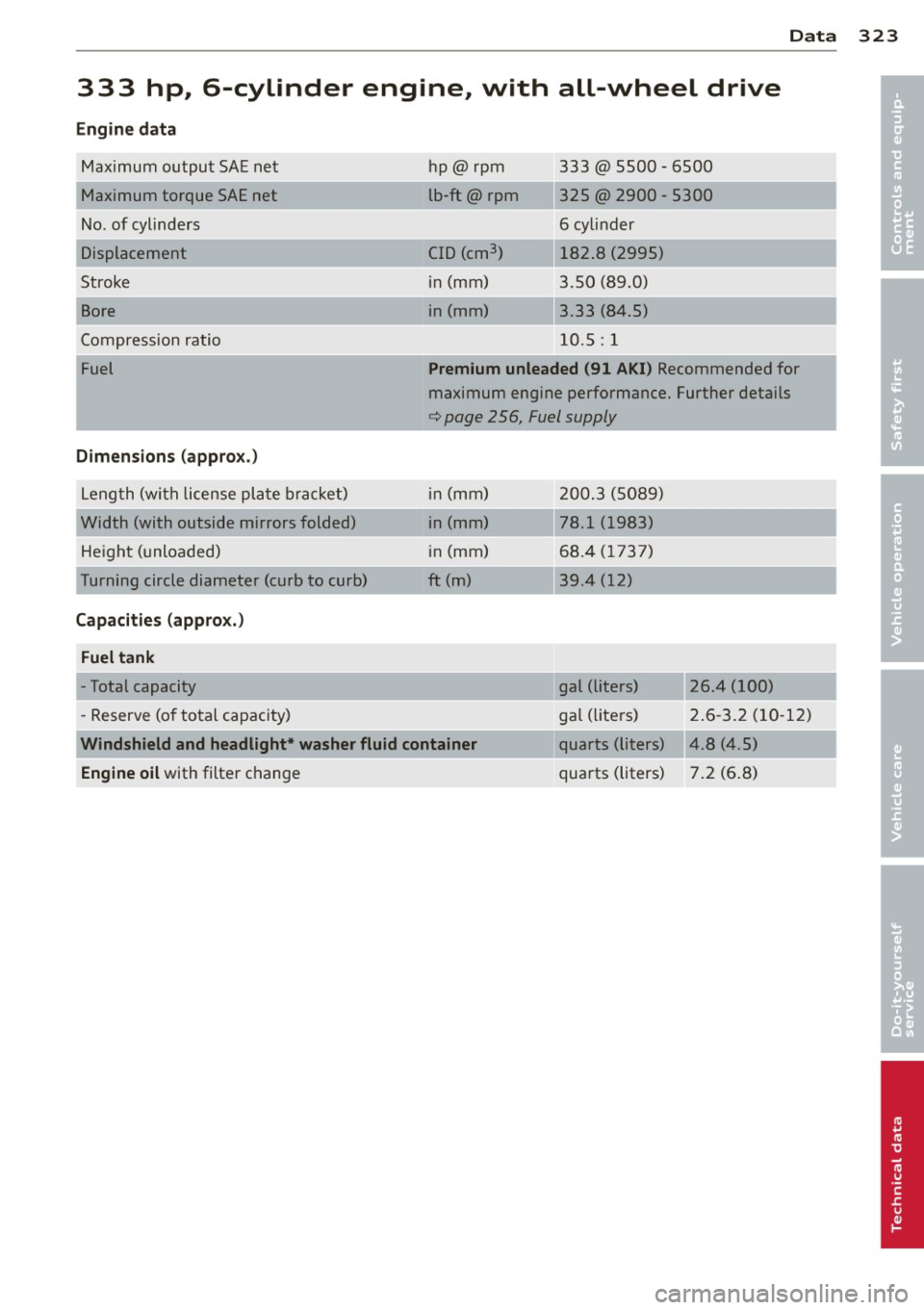
Data
333 hp, 6-cylinder engine, with all-wheel drive
Engine data
Maximum output SAE net
Maximum torque SAE net
No. of cylinders
Displacement
Stroke
Bore
Compression ratio
Fuel
Dim ension s (appro x.)
Leng th (with license pla te bracket)
Width (with outside mirrors folded) He igh t (unloaded)
T urning circle diameter (curb to curb)
Capacit ies (appro x.)
Fuel tank
- Total capacity
- Reserve (o f total capacity) 333@ 5500 - 6500
hp@rpm
lb-ft@ rpm
-~~-
CID (cm3
)
in (mm)
in (mm)
--·
325 @ 2900 - 5300
6 cylinder
182 .8 (2995)
3 .50 (89.0)
3 .33 (84.5)
10.5 : 1
Premium unleaded (91 AKI) Recommended for
maximum engine performance. Further details
<=> page 256, Fuel supply
in (mm) 200.3 (5089)
in (mm) 78.1 (1983)
in (mm) 68.4 (1737)
ft (m) 39 .4 (12)
gal (liters) 26 .4 (100)
gal (lite rs) 2 .6 -3.2 (10 -12)
Windshield and headlight* washer fluid container quarts (liters) 4 .8 (4 .5)
Engine oil with filter change quarts (liters) 7
.2 (6 .8)
323
•
•