air suspension AUDI Q7 2013 Owner´s Manual
[x] Cancel search | Manufacturer: AUDI, Model Year: 2013, Model line: Q7, Model: AUDI Q7 2013Pages: 348, PDF Size: 87.72 MB
Page 201 of 348
-If the ve hicle or the circuit interrupter
is scrapped, all applicable safety pre
cautions must be followed.
@ For the sake of the environment
Undep loyed airbag modu les and preten
sioners might be classified as Perchlorate
Material -special handling may app ly, see
www.dtsc.ca.gov/hazardouswaste/per chlorate . When the vehicle or parts of the
restraint system including airbag modules
and safety bel ts w ith pretens ioners are
scrapped, a ll applicable laws and regula
tions must be observed . Your authorized
Aud i dea le r i s familiar w it h these require
ments and we recommend that you have
your dea le r perform this service for you.
Other things that can affect Advanced
Airbag performance
Changing the vehicle's suspension system can
change the way that the Advanced A irbag Sys
tem pe rforms in a crash. For example, us ing
tire -r im combinations not approved by Aud i,
l owering the vehicle , changing the stiffness o f
the s uspension, incl uding the springs, s uspen
sion struts, shoc k absorbers etc. can change
the forces that are measured by the airbag
sensors and sent to the electronic control
un it. Some suspension changes can, for exam
p le, increase the force levels measured by the
sensors and make the airbag system deploy in
crashes in wh ich it would not dep loy if the
changes had not been made. Ot he r kinds of
changes may redu ce the force levels meas
ured by the sensors and prevent the a irbag
from deploying when it sho uld .
The senso rs in the safety belt buckle fo r th e
dr iver and front passenger sea t tell the elec
tronic control module if the safety belt is
l a tched o r not.
If the safety belt is being used,
the front airbag will deploy at a slightly high
er rate of vehicle deceleration than if the safe
ty belt is not being used. Therefore, in a par
ticular collision, it is poss ible that an airbag
will not deploy at a seati ng position where the
safety belt is being used but will inflate at the
A irba g sy stem 199
position where t he safety be lt is not be ing
u sed. It is important that nothing interfere
with the safety be lt b uckles so that the sen
sors can send the correct information about
safety belt use to the electronic control un it.
A WARNING
C hanging the vehicle's suspension includ
ing use of unapprove d tire-r im combina
tions can cha nge Advanc ed Airbag per
fo rman ce an d in crease the r isk of se rious
person al injury in a crash.
- Never install suspension components
tha t do no t have the same pe rforman ce
characteris tics a s the co m ponen ts origi
na lly installed on yo ur vehicle.
- N ever use tire-rim combin ations tha t
have not been approved by Audi.
A WARNING
-
Items stored between the safety be lt
b uckle and the cente r console can cause
the sensors in t he b uckle to send the
wrong information to the e lectronic con
trol module and prevent the Advanced Air bag System from working properly.
-A lways make su re that nothing can inter-
fere with the safety belt buckles and that
they are not obstructed .
Side airbags
Description of side airbags
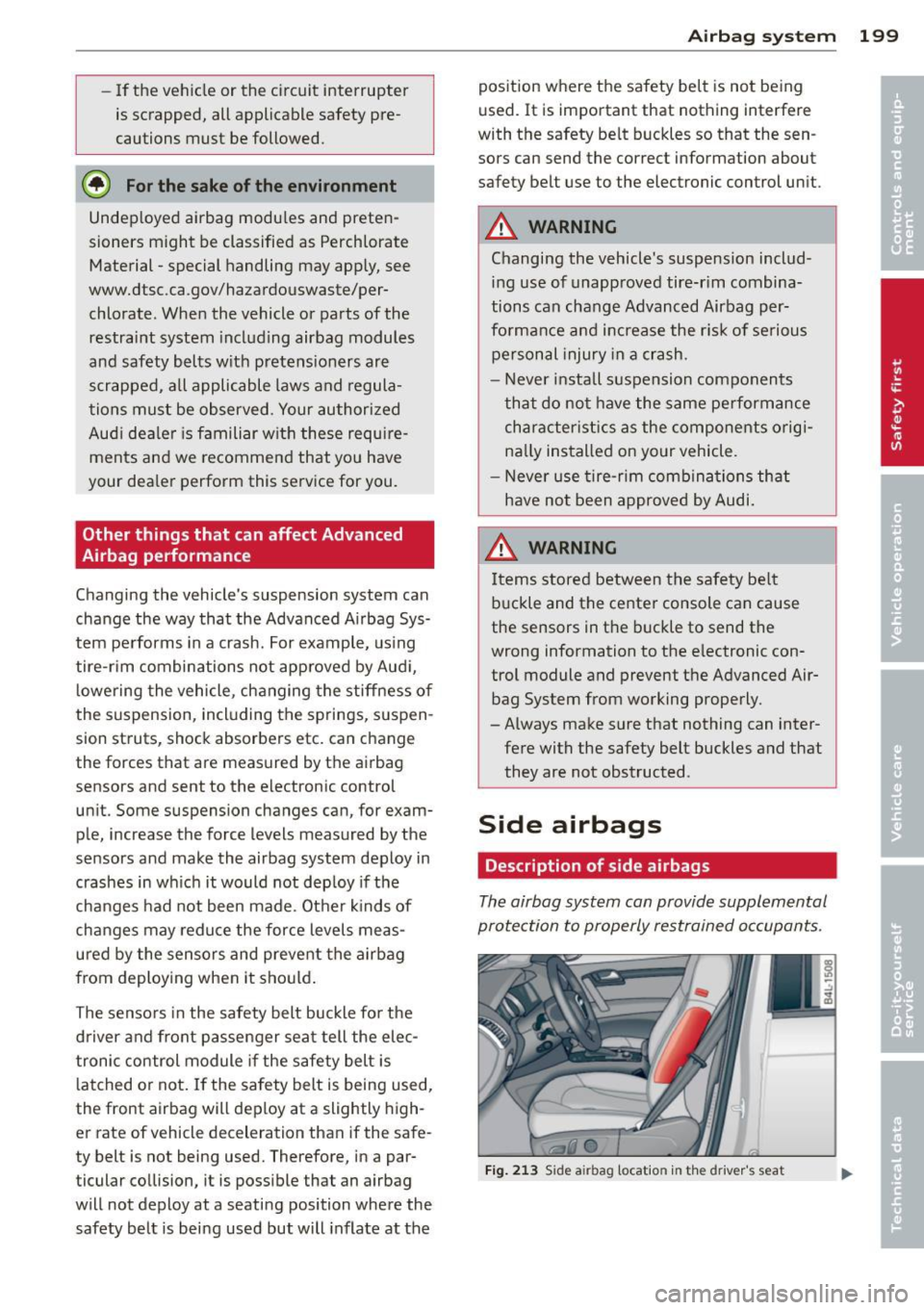
The airbag system can provide supplemental
protection to properly restrained occupants .
Fig. 2 13 Side a irbag locat io n in t he driver's seat
Page 241 of 348
on a slope w ithout the veh icle tipping over
sideways (depends on center of gravity). Maxi m um permitted latera l ang le: 35°
Breakover angle
I ndicates the angle up to whi ch the veh icle
can drive ove r a ramp at low speed w it h out
the unde rside of the vehicle hitting the edge
of the ramp.
- Vehicl es with out air spring s: maximum
breakover ang le: 21, 1 °
- Vehicl es with adaptive air su sp ension* :
maximum b reakove r angle: 23.8° (at h igh
l evel 2)
Approach /d eparture angle
Transition from the horizontal p lane to a gra
d ient or from a grade bac k to level ground . In
d ic a tes the angle up to which the vehicle can
drive onto or off a slope at low speed wi thout
striking the bumper or the underbody.
- Vehicl es without air spring s: maximum ap
proach/depart ure angle: 21.0° (front),
23.4 ° (rear)
- Vehicl es with adaptiv e air su sp ension* :
maximum approach/departu re angle at high
l evel 2 : (front) 23,5°, (rear) 25 .4°
Ground clearance
The distance between the road surface and
the lowest po int of the ve hicle underbody .
-Vehicles w ithout air spring s: ground clear
ance: 8 .1 in (204.8 mm)
- Vehicles w ith adapti ve air suspension *:
maximum ground clearance: 9 .4 i n
(239 .8 mm) at high level 2
A WARNING
Exceeding the stated maximum figures
can result in severe injuries or ve hicle dam
age.
- All the information was gathered on lev
el, firm and non-slippery road surfaces,
and unde r dry wea ther conditions.
- Ideal conditions do not p revail offroad.
Never utilize the maximum read ings to
Driving off road 239
their f ullest, always leave a safety re
serve.
Driving tips
On poor road and offroad, there is always on
ly one motto: Plan ahead and drive slowly!
Please obse rve the fo ll ow ing when d riving
away from paved roads :
.,. Drive on ly on roads and offroad sections
which ma tch the design of yo ur vehicle and
your abilities as a driver. Never take r isks!
.,. Drive slow ly and plan ahead!
.,. Take into consideration the
ground clear
an ce
of your vehicle .
.,. Act ivate the
ESC off road mode q page 225
as needed.
.,. Use the
hill descent control q page 226
when dr iv ing down steep sections on h ills .
Unpa ved ro ads and offroad
Drive slowly on unfamiliar roads and unknown
offroad section s, and look out for unexpected
obstacles (e .g. po tholes, rocks, tree s tumps,
etc .) .
To prevent the vehicle from bottoming and
avo id damage to the underbody, you should
drive straight across severe bumps in the
ground with only one side of the veh icle so
that only two of your whee ls cross the bumps .
Drive b risk ly through sandy or marshy offroad
sec tions and do not stop, i f at all possible .
Driving throu gh wate r
Note the following to avoid vehicle damage
when d riving through water, for examp le on
flooded roads:
- The wa ter must not be any higher than the
bottom of the vehicle body .
- Do not dr ive faste r tha n walk ing speed .
Driving on a slope
If you ever find yourself not able to climb a
s lope, do not try to turn around , drive back
down in
r e ver se . Otherwise, you run the r isk
of tipp ing ove r. ..,.
•
•
Page 292 of 348
2 90 Tires and wheels
Tire service life
The service life of tires depends on a lot of
different things including proper installation
and balancing, correct tire pressure and driv
ing style.
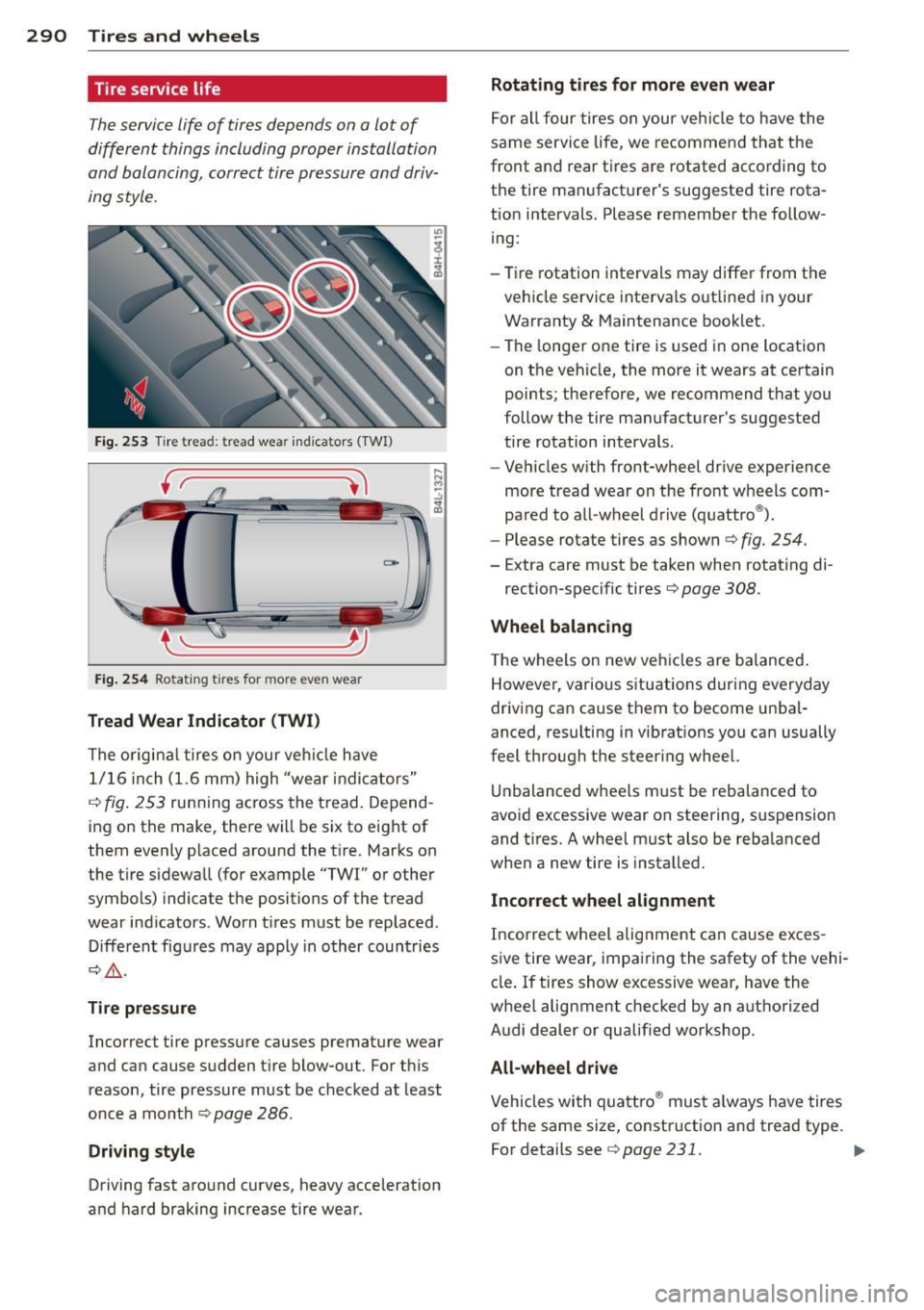
F ig. 2 53 Tire tread: tread wea r ind icators (TWI)
F ig. 25 4 Rotat ing t ires for more even wear
Tr ead Wear Indicator (TWI)
The o rigi na l t ires on your veh icle have
1/16 inch (1.6 mm) high "wear indicators"
.... N M
c::> fig . 253 running across the tread. Depend
ing on the make, there will be six to eight of
them evenly p laced around the t ire. Marks on
the tire sidewa ll (for example "TWI" or other
symbols) indicate the positions of the tread
wear ind icators . Worn t ires must be replaced .
Different fig ures may apply in o ther countries
c::> & .
Tire p ressure
Incorrect tire pressure causes premature wear
a nd can cause sudden t ire blow-out. For t his
reason, tire pressure must be checked at least
once a month
c::> page 2 86.
Driving style
Driving fast aro und curves, heavy acce leration
and hard braking increase tire wear.
Rotating tires for more even wear
F or all four tires on your ve hicl e to h ave the
same service life, we recommen d that t he
front and rear t ires are rotated according to
the tire manufact urer's suggested tire rota
tion intervals. Please remember the follow ing:
- Tire rotation intervals may differ from the
vehicle service inte rva ls o utlined in your
Warranty
& Maintenance booklet.
- The longer one tire is used in one location
on the vehicle, the more it wears at certain
points; therefore, we recommend that you
follow the tire manufact urer's suggested
tire rotation intervals .
- Vehi cles w ith front-wheel dr ive experience
more tread wear on the fro nt w heels com
pa red to all-wheel drive (quattro ®).
- Please rotate tires as shown
c::> fig. 254.
-Extra care must be taken when rotating di-
rection-specific tires
c::> page 308.
Wheel balancing
The wheels on new ve hicles are balanced .
However, various situations during everyday
driving can cause them to become unba l
anced, resulting in vibrat ions you can usually
feel through the steer ing wheel.
Un balanced whee ls must be rebalanced to
avo id excessive wear on steering, suspension
and t ires. A whee l m ust also be reba lanced
when a new tire is insta lled.
Incorrect wheel alignment
Incor rect w heel alig nment can cause exces
sive tire wear, impairing the safety of the vehi
cle . If tires show excessive wear, have the
whee l alignment checked by an aut horized
Audi dealer or qualif ied workshop .
All-wheel drive
Vehicles with q uattro ® mus t always have tires
of the same size, construction and tread type.
For details see
c::>page 231. ..,.
Page 299 of 348
driving a few yards and correct if neces
sary . Follow the instructions from the
snow cha in manufacturer when doing so.
- If the Adaptive Air Suspension* should
malfunction, do not mount or use snow
chains beca use the vehicle will be ex
tremely low. If you do drive with snow
chains on while the vehicle is at this lev el, the snow chains might severe ly dam
age the wheelhouse and other parts of
the veh icle.
(0 Tips
W here snow cha ins are mandatory oncer
tain roads, this normally also applies to
veh icles w ith all-whee l dr ive.
Wheel bolts
Wheel bolts must always be tightened to the
correct torque .
The design of whee l bolts is matched to the
factory insta lled r ims. If different rims are fit
t e d, the cor rect wheel bolts wit h the right
lengt h and correctly s haped bolt heads must
be used. This ens ures t hat w heels a re fitted
secure ly an d that the brake system f unctions
correctly.
I n ce rtain circumstances, you may not use
wheel bo lts from a d ifferent vehicle -even if it
is the s ame mode l
~page 32 7.
& WARNING
Improperly tig htened or maintained whee l
bolts can become loose ca using loss of
cont ro l, a co llision and serious persona l in
jury.
- Always keep the w heel bolts and the
threads in the wheel hubs clean so the
wheel bolts can turn easily and be prop erly t ightened.
- Never grease or oil the wheel bolts and the threads in the wheel hubs. They can
become loose w hile driving if greased or
o iled, even if tig hte ned to the specified
torq ue.
Tire s an d wheel s 297
-On ly use whee l bolts that be long to the
rim being installed.
- Never use different wheels bolts on yo ur
veh icle.
- Always maintain the correct t ightening
torque for the whee l bolts to reduce t he
risk o f a wheel loss. If the tightening tor
que of t he wheel bolts is too low, they
can loosen and come out when t he vehi
cle is mov ing.
If the tig hte ning torque is
too high, the wheel bolts and threads can be damaged and the whee l can be
come loose.
(D Note
The specified torque for the whee l bolts is
120
ft l b ( 160 Nm) with a to le rance of
± 7, 4
ft lb( ± 10 Nm). Torque w heel bo lts
d iagon ally . After changi ng a w heel, the
torque m ust be chec ke d as soon as poss i
b le with a to rque wrench -preferab ly by an
a uthorized Audi dea ler or q ua lified work
shop .
Low aspect ratio tires
Your Audi is factory-equ ipped with tow aspect
ratio tires. These tires have been thoroughly
tested and been se lected specifically for your
model for their superb perfo rmance, road feel
and handli ng under a var iety of drivi ng condi
tions. As k your au thori zed A udi dealer for
more de tails.
The low asp ect ratio of these tires is ind icated
by a nu mera l of
55 or l ess in the tire's s ize
designation. The n ume ra l rep resen ts the ra tio
of the tire's sidew all height in rel ation to its
tread width exp ressed in percentage . Conven
tiona l tires have a he ight/width ratio of 60 or
more.
The performance of low-aspect-ratio tire s is
particularly sensitive to improper inflation
pre ssure. It is therefore important that low
aspect ratio tires are inflated to the specified pressure and that the inflation pressure is
regularly checked and mainta ined. Tire pres-
sures should be checked at least once a .,..
•
•
Page 306 of 348
304 What do I do now?
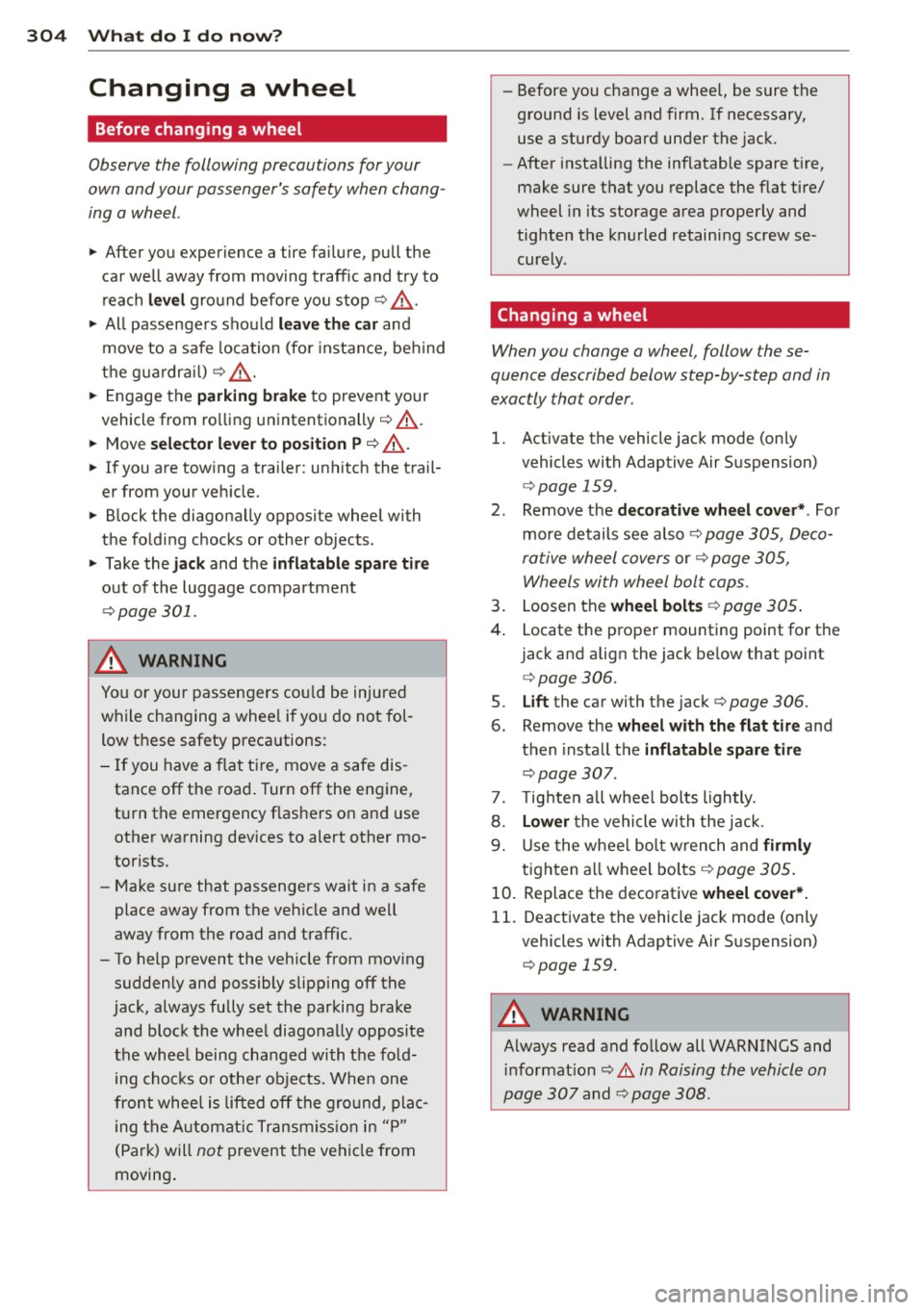
Changing a wheel
Before changing a wheel
Observe the following precautions for your
own and your passenger's safety when chang
ing a wheel .
• After you experience a tire failure, pull the
car well away from moving traffic and try to
reach
level ground before you stop ¢,& .
• All passengers should
leave the car and
move to a safe location (for instance, behind
the guardrail) ¢
A-
.. Engage the parking brake to prevent your
vehicle from rolling unintentionally ¢,& .
• Move
selector lever to position P <=> ,&.
• If you are towing a trailer: unhitch the trail
er from your vehicle.
• Block the diagonally opposite wheel wi th
the folding chocks or other objects.
• Take the
jack and the inflatable spare tire
out of the luggage compartment
¢page 301.
11. WARNING
=
You or your passengers could be injured
while changing a whee l if you do not fol
low these safety precautions :
- If you have a f lat tire,
move a safe dis
tance off the road . Turn off the engine,
turn the emergency flashers on and use
other warning devices to alert other mo
torists .
- Make sure that passengers wait in a safe
place away from the vehicle and well
away from the road and traff ic.
- To help prevent the vehicle from moving
suddenly and possibly slipping off the
jack, always fully set the parking brake
and block the wheel diagonally opposite
the wheel being changed with the fold
ing chocks or other objects. When one
front whee l is lifted off the ground, plac
ing the Auto mat ic Transmission in "P"
(Park) will
not prevent the vehicle from
moving .
-
-Before you change a wheel, be sure the
ground is level and firm. If necessary,
use a sturdy board under the jack.
- After installing the inflatable spare tire,
make sure that you replace the flat tire/
wheel in its storage area properly and
tighten the knurled retaining screw se
curely .
' Changing a wheel
When you change a wheel , follow the se
quence described below step-by-step and in
exactly that order .
l. Activate the vehicle jack mode (only
vehicles with Adaptive Air Suspension)
¢ page 159.
2. Remove the decorative wheel cover* . For
more details see also ¢
page 305, Deco
rative wheel covers
or ¢ page 305,
Wheels with wheel bolt caps.
3. Loosen the wheel bolts¢ page 305.
4. Locate the proper mounting point for the
jack and align the jack be low that point
¢ page 306.
5. Lift the car with the jack¢ page 306.
6. Remove the wheel with the flat tire and
then install the
inflatable spare tire
¢page 307 .
7. Tighten all whee l bolts lightly.
8.
Lower the vehicle with the jack .
9. Use the wheel bolt wrench and
firmly
tighten all wheel bolts¢ page 305.
10. Rep lace the decorative wheel cover*.
11. Deactivate the vehicle jack mode (only
vehicles with Adaptive Air Suspension)
¢page 159.
A WARNING
Always read and follow all WARNINGS and
inf ormat ion¢ .&.
in Raising the vehicle on
page
307 and ¢page 308.
Page 308 of 348
306 What do I do now?
Loosening
.,. Install the wheel bolt wrench over the
wheel bolt and push it down as far as it will
go .
.,. Take tight hold of the
end of the wrench
handle and turn the wheel bolts
counter
clockwise
about one single turn in the direc
tion of arrow
c:> fig. 264.
Tightening
.,. Install the wheel bolt wrench over the
wheel bolt and push it down as far as it will
go .
.,. Take tight hold of the
end of the wrench
handle and turn each wheel bolt
clockwise
until it is seated .
A WARNING
- Do not use force or hurry when changing
a wheel - you can cause the vehicle to slip
off the jack and cause serious personal
injuries.
- Do not loosen the wheel bolts more than
one turn
before you raise the vehicle with
the jack. - You risk an injury.
@ Tips
If a wheel bolt is very tight, you may find it
easier to loosen by carefully pushing down
on the end of the wheel bolt wrench with
one foot only. As you do so, hold on to the
car to keep your balance and take care not
to slip.
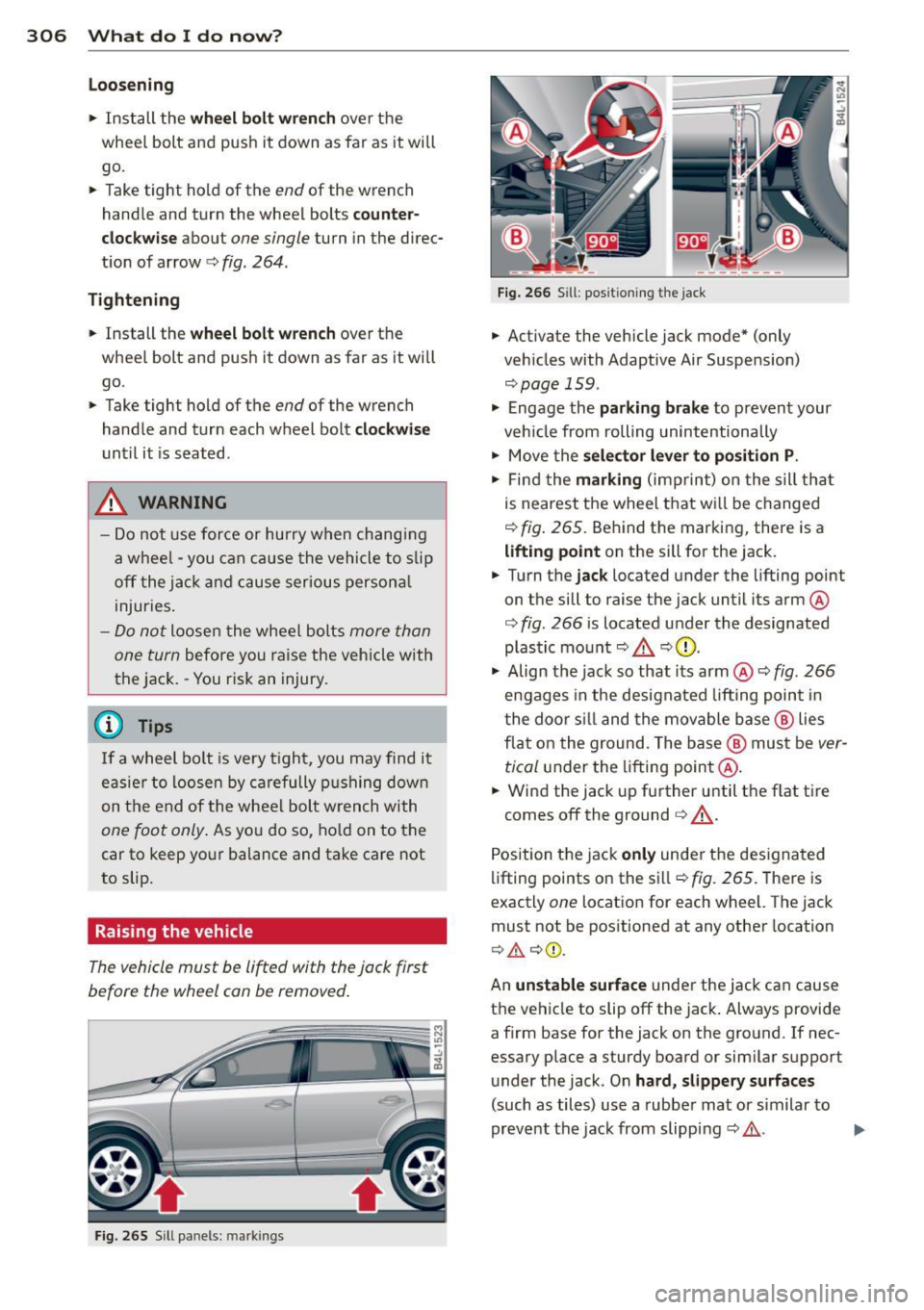
Raising the vehicle
The vehicle must be lifted with the jack first
before the wheel can be removed.
Fig. 265 Sill pane ls: mar kings
Fig. 266 Sill: posit ioning the jack
.,. Activate the vehicle jack mode* (only
vehicles with Adaptive Air Suspension)
<::> page 159 .
.,. Engage the parking brake to prevent your
vehicle from rolling unintentionally
.,. Move the
selector lever to position P .
.,. Find the marking (imprint) on the sill that
is nearest the wheel that will be changed
<=>
fig. 265. Behind the marking, there is a
lifting point on the sill for the jack.
.,. Turn the
jack located under the lifting point
on the sill to raise the jack until its arm@
<=>
fig . 266 is located under the designated
plastic mount<=>
& c::>(D .
.,. Align the jack so that its arm @ c::> fig. 266
engages in the designated lifting point in
the door sill and the movable base® lies
flat on the ground. The base @ must be
ver
tical
under the lifting point@.
.,. Wind the jack up further until the flat tire
comes off the ground
c:> ,& .
Position the jack only under the designated
lifting points on the sill
<=>fig . 265. There is
exactly
one location for each wheel. The jack
must not be positioned at any other location
<=>
.&. <=> CD .
An unstable surface under the jack can cause
the vehicle to slip off the jack. Always provide
a firm base for the jack on the ground. If nec
essary place a sturdy board or similar support
under the jack . On
hard, slippery surfaces
(such as tiles) use a rubber mat or similar to
prevent the jack from slipping
c:> ,&.. liJI,
Page 332 of 348
330 Index
A
Accessories
Adaptive A ir Suspension .... ... .. .. .. .
Cargo mode in the MMI .... .. .. .. .. . 327
155
160
Controls ...................... .. . 155
D .. escnpt 1on ... ........... .. .. .... .
H igh level . ............. ... .. .... .
Highway leve l .... ..... ... .. .. .... .
Instrument cluster display ... ... ... .
Jacking mode when changing a flat tire
Low level ................ .... .... . 155
155
155
158
159
155
Normal level ............. .... .... . 155
Segment display ........... .. .. ... 157
Sett ing the driving modes . ... .. .. .. . 157
Trailer towing mode ....... .... .... . 159
Using switch for cargo mode ...... ... 160
Warn ing/ indicator lights ..... .. .... .. 17
Adaptive cruise control .......... .. .. . 113
Changing speed . . . . . . . . . . . . . . . . . . . 11 7
C leaning senso rs .. ....... .. .. .. ... 247
Dr iver info rmation .......... .. .... . 120
Driver intervention prompt . .. .. .. .. . 124
Driving in traffic ................... 114
Driving program . . . . . . . . . . . . . . . . . . . 124
Error messages . . . . . . . . . . . . . . . . . . . 122
Open road .. ............. .. .. .. .. . 114
Override 114
Request for dr iver to assume control . . 114
Save speed ................. ... .. . 116
Setting distance . . . . . . . . . . . . . . . . . . . 118
Settings ... ............. .. .. .. .. . 124
Sett ing t ime interval .......... .... . 118
Specia l dr iv ing s ituations .. .. .. ..... 125
Status messages ........ ... .. .... . 122
Switching on and off ..... ... .. .... . 116
System limits . . . . . . . . . . . . . . . . . . . . . 125
Temporarily turning off .... .. .. .. .. . 118
warn ing/indicator lights ..... .. .... . 121
Adaptive light .......... ... ... ..... .. 59
defective . . . . . . . . . . . . . . . . . . . . . . . . . . 3 7
AdBlue .. .. .. ............. ........ .
261
Filling 262
Messages in the instrument cluster dis-
p lay .. ... ....... ....... ... .. .... .
261
Adding
Engine coolant ... ............ .... .
273
Engine oil 270
Windsh ield washer fluid ........ .... 279
Additional accessor ies
Additives Engine oil
Adjusting 327
270
Instrument cluster illumination .. .. .. . 13
Steering column electrically ..... .. .. 103
Steering column manually .. .. ... ... 103
Adjusting front seats . . . . . . . . . . . . . . . . . 71
Airbag
Warning/ind icator lights ........ .. .. .
16
Airbag system . . . . . . . . . . . . . . . . . 184, 201
Advanced Airbag System ..... ... .. .. 188
Advanced Airbag System components . 191
Care .. .... .... .. ............. .... 198
Children .. .. .. .. ............. .. .. 206
Child restraints ... .............. ... 207
Components (front airbags) ......... 191
Danger of fitting a child safety seat on
the front passenger seat ........ .. ..
186
Disposal .. .... .. ... .......... .... 198
Front airbags . . . . . . . . . . . . . . . . 188, 189
How do the front airbags work? ...... 193
How many a irbags does my vehicle
have? ....... ... .. .............. .
191
How the Advanced Airbag System com-
ponents work togethe r ......... ....
192
Important things to know ........ ... 184
Indicator light ... ............ .... . 195
Monitoring .... .. .......... ... .... 195
PASS ENGER AIR BAG OFF light . .. .. .. 195
Repairs ... .... .. .. ........... .... 198
Safety instructions ............... .. 197
Side airbags . .. .. .......... ...... . 199
Side curtain airbags ...... ...... .. .. 202
Weight-sensing mat .. ... ... ... .. .. 206
When must the system be inspected? . 195
Air conditioning
refer to Climate controls . . . . . . . . . . . . . 91
Air distribution
Climate controls .. ............. .... .
94
Four- zone automatic comfort air condi-
tioning . .. .. .. .. ............. .. .. .
99
Air pollutants filter
Climate controls . ............... ... .
91
Page 335 of 348
_______________________________ ___:I~n ~d ~e:.::x 333
Cleaning
A lcantara (synthetic suede) ... .. .. .. . 254
Eng ine compartment ... ... .. .. .. .. . 255
Exhaust tail p ipes ......... .. .. .. .. . 250
Fabrics and fabr ic coverings .. .. .. .. . 251
Instrument panel .............. .... 252
Inter ior . . . . . . . . . . . . . . . . . . . . . . . . . . 2 5 1
L eather .. ............ ...... .... .. 253
M MI con tro l conso le ...... .. .. .. .. . 251
M MI d isp lay ............. .... .. ... 2 51
Pl asti c and v inyl ....... ... .. .. .. ... 248
P lastic parts . ..... .... ... .. .. .. ... 252
Safety belts . ... .. .... ... .. .. .. ... 254
tr im strips . .. ........... .. .. .. ... 248
Trim str ips . ............. .... .. ... 248
C lean ing and pro tect ion .. ... .. .. .. .. . 2 45
Climate control . . . . . . . . . . . . . . . . . . . . . . 91
Synchron izing ............... ... ... . 92
Warm and cold ........... .... .. .. .. 9 1
Climate controls Air cond itioner o n/off ..... .. .. .. .. .. 93
A ir distribution .............. .... ... 94
A ir outlets ................. .... ... 96
A ir outlets (rear) ......... .. .. .. .. .. 96
A ir r eci rcula tion .......... .... .. .. .. 95
AUTO (st and ard setti ng) ... .. .. .. .. .. 94
B asic settings . . . . . . . . . . . . . . . . . . . . . . 99
Controls . . . . . . . . . . . . . . . . . . . . . . . . . . 92
Defrosting/defogging .. ... .. .. .... .. 94
Descr ipt ion . ............. .... .. .... 91
Energy management ...... .. .. .. .. .. 91
Fa n ... .. .. .. ........ ... .. ... ... .. 94
Front seat vent ilation ........ .... .. 100
H eated seats, front .............. .. 100
K ey coded sett ing ......... .. .. .. .. .. 9 1
Recirculation mode (autom atic) . . . . . . . 99
Recommended se tt ings . ... .. .. .... .. 91
Residua l heat ... .. .... ... .. .. .. .... 93
Sett ing t he temperature ... .. .. .. .. .. 94
Supp lementary heater ..... .. .. .. .. . 100
Synchroni zat ion . . . . . . . . . . . . . . . . . . . . 99
Turn ing on and off ........ .. .. .. .. .. 93
Using climate control economically . . . . 97
C lock ..... .. .. ... .. ..... ... .. .. .... 11
Closing Panor ami c slid ing su nroof .. .. .. .. .. .. S5
Coat hooks . . . . . . . . . . . . . . . . . . . . . . . . . 89
Cold tire inflat ion pressure ... .. .. .. .. . 284 Compass mir
ro r . . . . . . . . . . . . . . . . . . . . . 69
Compliance ....... .. ............... 328
Consume r Information . . . . . . . . . . 172, 325
Contacting N HTSA . . . . . . . . . . . . . . . . . . 172
Convenience key ... .. ................ 49
D river messages .. .. .......... .... . 108
Locking vehicl e . . . . . . . . . . . . . . . . . . . . . 50
START bu tton .. .. ................. 10 7
Star ting engi ne .. ............. .. .. 10 7
S TOP b utton ..... ... .. .. ..... ... .. 108
Switching engine off . .. ..... ... .. .. 108
Switching on ignition . .. ..... ... .. .. 107
Un locking vehicle . ................. . 49
Co nvertib le child sa fety se ats 212
Convertib le locking retractor
Act ivati ng ... .. .. .. . .. ... ... .. .. .. 217
Deact ivat ing . .. .. .. ............... 218
U si ng to secure a child safety seat 2.15, 217
Coolant system .. .. ................. 271
Cooling box in glove compa rtment ... .. . 88
Cooling System Expansion tank . .. .. . ... ...... ... .. 272
Cornering light . . . . . . . . . . . . . . . . . . . . . . 59
Cruise cont ro l
Changing speed .. .. . ... .... ... .. .. 112
Presetting your spe ed .. ..... ... .. .. 112
Switching off .. .. .. ............... 112
Switching on . .. .. .... .... ....... .. 111
Warning/ind ica tor lights .......... .. . 18
also refer to Adaptive cruise control ... 113
C ruising range . . . . . . . . . . . . . . . . . . . . . . . 24
(upholder . . . . . . . . . . . . . . . . . . . 78 , 85 , 86
D
Damp ing
r e fer to Adapt ive A ir Suspension . 155, 157
Data ......... .. .. .. . ... ....... .... 322
Dat a recorder . .. .. .. .. .... .... ..... 225
Date d isp lay . . . . . . . . . . . . . . . . . . . . . . . . 11
Daytime running lights. .. ..... ... . 57 , 58
De clara ti on of compliance
Adaptive cruise cont rol .. ....... .. .. 32 8
Audi s ide ass ist .... . .. ..... ... .. .. 328
Ce ll phone package .. ... .... ... .. .. 328
Convenience key .... . .. ..... ... .. .. 328
E lectronic immob ilizer ... .. ......... 328
•
•
Page 336 of 348
334 Index
------------------------------------
Homelink® universal remote control .. 328
Remote control key ................ 328
def What does this mean when it appea rs in
the trip odometer display? ... .. .... .. 12
Defective light bulb warning . . . . . . . . . . . 23
Defrosting/defogging the windows . . . . . . 94
Defrosting/defogging windows . .. ...... 96
Determining correct load limit . .. .... . 288
Diesel fuel ... ................ ..... . 257
Diesel particulate filter . . . . . . . . . . 37,235
Digital clock . . . . . . . . . . . . . . . . . . . . . . . . 11
Digital compass ......... .. .. .. .. .. .. 69
Digital speedometer ............ .. ... . 22
Dimensions ................ ... .... . 321
Dimming the rearview mirror .. .. ...... 69
Dipstick Reading the dipstick properly . .. .. .. . 269
Distance control system
refer to Adaptive cruise contro l .... ... 113
Doors Power child safety lock .... .. .. .. .. . . 48
Driver information system . .. .. .. .. .. .. 21
Dig ital speedometer ...... .. .. .. .. . . 22
Driver information messages . . . . . . . . . 30
Open door or rear lid warning . . . . . . . . . 22
Outside temperature display .. .. ...... 22
Sound system display ....... .. .... .. 21
Driver seat
refer to Seat ing pos ition ....... .. ... 166
Driver's seat . . . . . . . . . . . . . . . . . . . . . . . . 72
Driver's seat memory ....... .. .. .. .. . . 73
Activating remote control key ..... .. .. 74
Recalling a seat position . . . . . . . . . . . . . 73
Storing a seat position . . . . . . . . . . . . . . . 73
Driving messages . . . . . . . . . . . . . . . . . . . . 30
Driving mode
refer to Adaptive Air Suspension . lSS, 157
Driving offroad
Driving through water ..... .... .... . 239
Driving tips .............. .. .. .. .. . 238
Rules of behavior ........... .. .... . 238
Sand and mud .. ...... .... ... .. .. . 239
Snow-covered ground ...... ..... .. . 239
Unpaved roads ............... .. ... 239
Driving safely ............. .... .... . 165 Driving
through water ........... .. .. 239
Driving time . . . . . . . . . . . . . . . . . . . . . . . . 24
Duplicate key . .. .. ... .......... .. .. . 38
Dust filter
Climate controls . ................. .. 91
E
Easy entry feature .. .. ........... .. .. 104
Efficiency program . . . . . . . . . . . . . . . . . . . 26
Fuel economy messages . . . . . . . . . . . . . 27
Memory levels . . . . . . . . . . . . . . . . . . . . . 25
Other equipment ..... .... ..... .. .. . 27
Electric seat adjustment
refer to Power seat . . . . . . . . . . . . . . . . . 72
Electronic differential lock (EDL)
How the system works .............. 227
Warning/indicator lights ........ .. .. . 18
Electronic immob ilizer ........... .... . 40
Electronic power control (EPC) warning/indicator light . . . . . . . . . 15
E lectronic speed limiter ............... 28
Electronic Stabilization Control (ESC)
Hill descent control . ........... .. .. 225
How the system works .............. 225
Offroad mode .... ............. .... 225
Warning/indicator lights ............. 16
Emergency flasher . . . . . . . . . . . . . . . . . . . 60
Warning/ind icator lights ........ .... . 16
Emergency locking of doors ....... .. .. . 45
Emergency operation Rear lid ....... .. .. .............. .. 48
Emergency starting ................. 314
Emergency towing ... .... .... ... .. .. 316
Energy management ................ 231
Battery power ... ............. .... 233
Driver notification ............. .. .. 233
Engine Compartment .... ................ . 266
Coolant ....... .. .. .............. . 271
Hood ......... .. .. .............. . 264
Starting . . . . . . . . . . . . . . . . . . . . 105, 106
Starting with jumper cables ..... .... 314
Stopping .. .... .. ................. 106
Engine compartment
Safety instructions ................ . 264
Working the eng ine compartment .... 264
Page 339 of 348
Index 337
-----------------------------------.......
Hill hold
Starting on hills 110
H omelink ® universal remote contro l 161
Hood Opening 264
Release lever ............. ... ... .. 264
H orn ..... .. .. .. .. .. .... ... .. .. .... . 8
H ow are c hild restra int system anchors re -
la ted to child sa fe ty ........ .. .. .. .. . 218
H ow many airbags does my vehicle have? 191
H ow often sho uld I check my tire pres-
sures? . ..... .. .. ... ..... ... .. .. ... 287
H ow sa fe ty belt pre tensione rs wo rk . .. . 18 2
H ydroplani ng ............. .... .. ... 291
I
Ignition key . . . . . . . . . . . . . . . . . . . . . . . . 105
I gnition lock . .... ......... .... .. .. . 10 5
M alfunct ion . . . . . . . . . . . . . . . . . . . 34, 3 7
Ignition lock pos itio ns ...... .. .. .. .. . 105
Important things to do before driving . . 165
I mp ro perly wor n safety be lts . .. .. .. .. . 18 2
Indicato r lights . . . . . . . . . . . . . . . . . . . . . . 14
A irbag system .............. .... .. 195
P ASSENGER AIR BAG OFF ...... ... .. 195
Infant seats . ............. .... .. ... 211
I nfl atable spare t ire ........ .. .. .. .. . 30 2
I nflating ... ... .. ..... ... .. .. .. ... 30 3
Install ing ch ild safety seats
Safety belts . . . . . . . . . . . . . . . . . . . . . . 215
Instal ling the upper tet her strap on the
anchorage . .. .. ........... .. .. .. ... 223
I nstrument cluste r ill umination . ... .. .. 13
Instrumen ts and cont rols . ...... ... ... 10
Gene ral i llus tra tion ....... .. .. .. .. ... 8
Inter ior lights
Front .. .. .. .. .... ...... ... .. .. .. .. 61
Rear .. ... ... ................ .... . 61
Intermittent w iping
Ra in sensor . .... ......... .... .. .. .. 63
J
Jac k 301
J ump-start ing .... ...... ... .... .. ... 3 14
J umper cables ............. .... .. ... 315
K
Key ... ... .. .. .... ... .. .. ..... ... .. . 38
Battery replacement . .. ..... ... .. .. . 40
Coded settings ..... . .. .. ..... ... .. . 91
Convenience opening and closing of win -
dows ....... .. ...... ............. . 53
Emergency key . . . . . . . . . . . . . . . . . . . . . 38
Key rep lacement . . . . . . . . . . . . . . . . . . . 38
Master key . . . . . . . . . . . . . . . . . . . . . . . . 38
Valet key . . . . . . . . . . . . . . . . . . . . . . . . . . 38
Key coded settings Climate controls .. .... ............. . 91
Keyless ent ry remote cont ro l ... ... .. .. . 38
K ick-down
t ipt ron ic® . .. .. .. .... ........... .. 140
L
LATC H 218
Desc ription .. .. .. .. . ...... ...... .. 219
G ui dance fixtures for lower anc ho rages 220
Installing a ch ild restr aint ....... .. .. 22 1
L oca tion . ... .... .. . .. .. ..... ... .. 219
Mo unting and releasing the anchorage
hoo k ... .. .. .... .. . .. .. ..... ... .. 221
Late ra l ang le .. .. .. .... ........... .. 238
Leather ...... .. .. .... ............. 252
Cleaning .. .. .. .. .. . .. .... .... .. .. 253
Leve l adj ustment
refer to Adapt ive A ir Suspension . 155, 157
L ift ing jack . .. .. .. .... ............. 306
Lifting vehicle . .. .. .. . ....... ..... .. 318
Light Exte rior lig hting i n the mirror housing . . 59
l eav ing home .. .. ................. . 59
also refer to Amb ience lighting .... .. . 62
Ligh ting
refer to Ambience lighting . . . . . . . . . . . 62
Light ing in the m irror housing . ... ... .. . 59
Lights ... .. .. .. .. .. ............... . 57
Coming h ome . . . . . . . . . . . . . . . . . . . . . . 58
Daytime runn ing lights ............ .. 58
E mergency flashe rs . . . . . . . . . . . . . . . . . 60
E xterior lig hts ... .. . .. .... .... .. .. . 58
F ron t fog lights . . . . . . . . . . . . . . . . . . . . 58
H ead ligh ts .. .. .. .... ............. . 57
Hig h beam . . . . . . . . . . . . . . . . . . . . 57 , 60
•
•