change time AUDI Q7 2013 Owner´s Manual
[x] Cancel search | Manufacturer: AUDI, Model Year: 2013, Model line: Q7, Model: AUDI Q7 2013Pages: 348, PDF Size: 87.72 MB
Page 159 of 348
emphasis on comfort are selected in this
mode.
- Automatic lowering : When a speed of
abo ut 75 mph (120 km/h) is exceeded for
more than 30 seconds, the vehicle is auto
matically lowered by 0.6 inch (15 mm) to
low level .
-Automatic raising: The vehicle is automati
ca lly raised to
normal level again, if the
speed falls below about 44 mph (70 km/h)
for a period of 2 minutes . The vehicle is
raised immediately when speed falls below
about 22 mph (35 km/h) .
Offroad
Select the offroad mode when you have to
travel over poor quality sections of road (e .g.
trails). In th is mode, the vehicle is raised to
high level 1, and damp ing characteristics for
poor road stretches are selected . When
sw itch ing to offroad mode, the Adaptive Air
Suspension indicator appears automat ically in
the instrument cluster display ¢
page 158.
The offroad mode can only be activated at
speeds below 37 mph (60 km/h) . Offroad
mode ends automatically and the automatic
mode is activated when a speed of approxi
mately 50 mph (80 km/h) is exceeded.
Lift
Select the lift mode when except ionally high
ground clearance is needed at a reduced
speed. In this mode, the vehicle is raised to
high level 2. When switching to lift mode , the
Adaptive A ir Suspension indicator appears au
tomatically in the instrument cluster display
¢ page 158.
The lift mode can be activated only at speeds
be low 12 mph (20 km/h) . When a speed of
about 25 mph (40 km/h) is exceeded, the sys
tem automatically leaves lift mode and the
offroad mode is activated. The instrument
cluster display automat ically switches the dis
play to Adaptive Air Suspens ion to indicate re
duced ground clearance .
Adaptive Air Suspension 15 7
MMI settings
Applies to vehicles: wit h Adaptive A ir Suspension
Driving modes are adjusted in the MMI and
the current vehicle level is displayed .
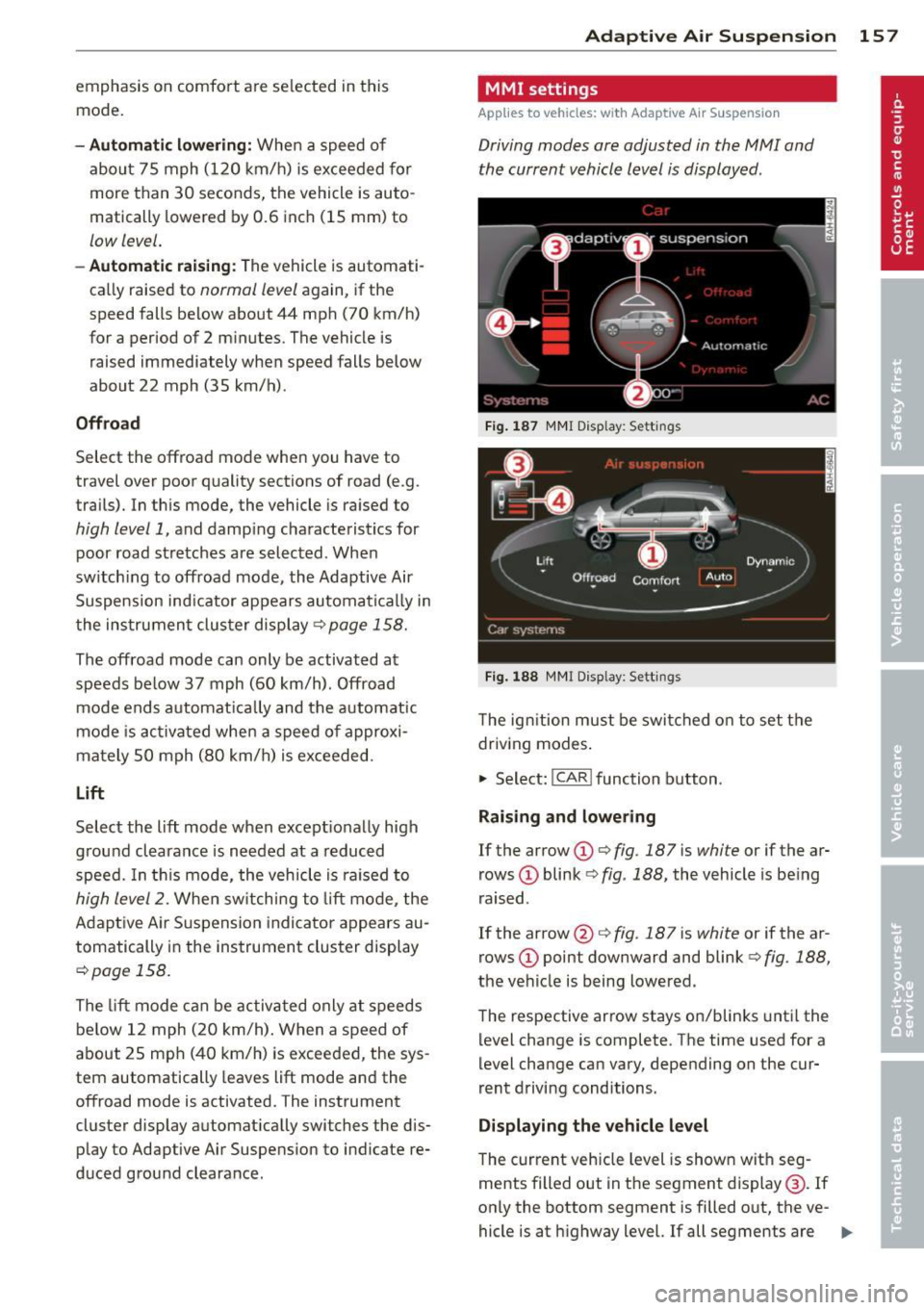
Fig. 187 MMI Display: Sett ings
Fig. 188 MMI Display: Sett ings
Th e ign ition must be switched on to set the
driving modes.
1-Select: !CAR ! function button .
Raising and lowering
If the arrow (D ¢ fig. 187 is white or if the ar
rows
(D blink ¢ fig. 188, the vehicle is being
raised .
If the arrow @¢
fig. 187 is white or if the ar
rows
(D point downward and blink ¢ fig. 188,
the vehicle is being lowered .
The respective arrow stays on/blinks until the
level change is complete . The time used for a
level change can vary, depending on the cur
rent driving conditions .
Displaying the vehicle level
The c urrent vehicle level is shown with seg
ments filled out in the segment display@. If
only the bottom segment is filled o ut, the ve-
hicle is at highway level. If all segments are
IJJ>-
Page 160 of 348
158 Adapti ve Air Suspens ion
fi lled out, the vehicle is at high level 2 and has
the greatest amount of ground clearance pos
sib le.
While the vehicle is being raised or lowered,
the target level is indicated by an arrow@
c::> fig. 187 or a white border @ c::> fig. 188 . The
arrow/border disappears aga in when the vehi
cle is at the target level.
Limitations to MMI s etting s
Please note that not eve ry dr iving mode can
be selected in every d riving situation . For ex
ample, it is not possible to switch to "lift"
mode at speeds above 12 mph (20 km/h) .
This mode is then shown
greyed out in the
MMI Display.
The vehicle can only be lowered when
all of
the vehicle's doors are closed. If one door is
open, all driving modes whose level sett ing is
belo w the current vehicle level appear
greyed
out
i n the MMI Display. If a door is opened
while the veh icle is being lowered, the lower
ing p rocess is interrupted u ntil all doors are
closed again .
If the system is temporar ily unava ilable due
to, for instance, an empty compressed air
tank, the driving modes that cannot be set ap pear
greyed out in the MM I Disp lay. As soon
as the system is available again, the driv ing
modes can once more be selected in the dis
p lay .
(D} Tips
- Fo r addition al in forma tion on the driv ing
modes
c:;> page 155, Chassis controls.
- When the compressed air tank is empty,
the compressor c an be switched on by
starting the engine . The Adaptive Air
Suspension is once again available, after
waiting a few minutes .
- To prevent over load, the system switches
off tempera rily if seve ral adj ustments
are made in a row. The Adaptive Air Sus
pension is once again available, after
waiting a few minutes. Appearance in the instrument cluster
display
Applies to veh
icles: w ith Adapt ive A ir Suspens ion
You can view th e current vehicle l evel in the
instrument cluster display.
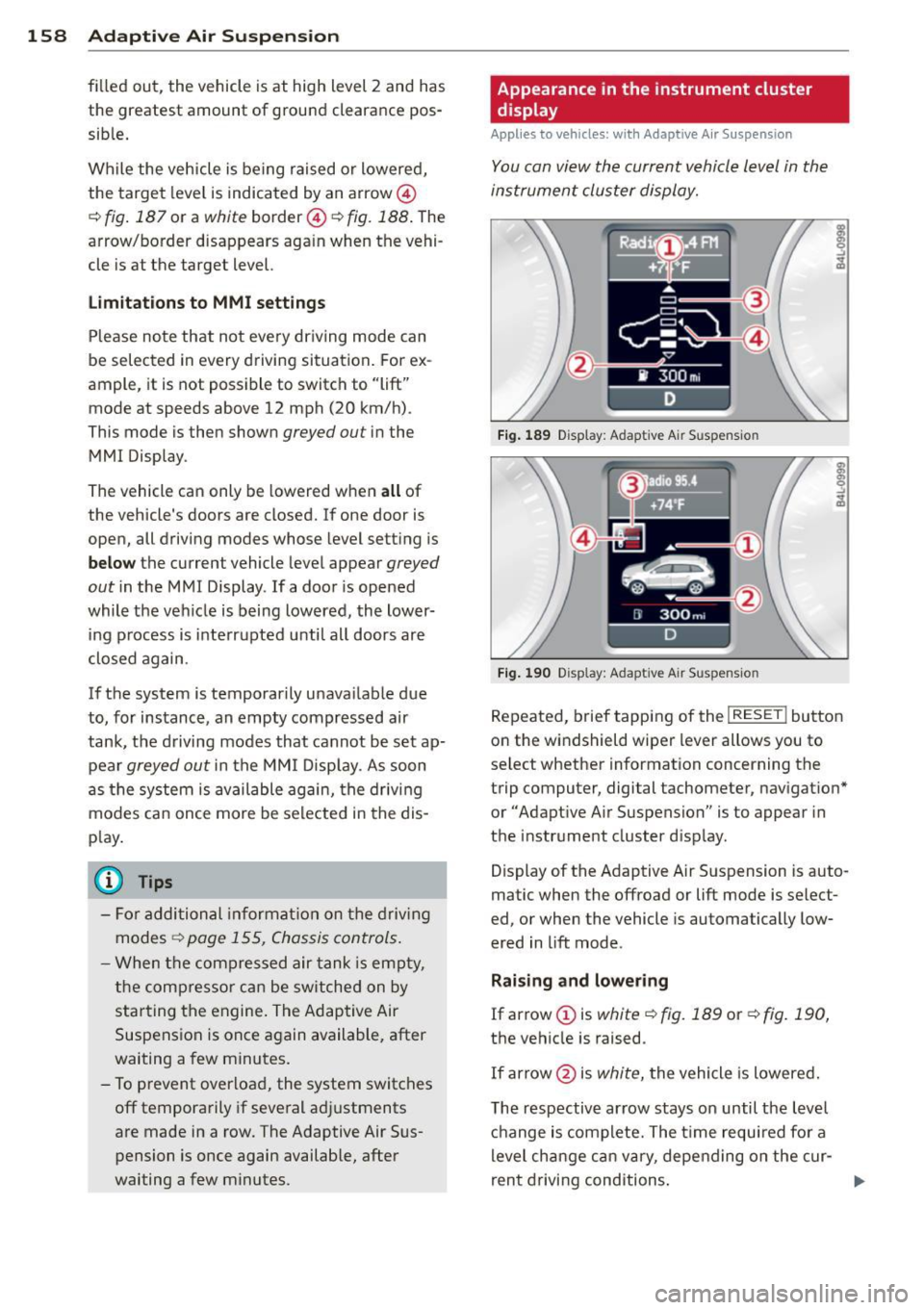
Fi g. 1 89 Display: Adaptive Air Suspension
F ig . 190 Display: Adaptive Air Suspension
Repeated, brief tapping of the I RESET ! button
on the windshield wiper lever allows you to
se lect whether information concerning the
trip computer, digital tachometer, nav igat ion*
or "Adapt ive A ir Suspension" is to appear in
t h e instrument cluster d isp lay .
Display of the Adaptive A ir S uspension is auto
matic when the offroad or lift mode is select
ed, or when the vehicle is automatically low
ered in lift mode.
Rai sing and lowe ring
If arrow
(J) is white c::> fig. 189 or c::> fig . 190,
the vehicle is raised.
If arrow @is
white, the vehicle is lowered .
The respective arrow stays on until the level ch ange is complete. The time requ ired fo r a
level change can vary, depending on the cur-
ren t drivi ng conditions . ..,_
Page 259 of 348
-Blend must contain not more than 1S%
MTBE.
Seasonally adjusted gasoline
Many gasoline grades are blended to perform
espec ially we ll for winter or summer driving.
During seasonal change-over, we suggest that
you fill up at busy gas stat ions where the sea
sonal adjustment is more likely to be made in
time .
(D Note
-Methanol fuels which do not meet these
requirements may cause corrosion and
damage to plastic and rubber compo
nents in the fuel system.
- Do not use fue ls that fail to meet the
specified criter ia in this chapter.
- If you are unable to determine whether
or not a particular fue l blend meets the
specifications, ask your service station or
its fuel supp lier.
- Do not use fuel for which the contents
cannot be identified.
- Fuel system damage and performance
problems resulting from the use of fuels
different from those specified are not
the responsibility of Audi and are not
covered under the New Vehicle or the Emission Control System Warranties.
- If you experience a loss of fuel economy
or driveability and performance prob l ems due to the use of one of these fuel
blends, we recommend that you switch
to unblended fuel.
Gasoline additives
Applies to vehicles : wit h gasoli ne e ng in e
A majo r concern among many auto manufac
ture rs is carbon deposit build-up caused by
the type of gasoline you use.
Although gasoline grades differ from one manufacturer to another , they have certain
things in common. All gasoline g rades contain
substances that can cause deposits to collect
on vital engine parts, such as fuel injectors
and intake valves. Although most gasoline
Fuel supply and filling your fuel tank 257
brands include additives to keep engine and
fuel systems clean, they are not equally effec
tive .
Audi recommends using TOP TIER Detergent
Gasoline . For more information on TOP TIER
Detergent Gasoline, please go to the official
webs ite (www.toptiergas.com).
After an extended per iod of using inadeq uate
fuels, carbon deposit build-ups can rob your
engine of peak performance.
(D Note
Damage or malf unct ion due to poor fuel
quality is not covered by the Audi New Ve
hicle Limited Warranty.
Diesel fuel
Applies to veh icles: w ith diesel engine
Always use ULSD (Ultra Low Sulfur Diesel) sul
fur content 15 ppm or less.
The ULSD (U ltra Low Sulfur Diesel) meets the
ASTM-D-97S (grade 2).
Die sel fuel with a higher concentration than
ULSD-Die sel No. 2 ASTM D975 and Bio-die
sel with a higher concentration than 5
% like
Bl 1 , B20 or B100 are strictly prohibited.
Service station fue l pumps are labeled with
the correct fuel information for easy recogni
tion by the user. If the diesel fuel pump is not
labeled ask the station operator what fuel is
being dispensed before filling up your vehicle.
Serv ice stations offering Diesel fuel are gener
ally located on truck routes or major high
ways . Directories of Diesel fuel stations are
usually available at Diese l fuel stations.
Some states in the USA require permits to
purchase Diesel fuel. Check with your State
Motor Vehicle Department .
Diesel fuel may not be available outside the
USA and Canada. Be sure to check before trav-
eling to other countries .
Ill-
•
•
Page 269 of 348
oils available today provide better engine lu
brication that can outlast traditional petrole
um-based oils, making them a smart choice
for use throughout the life of your Audi.
Whether you use synthetic or petroleumbased engine oil, the oil that you use must
conform to Audi's oil quality standard
VW 502 00 (vehicles with gasoline engine) or VW 507 00 (vehicles with diesel engine) to
help keep your vehicle's engine running
smoothly and help prevent the formation of harmful deposits , sometimes called "sludge,"
that over time can lead to expensive repairs.
At the time of printing, engine oils available in
the U .S . and Canada that meet the exacting
specifications of Audi oil standard VW 502 00 (vehicles with gasoline engine) or VW 507 00
(vehicles with diesel engine) are synthetic en
gine oils. This does not mean, however, that
every synthetic engine oil will meet Audi oil
standard VW 502 00 (vehicles with gasoline
engine) or VW 507 00 (vehicles with diesel
engine). So always be sure that you use an ap
proved oil.
To help prevent the formation of harmful de posits use only oil with the following specifi
cations printed on the oil container :
-Audi oil standard VW 502 00 (gasoline en
gine)
- Audi oil standard VW 507 00 (diesel en-
gine)
Oil container labels may carry the specifica
tion singly or in combination with other desig
nations and oil quality standards.
Viscosity
Engine oils are graded according to their vis
cosity . The proper viscosity grade oil for your
engine depends on climactic or seasonal con
ditions where you drive. You can use oil with a
viscosity grade of SAE SW40 ac ross all tem
perature ranges for normal driving conditions.
However, if engine oil viscosity grade SAE
SW40 is not available, you can also use viscos
ity grade SAE SW-30 or SAE OW-40 as long as
it meets Audi oil quality standard VW 502 00
Checking and filling 267
(vehicles with gasoline engine) or VW 507 00
(vehicles with diesel engine) specifications.
Because engine oil that meets the Audi oil
standard may not be available everywhere
when you need it, we strongly recommend
that you always carry with you an extra quart (liter) of oil that expressly conforms to the
VW 502 00 (vehicles with gasoline engine) or
VW 507 00 (vehicles with diesel engine) spec
ification, in case you have to top
off the oil
while on the road.
Applies to vehicles with gasoline engine on
ly: Only if the level of the oil is at or below the
minimum mark on the oil dipstick -and no oil
that expressly conforms to Audi oil standard
VW 502 00 specificat ions is available - may
you top
off with a high quality engine oil, pref
erably synthetic-based, that meets ACEA A3
or API SM specifications, but even then, only in viscosity grades SAE SW-40, SAE SW-30, or
SAE OW-40 . However, during the entire time
between oil change intervals, never top off
with more than a total of 0.5 qt/liter engine
oil that does not conform to Audi oil specifica
tion VW 502 00.
Applies to vehicles with diesel engine only:
Only if the level of the oil is at or below the
minimum mark on the oil dipstick - and no oil
that expressly conforms to Audi oil standard
VW 507 00 spec ifications is available - may
you top
off with a high quality engine oil, that
meets ACEA C3 or API CF specifications, but
even then, only in viscosity grades SAE
5W-40, SAE 5W-30, or SAE OW-40. However,
during the entire time between oil change in
tervals, never top off with more than a total
of 0 .5 qt/liter engine oil that does not con
form to Audi oil specification VW S07 00.
For more information about engine oil that
has been approved for your vehicle, please
contact either your authori zed Audi dealer or
Audi Customer Relations at 1 (800) 822-2834
or visit our web si te at www.audiusa .com or
www .audicanada .ca. Here you will also find a
current list of oils (manufacturers, brand
names etc.) that conform to Audi oil standard
lilJJ,,
•
•
Page 270 of 348
268 Checking and filling
VW 502 00 (vehicles with gasoline engine) or
VW 507 00 (vehicles with diesel engine).
Changing the engine oil
The engine oil and oil filter must be changed
according to the m ileage (ki lometers) and
time intervals specified in your vehicle 's War
ranty
& Maintenance booklet. Do not exceed
these intervals -harmful deposits from old
engine oil can reduce engine performance and
can lead to expensive engine repairs.
Changing the oil at the recommended inter
va ls is so very important because the lubricat
ing properties o f oi l decrease gradually during
normal vehicle use. If you are not sure when
you have your o il changed, ask your author
i z ed Audi Service Advisor.
Under some ci rcumstances the engine oi l
should even be changed more frequently .
Change oi l more often if you drive mostly
short distances, operate the vehicle in dusty
areas or mostly under stop-and-go traffic con
d itions, or when you use your vehicle w here
temperatures stay below freez ing point for
l ong periods .
Detergent additives in the o il w ill make fresh
oil look dark after the engine has been run
ni ng for a short time . This is normal and is not
a reason to change the oil more often than
recommended.
Damage or malfunctions due to lack of
maintenance
It is essential that you change your oil at the recommended intervals using only engine oil
that complies with Audi oi l standard
VW 502 00 (vehicles with gasoli ne engine) or
VW 507 00 (veh icles with diese l engine) . Your
Limited New Vehicle Warranty does not cover
damage or malf unctio ns due to failure to fol
lo w recommended maintenance and use re
quirements as set forth in the A udi Owner's
Manual and Warranty
& Maintenance booklet.
Your dea ler will have to deny warranty cover
age unless you present to the dealer proof in
the form of Service or Repa ir Orders that all scheduled maintenance was
performed in a
timely manner.
Engine oil consumption
To provide effective lubrication and cooling for
internal engine parts, all internal combustion
engines use some o il. Oil consumption varies
from engine to engine and may change over
the life of the engine. Engines tend to use
more o il during the break-in period tha n they
do afterward, when oil consumption has sta
bilized. Depending on the way the vehicle is
driven and the operating conditions, oil con
s u mption can be up to 1 quart per 1,200
miles (1 liter per 2,000 km) . Consumption
may be higher within the first 3,000 m iles
(5,000 km) .
Under normal conditions, the rate of oil con
sumption depends on oil quality as well as vis
cosity, engine speed (rpm), outs ide tempera
ture, road conditions, the amount of oil dilu
t ion caused by condensed water or fue l resi
due, and ox idat ion of the oil. Oil co nsumption
may increase with engine wear over time, un
t il replacement of worn engine pa rts may be
come necessary.
Because of all these variables, there is no
standard or "norma l" rate of oil consumption .
We urge you to check the engine oil level at
regular intervals, preferably every time you
fill the fuel tank, and always before a long
trip.
The oil pressure warning light. is not an
indicator of low engine oil level. If the warn
ing light does not go out after starting, or
flashes while driving (above 1500 rpm), a
buzzer will sound. It indicates that the oil
pressure is too low . Stop the engine immedi·
ately, check the engine oil level and add oil if
necessary. If the engine oil level is normal,
but the light continues to flash, do not keep
driving or let the engine idle, as damage may
occur .
II-
Page 272 of 348
2 70 Ch eck ing and filling
per 2,000 km). Consumption may be higher
within the first 3,000 mi les (5,000 km).
Adding engine oil "1:::7':
0 N ;:;
"' "' a:>
F ig . 2 46 Eng ine com part men t: cove r on the eng ine o il
filler neck
Before you check anything in the engine com
partment,
al way s read and h eed all W ARN
ING S
¢.&. in Working in the engine compart
ment on page 264 .
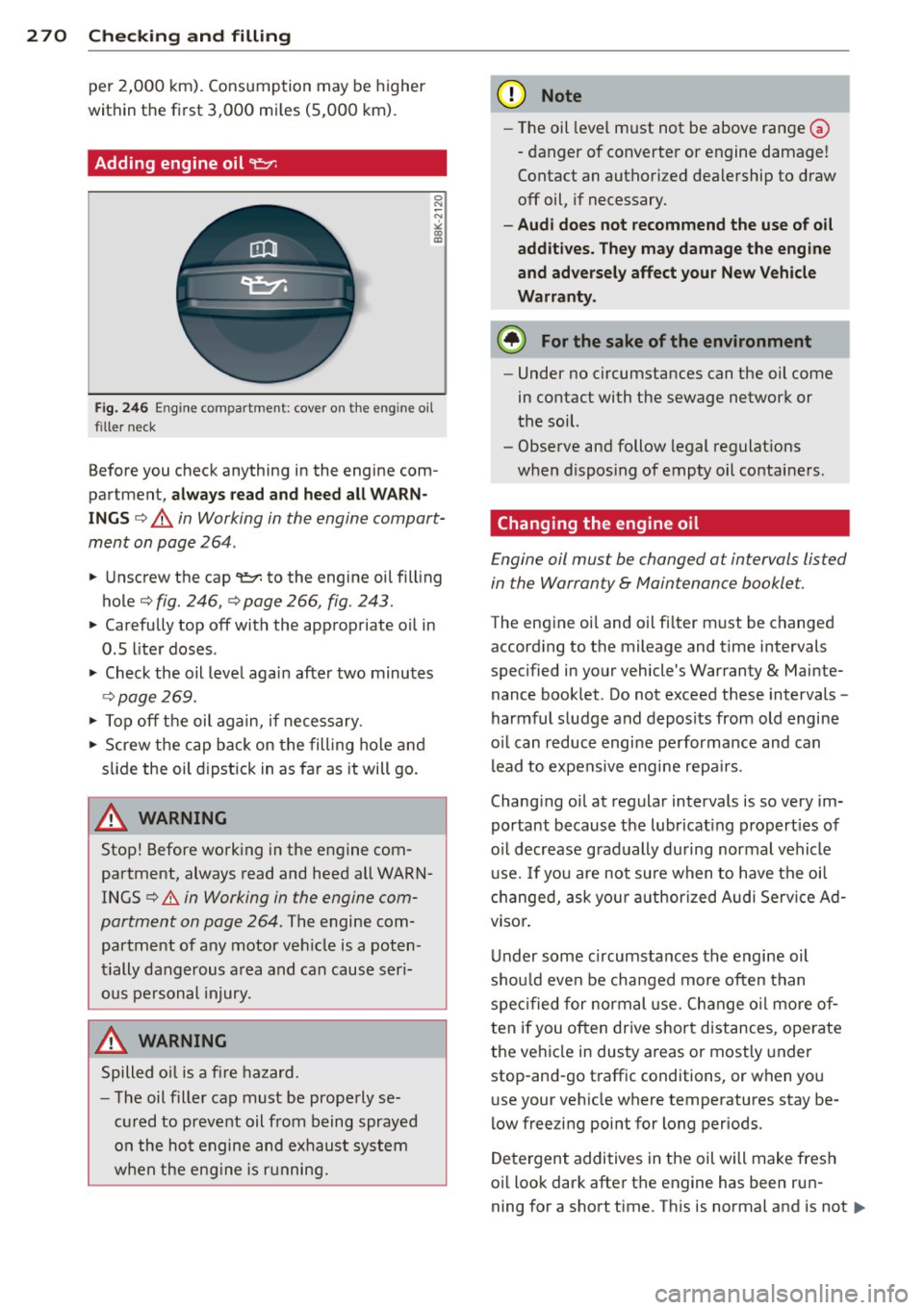
.. Unscrew the cap 't::r. to the engine oil fill ing
hole¢
fig. 246, ¢ page 266, fig . 243.
.. Carefully top off with the appropriate o il in
0 .5 liter doses .
.. Check the oil level aga in after two minutes
¢ page 269.
.. Top off the oil again, if necessary.
.. Screw the cap back on the filling hole and
s li de the oil dipstick in as far as it will go.
& WARNING
Stop! Before working in the engine com
partment, always read and heed a ll WARN
INGS
¢ .& in Working in the engine com
partment on page 264 .
The engine com
partment of any motor ve hicle is a poten
tially dangerous a rea and can cause ser i
ous personal injury.
& WARNING
Spilled o il is a fi re hazard.
- The oil fille r cap must be prope rly se
cured to prevent oil from being sprayed
on the hot engine and exhaust system
w hen the eng ine is r unning.
-
(D Note
- The oil leve l m ust not be above range 0
- danger of converter or engine damage !
Contact an authorized dealership to draw
off oil, if necessary.
- Audi does not recommend the use of oil
additives. They ma y damage the engine
and adversely aff ect your New Vehicle
Warranty .
~ For the sake of the environment
-Under no circumstances can the oil come
in contact with the sewage network or
the so il.
- Observe and follow legal regulations
when dispos ing of empty oil containers.
Changing the engine oil
Engine oil must be changed at intervals listed
in the Warranty
& Maintenance booklet.
The engine oi l and oil fi lter m ust be changed
accord ing to the mileage and time intervals
specified in your vehicle's Warranty
& Mainte
nance booklet . Do not exceed these intervals -
harmful s ludge and deposits from old engine
o il can reduce engi ne pe rformance and can
lead to expens ive engine repa irs.
Chang ing oi l at regular intervals is so very im
po rtant because t he lubricat ing propert ies of
o il decrease gradually du ring normal vehicle
use.
If you are not sure when to have the oi l
changed, ask your a uthorized Audi Servi ce Ad
visor .
U nder some c ircumstances the engine oil
sho uld even be changed more often than
specified for normal use. Change o il more of
ten if you often dr ive short distances, ope rate
the ve hicle in dusty a reas or mostly under
stop-and-go t raff ic conditions, or when you
u se your vehicle where temperatures stay be
low free zing point for long periods.
Detergent additives in the oil will make fresh
oi l look dark after the engine has been run-
ning for a short time . T hi s is normal and is not
IJ,,
Page 277 of 348
thoroughly checked by an authorized Audi
dealer or qualified workshop and the cause
corrected .
If the brake fluid level is too low ,
the brake warning/indicator light will i llum i
nate. Con tact an au thori zed Aud i dealer
im ·
mediately .
@ Tips
The brake fluid reservoir is located under
neath the cover.
Changing brake fluid
Have the brake fluid changed by an experi
enced technician .
Brake fluid absorbs moist ure from the a ir. If
the water content in the brake fluid is too
h igh, corrosion in the brake system may result
after a per iod of t ime . The bo iling po int of the
brake fluid w ill also decrease considerably and
decrease b raking performance .
Therefore, the brake flu id must be changed
every two years . Always use new brake fluid
which conforms to Federal Motor Vehicle
Standa rd "FMVSS 116 DOT 4".
The brake f lu id reservoir can be difficult to
reach, therefore, we recommend that yo u
have the brake f lu id changed by your author
i zed
Audi dea ler . Your deale r has the co rrect
too ls, the right b rake fluid and the know-how
to do this fo r you.
_& WARNING
- Br ake fluid is po isonous . It must be s to r
ed only in the closed orig inal con tainer
o ut of the reac h of c hildren!
- Br ake f ailure can resu lt from old or in ap
propr iate b ra ke fluid. Observe these pre
caut ions:
- Use on ly brake fluid that meets SAE
specif ication
J 1 703 and conforms to
Federal Motor V ehicle Sta ndard 116.
A lways check wi th you r auth o riz ed Audi
deale r to ma ke s ure you are using the
correct brake flu id . T he correc t type of
Checkin g and fillin g 275
brake f luid is also ind icated on t he
brake f luid rese rvoir.
- The bra ke fl uid must be new. Heavy use
of the brakes can cause a vapo r lock if
the brake fluid is left in the system too
l ong. This can seriously affect the effi
c iency of the brakes as well as your
safe ty. This co uld resu lt in an accide nt.
(1) Note
Brake fluid will damage the paint of your
vehicle.
@) For the sake of the environment
Because o f the prob lem of proper disposal
of brake fluid as well as the spec ial too ls
required and the necessary expertise, we
recomme nd that you have the brake flu id
changed by you r autho rized Aud i deale r.
Battery
General information
U nder normal operating cond itions, the bat
tery in your Audi does not need any ma inte
nance. With
high outside temperatures or
long da ily drives we recommend that you have
the e lectrolyte level chec ked by an au thorized
Audi dealer or qualified wo rkshop . The elec
t ro lyte level should also be che cked each time
t h e battery is cha rged
~ page 2 77.
Have the battery checked when you take your
vehicle in for se rv ice . You a re well advised to
replace a battery that is o lde r th an 5 years .
With certain types of airbag deployment, the ba tte ry is disconnected from the ve hicle elec
t rical sys tem for safety reasons
~ A in Re
pair, care and disposal of the airbags on
page 198.
Disconnecting the battery terminals
Some vehicle fu nctions (power window regu
lators, fo r example) are lost if the battery te r
mina ls are disconn ected . T hese functions have
to be relearned after the bat tery termina ls are
conne cte d ag ain. To p revent t his, the battery .,.
•
•
Page 279 of 348
could leak out of the ventilation open
ings.
- If you get battery acid in your eyes or
on your skin, immediately rinse with
cold water for several minutes and get
medical attention.
- If you should ingest any battery acid,
seek medical attention immediately.
- Do not expose the battery to an open
flame, electric sparks or an open light.
- Do not smoke.
- Do not interchange the positive and neg-
ative cables.
- When working on the battery, be sure
not to short-circuit the terminals with
tools or other metal objects. This would cause the battery to heat up very quickly,
which could lead to damage or explosion and personal injury.
- When a battery is charged, it produces hydrogen gas which is explosive and
could cause personal injury.
- Always keep the battery well out of the
reach of children.
- Before work is done on the electrical sys tem, disconnect the negative ground ca
ble .
- Before performing any work on the elec
trical system, switch off the engine and
ignition as well as any electrical equip
ment . The negative cable on the battery
must be disconnected. If you are just go
ing to replace a light bulb, then it is
enough to switch off the lights.
- Before disconnecting the battery, switch
off the anti-theft alarm system! Other
wise you will set off the alarm.
- When disconnecting the battery, first
disconnect the negative cable and then
the positive cable.
- Before reconnecting the battery, make
sure all electrical consumers are switch
ed off. Reconnect the positive cable first
and then the negative cable. Never inter
change the cables -this could start a fire!
- Never charge a frozen or a thawed-out
battery. It could explode! If a battery has
fro zen, then it must be replaced. A dis-
Checking and filling 2 77
charged battery can freeze over at 32 °F
(0 oc).
-Make sure the vent hose is always attach
ed to the opening on the side of the bat
tery .
- Never use batteries which are damaged.
There is the danger of an explosion! Al
ways replace a damaged battery.
A WARNING
California Proposition 65 Warning:
- Battery posts, terminals and related ac
cessories contain lead and lead com pounds, chemicals known to the State of
California to cause cancer and reproduc
tive problems . Wash hands after han
dling.
(D Note
- Do not disconnect the vehicle battery
when the ignition is switched on or when the engine is running, otherwise, you will
damage electronic components in the
electrical system.
- If your vehicle is going to stand for a
long period of time without being driven ,
protect the battery from "freezing ", oth
erwise it will be damaged and will then
have to be replaced.
Battery charging
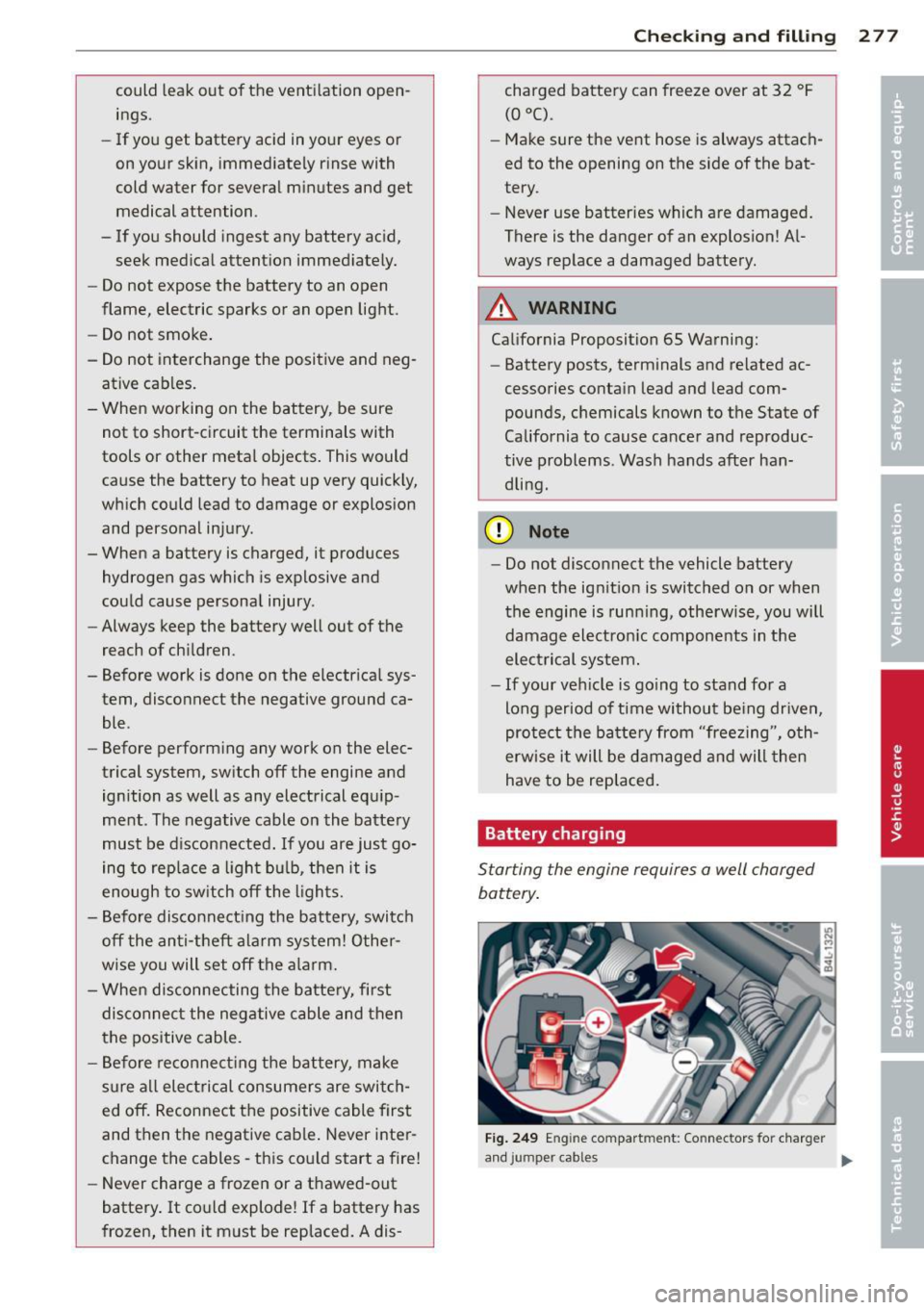
Starting the engine requires a well charged
batt ery.
Fig. 249 Engin e compart men t: Co nnectors fo r charger
and j umper ca bles ..,_
Page 281 of 348

Battery replacement
The new battery must have th e sam e specifi
cations and dim ensions as the original equip
ment battery.
Intell igent energy management in your vehi
cle is respons ible for d istr ibuting the e lectr i
cal energy throughout your vehicle
c::> page 231. The intel ligent e nergy ma nage
men t system w ill keep the eng ine ba tte ry
ch arged be tte r th en vehicles w ithout t his sys
tem . To make sure the additional e lectrica l en
e rgy is available once again after you have
changed the battery, we recommend that you install batteries of the same type and man u
facture only (the same as those installed at
the time your vehicle was delivered). Specifi
cations a re listed on the battery hous ing . Your
author ized dealer must code the battery in
the energy manageme nt system to enable yo u
to use the energy managemen t fu nctions co r
rectly after rep lac ing the b attery .
If it is not poss ible to use a battery of this
type, the new battery must have the same ca p aci ty, voltage
(12 volts) , a mpe rage , con
s truc tion and pl ug sea ling.
W hen insta lli ng the battery, make sure the ig
ni tion and all e lectr ical c ons umers a re turned
off.
CD Note
Ma ke s ure the venti lation hose on the s ide
of the bat tery is connected, ot he rwise
fumes or ba ttery a cid c an leak out.
@, For the sake of the environment
Because of the probl em of proper d isposa l
of a batte ry, we recommend your autho r
i z e d Au di d ealer change the batt ery f or
you. Batter ies co ntain s ulfu ric ac id and
lead and m ust always be dis posed of prop
erly i n complia nce w ith all environmenta l
reg ulations. D isposin g of vehicle batteries
improper ly is very dangerous to the envi
ronment.
Checkin g and fillin g 2 79
Windshield/headlight
washer container
Fig. 2 50 En gin e compart ment: cover on t he w inds hield
a n d head lig ht* was her fl ui d reservo ir
The washer fluid conta iner is marked w ith the
symbol Won its cap
c::> fig . 250, c::> page 266,
fig . 243 .
.. Before yo u check anything in the engine
compartment,
always read and heed all
WARNINGS c::> &. in Working in the engine
compartment on page 264 .
.. Lift t he fi ller cap tongue to add washer flu
id. You can fi ll the containe r to t he top .
.,. Press the cap back o nto the fi lle r ne ck afte r
f illing the container.
You can find the reservo ir
capacity in t he table
in
c::> page 32 2.
Clean water should be used when filling up . If
poss ible , use soft water to prevent scaling on
the washer jets. A lways add a glass cleane r
solution (with frost pro te ction in t he winter).
CD Note
Do not mix engine coo lant antifreez e or
a ny other addit ives to f ill up t he win d
sh ield washer rese rvo ir.
•
•
Page 284 of 348
282 Tires and wheels
Maximum loaded vehicle weight
means t he sum of:
(a) Curb weight
(b) Accessory weight
( c ) Vehicle capacity we ight, and
(d) P rod uction options weight
Maximum (permissible) inflation pressure
means t he max imum co ld in flation pressu re
to which a tire may be in flate d. Also called
"maxim um inflation p ress ure."
Normal occupant weight
means 150 lbs. (68 kilog rams) times the
nu mbe r of o ccupants seated in t he vehicle up
to the tot al sea ting capa cit y of yo ur vehicle .
Occupant distribution means dist ribution of occupants in a veh icle .
Outer diameter means t he overa ll diameter of a n inf lated new
tire.
Overall width
means t he linear dis tan ce between the ex ter i
ors o f th e sidewalls of an inflated tire, in cl ud
ing e levations due to labeling, decorations, or
p rotective bands o r ribs.
Ply
mea ns a laye r of r ubber- co ate d parall el c ords.
Production options weight
means t he comb ined we ight of those installed
regular produc tion options weigh ing ove r 5
l bs . (2 .3 kg) in excess of t hose standard items
which t hey repla ce, no t previously considered
in cur b weight o r acc essory weig ht, incl uding
h eavy duty brakes, r ide leve le rs, roof ra ck,
h eavy duty ba ttery, a nd specia l trim .
Radial ply tire
means a pneumatic t ire in whic h the p ly co rds
that ex tend to the beads are laid a t sub stan
ti ally 9 0 degrees to the ce nt erline o f the
tread . Recommended inflation pressure
see
~
page 281, C old tire infla tio n pressure.
Reinforced tire
means a t ire design to operate a t higher loads
and at h igher inflation pressures than t he cor
r espondi ng stan da rd tire. Reinforce d tires
may be identifie d as "XL ", "xl ", "EX TRA LOAD",
o r "RF " on t he sidewa ll.
Rim
means a metal s upport for a tire or a t ire and
tu be assembly upon which the tire beads are
seated.
Rim diameter
means nom inal d iameter of the bead seat. If
you change your wheel s ize, you w ill have to
purch ase new tires to match th e new r im di
ameter .
Rim size designation
means r im diamete r and width.
Rim width
means nom inal dista nce between rim flanges .
Sidewall
means tha t p ort ion of a t ire betw ee n t he
t read a nd bead.
Speed rating (letter code)
means the speed at which a tire is designed to
be driven for extended periods of time. The
r a ti ngs range from 93 mph ( 150 km/h) to
186 mph (298 km/h)
~ page 292 . Y o u may
not fi nd this informa tio n on all ti res because
it is no t re quir ed by law.
T he speed rating letter code, wh ere applica
ble , is molde d on the tire sidewall a nd indi
c ates the max imu m permi ssibl e road spee ds
~ A in Winter tire s on page 296 .
Tire pressure monitoring system mea ns a system that detects when o ne or
more of a ve hicle 's tires are unde rinf lated an d
i lluminat es a low tir e pr essure w arning t ell-
tal e. ..,_