change wheel AUDI Q7 2013 Owner´s Manual
[x] Cancel search | Manufacturer: AUDI, Model Year: 2013, Model line: Q7, Model: AUDI Q7 2013Pages: 348, PDF Size: 87.72 MB
Page 287 of 348
Tires an d wheel s 285
change. In the event of discrepancies, the tire
pressure label located on the driver's side 8-
p ill ar a lways takes precedence.
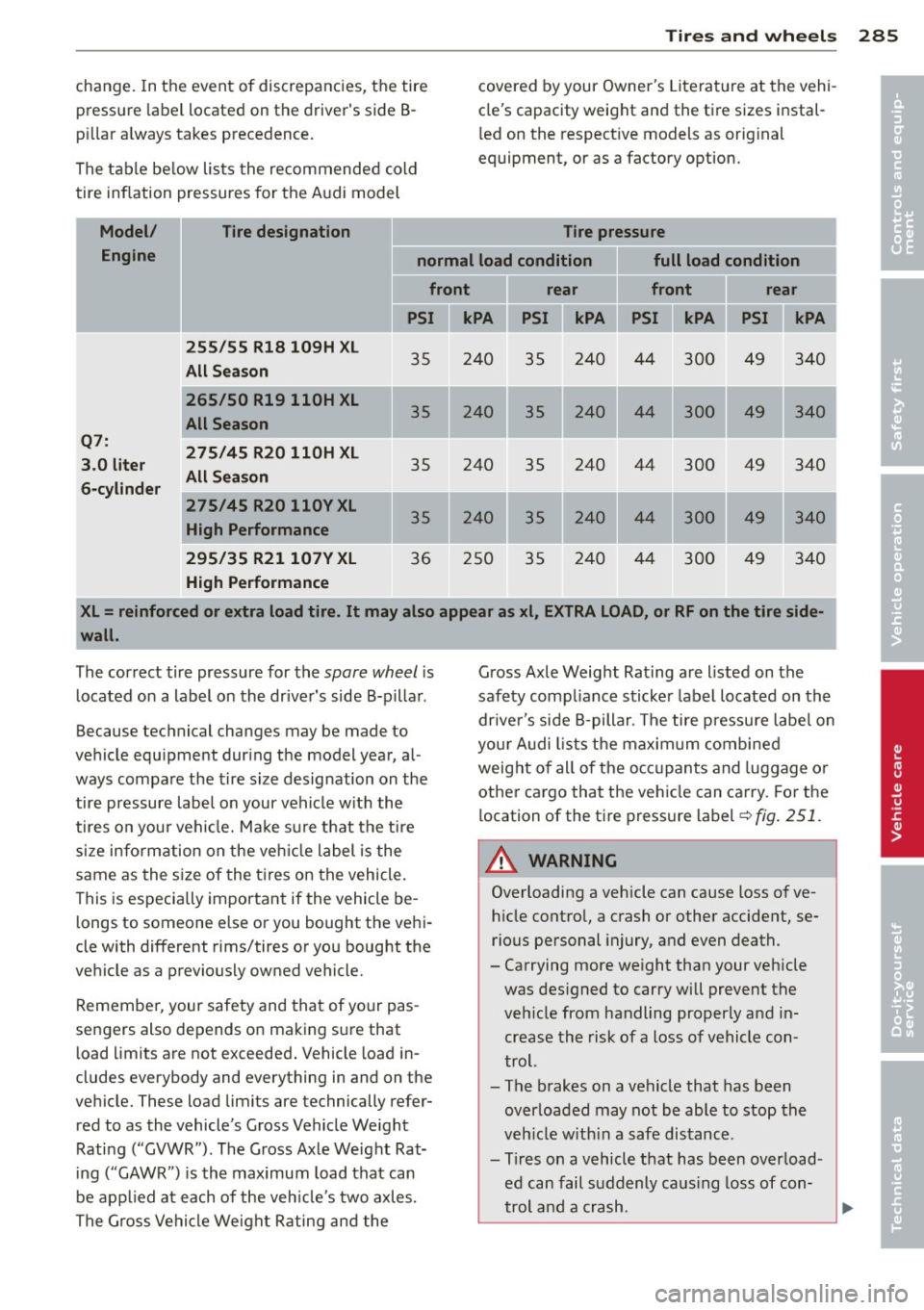
The table be low lists the recommended cold
tire inf lation pressures for the A udi model
I Model / Tire designation
covered by your Owner's Literature at the vehi
cle's capacity weight and the tire sizes instal
l ed on the respect ive models as orig inal
equipment, or as a factory option.
Tire pressure
Engine normal load condition full load condition
front rear front rear
I
PSI II kPA PSI kPA PSI j[ kPA PSI kPA
Q7:
3.0 liter
6-cy linder 2
55/5 5 Rl8 109H XL
All Sea son
265 /50 Rl9 ll0H XL
All Sea son
2 75/45 R20 ll0H XL
All S ea so n
275 /45 R20 110V XL
High Performance
295 /35 R21 10 7V XL
High Performance
35 240 35
35 240 35
35 240 35
35 240 35
36 250 35 240
44
300 49 340
240 44 300 49 340
240 44 300 49 340
•
240 44 300 49 340
I
240 44 300 49 340
XL= reinforced or extra load tire. It may als o appear as xl, EXTRA LOAD, or RF on the tire side
wall.
The correct tire pressure for the spare wheel i s
l ocated on a label on the driver's side 8-pilla r.
Because technical changes may be made to
vehicle equ ipment during the model year, al
ways compare the tire size designation on the
tire pressure label on your vehicle w ith the
tires on your vehicle. Ma ke sure that the tire
size information on the veh icle label is the
same as the s ize of the t ires on the vehicle.
This is especially important if the vehicle be l ongs to someone else or you bought the vehi
cle with different rims/tires or you bought the
vehicle as a previously owned vehicle.
Remember, your safety and that of your pas
sengers also depends on making sure that
l oad limits are not exceeded. Vehicle load in
cludes everybody and everything in and on the
vehicle. These load limits are technically refer red to as the vehicle's Gross Vehicle We ight
Rating ("GVWR") . The Gross Axle Weight Rat
i ng ("GAWR") is the maximum load that can
be appl ied at each of the veh icle's two axles.
The G ross Vehicle Weight Rating and the Gross Axle Weig
ht Rating are listed on the
safety compl iance sticker label located on the
drive r's side 8-pillar . The tire pressure labe l on
your A udi lists the maxim um combined
weight of all of the occ upants and luggage or
other cargo that t he vehicle can carry. Fo r the
location of the tire pressure label ¢
fig. 251.
A WARNING
Overloading a vehicle can cause loss of ve
h icle control, a crash or other accident, se
rious personal injury, and even death.
- Carrying more we ight than your veh icle
was des igned to carry will prevent the
veh icle from handling properly and in
crease the risk of a loss of vehicle con
trol.
- The brakes on a vehicle that has been overloaded may not be able to stop the
veh icle w ith in a safe distance.
- T ires on a vehicle that has been overload
ed can fail suddenly caus ing loss of con-
trol and a crash. ..,.
•
•
Page 289 of 348
pressure label lists the recommended cold
tire inflatio n pressures for the vehicle at its
maximum capacity we ight a nd the tires that
were on your vehicle at the time it was man
ufactured . For recommended t ire pressures
for normal load condit ions, please see chap
ter ~
page 284 .
-Turn the valve stem cap counter-clockwise
to remove it from the tire valve .
- Place the air pressure gauge on the valve.
- The tire pressures should only be checked
and adjusted when the tires are cold . The
s light ly raised pressures of warm tires must
not be reduced .
- Adjust the tire pressure to the load you are
carrying.
- Re insta ll the va lve stem cap on the valve .
When should I check the tire pressure ?
The correct tire pressure is especially impor
tant at high speeds . The pressure sho uld
therefo re be checked at least once a month
and a lways before start ing a journey. Do not
forget to check the tire pressure for the spare
wheel.
When should I adju st the tire pre ssures?
Ad just the tire pressure to the load you are
carrying. After changing a wheel
or replacing
wheels you have to adjust the tire pressures
on all wheels. In addition, you must then
store the new tire pressures i n the t ire pres
sure mon itor ing system
~ page 300.
A WARNING
Incorrect tire pressures and/or unde rinfla
tion ca n lead sudden tire failure, loss of
cont ro l, col lision, ser ious persona l inju ry
or even death.
- Whe n the wa rning symbo l
[ti] appears in
the instrume nt cl uster, s top and inspect
the tires.
- Incorrect tire pressure and/or underinfl a
t ion can ca use inc reased t ire wear and
can affect the handling o f the veh icle and
stopp ing ability .
- Incorrect tire pressures and/or underin
flation ca n also lead to sud den tire fa il-
Tires an d wheel s 287
ure, including a blowout and sudden de
flation, ca using loss of veh icle contro l.
- The driver is responsi ble for the co rrect
tire pressures for all tires on the veh icle.
The applicable pressure values are locat
ed on a sticker o n the dr iver's s ide B-pil
lar .
- Onl y when all tires on the vehicle are fil
led to the correct pressure, the t ire pres
sure mon itor ing system can work cor
rectly .
- The use of incorrect tire pressure va lues
can lead to acc idents or other damage .
Therefore it is ess ential that th e drive r
observe t he spec ified t ire p ress ure val ues
for the tires and the cor rect pressures for
the func tion of the t i re p ress ure moni to r
ing system.
- Always in flate tires to the recommen ded
a nd correct t ire p ress ure be fore dr iv ing
off .
- D riving with unde rinf lated tires bend
mo re, letting them get too hot resulting
in tread separation, s udden tire failure
and loss of control.
- Excessive speed and/overloading can
cause heat b uild- up, sudden tire failure
and loss of control.
- If the tire pressure is too low or too high,
the t ires will wear premat urely and the
veh icle w ill not handle well.
- If the tire is not flat and you do not have
to change a wheel immediately, d rive at
red uced speed to the nearest service sta
tion to check the t ire press ure and add
air as requ ired .
(D Note
Driving w ithout valve stem caps can cause
damage to the tire valves. To prevent this,
a lways make sure that factory installed
valve s tem caps o n all whee ls are sec urely
mounted o n the valve .
@ For the sake of the environment
Underinflated tires will also increase the
fuel consumpt ion.
•
•
Page 301 of 348
TPMS malfunction indicator is combined with
the low tire pressure tellta le . When the sys
tem detects a malf unct ion, the te lltale will
flash for approximately one minute and then remain cont inuously illuminated. This se
quence will continue upon subsequent vehicle
start-ups as long as the malfunction ex ists .
When the malfunct ion indicator is illuminat
ed, the system may not be able to detect or
sig nal low t ire pressure as intended . TPMS
malfunct ions may occur for a variety of rea
sons, including the installat ion of rep lace
ment or alternate tires o r whee ls on the veh i
cle that prevent the TPMS from funct io ni ng
p roperly. Always check the TPM S malfunct ion
tellta le after replacing one or more tires or
wheels on your vehicle to ensure that the re p lacement or a lternate tires and wheels allow
the TPMS to continue to function properly.
Tire pressure indicator appears
The tire pressure indicator in the instrument
cluster informs you if the tire pressure is too
low or if there is a system malfunction.
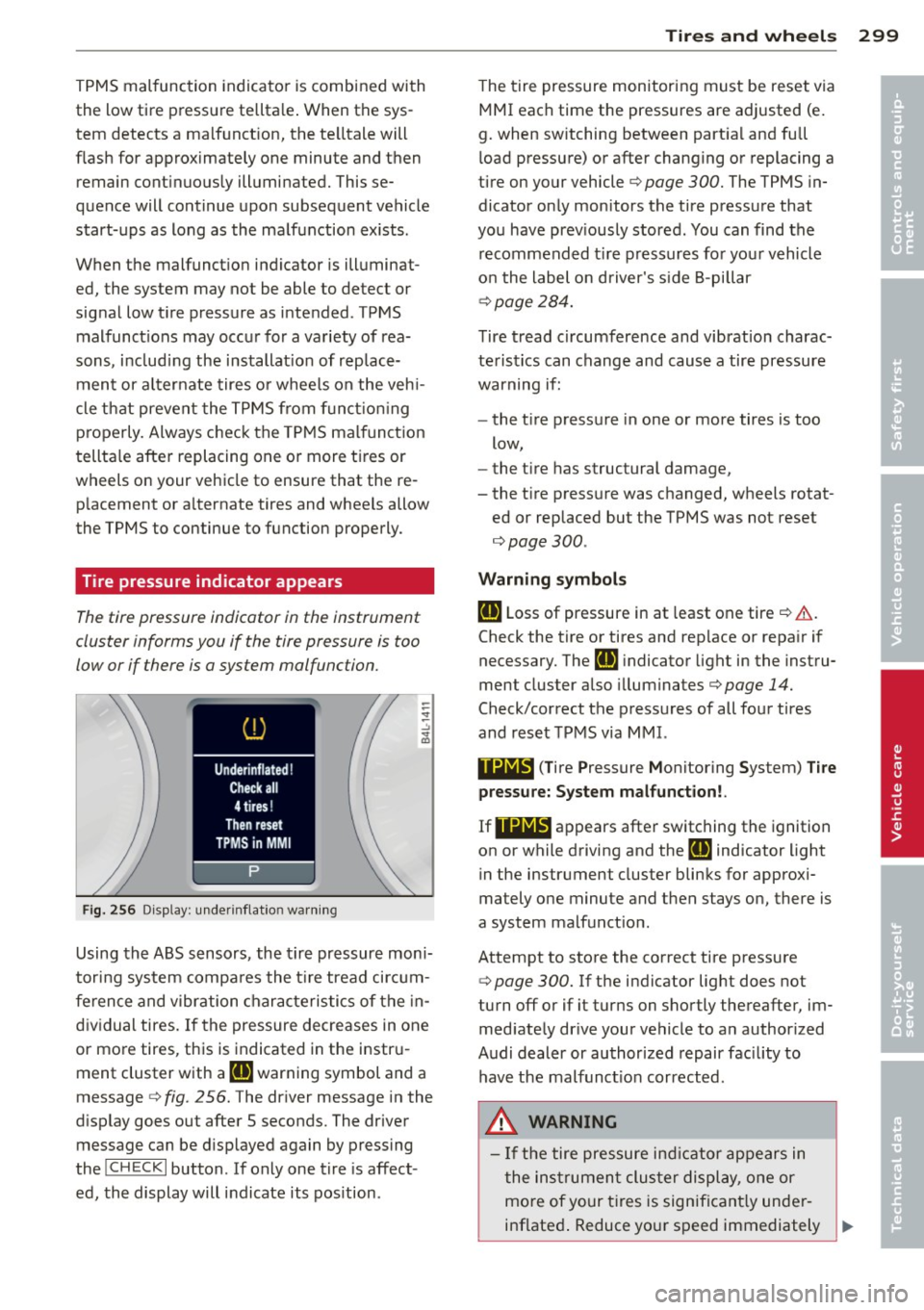
Fi g. 25 6 Display: under inflat io n warn ing
Using the ABS sensors, the tire pressure mon i
tori ng system compa res the t ire tread ci rcum
fe rence and vibration characteristics of the in
dividual tires. If the pressure decreases in one
or more tires, this is indicated in the instr u
ment cluster with a
IE warning symbol and a
message
c:> fig . 256. The driver message in the
d isplay goes out after 5 seconds. The driver
message can be d isplayed again by pressing
the
! CHECK I button . If only one tire is affect
ed, the display will indicate its pos ition .
Tire s an d wheel s 2 99
The t ire pressure monitoring must be reset via
MMI each time the pressures are adjusted (e.
g. when switching between part ia l and full
l oad pressure) or after changing or replacing a
tire on your vehicle
c:> page 300. The TPMS in
dicator on ly monitors the tire pressure that
you have prev iously stored . You can find the
recommended t ire pressures for you r vehicle
o n the label on driver's s ide 8-pillar
¢ page 284.
Tire tread circumference and vibration charac
teristics can change and cause a tire pressure
warning if:
- the t ire pressure in one or more tires is too
low,
- the t ire has structural damage,
- the t ire press ure was changed, wheels rotat-
ed or replaced but the TPMS was not reset
¢page 300.
Warni ng symbo ls
IE Loss of pressure in at least one tire ¢ &..
Check the tire or tires and rep lace or repa ir if
necessary. The
Rt] i ndicator light in the instru
ment cluster also illuminates¢
page 14.
Check/correct the p ressures of all four tires
and reset TPMS via MMI.
••NIB (T ire Pressure Monitoring System) Tir e
pressure: System malfunct ion!.
If llilW appears
after switching the ignition
on or while driving and the
IE indicator light
in the instrument cluster blinks for approxi
mately one minute and then stays on, there is
a system malfunct ion.
Attempt to store the correct tire pressure
¢
page 300. If the indicator light does not
turn off or if it turns on shortly thereafter, im med iate ly dr ive your vehicle to an author ized
Audi dealer or authorized repair fac ility to
have the malfunct ion corrected.
_&, WARNING
- If the tire pressure ind icator appears in
the ins trument cluster display, one or
mo re of your t ires is significant ly under
inflated . Reduce your speed immediately ..,
•
•
Page 302 of 348
300 Tire s and whee ls
and avoid any hard steering or braking
maneuvers. Stop as soon as possible and
check the tires and their pressures. In
flate the tire pressure to the proper pres
sure as indicated on the vehicle's t ire
pressure label~
page 284 . Driving on a
significantly under-inflated tire causes
the tire to overheat and can lead to tire
failure. Under-inflation also is likely to impair the vehicle's handling and stop
ping ability.
- T he driver is responsible for ma inta ining
the correct tire pressures . You must
check the tire pressures regular ly.
- Under certain conditions (such as a spor
ty driving style, winter conditions or unpaved roads), the pressure monitor ind i
cator may be de layed.
- Ask your authorized Audi dealer if run
flat tires may be used on your veh icle.
Your vehicle registration becomes invalid if you use these tires when not permit
ted . Damage to your veh icle or acc idents
could also result .
(D Tips
-The tire pressure monitoring system
stops working when there is an ESC/ABS
malfunction .
- Using snow chains may result in a system
malfunction.
- The tire pressure monitoring system on
your Audi was developed using t ires with
the "AO" or "RO" identification on the
tire sidewall
Q page 291 . We recom
mend using these t ires.
Reset tire pressure monitoring system
If the tire pressure is adjusted , wheels are ro
tated or changed, the TPMS must be reset via
MMI.
.. Before resetting the TPMS, the current pres
sures of all four tires must correspond to
the specified val ues. Adjust the tire pressure
and reset the pressure i n the t ire p ressu re monitoring system according to the load
you are carrying
Q page 284.
.. Turn on the ign ition.
.. Select:
!CAR ! function button> Systems *
contro l bu tto n > Tire p ressure monitoring >
S tor e now . Or
.. Select :
!CAR ! function button> Car sy s
tems *
contro l button > Se rvicing & che cks >
Tire pres sure monitoring > Sto re tir e pre s
s ure s.
(D Tips
Do not sto re the tire pressure if there are
snow cha ins on the tire.
Page 304 of 348
302 What do I do now ?
plate. If this happens, the vehicle may
start to move while a wheel is being changed.
- Never use the folding chocks if they are
damaged or if they have not been assem
bled correctly.
A WARNING
Improper use of the vehicle jack can cause
ser ious persona l injuries.
- Never use the jack supplied with your
Audi on anothe r vehicle, particularly on a
heavier one. The jack is only suitable for
use on the vehicle it came w ith.
- Us ing a bumper jack to raise the vehicle
will damage the bump er system. The
jack may slip, causing in jury.
- Never support your veh icle on cinder
blocks, b ricks or other objec ts. These
may no t be ab le to suppor t the load and
c ou ld cau se injury whe n they fail.
- Never start o r run the engine while the
vehicle is supported by the j ack.
- If you must wo rk under the vehicle, al
ways use safety stands specifically de
signed for this purpose.
- Always make su re the inf latable spare
ti re and even a flat tire a re se cu red in
pla ce and not loose, otherwise t hey
c ou ld f ly forward, causing personal in jury
to passengers in the veh icle in an acc i
dent o r sudden mane uver.
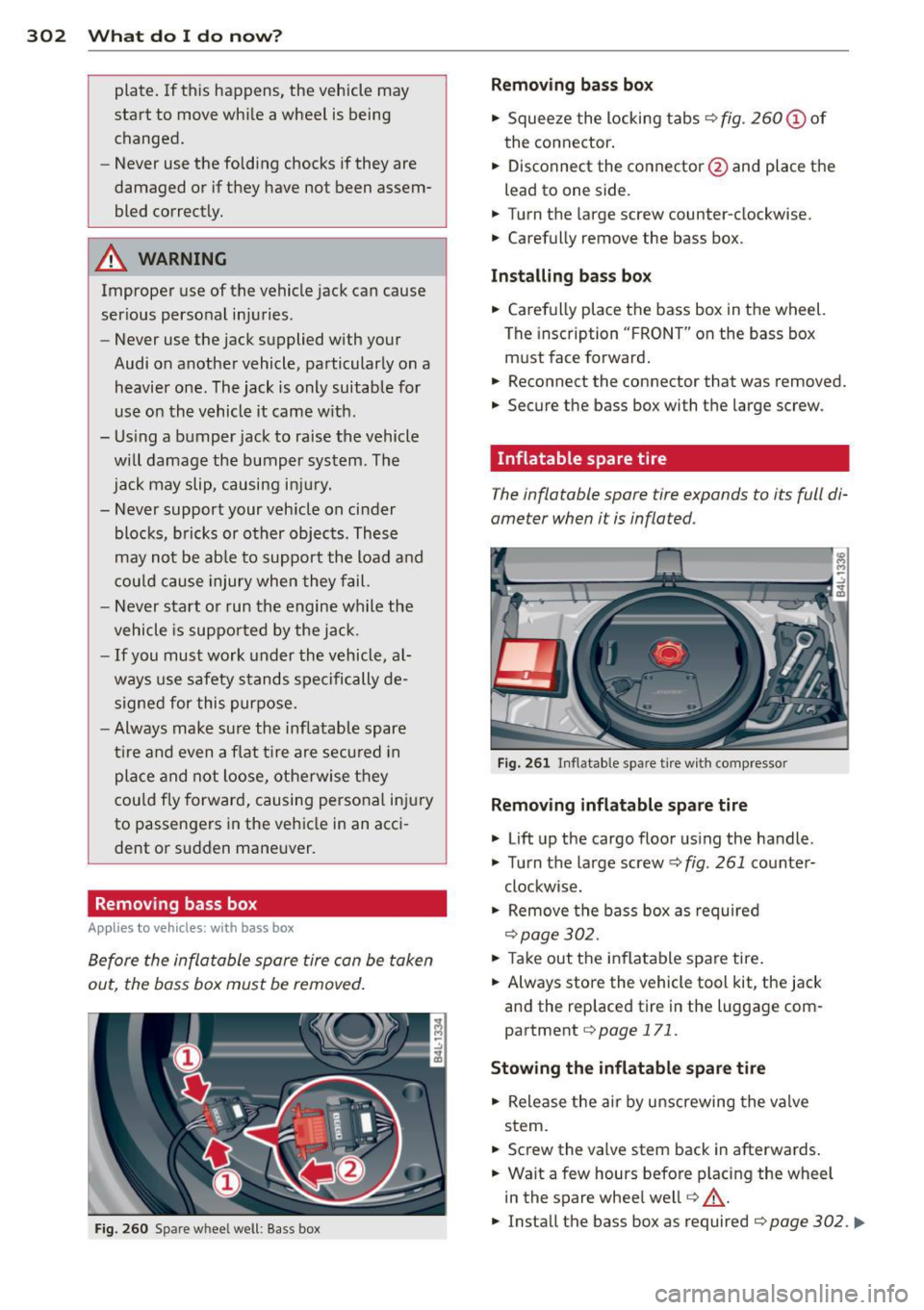
Removing bass box
Applies to vehicles: with bass box
Before the inflatable spare tire can be taken
out, the bass box must be removed .
Fig. 260 Spare wheel well: Bass box
Removing bass box
" Squee ze the locking tabs ¢ fig. 260 (!) of
the connector .
" Disconnect the connector @and place the
lead to one side.
" Turn t he large screw counter-clockwise.
" Carefully
remove the bass box.
Installing bass bo x
" Carefully place t he bass box in the wheel.
The insc ription "FRO NT" on the bass box
m ust face forward .
" Reconnect the connector that was removed.
" Secure the bass box with t he large screw.
· Inflatable spare tire
The inflatable spare tire expands to its full di
ameter when it is inflated.
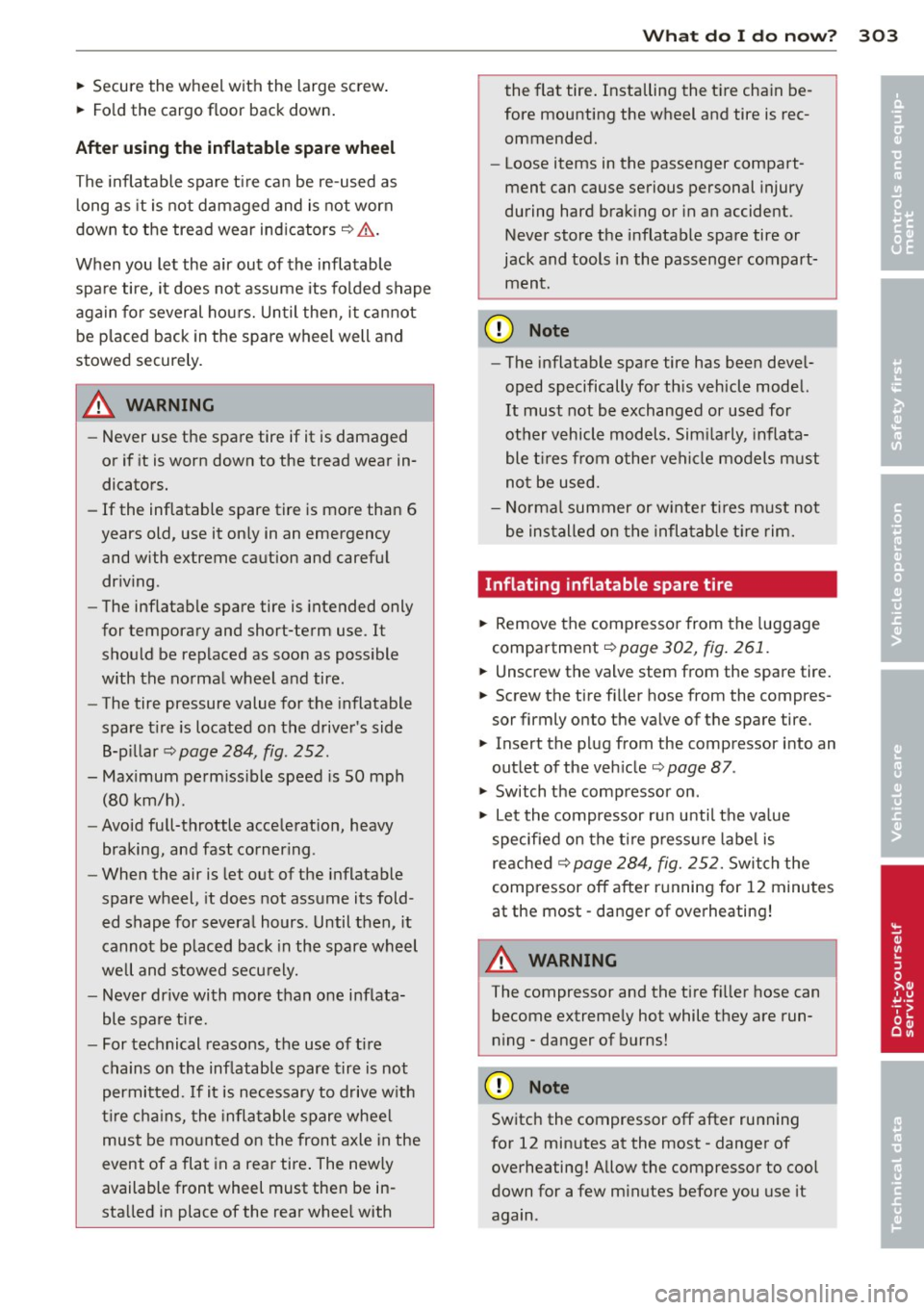
Fi g. 2 61 In flatable spare t ire w ith compressor
Removing inflatable spare tire
" Lift up the cargo floor us ing the handle .
" Tu rn the large screw¢
fig. 261 co unter-
clockwise.
" Remove the bass box as required
¢page 302.
" Take out the inflatable spare tire .
" Always sto re the vehicle tool kit, the jack
and the replaced tire in the luggage com
partment
¢page 171.
Stowing the inflatable spar e tire
" Release the air by unscrewing the valve
stem.
" Screw the valve stem back in afterwards .
" Wait a few hours befo re p lacing the wheel
in the spare whee l we ll
r=:, _.&.
" Install the bass box as required r=:, page 302 . ..,.
Page 305 of 348
• Secure the wheel with the large screw.
• Fold the cargo floor back down.
After using the inflatable spare wheel
The inflatable spare tire can be re-used as
long as it is not damaged and is not worn
down to the tread wear indicators~.&. .
When you let the air out of the inflatable
spare tire, it does not assume its folded shape
again for several hours. Until then, it cannot
be placed back in the spare wheel well and
stowed securely.
A WARNING
- Never use the spare tire if it is damaged
or if it is worn down to the tread wear in
dicators.
- If the inflatable spare tire is more than 6
years old, use it only in an emergency
and with extreme caution and careful
driving .
- The inflatable spare tire is intended only
for temporary and short-term use .
It
should be replaced as soon as possible
with the normal wheel and tire.
- The tire pressure value for the inflatable
spare tire is located on the driver's side
B-pillar ~page284,
fig . 252.
-Maximum permissible speed is 50 mph
(80 km/h).
- Avoid full-throttle acceleration, heavy
braking, and fast cornering.
- When the air is let out of the inflatable
spare wheel, it does not assume its fold
ed shape for several hours . Until then, it
cannot be placed back in the spare wheel
well and stowed securely.
- Never drive with more than one inflata
ble spare tire.
- For technical reasons, the use of tire
chains on the inflatable spare tire is not
permitted. If it is necessary to drive with
tire chains, the inflatable spare wheel
must be mounted on the front axle in the
event of a flat in a rear tire. The newly
available front wheel must then be in
stalled in place of the rear wheel with
What do I do now? 303
the flat tire. Installing the tire chain be
fore mounting the wheel and tire is rec
ommended.
- Loose items in the passenger compart
ment can cause serious personal injury
during hard braking or in an accident.
Never store the inflatable spare tire or
jack and tools in the passenger compart
ment.
(D Note
- The inflatable spare tire has been devel
oped specifically for this vehicle model.
It must not be exchanged or used for
other vehicle models. Similarly, inflata
ble tires from other vehicle models must
not be used.
- Normal summer or winter tires must not
be installed on the inflatable tire rim.
Inflating inflatable spare tire
• Remove the compressor from the luggage
compartment ~
page 302, fig. 261.
• Unscrew the valve stem from the spare tire.
• Screw the tire filler hose from the compres
sor firmly onto the valve of the spare tire.
• Insert the plug from the compressor into an
outlet of the vehicle~
page 87.
• Switch the compressor on .
• Let the compressor run until the value
specified on the tire pressure label is
reached
~ page 284, fig. 252. Switch the
compressor off after running for 12 minutes
at the most -danger of overheating!
A WARNING
-
The compressor and the tire filler hose can
become extremely hot while they are run
ning -danger of burns!
(D Note
Switch the compressor off after running
for 12 minutes at the most -danger of
overheating! Allow the compressor to cool
down for a few minutes before you use it
again .
•
•
Page 306 of 348
304 What do I do now?
Changing a wheel
Before changing a wheel
Observe the following precautions for your
own and your passenger's safety when chang
ing a wheel .
• After you experience a tire failure, pull the
car well away from moving traffic and try to
reach
level ground before you stop ¢,& .
• All passengers should
leave the car and
move to a safe location (for instance, behind
the guardrail) ¢
A-
.. Engage the parking brake to prevent your
vehicle from rolling unintentionally ¢,& .
• Move
selector lever to position P <=> ,&.
• If you are towing a trailer: unhitch the trail
er from your vehicle.
• Block the diagonally opposite wheel wi th
the folding chocks or other objects.
• Take the
jack and the inflatable spare tire
out of the luggage compartment
¢page 301.
11. WARNING
=
You or your passengers could be injured
while changing a whee l if you do not fol
low these safety precautions :
- If you have a f lat tire,
move a safe dis
tance off the road . Turn off the engine,
turn the emergency flashers on and use
other warning devices to alert other mo
torists .
- Make sure that passengers wait in a safe
place away from the vehicle and well
away from the road and traff ic.
- To help prevent the vehicle from moving
suddenly and possibly slipping off the
jack, always fully set the parking brake
and block the wheel diagonally opposite
the wheel being changed with the fold
ing chocks or other objects. When one
front whee l is lifted off the ground, plac
ing the Auto mat ic Transmission in "P"
(Park) will
not prevent the vehicle from
moving .
-
-Before you change a wheel, be sure the
ground is level and firm. If necessary,
use a sturdy board under the jack.
- After installing the inflatable spare tire,
make sure that you replace the flat tire/
wheel in its storage area properly and
tighten the knurled retaining screw se
curely .
' Changing a wheel
When you change a wheel , follow the se
quence described below step-by-step and in
exactly that order .
l. Activate the vehicle jack mode (only
vehicles with Adaptive Air Suspension)
¢ page 159.
2. Remove the decorative wheel cover* . For
more details see also ¢
page 305, Deco
rative wheel covers
or ¢ page 305,
Wheels with wheel bolt caps.
3. Loosen the wheel bolts¢ page 305.
4. Locate the proper mounting point for the
jack and align the jack be low that point
¢ page 306.
5. Lift the car with the jack¢ page 306.
6. Remove the wheel with the flat tire and
then install the
inflatable spare tire
¢page 307 .
7. Tighten all whee l bolts lightly.
8.
Lower the vehicle with the jack .
9. Use the wheel bolt wrench and
firmly
tighten all wheel bolts¢ page 305.
10. Rep lace the decorative wheel cover*.
11. Deactivate the vehicle jack mode (only
vehicles with Adaptive Air Suspension)
¢page 159.
A WARNING
Always read and follow all WARNINGS and
inf ormat ion¢ .&.
in Raising the vehicle on
page
307 and ¢page 308.
Page 307 of 348
After changing a wheel
A wheel change is not complete without doing the following .
• Always store the vehicle tool kit, the jack
and the replaced tire in the luggage com
partment <=>
page 171.
• As soon as possible, have the tightening
torques
on all wheel bolts checked with a
torque wrench . The correct tightening tor
que is 120
ft lb (160 Nm).
• Have the flat tire
replaced as soon as poss i
ble.
(D Tips
- If you notice that the wheel bolts are
corroded and difficult to turn while
changing a tire, they should be replaced
before you check the tighten ing torque.
- Drive at reduced speed until you have the
tightening torq ues checked.
Decorative wheel covers
Applies to vehicles: with decorative wheel cove rs
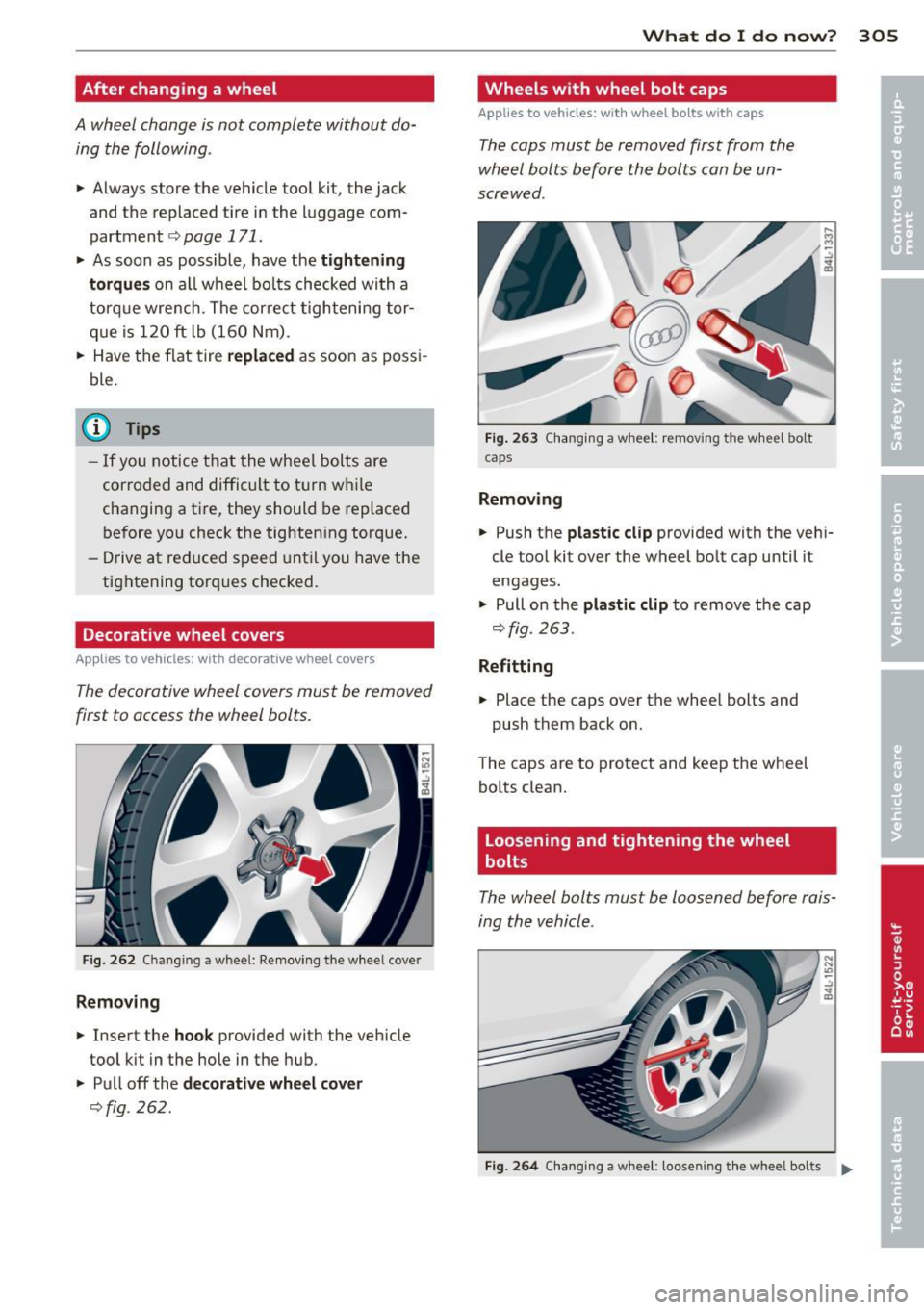
The decorative wheel covers must be removed
first to access the wheel bolts.
Fig . 262 C h ang ing a whee l: Removing the wheel cove r
Removing
• Insert the hook provided with the veh icle
tool kit in the hole in the hub.
• Pull off the
decorative wheel cover
c>fig . 262.
What do I do now? 305
Wheels with wheel bolt caps
Applies to vehicles: with wheel bolts with caps
The cops must be removed first from the
wheel bolts before the bolts can be un
screwed .
Fig. 263 Chang ing a whee l: removing the wheel bo lt
caps
Removing
• Push the plastic clip provided with the veh i
cle tool kit over the wheel bolt cap until it
engages .
• Pull on the
plastic clip to remove the cap
c>fig. 263.
Refitting
• Place the caps over the wheel bolts and
push them back on.
The caps are to protect and keep the wheel bolts clean.
Loosening and tightening the wheel
bolts
The wheel bolts must be loosened before rais
ing the vehicle.
Fig. 264 C ha ng in g a wheel : loosen ing t he whee l bol ts ...
Page 308 of 348
306 What do I do now?
Loosening
.,. Install the wheel bolt wrench over the
wheel bolt and push it down as far as it will
go .
.,. Take tight hold of the
end of the wrench
handle and turn the wheel bolts
counter
clockwise
about one single turn in the direc
tion of arrow
c:> fig. 264.
Tightening
.,. Install the wheel bolt wrench over the
wheel bolt and push it down as far as it will
go .
.,. Take tight hold of the
end of the wrench
handle and turn each wheel bolt
clockwise
until it is seated .
A WARNING
- Do not use force or hurry when changing
a wheel - you can cause the vehicle to slip
off the jack and cause serious personal
injuries.
- Do not loosen the wheel bolts more than
one turn
before you raise the vehicle with
the jack. - You risk an injury.
@ Tips
If a wheel bolt is very tight, you may find it
easier to loosen by carefully pushing down
on the end of the wheel bolt wrench with
one foot only. As you do so, hold on to the
car to keep your balance and take care not
to slip.
Raising the vehicle
The vehicle must be lifted with the jack first
before the wheel can be removed.
Fig. 265 Sill pane ls: mar kings
Fig. 266 Sill: posit ioning the jack
.,. Activate the vehicle jack mode* (only
vehicles with Adaptive Air Suspension)
<::> page 159 .
.,. Engage the parking brake to prevent your
vehicle from rolling unintentionally
.,. Move the
selector lever to position P .
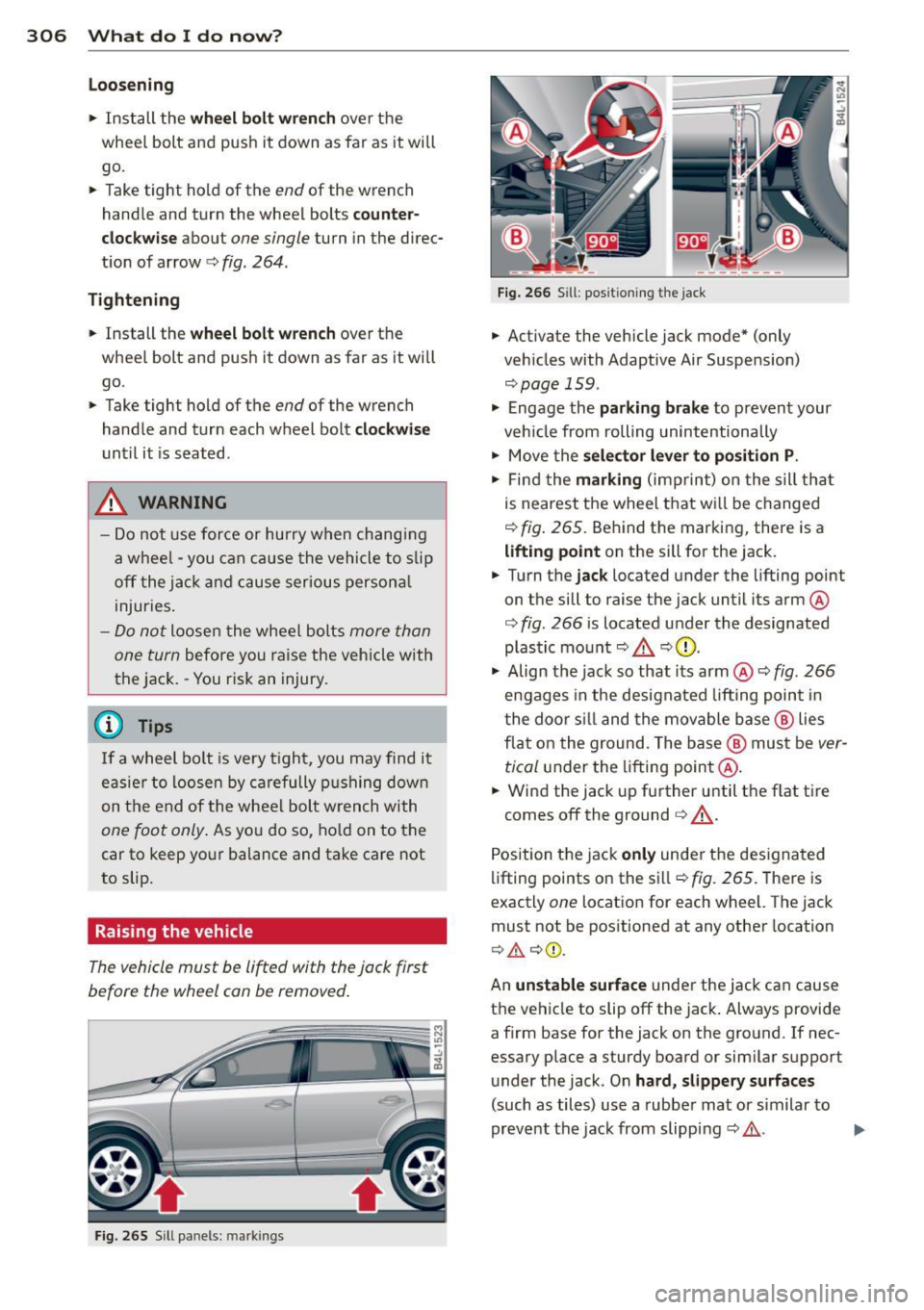
.,. Find the marking (imprint) on the sill that
is nearest the wheel that will be changed
<=>
fig. 265. Behind the marking, there is a
lifting point on the sill for the jack.
.,. Turn the
jack located under the lifting point
on the sill to raise the jack until its arm@
<=>
fig . 266 is located under the designated
plastic mount<=>
& c::>(D .
.,. Align the jack so that its arm @ c::> fig. 266
engages in the designated lifting point in
the door sill and the movable base® lies
flat on the ground. The base @ must be
ver
tical
under the lifting point@.
.,. Wind the jack up further until the flat tire
comes off the ground
c:> ,& .
Position the jack only under the designated
lifting points on the sill
<=>fig . 265. There is
exactly
one location for each wheel. The jack
must not be positioned at any other location
<=>
.&. <=> CD .
An unstable surface under the jack can cause
the vehicle to slip off the jack. Always provide
a firm base for the jack on the ground. If nec
essary place a sturdy board or similar support
under the jack . On
hard, slippery surfaces
(such as tiles) use a rubber mat or similar to
prevent the jack from slipping
c:> ,&.. liJI,
Page 310 of 348
308 What do I do no w?
When removing or installing the wheel,
the rim could hit the brake rotor and dam
age the rotor. Work carefully and have a
second person help you.
- When mounting tires with
unid irection al
tread design
make sure the tread pat
tern is pointed the right way
¢ page 308 .
-The wheel bolts should be clean and easy
to turn. Check for d irt and corrosion on
the mat ing surfaces of both the wheel
and the hub . Remove all dirt from these
su rfaces before remount ing the wheel.
Tires with unidirectional tread design
Tires with unidirectional tread design must be
mounted with their tread pattern pointed in
the right direction.
Using a spare t ire w ith a tread pattern
int ended fo r use in a specific direct ion
When us ing a spa re tire w ith a t read patte rn
i n te nded for use in a specific direction, p lease
note the fo llowing:
- The direction of rotation is marked by an ar
row on the side of the tire .
- If the spare t ire has to be in stalled in the in
correct d irection, use the spare tire only
temporarily since the t ire will not be able to
a chieve its optimum perfo rmance character
ist ics w ith reg ard to aquapl ani ng, noise and
wea r.
- We recommend tha t you pay pa rticular at
tent ion to this fact du ring wet weather and
that you adjust your speed to ma tch road
conditions .
- Replace the fla t tire w ith a new one and
have it installed on your veh icle as soon as
poss ible to restore the handling advantages
of a unid irect iona l tire .
Notes on wheel changing
Please read t he i nfo rmat ion Q page 291 , New
tires and replacing tires and wheels
if yo u are
go ing to use a spa re tire which is different
from the tires on yo ur vehicle.
After you change a tire:
- Check the tire pressure on the spar e imm e
diately after installation .
- Ha ve the wheel bolt tightening torque
ch ecked with a torque wr ench as soon a s
po ssible by your authorized Audi deal er or
a qua lifi ed workshop.
- With steel and alloy wheel rim s, the wheel
bolt s are corre ctly tightened at a torque of
120 ft lb (160 Nm) .
- If you notice that the wheel bolts ar e cor
roded and difficult to turn while changing
a tir e, they should be repla ced before y ou
c h eck the tightening torque .
- Re pla ce the flat tire wi th a new on e and
have it in stalled on y our vehi cle a s soon a s
po ssible. Remount the wheel cover.
Until th en , dr iv e with extra car e and at re
duc ed sp eed s.
&_ WARNING
-
- If you a re going to eq uip your vehi cle
with tires or rims which differ from those
which were factory installed, then be
sure to read the information
Q page 291,
New tires and replacing tires and
wheels.
- Always make s ure the damaged wheel o r
even a flat tire and the jack and tool kit
are property secured in the luggage com
partment and are not loose in the pas
senger compartment .
- In an accident or sudden maneuver they
could fly forwa rd, injuring anyone in the
ve hicle .
- Always store damaged wheel, jack and
too ls securely in the luggage compa rt
ment. Othe rwise, in a n accident o r sud
den maneuve r they could f ly forwa rd ,
causing inj ury to passengers in the ve hi
cle .