cooling AUDI Q7 2013 Owner´s Manual
[x] Cancel search | Manufacturer: AUDI, Model Year: 2013, Model line: Q7, Model: AUDI Q7 2013Pages: 348, PDF Size: 87.72 MB
Page 99 of 348
@ Tips
If the climate control system is operating
in cooling mode, a ir flows primarily from
the outlets in the center conso le and in the
door pillars. To achieve adequate cooling,
you should never close the outlets com
pletely .
Using climate control economically
Using the climate controls prudently can help
save fuel.
When you use the air conditioner, engine pow
er is reduced and fuel consumption increases.
To save fuel, you should use the air condition
e r only when necessary. Also please note the
following points :
.,. To save fuel, turn off cooling mode by press
ing the
I AC ! button (indicator light goes
out) .
.,. In add ition, if you open the window or the
Panoramic sliding sunroof* while driving,
turn off cooling mode by p ress ing the
IACI
button (indicator light goes out).
.,. If the vehicle is extremely hot due to the
heat of the sun, briefly open doors and win
dows.
@ For the sake of the environment
By reducing the amount of fue l you use,
you also reduce the amount of poll utants
emitted into the air. W
arm and cold 9 7
Rear Air Conditioning
Rear air conditioning - controls
Applies to vehicles: with four-zone automatic comfort air
conditio nin g
This overview is to assist you in familiarizing
yourself with the rear air conditioning con
trols.
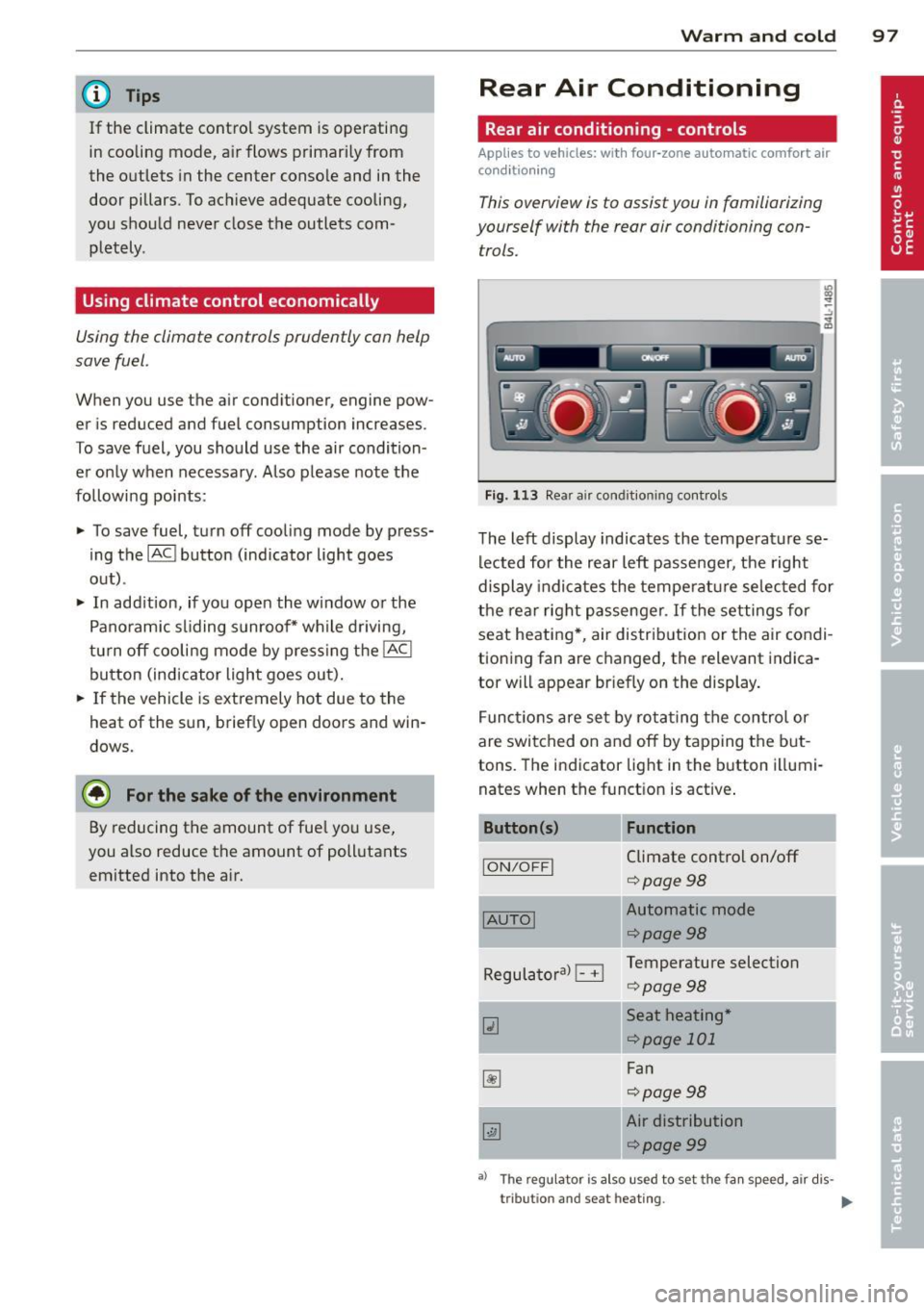
lll ... :;
- --- ------------....... ~
Fig . 113 Rea r air conditioning controls
The left display indicates the temperature se
lected for the rear left passenger, the right
display indicates the temperature selected for
the rear right passenger . If the settings for
seat heating *, air distribution or the air condi
tioning fan are changed, the relevant indica
tor will appear br iefly on the display .
Funct io ns are set by ro tating the control or
are switched on and off by tapping the but
tons. The indicator light in the button illumi
nates when the function is active.
Button (s) Function
ION/OFFI Climate control on/off
¢ page98
-
IAUTOI Automatic mode
¢page98
Regulatoral El Temperature selection
¢page98
Qi Seat heating *
¢page 101
~
Fan
¢page98
~
Air distribution
¢page99
a) The regu lator is also u sed to set the fan sp ee d, air dis-
tribut ion and seat heating .
IIJ,
Page 100 of 348
98 Warm and cold
Synchronizin g rear ai r conditioni ng: By
pressing and holding the regulator on the rear
left side, the temperature setting of the rear
left side can be switched to the rear r ight side
and v ice versa. The new temperature is shown
in the display .
Turning on and off~
App lies to vehicles: with four -zone automat ic comfort a ir
co nd it io nin g
Tu rning the clim ate co ntro l on
"' Press the !ON /OFF I button , or
"' Press the
!AU TO I button.
Tu rning the climate con trol off
"' Press the !ON /O FF I button to swi tch the cli
mate control off and to b lock the air supply
from the outside .
The air conditioner turns back on when you
press the
temp eratu re reg ula tor or one of the
buttons .
{D) Tips
If the power child safety lock is on, the
rea r air condi tioning control element wi ll
not operate . In this case, dashes" ••• " wi ll
appear in the air condit ion ing control ele
ment d isp lay.
Automat ic mode in rear~
Applies to vehicles: with four-zone automat ic comfort a ir
co nd it io nin g
The automatic mode is the standard setting
for all seasons.
"' Se lect temperature between 60 °F (+16 °C)
and
84 °F (+28 °().
"' Press the
!AUTO I button.
Automatic operation ensu res constant tem
pe ratures in the inter io r and dehum idifies the
a ir i nside the vehicle. Ai r temperature, vo lume
and d istr ibu tion a re con trolled a utomat ically
to reach or maintain the desired inter ior tem
perat ure as quickly as possible . Fl uctuations
in exterior t emperat ure and the effects of temperature from the position of the s
un are
compensated for automatically .
T his operating mode works on ly in the adj ust
able temperature range, from
60 ° F (+ 16 °C )
to
84 °F ( + 28 °C) . If a temperature below 60
°F (+ 16 °C) is se lected, LO appears in the dis
play . At temperatures above
84 ° F (+ 28 °(),
HI is displayed . At bot h extreme sett ings, cli
mate control runs contin uously at maximum
cooling o r heating power . There is no temper
ature regulat ion.
Setting rear temperature
App lies to vehicles: wit h four-zone auto matic comfort air
conditio ning
The temperature can be separately adjusted
for the rear left and right sides .
"' Rotate the regulator to the left to red uce
the temperature, or to the r ight to increase
the temperature .
T he selected temperature appea rs on the cl i
mate control display.
Rear fan~
Appl ies to vehicles : wit h four-zone auto matic co mfo rt air
condition ing
The automatically preset fan speed can be re
duced or increased .
"' Press the~ butto n.
"' Rotate the regulator to the des ired fan
speed.
The climate control system automatically reg u lates fan speed depending on inter ior tem
perature. You ca n adjust the volume of air p ro
duced by the fan to your own requirements .
(D Tips
It is possible that the fan speed may
change automatically. This occurs to en
su re that the des ired temperature setting
i s reached as quickly as possible.
Page 244 of 348
242 Trailer towing
Weight Rating will also change the per
formance and handling characterist ics of
your vehicle, which could cause a crash result ing in serious injury or death .
- The Gross Vehicle Weight Rat ing for your
vehicle would be exceeded if your vehicle
is simultaneously equipped with Panor
am ic sliding sunroof; th ird-row seating;
t railer towing equipment (factory or
dealer-installed) , and running boards
(deale r-installed) . UNDER NO CIRCUM
STANCES MAY ALL SUCH ITEMS BE IN
STALLED ON THE SAME VEHICLE.
Operating instructions
MAX 6.9"
MAX175mm
E
Ill E Ill ... Q) m
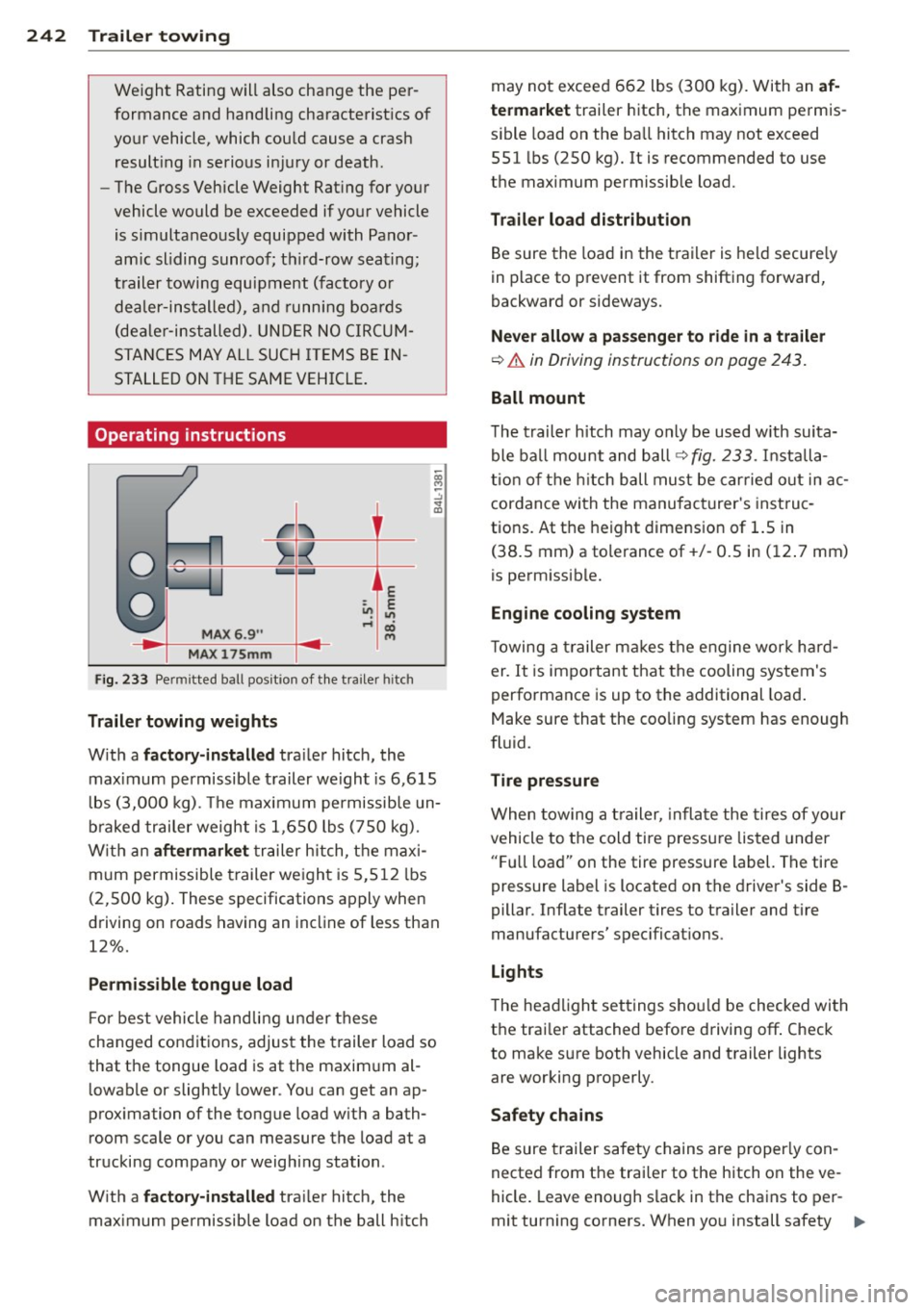
Fig. 233 Permi tted ba ll pos it ion of t he t ra iler h itc h
Trailer towing weights
With a factory-installed trailer hitch, the
maximum permissible trailer weight is 6,615
l bs (3,000 kg) . Th e maximum permissible un
braked trailer weight is 1,650 lbs (750 kg).
With an
aftermarket trailer hitch, the maxi
m um permissible trailer weight is 5,512 lbs
(2,500 kg) . These specifications apply when
driving on roads having an incline of less than
12%.
Permissible tongue load
F or best vehicle handling under these
changed condit ions, adjust the trailer load so
that the tongue load is at the maximum al
lowable or slightly lower . You can get an ap
prox imation of the tongue load w ith a bath
room scale or you can measure the load at a
trucking company or weighing station .
With a
factory-installed trailer hitch, the
maximum permissible load on the ball h itch may not exceed 662 lbs
(300 kg). With an
af
termarket
trailer hitch, the maximum permis
s ib le load on the ba ll hitch may not exceed
551 lbs (250 kg). It is recommended to use
the maximum permissible load.
Trailer load distribution
Be sure the load in the trailer is held secure ly
in place to prevent it from shifting forward,
backward or sideways.
Never allow a passenger to ride in a trailer
¢&. in Driving instructions on page 243.
Ball mount
The trailer hitch may only be used w ith suita
ble ball mount and ball¢
fig. 233. In stalla
tion of the hitch ball must be carried out in ac
cordance with the manufac turer's instruc
tions. At the height dimension of 1.5 in
(38.5 mm) a tolerance of +/- 0.5 in (12. 7 mm)
is permissib le.
Engine cooling system
Towing a trailer makes the engine work ha rd
er . It is important that the cooling system's
performance is up to the additional load .
Make sure that the cooling system has enough
fluid .
Tire pressure
When towing a trailer, infla te the tires of your
vehicle to the cold tire pressu re listed under
" Full l oad" on the tire pressure label. The tire
pressure label is located on the driver's side B
pillar . Inflate trailer tires to trailer and tire
manufacturers' spec ificat ions .
Lights
The headlight settings shou ld be checked with
the trai ler attached before driving
off. Check
to make sure both vehicle and trailer lights
are working properly.
Safety chains
Be sure trailer safety chains are properly con
nected from the trai ler to the h itch on the ve
hicle. Leave enough slack in the chains to per
mit turning corners. When you install safety
IJ,,
Page 270 of 348
268 Checking and filling
VW 502 00 (vehicles with gasoline engine) or
VW 507 00 (vehicles with diesel engine).
Changing the engine oil
The engine oil and oil filter must be changed
according to the m ileage (ki lometers) and
time intervals specified in your vehicle 's War
ranty
& Maintenance booklet. Do not exceed
these intervals -harmful deposits from old
engine oil can reduce engine performance and
can lead to expensive engine repairs.
Changing the oil at the recommended inter
va ls is so very important because the lubricat
ing properties o f oi l decrease gradually during
normal vehicle use. If you are not sure when
you have your o il changed, ask your author
i z ed Audi Service Advisor.
Under some ci rcumstances the engine oi l
should even be changed more frequently .
Change oi l more often if you drive mostly
short distances, operate the vehicle in dusty
areas or mostly under stop-and-go traffic con
d itions, or when you use your vehicle w here
temperatures stay below freez ing point for
l ong periods .
Detergent additives in the o il w ill make fresh
oil look dark after the engine has been run
ni ng for a short time . This is normal and is not
a reason to change the oil more often than
recommended.
Damage or malfunctions due to lack of
maintenance
It is essential that you change your oil at the recommended intervals using only engine oil
that complies with Audi oi l standard
VW 502 00 (vehicles with gasoli ne engine) or
VW 507 00 (veh icles with diese l engine) . Your
Limited New Vehicle Warranty does not cover
damage or malf unctio ns due to failure to fol
lo w recommended maintenance and use re
quirements as set forth in the A udi Owner's
Manual and Warranty
& Maintenance booklet.
Your dea ler will have to deny warranty cover
age unless you present to the dealer proof in
the form of Service or Repa ir Orders that all scheduled maintenance was
performed in a
timely manner.
Engine oil consumption
To provide effective lubrication and cooling for
internal engine parts, all internal combustion
engines use some o il. Oil consumption varies
from engine to engine and may change over
the life of the engine. Engines tend to use
more o il during the break-in period tha n they
do afterward, when oil consumption has sta
bilized. Depending on the way the vehicle is
driven and the operating conditions, oil con
s u mption can be up to 1 quart per 1,200
miles (1 liter per 2,000 km) . Consumption
may be higher within the first 3,000 m iles
(5,000 km) .
Under normal conditions, the rate of oil con
sumption depends on oil quality as well as vis
cosity, engine speed (rpm), outs ide tempera
ture, road conditions, the amount of oil dilu
t ion caused by condensed water or fue l resi
due, and ox idat ion of the oil. Oil co nsumption
may increase with engine wear over time, un
t il replacement of worn engine pa rts may be
come necessary.
Because of all these variables, there is no
standard or "norma l" rate of oil consumption .
We urge you to check the engine oil level at
regular intervals, preferably every time you
fill the fuel tank, and always before a long
trip.
The oil pressure warning light. is not an
indicator of low engine oil level. If the warn
ing light does not go out after starting, or
flashes while driving (above 1500 rpm), a
buzzer will sound. It indicates that the oil
pressure is too low . Stop the engine immedi·
ately, check the engine oil level and add oil if
necessary. If the engine oil level is normal,
but the light continues to flash, do not keep
driving or let the engine idle, as damage may
occur .
II-
Page 273 of 348
a reason to change the oil more often than recommended.
A WARNING
Stop! Before working in the engine com
partme nt, always read and heed all WARN
INGS
q & in Working in the engine com
partment on page 264.
The engine com
partme nt of any motor veh icle is a poten
tially dangerous a rea and can cause ser i
ous pe rsonal injury.
A WARNING
If you must change the engine o il i n your
vehicle:
- Always wea r eye p rotection.
- To reduce the r isk of burns from hot en-
gine oil let the engine cool down to the
t ouch.
- When removing the oil drain plug with
yo ur finge rs, stay as far away as possible.
Always kee p your forea rm pa ra llel to the
ground to he lp prevent ho t oi l from r un
ning down your arm.
- Drain the o il into a co nt ainer designed
f or this p urpose, one large enough to
hold at least the total amount of oil in
yo ur engine .
- T o reduce the r is k of po ison ing, never use
empty food or beverage containers that
might mis lead someone into drinking
from them.
- Engine oil is poisono us. Keep it well out
of the reach of chi ldren.
- Cont in u ous contact with used engi ne oil
is harmful to your skin. Always protect
yo ur sk in by washing tho ro ughly with
soap and water.
(D Note
Never mix oi l addit ives with your engine
oil. These additives can damage your en
gine and adverse ly affect your Audi Limit
ed New Vehicle Warranty.
-
Checkin g and fillin g 2 71
@) For the sake of the environment
-Before changing the oil, first make sure
you know where you can prope rly dispose
of the old o il.
- Always dispose of used oil p ro perly. Nev
er dump it on garden soil, in wooded
areas, into streams or down sewage
dra ins.
- Recycle used o il by tak ing it to a used en
gine oil collection facility in your area, or
contact a service station.
- We strongly recommend that yo u have
your oil cha nged by an authorized Audi
dealer or a qualified wo rkshop with the
special tools a nd expert ise required, and
proper m eans of disposa l.
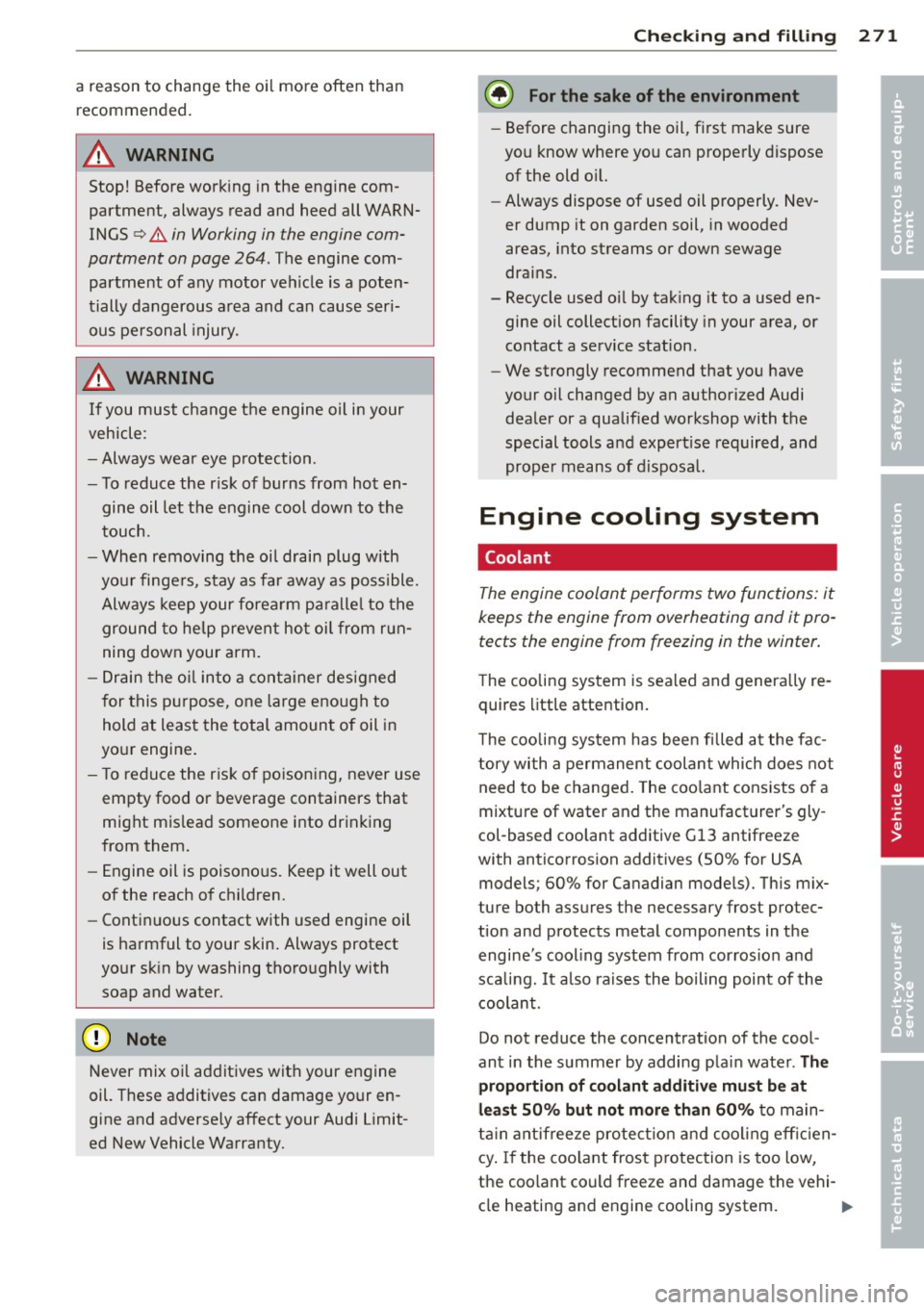
Engine cooling system
Coolant
The engine coolant performs two functions: it
keeps the engine from overheating and it pro tects the engine from freezing in the winter.
T he cooling sys tem is sealed and genera lly re
quires little attention.
T he cooli ng system has bee n filled a t the fac
t ory with a permanent coolant which does not
need to be c hanged . The coo lant cons ists of a
mixture of water and the manufacturer's gly
col-based coo lant additive G l3 antifreeze
with anticorrosion additives (50% for USA
models; 60% for Canadian mode ls). This m ix
ture both assures the necessary frost protec
tion and protects meta l compone nts in t he
engine's cool ing system from corros io n and
sca ling.
It also raises the boiling point of the
c oolant.
Do not reduce the concentration of the cool
ant in the s ummer by adding p lai n water .
The
proportion of coolant additive must be at
lea st 50 % but not more than 60 %
to main
tai n antifree ze pro te ct io n a nd coo ling eff icien
cy .
If the coo lant fros t protection is too low,
the coo lant co uld freeze and damage the vehi-
cle heating and engine cooling system. .,..
•
•
Page 274 of 348
272 Che cking and filling
For year-round driving, antifreeze is added at
the factory for temperatures down to:
- -31° F(-35°C)USA
- - 40 °F ( - 40 °C) Canada.
_& WARNING
-
Before yo u check anything in the e ngine
compar tment, alw ays read and heed all
WARN INGS
¢.&. in Working in the engine
compartment on page 264 .
(D Note
- Befo re win ter se ts in, have the coolan t
che cked to see if t he coolant ad dit ive in
you r vehicle is s ufficien t to mee t the cli
mate conditions. T his is especially impor
tant if yo u live in a region where the w in
ter is extremely co ld. If necessary, in
crease the proport io n of coolant additive
to 60%.
- When adding coolant addit ive to your
cooling system, remember:
- We recommend using only coolant ad
ditive G1 2++ o r G13 fo r your vehicle.
Thi s coo lant add itive is available at au
thorized A ud i dealers. Other types of
antifreeze can significantly reduce cor
rosion protection. The res ulting corro
sion can cause a loss of coo lant and se
r ious eng ine damage.
- Do not add any type of radiator leak sea l
ant to your ve hicle's engine coo lant.
Adding rad iator repair fluid may adve rse
ly affec t the function and perfo rmance of
you r cooling system and could result in
damage not cove red by your New Vehicle
Limited Wa rranty.
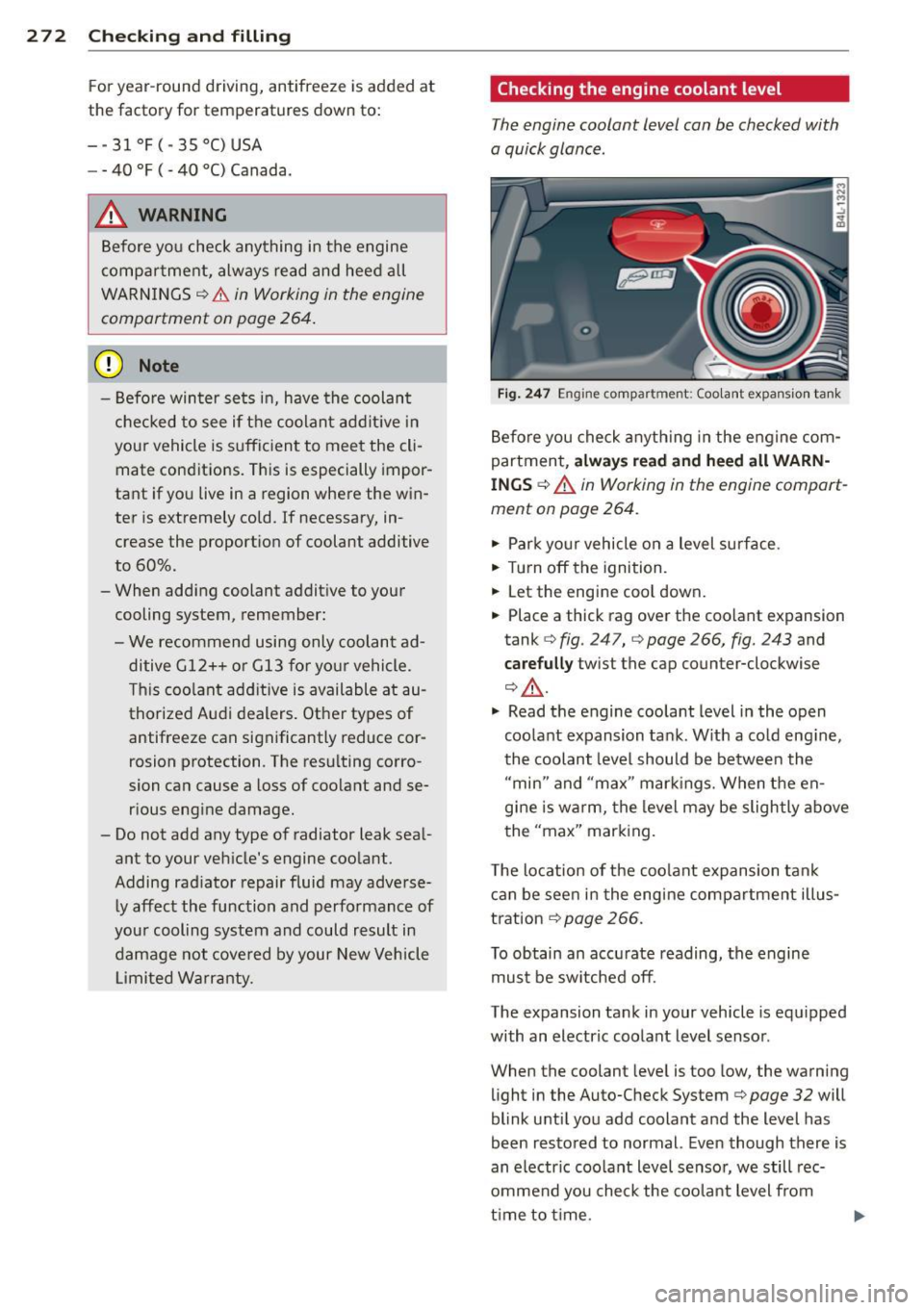
Checking the engine coolant level
T he engine coolant level can be checked with
a quick glance .
Fig . 2 4 7 Engin e compa rtm en t: Coo lant expansio n ta nk
Befo re you check anyth ing in the en gine com
partment,
alway s read and h eed all WARN
INGS ¢ A in Working in the engine compart
ment on page 264.
.,. Park yo ur vehicle on a level surf ace .
.,. Tur n off the ignition.
.,. Let the engine cool down.
.,. Place a thick rag over the coolant expansion
tank ¢
fig. 24 7, ¢ page 266, fig . 243 and
carefull y twist the cap counter-clockwise
¢,&. .
.,. Read the engine coolant level in the open
coo lant expansion ta nk. W ith a cold eng ine,
the coolant level should be between the "min " and "max " mar kings. When t he en
g ine is wa rm, the level may be slightly above
the "max" mark ing.
T he locat ion of the coo lant expansion tan k
c an be see n in the engine compartmen t illu s
t ration
¢ page 266.
T o obtain an accu rate reading, the engine
must be switched off.
The expansion tank in your veh icle is equipped
with an electr ic coo lant level senso r.
When the coolant leve l is too low, the warning
light in the Auto-Check System¢
page 32 will
blink unti l you add coolant and the level has
been resto red to normal. Even though there is
an electric coo lant level senso r, we still rec
ommend you check the coolant level from
time to t ime .
Page 275 of 348
Coolant loss
Coolant loss may indicate a leak in the cooling
system . In the event of coolant loss, the cool
ing system should be inspected immediately
by your authorized Audi dealer. It is not
enough merely to add coolant.
In a
sealed system, losses can occur only if
the boiling point of the coolant is exceeded as
a result of overheating.
A WARNING
The cooling system is under pressure and
can get very hot. Reduce the risk of scald
ing from hot coolant by following these
steps.
- Turn off the engine and allow it to cool
down.
- Protect your face, hands and arms from
escaping fluid and steam by covering the
cap with a large, thick rag.
- Turn the cap slowly and very carefully in
a counter-clockwise direction while ap
plying light, downward pressure on the
top of the cap.
- To avoid being burned, do not spill anti freeze or coolant on the exhaust system
or hot engine parts. Under certain condi
tions, the ethylene glycol in engine cool
ant can catch fire.
(D Note
Do not add any type of radiator leak seal
ant to your vehicle's engine coolant. Add
ing radiator repair fluid may adversely af
fect the function and performance of your
cooling system and could result in damage
not covered by your New Vehicle Limited
Warranty.
Adding coolant
Be very careful when adding engine coolant.
Before you check anything in the engine com
partment,
always read and heed all WARN
INGS c:;, A in Working in the engine compart
ment on page 264.
Checking and filling 273
.. Turn off the engine .
.. Let the engine cool down.
.. Place a thick rag over the coolant expansion
tank
c:;, page 2 72, fig. 247 and carefully
twist the cap counter-clockwise c:;, &, .
.. Add coolant .
.. Twist the cap on again
tightly.
Replacement engine coolant must conform to
exact specificat ions
c:;, page 2 71, Coolant. We
recommend using only coolant additive G12+
+, G13 or in an emergency G12 +. Do
not use a
different additive. In an emergency use plain
water until you can get the correct additive
and can restore the correct ratio. This should
be done as soon as possible.
If you have lost a considerable amount of
coolant, then you should add cold antifreeze
and cold water only when the engine is cold.
Always use
new engine coolant when refilling .
Do not fill coolant above the "MAX" mark. Ex
cess coolant will be forced out through the
pressure relief valve in the cap when the en
gine becomes hot.
A WARNING
- The cooling system is under pressure and
can get very hot. Reduce the risk of
scalding from hot coolant by following
these steps.
- Turn off the engine and allow it to cool
down.
- Protect your face, hands and arms from
escaping fluid and steam by covering
the cap with a large, thick rag.
- Turn the cap slowly and very carefully
in a counter-clockwise direction while
applying light, downward pressure on
the top of the cap.
- To avoid being burned, do not spill an
tifreeze or coolant on the exhaust sys
tem or hot engine parts. Under certain
conditions, the ethylene glycol in en
gine coolant can catch fire.
- Antifreeze is poisonous. Always store an
tifreeze in its original container and well
out of the reach of children. .,.
•
•
Page 335 of 348
_______________________________ ___:I~n ~d ~e:.::x 333
Cleaning
A lcantara (synthetic suede) ... .. .. .. . 254
Eng ine compartment ... ... .. .. .. .. . 255
Exhaust tail p ipes ......... .. .. .. .. . 250
Fabrics and fabr ic coverings .. .. .. .. . 251
Instrument panel .............. .... 252
Inter ior . . . . . . . . . . . . . . . . . . . . . . . . . . 2 5 1
L eather .. ............ ...... .... .. 253
M MI con tro l conso le ...... .. .. .. .. . 251
M MI d isp lay ............. .... .. ... 2 51
Pl asti c and v inyl ....... ... .. .. .. ... 248
P lastic parts . ..... .... ... .. .. .. ... 252
Safety belts . ... .. .... ... .. .. .. ... 254
tr im strips . .. ........... .. .. .. ... 248
Trim str ips . ............. .... .. ... 248
C lean ing and pro tect ion .. ... .. .. .. .. . 2 45
Climate control . . . . . . . . . . . . . . . . . . . . . . 91
Synchron izing ............... ... ... . 92
Warm and cold ........... .... .. .. .. 9 1
Climate controls Air cond itioner o n/off ..... .. .. .. .. .. 93
A ir distribution .............. .... ... 94
A ir outlets ................. .... ... 96
A ir outlets (rear) ......... .. .. .. .. .. 96
A ir r eci rcula tion .......... .... .. .. .. 95
AUTO (st and ard setti ng) ... .. .. .. .. .. 94
B asic settings . . . . . . . . . . . . . . . . . . . . . . 99
Controls . . . . . . . . . . . . . . . . . . . . . . . . . . 92
Defrosting/defogging .. ... .. .. .... .. 94
Descr ipt ion . ............. .... .. .... 91
Energy management ...... .. .. .. .. .. 91
Fa n ... .. .. .. ........ ... .. ... ... .. 94
Front seat vent ilation ........ .... .. 100
H eated seats, front .............. .. 100
K ey coded sett ing ......... .. .. .. .. .. 9 1
Recirculation mode (autom atic) . . . . . . . 99
Recommended se tt ings . ... .. .. .... .. 91
Residua l heat ... .. .... ... .. .. .. .... 93
Sett ing t he temperature ... .. .. .. .. .. 94
Supp lementary heater ..... .. .. .. .. . 100
Synchroni zat ion . . . . . . . . . . . . . . . . . . . . 99
Turn ing on and off ........ .. .. .. .. .. 93
Using climate control economically . . . . 97
C lock ..... .. .. ... .. ..... ... .. .. .... 11
Closing Panor ami c slid ing su nroof .. .. .. .. .. .. S5
Coat hooks . . . . . . . . . . . . . . . . . . . . . . . . . 89
Cold tire inflat ion pressure ... .. .. .. .. . 284 Compass mir
ro r . . . . . . . . . . . . . . . . . . . . . 69
Compliance ....... .. ............... 328
Consume r Information . . . . . . . . . . 172, 325
Contacting N HTSA . . . . . . . . . . . . . . . . . . 172
Convenience key ... .. ................ 49
D river messages .. .. .......... .... . 108
Locking vehicl e . . . . . . . . . . . . . . . . . . . . . 50
START bu tton .. .. ................. 10 7
Star ting engi ne .. ............. .. .. 10 7
S TOP b utton ..... ... .. .. ..... ... .. 108
Switching engine off . .. ..... ... .. .. 108
Switching on ignition . .. ..... ... .. .. 107
Un locking vehicle . ................. . 49
Co nvertib le child sa fety se ats 212
Convertib le locking retractor
Act ivati ng ... .. .. .. . .. ... ... .. .. .. 217
Deact ivat ing . .. .. .. ............... 218
U si ng to secure a child safety seat 2.15, 217
Coolant system .. .. ................. 271
Cooling box in glove compa rtment ... .. . 88
Cooling System Expansion tank . .. .. . ... ...... ... .. 272
Cornering light . . . . . . . . . . . . . . . . . . . . . . 59
Cruise cont ro l
Changing speed .. .. . ... .... ... .. .. 112
Presetting your spe ed .. ..... ... .. .. 112
Switching off .. .. .. ............... 112
Switching on . .. .. .... .... ....... .. 111
Warning/ind ica tor lights .......... .. . 18
also refer to Adaptive cruise control ... 113
C ruising range . . . . . . . . . . . . . . . . . . . . . . . 24
(upholder . . . . . . . . . . . . . . . . . . . 78 , 85 , 86
D
Damp ing
r e fer to Adapt ive A ir Suspension . 155, 157
Data ......... .. .. .. . ... ....... .... 322
Dat a recorder . .. .. .. .. .... .... ..... 225
Date d isp lay . . . . . . . . . . . . . . . . . . . . . . . . 11
Daytime running lights. .. ..... ... . 57 , 58
De clara ti on of compliance
Adaptive cruise cont rol .. ....... .. .. 32 8
Audi s ide ass ist .... . .. ..... ... .. .. 328
Ce ll phone package .. ... .... ... .. .. 328
Convenience key .... . .. ..... ... .. .. 328
E lectronic immob ilizer ... .. ......... 328
•
•
Page 338 of 348
336 Index
Rear air distribution .... ... .. .. .... .. 99
Rear controls . . . . . . . . . . . . . . . . . . . . . . 97
Rear fan ... ... ... .... ... .. .. .... .. 98
Rear operat ion ........... .... ..... 100
Rear temperature . . . . . . . . . . . . . . . . . . . 98
Synchron izat ion ........... ... .. ... 100
Turn ing o n/off ..... ...... .. .. .. .. .. 98
Front airbags Descr ipt ion ... ........... .. .. .... . 188
H ow they work . . . . . . . . . . . . . . . . . . . . 193
Fr onta l co llisions and the laws of physics 17 6
F ront fog l ights . . . . . . . . . . . . . . . . . . . . . . 58
Front seats .. ..................... .. 71
Ad justing ........................ 167
C hi ld restra ints in the front seat . ..... 186
Fu el
Additives ... ... . ...... ... .. .. .... . 256
Blended gasoline .................. 256
Consumpt ion . . . . . . . . . . . . . . . . . . . . . . 24
F ill er neck ............... ........ . 258
Fue l gauge . .............. ... .. .... 12
Gasoline ... ... .... ...... .. .. .. .. . 256
Gasoline additives . ........ ... .. .. . 257
L ow fue l level . . . . . . . . . . . . . . . . . . 12 , 35
Octane r ating . ......... .. .. .. .. .. . 256
Recommendation . ..... ... .. .. .... . 25 6
Refue lling . .. .. .. ..... ... .. .. .... . 259
Reserve .... ... . ...... ... .. .. .... .. 12
Tank capacity .............. .. .... . 322
Unlock ing the fuel filler flap by hand .. 261
Fu el economy messages (eff iciency pro -
gram) ... .... ... . ...... ... .. .. .... .. 27
Fuse ar rangement .......... ... .. ... 309
G
Garage door opener (HomeL ink ®) 161
Gas discharge lamps ... ... .. .. .. .. .. . 3 12
Gauges Eng ine coolan t temperature .. .. ...... 10
Fu el gauge .............. .. .. .. .. .. 12
Speedometer .. .. ..... ... .. .. .... .. 12
Tac hometer . . . . . . . . . . . . . . . . . . . . . . . 11
Trip odometer ........... .. .. .... .. 12
Ge ne ral illus tra tion
I ns trumen ts an d con trols . . . . . . . . . . . . . 8 G
eneral rules and dr iv ing t ips ... ... . .. 238
Befo re dr iving offroad .. ..... ... .. .. 238
Driving offroad ... ... .. ..... ... .. .. 238
G lossary of tire and loading term inology 281
G love compartment .................. 88
Cooling box . . . . . . . . . . . . . . . . . . . . . . . . 88
Valet key funct io n ................ .. 41
G love compartment -emergency unlock-
i ng ................................ 88
G low p lug system
Indicator light ... .. .... .... ... .. .. . 15
G radient angle .. ............ ....... 238
Gross Vehicle Weight Rating (GVWR) . .. 320
G ro u nd cle arance 238
H
Head lights . .. .. .. ... .......... .. .. . 57
Ad aptive ligh t . . . . . . . . . . . . . . . . . . . . . . 59
D efec tive . .. ................. .. .. . 23
Front fog lights . . . . . . . . . . . . . . . . . . . . 58
Hea dlight range control ..... ... .. .. . 36
Switching off ...................... 57
Switching on . . . . . . . . . . . . . . . . . . . . . . . 57
Washer system . . . . . . . . . . . . . . . . . . . . . 66
Xenon headlights . . . . . . . . . . . . . . . . . . . 57
Head light washer reservoir .. ... .. .. .. 279
Head restrai nts ..................... 168
Adjus ting . .. .. .. ................. 168
F ron t se ats . . . . . . . . . . . . . . . . . . . . . . . . 76
Rear seats . . . . . . . . . . . . . . . . . . . . . . . . . 77
Heated Exte rior m irrors ............... .. ... 68
F ron t seats ....................... 100
Rea r sea ts . .. .. .. ... .......... .... 101
Rea r seats (four -zone a utomat ic comfort
air conditioning) .. ... .. ..... ... .. .. 101
Steering w heel ... .. ... ..... ... .. .. 101
Washer jets . . . . . . . . . . . . . . . . . . . . . . . 63
He ating
C limate controls . .... .. ..... ... .. .. . 91
Heavy clothi ng a nd safety be lts ....... . 178
Highbeam .. ................... . 57,60
Warning/ind icator lights ........ ..... 18
Hig h voltage warning label ........... 320
Hill descent con trol ................ . 225