engine oil AUDI Q7 2013 Owner´s Manual
[x] Cancel search | Manufacturer: AUDI, Model Year: 2013, Model line: Q7, Model: AUDI Q7 2013Pages: 348, PDF Size: 87.72 MB
Page 237 of 348
Catalytic converter
Applies to vehicles: with gasoline engine
It is very important that your emission control system (catalytic converter) is function
ing properly to ensure that your vehicle is run
ning in an environmentally sound manner .
... Always use lead-free gasoline¢ page 256,
Gasoline .
... Never run the tank down all the way to
empty .
... Never put too much motor oil in your en-
gine
¢ page 270, Adding engine oil~-
.,. Never try to push- or tow-start your veh icle.
The catalytic converter is an eff icient "clean
up" device built into the exhaust system of
the vehicle. The catalytic converter burns
many of the poll utants in the exhaust gas be
fore they are released into the atmosphe re.
The exclusive use of unleaded fuel is cr it ically
i mportant for the life of the cata lytic convert
e r and proper fu nctioning of the engine.
A WARNING ,~
- Do not park or operate the veh icle in
areas where the hot exhaust system may
come in contact with dry grass, brush,
fuel spill or other material which can
cause a fire.
- Do not apply additional undercoating or
rustproofing on or near the exhaust
man ifold, exhaust p ipes, catalytic con
verter or heat shie lds . During driving, the
substance used for undercoating could
overheat and cause a fire.
{[) Note
-Be aware that just one tank fi lling with
le aded fuel will already seriously de
grade the performance of the catalytic
conve rter .
- Do not exceed the correct engine oil level
¢ page 270.
-Do not drive until the fuel tank becomes
completely empty. The eng ine could mis
fire . U nburned fuel could a lso get into
Dri vin g and en vironm ent 235
the exhaust system and this cou ld cause
the catalytic converter to overheat .
- Do not turn off the igni tion while the ve
hicle is moving.
- Do not con tinue to ope rate your veh icle
unde r these conditions, as othe rwise fuel
can reach the catalytic converter. This
co uld result in overheating o f the con
verter, requir ing its replacement.
- To assure efficient operation of the Emis
sion Control System:
- H ave your vehicle maintained prope rly
and in accordance w ith the se rv ice rec
ommendat ions in you r Warranty &
M aintenance boo klet.
- L ack of prope r maintenance as we ll as
improper use of the vehi cle w il l impair
the function of the em ission contro l
system and could lead to damage .
@ For the sake of the environment
Even when the Emiss ion Control System is
operat ing properly, the exha ust gas can
have a sul fur -li ke exhaust gas smell under
some operating states . This depends on
the sulfur content of the fuel being used .
Using a different brand of fue l may help,
or f illing the tank with lead-free super
grade gasoline .
Diesel particulate filter
Applies to vehicles : with diese l eng ine
The diesel part iculate filter filters nearly all of
the soot particles out of the exhaust . The fil
ter cleans itself automat ica lly under normal
driv ing cond itions . If the filter ca nnot clean it
self (for example, because you a re o nly dr iving
short distances), the fi lter becomes clogged
with soot and the
II symbo l for the diesel
particu late filter ill uminates ¢
page 3 7.
A WARNING
- Do not park your vehicle over flammab le
materia ls such as grass or leaves because
the high temperature of the diesel par-
ticulate f ilter could start a fire. ..,. •
•
Page 239 of 348
It takes a long time for the engine to warm up
fu lly when it is running at idle. However , wear
and nox ious em issions are especially high
when the engine is warming up. So you should drive away as soon as you start the engine and
avoid running at high rpms while the engine is
still warming up .
(D Note
Do not leave engine idling unattended af
ter starting . If warning lights should come
on to indicate improper operation, they
wou ld go unheeded. Extended idling also
p roduces heat, which cou ld resu lt i n over
heating or other damage to the vehicle or
other property.
Regular maintenance
A badly tuned engine unnecessarily wastes a lot of fuel.
"' Have your vehicle serv iced at regular inter-
vals.
By having your vehicle regularly serviced by an
author ized Audi dealer helps to ensure that it
r uns p roper ly and economically. The condition
of your vehicle not only affects its safety and
ab ility to hold its value, it also affects
fuel
c on sumption.
Ch eck your oil each time you fill your tank .
The amount of oil used is related to engine
load and speed .
It is normal for the oil consumption of a new
engine to reach its lowest v alue after a certain
mileage has been dr iven .
You must drive your vehicle about 3,000 miles (5,000 ki lometers) before you can properly
assess o il consumption .
This a lso applies to fuel consumption and en
gin e output.
0 Note
- Have yo ur vehicle maintained properly
and in accordance wit h the service rec
ommendations in your War ranty
& Main-
Dri vin g and en vironm ent 237
tenance book let. Lack of p roper mainte
nance as well as improper use of the ve
hicle will impair the function of the
em ission contro l system and could lead
to damage.
- Do not alter or remove any component of the Emission Control System unless approved by the manufacturer.
- Do not alter or remove any device, such as heat shie lds, switches, ign ition w ires,
valves, which are designed to protect
your vehicle's Emission Control System and other impo rtant vehicle compo
nents.
Fewer short trips
Fuel consumption will always be relatively
high on short trips .
"' Try to avoid driv ing short distances w ith a
cold engine .
The eng ine and cataly tic converter have to
reach their opt imal
operat ing temperature t o
reduce fuel consumpt ion and nox ious em is
s ions effect ively .
Just after starting, a co ld eng ine in a mid-s iz e
car only achieves a fuel economy of 6-8 mi les
per gallon (30 -40 l/l00km). After about a
half a mile , fuel economy cl imbs to 12 mpg
(20 l/100 km) . After about
2.5 miles (4 km),
t he engine is at i ts p rope r opera ting tempe ra
tu re and f uel economy has reached a normal
l evel. So you can see that yo u should avo id
short trips whenever possible.
T he
out sid e t emperature is also cr itica l in th is
regard. Your car consumes more fue l in the
winter than in the s ummer.
•
•
Page 240 of 348
238 Driving off road
Driving off road
Driving in difficult road
conditions and offroad
General information
The operation of the E lectronic Stabilization
Control (ESC) is expanded for operation away
from paved roads. In situations where slip or a
differential locking function is required, the ESC offroad mode can be activated
c::> page 225 . Hill descent control is also availa
ble in the ESC offroad mode, which automati
cally brakes the vehicle and thereby keeps
speed constant when diffe rent wheel speeds
a re detected when descending a hill
c::> page 226. Your Audi also has permanent
a ll-wheel drive in addition.
H owever, your Aud i is not a pure off road vehi
cle .
It was not built for d riving unde r extreme
conditions, e.g. fo r trips that are in the nature
of an expedition.
Dri ve only on road s and offroad section s
which mat ch the de sig n of your vehi cle and
y our a biliti es as a driver. Ne ver t ake ris k s!
Before driving offroad
- Check the eng ine oil level, tire pressure,
coolant level , and the fluid level in the w ind
shield washe r reservo ir.
- Stow luggage items and other objects in the
luggage compartment, and secure them
against s lid ing aro und .
After driving offro ad
- After trips offroad, remove any twigs and
other foreign objects from the grill, the underbody and the wheels. Pay spec ia l atten
t ion to fore ign objects (stones) which have
become lodged in the tire tread.
- Clean the body and the veh icle unders ide,
and inspec t the veh icle for poss ible damage.
- Clean dirty w indows , headlamp lenses , rear
l ights, and license plates .
- Perform a brake check (part icularly after
t ravel ling through water) .
A WARNING
-Drive especially attentively and plan
ahead in d iff icu lt road conditions and
when offroad. Excessive speed o r inco r
rect maneuvers can cause injuries and
damage to the vehicle.
-
- Always adapt your speed and driving
style to road, offroad, t raff ic, and weath
er cond itions. Drive especially slowly off
road when you r view is res tricted.
- Please be awa re that in ESC off road
mode, particularly on a smoo th and s lip
pery road, the wheels may have an in
creased tendency to spin and the vehicle may break away -danger of skidding!
- Stability is limited in the ESC off road
mode .
@) For the sake of the environment
Avoid damage to the environment and re
spect nature .
(D Tips
Only drive w here it is permitted and stay
on marked roads and paths.
Explanation of some technical terms
T he following data refe r to ideal cond itions.
Depend ing on veh icle load and ground condi
tions and the environment, the numbers may
vary. It is the driver's responsibility to decide
whether a vehicle can overcome a specific s it
uat ion
c::> ,&. .
Gradient angle
The number of meters in alt itude gained over
a distance of 109.4 yards or 100 meters
(grade) are given as a percentage or degrees.
Information about the gradient the vehicle
can climb under its own power (depends in
part on the road surface and engine power) .
Max imum perm itted grade : 3 1
°
Late ral angle (slope of vehicle )
Indicates the angle up to which the vehicle
can be driven diagonally or across the fall line ..,.
Page 260 of 348
258 Fuel supply and filling your fuel tank
Winter operation
At temperatures below 20° F (-7° C), Diesel
fuel No.
2 loses its fluidity due to wax separa
tion, which may clog the fuel filter or tank fil
ter and keep the engine from running .
To help the filter from being clogged by wax,
the fue l filter in your vehicle is automatically
preheated. Preheating the fuel filter makes
operation of your vehicle possible with Diesel
fuel No. 2 down to -10° F (-24° C).
If you expect temperatures below
5° F
(-15° C)
ask your fuel dealer whether their
Diese l fuel No.
2 is sufficiently winterized for
the prevailing and expected temperatures.
If not winterized or insufficiently winterized
Diesel fuel has already thickened to the extent
that the engine will not start, warm the vehi
cle up by leaving it in a heated garage.
It is normal that the engine noise leve l (die
seling) is louder during the warm-up period in
winter. It is also norma l when whitish-blue
smoke comes out of the tailpipe after starting
and during warm-up . The amount of smoke
depends on the outs ide temperature.
Do not let your Diese l engine idle unnecessari
ly after a cold start. Driving off slowly will
shorten the warm-up period.
A WARNING
- Never use "starting assist fluids." They
may be potent ially explosive or cause a
"run-away" engine condition. This could
result in ser ious engine damage and per
sonal injur y.
- Never use fuel line anti-freeze offered for
gasoline engines.
(D Note
- Your Diesel engine has been specifically designed to operate only on Ultra Low
Sulfur Diesel fuel. Therefore, never use
home heating oil or regular gasoline. The
properties of these fuels may cause seri
ous damage to the fuel injection system
and to the engine. Using these fuels can
-
cause expensive engine repairs and will
also adversely affect your New Vehicle
Limited Warranty.
- If Diesel fuel sho uld get on any rubber
hose, it must be wiped off immediately.
Then wash the contaminated hose por
tion with soap and warm water. Do not allow D iesel fuel to remain on connect
ing hoses . They may develop leaks and
cause serious damage.
Fuel tank
Fuel filler neck
The fuel filler neck is located on the right rear
side panel behind the fuel filler flap.
If the power locking system shou ld fail, you
can still open the flap manua lly -for detailed
instructions see ¢
page 261.
You can find the fuel tank capacity of your ve
hicle in
Technical Data ¢page 322 .
The label on the inside of the fuel filler flap
te lls you the correct fuel for your vehicle. For
more information about fuel specifications,
see ¢
page 256.
Your vehicle fuel tank has an on-board refuel
ling vapo r recovery system. This feature helps
to prevent fue l vapors from escaping from the
tank and polluting the environment while you refuel your vehicle. In order to fi ll the tank
proper ly while protecting the environment,
please fo llow this refueling procedure careful
ly.
A WARNING
-Under normal operating conditions, never
carry addit ional fuel conta iners in your car .
Gas canisters and other conta iners used to
transport fuel can be dangerous. Such con
tainers, full or empty, may leak and could
cause a fire in a collision.
If you must
transport fuel to use for your lawn mower,
snow blower, etc., be very careful and al
ways observe loca l and state laws regard
ing the use, transportation and storage of
such fuel containers. Make certain the ..,.
Page 267 of 348
-Apply the parking brake.
- Move selector lever to "P" (Park).
- Always let the engine cool down. Hot
components will burn skin on contact.
- To reduce the risk of being burned, never
open the hood if you see or hear steam
or coolant escaping from the engine
compartment. Wa it until no steam or
coolant can be seen or heard before care
fully opening the hood.
- Keep children away from the engine com
partment .
- Never spill fluids on hot engine compo
nents. They can cause a fire.
- Never touch the radiator fan. The auxili
ary electric fan is temperature controlled
and can switch on suddenly.
- Never open the coolant reservoir cap
when the engine is still warm. The cool
ant system is pressurized and hot cool
ant could spray out .
- Protect your face, hands and arm from
steam or hot engine coolant by placing a
thick rag over the cap when you open the
coolant reservoir .
- Do not remove the engine cover under
any circumstances . This increases the
risk of burns.
- If work on the fuel system or the electri
cal system is necessary:
- Always disconnect the battery .
- Never smoke or work near heaters or
open flames. Fluids in the engine com
partment could start a fire.
- Keep an approved fire extinguisher im
mediately available.
- To avoid electrical shock and personal in
jury while the engine is running or being
started, never touch:
- Ignition cables
- Other components of the high voltage
electronic ignition system.
- If you must perform a check or repair
with the engine running:
Checking and filling 265
- First, fully apply the parking brake,
move selector lever to "P" (Park) .
- Always use extreme caution to prevent
clothing, jewelry, or long hair from get
ting caught in the radiator fan, V-belts
or other moving parts, or from contact
ing hot parts . Tie back hair before
starting, and do not wear clothing that
will hang or droop into the engine.
- Minimize exposure to emission and
chemical hazards~&. .
A WARNING
California Proposition 65 Warning:
- Engine exhaust, some of its constituents,
and certain vehicle components contain
or emit chemicals known to the State of
California to cause cancer and birth de
fects and reproductive harm. In addition,
certain fluids contained in vehicles and
certain products of component wear con
tain or emit chemicals known to the State of California to cause cancer and
birth defects or other reproductive harm.
- Battery posts, terminals and related ac
cessories contain lead and lead com
pounds, chemicals known to the State of
California to cause cancer and reproduc
tive harms. Wash hands after handling.
Q) Note
When adding fluids, always make sure that
they are poured into the proper container
or filler opening, otherwise serious dam
age to vehicle systems will occur .
@ For the sake of the environment
To detect leaks in time, inspect the vehicle
floor pan from underneath regularly . If
you see spots from oil or other vehicle flu ids, have your vehicle inspected by an au
thorized Audi dealer. •
•
Page 268 of 348
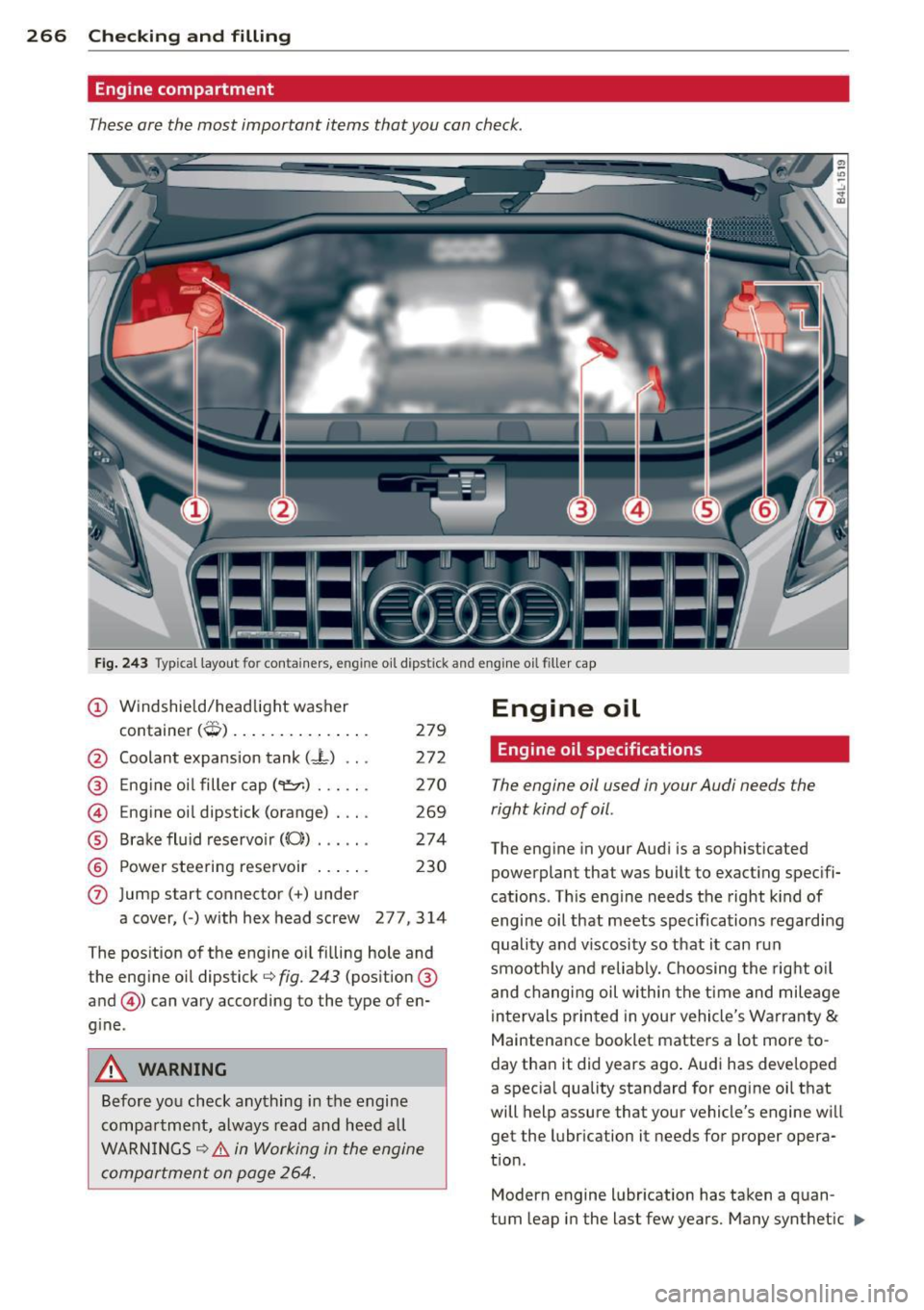
266 Checking and filling
Engine compartment
These are the most important items that you can check .
Fig. 243 Typical layout for containers, engine oil di pstick and engine oil fille r cap
CD W indshield/head light washer
. ( ") container O ......... ... .. . 279
@ Coolant expansion tank (-L) ... 272
® E
ng ine oi l filler cap ('t".:r.) ... .. . 270
© Eng ine oil dipstick (orange) . .. . 269
® Brake fluid reservoir ((0)) ...... 274
® Power steering reservoir ... .. . 230
(j) Jump start connector(+) under
a cover, ( -) with hex head screw
277, 314
The position of the engine o il fi lling hole and
the engine oil dipstick
r=;, fig. 243 (position ®
and @) can vary according to the type of en
gine .
_&. WARNING
Before you check anything in the engine
compartment, always read and heed all
WARNINGS ¢.&.
in Working in the engine
comportment on page 264.
-
Engine oil
Engine oil specifications
The engine oil used in your Audi needs the
right kind of oil.
The engine in your Audi is a sophist icated
powerplant that was built to exacting specifi
cations. This engine needs the right kind of
engi ne oil that meets specifications regard ing
quality and v iscosity so that it can run
smooth ly and reliab ly. Choosing the right oil
and changing oil within the time and mileage
intervals printed in your vehicle's Warranty
&
Maintenance booklet matters a lot more to
day than it did years ago . Audi has developed
a spec ia l quality standard for eng ine oil that
will help assure that your vehicle's engine w ill
get the lubrication it needs for proper opera
t ion .
Modern engine lubr ication has taken a quan
tum leap in the last few years. Many synthetic "'
Page 269 of 348
oils available today provide better engine lu
brication that can outlast traditional petrole
um-based oils, making them a smart choice
for use throughout the life of your Audi.
Whether you use synthetic or petroleumbased engine oil, the oil that you use must
conform to Audi's oil quality standard
VW 502 00 (vehicles with gasoline engine) or VW 507 00 (vehicles with diesel engine) to
help keep your vehicle's engine running
smoothly and help prevent the formation of harmful deposits , sometimes called "sludge,"
that over time can lead to expensive repairs.
At the time of printing, engine oils available in
the U .S . and Canada that meet the exacting
specifications of Audi oil standard VW 502 00 (vehicles with gasoline engine) or VW 507 00
(vehicles with diesel engine) are synthetic en
gine oils. This does not mean, however, that
every synthetic engine oil will meet Audi oil
standard VW 502 00 (vehicles with gasoline
engine) or VW 507 00 (vehicles with diesel
engine). So always be sure that you use an ap
proved oil.
To help prevent the formation of harmful de posits use only oil with the following specifi
cations printed on the oil container :
-Audi oil standard VW 502 00 (gasoline en
gine)
- Audi oil standard VW 507 00 (diesel en-
gine)
Oil container labels may carry the specifica
tion singly or in combination with other desig
nations and oil quality standards.
Viscosity
Engine oils are graded according to their vis
cosity . The proper viscosity grade oil for your
engine depends on climactic or seasonal con
ditions where you drive. You can use oil with a
viscosity grade of SAE SW40 ac ross all tem
perature ranges for normal driving conditions.
However, if engine oil viscosity grade SAE
SW40 is not available, you can also use viscos
ity grade SAE SW-30 or SAE OW-40 as long as
it meets Audi oil quality standard VW 502 00
Checking and filling 267
(vehicles with gasoline engine) or VW 507 00
(vehicles with diesel engine) specifications.
Because engine oil that meets the Audi oil
standard may not be available everywhere
when you need it, we strongly recommend
that you always carry with you an extra quart (liter) of oil that expressly conforms to the
VW 502 00 (vehicles with gasoline engine) or
VW 507 00 (vehicles with diesel engine) spec
ification, in case you have to top
off the oil
while on the road.
Applies to vehicles with gasoline engine on
ly: Only if the level of the oil is at or below the
minimum mark on the oil dipstick -and no oil
that expressly conforms to Audi oil standard
VW 502 00 specificat ions is available - may
you top
off with a high quality engine oil, pref
erably synthetic-based, that meets ACEA A3
or API SM specifications, but even then, only in viscosity grades SAE SW-40, SAE SW-30, or
SAE OW-40 . However, during the entire time
between oil change intervals, never top off
with more than a total of 0.5 qt/liter engine
oil that does not conform to Audi oil specifica
tion VW 502 00.
Applies to vehicles with diesel engine only:
Only if the level of the oil is at or below the
minimum mark on the oil dipstick - and no oil
that expressly conforms to Audi oil standard
VW 507 00 spec ifications is available - may
you top
off with a high quality engine oil, that
meets ACEA C3 or API CF specifications, but
even then, only in viscosity grades SAE
5W-40, SAE 5W-30, or SAE OW-40. However,
during the entire time between oil change in
tervals, never top off with more than a total
of 0 .5 qt/liter engine oil that does not con
form to Audi oil specification VW S07 00.
For more information about engine oil that
has been approved for your vehicle, please
contact either your authori zed Audi dealer or
Audi Customer Relations at 1 (800) 822-2834
or visit our web si te at www.audiusa .com or
www .audicanada .ca. Here you will also find a
current list of oils (manufacturers, brand
names etc.) that conform to Audi oil standard
lilJJ,,
•
•
Page 270 of 348
268 Checking and filling
VW 502 00 (vehicles with gasoline engine) or
VW 507 00 (vehicles with diesel engine).
Changing the engine oil
The engine oil and oil filter must be changed
according to the m ileage (ki lometers) and
time intervals specified in your vehicle 's War
ranty
& Maintenance booklet. Do not exceed
these intervals -harmful deposits from old
engine oil can reduce engine performance and
can lead to expensive engine repairs.
Changing the oil at the recommended inter
va ls is so very important because the lubricat
ing properties o f oi l decrease gradually during
normal vehicle use. If you are not sure when
you have your o il changed, ask your author
i z ed Audi Service Advisor.
Under some ci rcumstances the engine oi l
should even be changed more frequently .
Change oi l more often if you drive mostly
short distances, operate the vehicle in dusty
areas or mostly under stop-and-go traffic con
d itions, or when you use your vehicle w here
temperatures stay below freez ing point for
l ong periods .
Detergent additives in the o il w ill make fresh
oil look dark after the engine has been run
ni ng for a short time . This is normal and is not
a reason to change the oil more often than
recommended.
Damage or malfunctions due to lack of
maintenance
It is essential that you change your oil at the recommended intervals using only engine oil
that complies with Audi oi l standard
VW 502 00 (vehicles with gasoli ne engine) or
VW 507 00 (veh icles with diese l engine) . Your
Limited New Vehicle Warranty does not cover
damage or malf unctio ns due to failure to fol
lo w recommended maintenance and use re
quirements as set forth in the A udi Owner's
Manual and Warranty
& Maintenance booklet.
Your dea ler will have to deny warranty cover
age unless you present to the dealer proof in
the form of Service or Repa ir Orders that all scheduled maintenance was
performed in a
timely manner.
Engine oil consumption
To provide effective lubrication and cooling for
internal engine parts, all internal combustion
engines use some o il. Oil consumption varies
from engine to engine and may change over
the life of the engine. Engines tend to use
more o il during the break-in period tha n they
do afterward, when oil consumption has sta
bilized. Depending on the way the vehicle is
driven and the operating conditions, oil con
s u mption can be up to 1 quart per 1,200
miles (1 liter per 2,000 km) . Consumption
may be higher within the first 3,000 m iles
(5,000 km) .
Under normal conditions, the rate of oil con
sumption depends on oil quality as well as vis
cosity, engine speed (rpm), outs ide tempera
ture, road conditions, the amount of oil dilu
t ion caused by condensed water or fue l resi
due, and ox idat ion of the oil. Oil co nsumption
may increase with engine wear over time, un
t il replacement of worn engine pa rts may be
come necessary.
Because of all these variables, there is no
standard or "norma l" rate of oil consumption .
We urge you to check the engine oil level at
regular intervals, preferably every time you
fill the fuel tank, and always before a long
trip.
The oil pressure warning light. is not an
indicator of low engine oil level. If the warn
ing light does not go out after starting, or
flashes while driving (above 1500 rpm), a
buzzer will sound. It indicates that the oil
pressure is too low . Stop the engine immedi·
ately, check the engine oil level and add oil if
necessary. If the engine oil level is normal,
but the light continues to flash, do not keep
driving or let the engine idle, as damage may
occur .
II-
Page 271 of 348
If you be lieve your e ngine uses too much oil,
w e recommend that you consult your author
ized Audi dealer so that the cause of your con
cern can be properly diagnosed . Keep in mind
that accurate measurement of oil consump tion requires great care and may take some
time . Your Aud i dealer has inst ruct ions for
how to measure oil consumption acc urately .
_& WARNING
Stop! Before work ing in the engine com
pa rtment, always read and heed all WARN
IN GS
¢ .& in Working in the engine com
partment on page 264.
The engine com
partment of any motor ve hicle is
a poten
tially dangerous a rea and can cause ser i
ous pe rsonal injury.
(D Note
- The eng ine depends on oi l to lubr icate
and cool a ll of its moving parts . The en
gine o il m ust be checked regu larly and
kept at the required leve l.
- Make it a habit to have the engine oil lev
el checked every time you fill the fue l
ta nk.
- Too litt le engine oil may ca use severe en
gine damage.
Checking the engine oil level
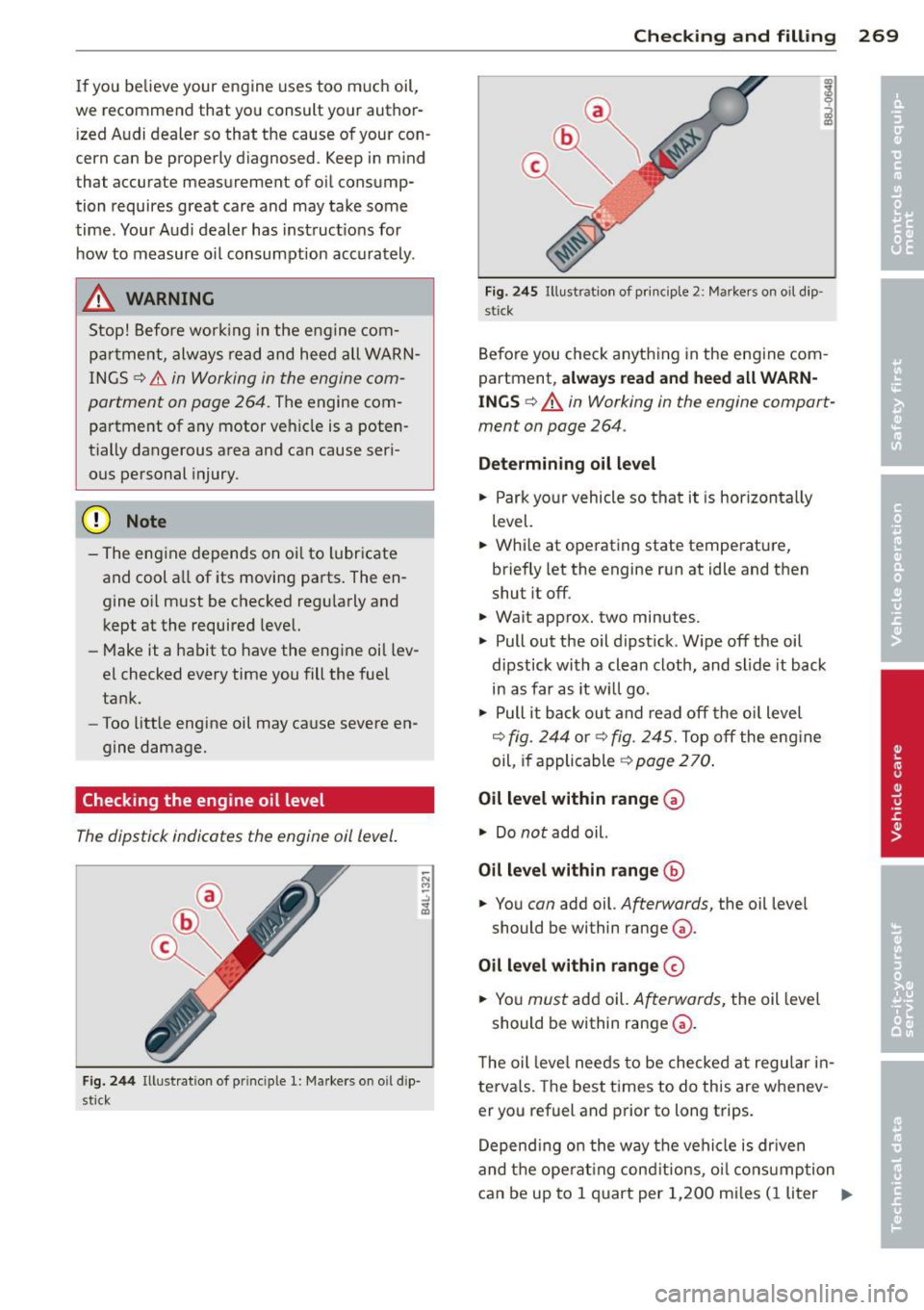
The dipstick indicates the engine oil level.
F ig. 244 Illust rat io n of p rinc ip le 1: Ma rkers on o il dip
s tick
Checkin g and fillin g 269
Fig . 2 45 Il lust rat io n of p rin ciple 2: Ma rke rs o n oil d ip
s tick
Befo re you check anyt hing in the engine com
partment,
always read and heed all WARN
INGS ¢ A in Working in the engine compart
ment on page 264 .
Determining oil level
.,. Park yo ur vehicle so that it is horizonta lly
level.
.,. While at operating state tempe rature,
briefly let the engine run at idle and then
shut it off.
.,. Wait approx. two minutes.
.,. Pull out the oil dipstick . W ipe off the oil
d ipstick with a clean cloth, and sl ide it back
in as far as it w ill go.
.,. Pull it back out and read off the o il level
r=> fig. 244 or ¢ fig. 2 45. Top off the eng ine
oil, if applicable ¢
page 2 70 .
Oil level within range (v
.,. Do not add oil.
Oil le vel within range@
.,. You can add oil. Afterwards, the oil leve l
sh ould be within range @.
Oil le vel within range 0
.,. Yo u must add oil. Afterwards, the oil leve l
should be within range @.
T he oil leve l needs to be checke d at regu lar in
terva ls. The best t imes to do this are whenev -
er yo u refuel and prior to long trips.
Depend ing o n the way the vehicle is dr iven
and t he ope rat ing con ditions, o il co nsu mption
can be up to 1 q uart per 1,200 mi les ( 1 liter
Ill>
Page 272 of 348
2 70 Ch eck ing and filling
per 2,000 km). Consumption may be higher
within the first 3,000 mi les (5,000 km).
Adding engine oil "1:::7':
0 N ;:;
"' "' a:>
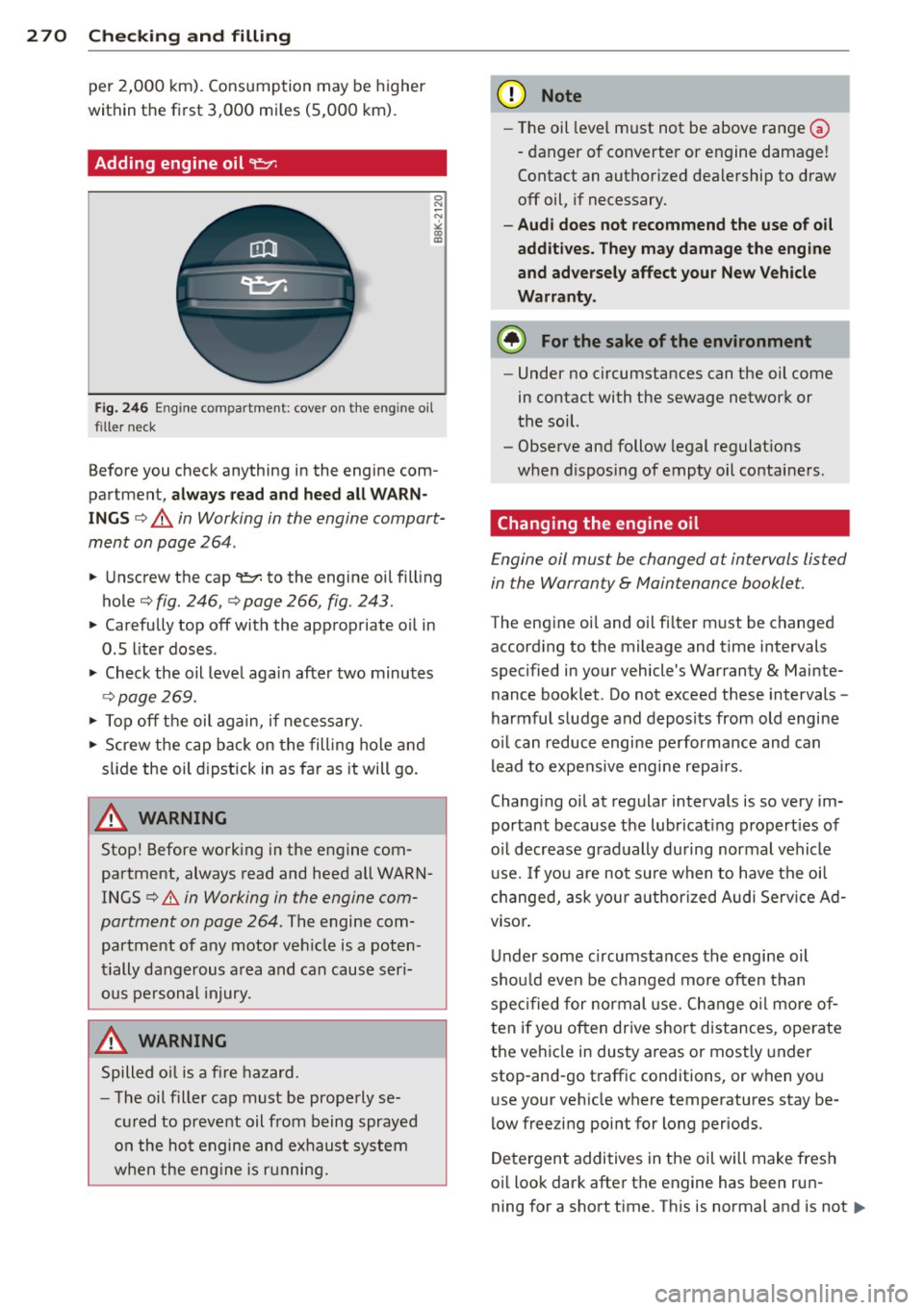
F ig . 2 46 Eng ine com part men t: cove r on the eng ine o il
filler neck
Before you check anything in the engine com
partment,
al way s read and h eed all W ARN
ING S
¢.&. in Working in the engine compart
ment on page 264 .
.. Unscrew the cap 't::r. to the engine oil fill ing
hole¢
fig. 246, ¢ page 266, fig . 243.
.. Carefully top off with the appropriate o il in
0 .5 liter doses .
.. Check the oil level aga in after two minutes
¢ page 269.
.. Top off the oil again, if necessary.
.. Screw the cap back on the filling hole and
s li de the oil dipstick in as far as it will go.
& WARNING
Stop! Before working in the engine com
partment, always read and heed a ll WARN
INGS
¢ .& in Working in the engine com
partment on page 264 .
The engine com
partment of any motor ve hicle is a poten
tially dangerous a rea and can cause ser i
ous personal injury.
& WARNING
Spilled o il is a fi re hazard.
- The oil fille r cap must be prope rly se
cured to prevent oil from being sprayed
on the hot engine and exhaust system
w hen the eng ine is r unning.
-
(D Note
- The oil leve l m ust not be above range 0
- danger of converter or engine damage !
Contact an authorized dealership to draw
off oil, if necessary.
- Audi does not recommend the use of oil
additives. They ma y damage the engine
and adversely aff ect your New Vehicle
Warranty .
~ For the sake of the environment
-Under no circumstances can the oil come
in contact with the sewage network or
the so il.
- Observe and follow legal regulations
when dispos ing of empty oil containers.
Changing the engine oil
Engine oil must be changed at intervals listed
in the Warranty
& Maintenance booklet.
The engine oi l and oil fi lter m ust be changed
accord ing to the mileage and time intervals
specified in your vehicle's Warranty
& Mainte
nance booklet . Do not exceed these intervals -
harmful s ludge and deposits from old engine
o il can reduce engi ne pe rformance and can
lead to expens ive engine repa irs.
Chang ing oi l at regular intervals is so very im
po rtant because t he lubricat ing propert ies of
o il decrease gradually du ring normal vehicle
use.
If you are not sure when to have the oi l
changed, ask your a uthorized Audi Servi ce Ad
visor .
U nder some c ircumstances the engine oil
sho uld even be changed more often than
specified for normal use. Change o il more of
ten if you often dr ive short distances, ope rate
the ve hicle in dusty a reas or mostly under
stop-and-go t raff ic conditions, or when you
u se your vehicle where temperatures stay be
low free zing point for long periods.
Detergent additives in the oil will make fresh
oi l look dark after the engine has been run-
ning for a short time . T hi s is normal and is not
IJ,,