parking brake AUDI Q7 2013 Owner´s Manual
[x] Cancel search | Manufacturer: AUDI, Model Year: 2013, Model line: Q7, Model: AUDI Q7 2013Pages: 348, PDF Size: 87.72 MB
Page 246 of 348
244 Trailer towing
have become comp lete ly familiar with the way
your vehicle-trailer combination behaves and responds.
Backing up is difficult and requires practice.
Backing up with a trai ler genera lly requires
steering action opposite to that when backing
up your veh icle without a trailer .
Maintain a greater distance be tween your ve
hicle and the one in front of you. You will need
more room to stop. To compensate for the
trailer, you will need a larger than normal
turning radius.
When passing, remember that you cannot ac
celerate as fast as you normally would be
cause of the added load. Make sure you have
enough room to pass . After passing, allow
plenty of room for your trailer before chang
ing lanes again .
Avoid jerky starts, sharp turns or rapid lane
changes.
- Do not tow a trailer during the break-in
period of your vehicle.
- If you tow a trailer, your Audi may re
quire more freq uent maintenance due to
the extra load
c> page 325.
Parking on a slope
Do not pork on a slope with a trailer. If it can
not be avoided, do so only after doing the fol
lowing:
When parking:
.. Apply the foot brake .
.. Have someone place chocks under both the
vehicle and the trai ler wheels .
.. With chocks in p lace, slowly re lease the
brakes until the wheel chocks absorb the
load .
.. Turn the wheels towards the curb .
.. Apply the parking brake .
.. Move the selector lever to
P.
When restarting after parking:
.. Apply the foot brake. ..
Start the engine.
.. Move the se lector lever to
D.
.. Release the parking brake and s low ly pull
out and away from the wheel chocks.
.. Stop and have someone retr ieve the wheel
chocks .
(D Tips
If you move the selector lever of the auto
matic transmission to
P before applying
the parking brake and before blocking the
wheels, you may have to use more fo rce
l ater to move the lever out of the
P posi
tion.
Page 267 of 348
-Apply the parking brake.
- Move selector lever to "P" (Park).
- Always let the engine cool down. Hot
components will burn skin on contact.
- To reduce the risk of being burned, never
open the hood if you see or hear steam
or coolant escaping from the engine
compartment. Wa it until no steam or
coolant can be seen or heard before care
fully opening the hood.
- Keep children away from the engine com
partment .
- Never spill fluids on hot engine compo
nents. They can cause a fire.
- Never touch the radiator fan. The auxili
ary electric fan is temperature controlled
and can switch on suddenly.
- Never open the coolant reservoir cap
when the engine is still warm. The cool
ant system is pressurized and hot cool
ant could spray out .
- Protect your face, hands and arm from
steam or hot engine coolant by placing a
thick rag over the cap when you open the
coolant reservoir .
- Do not remove the engine cover under
any circumstances . This increases the
risk of burns.
- If work on the fuel system or the electri
cal system is necessary:
- Always disconnect the battery .
- Never smoke or work near heaters or
open flames. Fluids in the engine com
partment could start a fire.
- Keep an approved fire extinguisher im
mediately available.
- To avoid electrical shock and personal in
jury while the engine is running or being
started, never touch:
- Ignition cables
- Other components of the high voltage
electronic ignition system.
- If you must perform a check or repair
with the engine running:
Checking and filling 265
- First, fully apply the parking brake,
move selector lever to "P" (Park) .
- Always use extreme caution to prevent
clothing, jewelry, or long hair from get
ting caught in the radiator fan, V-belts
or other moving parts, or from contact
ing hot parts . Tie back hair before
starting, and do not wear clothing that
will hang or droop into the engine.
- Minimize exposure to emission and
chemical hazards~&. .
A WARNING
California Proposition 65 Warning:
- Engine exhaust, some of its constituents,
and certain vehicle components contain
or emit chemicals known to the State of
California to cause cancer and birth de
fects and reproductive harm. In addition,
certain fluids contained in vehicles and
certain products of component wear con
tain or emit chemicals known to the State of California to cause cancer and
birth defects or other reproductive harm.
- Battery posts, terminals and related ac
cessories contain lead and lead com
pounds, chemicals known to the State of
California to cause cancer and reproduc
tive harms. Wash hands after handling.
Q) Note
When adding fluids, always make sure that
they are poured into the proper container
or filler opening, otherwise serious dam
age to vehicle systems will occur .
@ For the sake of the environment
To detect leaks in time, inspect the vehicle
floor pan from underneath regularly . If
you see spots from oil or other vehicle flu ids, have your vehicle inspected by an au
thorized Audi dealer. •
•
Page 306 of 348
304 What do I do now?
Changing a wheel
Before changing a wheel
Observe the following precautions for your
own and your passenger's safety when chang
ing a wheel .
• After you experience a tire failure, pull the
car well away from moving traffic and try to
reach
level ground before you stop ¢,& .
• All passengers should
leave the car and
move to a safe location (for instance, behind
the guardrail) ¢
A-
.. Engage the parking brake to prevent your
vehicle from rolling unintentionally ¢,& .
• Move
selector lever to position P <=> ,&.
• If you are towing a trailer: unhitch the trail
er from your vehicle.
• Block the diagonally opposite wheel wi th
the folding chocks or other objects.
• Take the
jack and the inflatable spare tire
out of the luggage compartment
¢page 301.
11. WARNING
=
You or your passengers could be injured
while changing a whee l if you do not fol
low these safety precautions :
- If you have a f lat tire,
move a safe dis
tance off the road . Turn off the engine,
turn the emergency flashers on and use
other warning devices to alert other mo
torists .
- Make sure that passengers wait in a safe
place away from the vehicle and well
away from the road and traff ic.
- To help prevent the vehicle from moving
suddenly and possibly slipping off the
jack, always fully set the parking brake
and block the wheel diagonally opposite
the wheel being changed with the fold
ing chocks or other objects. When one
front whee l is lifted off the ground, plac
ing the Auto mat ic Transmission in "P"
(Park) will
not prevent the vehicle from
moving .
-
-Before you change a wheel, be sure the
ground is level and firm. If necessary,
use a sturdy board under the jack.
- After installing the inflatable spare tire,
make sure that you replace the flat tire/
wheel in its storage area properly and
tighten the knurled retaining screw se
curely .
' Changing a wheel
When you change a wheel , follow the se
quence described below step-by-step and in
exactly that order .
l. Activate the vehicle jack mode (only
vehicles with Adaptive Air Suspension)
¢ page 159.
2. Remove the decorative wheel cover* . For
more details see also ¢
page 305, Deco
rative wheel covers
or ¢ page 305,
Wheels with wheel bolt caps.
3. Loosen the wheel bolts¢ page 305.
4. Locate the proper mounting point for the
jack and align the jack be low that point
¢ page 306.
5. Lift the car with the jack¢ page 306.
6. Remove the wheel with the flat tire and
then install the
inflatable spare tire
¢page 307 .
7. Tighten all whee l bolts lightly.
8.
Lower the vehicle with the jack .
9. Use the wheel bolt wrench and
firmly
tighten all wheel bolts¢ page 305.
10. Rep lace the decorative wheel cover*.
11. Deactivate the vehicle jack mode (only
vehicles with Adaptive Air Suspension)
¢page 159.
A WARNING
Always read and follow all WARNINGS and
inf ormat ion¢ .&.
in Raising the vehicle on
page
307 and ¢page 308.
Page 308 of 348
306 What do I do now?
Loosening
.,. Install the wheel bolt wrench over the
wheel bolt and push it down as far as it will
go .
.,. Take tight hold of the
end of the wrench
handle and turn the wheel bolts
counter
clockwise
about one single turn in the direc
tion of arrow
c:> fig. 264.
Tightening
.,. Install the wheel bolt wrench over the
wheel bolt and push it down as far as it will
go .
.,. Take tight hold of the
end of the wrench
handle and turn each wheel bolt
clockwise
until it is seated .
A WARNING
- Do not use force or hurry when changing
a wheel - you can cause the vehicle to slip
off the jack and cause serious personal
injuries.
- Do not loosen the wheel bolts more than
one turn
before you raise the vehicle with
the jack. - You risk an injury.
@ Tips
If a wheel bolt is very tight, you may find it
easier to loosen by carefully pushing down
on the end of the wheel bolt wrench with
one foot only. As you do so, hold on to the
car to keep your balance and take care not
to slip.
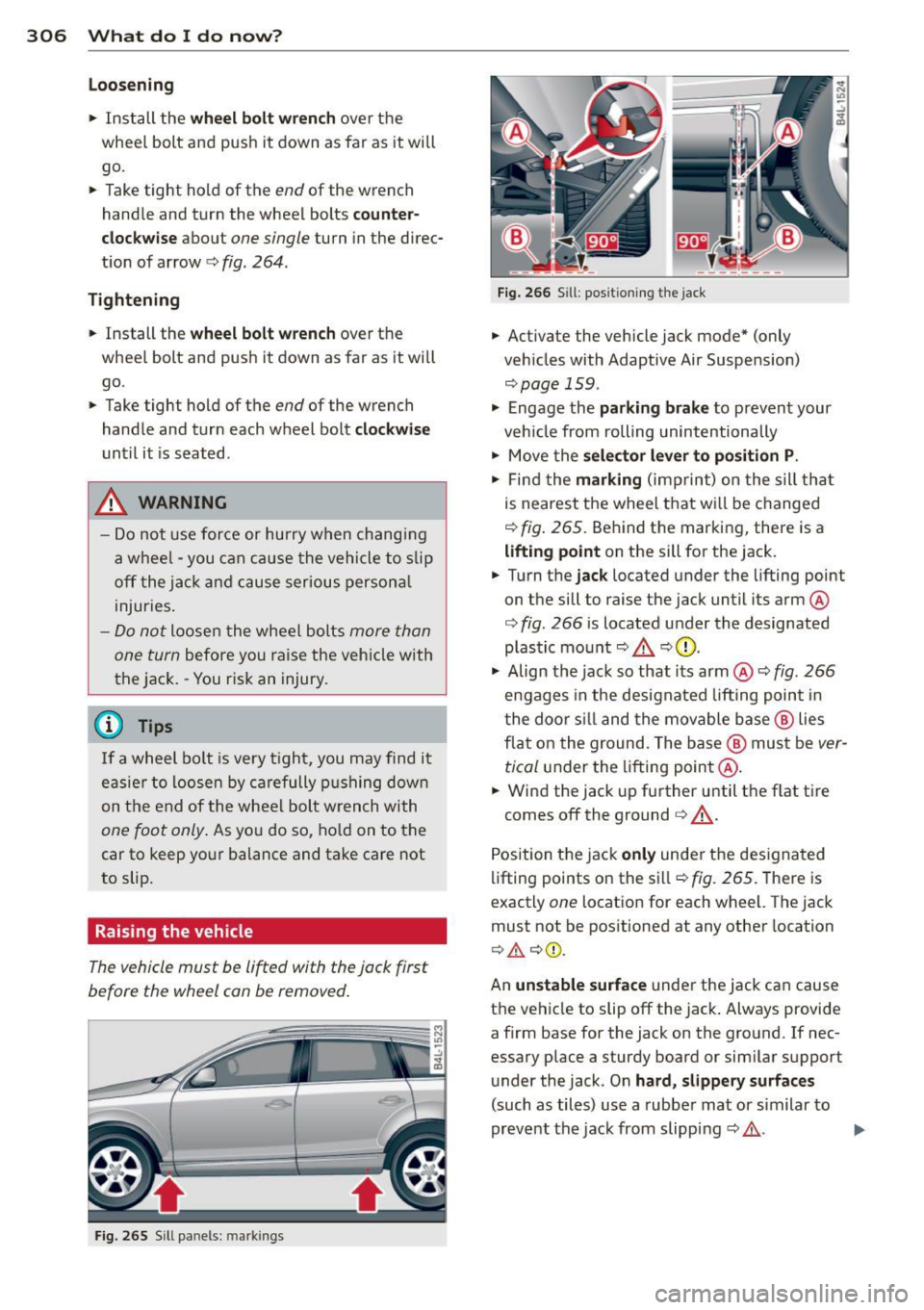
Raising the vehicle
The vehicle must be lifted with the jack first
before the wheel can be removed.
Fig. 265 Sill pane ls: mar kings
Fig. 266 Sill: posit ioning the jack
.,. Activate the vehicle jack mode* (only
vehicles with Adaptive Air Suspension)
<::> page 159 .
.,. Engage the parking brake to prevent your
vehicle from rolling unintentionally
.,. Move the
selector lever to position P .
.,. Find the marking (imprint) on the sill that
is nearest the wheel that will be changed
<=>
fig. 265. Behind the marking, there is a
lifting point on the sill for the jack.
.,. Turn the
jack located under the lifting point
on the sill to raise the jack until its arm@
<=>
fig . 266 is located under the designated
plastic mount<=>
& c::>(D .
.,. Align the jack so that its arm @ c::> fig. 266
engages in the designated lifting point in
the door sill and the movable base® lies
flat on the ground. The base @ must be
ver
tical
under the lifting point@.
.,. Wind the jack up further until the flat tire
comes off the ground
c:> ,& .
Position the jack only under the designated
lifting points on the sill
<=>fig . 265. There is
exactly
one location for each wheel. The jack
must not be positioned at any other location
<=>
.&. <=> CD .
An unstable surface under the jack can cause
the vehicle to slip off the jack. Always provide
a firm base for the jack on the ground. If nec
essary place a sturdy board or similar support
under the jack . On
hard, slippery surfaces
(such as tiles) use a rubber mat or similar to
prevent the jack from slipping
c:> ,&.. liJI,
Page 317 of 348
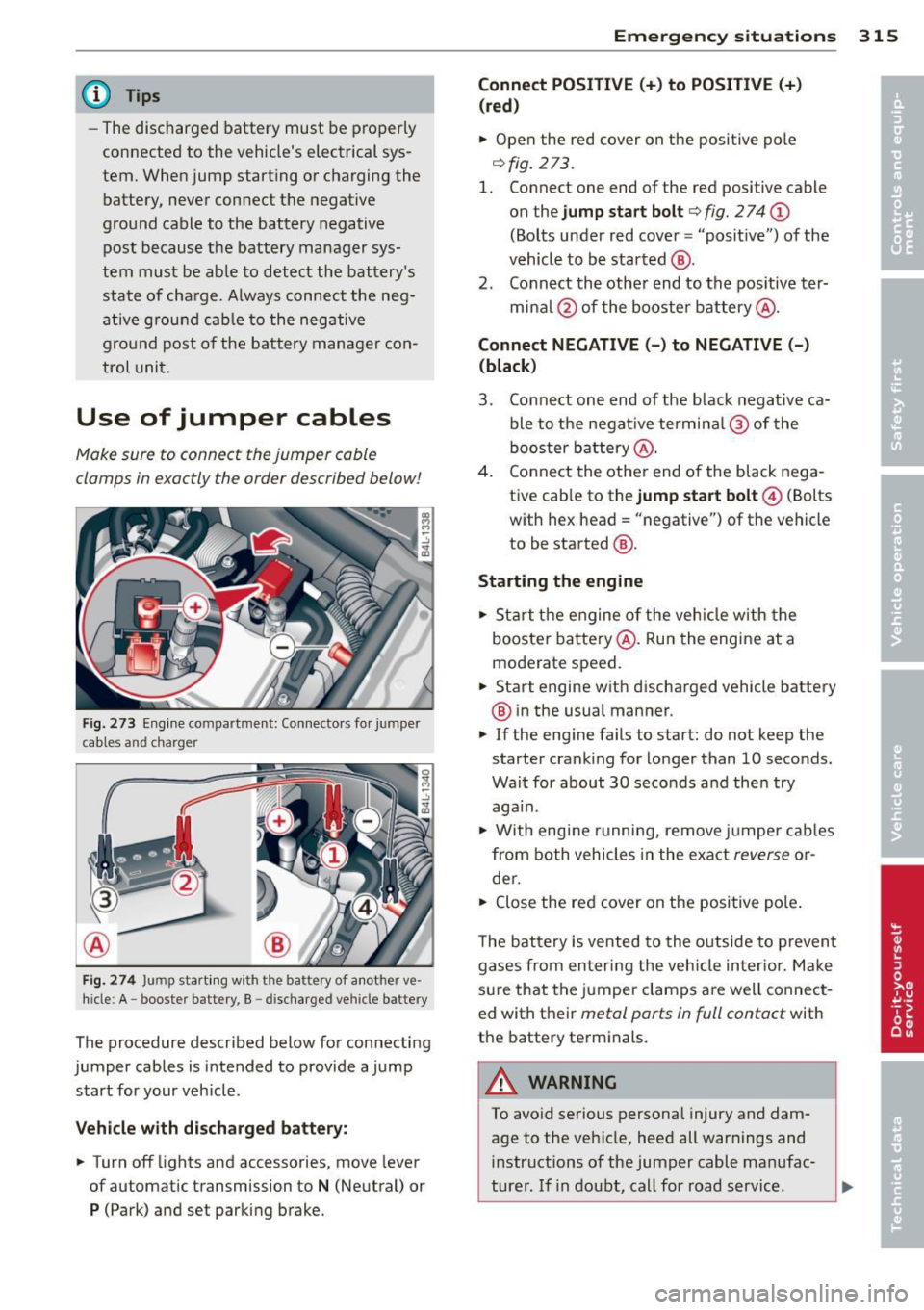
@ Tips
-The discharged battery must be properly
connected to the vehicle's electrical sys
tem. When jump start ing or charging the
battery, never connect the negative
ground cable to the battery negative
post because the battery manager sys
tem must be able to detect the battery's
state of cha rge. A lways connect the neg
ative g round cab le to the negative
gro und post o f the battery manage r con
trol uni t.
Use of jumper cables
Make sure to connect the jumper coble
clomps in exactly the order described below!
Fig. 273 Engine compartment: Con nectors fo r jumper
cables and charger
Fi g. 27 4 Jump start ing with the battery of another ve
hicle:
A-booster battery, B -discha rged vehicle battery
The procedure described below for connecting
jumper cables is intended to provide a jump
start for your veh icle .
Vehicle with discharged batter y:
.. Turn off lights and accessories, move lever
of automatic transmission to
N (Neutral) or
P (Park) and set parking brake.
Emergenc y situ ation s 315
Connect POSI TIVE(+ ) to POSITIVE (+ )
(red )
.. Open the red cover on the positive pole
¢fig. 273.
1. Connect one end of the red positive cable
on the
jump sta rt bolt ¢ fig. 2 7 4 (D
(Bolts under red cover = "posit ive") of the
vehicle to be started ®·
2. Co nnect th e other end to the pos itive ter-
mina l@ of the booster battery @.
Connect NEGATIVE( -) to NEGATIVE(-)
( black )
3. Connect one end of the black negative ca
ble to the negat ive termina l@ of the
booster b attery @.
4 . Connect the othe r end of the black nega
tive cable to the
jump start bolt@ (Bolts
with hex head= "negative") of the vehicle
to be started @.
Sta rting the engine
.,. Sta rt the e ngine of the veh icle with the
booster ba tte ry @ . Ru n the engine at a
moderate speed .
.. Start engine with discharged vehicle battery
® in the usual manner.
.. If the engine fails to start: do not keep the
starter crank ing fo r longer than 10 seconds.
Wa it for about 30 seconds a nd the n try
again .
.,. With engine runni ng, remove jumper cab les
from both vehicles in the exa ct
reverse or
de r .
.. Close the red cover on the posi tive po le .
T he battery is vented to the outside to p reven t
gases from en ter ing the veh icle inter ior. Make
s ur e that the jumper clamps a re well connect
ed with their
metal ports in full contact with
the battery term inals.
.&_ WARNING
-To avoid serious personal injury and dam
age to the ve hicle, heed all warnings and
i n structions of the jumper cable manufac-
-
turer . If in doubt, call for road service . IIJ>
Page 334 of 348
332 Index
How does moisture or road salt affect the
brakes? .................... ..... . 228
Malfunction .............. ... .... .. 32
Parking brake ............ .. .. .... . 109
Warning/indicator lights ... .. .. .... .. 19
Worn brake pads symbol ....... .. .... 36
Braking guard
refer to Audi braking guard .......... 127
Break-in period ............ .. .. .... . 234
Brake pads ............ .. .... .. .. . 234
Tires .... .. ................ ..... . 234
Breakover angle .. .. ........ ... .. .. . 238
Bulbs ... .. .. ..................... . 312
Bumper cover Caution when parking near a parking bar-rier or curb ............... ... .... . 110
C
California Proposition 65 Warning .. .. . 265
Battery specific .............. .... . 277
Capacities ... ... .... ...... .. .. .. .. . 322
Car -Systems
Ambience lighting . . . . . . . . . . . . . . . . . . 62
Lighting profiles ............ .. .... .. 62
Car care ..... ................ ..... . 245
Interior . . . . . . . . . . . . . . . . . . . . . . . . . . 251
Plastic and vinyl ................ .. . 248
Care of exterior ............ .. .. .. .. . 245
Cargo area
refer to Loading the luggage compart-
ment .. .. .. ... .... ...... .. .. .. .. . 171
Cargo floor .. ............. .. .. .. .. .. 82
Cargo net .... ... .......... .. .. .. .. .. 80
Catalytic converter ... ...... .. .. .. .. . 235
Center armrest Cup holder . . . . . . . . . . . . . . . . . . . . . . . . 77
Storage compartment . . . . . . . . . . . . . . . 77
Center console in rear ..... .. .. .. .. .. . . 78
Central locking Emergency locking .. ...... .. .. .. .. . . 45
Panoramic slid ing sunroof .. .. .. .. .. . . 55
Certification .............. .. .. .. .. . 328
Changing a flat tire .......... ... .... . 304
Changing a wheel .............. .. ... 304
Changing engine oil ......... .... ... . 270 Chassis
Undercoating
also refer to Adaptive Air Suspen- 250
sion . . . . . . . . . . . . . . . . . . . . . . . . 155, 157
CHECK button ..... ................. . 12
Checking Engine coolant level . ............ ... 272
Checking tire pressure ........... .... 286
Child restraints
Danger of using child restraints in the
front seat . . . . . . . . . . . . . . . . . . . . . . . . 186
Where can I get additional information
about child restraints and their use? .. 224
Child restraint system anchors .... .. .. 218
Child safety ..... .. .......... ... .. .. 205
Convertible locking retractor ... .. .. .. 215
Guidance fixtures for lower anchorages 220
Important safety instructions for using
child safety seats . ............. .. .. 208
Important things to know when driving
with children .... ................ . 205
Installing a child restraint using the
LATCH system .. .. ............. .. .. 221
Mounting and releasing the anchorage
hook . .... .... ................... 221
Tether anchors . .. .......... ... .. .. 222
Tether straps . ... ....... ...... .. .. 222
Child safety lock
rear doors (power) .. ........... .... . 48
Child safety seat Unused safety belts on the rear seat . . 210
Child safety seats .. ..... ..... ... .. .. 211
Booster seats ................. .... 213
Convertib le child seats ............. 212
Convertible locking retractor ......... 215
Danger of using child restraints in the
front seat ..... .. ................ . 186
How do I properly install a child safety
seat in my vehicle? ............... .. 208
Infant seats .................. .... 211
Installing ... .. .. ....... ...... .. .. 215
LATCH system .. .. ... ......... ... .. 221
Safety instructions ... .. ..... ... .. .. 208
Child seats Lower anchorages ............. .... 219
Page 341 of 348
Convenience closing ......... .. .. .. .. 55
Emergency closing . . . . . . . . . . . . . . . . . . 56
sliding open . . . . . . . . . . . . . . . . . . . . . . . 54
Sunshade . . . . . . . . . . . . . . . . . . . . . . . . . 56
tilt ing ... .. ................. .. .... 54
P ark ing ..... .. .. .. .. .... ... .. .. ... 110
Automatic transmission ... .. .. .. .. . 137
Caution when parking near a parking bar- rier or curb . ............. .... .. ... 110
Low bumper cover, spoi lers and suspen-
sion ..... ... ...... ............. .. 110
Parking brake . .... ..... ... .. .. .. ... 109
Parking .... .. .... .... ... .. .. .. ... 110
Warn ing/ indicator lights ... .. .. .. .. .. 19
P ar king on a decline (downhill) . .. .. .. . 110
Park ing on an incline (uphill) ..... . ... . 110
Parking systems . ... .... ... .. .. .. ... 143
Ad justing the disp lay/warning tone .. . 153
Aud i parking system plus with front- and
rearv iew camera . . . . . . . . . . . . . . . . . . . 148
Aud i pa rking system plus with rearv iew
camera . ... ... .. .. ...... .. .. .. .. . 144
C lean ing senso rs/camera .. .. .. .. .. . 247
M alfunc tion ................ ... .. . 153
Rear p ark assist .......... .... .. .. . 14 4
Safety precautions . . . . . . . . . . . . . . . . . 14 5
T railer hitch . ..... .... ... .. .. .. ... 153
P art icle filter
refer to Diesel particula te filter . . . . . . . 3 7
Parts rep lacement ......... .. .. .. .. . 327
P ASSENGER AIR BAG O FF light ... .. .. . 195
P assenge r's seat . . . . . . . . . . . . . . . . . . . . . 72
Passive safety system ....... .. .. .. .. . 165
P ed als .... .. ................. ..... 170
Perimeter light ing ...... .... ... ... ... 59
Physica l princ iples of a frontal coll is ion . 176
P olishing .. .. ............. .... .. ... 2 48
Pollen filter Climate controls . . . . . . . . . . . . . . . . . . . . 91
P owe r locking switch . . . . . . . . . . . . . . . . . 4 4
P owe r locking system ....... ... .. .... . 41
Conve nien ce close/open feat ure . .. .... 53
L o cki ng and unlocking the vehicle from
ins ide ..... .. ... .. ..... ... .. .. .... 4 4
Opening and clos ing the windows . ... .. 53
Rear lid/trunk lid . ..... ... .. .. .. .. .. 45
Remote control key . . . . . . . . . . . . . . . . . 38
Inde x 339
Selective unlock feature ..... ... .. .. . 44
Settings . . . . . . . . . . . . . . . . . . . . . . . . . . 44
U nlocking and locking vehicle . ... .. .. . 43
Power out lets . . . . . . . . . . . . . . . . . . . . . . . 87
Power seat Controls . . . . . . . . . . . . . . . . . . . . . . . . . . 72
Seat adjustment . . . . . . . . . . . . . . . . . . . . 72
Power steering .. ................... 230
Power w indow switches .......... .... . 51
In the driver's door . . . . . . . . . . . . . . . . . 52
In the front passenger's door . . . . . . . . . 53
Reactivating the system . . . . . . . . . . . . . 54
Pregnan t women
Spe cial consider ations w hen wear ing a
sa fe ty belt . . . . . . . . . . . . . . . . . . . . . . . 180
Programming the HomeL ink® u niversa l re-
mote control ...... .. . .. ... .... .. ... 161
Proper occupant seating positions ... .. 166
P roper safety belt posi tion ............ 18 0
Proper seating position Front passenger .. .. .. .. ...... ... .. 167
Occupants . .. .. .. .... ........... .. 166
Rea r passenger s ................... 168
Protective tray . . . . . . . . . . . . . . . . . . . . . . .
82
Q
quattro ®
refer to All-wheel drive
231
Ques tion
What happens to unbelted occupants? 177
Why safety be lts? . .. .. .. ..... ... .. 175
R
Radiator fan . ..... .. . .. .. ..... ... .. 274
Rain senso r . . . . . . . . . . . . . . . . . . . . . . . . . 63
Rain sensor defective . . . . . . . . . . . . . . . . . 35
Re ading ligh ts
F ron t ....... .. .. .................. 61
Rear ... .. .. .... .. . .. .. ..... ... .. . 61
Rea r asht ray .. .. .. .. . .. .... .... .. .. . 86
Rear fog lights .. ................... . 59
Re ar li d
Au tomat ic operation . .. ..... ... .. .. . 46
Emergency unlocking . .. ..... ... .. .. . 48
Opening and closing . .. ..... ... .. .. . 45
Valet key funct ion ................. . 41
•
•