transmission AUDI Q7 2013 Owner´s Manual
[x] Cancel search | Manufacturer: AUDI, Model Year: 2013, Model line: Q7, Model: AUDI Q7 2013Pages: 348, PDF Size: 87.72 MB
Page 246 of 348
244 Trailer towing
have become comp lete ly familiar with the way
your vehicle-trailer combination behaves and responds.
Backing up is difficult and requires practice.
Backing up with a trai ler genera lly requires
steering action opposite to that when backing
up your veh icle without a trailer .
Maintain a greater distance be tween your ve
hicle and the one in front of you. You will need
more room to stop. To compensate for the
trailer, you will need a larger than normal
turning radius.
When passing, remember that you cannot ac
celerate as fast as you normally would be
cause of the added load. Make sure you have
enough room to pass . After passing, allow
plenty of room for your trailer before chang
ing lanes again .
Avoid jerky starts, sharp turns or rapid lane
changes.
- Do not tow a trailer during the break-in
period of your vehicle.
- If you tow a trailer, your Audi may re
quire more freq uent maintenance due to
the extra load
c> page 325.
Parking on a slope
Do not pork on a slope with a trailer. If it can
not be avoided, do so only after doing the fol
lowing:
When parking:
.. Apply the foot brake .
.. Have someone place chocks under both the
vehicle and the trai ler wheels .
.. With chocks in p lace, slowly re lease the
brakes until the wheel chocks absorb the
load .
.. Turn the wheels towards the curb .
.. Apply the parking brake .
.. Move the selector lever to
P.
When restarting after parking:
.. Apply the foot brake. ..
Start the engine.
.. Move the se lector lever to
D.
.. Release the parking brake and s low ly pull
out and away from the wheel chocks.
.. Stop and have someone retr ieve the wheel
chocks .
(D Tips
If you move the selector lever of the auto
matic transmission to
P before applying
the parking brake and before blocking the
wheels, you may have to use more fo rce
l ater to move the lever out of the
P posi
tion.
Page 257 of 348
Engine compartment
Be especially careful when cleaning the en
gine compartment.
Al ways s witch off the ign ition befor e clean
ing the eng in e
c:> & .
Plenum panel
Remove leaves from the plenum pane l in front
of the windshield under the engine hood. This
prevents the water drain holes from becoming
blocked, and it prevents debris from entering
the vehicle interior through the heating and
ventilation ducts .
Corrosion protecti on
The engine compartment and transmission
have been corrosion-protected at the factory.
Good anti-corrosion treatment is very impor
tant, particular ly in the winter . If the vehicle
is frequent ly driven on salt treated roads, the
entire engine compartment and plenum panel
should be thoroughly cleaned at the end of
winter and retreated to prevent sa lt damage.
At the same time, the underside of the vehicle
should be washed as we ll.
If the engine compartment is cleaned at any
time with grease removing solut ions
1>, or if
you have the engine washed, the anti-corro
sion treatment is a lmost always removed as
well.
It is therefore essential to have a long
lasting co rrosion protection reapp lied to a ll
surfaces, seams, joints and components in the
engine compartment.
A WARNING
Be aware: The engine compa rtment of any
motor vehicle is a potentially hazardous
area.
- Before working in the engine compart
ment, be s ure to read the in format ion
c:> page 264.
- Before reaching into the front plenum
pane l, always remove the ignition key.
l) Use only the correct cleaning sol utions. Never use gas
oline or diesel fuel.
Cleaning and protec tion 255
Otherwise, the windshield wiper system
could un intentionally be switched on,
possibly caus ing personal injury from the
mov ing wiper linkage.
- Never reach into the area around or
touch the radiator fan. The aux iliary fan
is temperature controlled and can sw itch
on suddenly - even when the ignition is
off.
- Do not wash, wax or dry the eng ine with
the engine running. Moving or hot parts could injure you.
- Do not clean the underside of the chas
sis, fenders, wheel covers, or other ha rd
to reach pa rts without protect ing your
hands and arms. You may cut yourself on
sharp-edged metal parts .
- Always read and heed all WARNINGS and
o ther info rmation
c:> page 245.
•
•
Page 283 of 348
-Never mount used tires on yo ur vehicle if
you are not sure of their "previous histo
ry." Old used tires may have bee n dam
aged even though the damage cannot be
seen that can lead to sudden tire failure
and loss of vehicle control.
Glossary of tire and loading terminology
Accessory weight
means the comb ined weight (in excess of
those standard items wh ich may be rep laced)
of automati c transmission, power steering,
power br akes, power wi ndows, power sea ts,
radio, and heater, to the ex tent that these
items are avai lab le as factory -installed equip
ment (whether installed or not).
Aspect ratio
means the ratio of the height to the w idt h of
the tire in percent. Numbers of 55 or lower in
d icate a low sidewall fo r improved s teer ing re
sponse and better overall handling on dry
pavement.
Bead
means the pa rt of the t ire that is made of
s teel wires, wrapped or re inforced by ply cor ds
and that is shaped to fit the r im.
Bead separation
means a b reakdown of the bond between
components in the bead.
Cord
means the strands forming the plies in the
tire.
Cold t ir e infl ation pr essure
means the tire pressure recommended by the
vehicle manufacturer for a t ire of a designated
size that has not been dr iven for more than a
couple of miles (kilometers) at low speeds in
the three hour period before the tire pressure i s measu red or adjusted.
Tire s an d wheel s 281
-If you notice un usua l vibration or if the
veh icle pulls to one side when driv ing, a l
ways stop as soon as it is safe to do so and check the wheels and tires for dam
age.
Curb weight
mea ns the weight of a motor ve hicle w ith
standard equipment includ ing t he maximum
capa city of fuel, o il, and coolant, ai r cond i
tion ing a nd addi tional weig ht o f optiona l
equipment .
Extra load tire
means a tire design to operate at higher loads
and at higher inflation pressures than the cor
respondi ng s tanda rd tire. Extra load tires may
be identified as "X L", "xl", "EXTRA LOAD", o r
"R F" on the sidewall .
Gross Axle Weight Rating ( "GAWR ")
mea ns the load-carrying capacity of a single
axle system, measured at the tire-ground in
te rfaces.
Gross Vehicle Weight Rating ( "GVWR ")
means the maximum total loaded we ight of
t h e ve hicle.
Groo ve
means the space between two adjacent tread
ribs.
Load rating (code )
means the maximum load tha t a t ire is rated
to carry for a given inflation pressure. Yo u
may not find this information on all tires be
ca use it is not required by law.
Maximum load rating
me ans the load r ating for a tire at the maxi
mum pe rm issi ble inflat ion pressure for that
ti re .
•
•
...
Page 306 of 348
304 What do I do now?
Changing a wheel
Before changing a wheel
Observe the following precautions for your
own and your passenger's safety when chang
ing a wheel .
• After you experience a tire failure, pull the
car well away from moving traffic and try to
reach
level ground before you stop ¢,& .
• All passengers should
leave the car and
move to a safe location (for instance, behind
the guardrail) ¢
A-
.. Engage the parking brake to prevent your
vehicle from rolling unintentionally ¢,& .
• Move
selector lever to position P <=> ,&.
• If you are towing a trailer: unhitch the trail
er from your vehicle.
• Block the diagonally opposite wheel wi th
the folding chocks or other objects.
• Take the
jack and the inflatable spare tire
out of the luggage compartment
¢page 301.
11. WARNING
=
You or your passengers could be injured
while changing a whee l if you do not fol
low these safety precautions :
- If you have a f lat tire,
move a safe dis
tance off the road . Turn off the engine,
turn the emergency flashers on and use
other warning devices to alert other mo
torists .
- Make sure that passengers wait in a safe
place away from the vehicle and well
away from the road and traff ic.
- To help prevent the vehicle from moving
suddenly and possibly slipping off the
jack, always fully set the parking brake
and block the wheel diagonally opposite
the wheel being changed with the fold
ing chocks or other objects. When one
front whee l is lifted off the ground, plac
ing the Auto mat ic Transmission in "P"
(Park) will
not prevent the vehicle from
moving .
-
-Before you change a wheel, be sure the
ground is level and firm. If necessary,
use a sturdy board under the jack.
- After installing the inflatable spare tire,
make sure that you replace the flat tire/
wheel in its storage area properly and
tighten the knurled retaining screw se
curely .
' Changing a wheel
When you change a wheel , follow the se
quence described below step-by-step and in
exactly that order .
l. Activate the vehicle jack mode (only
vehicles with Adaptive Air Suspension)
¢ page 159.
2. Remove the decorative wheel cover* . For
more details see also ¢
page 305, Deco
rative wheel covers
or ¢ page 305,
Wheels with wheel bolt caps.
3. Loosen the wheel bolts¢ page 305.
4. Locate the proper mounting point for the
jack and align the jack be low that point
¢ page 306.
5. Lift the car with the jack¢ page 306.
6. Remove the wheel with the flat tire and
then install the
inflatable spare tire
¢page 307 .
7. Tighten all whee l bolts lightly.
8.
Lower the vehicle with the jack .
9. Use the wheel bolt wrench and
firmly
tighten all wheel bolts¢ page 305.
10. Rep lace the decorative wheel cover*.
11. Deactivate the vehicle jack mode (only
vehicles with Adaptive Air Suspension)
¢page 159.
A WARNING
Always read and follow all WARNINGS and
inf ormat ion¢ .&.
in Raising the vehicle on
page
307 and ¢page 308.
Page 313 of 348
Fuse s and bulb s 311
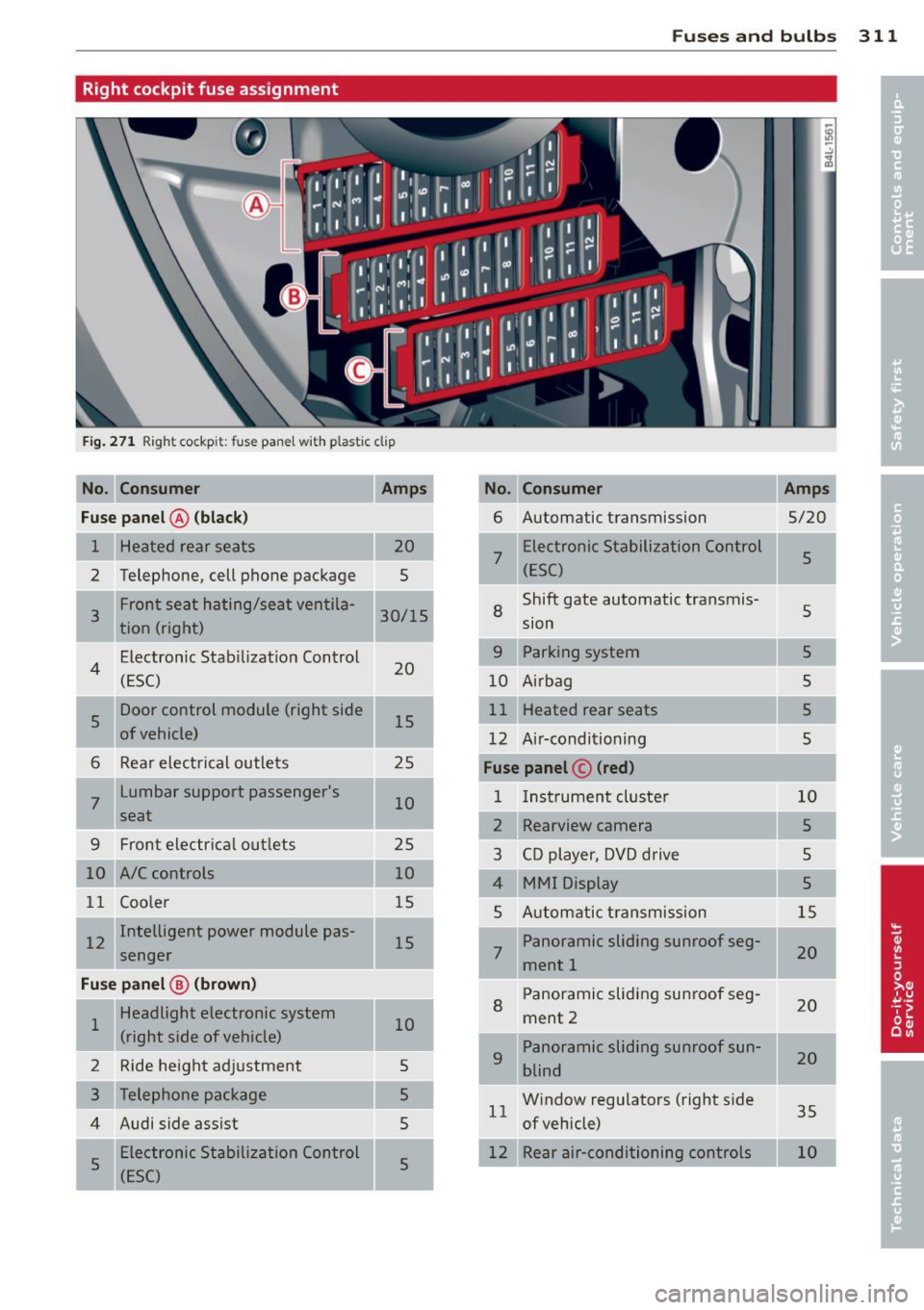
Right cockpit fuse assignment
Fig . 27 1 Righ t cockp it: f use pane l w ith pla stic clip
No. Con sumer Amps No. Consumer Amps
Fu se pa nel@ (bla ck )
6 Automatic transmission
5/20
1 Heated rear seats
7
Electronic Stabilization Control 5
2 Telephone, cell phone package (ESC)
--Shift gate automatic transmis-
Front seat hating/seat ventila-
8 s 3 30/15
tion (right) sion
Electron ic Stab ilizat ion Control
9 Parking system 5
4 (ESC) 20
10 Airbag s
s
Door control module (right side 15 Heated rear seats
5
of vehicle) 12 Ai r·conditioning 5
6 Rear electrical outlets 25 Fuse panel © (red )
7
Lumbar support passenger's
10 1
Instrument cluste r 10
seat 2 Rearview camera 5
9 Front electrical outlets 25
3 CD player, DVD drive s
10 A/C controls 10
MMI Display 5
11 Coo ler 15
5 Automatic transmission 15
I 12 Intelligent power module pas-
15 Panoramic sliding sunroof seg-
senger 7 ment 1 20
Fu
se p anel@ (b rown ) Panoramic sliding sunroof seg-
Headlight electronic system
8 ment 2 20
1 10
(right side of vehicle) Panoramic sliding sunroof sun-
2 Ride height adjustment 5
9 blind 20
5 Window regulators (right side
1 1 35
4 Audi side assist
5 of vehicle)
5 Electronic Stabili
zation Control
5 12 Rear air-conditioning controls
(ESC)
Page 316 of 348
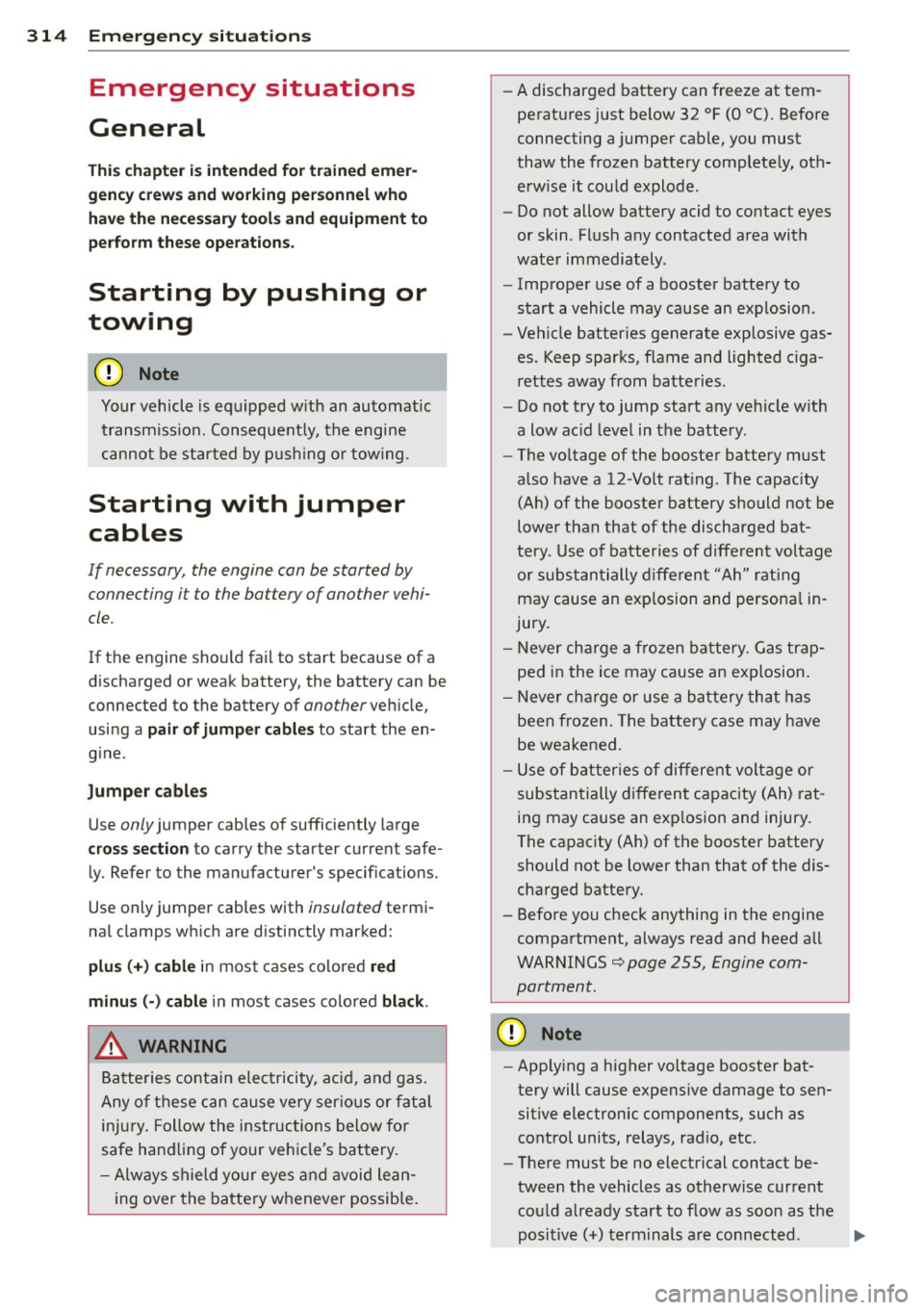
314 Emergency situations
Emergency situations
General
This chapter is intended for trained emer
gency crews and working personnel who
have the necessary tools and equipment to perform these operations.
Starting by pushing or
towing
Q;) Note
Your vehicle is equipped with an automatic
transmission. Consequently, the engine
cannot be started by pushing or towing.
Starting with jumper
cables
If necessary, the engine can be started by
connecting it to the battery of another vehi
cle.
If the engine should fail to start because of a
discharged or weak battery, the battery can be
connected to the battery of
another vehicle,
using a
pair of jumper cables to start the en
gine .
Jumper cables
Use only jumper cables of sufficiently large
cross section to carry the starter current safe
ly. Refer to the manufacturer's specifications.
Use only jumper cables with
insulated termi
nal clamps which are distinctly marked:
plus(+) cable in most cases colored red
minus(-) cable
in most cases colored black .
A WARNING
Batteries contain electricity, acid, and gas.
Any of these can cause very serious or fatal
injury. Follow the instructions below for
safe handling of your vehicle's battery.
- Always shield your eyes and avoid lean
ing over the battery whenever possible. -
A discharged battery can freeze at tem
peratures just below 32 °F (0 °C). Before
connecting a jumper cable, you must
thaw the frozen battery completely, oth
erwise it could explode.
- Do not allow battery acid to contact eyes
or skin . Flush any contacted area with
water immediately .
- Improper use of a booster battery to
start a vehicle may cause an explosion.
- Vehicle batteries generate explosive gas
es . Keep sparks, flame and lighted ciga
rettes away from batteries.
- Do not try to jump start any vehicle with
a low acid level in the battery .
- The voltage of the booster battery must
also have a 12-Volt rating. The capacity
(Ah) of the booster battery should not be
lower than that of the discharged bat
tery . Use of batteries of different voltage
or substantially different "Ah" rating
may cause an explosion and personal in
jury.
- Never charge a frozen battery. Gas trap
ped in the ice may cause an explosion.
- Never charge or use a battery that has
been frozen. The battery case may have
be weakened.
- Use of batteries of different voltage or
substantially different capacity (Ah) rat
ing may cause an explosion and injury.
The capacity (Ah) of the booster battery
should not be lower than that of the dis
charged battery.
- Before you check anything in the engine
compartment, always read and heed all
WARNINGS¢
page 255, Engine com
partment.
@ Note
- Applying a higher voltage booster bat
tery will cause expensive damage to sen
sitive electronic components, such as
control units, relays, radio, etc.
- There must be no electrical contact be
tween the vehicles as otherwise current
could already start to flow as soon as the
positive(+) terminals are connected. ..,.
Page 317 of 348
@ Tips
-The discharged battery must be properly
connected to the vehicle's electrical sys
tem. When jump start ing or charging the
battery, never connect the negative
ground cable to the battery negative
post because the battery manager sys
tem must be able to detect the battery's
state of cha rge. A lways connect the neg
ative g round cab le to the negative
gro und post o f the battery manage r con
trol uni t.
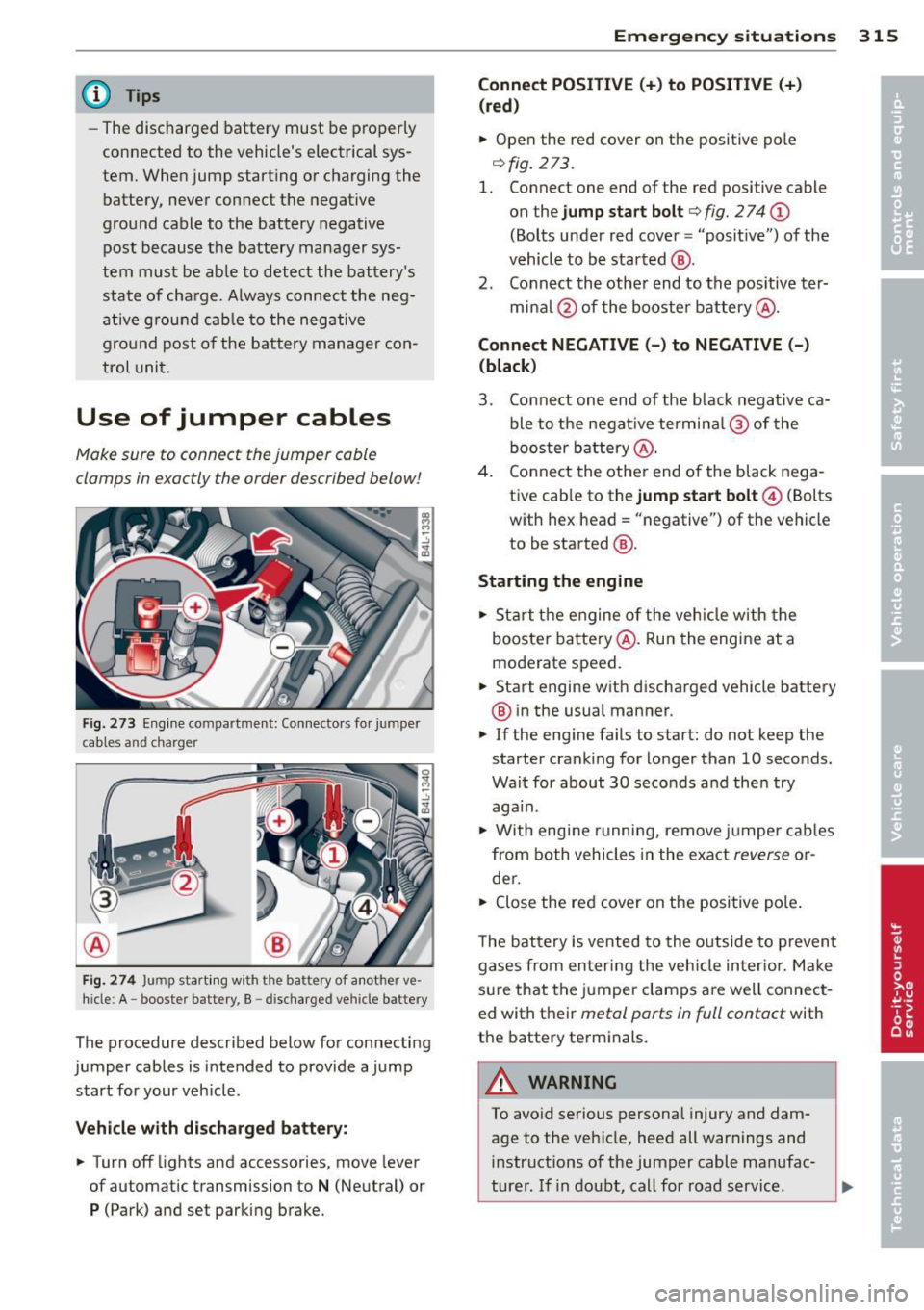
Use of jumper cables
Make sure to connect the jumper coble
clomps in exactly the order described below!
Fig. 273 Engine compartment: Con nectors fo r jumper
cables and charger
Fi g. 27 4 Jump start ing with the battery of another ve
hicle:
A-booster battery, B -discha rged vehicle battery
The procedure described below for connecting
jumper cables is intended to provide a jump
start for your veh icle .
Vehicle with discharged batter y:
.. Turn off lights and accessories, move lever
of automatic transmission to
N (Neutral) or
P (Park) and set parking brake.
Emergenc y situ ation s 315
Connect POSI TIVE(+ ) to POSITIVE (+ )
(red )
.. Open the red cover on the positive pole
¢fig. 273.
1. Connect one end of the red positive cable
on the
jump sta rt bolt ¢ fig. 2 7 4 (D
(Bolts under red cover = "posit ive") of the
vehicle to be started ®·
2. Co nnect th e other end to the pos itive ter-
mina l@ of the booster battery @.
Connect NEGATIVE( -) to NEGATIVE(-)
( black )
3. Connect one end of the black negative ca
ble to the negat ive termina l@ of the
booster b attery @.
4 . Connect the othe r end of the black nega
tive cable to the
jump start bolt@ (Bolts
with hex head= "negative") of the vehicle
to be started @.
Sta rting the engine
.,. Sta rt the e ngine of the veh icle with the
booster ba tte ry @ . Ru n the engine at a
moderate speed .
.. Start engine with discharged vehicle battery
® in the usual manner.
.. If the engine fails to start: do not keep the
starter crank ing fo r longer than 10 seconds.
Wa it for about 30 seconds a nd the n try
again .
.,. With engine runni ng, remove jumper cab les
from both vehicles in the exa ct
reverse or
de r .
.. Close the red cover on the posi tive po le .
T he battery is vented to the outside to p reven t
gases from en ter ing the veh icle inter ior. Make
s ur e that the jumper clamps a re well connect
ed with their
metal ports in full contact with
the battery term inals.
.&_ WARNING
-To avoid serious personal injury and dam
age to the ve hicle, heed all warnings and
i n structions of the jumper cable manufac-
-
turer . If in doubt, call for road service . IIJ>
Page 321 of 348
fall f rom a lift if the re is a change in ve
h icle we ight d istr ibut ion and balance.
This might happen, for examp le, when
heavy components such as the engi ne
b lock or transmiss io n are removed .
- Whe n removing heavy components like
these, ancho r vehicle to ho ist o r add cor
r e spond ing w eig hts to ma intai n the cen
te r of g ravity . Othe rwise, the vehicl e
mi ght til t or slip off th e hoi st, causi ng
s er ious perso nal inju ry.
(D Note
- Be awa re of th e f ollowing po in ts b efore
li fting t he vehi cle:
- The vehicle should never be lifted or
jacked up from underneath the engine oil pan, the transmission housing, the
front or rear axle or the body side
members. This could lead to serious
damage .
- To avoid damage to the underbody or
chassis frame, a rubber pad must be
inserted between the floor jack and
the lift points.
- Before driving over a workshop hoist,
check that the vehicle weight does not
exceed the permissible lifting capacity
of the hoist.
- Before driving over a workshop hoist,
ensure that there is sufficient clear ance between the hoist and low parts
of the vehicle .
Emergency situations 319
•
•
Page 322 of 348
320 General information
General information Explanation of
technical data
Some of the technical data listed in this man
ual requires further explanation .
The technical data for your vehicle is listed in
the charts starting on
r:::>page 322. This sec
tion provides general information, notes and
restrictions which apply to this data .
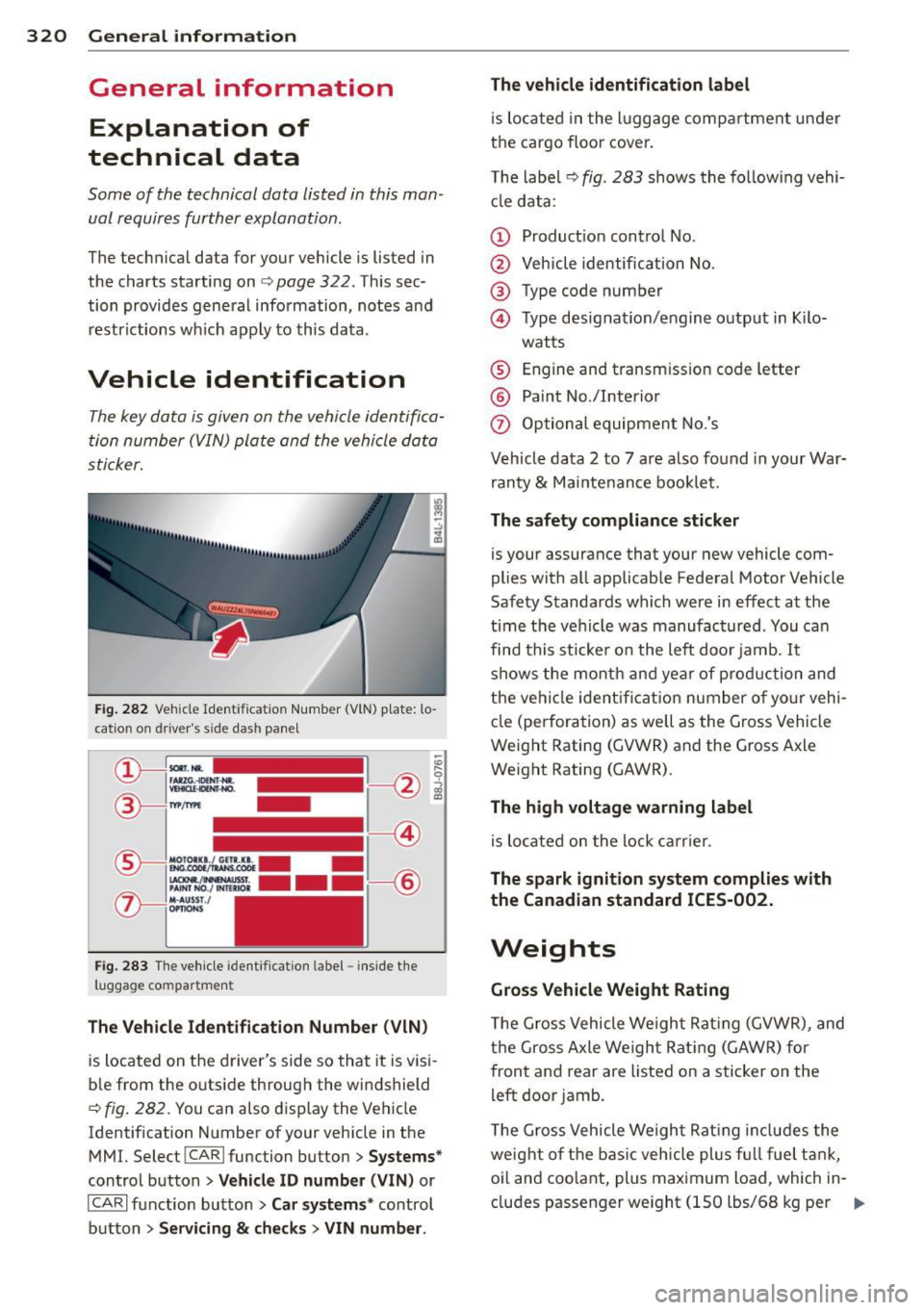
Vehicle identification
The key data is given on the vehicle identifica
tion number (VIN) plate and the vehicle data
sticker.
Fig. 282 Veh icle Ide ntific atio n Number (VlN) p late: lo
cation on driver 's sid e das h panel
Fig. 283 The vehicle identi fication label -inside the
luggage co mpa rtmen t
The Vehicle Identification Number (VIN)
is located on the driver's side so that it is visi
b le from the outside through the windshield
r:::> fig . 282 . You can also display the Vehicle
Identification Number of your vehicle in the
MMI. Select !CAR lfunc tion button>
Systems*
control button > Vehicle ID number (V IN) or
ICARI function button >
Car systems * control
button >
Servicing & checks > VIN number . The
vehicle identification label
is located in the luggage compartment under
the cargo floor cover.
The label¢
fig. 283 shows the following vehi
cle data :
(D Production control No .
@ Vehicle identification No.
® Type code number
@ Type designation/engine output in Kilo-
watts
® Engine and transmission code letter
@ Paint No./Interior
(f) Optional equipment No.'s
Vehicle data 2 to 7 are also found in your War
ranty
& Maintenance booklet.
The safety compliance sticker
is you r assurance that your new vehicle com
plies with all applicable Federal Motor Vehicle
Safety Standards which were in effect at the
time the vehicle was manufactured . You can
find this sticker on the left door jamb.
It
shows the month and year of production and
the ve hicle ident ification number of your vehi
cle (perforation) as well as the Gross Vehicle
Weight Rating (GVWR) and the Gross Axle
Weight Rating (GAWR) .
The high voltage warning label
is located on the lock carr ier .
The spark ignition system complies with
the Canadian standard ICES-002.
Weights
Gross Vehicle Weight Rating
The Gross Vehicle Weight Rating (GVWR), and
the Gross Axle Weight Rating (GAWR) for
front and rear are Listed on a sticker on the
left door jamb.
The Gross Vehicle Weight Rating includes the
weight of the basic vehicle plus full fuel tank,
oi l and coolant, plus maximum load, wh ich in
cludes passenger weight (lSO lbs/68 kg per
Ill>
Page 341 of 348
Convenience closing ......... .. .. .. .. 55
Emergency closing . . . . . . . . . . . . . . . . . . 56
sliding open . . . . . . . . . . . . . . . . . . . . . . . 54
Sunshade . . . . . . . . . . . . . . . . . . . . . . . . . 56
tilt ing ... .. ................. .. .... 54
P ark ing ..... .. .. .. .. .... ... .. .. ... 110
Automatic transmission ... .. .. .. .. . 137
Caution when parking near a parking bar- rier or curb . ............. .... .. ... 110
Low bumper cover, spoi lers and suspen-
sion ..... ... ...... ............. .. 110
Parking brake . .... ..... ... .. .. .. ... 109
Parking .... .. .... .... ... .. .. .. ... 110
Warn ing/ indicator lights ... .. .. .. .. .. 19
P ar king on a decline (downhill) . .. .. .. . 110
Park ing on an incline (uphill) ..... . ... . 110
Parking systems . ... .... ... .. .. .. ... 143
Ad justing the disp lay/warning tone .. . 153
Aud i parking system plus with front- and
rearv iew camera . . . . . . . . . . . . . . . . . . . 148
Aud i pa rking system plus with rearv iew
camera . ... ... .. .. ...... .. .. .. .. . 144
C lean ing senso rs/camera .. .. .. .. .. . 247
M alfunc tion ................ ... .. . 153
Rear p ark assist .......... .... .. .. . 14 4
Safety precautions . . . . . . . . . . . . . . . . . 14 5
T railer hitch . ..... .... ... .. .. .. ... 153
P art icle filter
refer to Diesel particula te filter . . . . . . . 3 7
Parts rep lacement ......... .. .. .. .. . 327
P ASSENGER AIR BAG O FF light ... .. .. . 195
P assenge r's seat . . . . . . . . . . . . . . . . . . . . . 72
Passive safety system ....... .. .. .. .. . 165
P ed als .... .. ................. ..... 170
Perimeter light ing ...... .... ... ... ... 59
Physica l princ iples of a frontal coll is ion . 176
P olishing .. .. ............. .... .. ... 2 48
Pollen filter Climate controls . . . . . . . . . . . . . . . . . . . . 91
P owe r locking switch . . . . . . . . . . . . . . . . . 4 4
P owe r locking system ....... ... .. .... . 41
Conve nien ce close/open feat ure . .. .... 53
L o cki ng and unlocking the vehicle from
ins ide ..... .. ... .. ..... ... .. .. .... 4 4
Opening and clos ing the windows . ... .. 53
Rear lid/trunk lid . ..... ... .. .. .. .. .. 45
Remote control key . . . . . . . . . . . . . . . . . 38
Inde x 339
Selective unlock feature ..... ... .. .. . 44
Settings . . . . . . . . . . . . . . . . . . . . . . . . . . 44
U nlocking and locking vehicle . ... .. .. . 43
Power out lets . . . . . . . . . . . . . . . . . . . . . . . 87
Power seat Controls . . . . . . . . . . . . . . . . . . . . . . . . . . 72
Seat adjustment . . . . . . . . . . . . . . . . . . . . 72
Power steering .. ................... 230
Power w indow switches .......... .... . 51
In the driver's door . . . . . . . . . . . . . . . . . 52
In the front passenger's door . . . . . . . . . 53
Reactivating the system . . . . . . . . . . . . . 54
Pregnan t women
Spe cial consider ations w hen wear ing a
sa fe ty belt . . . . . . . . . . . . . . . . . . . . . . . 180
Programming the HomeL ink® u niversa l re-
mote control ...... .. . .. ... .... .. ... 161
Proper occupant seating positions ... .. 166
P roper safety belt posi tion ............ 18 0
Proper seating position Front passenger .. .. .. .. ...... ... .. 167
Occupants . .. .. .. .... ........... .. 166
Rea r passenger s ................... 168
Protective tray . . . . . . . . . . . . . . . . . . . . . . .
82
Q
quattro ®
refer to All-wheel drive
231
Ques tion
What happens to unbelted occupants? 177
Why safety be lts? . .. .. .. ..... ... .. 175
R
Radiator fan . ..... .. . .. .. ..... ... .. 274
Rain senso r . . . . . . . . . . . . . . . . . . . . . . . . . 63
Rain sensor defective . . . . . . . . . . . . . . . . . 35
Re ading ligh ts
F ron t ....... .. .. .................. 61
Rear ... .. .. .... .. . .. .. ..... ... .. . 61
Rea r asht ray .. .. .. .. . .. .... .... .. .. . 86
Rear fog lights .. ................... . 59
Re ar li d
Au tomat ic operation . .. ..... ... .. .. . 46
Emergency unlocking . .. ..... ... .. .. . 48
Opening and closing . .. ..... ... .. .. . 45
Valet key funct ion ................. . 41
•
•