roof AUDI Q7 2013 Owner´s Manual
[x] Cancel search | Manufacturer: AUDI, Model Year: 2013, Model line: Q7, Model: AUDI Q7 2013Pages: 348, PDF Size: 87.72 MB
Page 211 of 348
A WARNING
1
Not using a child safety seat, using the
wrong child safety seat or improperly in
stalling a child restraint increases the risk
of serious personal injury and death .
-All vehicle occupants and especially chil dren must always be restrained properly
whenever riding in a vehicle.
- An unrestrained or improperly restrain
ed child can be injured or killed by be
ing thrown against the inside of the ve
hicle or by being ejected from it during
a sudden maneuver or impact.
- An unrestrained or improperly restrain
ed child is at much greater risk of injury
or death by being struck by an inflating
airbag.
- Commercially available child safety seats
are required to comply with U.S. Federal
Motor Vehicle Safety Standard (FMVSS)
213 (in Canada CMVSS 213).
- When buying a child restraint, select
one that fits your child and the vehicle.
- Only use child restraint systems that
fully contact the flat portion of the
seat cushion. The child restraint must
not tip or lean to either side. Audi does
not recommend using child safety
seats that rest on legs or tube-like
frames . They do not provide adequate
contact with the seat.
-Always heed all legal requirements per
taining to the installation and use of
child safety seats and carefully follow
the instructions provided by the manu
facturer of the seat you are using.
- Never allow children under 57 inches
(1.45 meters) to wear a normal safety
belt. They must always be restrained by a
proper child restraint system. Otherwise,
they could sustain injuries to the abdo
men and neck areas during sudden brak
ing maneuvers or accidents.
- Never let more than one child occupy a
child safety seat .
Child Safety 209
-Never let babies or older children ride in
a vehicle while sitting on the lap of an
other passenger.
- Holding a child in your arms is never a
substitute for a child restraint system .
- The strongest person could not hold
the child with the forces that exist in
an accident. The child will strike the in
terior of the vehicle and can also be
struck by the passenger.
- The child and the passenger can also
injure each another in an accident.
- Never install rear-facing child safety
seats or infant carriers on the front pas
senger seat . A child will be seriously in
jured and can be killed when the passen
ger airbag inflates -even with an Ad
vanced Airbag System .
- The inflating airbag will hit the child
safety seat or infant carrier with great
force and will smash the child safety seat
and child against the backrest, center
armrest, door or roof .
-Always install rear-facing child safety
seats or infant carriers on the rear seat .
- Forward-facing child safety seats instal
led on the front passenger's seat can in
terfere with the airbag when it inflates
and cause serious injury to the child.
Al
ways install forward-facing child safety
seats on the rear seat .
- If exceptional circumstances require the
use of a forward-facing child restraint on
the front passenger's seat, the child 's
safety and well-being require that the
following special precautions be taken:
- Make sure the forward-facing seat has
been designed and certified by its man
ufacturer for use on a front seat with a
passenger front and side airbag.
- Always carefully follow the manufac
turer's instructions provided with the
child safety seat or carrier.
- Always move the front passenger seat
into the rearmost position of the pas
senger seat's fore and aft adjustment range, and as far away from the airbag •
•
•
•
Page 213 of 348
Child safety seats
Infant seats
Babies and infants up to about one year old
and 20 lbs. or 9 kg need special rearward -fac
ing child restraints that support the back,
neck and head in a crash.
Fig . 218 Sche matic overv iew: rearward-fac ing infant
seat, properly installed o n the rear seat
.,. When using the vehicle safety belt to install
a ch ild safety seat, you must first activate
the convertible locking retracto r on the
safety be lt to prevent the child safety seat
from moving
¢ page 215 or install the seat
using the LA T CH attachments.
.,. Push the child safety seat down with your
full weight to get the safety belt rea lly tight
so that the seat cannot move forward or
sideways more than one inch (2.5 cm).
.,. Secure unused safety belts on the rear seat
¢page 210.
Infants up to about one year (20 lbs. or 9 kg)
are best protected in special infan t carriers
and child safety seats designed for their age
group . Many experts believe that infants and
small children should ride only in spec ial re
straints in which the ch ild faces the back of
the vehicle. These infant seats support the ba
by's back, neck and head in a crash
¢fig . 218.
The airbag on the passenger side makes the
front seat a po tentially dangerous place for a
child to r ide . The front seat is not the safest
p lace for a child in a forward -facing child seat.
It is a very dangerous p lace for an infant or a
l arger ch ild in a rearward-facing seat.
Child Safety 211
A WARNING
Not using a child safety seat, using t he
wrong child safety seat or improperly in
stall ing a ch ild restraint increases the risk
of ser ious personal injury and death in a
crash.
- Never install rear-facing child safety
seats or infant ca rr ie rs on the front pas
senger seat -even with an Advanced Air
bag Sys tem. A ch ild will be ser iously in
jured and ca n be killed when the inflat
ing airbag hits the child safety seat or in
fant carrier with great force and smashes the child safety seat and child against
the backrest, center armrest, door or
roof ¢
page 186, Child restraints on the
front seat- some important things to
know .
-Always install rear-fac ing ch ild safety
seats or infant carriers on the rear seat .
- Never install a rear-fac ing ch ild restraint
in the forward-fac ing d irect ion. Such re
straints are designed for the special needs of infants and very small ch ild ren
and cannot prote ct them properly if the
seat is forward- facing.
- If you mus t insta ll a rearward fac ing
child sa fety seat on the fro nt passenger
seat because of exceptiona l circumstan
ces and t he
PASSENGER AIR BAG OFF
light does not come on and stay on, im
mediately insta ll the rear -fac ing ch ild
safety seat in a rear seating position and
have the airbag system inspected by your
Aud i dea ler .
- Always read and heed all WARNINGS
wheneve r us ing a child restrained in ave
hicle is being used¢
page 175 , Safety
belts,
¢ page 184, Airbag system and
¢ page 205, Important things to know.
Page 214 of 348
212 Child Safety
Convertible child safety seats
Properly used convertible child safety seats
can help protect toddlers and children over
age one who weigh between
20 and 40 lbs. (9
and 18 kg) in a crash.
Fig. 219 Schematic overv iew : ins tallat ion of t he at
ta chments applicable to a LATCH seat
Fig. 220 Sche matic overview: insta llation of th e sea t
us ing t he veh icle's safety be lt system
.. When using the vehicle safety belt to install
a chi ld safety seat, you must f irst activate
the convertible locking feature on the safety
belt to prevent the child safety seat from
moving ¢
page 215 or install the seat using
the LATCH attachments .
.. Push the child safety seat down with your
full weight to get the safety belt really t ight
so that the seat cannot move forward or sideways more than one inch (2.5 cm)
¢page 215.
.. If the child safety seat is equ ipped with a
tether strap, attach it to the tether anchors
¢page 222.
.. Secure unused safety belts on the rear seat
¢page 210.
A toddler or child is usually too large for an in
fant restra int if it is more than one year o ld
and weighs more than 20 lbs. (9 kg). T
oddlers and children who are older than one
year up to about 4 years old and weigh more
than 20 lbs. (9 kg) up to 40 lbs. (18 kg) must
always be properly restrained in a child safety
seat certified for their size and weight
¢ fig . 219 and ¢ fig. 220 .
The airbag on the passenger side makes the
front seat a potentia lly dangerous place for a
child to ride. The front seat is not the safest
place for a child in a forward-facing child safe
ty seat . It is a very dangerous place for an in
fant or a larger child in a rearward-facing seat.
_&. WARNING
Not using a child safety seat, using the
wrong child safety seat or improp erly in
stalling a chi ld restraint increases the risk
of serious personal injury and death in a
collision or other emergency situation .
- Children on the front seat of any car,
-
even with Advanced Airbags, can be seri
ously injured or even killed when an air bag inflates . A chi ld in a rearward-facing
child safety seat installed on the front passenger seat will be serious ly injured
and can be killed if the front airbag in
f la tes -even with an Advanced Airbag
System .
- The inflating airbag will hit the child
safety seat or infant carrier with great
force and will smash the child safety seat
and child against the backrest, center
armrest, door or roof.
- Always install rear-facing child safety
seats on the rear seat .
- If you must install a rearward facing
child safety seat on the front passenger
seat because of exceptiona l circumstan
ces and the
PASSENGER AIR BAG OFF
light does not come on and stay on, im
mediately insta ll the rear-facing child
safety seat in a rear seating position and
have the airbag system inspected by your
Aud i dealer.
- The rear side of the child safety seat
should be pos itioned as close as possible ..,.
Page 218 of 348
216 Child Safety
and child against the backrest, center
armrest, door or roof.
- Always install rear-facing child safety
seats or infant carriers on the rear seat.
- Forward-facing child safety seats or in
fant carriers installed on the front pas
senger's seat may interfere with the de
ployment of the airbag and cause serious
injury to the child.
- It is safer to install a forward-facing
child safety seat on the rear seat.
- Always read and heed all WARNINGS whenever using a child restrained in ave
hicle is being used
c::> page 205 . Special
precautions apply when installing a child
safety seat on the front passenger seat
c::> page 186, Child restraints on the front
seat -some important things to know.
A WARNING
Always take special precautions if you
must install a forward or rearward-facing
child restraint on the front passenger's
seat in exceptional situations:
- Whenever a forward or rearward-facing
child restraint is installed on the front
passenger seat, the
PASSENGER AIR
BAG OFF
light must come on and stay on
whenever the ignition is switched on.
- If the
PASSENGER AIR BAG OFF light
does not come on and stay on, perform
the checks described
<=:> page 195, Moni
toring the Advanced Airbag System.
- Take the child restraint off the front pas
senger seat and install it properly at one
of the rear seat positions if the
PASSEN
GER AIR BAG OFF
light does not stay on
whenever the ignition is switched on.
- Improper installation of child restraints
can reduce their effectiveness or even
prevent them from providing any protec
tion.
- An improperly installed child restraint
can interfere with the airbag as it de
ploys and seriously injure or even kill the
child. -
Always carefully follow the manufactur
er's instructions provided with the child
safety seat or carrier.
- Never place additional items on the seat
that can increase the total weight regis
tered by the weight-sensing mat and can
cause injury in a crash .
A WARNING
-Forward-facing child restraints:
- Always make sure the forward-facing
seat has been designed and certified by its manufacturer for use on a front seat
with a passenger front and side airbag .
- Never put the forward-facing child re straint up, against or very near the in
strument panel.
- Always move the passenger seat into its
rearmost position in the seat's fore and
aft adjustment range, as far away from
the airbag as possible before installing
the forward-facing child restraint. The
backrest must be adjusted to an upright
position.
- Make sure that the PASSENGER AIR BAG
OFF
light comes on and stays on all the
time whenever the ignition is switched
on .
A WARNING
Rearward-facing child restraints:
- A child in a rearward-facing child safety
seat installed on the front passenger
seat will be seriously injured and can be killed if the front airbag inflates -even
with an Advanced Airbag System .
- The inflating airbag will hit the child
safety seat or infant carrier with great
force and will smash the child safety seat
and child against the backrest, center
armrest, door or roof.
- Always be especially careful if you must
install a rearward facing child safety seat
on the front passenger seat in exception-
al circumstances.
~
Page 237 of 348
Catalytic converter
Applies to vehicles: with gasoline engine
It is very important that your emission control system (catalytic converter) is function
ing properly to ensure that your vehicle is run
ning in an environmentally sound manner .
... Always use lead-free gasoline¢ page 256,
Gasoline .
... Never run the tank down all the way to
empty .
... Never put too much motor oil in your en-
gine
¢ page 270, Adding engine oil~-
.,. Never try to push- or tow-start your veh icle.
The catalytic converter is an eff icient "clean
up" device built into the exhaust system of
the vehicle. The catalytic converter burns
many of the poll utants in the exhaust gas be
fore they are released into the atmosphe re.
The exclusive use of unleaded fuel is cr it ically
i mportant for the life of the cata lytic convert
e r and proper fu nctioning of the engine.
A WARNING ,~
- Do not park or operate the veh icle in
areas where the hot exhaust system may
come in contact with dry grass, brush,
fuel spill or other material which can
cause a fire.
- Do not apply additional undercoating or
rustproofing on or near the exhaust
man ifold, exhaust p ipes, catalytic con
verter or heat shie lds . During driving, the
substance used for undercoating could
overheat and cause a fire.
{[) Note
-Be aware that just one tank fi lling with
le aded fuel will already seriously de
grade the performance of the catalytic
conve rter .
- Do not exceed the correct engine oil level
¢ page 270.
-Do not drive until the fuel tank becomes
completely empty. The eng ine could mis
fire . U nburned fuel could a lso get into
Dri vin g and en vironm ent 235
the exhaust system and this cou ld cause
the catalytic converter to overheat .
- Do not turn off the igni tion while the ve
hicle is moving.
- Do not con tinue to ope rate your veh icle
unde r these conditions, as othe rwise fuel
can reach the catalytic converter. This
co uld result in overheating o f the con
verter, requir ing its replacement.
- To assure efficient operation of the Emis
sion Control System:
- H ave your vehicle maintained prope rly
and in accordance w ith the se rv ice rec
ommendat ions in you r Warranty &
M aintenance boo klet.
- L ack of prope r maintenance as we ll as
improper use of the vehi cle w il l impair
the function of the em ission contro l
system and could lead to damage .
@ For the sake of the environment
Even when the Emiss ion Control System is
operat ing properly, the exha ust gas can
have a sul fur -li ke exhaust gas smell under
some operating states . This depends on
the sulfur content of the fuel being used .
Using a different brand of fue l may help,
or f illing the tank with lead-free super
grade gasoline .
Diesel particulate filter
Applies to vehicles : with diese l eng ine
The diesel part iculate filter filters nearly all of
the soot particles out of the exhaust . The fil
ter cleans itself automat ica lly under normal
driv ing cond itions . If the filter ca nnot clean it
self (for example, because you a re o nly dr iving
short distances), the fi lter becomes clogged
with soot and the
II symbo l for the diesel
particu late filter ill uminates ¢
page 3 7.
A WARNING
- Do not park your vehicle over flammab le
materia ls such as grass or leaves because
the high temperature of the diesel par-
ticulate f ilter could start a fire. ..,. •
•
Page 244 of 348
242 Trailer towing
Weight Rating will also change the per
formance and handling characterist ics of
your vehicle, which could cause a crash result ing in serious injury or death .
- The Gross Vehicle Weight Rat ing for your
vehicle would be exceeded if your vehicle
is simultaneously equipped with Panor
am ic sliding sunroof; th ird-row seating;
t railer towing equipment (factory or
dealer-installed) , and running boards
(deale r-installed) . UNDER NO CIRCUM
STANCES MAY ALL SUCH ITEMS BE IN
STALLED ON THE SAME VEHICLE.
Operating instructions
MAX 6.9"
MAX175mm
E
Ill E Ill ... Q) m
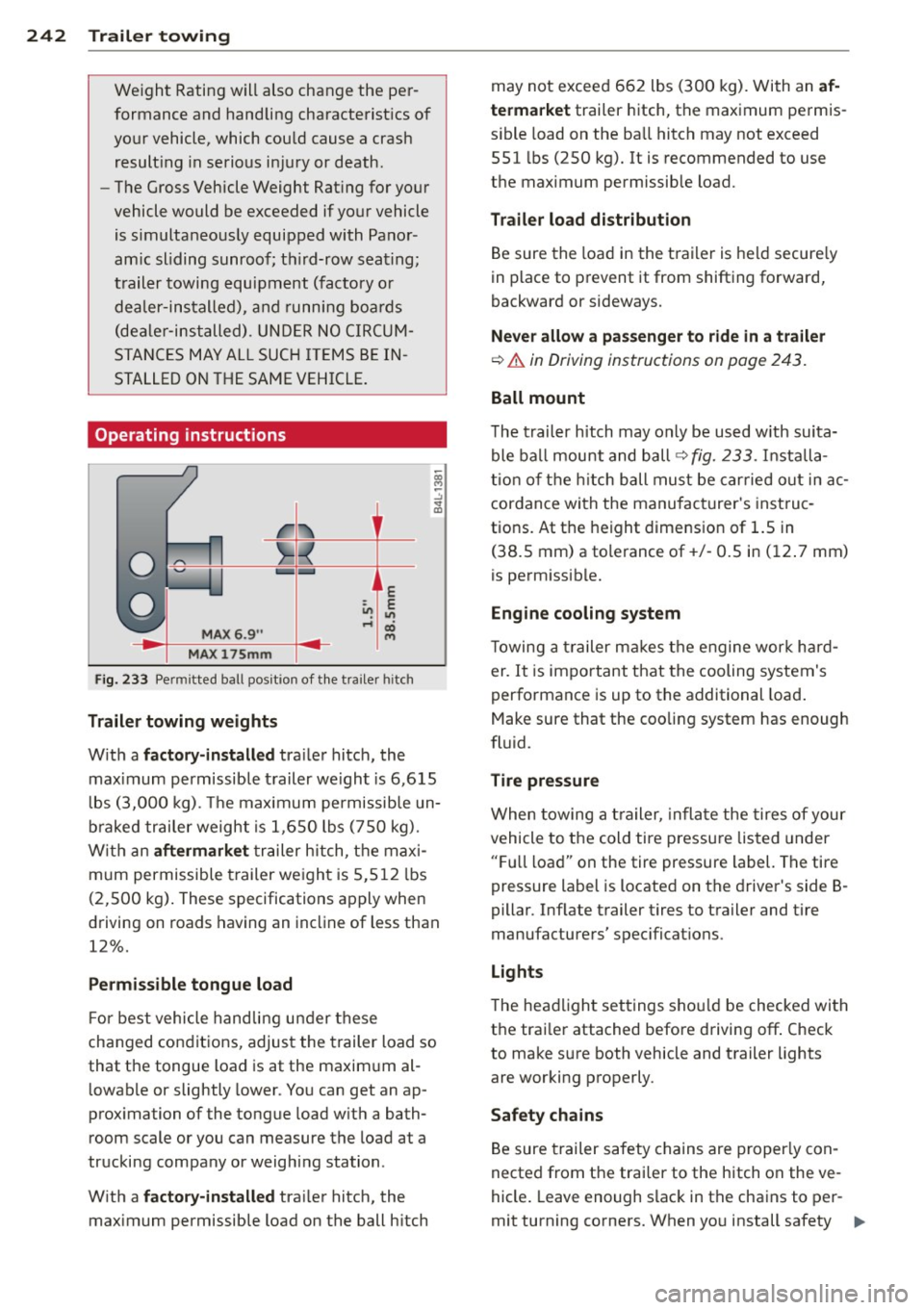
Fig. 233 Permi tted ba ll pos it ion of t he t ra iler h itc h
Trailer towing weights
With a factory-installed trailer hitch, the
maximum permissible trailer weight is 6,615
l bs (3,000 kg) . Th e maximum permissible un
braked trailer weight is 1,650 lbs (750 kg).
With an
aftermarket trailer hitch, the maxi
m um permissible trailer weight is 5,512 lbs
(2,500 kg) . These specifications apply when
driving on roads having an incline of less than
12%.
Permissible tongue load
F or best vehicle handling under these
changed condit ions, adjust the trailer load so
that the tongue load is at the maximum al
lowable or slightly lower . You can get an ap
prox imation of the tongue load w ith a bath
room scale or you can measure the load at a
trucking company or weighing station .
With a
factory-installed trailer hitch, the
maximum permissible load on the ball h itch may not exceed 662 lbs
(300 kg). With an
af
termarket
trailer hitch, the maximum permis
s ib le load on the ba ll hitch may not exceed
551 lbs (250 kg). It is recommended to use
the maximum permissible load.
Trailer load distribution
Be sure the load in the trailer is held secure ly
in place to prevent it from shifting forward,
backward or sideways.
Never allow a passenger to ride in a trailer
¢&. in Driving instructions on page 243.
Ball mount
The trailer hitch may only be used w ith suita
ble ball mount and ball¢
fig. 233. In stalla
tion of the hitch ball must be carried out in ac
cordance with the manufac turer's instruc
tions. At the height dimension of 1.5 in
(38.5 mm) a tolerance of +/- 0.5 in (12. 7 mm)
is permissib le.
Engine cooling system
Towing a trailer makes the engine work ha rd
er . It is important that the cooling system's
performance is up to the additional load .
Make sure that the cooling system has enough
fluid .
Tire pressure
When towing a trailer, infla te the tires of your
vehicle to the cold tire pressu re listed under
" Full l oad" on the tire pressure label. The tire
pressure label is located on the driver's side B
pillar . Inflate trailer tires to trailer and tire
manufacturers' spec ificat ions .
Lights
The headlight settings shou ld be checked with
the trai ler attached before driving
off. Check
to make sure both vehicle and trailer lights
are working properly.
Safety chains
Be sure trailer safety chains are properly con
nected from the trai ler to the h itch on the ve
hicle. Leave enough slack in the chains to per
mit turning corners. When you install safety
IJ,,
Page 248 of 348
24 6 Cl eaning and protec tio n
Automatic car wash
The vehicle can be washed in almost any
modern automatic car wash .
The vehicle paint is so durable that the vehicle
can normally be washed without problems in
an automatic car wash. However, the effect on
the paint depends to a large extent on the de
sign of the facility, the filtering of the wash
water, the type of wash and care mater ial , etc.
I f the pa int has a dull appearance afte r going
through the car wash or is scratched, bring
this to the attention of the operator immedi
ately. If necessary, use a different car wash.
Before going through a car wash, be sure to
take the usual precautions such as closing the
windows and the Panoramic sliding s unroof.
Factory installed antennas must not be re
moved.
I f you have installed additional accessories on
the vehicle - such as spoilers, roof rack, etc. -
it is best to ask the car wash operator if these
should be removed.
A WARNING
Please take note of the following po ints
before going through an automatic car
wash with your vehicle, so that you can avoid damage to your vehicle .
- Compare the track of your vehicle with the distance between the gu ide rails of
the fac ility- there is a risk of damage to
the whee ls and t ires.
- Compare the height and w idth of your
vehicle with the height and width of the
tunnel at the facility.
- Fold the exte rior mirrors flat - there is a
risk of damag ing the exte rior m irrors.
Power folding exterior mirrors* mus t not
be folded in or out by hand. Use the pow
er function!
- Do not al low the wiper blade to fall onto
the windshield after the vehicle is dried -
there is a risk of damag ing the paint on
the hood.
- Always read and heed all WARNINGS and other information ¢
page 245.
Washing the vehicle by hand
A lot of water is needed when washing a vehi
cle by hand .
.,. Before you start washing, make sure you
have read and understood the WARNINGS
¢ .&. in General information on page 245 .
.,. First soak all dried d irt unt il it is soft, then
r inse it off .
.,. As you clean you r vehicle , start w it h the
roof and work your way down to the bottom,
using a sponge, a sponge g love or a clean
brush.
.,. Rinse the sponge or the sponge glove often,
flushing it clean each time.
.,. Use spec ial car shampoo only for very per
sistent d irt .
.,. Rinse the car thoroughly wit h water .
.,. Use a chamo is leather to gently w ipe the ex-
ter ior d ry.
Use a separate sponge for cleaning the
wheels, door s ills and other regions exposed
to road dirt . In this way, you will not scratch
the pa int with coarse pa rticles imbedded in
the sponge the next time you wash the car.
A WARNING ~ -
- Do not clean the underside of the chas
sis, fenders, wheel covers , or other ha rd
to reach pa rts without protect ing your
hands and arms . You may cut yourself on
sharp-edged metal parts.
- Always read and heed a ll WARNINGS and
other information ¢
page 245.
(D Note
- Never try to remove dirt, mud or dust if
the surface of the ve hicle is dry . Never
use a dry cloth or sponge, s ince this
co uld scratch your vehicle's paint or win
dows .
- Never wash your car in bright s unlight.
Drops of water act as magn ifying lenses
and may damage your paint .
- When you wash your car in the winter: if you rinse your vehicle with a hose, be careful not to aim the stream of water
Page 252 of 348
250 Cleaning and protec tio n
Cast (light) alloy wheels
Cast (light) alloy wheels require special care .
• Wash the whee ls with a sponge or hose
brush every other week.
• For deep cleaning afterwards, use only a
dedicated
aci d-fr ee cast alloy wheel cleaner .
• Rub a coat of
liq uid wax onto the r ims every
t h ree months. Be su re to reach and treat all
parts of the rim .
To preserve the decorat ive appearance of the
cast alloy whee ls, some specia l care is neces
sa ry. In addit ion to road dirt and sa lt, b rake
d ust is a lso corros ive. If left on for too long,
b rake dust can cause pitting.
Use only specia l
acid-free cleaners formulated
for a lloy rims . Safe p roducts are available at
your author ized Audi dealer. Never leave the
cleane r on the rims longe r than specified on
the label. If not rinsed off promptly, the acid
contained in some cleaners can attack the
threads on the whee l bolts.
Never use ab rasive or metal polishing clean
ing agents. If the protective coating has been
chipped, e .g. by k icked up road dirt, touch it
up as soon as possible.
A WARNING
- Moisture and ice on brakes may affect
braking efficiency¢
page 228, General
information.
Test the brakes carefully
each time you wash the veh icle .
- Always read and heed all WARNINGS and
other information
¢ page 245.
-
Body cavity sealing
The body cavity sealing does no t need to be
checked.
A ll body cavities which co uld be affected by
corrosion have been thoro ughly protected at
the factory.
This sealing does not require any inspection or
addit ional treatment . If any wax should seep
out of the cav ity when the ambient tempera- ture is high, it can be removed with a p
lastic
scraper and a suitable solvent.
A WARNING
-Solvents can be dangerous.
- Benzine is flammab le and toxic. If you
use benzine for removing the wax, keep
sparks, flame and lighted cigarettes
away. Never dump benz ine on the
ground, into open streams or down sew
age drains.
- Be sure to observe all safety and environ
mental regulat ions . Follow all instruc
tions on the container .
- Always read and heed all WARNINGS and
other information ¢
page 245.
, Chassis
Have the undercoating checked for damage
from time to time.
The lower body shell of your Audi is also thor
oughly protected against corros ion.
Any damage to the undercoating caused by road hazards should be repaired prompt ly .
A WARNING
Too much undercoating in the wrong p la
ces can cause a fire.
- Do not app ly additional undercoating or
r u stproof ing on or near the exhaust
manifold, exhaust pipes, catalytic con
verter or heat shields. While driving, the substance used for undercoating could
overheat and cause a fire.
'
- Always read and heed all WARNINGS and
other information ¢
page 245.
Exhaust tail pipes
Road salt and other corrosive materials will
damage the material in the exhaust tail pipes
if they are not cleaned regularly. Do not clean
the tail pipes with wheel cleaner, pa int polish,
chrome polish or other ab rasive cleaners.
Clean the tail pipes with car care products
that are suitable for stainless steel.
Page 270 of 348
268 Checking and filling
VW 502 00 (vehicles with gasoline engine) or
VW 507 00 (vehicles with diesel engine).
Changing the engine oil
The engine oil and oil filter must be changed
according to the m ileage (ki lometers) and
time intervals specified in your vehicle 's War
ranty
& Maintenance booklet. Do not exceed
these intervals -harmful deposits from old
engine oil can reduce engine performance and
can lead to expensive engine repairs.
Changing the oil at the recommended inter
va ls is so very important because the lubricat
ing properties o f oi l decrease gradually during
normal vehicle use. If you are not sure when
you have your o il changed, ask your author
i z ed Audi Service Advisor.
Under some ci rcumstances the engine oi l
should even be changed more frequently .
Change oi l more often if you drive mostly
short distances, operate the vehicle in dusty
areas or mostly under stop-and-go traffic con
d itions, or when you use your vehicle w here
temperatures stay below freez ing point for
l ong periods .
Detergent additives in the o il w ill make fresh
oil look dark after the engine has been run
ni ng for a short time . This is normal and is not
a reason to change the oil more often than
recommended.
Damage or malfunctions due to lack of
maintenance
It is essential that you change your oil at the recommended intervals using only engine oil
that complies with Audi oi l standard
VW 502 00 (vehicles with gasoli ne engine) or
VW 507 00 (veh icles with diese l engine) . Your
Limited New Vehicle Warranty does not cover
damage or malf unctio ns due to failure to fol
lo w recommended maintenance and use re
quirements as set forth in the A udi Owner's
Manual and Warranty
& Maintenance booklet.
Your dea ler will have to deny warranty cover
age unless you present to the dealer proof in
the form of Service or Repa ir Orders that all scheduled maintenance was
performed in a
timely manner.
Engine oil consumption
To provide effective lubrication and cooling for
internal engine parts, all internal combustion
engines use some o il. Oil consumption varies
from engine to engine and may change over
the life of the engine. Engines tend to use
more o il during the break-in period tha n they
do afterward, when oil consumption has sta
bilized. Depending on the way the vehicle is
driven and the operating conditions, oil con
s u mption can be up to 1 quart per 1,200
miles (1 liter per 2,000 km) . Consumption
may be higher within the first 3,000 m iles
(5,000 km) .
Under normal conditions, the rate of oil con
sumption depends on oil quality as well as vis
cosity, engine speed (rpm), outs ide tempera
ture, road conditions, the amount of oil dilu
t ion caused by condensed water or fue l resi
due, and ox idat ion of the oil. Oil co nsumption
may increase with engine wear over time, un
t il replacement of worn engine pa rts may be
come necessary.
Because of all these variables, there is no
standard or "norma l" rate of oil consumption .
We urge you to check the engine oil level at
regular intervals, preferably every time you
fill the fuel tank, and always before a long
trip.
The oil pressure warning light. is not an
indicator of low engine oil level. If the warn
ing light does not go out after starting, or
flashes while driving (above 1500 rpm), a
buzzer will sound. It indicates that the oil
pressure is too low . Stop the engine immedi·
ately, check the engine oil level and add oil if
necessary. If the engine oil level is normal,
but the light continues to flash, do not keep
driving or let the engine idle, as damage may
occur .
II-
Page 284 of 348
282 Tires and wheels
Maximum loaded vehicle weight
means t he sum of:
(a) Curb weight
(b) Accessory weight
( c ) Vehicle capacity we ight, and
(d) P rod uction options weight
Maximum (permissible) inflation pressure
means t he max imum co ld in flation pressu re
to which a tire may be in flate d. Also called
"maxim um inflation p ress ure."
Normal occupant weight
means 150 lbs. (68 kilog rams) times the
nu mbe r of o ccupants seated in t he vehicle up
to the tot al sea ting capa cit y of yo ur vehicle .
Occupant distribution means dist ribution of occupants in a veh icle .
Outer diameter means t he overa ll diameter of a n inf lated new
tire.
Overall width
means t he linear dis tan ce between the ex ter i
ors o f th e sidewalls of an inflated tire, in cl ud
ing e levations due to labeling, decorations, or
p rotective bands o r ribs.
Ply
mea ns a laye r of r ubber- co ate d parall el c ords.
Production options weight
means t he comb ined we ight of those installed
regular produc tion options weigh ing ove r 5
l bs . (2 .3 kg) in excess of t hose standard items
which t hey repla ce, no t previously considered
in cur b weight o r acc essory weig ht, incl uding
h eavy duty brakes, r ide leve le rs, roof ra ck,
h eavy duty ba ttery, a nd specia l trim .
Radial ply tire
means a pneumatic t ire in whic h the p ly co rds
that ex tend to the beads are laid a t sub stan
ti ally 9 0 degrees to the ce nt erline o f the
tread . Recommended inflation pressure
see
~
page 281, C old tire infla tio n pressure.
Reinforced tire
means a t ire design to operate a t higher loads
and at h igher inflation pressures than t he cor
r espondi ng stan da rd tire. Reinforce d tires
may be identifie d as "XL ", "xl ", "EX TRA LOAD",
o r "RF " on t he sidewa ll.
Rim
means a metal s upport for a tire or a t ire and
tu be assembly upon which the tire beads are
seated.
Rim diameter
means nom inal d iameter of the bead seat. If
you change your wheel s ize, you w ill have to
purch ase new tires to match th e new r im di
ameter .
Rim size designation
means r im diamete r and width.
Rim width
means nom inal dista nce between rim flanges .
Sidewall
means tha t p ort ion of a t ire betw ee n t he
t read a nd bead.
Speed rating (letter code)
means the speed at which a tire is designed to
be driven for extended periods of time. The
r a ti ngs range from 93 mph ( 150 km/h) to
186 mph (298 km/h)
~ page 292 . Y o u may
not fi nd this informa tio n on all ti res because
it is no t re quir ed by law.
T he speed rating letter code, wh ere applica
ble , is molde d on the tire sidewall a nd indi
c ates the max imu m permi ssibl e road spee ds
~ A in Winter tire s on page 296 .
Tire pressure monitoring system mea ns a system that detects when o ne or
more of a ve hicle 's tires are unde rinf lated an d
i lluminat es a low tir e pr essure w arning t ell-
tal e. ..,_