brake AUDI Q7 2013 Owner´s Manual
[x] Cancel search | Manufacturer: AUDI, Model Year: 2013, Model line: Q7, Model: AUDI Q7 2013Pages: 348, PDF Size: 87.72 MB
Page 268 of 348
266 Checking and filling
Engine compartment
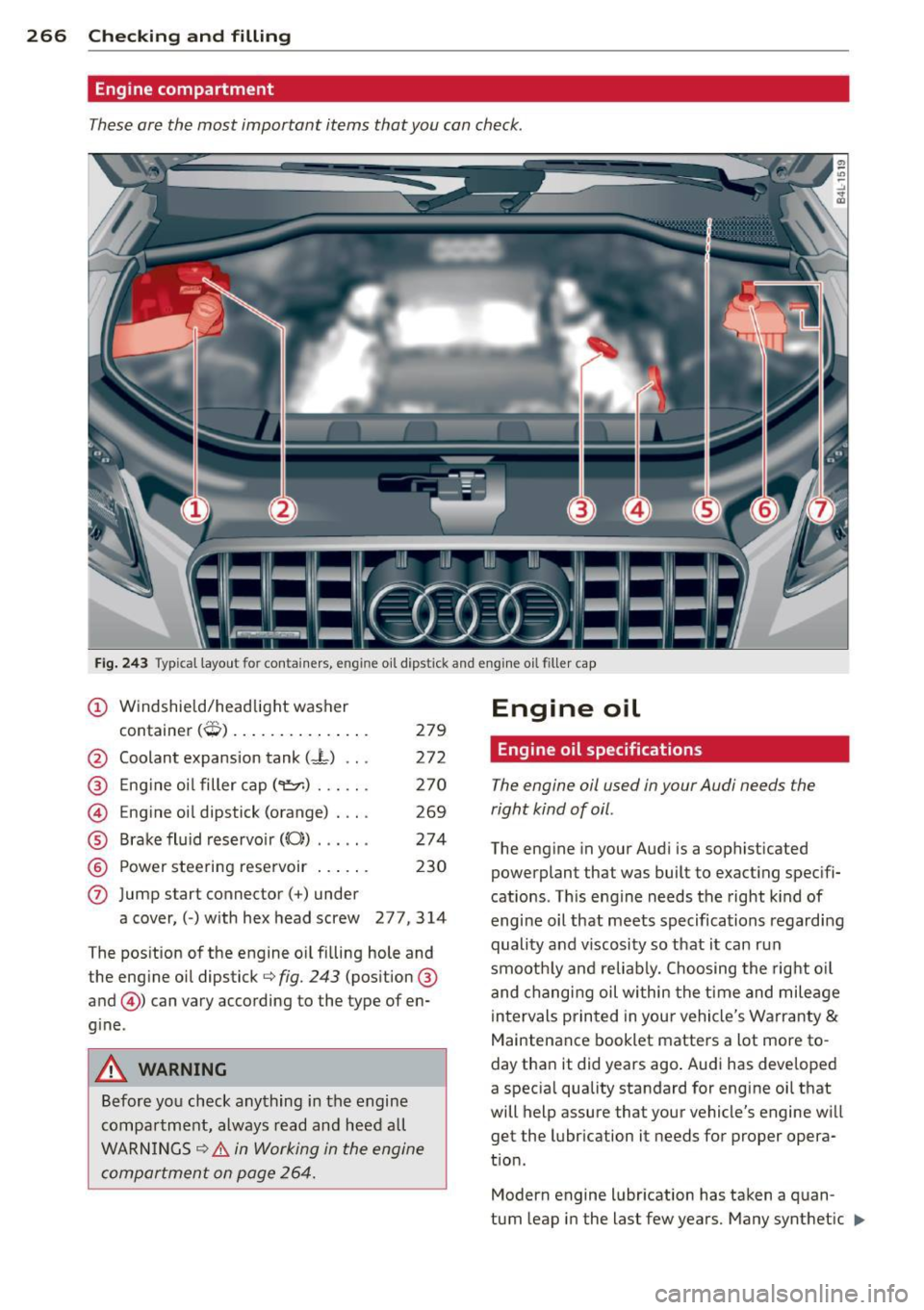
These are the most important items that you can check .
Fig. 243 Typical layout for containers, engine oil di pstick and engine oil fille r cap
CD W indshield/head light washer
. ( ") container O ......... ... .. . 279
@ Coolant expansion tank (-L) ... 272
® E
ng ine oi l filler cap ('t".:r.) ... .. . 270
© Eng ine oil dipstick (orange) . .. . 269
® Brake fluid reservoir ((0)) ...... 274
® Power steering reservoir ... .. . 230
(j) Jump start connector(+) under
a cover, ( -) with hex head screw
277, 314
The position of the engine o il fi lling hole and
the engine oil dipstick
r=;, fig. 243 (position ®
and @) can vary according to the type of en
gine .
_&. WARNING
Before you check anything in the engine
compartment, always read and heed all
WARNINGS ¢.&.
in Working in the engine
comportment on page 264.
-
Engine oil
Engine oil specifications
The engine oil used in your Audi needs the
right kind of oil.
The engine in your Audi is a sophist icated
powerplant that was built to exacting specifi
cations. This engine needs the right kind of
engi ne oil that meets specifications regard ing
quality and v iscosity so that it can run
smooth ly and reliab ly. Choosing the right oil
and changing oil within the time and mileage
intervals printed in your vehicle's Warranty
&
Maintenance booklet matters a lot more to
day than it did years ago . Audi has developed
a spec ia l quality standard for eng ine oil that
will help assure that your vehicle's engine w ill
get the lubrication it needs for proper opera
t ion .
Modern engine lubr ication has taken a quan
tum leap in the last few years. Many synthetic "'
Page 276 of 348
274 Che cking and filling
-If you drain the coolant, it must be
caught and safely stored in a proper con
tainer clearly marked "poison".
(D Note
- Coolant pollutes the environment and
could cause an engine fire . Excess coo l-
ant will be forced out through the pres
sure relief valve in the cap when the en
gine becomes hot.
- If, in an emergency, only water can be
added, the correct ratio between water
and antifreeze
c:;, page 271 must be re
stored as soon as possible .
@ For the sake of the environment
Dra ined coolant should not be reused. Al
ways dispose of used coolant while observ ing all environmental regulations.
Radiator fan
The radiator fan switches on automatically by
itself
The radiator fan is driven by the engine via the
V-belt . The viscous clutch regulates the speed
of the fan accord ing to t he temperature of the
coolant.
An auxiliary electric radiator fan* switches on
and off depending on coolant temperature
and other vehicle operating conditions.
After you switch the engine off, the auxiliary
fan can continue running for up to 10 minutes - even with the ignition off. It can even switch
on again later by itself
c:;, &. , if
- the temperature of the engine coolant rises
due to the heat build-up from the engine in
the engine compartment, or
- the engine compartment heats up because
the vehicle is parked in intense sunlight.
_&. WARNING
- To reduce the risk of personal injury nev
er touch the radiator fan . -
The auxiliary electric fan is temperature
controlled and can switch on suddenly
even when the engine is not running.
- The auxiliary radiator fan switches on au
tomatically when the engine coolant
reaches a certain temperature and will
continue to run until the coolant temper
ature drops.
Brake fluid
Checking brake fluid level
The brake fluid level can be checked with a
quick glance.
Fig. 248 Eng ine compart men t: cover on the brake fluid
reservoir
Before you check anyth ing in the engine com
partment,
always read and heed all WARN
INGS c:;, _&. in Working in the engine compart
ment on page 264.
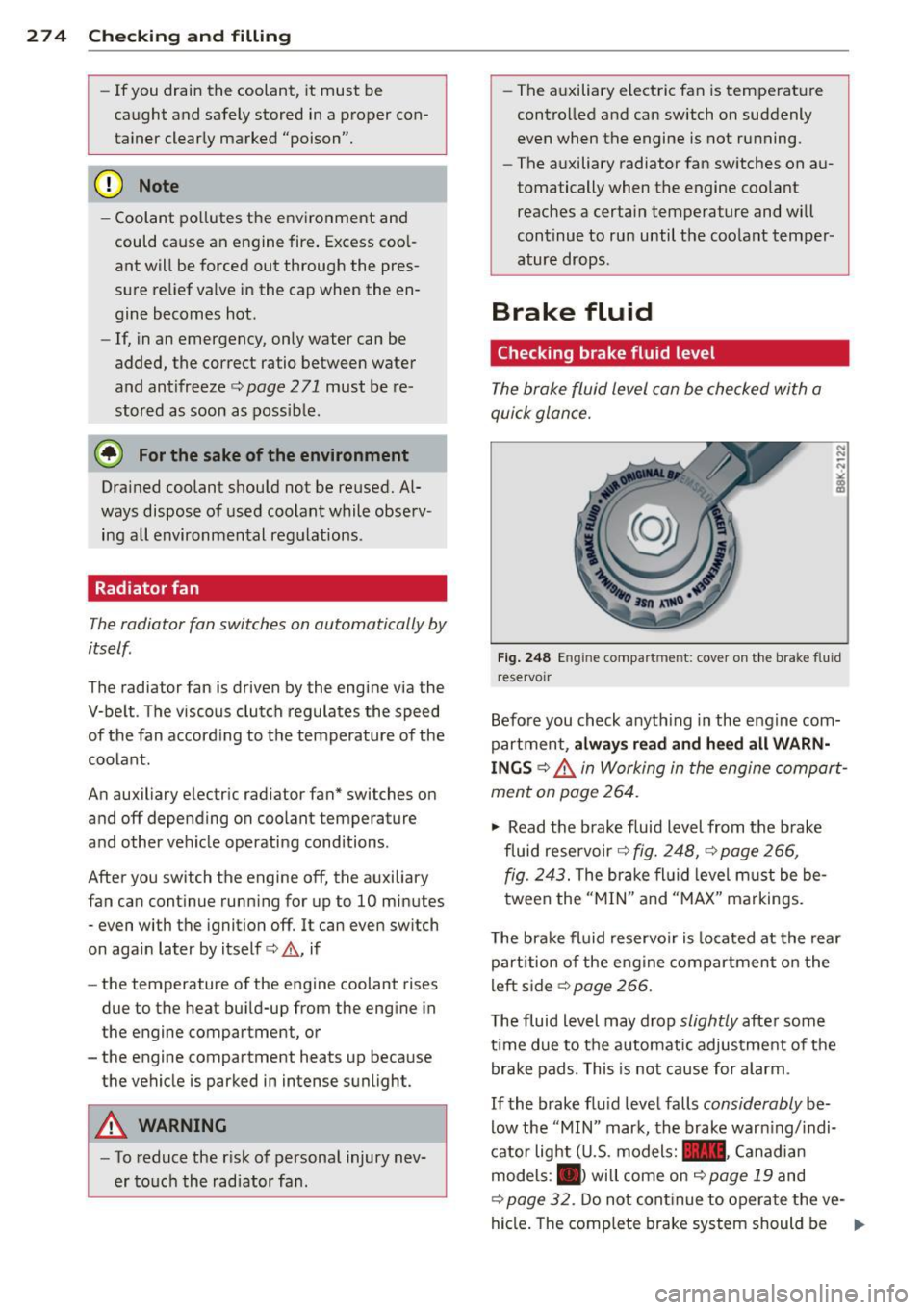
.,. Read the brake fluid level from the brake
fluid reservoir
c::> fig. 248, c:;, page 266,
fig. 243.
The brake fluid level m ust be be
tween the "MIN" and "MAX" markings.
The brake fluid reservoir is located at the rear
part ition of the engine compartment on the
left side
c:;, page 266.
The fluid level may drop slightly after some
time due to the automatic adjustment of the brake pads. This is not cause for alarm .
If the brake flu id level falls
considerably be
low the
"MIN" mark, the brake warn ing/indi
cator light ( U.S. models:
1111 , Canadian
models :. will come on
c::> page 19 and
c::>page 32. Do not continue to operate the ve-
hicle. The complete brake system should be ..,.
Page 277 of 348
thoroughly checked by an authorized Audi
dealer or qualified workshop and the cause
corrected .
If the brake fluid level is too low ,
the brake warning/indicator light will i llum i
nate. Con tact an au thori zed Aud i dealer
im ·
mediately .
@ Tips
The brake fluid reservoir is located under
neath the cover.
Changing brake fluid
Have the brake fluid changed by an experi
enced technician .
Brake fluid absorbs moist ure from the a ir. If
the water content in the brake fluid is too
h igh, corrosion in the brake system may result
after a per iod of t ime . The bo iling po int of the
brake fluid w ill also decrease considerably and
decrease b raking performance .
Therefore, the brake flu id must be changed
every two years . Always use new brake fluid
which conforms to Federal Motor Vehicle
Standa rd "FMVSS 116 DOT 4".
The brake f lu id reservoir can be difficult to
reach, therefore, we recommend that yo u
have the brake f lu id changed by your author
i zed
Audi dea ler . Your deale r has the co rrect
too ls, the right b rake fluid and the know-how
to do this fo r you.
_& WARNING
- Br ake fluid is po isonous . It must be s to r
ed only in the closed orig inal con tainer
o ut of the reac h of c hildren!
- Br ake f ailure can resu lt from old or in ap
propr iate b ra ke fluid. Observe these pre
caut ions:
- Use on ly brake fluid that meets SAE
specif ication
J 1 703 and conforms to
Federal Motor V ehicle Sta ndard 116.
A lways check wi th you r auth o riz ed Audi
deale r to ma ke s ure you are using the
correct brake flu id . T he correc t type of
Checkin g and fillin g 275
brake f luid is also ind icated on t he
brake f luid rese rvoir.
- The bra ke fl uid must be new. Heavy use
of the brakes can cause a vapo r lock if
the brake fluid is left in the system too
l ong. This can seriously affect the effi
c iency of the brakes as well as your
safe ty. This co uld resu lt in an accide nt.
(1) Note
Brake fluid will damage the paint of your
vehicle.
@) For the sake of the environment
Because o f the prob lem of proper disposal
of brake fluid as well as the spec ial too ls
required and the necessary expertise, we
recomme nd that you have the brake flu id
changed by you r autho rized Aud i deale r.
Battery
General information
U nder normal operating cond itions, the bat
tery in your Audi does not need any ma inte
nance. With
high outside temperatures or
long da ily drives we recommend that you have
the e lectrolyte level chec ked by an au thorized
Audi dealer or qualified wo rkshop . The elec
t ro lyte level should also be che cked each time
t h e battery is cha rged
~ page 2 77.
Have the battery checked when you take your
vehicle in for se rv ice . You a re well advised to
replace a battery that is o lde r th an 5 years .
With certain types of airbag deployment, the ba tte ry is disconnected from the ve hicle elec
t rical sys tem for safety reasons
~ A in Re
pair, care and disposal of the airbags on
page 198.
Disconnecting the battery terminals
Some vehicle fu nctions (power window regu
lators, fo r example) are lost if the battery te r
mina ls are disconn ected . T hese functions have
to be relearned after the bat tery termina ls are
conne cte d ag ain. To p revent t his, the battery .,.
•
•
Page 284 of 348
282 Tires and wheels
Maximum loaded vehicle weight
means t he sum of:
(a) Curb weight
(b) Accessory weight
( c ) Vehicle capacity we ight, and
(d) P rod uction options weight
Maximum (permissible) inflation pressure
means t he max imum co ld in flation pressu re
to which a tire may be in flate d. Also called
"maxim um inflation p ress ure."
Normal occupant weight
means 150 lbs. (68 kilog rams) times the
nu mbe r of o ccupants seated in t he vehicle up
to the tot al sea ting capa cit y of yo ur vehicle .
Occupant distribution means dist ribution of occupants in a veh icle .
Outer diameter means t he overa ll diameter of a n inf lated new
tire.
Overall width
means t he linear dis tan ce between the ex ter i
ors o f th e sidewalls of an inflated tire, in cl ud
ing e levations due to labeling, decorations, or
p rotective bands o r ribs.
Ply
mea ns a laye r of r ubber- co ate d parall el c ords.
Production options weight
means t he comb ined we ight of those installed
regular produc tion options weigh ing ove r 5
l bs . (2 .3 kg) in excess of t hose standard items
which t hey repla ce, no t previously considered
in cur b weight o r acc essory weig ht, incl uding
h eavy duty brakes, r ide leve le rs, roof ra ck,
h eavy duty ba ttery, a nd specia l trim .
Radial ply tire
means a pneumatic t ire in whic h the p ly co rds
that ex tend to the beads are laid a t sub stan
ti ally 9 0 degrees to the ce nt erline o f the
tread . Recommended inflation pressure
see
~
page 281, C old tire infla tio n pressure.
Reinforced tire
means a t ire design to operate a t higher loads
and at h igher inflation pressures than t he cor
r espondi ng stan da rd tire. Reinforce d tires
may be identifie d as "XL ", "xl ", "EX TRA LOAD",
o r "RF " on t he sidewa ll.
Rim
means a metal s upport for a tire or a t ire and
tu be assembly upon which the tire beads are
seated.
Rim diameter
means nom inal d iameter of the bead seat. If
you change your wheel s ize, you w ill have to
purch ase new tires to match th e new r im di
ameter .
Rim size designation
means r im diamete r and width.
Rim width
means nom inal dista nce between rim flanges .
Sidewall
means tha t p ort ion of a t ire betw ee n t he
t read a nd bead.
Speed rating (letter code)
means the speed at which a tire is designed to
be driven for extended periods of time. The
r a ti ngs range from 93 mph ( 150 km/h) to
186 mph (298 km/h)
~ page 292 . Y o u may
not fi nd this informa tio n on all ti res because
it is no t re quir ed by law.
T he speed rating letter code, wh ere applica
ble , is molde d on the tire sidewall a nd indi
c ates the max imu m permi ssibl e road spee ds
~ A in Winter tire s on page 296 .
Tire pressure monitoring system mea ns a system that detects when o ne or
more of a ve hicle 's tires are unde rinf lated an d
i lluminat es a low tir e pr essure w arning t ell-
tal e. ..,_
Page 287 of 348
Tires an d wheel s 285
change. In the event of discrepancies, the tire
pressure label located on the driver's side 8-
p ill ar a lways takes precedence.
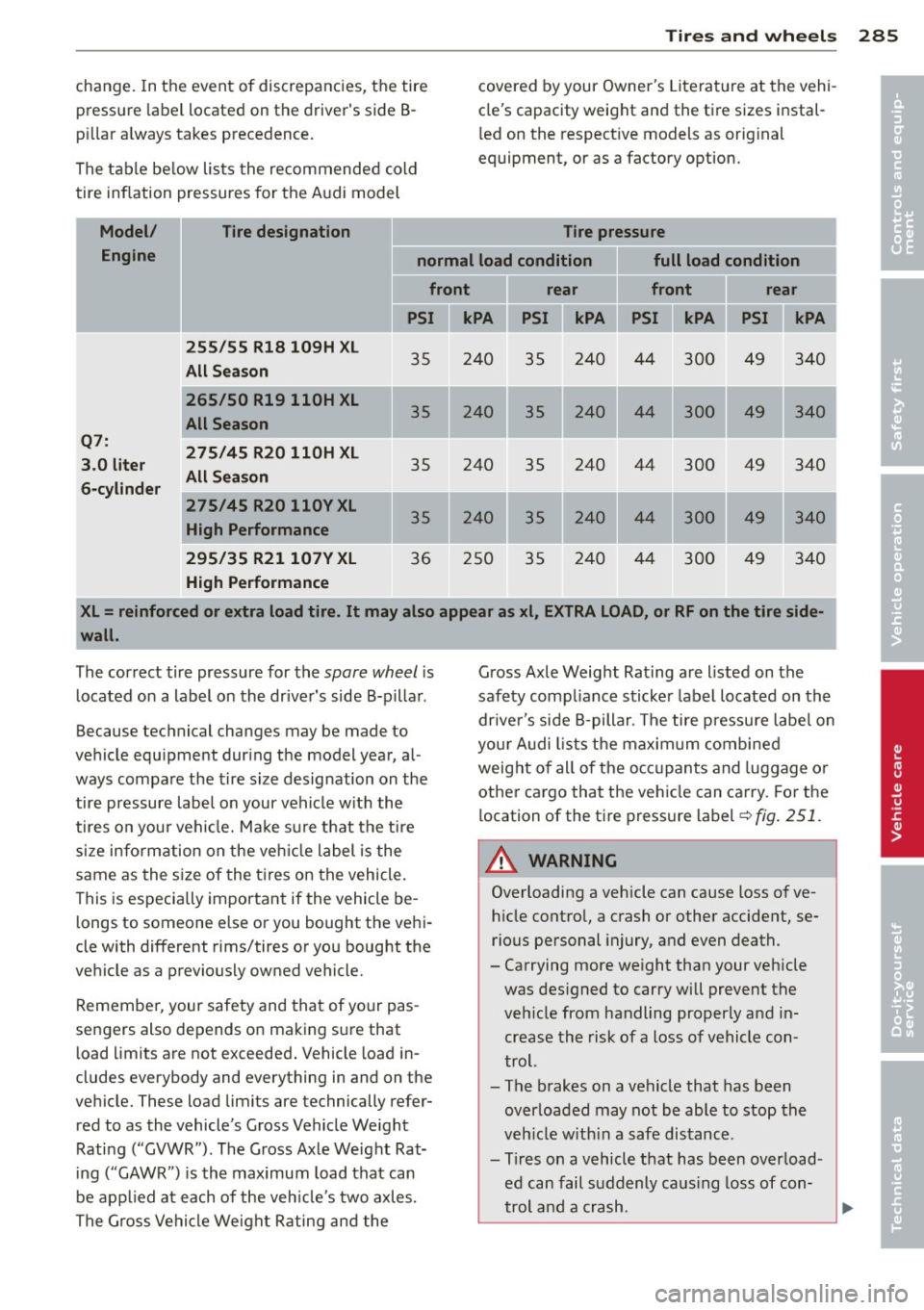
The table be low lists the recommended cold
tire inf lation pressures for the A udi model
I Model / Tire designation
covered by your Owner's Literature at the vehi
cle's capacity weight and the tire sizes instal
l ed on the respect ive models as orig inal
equipment, or as a factory option.
Tire pressure
Engine normal load condition full load condition
front rear front rear
I
PSI II kPA PSI kPA PSI j[ kPA PSI kPA
Q7:
3.0 liter
6-cy linder 2
55/5 5 Rl8 109H XL
All Sea son
265 /50 Rl9 ll0H XL
All Sea son
2 75/45 R20 ll0H XL
All S ea so n
275 /45 R20 110V XL
High Performance
295 /35 R21 10 7V XL
High Performance
35 240 35
35 240 35
35 240 35
35 240 35
36 250 35 240
44
300 49 340
240 44 300 49 340
240 44 300 49 340
•
240 44 300 49 340
I
240 44 300 49 340
XL= reinforced or extra load tire. It may als o appear as xl, EXTRA LOAD, or RF on the tire side
wall.
The correct tire pressure for the spare wheel i s
l ocated on a label on the driver's side 8-pilla r.
Because technical changes may be made to
vehicle equ ipment during the model year, al
ways compare the tire size designation on the
tire pressure label on your vehicle w ith the
tires on your vehicle. Ma ke sure that the tire
size information on the veh icle label is the
same as the s ize of the t ires on the vehicle.
This is especially important if the vehicle be l ongs to someone else or you bought the vehi
cle with different rims/tires or you bought the
vehicle as a previously owned vehicle.
Remember, your safety and that of your pas
sengers also depends on making sure that
l oad limits are not exceeded. Vehicle load in
cludes everybody and everything in and on the
vehicle. These load limits are technically refer red to as the vehicle's Gross Vehicle We ight
Rating ("GVWR") . The Gross Axle Weight Rat
i ng ("GAWR") is the maximum load that can
be appl ied at each of the veh icle's two axles.
The G ross Vehicle Weight Rating and the Gross Axle Weig
ht Rating are listed on the
safety compl iance sticker label located on the
drive r's side 8-pillar . The tire pressure labe l on
your A udi lists the maxim um combined
weight of all of the occ upants and luggage or
other cargo that t he vehicle can carry. Fo r the
location of the tire pressure label ¢
fig. 251.
A WARNING
Overloading a vehicle can cause loss of ve
h icle control, a crash or other accident, se
rious personal injury, and even death.
- Carrying more we ight than your veh icle
was des igned to carry will prevent the
veh icle from handling properly and in
crease the risk of a loss of vehicle con
trol.
- The brakes on a vehicle that has been overloaded may not be able to stop the
veh icle w ith in a safe distance.
- T ires on a vehicle that has been overload
ed can fail suddenly caus ing loss of con-
trol and a crash. ..,.
•
•
Page 290 of 348
288 Tires and wheels
Tires and vehicle load limits
There are limits to the amount of load or
weight that any veh icle and any t ire can carry.
A vehicle that is overloaded wi ll not handle
well and is more difficult to stop. Overload ing
can not on ly lead to loss of vehicle control
,
but can a lso damage important parts of the
vehicle and can lead to sudden tire failure in-
,
eluding a blowout and sudden deflation that
can cause the vehicle to crash .
Your safety and that of your passengers a lso
depends on making sure that load limits are
not exceeded. Vehicle load includes everybody
and everyth ing in and on the vehicle . These
load limits are tech nically referred to as the
vehicle's
Gross Vehicle Weight Rating
("GVWR").
The "GVWR" includes the we ight of the basic
vehicle, all factory installed accessories , a full
tank of fuel , oi l, coo lant and other fluids plus
maximum load. The maxim um load includes
the number of passengers that the vehicle is intended to carry ("seating capacity") with an
assumed weight of 150 lbs (68 kg) for each
passenger at a designated seating position
and the tota l weight of any l uggage in the ve
hicle. If you tow a trailer, the weight of the
trailer hitch and the tongue weight of the
loaded trailer must be included as part of the
veh icle load .
The
Gross Axle Weight Rating ("GAWR") is
the maximum load that can be applied at each
of the vehicle's two axles .
The Gross Vehicle Weight Rating and the
Gross Axle Weight Rating are listed on the
safety compliance st icker label located on the
driver's side B -pillar. Your Audi has 5 seating
positions, 2 in the front and 3 in the rear for
total seating capacity of 5. On vehicles w ith
six seats*, your veh icle has two front seats,
two seats in the second row seating and two
seats in the third row seating. On vehicles
with seven seats*, your vehicle has two front
seats, three seats in the second row seating
and two seats in the third row seating . Each seating
position has a seat belt
q page 175,
Safety belts .
The fact that there is an upper limit to your
vehicle's Gross Vehicle Weight Rating means
that the total weight of whatever is being car
ried in the vehicle (including the weight of a
trailer hitch and the tongue weight of the
loaded trailer) is lim ited. The more passen
gers in the vehicle or passengers who are
heavier than the standard we ights assumed
mean that less weight can be carr ied as lug
gage .
The tire pressure label on your Audi also lists
the maximum combined weight of all of the
occupants and luggage or other cargo that
the vehicle can carry . For the location of the
label
q page 284, fig. 251.
_& WARNING
Overloading a vehicle can cause loss of ve
h icl e control, a crash or other accident, se
rious personal injury, and even death.
- Carrying more weight than your vehicle
was designed to carry will prevent the
vehicle from handling properly and in
crease the risk of the loss of vehicle con
trol.
- The brakes on a vehicle that has been
overloaded may not be able to stop the
veh icle w ith in a safe distance.
- Tires on a vehicle that has been over load
ed can fail suddenly, including a blowout
and sudden deflation, causing loss of
control and a crash .
- Always make sure that the total load be
ing transported -including the weight of
a trailer hitch and the tongue we ight of a
loaded trailer -does not make the vehi
cle heavier than the vehicle's Gross Vehi
cle Weight Rating.
Determining correct load limit
Use the example below to cal
culate the total weight of the
passengers and luggage or
Page 293 of 348

A WARNING
Sudden tire failure can lead to loss of con
trol, a crash and serious personal injury!
- Never drive a vehicle when the tread on
any tire is worn down to the wear indica
tors.
- Worn tires are a safety hazard, they do
not grip well on wet roads and increase
your risk of "hydroplaning" and loss of
control.
- Always keep chemicals that can cause
tire damage, such as grease, oil, gasoline
and brake fluid away from t ires.
- Tires age even if they are not be ing used
and can fail suddenly, especially at high
speeds . Tir es that are more than 6 years
old can only be used in an emergency
and then with special care and at lower
speeds.
- Never mount used tires on your vehicle if
you are not sure of their" previous histo
ry ." Old used tires may have been dam
aged even though the damage cannot be
seen that can lead to sudden tire failure
and loss of vehicle control. Tires and wheels 291
New tires and replacing tires and wheels
New tires and wheels have to be broken in
.
Fig. 255 Tir e specificat ion codes on t he s idewall o f a
tire
No. Description
CD Passenger car tire (where applicable)
@ Nominal width of tire in millimeters
® Ratio of height to width (aspect ratio)
© Radial
® Rim diameter code
® Load index and speed rat ing
(f) U.S. DOT tire identification number
® Audi Original tire
® Sever snow conditions
@ Tire ply composition and materials
used
@ Maximum load rating
@ Treadwear, traction and temperature
grades
@ Maximum permissible inflation pres-
sure
The tires and rims are essential parts of the
vehicle's design . The ti res and rims approved
by Audi are spec ially matched to the charac
teristics of the vehicle and can make a major .,.
•
Page 296 of 348
29 4 T ire s and wheel s
-All four wheels must be fitted with radia l
t ires of the same type, size (roll ing c ir
cumference) and the same tread pattern.
Driv ing with different tires reduces veh i
cle handling and can lead to a loss of
control.
- If the spare tire is not the same as the
t ir es that are mounted on the veh icle -
for example with wi nter tires - on ly use
the spare tire for a short period of time
and dr ive with extra care. Refit the no r
ma l road whee l as soon as safely possi
ble.
- Never drive faster than the maxim um
speed for which the tires on your vehicle
are rated because tires that are drive n
faster than their rated speed can fail
sudden ly.
- Overloading ti res cause heat build- up,
sudden tire failure, including a blowout
and sudden deflation and loss of control.
- Temperature grades app ly to tires that
are properly inflated and not over or un
derinflated.
- For technical reasons it is not a lways
poss ible to use wheels from other
vehicles -in some cases not even wheels
from the same vehicle model.
- If you install wheel tr im discs on the ve
hicle whee ls, make sure that the air flow
to the brakes is not blocked . Reduced air
flow to the brakes can them to overheat,
increasing stopping d istances and caus
ing a collision.
- Run flat t ires may on ly be used on
vehicles that we re eq uipped w it h them
at the f acto ry. The vehicle must have a
chassis des igned for r un flat t ires . Incor
rect use of run flat tires can lead to vehi
cle damage or acc idents . Check with an
authorized Audi dealer or t ire specia list
to see if your vehicle can be equipped
with run flat t ires. If run flat tires are
used, they must be installed o n all four
wheels. Mix ing tire types is not permit
ted. (D Note
- For technical reasons, it is not generally
poss ible to use the wheel rims from oth
er veh icles. T his can hold tr ue for wheels
of the same vehicle type.
- If the spare tire is diffe rent from the
tires that you have mounted on your ve
hicle (for example winter tires or wide
profi le tires), then use the spare tire for a
short period of time only and drive w ith
extra care. Replace the flat tire w it h the
ti re mat ching the othe rs on your vehicle
as soon as possi ble.
- Never d rive without the valve stem cap.
T he v alves co uld get damaged.
@ For the sake of the environment
Dispose of o ld tires in accordance w ith the
l ocal requirements.
Uniform tire quality grading
- Tread wear
- Tra ction AA A B (
- Temperature ABC
Quality grades can be found where applicab le
on the tire s ide wall between tread shoulder
and maximum section width
c> page 291,
fig . 255 .
For example: Tread wear 200 , Traction AA ,
Temperature A .
All passenger car ti res must conform to Feder
al Safety Requirements in add ition to these
grades .
Tread wear
The tread wear g rade is a comparative rating
based on the wear rate of the tire when tested
u nder contro lled conditions o n a specified
government test course.
F o r example, a tire graded 150 wo uld wear
one and one ha lf (11/2) times as well on the
government course as a ti re graded 100.
Page 299 of 348
driving a few yards and correct if neces
sary . Follow the instructions from the
snow cha in manufacturer when doing so.
- If the Adaptive Air Suspension* should
malfunction, do not mount or use snow
chains beca use the vehicle will be ex
tremely low. If you do drive with snow
chains on while the vehicle is at this lev el, the snow chains might severe ly dam
age the wheelhouse and other parts of
the veh icle.
(0 Tips
W here snow cha ins are mandatory oncer
tain roads, this normally also applies to
veh icles w ith all-whee l dr ive.
Wheel bolts
Wheel bolts must always be tightened to the
correct torque .
The design of whee l bolts is matched to the
factory insta lled r ims. If different rims are fit
t e d, the cor rect wheel bolts wit h the right
lengt h and correctly s haped bolt heads must
be used. This ens ures t hat w heels a re fitted
secure ly an d that the brake system f unctions
correctly.
I n ce rtain circumstances, you may not use
wheel bo lts from a d ifferent vehicle -even if it
is the s ame mode l
~page 32 7.
& WARNING
Improperly tig htened or maintained whee l
bolts can become loose ca using loss of
cont ro l, a co llision and serious persona l in
jury.
- Always keep the w heel bolts and the
threads in the wheel hubs clean so the
wheel bolts can turn easily and be prop erly t ightened.
- Never grease or oil the wheel bolts and the threads in the wheel hubs. They can
become loose w hile driving if greased or
o iled, even if tig hte ned to the specified
torq ue.
Tire s an d wheel s 297
-On ly use whee l bolts that be long to the
rim being installed.
- Never use different wheels bolts on yo ur
veh icle.
- Always maintain the correct t ightening
torque for the whee l bolts to reduce t he
risk o f a wheel loss. If the tightening tor
que of t he wheel bolts is too low, they
can loosen and come out when t he vehi
cle is mov ing.
If the tig hte ning torque is
too high, the wheel bolts and threads can be damaged and the whee l can be
come loose.
(D Note
The specified torque for the whee l bolts is
120
ft l b ( 160 Nm) with a to le rance of
± 7, 4
ft lb( ± 10 Nm). Torque w heel bo lts
d iagon ally . After changi ng a w heel, the
torque m ust be chec ke d as soon as poss i
b le with a to rque wrench -preferab ly by an
a uthorized Audi dea ler or q ua lified work
shop .
Low aspect ratio tires
Your Audi is factory-equ ipped with tow aspect
ratio tires. These tires have been thoroughly
tested and been se lected specifically for your
model for their superb perfo rmance, road feel
and handli ng under a var iety of drivi ng condi
tions. As k your au thori zed A udi dealer for
more de tails.
The low asp ect ratio of these tires is ind icated
by a nu mera l of
55 or l ess in the tire's s ize
designation. The n ume ra l rep resen ts the ra tio
of the tire's sidew all height in rel ation to its
tread width exp ressed in percentage . Conven
tiona l tires have a he ight/width ratio of 60 or
more.
The performance of low-aspect-ratio tire s is
particularly sensitive to improper inflation
pre ssure. It is therefore important that low
aspect ratio tires are inflated to the specified pressure and that the inflation pressure is
regularly checked and mainta ined. Tire pres-
sures should be checked at least once a .,..
•
•
Page 306 of 348
304 What do I do now?
Changing a wheel
Before changing a wheel
Observe the following precautions for your
own and your passenger's safety when chang
ing a wheel .
• After you experience a tire failure, pull the
car well away from moving traffic and try to
reach
level ground before you stop ¢,& .
• All passengers should
leave the car and
move to a safe location (for instance, behind
the guardrail) ¢
A-
.. Engage the parking brake to prevent your
vehicle from rolling unintentionally ¢,& .
• Move
selector lever to position P <=> ,&.
• If you are towing a trailer: unhitch the trail
er from your vehicle.
• Block the diagonally opposite wheel wi th
the folding chocks or other objects.
• Take the
jack and the inflatable spare tire
out of the luggage compartment
¢page 301.
11. WARNING
=
You or your passengers could be injured
while changing a whee l if you do not fol
low these safety precautions :
- If you have a f lat tire,
move a safe dis
tance off the road . Turn off the engine,
turn the emergency flashers on and use
other warning devices to alert other mo
torists .
- Make sure that passengers wait in a safe
place away from the vehicle and well
away from the road and traff ic.
- To help prevent the vehicle from moving
suddenly and possibly slipping off the
jack, always fully set the parking brake
and block the wheel diagonally opposite
the wheel being changed with the fold
ing chocks or other objects. When one
front whee l is lifted off the ground, plac
ing the Auto mat ic Transmission in "P"
(Park) will
not prevent the vehicle from
moving .
-
-Before you change a wheel, be sure the
ground is level and firm. If necessary,
use a sturdy board under the jack.
- After installing the inflatable spare tire,
make sure that you replace the flat tire/
wheel in its storage area properly and
tighten the knurled retaining screw se
curely .
' Changing a wheel
When you change a wheel , follow the se
quence described below step-by-step and in
exactly that order .
l. Activate the vehicle jack mode (only
vehicles with Adaptive Air Suspension)
¢ page 159.
2. Remove the decorative wheel cover* . For
more details see also ¢
page 305, Deco
rative wheel covers
or ¢ page 305,
Wheels with wheel bolt caps.
3. Loosen the wheel bolts¢ page 305.
4. Locate the proper mounting point for the
jack and align the jack be low that point
¢ page 306.
5. Lift the car with the jack¢ page 306.
6. Remove the wheel with the flat tire and
then install the
inflatable spare tire
¢page 307 .
7. Tighten all whee l bolts lightly.
8.
Lower the vehicle with the jack .
9. Use the wheel bolt wrench and
firmly
tighten all wheel bolts¢ page 305.
10. Rep lace the decorative wheel cover*.
11. Deactivate the vehicle jack mode (only
vehicles with Adaptive Air Suspension)
¢page 159.
A WARNING
Always read and follow all WARNINGS and
inf ormat ion¢ .&.
in Raising the vehicle on
page
307 and ¢page 308.