check oil AUDI Q7 2014 Owner´s Manual
[x] Cancel search | Manufacturer: AUDI, Model Year: 2014, Model line: Q7, Model: AUDI Q7 2014Pages: 340, PDF Size: 85.02 MB
Page 262 of 340
260 Check ing and filling
oils available today provide better engine lu
brication that can outlast tradit ional petrole
um-based o ils, making them a smart choice
for use throughout the life of your Audi.
Whether you use synthetic or petroleum
based engine oil, the oil that yo u use must
conform to Audi's oil q uality standard
VW 502 00 (vehicles with gasoline engine) or
VW 507 00 (veh icles with diesel engine) to
he lp keep you r vehicle's eng ine running
smoothly and help preve nt the formation of
h a rmful depos its , somet imes ca lled "sludge,"
that ove r time can lead to expensive repairs.
At the time of pri nting, engine oi ls available in
the U .S . and Canada that meet the exacti ng
specifications of A udi oi l standard VW 502 00
(vehicles wi th gasol ine engine) or VW 507 00
(vehicles wi th diesel engine) are synthetic en
g ine oi ls . T his does not mean, however, that
eve ry synthetic engine oil will meet Aud i oil
standard VW 502 00 (vehicles with gaso line
engine) or VW 507 00 (veh icles w ith diese l
engine). So always be sure that you use an ap
proved oil.
To help preve nt the fo rmation of harmful de
posits use only oi l w ith the fo llow ing spec ifi
cations printed on the oil container :
-Audi oil standard VW 502 00 (ga soline en
gine )
- Audi oil standard VW 507 00 (die sel en-
gine )
Oil conta iner labe ls may ca rry t he specifi ca
tion s ingly or in combinat ion wi th o ther des ig
nations and oil q ua lity standards.
Visco sity
Eng ine oils are graded acco rding to their v is
cosity . T he proper v iscosity grade o il for your
engine d epends on cl imactic or seasonal con
d it ions where you dr ive. You can use oi l w ith a
v iscosi ty g rade of SAE SW40 a cross all te m
pe ra tu re ranges for normal d riving conditions.
H owever, if eng ine o il viscos ity grade SAE
SW40 is not avai lab le, you ca n also use viscos
ity grade SA E SW-3 0 or SA E OW -40 a s long as
it meets A udi o il quality stan dard VW 5 02 00 (veh
icles w ith gasoline engine) o r VW 50 7 00
(ve hicles w ith diese l engine) specifications .
B ecau se eng ine o il that mee ts the Audi o il
sta ndard may not be availab le everywhere
when you need it, we strong ly recommend
t h at you a lways carry with you an extra quart
( li ter) of oil that express ly con forms to the
VW 502 00 (veh icles with gasoline engine) or
VW 507 00 (vehicles with d iese l eng ine) spec
ification , in case you have to top off t he oi l
wh ile on the road.
Applies to vehicles with gasoline engine on
ly:
Only if the level of the o il is at or below the
min imum ma rk o n the o il dipstick -and no oi l
that expressly conforms to Audi o il standard
VW 502 00 spec ificat ions is available - may
yo u t op off with a high quali ty e ngine o il, pr ef
er ab ly synthe tic-based, tha t mee ts AC EA A3
o r API SM spec ificat ions, bu t even then, only
in viscosi ty g rades SAE SW -40, SAE SW -30, o r
SAE OW -40 . However, during t he ent ire time
between oil change intervals, never top off
with more than a total of 0.5 qt/liter engine
o il that does not conform to Audi o il specifica
t ion VW 502 00 .
Applies to vehicles with diesel engine only:
Only if the level of the oil is at or be low the
min imum mark on the o il dipstick - and no oi l
that expressly conforms to Audi o il standard
VW 507 00 spec ificat ions is ava ilable - may
you top off with a h igh quality engine o il, that
mee ts AC EA C3 o r AP I CF spe cifica tions, bu t
even then, on ly in vis cosity gr ades SA E
SW -40, SA E SW -30, or SAE OW- 40. However,
during the entire time between oi l change in
terva ls , never top off with more than a tota l
of 0 .5 qt/liter engine oil that does not con
form to Audi oil specification VW 507 00.
F or more information about engine oi l that
has been approved for your vehicle, please
contact e ither yo ur authorized Aud i dea le r or
Audi C ustomer Re lations at 1 (800) 822-2834
or v is it our web si te at www.audiusa.com or
www .aud icanada .ca. Here you w ill also find a
c ur rent list of oi ls (manufacturers, bra nd
names etc.) that conform to Aud i oil standa rd .,.
Page 263 of 340
VW 502 00 (vehicles with gasoline engine) or
VW
507 00 (vehicles with diesel engine).
C han gin g the en gin e o il
The engine oil and oil filter must be changed
according to the m ileage (ki lomete rs) and
time inte rva ls specified in your vehicle 's War
r anty
& M aintenance booklet. Do not ex ceed
t hese intervals -harmf ul depos its from old
engine oi l can reduce engine performance and
can lead to expensive engine repairs.
Changing the o il at the recommended inte r
va ls is so very important because the lub ric at
ing p roperties o f oi l decrease grad ually during
norma l vehicle use . If you are not sure when
you have yo ur oi l changed, ask your a uthor
ized A udi Service Advisor.
Unde r some ci rc u mstances the engine o il
should even be changed more frequently.
Change o il more often if you drive mostly
short distances, operate the vehicle in dusty
areas or mostly under stop-and-go traffic con
d itions, or when you use your vehicle where
temperatures stay below freezing po int for
l ong periods .
Detergent addit ives in the o il w ill make fresh
oil look dark after the eng ine has been run
ni ng fo r a short time . This is no rmal and is not
a reason to change the o il mo re often than
r ec om mended.
Damage or malfun ctions due to lack of
maintenance
It is essential that yo u change your oil at the
recommended interva ls using only engine oil
that complies with Audi oi l standard
VW
502 00 (vehicles with gasoli ne engine) or
VW
507 00 (veh icles with diesel engine) . You r
Lim ited New Vehicle Wa rra nty does not cove r
damage or m alfu nct ions due to f ailure to fol
l ow recommended maintenance and use re
q uir ements as set forth in the A udi Owner's
M anual and Warranty
& M aintenance book let.
Your dea ler will have to deny warranty cover
age un less you present to the dea ler proof in
the form of Service or Repa ir Orders that all
Checkin g and fillin g 261
scheduled maintenance was performed in a
timely manner.
· Engine oil consumption
To provide effective l ubr ication and cooling for
interna l eng ine parts, all interna l combustion
engines use some oi l. Oi l consumption varies
from eng ine to engine and may change over
the life of the engine . Engines tend to use
more o il du ring the b reak-in period tha n they
do afterward, when o il cons umption has sta
bilized. Depend ing on the way the vehicle is
driven and the operating conditions, oil con
s u mption can be up to
1 quart per 1,200
miles (l liter per 2,000 km) . Consumption
may be higher within the first
3,000 m iles
(5,000 km) .
U nder normal conditions , the rate of oi l con
s u mption depends on oi l quality as well as vis
cosity, engine speed (rpm), outs ide tempera
ture, road conditions, the amount of oil dilu
tion caused by condensed water or fue l resi
due, and ox idat ion of the o il. Oi l consumption
may increas e with eng ine wear over time, un
t il rep lacement of worn engine pa rts may be
come ne cessa ry.
Because of all these var iables, there is no
standard o r "n orma l" rate of o il cons umption .
We urge you to check the engine oil level at
regular interval s, preferably every time y ou
fill the fuel t ank, and always before a long
trip .
The oil pres sure warning light. i s not an
indicator of low engine oil level. If the warn
ing light does not go out after starting, or
flashes while dr iving (above 1500 rpm), a
buzzer will sound. It indicate s that the oil
pressure is too low . Stop the engine immedi
ately , check the engine oil level and add oil if
necessa ry. If the engine oil level is normal,
but the l ight continues to fla sh, do not keep
driving or let the engine idle, as damage may
occur .
IIJ,
•
•
Page 264 of 340
262 Checking and filling
If you believe your engine uses too much oil,
we recommend that you consult your author
ized Audi dealer so that the cause of your con
cern can be properly diagnosed. Keep in m ind
that accurate measurement of oil consump
tion requires great care and may take some
time. Your Audi dealer has inst ruct ions for
how to measure oil consumption accurately .
_& WARNING
Stop! Before working in the engine com
pa rtment, always read and heed all WARN
INGS
9 .&. in Working in the engine com
partment on page 257.
The engine com
partme nt of any motor veh icle is a poten
tially dangerous area and can cause ser i
ous personal injury.
(D Note
- The eng ine depends on oi l to Lubricate
and cool a ll of its moving parts . The en
gine oil must be checked reg ularly and
kept at the required level.
- Make it a habit to have the engine oil Lev
el checked every time you fill the fuel
tank.
- Too little engine oi l may ca use severe en
gine damage.
Checking the engine oil level
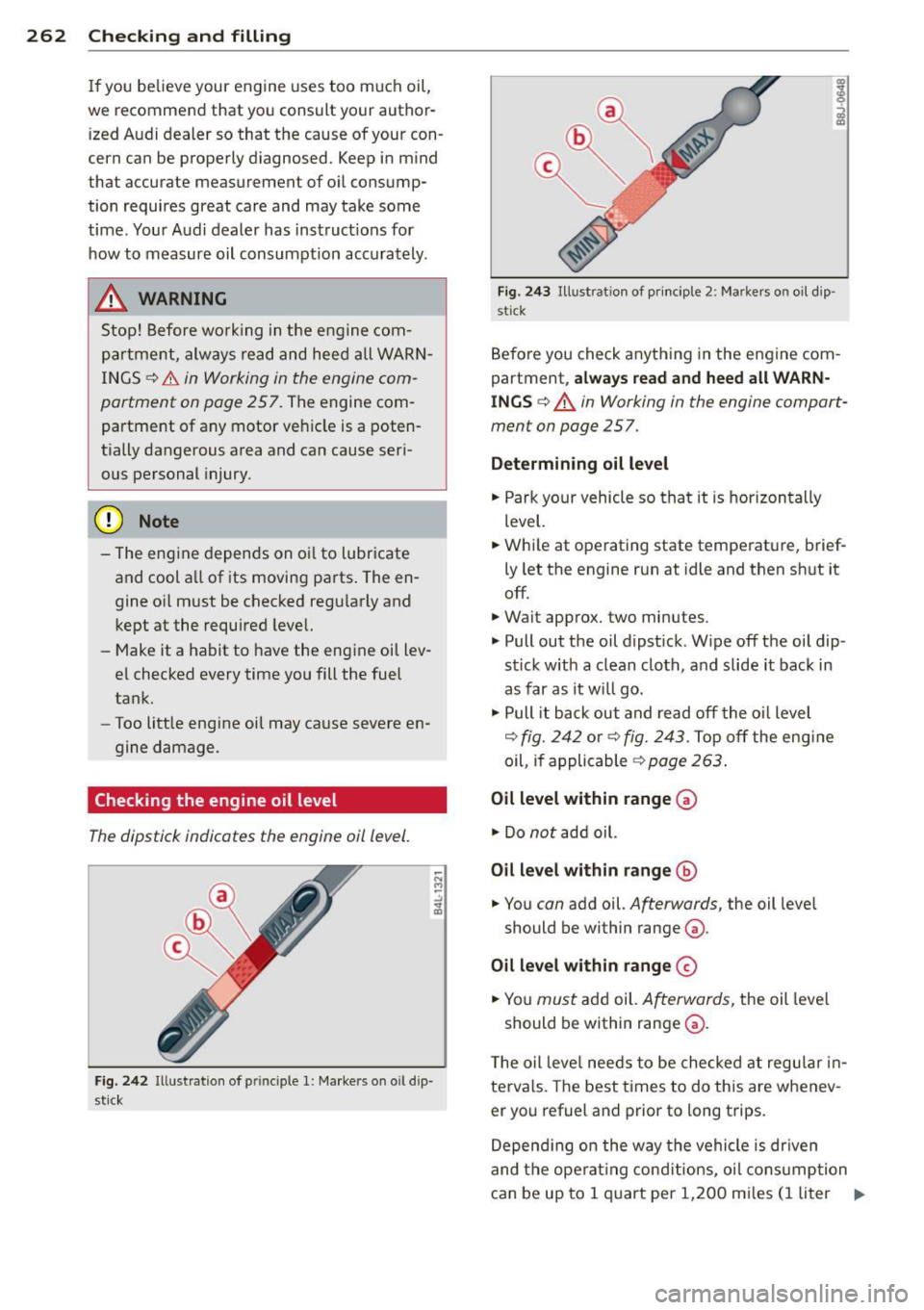
The dipstick indicates the engine oil level.
F ig. 2 42 Illustrat ion of p rincip le 1: Ma rkers o n oil dip·
st ick
Fig. 243 Illust ratio n of p rinciple 2: Ma rke rs on oil d ip ·
s ti ck
Befo re you check a nyth ing in the engine com
partment,
alway s read and heed all WARN
INGS 9 A in Working in the engine compart
ment on page 257 .
Determining oil level
.,. Park your vehicle so tha t it is horizontally
Level.
.,. Whi le at operating state temperature, br ief
ly let the engine run at idle and then shut it
off.
.,. Wait approx. two minutes .
.,. Pull out the oil d ipst ick . W ipe off the oil dip
st ick w ith a clean cloth, and slide it back in
as far as it wi ll go.
.,. Pull it back out and read off the o il Level
r=.> fig. 242 or 9 fig. 243. Top off the eng ine
oil, if applicable
9 page 263 .
Oil level within range@
.,. Do not add oil.
Oil le vel within r ange @
.,. You can add oil. Afterwards, the oil leve l
should be within range
G) .
Oil lev el within rang e 0
.,. Yo u must add oil. Afterwards, the oil leve l
should be within range
G) .
The oil leve l needs to be checked at regular in
terva ls. The best times to do this are whenev-
er you refuel and prior to Long trips .
Depend ing on the way the vehicle is dr iven
and the opera ting cond it ions, oi l cons umption
can be up to 1 quart per 1,200 mi les (1 liter ..,.
Page 265 of 340
per 2,000 km). Consumption may be higher
within the first 3 ,000 mi les (S,000 km).
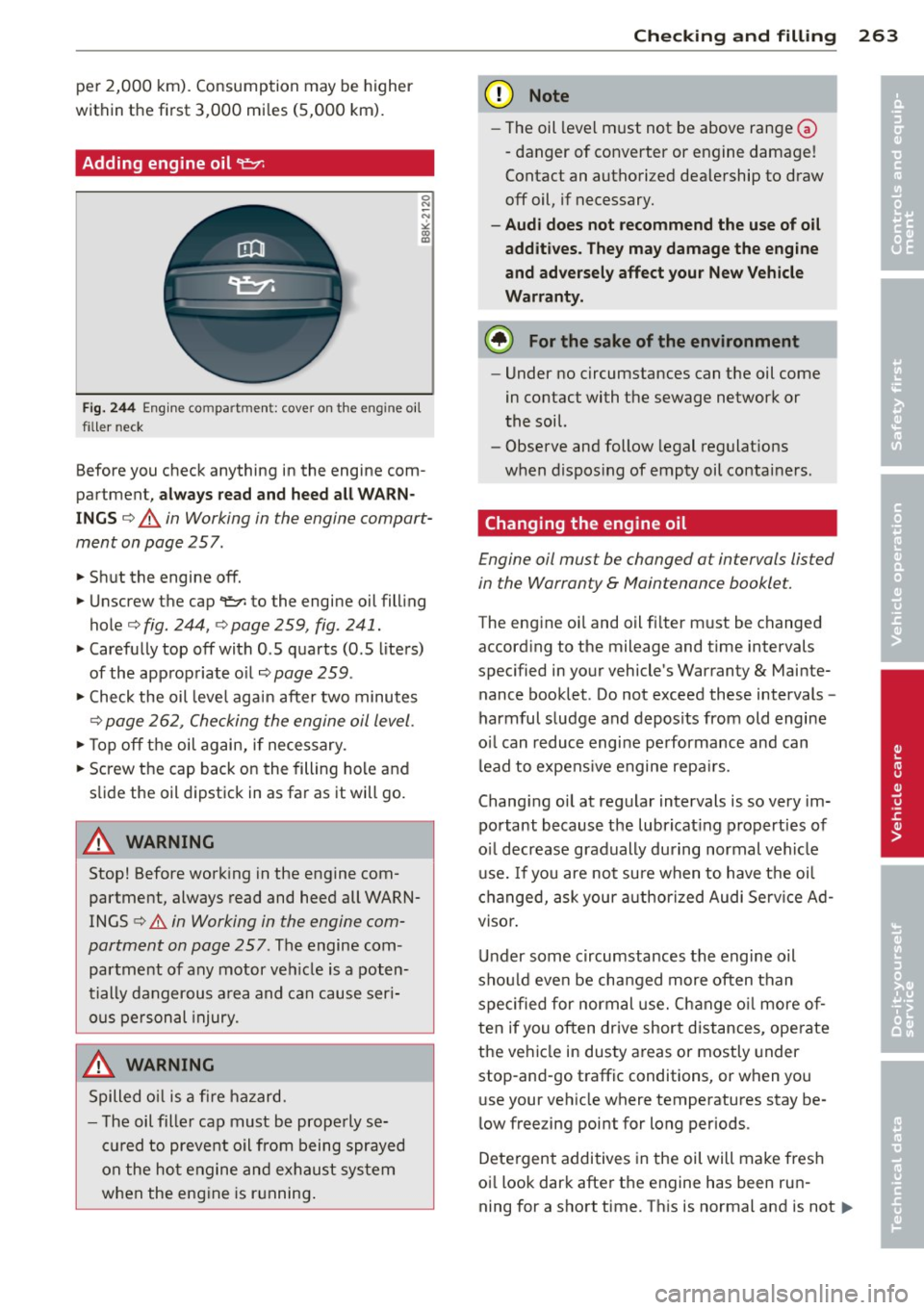
Adding engine oil "1:::1:
0 N ~ N
" "' "'
F ig . 2 44 Eng in e c omp art m ent: co ver on the eng ine o il
fi ller nec k
Befo re you check anything in the engine com
partment,
al way s read and heed all WARN ·
INGS ¢&. in Working in the engine compart
ment on page 257 .
... Sh ut the engine off.
.,. Unscrew the cap~ to the engine oil fill ing
hole ¢
fig. 244, ¢ page 259 , fig . 241.
... Carefully top off with 0 .5 quarts (0 .5 lite rs)
of the appropriate o il ¢ page 259.
.,. Check the oil leve l aga in afte r two minutes
¢ page 262, Checking the engine oil level.
.,. Top off the oil again, if necessary.
... Screw the cap back on the filling hole and
sli de the oil dipst ick in as far as it will go.
A WARNING
Stop! Before work ing in the engine com
partment, always read and heed all WARN
INGS
c> .& in Working in the engine com
partment on page 257 .
The engine com
partment of any motor veh icle is a poten
tially dangerous a rea and can cause ser i
ous pe rsonal injury.
.&, WARNING
Spilled o il is a fi re ha zard.
- The oil filler cap must be prope rly se
cur ed to preve nt oil from being sprayed
on the ho t engine and exhaust sys tem
when the eng ine is r unning .
-
Checkin g and fillin g 263
@ Note
-The oil leve l m ust not be above range (v
- danger of converter or engine damage!
Contact an authori zed dealership to draw
off oil, if necessary.
- Audi does not recommend the use of oil
additives. They may damage the engine
and adverse ly affect your New Vehicle
Warranty.
® For the sake of the environment
- Under no circumstances can the oil come
in contact with the sewage network or
the soil.
- Observe and follow legal regulat ions
when dispos ing of empty oil containers.
Changing the engine oil
E ngine oil mus t be changed a t in tervals lis ted
in the Warranty
& Maintenance bookle t.
The engin e oi l and oil f ilter m ust be changed
acco rd ing to the mileage and time intervals
specified in yo ur vehicle's Warranty & Mainte·
nance booklet . Do not exceed these intervals -
harmful s ludge and deposits from old engine
o il can reduce engi ne pe rformance and can
l ead to expens ive engine repa irs .
Chang ing oil at regular interval s is so very im
po rtant because the lubricat ing p roperties of
o il decrease gradually du ring normal veh icle
use. If you are no t su re when to have t he oi l
c h anged, ask your a uthori zed Audi Serv ice Ad
visor .
U nder some circumstances the engine oil
shou ld eve n be cha nged more often than
spec ified for normal use. Ch ange o il more of
ten if you often drive short distances , operate
the ve hicle in dusty areas or mostly under
stop -and -go t raffic conditions, or when you
u se you r veh icle where temperatures stay be
low free zing point for long periods .
Dete rgent additives in the oil will make fres h
oi l look dark afte r the engine has been run-
ning for a short time . Th is is normal and is not
Ill>
•
•
Page 266 of 340
264 Check ing and filling
a reason to change the oil more often than
recommended.
A WARNING
Stop! Before working in the engine com
partment, a lways read and heed all WARN
INGS
c> .&. in Working in the engine com
partment on page 257. The engine com
partment of any motor veh icle is a poten
tially dangerous a rea and can cause ser i
ous personal injury.
A WARNING
If you must change the engine oil in your
vehicle:
- Always wea r eye p rotection.
- T o reduce the r isk of burns from hot en-
gine oil let the engine cool down to the
touch.
- When removing the oil drai n plug with
yo ur finge rs, stay as far away as possible.
Always keep your forea rm pa ra ll el t o the
ground to he lp prevent hot oil from run
ning down your arm.
- Dr ain the o il into a container designed
for this p urpose, one large enough to
hold at least the total amount of oil in
yo ur engine .
- T o reduce the r is k of po ison ing, never use
empty food or beverage containers that
might mis lead someone into drinking
from them.
- Engine oil is poisono us. Keep it well out
of the reach of children.
- Cont inuo us contact with used engine oil
is harmful to your skin . Always protect
yo ur sk in by washing thoro ughly with
soap and water.
@ Note
Never mix oil ad ditives with your engine
oil. These additives can damage your en
gine and adverse ly affect your Audi Limit
ed New Vehicle Warranty.
(® For the sake of the environment
- Before changing the oil, first make sure
you know where you can prope rly dispose
of the old o il.
- Always dispose of used oil p roperly. Nev
er dump it on garden soil, in wooded
areas, into streams or down sewage
dra ins.
- Recycle used o il by tak ing it to a used en
gine oil collection facility in your area, or
contact a se rvice station.
- We strongly recommend that yo u have
your oil cha nged by an authorized Audi
dealer or a qualified workshop with the
special tools a nd expert ise required, and
prope r m eans of disposal.
Engine cooling system
Coolant
The engine coolant performs two functions: it
keeps the engine from overheating and it pro
tects the engine from freezing in the winter.
T he cooling sys tem is sealed and genera lly re
quires little attention.
T he coo lin g sys tem has been fi lled a t the fac
tory with a permanent coolan t which does not
need to be changed . The coo lant cons ists of a
mixture of specially conditioned water and the
manufacture r's g lycol-basedcoo lant add i-
t ive
Gl3 antifreeze with anticorrosion addi
t ives (SO% for USA models; 60% for Canadian
models). This mixture both assures the neces
sa ry frost protection and protects metal com
ponents in the eng ine's cooling system from
corros io n and scaling.
It also ra ises the bo il
i ng po in t of the coolan t.
Do not reduce the concentration of the cool
ant in the summer by addi ng p lain water .
The
proportion of coolant additiv e must be at
lea st 50 % but not more than 60°/o
to main
t ai n ant ifree ze pro te ct io n and cooling eff ic ien
cy .
If the coo lant fros t protec tion is too low '
t h e coo lant co uld freeze and damage the vehi-
cle heating and engine cooling system. ..,.
Page 268 of 340
26 6 Ch eck ing and filling
Coolant lo ss
Coolant loss may indicate a l ea k in t he cooling
system. In the event of coolant loss, the cool
ing system should be inspected immediately
by your authorized Audi dealer. It is not
enough merely to add coolant.
I n a
se ale d system, losses can occur only if
the boiling point of the coolant is exceeded as
a result of overheating.
A WARNING
The cooling system is under pressure and
can get very hot. Reduce the risk of scald
ing from hot coolant by following these
steps .
- Turn off the engine and allow it to cool
down.
- Protect your face, hands and arms from
escaping fluid and steam by covering the
cap with a large, thick rag .
- Turn the cap slowly and very carefully in
a counter -clockwise direction wh ile ap
plying light, downward pressure on the
top of the cap .
- To avoid being burned, do not spill ant i
freeze or coolant on the exhaust system
or hot eng ine parts. Under certain condi
t ions, the ethy lene g lycol in engine cool
an t can ca tch f ire.
0 Note
Do not add any type of radiator leak seal
ant to your vehicle's eng ine coolant. Add
ing radiato r repair fluid may adve rsely af
fect the function and performance of your
cooling system and could res ult in damage
not covered by your New Vehicle Limited
Warranty .
Adding coolant
Be very careful when adding engine coolant.
Before you check anything i n the engine com
pa rtmen t,
a lwa ys rea d and h eed all WARN
INGS c:::> A in Working in the engine compart
ment on page 257.
.. Tu rn off the engine .
.. Let the engine cool down.
.. Place a thick rag over the coo lant expansion
tank
c> page 265 , fig. 245 and car efully
twist the cap counter-clockwise c> ,&. .
.. Add coo lant m ixed in the correct rat io
c:::> page 264, Coolant.
.. Twist the cap on again tightly.
Replacement engine coolant must conform to
exact spec ificat ions
c> page 264, Coolant.
We recommend using only coo lant additive
G12 ++, G13 or in an emergency G12 +. Do
not
use a different add itive. In an emergency use
plain water until you can get the correct addi
t ive and can restore the correct ratio . This
shou ld be done as soon as poss ib le.
If you have lost a considerable amount of
coolant, then you should add cold ant ifreeze
and co ld water only when the eng ine is cold .
Always use
new engine coolant when refilling.
Do not fi ll coolant above the "MAX" mark. Ex
cess coolant will be forc ed out through the
pressure relief valve in the cap when the en
gine becomes hot.
A WARNING
- The cooling system is under pressure and
can get very hot. Reduce the risk of
scalding from hot coolant by following
these steps.
- Turn off the engine and allow it to coo l
down.
- Protect your face, hands and arms from
escaping fluid and steam by covering
the cap with a large, th ick rag.
- Turn the cap s low ly and very carefully
in a counter-clockwise direction while
applying light, downward pressure on
the top of the cap.
- To avoid being burned, do not spill an
tifreeze or coolant on the exhaust sys
tem or hot engine parts. Under certain
cond it ions, the ethylene g lycol in en
gine coolant can catch fire .
Page 276 of 340
274 T ire s and wheel s
-Never mount used tires on yo ur vehicle if
you are not sure of their "previous histo
ry." Old used tires may have been dam
aged even though the damage cannot be
seen that can lead to sudden t ire failure
and loss of vehicle control.
- If you notice unusual vibration or if the
vehicle pulls to one side when driving, al
ways stop as soon as it is safe to do so
and check the wheels and tires for dam
age.
(D Note
Please note that summer and winter tires
are designed for the cond itions that are
Glossary of tire and loading terminology
Accessory weight
means t he comb ined we ight (in excess of
those sta ndard items which may be rep laced)
of au toma tic tra nsmission, power steer ing,
power brakes, power windows, power seats,
radio, and heater, to the extent that th ese
items are availab le as factory -installed equip
ment (whether installed or not) .
Aspect ratio
means t he ratio of the he ight to the w idth of
the tire in percent . Numbers of 55 or lower in
dicate a low sidewall for improved steering re
sponse and better overall handling on dry pavement .
Bead
means the part of the ti re that is made of
steel wires, wrapped or reinforced by ply cords
and that is shaped to fit the rim.
Bead separation
means a b reakdown of the bond between
components in the bead.
Cord
means the strands forming the plies in the
tire . typ
ica l in those seasons . Audi recommends
using winter tires during the winter
months . Low temperatures signif icant ly
decrease the e lasticity of summer tires,
which affects tract ion and brak ing ability.
If summer tires are used in very co ld tem
peratures, cracks ca n form on the tread
bars, res ulting in permanent tire damage
that can cause loud driving no ise and un
balan ced t ires. Audi is not responsible for
th is type of damage .
Cold tire inflation pressure
means the tire p ressu re recommended by t he
vehicle manufacturer fo r a tire of a des igna ted
s iz e that has not bee n driven for more than a
coup le of miles (k ilometers) at low speeds in
t h e three hour period before the tire pressure
is measured or adjusted.
Curb weight
mea ns the we ight of a motor ve hicl e w ith
standard equipment including the max imum
capacity of fuel, oil, and coolant, air condi
tioning and additional weight of optiona l
equipment.
Extra load tire
me ans a t ire design to operate at higher loads
and at h igher inflation pressures than the cor
responding standard tire . Extra load tires may
be identified as "XL", "x l" , "EXTRA LOAD", or
"RF" on the sidewall.
Gross A xle Weight Rating ("GAWR ")
means the lo ad -c a rry ing c apac ity of a s ingle
axle system , measured a t the tire-ground in
terfaces.
Gross Vehicle Weight Rating ("GVWR ")
mea ns the maximum total loaded we ight of
t h e ve hicl e. .,.
Page 283 of 340
-If the ti re is not flat and y ou do not have
to change a wheel immed iate ly, drive at
reduced speed to the nearest service sta
t ion to check the tire pressure and add
air as required.
(D Note
Dr iving without va lve stem caps can cause
damage to the t ire va lves. To prevent this,
always make sure that factory installed
valve stem caps on all wheels are secu re ly
mounted on the va lve.
@) For the sake of the environment
Underinflated tires will a lso increase the
fue l consumption.
Tires and vehicle load limits
There are limits to the amount of load or
weight t hat any veh icle and any t ire ca n car ry.
A vehicle that is overloaded w ill not handle
well and is more difficult to stop. Overload ing
can not on ly lead to loss of vehicle contro l,
but can a lso damage important parts of the
vehicle and can lead to sudden tire failure, in
cluding a blowout and sudden deflation that
can cause the ve hicle to crash.
Your safety and that of yo ur passenge rs a lso
depends on making sure that load limits are
not exceeded. Vehicle load includes everybody
and everyth ing in and on the vehicle. These
load limits a re tech nica lly referred to as the
ve hicle's
Gross Veh icle Weight Rating
("GVWR").
The "GVWR" includes the we ight of the basic
ve hicle, all factory installed accessories, a full
tank of f uel, oil, coo lant and othe r fluids plus
max imum load. The maximum load includes
the number o f passenger s that the ve hicl e is
intended to carry ("se ating capacity") w it h an
assumed weig ht o f 150 lbs (68 kg) for each
passenger at a designated seating position
and the tota l weight of any luggage in the ve
h icle. If you tow a trailer, the weight of the
trailer hitch and the tong ue weight of the
Tire s an d wheel s 281
loaded tra ile r must be included as part of the
vehicle load .
T he
Gro ss Ax le Weight Rating (" GAWR") is
the max imum load th at can be applied at each
of the vehicle's two axles .
T he Gross Vehicle Weight Rat ing and t he
G ross Ax le Weig ht Ra ting are l iste d on the
s af ety comp liance s tic ke r la bel lo cated on the
driver's side 8 -pillar . Your Audi has 5 seating
positions, 2 in the front and 3 in the rear fo r
total seating capacity of 5. On vehicles with
s ix seats*, your vehicle has two front seats,
two seats in the second row seat ing and two
seats in the th ird row seati ng. On veh icles
with seven seats*, your vehicle has two front
seats, t hree seats in the second row s eating
and two seats in t he third row seating. Ea ch
seat ing pos itio n has a se at belt
~page 174,
Safety be lts .
The fact that ther e is a n upper limit to you r
vehicle's G ross Vehicle Weigh t Rati ng means
that the to tal weig ht of whatever is bei ng car
ried in the vehicle ( in cl ud ing the weight of a
trailer hitch and the tongue weight of the l oa ded trai le r) is limite d. The more passen
gers in the vehicle or passengers who are heavier than the standard we ights assumed
mean that less we ight can be carried as lug
gage.
The tire pressure label on your Audi also lists
the max imum combined weight of all of the
occupants and luggage or other cargo that
t h e ve hicle can carry. Fo r the locat ion of the
label
~page 277, fig . 249.
A WARNING
Overloading a veh icl e can cause loss of ve
h icl e cont ro l, a crash or o ther accide nt, se
rio us pe rson al inj ury, a nd eve n death .
- Ca rrying more we ight tha n your ve hicle
was des igned to carry w ill prevent the
veh icle from h andling proper ly and in
crease the risk of the loss o f vehicle con
trol.
•
•
Page 292 of 340

29 0 T ire s and wheel s
driving a few yards and correct if neces
sary. Follow the instructions from the
snow cha in manufacturer when doing so .
- If the Adaptive Air Suspension* should
malfunction, do not mount or use snow
chains because the vehicle will be ex
tremely low. If you do dr ive with snow
chains on while the vehicle is at this lev
el, the snow chains might severely dam
age the wheelhouse and other parts of
the veh icle.
(!) Tips
Where snow cha ins are mandatory oncer
tain roads, this normally also applies to
veh icles with all-whee l dr ive.
Wheel bolts
Wheel bolts must always be tightened to the
correct torque .
The design of wheel bolts is matched to the
factory installed r ims. If different rims are fit
ted, the correct wheel bolts with the r ight
l ength and correctly shaped bolt heads must
be used. This ensures t hat wheels a re fitted
secure ly and that the brake system f unctions
correctly .
I n ce rtain circumstances, you may not use
wheel bolts from a different vehicle -even if it
is the same mode l
<=?page 318.
.&_ WARNING
Improperly tightened o r maintained wheel
bolts can become loose ca using loss of
contro l, a co llision and serious persona l in
jury.
- Always keep the wheel bolts and the
threads in the wheel hubs clean so the
wheel bolts can turn easily and be prop
erly t ightened.
- Never grease or oil the wheel bo lts and
the threads in the wheel hubs. They can
become loose w hile driving if greased or
oiled, even if tightened to the specified
torque. -
On ly use wheel bolts that be long to the
rim being installed .
- Never use different wheels bolts on yo ur
veh icle.
- Always maintain the correct tightening
torque for the whee l bolts to reduce the
risk of a whee l loss. If the tightening tor
que of the wheel bolts is too low, they
can loosen and come out when the vehi
cle is mov ing. If the tightening torque is
too high, the wheel bolts a nd threads
can be damaged and the whee l can be
come loose.
(D Note
The specified torque for the wheel bolts is 120 ft lb ( 160 Nm) with a to le rance of
± 7,4 ft lb( ± 10 Nm) . T orque wheel bolts
diagonally. After changi ng a wheel, the
torque m ust be che cked as soon as possi
ble with a to rque wrenc h - preferab ly by an
a uthorized Audi dea le r or q ualified work
shop.
Low aspect ratio tires
Your Audi is factory-equipped w ith low aspect
ratio tires. These tires have been tho roughly
tested and been se lected specifically for your
model for their superb performance, road fee l
and hand ling under a variety of d riving condi
tions . As k your au thor ized A udi dealer for
more de tails .
T he low aspect ratio of these t ires is ind icated
by a numera l of
55 or l ess in the tire's s ize
designation. The n umeral rep resen ts the ratio
of the tire's s idewa ll height in relation to its
tread width exp ressed in percentage . Conven
t iona l tires have a he ight/width ratio of 60 or
more.
The performan ce of l ow-a spect-r atio tire s is
particularl y sen sitive to imp roper inflation
pre ssure. It is therefo re important that low
a spect ratio tires are inflated to the specified
pressure and th at the inflation pressure is
regularly checked and mainta ined. Tire pres -
s u res should be checked at least onc e a ..,.
Page 314 of 340

312 Emergency situations
fall from a lift if there is a change in ve
hicle weight distribution and balance.
This might happen, for example, when
heavy components such as the engine
block or transmission are removed .
- When removing heavy components like
these, anchor vehicle to hoist or add cor
responding weights to maintain the cen
ter of gravity. Otherwise, the vehicle
might tilt or slip off the hoist, causing
serious personal injury.
(D Note
- Be aware of the following points before
lifting the vehicle:
-The vehicle should never be lifted or
jacked up from underneath the engine
oil pan, the transmission housing, the
front or rear axle or the body side
members. This could lead to serious
damage.
- To avoid damage to the underbody or
chassis frame, a rubber pad must be
inserted between the floor jack and
the lift points.
- Before driving over a workshop hoist,
check that the vehicle weight does not
exceed the permissible lifting capacity
of the hoist.
- Before driving over a workshop hoist,
ensure that there is sufficient clear
ance between the hoist and low parts
of the vehicle.