flat tire AUDI Q7 2014 Owner´s Manual
[x] Cancel search | Manufacturer: AUDI, Model Year: 2014, Model line: Q7, Model: AUDI Q7 2014Pages: 340, PDF Size: 85.02 MB
Page 279 of 340
Tires and wheels 277
Occupant loading and distribution for vehicle normal load fo r various d esignated seat ing
capaci tie s
Designated seating capacity , Vehicle normal load , number Occupant distribution in a nor-
number of occupants of occupants mally loaded vehicle
5/6*/7" 3 2 in front, 1 in second seat
Cold tire inflation pressure
Tire pressure affects the overall handling, performance and safety of a vehicle.
I
JJ
0
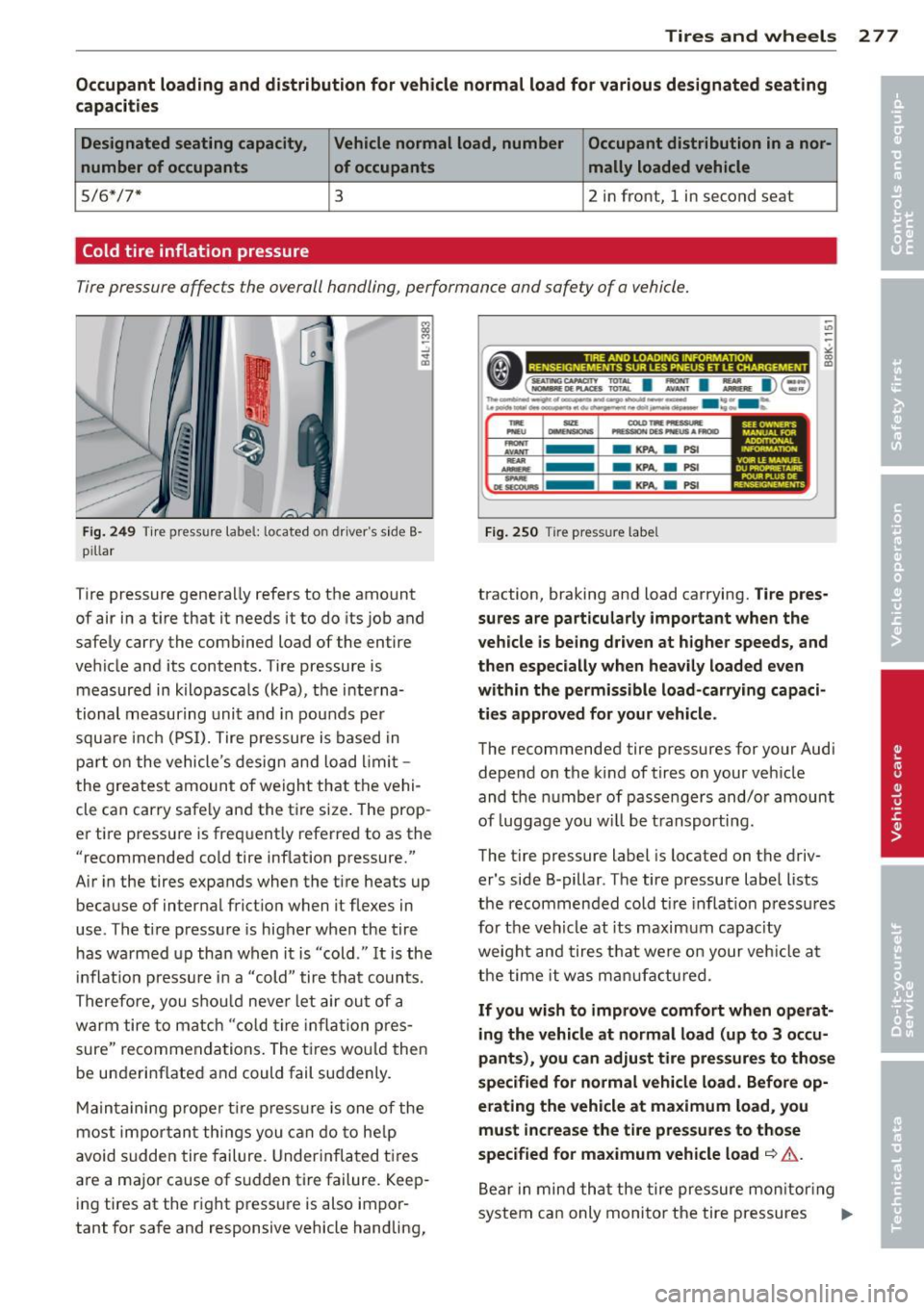
Fig. 249 Tire pressure labe l: located on driver 's s ide B·
p ill ar
Tire pressure genera lly refers to the amount
of air in a tire that it needs it to do its job and
safely carry the combined load of the entire
vehicle and its contents . Tire pressure is
measured in kilopasca ls (kPa), the i nte rna
tional measur ing unit and in pounds pe r
squa re i nch (PSI). Tire pressure is based in
part on the vehicle 's design and load limi t -
the greatest amount of weight that the vehi cle can carry safe ly and the t ire size . The prop
er tire pressure is frequent ly referred to as the
"recommended cold tire inflation pressure."
A ir in the tires expands when the tire heats up
because of internal friction when it flexes in
use . The tire p ressu re is higher when the tire
has warmed up than when it is "cold ."
It is the
i nflat ion p ressure i n a "cold " tire that counts.
Therefo re, you shou ld neve r let air out of a
warm tire to ma tch "cold tire infla tion pres
sure" recommendations. The t ires wo uld then
be underinflated and could fail suddenly .
M aintaining p roper t ire press ure is one of the
most impor tant things you can do to he lp
avoid sudden tire failure. Underinflated t ires
are a ma jo r cause of s udden tire failure . Keep·
ing tires at the right pressure is also impor
tant for safe and responsive vehicle handling,
-tD
-
---------------------.. ,;
•(==.: I :::; I :,,. I)@ gi n. ............ .,_____, .... -.ito._.. ____ .... _ ...
&..p0idit,101111-~--.,...,....-- ..... ~ .... ..
-··-.....
-
-Dlst<:OURS
- KPA.. a PSI
- KPA..
a PS I
- KPA.. a PSI
Fig. 2 50 Tire pressu re labe l
traction, braking and load carrying. Tire p res
sures are particularly importa nt when the
vehicle is being dr iven at higher speeds, and
th en e spe cially when heav ily load ed even
with in the permissible load-carrying capaci
ties approved for your veh icle.
The recommended tire pressures for your Audi
depend on the kind of tires on your ve hicle
and the n umbe r of passengers and/o r amount
of luggage you w ill be transporti ng.
The tire pressure label is located on the driv
er's side B -pillar . The tire pressure labe l lists
the recommended cold t ire inflat io n pressures
for t he vehicle at its maxi mum capac ity
weight and tires that were on your veh icle at
t he time it was m anufactu red.
If you wish to improve comfort wh en operat
ing the vehicle at normal load (up to 3 occu
pant s), you can adju st tire press ures to those
spe cified for n ormal vehi cle load . Before op
erating the vehicle at maximum load , you
must increase the tire pre ssure s to those
specified for ma ximum vehicle load
¢ & .
Bear in mind that the tire pressure mon itor ing
system can only monitor the tire pressures
II>
Page 280 of 340
278 Tires and wheels
you have stored. The system does not recog
nize the load condition of your vehicle.
The effectiveness of the tire pressure monitor
ing system w ill be impaired if yo u store nor
mal load pressures but then operate the vehi
cle at its maximum load¢.&. .
See the illustration¢
fig. 249 for the location
of the label on driver's side 8-pillar (color of
the actua l label and exact location on the ve
hicle wi ll vary slightly).
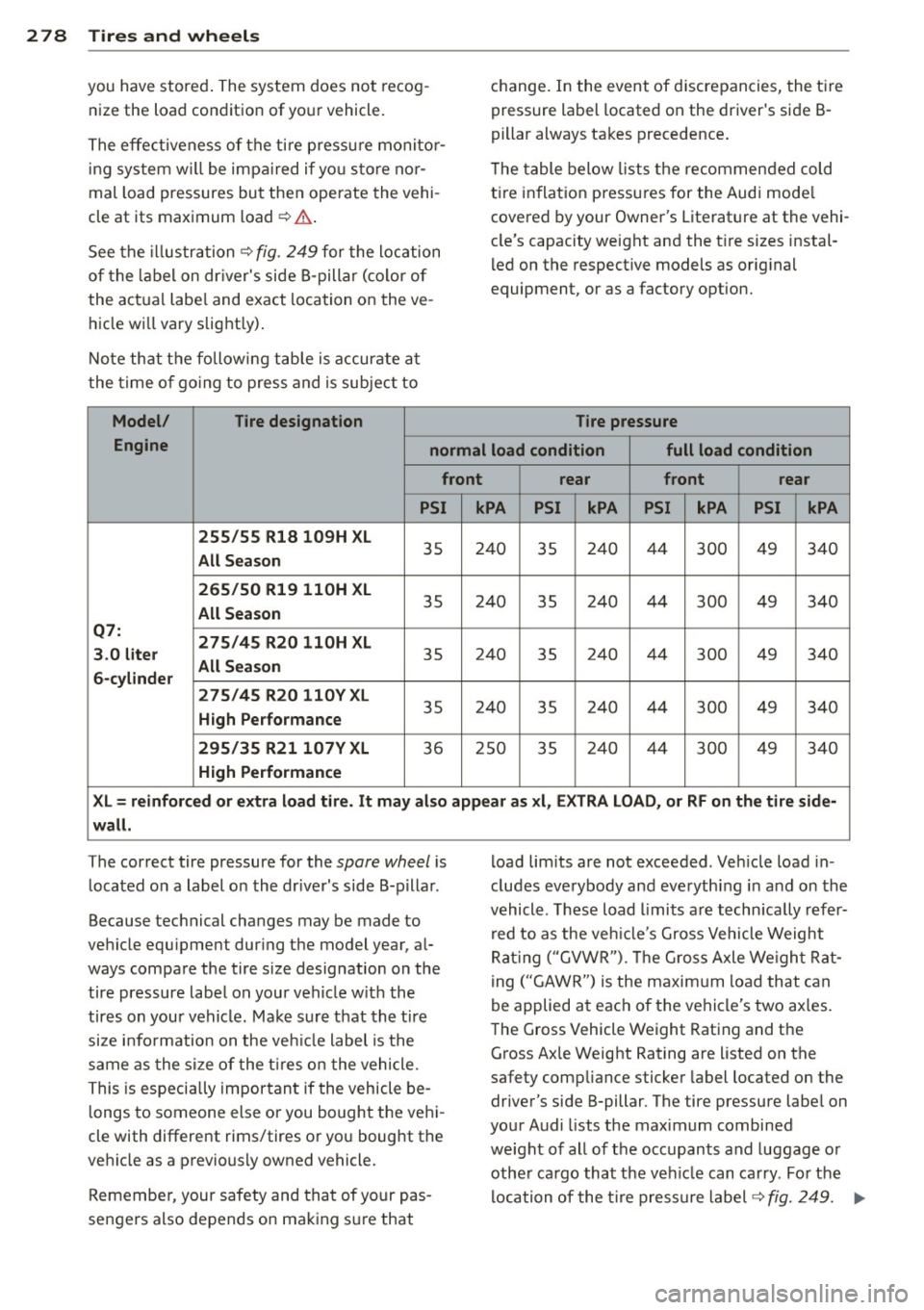
Note that the following table is accurate at
the time of going to press and is subject to
Model/ Tire designation
change. In the event of discrepancies, the tir e
pressure label located on the driver's side 8-
pillar always takes precedence.
T he table below lists the recommended cold
ti re inflation pressures for the Audi mode l
covered by your Owner's Literature at the vehi
cle's capacity weight and the t ire sizes instal
l ed on the respective models as original
equipment, or as a factory option.
Tire pressure
Engine normal load condition full load condition
front rear
front rear
PSI kPA PSI kPA PSI kPA PSI kPA
255/55 Rl8 109H XL
35 240 35 240 44
300 49 340 All Season
265/50 Rl9 llOH XL
35 240
35 240
44
300 49 340 All Season
Q7: 275/45 R20 llOH XL
3 .0 liter
35 240
35 240 44
300 49 340 All Season
6-cylinder
275/45 R20 llOYXL
35 240 35 240 44 300 49 340 High Performance
295/35 R21 107V XL
36 250 35 240 44 300 49 340
High Performance
XL= reinforced or extra load tire. It may also appear as xl, EXTRA LOAD, or RF on the tire side-
wall.
The correct tire pressure for the spare wheel is
located on a label on the driver's side 8-p illar .
Because technical changes may be made to
vehicle equipment dur ing the model year, al
ways compare the tire size designation on the
tire pressure label on your vehicle w ith the
tires on your vehicle. Make sure that the tire
size info rmation on the vehicle label is the
same as the size of the tires on the vehicle.
This is especially important if the vehicle be
l ongs to someone else or you bought the vehi
cle with different rims/tires or you bought the
vehicle as a previously owned vehicle.
Remember, your safety and that of yo ur pas
sengers also depends on making s ure that load
limits are not exceeded . Veh icle load in
cludes everybody and eve ryth ing in and on the
vehicle. These load limits are techn ica lly refer
red to as the veh icle's Gross Vehicle Weight
Rating ("GVWR"). The Gross Axle We ight Rat
ing ("GAWR") is the maximum load that can
be applied at each of the vehicle's two ax les.
The Gross Vehicle Weight Rating and the Gross Axle Weight Rating are listed on the
safety comp liance sticker label located on the
driver's side 8-pillar . The tire pressure label on
your Audi lists the maximum combined
weight of all of the occupants and luggage or
other cargo that the veh icle can carry . For the
location of the tire pressure label¢
fig. 249. ..,_
Page 281 of 340
& WARNING
Overloading a vehicle can cause loss of ve
hicle control, a crash or other accident, se
rious personal injury, and even death .
- Carrying more weight than yo ur vehicle
was designed to carry will prevent the
vehicle from handling properly and in crease the risk of a loss of veh icle con
trol.
- The brakes on a veh icle that has been
overloaded may not be able to stop the
vehicle within a safe distance .
- Tires on a vehicle that has been overload
ed can fail suddenly causing loss of con
tro l and a crash .
- Always make sure that the tota l load be
ing transported -including the we ight of
a tra ile r hi tch and the tongue weight of a
loaded trailer -does not make the veh i
cle heav ier than the veh icle's Gross Vehi
cl e Weight Rating.
& WARNING
- Incorre ct tire pressures and/or underin
fla tion can lead to a serious o r fatal acci
dent.
- Incorrect tire pressures and/or underin
flation cause increased tire wear and can
affect the handling of the vehicle .
- Incorre ct tire pressures and/or underin
fla tion can also lead to sudden tire fa il
ure, incl uding a blowo ut and sudden de
flation, causing loss of vehicle control.
Checking tire pressure
-
The correct tire pressure for the tires original
ly installed on your vehicle is listed on the tire
pressure label located on driver's side 8-pil lar.
The recommended tire pressures are on the
tire pressure label and in the tab le
c:::> page 277, Cold tire inflation pressure .Th is
means that the pressure must be checked and
adjusted when the tire has not been driven for more than a couple of m iles (kilometers) at
low speeds during the p revious three hours .
Tires an d wheel s 2 79
Air in the tires expands when the tire heats up
as a result of internal friction as it flexes in
u se . The tire pressure is h igher when the tire
has warmed up than when it is "cold."
It is the inflation pressure in a "co ld" t ire that
counts . The refore, you should never let air o ut
of a warm tire to match "Cold t ire in flat ion
pressure" recommendat ions ¢
page 277 . The
tires wo uld then be underinf lated and could
fail suddenly .
The t ire pressure label on your Audi lists the
recommended co ld tire inflation pressures at
maximum capacity for the new, orig inal
equipment tires that were on your ve hicle at
the time it was ma nufactured . For the loca
tion of the labe l
¢page 277, fig . 249 .
Most tires lose air naturally over t ime . They
can a lso lose some air if you drive over a pot
hole or hit a curb while park ing.
It is usually
not poss ible to see whethe r the rad ia l tires
u sed today are under inflated just by loo kin g
at them.
T herefo re, be su re to check t ire pressu res at
l east once a mo nth and a lways befo re go ing
o n a long tr ip. Ma ke s ure to ta ke t he number
of peop le and the amount of luggage in to ac
count when ad justing tire pressu re for a trip -
even one that yo u wo uld not conside r to be
"long." See¢
page 281, Tires and vehicle
load limits
for more important information .
A lways use an acc ura te tire pressu re ga uge
when checking and adj usting inf lation pres
s ur es . Check a ll of the tires and be sure not to
forget the spare tire. If the pressure in any t ire
is too high when the tire is "cold," let a ir o ut
of the t ire s low ly w ith the edge of the tire
gauge and keep checking the pressure until
yo u reach the pressure that is correct for the
load (passengers and luggage) and k ind of
driv ing you plan to do.
If the pressure in any tire is too low, note the
difference between the pressure i n the cold
t ir e and the pressu re you need and add the air
t h at you need to reach the cor re ct pressure for
the ve hicle load (passengers and luggage) for
the tires on your vehi cle as listed on the on •
•
Page 282 of 340
28 0 T ire s and wheel s
your veh icle and in this manua l and the kind
of driving yo u plan to do .
Neve r e xcee d the m ax imum inflati on pres
s u re list e d on th e tir e s ide wall f or a ny r ea
s on.
Remember that the vehicle manufacturer, not
the tire manufacturer , determ ines the co rrect
tire pressure for the t ires on your veh icle .
It is important to check the tire pressure when
the tires a re cold .
- Read the required t ire pres sure from the tire
pressure label. The ti re pressure label is lo
cated on the driver's side 8-p illar . The t ire
pressure label lists the recommended cold
t ire inflat ion p ressu res for the veh icle at its
maximum capacity we ight and the tires that
were on you r vehicle at the time it was man
ufactured . For recommended tire pressures
for normal load condit ions, please see chap
ter
c:> page 2 77.
- Turn the valve stem cap counter-clockwise
to remove it from the tire valve.
- Place the a ir pressure gauge on the valve.
- T he tire pressures should on ly be checked
and adjusted when the tires are cold. The
s li ghtly raised pressures of warm tires must
not be reduced.
- Adjust the tire pressure to the load you are
carrying .
- Reinsta ll the va lve stem cap on the valve.
When should I check the tire pressur e?
The correct tire pressure is especially impor
tant at high speeds. The pressure should
therefore be checked at least once a month
and always befo re starting a journey. Do not
forget to check the tire pressure for the spare wheel.
When should I ad ju st th e tire p re ss ures?
Adj ust the tire p ressure to the load you are
carry ing . After chang ing a wheel
or replacing
wheels you have to adjust the tire pressures
on all wheels . In addition, you must then
store the new tire press ures in the tir e pres
sure monito ring system
c:> page 293.
A WARNING
Incorrect tire pressures and/or underinfla
tion can lead sudden tire fa ilure, loss of
control, collision, serious personal injury
or even death .
- When the warn ing symbol
[I] appears in
the instrument cluster, stop and inspect
the t ires.
- Incorrect tire pressure and/or underinfla
tion can cause increased tire wear and
can affect the hand ling of the vehicle and
stopping abi lity.
- I nco rrect tire pressures a nd/or underin
f lation can a lso lead to sudden t ire fail
ure, including a blowout and sudden de
flation, ca using loss of vehicle contro l.
- The drive r is responsible for the correc t
tire pressures for all tires on the veh icle.
The applicable pressure values are locat
ed on a sticker on the driver's side B -pil
lar.
- On ly when all tires on the vehicle are fil
led to the correct pressure, the tire pres
sure mon itoring system can work cor
rectly.
- The use of incorrect tire pressure va lues
can lead to acc idents or other damage.
Therefore it is essential that the driver
observe the spec ified t ire pressure values
for the tires and the correct pressures for
the function of the t i re press ure monitor
ing system.
- Always inflate t ires to the recommended
and correct t ire p ressure before dr iv ing
off.
- Driving with underinf lated tires bend
mo re, letting them get too hot resulting
in tread sepa ration, s udde n tire failure
and loss of cont ro l.
- E xcessive speed and/overloadi ng can
cause heat b uild- up, sudden tire failure
and loss of cont ro l.
- I f the tire pressure is too low or too high,
the t ires will wear prema turely and the
vehicle wi ll not handle well. ..,
Page 283 of 340
-If the ti re is not flat and y ou do not have
to change a wheel immed iate ly, drive at
reduced speed to the nearest service sta
t ion to check the tire pressure and add
air as required.
(D Note
Dr iving without va lve stem caps can cause
damage to the t ire va lves. To prevent this,
always make sure that factory installed
valve stem caps on all wheels are secu re ly
mounted on the va lve.
@) For the sake of the environment
Underinflated tires will a lso increase the
fue l consumption.
Tires and vehicle load limits
There are limits to the amount of load or
weight t hat any veh icle and any t ire ca n car ry.
A vehicle that is overloaded w ill not handle
well and is more difficult to stop. Overload ing
can not on ly lead to loss of vehicle contro l,
but can a lso damage important parts of the
vehicle and can lead to sudden tire failure, in
cluding a blowout and sudden deflation that
can cause the ve hicle to crash.
Your safety and that of yo ur passenge rs a lso
depends on making sure that load limits are
not exceeded. Vehicle load includes everybody
and everyth ing in and on the vehicle. These
load limits a re tech nica lly referred to as the
ve hicle's
Gross Veh icle Weight Rating
("GVWR").
The "GVWR" includes the we ight of the basic
ve hicle, all factory installed accessories, a full
tank of f uel, oil, coo lant and othe r fluids plus
max imum load. The maximum load includes
the number o f passenger s that the ve hicl e is
intended to carry ("se ating capacity") w it h an
assumed weig ht o f 150 lbs (68 kg) for each
passenger at a designated seating position
and the tota l weight of any luggage in the ve
h icle. If you tow a trailer, the weight of the
trailer hitch and the tong ue weight of the
Tire s an d wheel s 281
loaded tra ile r must be included as part of the
vehicle load .
T he
Gro ss Ax le Weight Rating (" GAWR") is
the max imum load th at can be applied at each
of the vehicle's two axles .
T he Gross Vehicle Weight Rat ing and t he
G ross Ax le Weig ht Ra ting are l iste d on the
s af ety comp liance s tic ke r la bel lo cated on the
driver's side 8 -pillar . Your Audi has 5 seating
positions, 2 in the front and 3 in the rear fo r
total seating capacity of 5. On vehicles with
s ix seats*, your vehicle has two front seats,
two seats in the second row seat ing and two
seats in the th ird row seati ng. On veh icles
with seven seats*, your vehicle has two front
seats, t hree seats in the second row s eating
and two seats in t he third row seating. Ea ch
seat ing pos itio n has a se at belt
~page 174,
Safety be lts .
The fact that ther e is a n upper limit to you r
vehicle's G ross Vehicle Weigh t Rati ng means
that the to tal weig ht of whatever is bei ng car
ried in the vehicle ( in cl ud ing the weight of a
trailer hitch and the tongue weight of the l oa ded trai le r) is limite d. The more passen
gers in the vehicle or passengers who are heavier than the standard we ights assumed
mean that less we ight can be carried as lug
gage.
The tire pressure label on your Audi also lists
the max imum combined weight of all of the
occupants and luggage or other cargo that
t h e ve hicle can carry. Fo r the locat ion of the
label
~page 277, fig . 249.
A WARNING
Overloading a veh icl e can cause loss of ve
h icl e cont ro l, a crash or o ther accide nt, se
rio us pe rson al inj ury, a nd eve n death .
- Ca rrying more we ight tha n your ve hicle
was des igned to carry w ill prevent the
veh icle from h andling proper ly and in
crease the risk of the loss o f vehicle con
trol.
•
•
Page 284 of 340
282 Tires and wheels
-The brakes on a vehicle that has been
overloaded may not be able to stop the
vehicle within a safe distance.
- Tires on a vehicle that has been overload
ed can fail suddenly, including a blowout
and sudden deflation, causing loss of
control and a crash.
- Always make sure that the total load be
ing transported -including the weight of
a trailer hitch and the tongue weight of a
loaded trailer -does not make the vehi
cle heavier than the vehicle's Gross Vehi
cle Weight Rating.
Determining correct load limit
Use the example below to cal
culate the total weight of the
passengers and luggage or oth
er things that you plan to trans
port so that you can make sure
that your vehicle will not be overloaded.
Steps for Determining
Correct Load Limit
1. Locate the statement "THE COMBINED WEIGHT OF OC
CUPANTS AND CARGO
SHOULD NEVER EXCEED XXX KG OR XXX LBS"on your vehi
cle's placard (tire inflation pressure label)
¢ page 2 77,
fig. 249.
2. Determine the combined
weight of the driver and pas
sengers that will be riding in
your vehicle. 3
. Subtract the combined
weight of the driver and pas sengers from
"XXX" kilo
grams or
"XXX" pounds
shown on the sticker
¢page 277, fig. 249.
4. The resulting figure equals the available amount of car
go and luggage load capaci
ty. For example, if the
"XXX"
amount equals 1400 lbs.
and there will be five
150
lbs. passengers in your vehi
cle, the amount of available
cargo and luggage load ca
pacity is
650 lbs. (1400-7 50
(5 X 150) = 650 lbs.)
5. Determine the combined
weight of luggage and cargo
being loaded on the vehicle.
That weight may not safely
exceed the available cargo
and luggage load capacity
calculated in Step 4.
6. If your vehicle will be towing
a trailer, load from your trail
er will be transferred to your
vehicle. Consult this manual
to determine how this re duces the available cargo
and luggage load capacity of
your vehicle. ..,
Page 286 of 340

284 Tires and wheels
All-wheel drive
Vehicles with quattro must always have tires
of the same size , construction and tread type.
For details see Qpage 228.
~ WARNING
Sudden tire failure can lead to loss of con
trol, a crash and serious persona l injury!
- Never drive a vehicle when the tread on
any tire is worn down to the wear indica
tors.
- Worn tires are a safety hazard, they do
not grip well on wet roads and increase
your risk of "hydroplaning" and loss of
control.
- Always keep chemicals that can cause
tire damage , such as grease, oil, gasoline
and brake fluid away from tires .
- Tires age even if they are not being used
and can fail suddenly, especially at high
speeds. Tires that are more than 6 years
old can only be used in an emergency
and then with special care and at lower
speeds.
- Never mount used tires on your vehicle if
you a re not sure of their "previous histo
ry." Old used tires may have been dam
aged even though the damage cannot be
seen that can lead to sudden tire failure
and loss of vehicle control.
New tires and replacing tires and wheels
New tires and wheels have to be broken in .
Fig. 253 Tir e specificat ion c odes on t he s idewall o f a
t ire
No. Description
® Ratio of height to width (aspect ratio)
© Radial
® Rim diameter code
® Load index and speed rating
(J) U.S. DOT tire identification number
® Audi Original tire
® Sever snow conditions
@ Tire ply composition and materials
used
@ Maximum load rat ing
@ Treadwear, traction and temperature
grades
@ Maximum permissible inflation pres-
sure
T he tires and rims are essential parts of the
vehicle 's design . The tires and rims approved
by Audi are spec ially matched to the charac
teristics of the vehicle and can make a major .,..
Page 287 of 340

contribution to good road holding and safe
handling when in good condition and properly
inflated
¢ .&. .
We recommend that all work on t ires and
wheels be performed by an authorized A udi
dealer. They are familiar with recommended
procedures and have the necessary spec ial
too ls and spare parts as we ll as the proper fa
cilities for dispos ing of the old tires .
Authorized Audi dealers have the necessary information about techn ica l requ irements for
installing or changing tires and r ims.
R eplacing t ires and wheel s
Tires shou ld be rep laced at least in pairs and
not individua lly (for example both front tires
or both rear tires together).
Be s ure to read and heed the information to
the tire pressure monitoring system
¢page 291.
Always buy rep lacement radial tires that have
the same specifications as the t ires approved
for your ve hicle by Audi. Replacement tires
must always have the same load rating speci
fication as the original equipment or approved
optional tires listed in the table
¢ page 277.
Aud i-approved specification tires are specially
matched to your vehicle and its load limits,
and can contribute to the important road hold
ing, driving character istics, and safety of the
veh icle. The table
(¢page 277) lists spec ifica
tions of the t ires approved for the Audi mod
e ls covered by your Owner's Literature .
The tire pressure labe l located on the driver's
side B-pillar
¢ page 2 77, fig. 250 lists the
specif ications of the or iginal equipment tires
installed on your vehicle at the time it was
manufactured.
Federal law requires t ire manufacturers to
p lace standard ized information on the s ide
wall of all tires
¢ fig . 253 . This information
i dent ifies and desc ribes the fundamental
characterist ics, the quality grade of the tire
and a lso provides a tire ide ntificat io n number
Tire s an d wheel s 285
for sa fety standard certification and in case of
a reca ll.
Tire specifications
Knowledge of tire specifications makes it eas
ier to choose the co rrec t tires . Radial ti res
have the tire specifications marked on the
sidewa ll, for examp le:
P255 / 55 R 18 109 H XL
This co nta ins the following information:
P Indicates the tire is for passenger cars
(where app licab le)
255 Nom inal tire width i n mm of the tire
from sidewall edge to sidewall edge. In
general, the larger the number, the wider
the tire
55 Height/w idth ratio in percent (aspect ra -
t io)
R Tire construct ion: Radial
18 Rim diameter code (i n inches)
10 9 Load ra ting code
H Speed ra ting letter code
XL (or "xl", "EXTRA LOAD", or "RF" Indicates
t h at the t ire is a"Re info rced" or an " Extra
Load " tir e
M+S (or "M/S") Indicates that the ti re has
some mud and snow capab ility
The tires could also have the informat ion of
direction of rotation ¢
page 273 .
Tire manufacturing d ate
The manufact uring date is also indicated on
the tire sidewall (possibly only on the
inner
s ide of the wheel):
"DOT ... 2213 .. . "means, for examp le, that
the tire was produced in the 22nd week of 2013.
Speed rating (letter cod e)
The speed rating letter code on the whee ls in
dicates the maximum permissible road speeds
¢ .&. in Winter tires on page 289.
P up to 93 mp h (150 km/h)
Q up to 99 mp h (1 58 km/h)
R up to 106 mph ( 170 km/h)
•
•
Page 288 of 340
286 Tires and wheels
S up to 110 mph (180 km/h)
T up to 118 mph (190 km/h)
U up to 124 mph (200 km/h)
H up to 130 mph (210 km/h)
V up to 149 mph (240 km/h)1l
Z over 149 mph (240 km/h)ll
W up to 168 mph (270 km/h)ll
Y up to 186 mph (298 km/h)
1
l
Your veh icle is normally factory equipped with
tires, which possess excellent driving charac
teristics and give yo ur Audi opt imum d riving
comfort . An electronic speed limiter
c::> page 28 will normally prevent your vehicle
from going faster than the tire speed rating
¢ &. .
U.S. DOT Tire Identification Number (TIN)
and tire manufacture date
This is the tire's "serial number". It begins
with the letters "DOT" and indicates that the
tire meets all federal standards. The next two
numbers or letters indicate the plant where it
was manufactured, and the last four numbers
represent the week and year of manufacture.
For example, the numbers 2213 mean that
the tire was produced in the 22nd wee k of
2013. The other numbers are mar keting co
des that may or may not be used by the tire
manufacturer . This information is used to con
tact consumers if a tire defect requires a re
call.
Audi Original tire
Tires with the identification "AO" or "RO" have
been specia lly matched with your Audi . We
recommend using only these tires because
they meet the highest standards regard ing
safety and driving character istics when used
correctly. Your authorized Audi dealer will
gladly provide you with more information.
Tire ply composit ion and materials used
The number of plies indicates the number of
l ayers of rubber-coated fabric in the tire. In
ll For tir es w it h a m ax im um spee d ca pabil ity ove r 149
mph (2 40 km/ h), ti re manufact urers somet imes use
the lett ers " ZR."
genera l, the greater the number of plies, the
more weight a tire can support. Tire manufac
turers also must indicate the materials in the
t ir e, which include steel, nylon, po lyester, and
others.
Maximum Load Rating
This number ind icates the maximum load in
kilograms and pounds that can be carried by
the tire.
Tire quality grading for treadwear,
traction , and temperature resistance
Tread wear, traction and temperature grades
c::> page
287.
Maximum Permissible Inflation Pressure
Th is number is the greatest amount of air
pressure that should ever be put in the tire
u nder normal driving conditions.
.&, WARNING ~ -
-Using incorrect or unmatched tires and/
or wheels or improper tire and wheel
comb inat ions can lead to loss of control,
coll is ion and serious personal injury.
-Always use t ires, rims and whee l bolts
that meet the specifications of original
factory- installed tires or other combina
tions that have been specifically ap
proved by the vehicle manufacturer.
- Tires age even if they are not being used
and can fail suddenly, especially at high
speeds. Tires that are more than 6 years
old can only be used in an emergen cy
and then with special care and at lower
speeds.
- Never mount used tires on your vehicle if
you are not sure of their "previous histo
ry." Old used tires may have been dam
aged even though the damage cannot be
seen that can lead to sudden tire fa ilure
and loss of vehicle control.
Page 289 of 340

-All four wheels must be fitted with radial
tires of the same type, size (rolling cir
cumference) and the same tread pattern .
Driving with different tires reduces vehi
cle handling and can lead to a loss of
control.
- If the spare tire is not the same as the
tires that are mounted on the vehicle -
for example with winter tires -only use
the spare tire for a short period of time and drive with extra care. Refit the nor
mal road wheel as soon as safely possi
ble.
- Never drive faster than the maximum
speed for which the tires on your vehicle
are rated because tires that are driven
faster than their rated speed can fail
suddenly.
- Overloading tires cause heat build-up,
sudden tire failure, including a blowout
and sudden deflation and loss of control.
- Temperature grades apply to tires that
are properly inflated and not over or un
derinflated .
- For technical reasons it is not always
possible to use wheels from other
vehicles -in some cases not even wheels
from the same vehicle model.
- If you install wheel trim discs on the ve
hicle wheels, make sure that the air flow
to the brakes is not blocked. Reduced air
flow to the brakes can them to overheat,
increasing stopping distances and caus
ing a collision.
- Run flat tires may only be used on
vehicles that were equipped with them at the factory. The vehicle must have a
chassis designed for run flat tires. Incor
rect use of run flat tires can lead to vehi
cle damage or accidents. Check with an
authorized Audi dealer or tire specialist
to see if your vehicle can be equipped
with run flat tires. If run flat tires are
used, they must be installed on all four
wheels . Mixing tire types is not permit
ted.
Tires and wheels 287
@ Note
- For technical reasons, it is not generally
possible to use the wheel rims from oth
er vehicles. This can hold true for wheels
of the same vehicle type.
- If the spare tire is different from the
tires that you have mounted on your ve
hicle (for example winter tires or wide
profile tires), then use the spare tire for a
short period of time only and drive with
extra care. Replace the flat tire with the
tire matching the others on your vehicle
as soon as possible.
- Never drive without the valve stem cap .
The valves could get damaged.
(® For the sake of the environment
Dispose of old tires in accordance with the
local requirements.
Uniform tire quality grading
- Tread wear
- Traction AA A B C
- Temperature ABC
Quality grades can be found where applicable
on the tire side wall between tread shoulder
and maximum section width
¢ page 284,
fig. 253.
For example: Tread wear 200, Traction AA,
Temperature A.
All passenger car tires must conform to Feder
al Safety Requirements in addition to these
grades.
Tread wear
The tread wear grade is a comparative rating
based on the wear rate of the tire when tested
under controlled conditions on a specified
government test course.
For example, a tire graded 1S0 would wear
one and one half (1 1/2) times as well on the
government course as a tire graded 100. •
•