oil AUDI Q7 2014 Owner´s Manual
[x] Cancel search | Manufacturer: AUDI, Model Year: 2014, Model line: Q7, Model: AUDI Q7 2014Pages: 340, PDF Size: 85.02 MB
Page 112 of 340
110 On the road
The parking brake warning light. (USA)/ .
(CON) illuminates when the parking brake is
set and you switch on the ignition.
A WARNING
-
Always release the parking brake com
pletely. A partially engaged brake will
overheat the rear brakes, reduce their ef
fectiveness and cause excessive wear. This could lead to brake failure and an accident .
(D Note
Only after the vehicle has come to com
plete stop, should you firmly set the park
ing brake and
move the selector lever into
P.
Parking
• Press the brake pedal to stop the vehicle .
• Apply the parking brake firmly
r=,> page 109,
fig. 123 @.
• Move the selector lever to P.
.. Turn the engine off~_& .
.. When on inclines or declines, turn the steer
ing wheel so that the vehicle will roll into
the curb if it begins to
move.
A WARNING
This is how you can reduce the risk of in
jury when leaving your vehicle.
- Never park the vehicle where it can come
in contact with dry grass, spilled fuel or
any other flammable materials.
- When parking on hills, always turn the
wheels so that the front wheels will first
roll into the curb, if the vehicle should
start to roll.
- Never allow anyone - especially small
children - to remain in the vehicle when
it is locked. Locked doors make it more
difficult for rescuers to access the pas
senger compartment in the event of an
emergency. Danger to life!
- Never leave children unsupervised in the
vehicle. Children could release the park
ing brake or
move the gearshift lever out
-
of gear. The vehicle could start to roll
away and cause an accident.
- No matter what the season is, the tem
perature in a parked vehicle can reach
dangerous levels.
Q) Note
- Please exercise care when you park your
vehicle in parking areas with parking bar
riers or curbs. Parking barriers and curbs
vary in height and could damage your
bumper and related components as the
front of your vehicle
moves over a barrier
or curb that is too high, as you park or as
you back out of a parking spot. In order
to be sure that no such damage can oc
cur, you may wish to stop short of having
the front tires of your car touch the park
ing barrier or curb.
- Please also exercise exceptional care
when you drive up or down steep ramps
or drive
over curbs or other obstacles, for
which the vehicle is not designed, be
cause components of th@ vehicle close to
the ground, such as bumper covers,
spoilers and suspension and exhaust sys
tem components, may become dam
aged.
Starting on hills
Hill Hold makes it easier to start on hills.
The system is activated when the brake pedal
is depressed
for a few seconds . For this, the
vehicle must be standing in uphill driving di rection.
After releasing the brake pedal, the brake power is held for a
brief moment to prevent
the vehicle from rolling back when starting. At
this time, you can easily begin to
move your
vehicle.
A WARNING
- If you did not begin moving immediately
after releasing the brake pedal, under
certain circumstances, the vehicle would
begin to roll backward. Depress the ..,.
Page 132 of 340

130 Audi side assist
-The radar sensor's vision can be reduced
or entirely blocked by rain, snow, and
heavy spray . This can result in side assist
not adequately detecting vehicles or, in
some cases, not detecting them at all.
Always keep an eye on the direction you
are traveling and the relevant area
around the vehicle.
- Please note that side assist indicates
there are approaching vehicles, or
vehicles in your blind spot, only after
your vehicle has reached a driving speed
of at least 19 mph (30 km/h).
- Side assist signal does not work around
tight corners (turning radius less than
328 feet, or 100 m).
- Side assist is no replacement for the driv
er's full attention. The driver alone is re
sponsible for lane changes and similar
driving maneuvers. Always keep an eye
on the direction you are traveling and the relevant area around the vehicle.
- To ensure that you do not adversely af
fect side assist, do not block the area on
the rear bumper where the radar sensors
are located with foreign objects (such as
stickers or bicycle racks).
- Make sure that the signal light on the
outside mirror is not blocked by stickers
or other items.
(Di Tips
- Side assist automatically deactivates if it
detects that the radar sensors are
blocked ¢
page 135. The indicator light
on the button goes out .
- The area on the bumper where the radar
sensors are located must consistently re
main free of snow, ice, and heavy soiling
so that side assist can function properly.
Follow the additional notes on
¢page 136.
-For vehicles with a factory installed tow
ing hitch* or a trailer hitch* that was in
stalled later according to factory specifi
cations, side assist is automatically deac- tivated
as soon as the electrical connec
tion to the trailer electrical socket is made
¢ page 135.
-For vehicles with a trailer hitch that was
not installed according to factory specifi
cations, switch off the side assist when
towing a trailer .
- Additional tinting on the front side win
dows can make it harder to see and cor
rectly understand the signal light on the
outside mirror.
- For Declaration of Compliance to United
States FCC and Industry Canada regula
tions¢
page 319.
Sensor detection area
Applies to vehicles: with side assist
-----··· .... ·--·--
@ / ,
--
ill b''T -
Fig. 150 Sc hematic illustration: Sensor detectio n area
The detection ¢ fig. 150 of the radar sensor
detection area is made up of:
-
- the approach area (light red area) (D, about
230 feet (70 m) behind the vehicle, and
- the "blind spot" (dark red area) @.
The radar sensors cover the adjacent left and
right lanes. Other lanes are
not covered by the
radar sensors.
(D Tips
Side assist does not measure actual lane
width. The system assumes a fixed lane
width . Detection in the left and right lanes
is based on this assumed lane width.
When driving on narrow roads or when
driving to the left or right of the center of
a travel lane, it is possible that vehicles
will be detected that are
not in the lane
Page 229 of 340
When you are driving at higher speeds wit h
the windshield wipers on, the brake pads will briefly touch the brake d iscs in regular inter
vals so as to improve reaction t ime when brak
ing on wet surfaces. You, the driver, will not
notice anything .
The effectiveness of the brakes can be reduced
when the vehicle is driven on a salt-covered
road and the brakes are not used . Here too,
you should clean
off accumulated salt coat ing
from brake discs and pads with a few careful
applications of the brake ¢ & .
Cor ro sion
There may be a tendency for dirt to build up
on the brake pads and corrosion to form on
the discs if the car is not dr iven regularly or
only for sho rt trips with little use of the
b rakes .
If the brakes are not used frequently, or if cor rosion has formed on the discs, it is advisable
to clean
off the pads and discs by b rak ing
fi rm ly a few times from a mode rately h igh
speed ¢.& .
Faults in the brake system
If you should notice a sudden increase in
brake peda l travel, t hen one of the two brake
circu its may have failed¢& .
Low brake flu id le vel
Malfunct ions can occur in the brake system if
the brake fl uid level is too low . T he brake fluid
level is monitored electronically .
Brake booste r
The brake booster increases the pressure t hat
you generate w ith the bra ke pedal. It on ly op
erates while the eng ine is running¢ &.
Brake lining wear statu s
Brake lining wea r may be c hecked by vis ual in
spection of the condition of the brake pads
through the openings in the whee l. If neces
sary, the whee l may be removed for this in
spection ¢
page 297, Changing a wheel.
Intellig ent technolog y 22 7
A WARNING
-You should perform braking maneuvers
for the purpose of cleaning the brake
system only if road conditions permit.
Othe r road use rs must not be put at risk -
you may ca use an accident!
- Before descend ing a steep grade, reduce
speed a nd s hift transmission into a lower
gea r o r l ower dr iving range. Do not ride
the br akes or ho ld t he pedal down too
long o r too often. This could cause the
brakes to get hot and diminish braking
efficiency .
- Do not " ride the brakes" by rest ing you r
foot on the pedal when you do not intend
to brake. This may ca use the brakes to
overheat, premature wear and increased
stopping distance .
- Under certain cl imatic and ope rat ing
conditions such as passing thro ugh wa
ter , dr iv ing in heavy rain o r after washing
the vehicle , the effectiveness of the
brakes can be reduced . In winte r, ice can
accumu late on the bra ke pads, lin ings,
d iscs a nd drum s. Carefu lly app ly bra ke s
for a test. Brakes w ill dry and ice co at
ings w ill be cleaned
off after a few care
fu l brake applicat ions.
- Driving for an exten ded period o f time o n
salt -cove red roads without using your
brakes can a lso affect braking efficiency .
C lean
off accum ulated salt coating from
brake discs and pads with a few careful
brake applications.
- I f you damage the front spoiler, o r if you
install a different spoiler, be sure the air
f low to the front brakes is not obstruct
ed. Otherw ise the brak e system could
overheat reducing the effectiveness of
the entire brake system.
- Failure of one b rake circuit will impai r
the braking capab ility result ing in an in
creased s topping distance. Avoid driving
the vehicle a nd have it towed to the ne ar
est a uthorized Audi dea le r or qu alified
wo rkshop.
•
•
Page 235 of 340
Catalytic converter
Applies to vehicles: with gasoline engine
It is very important that your emission con
trol system (catalytic converter) is function
ing properly to ensure that your vehicle is run
ning in an environmentally sound manner .
... Always use lead-free gasoline c::> page 249,
Gasoline .
... Never run the tank down all the way to emp
ty .
... Never put too much motor oil in your engine
c::> page 263, Adding engine oil 't=r..
.,. Never try to push-or tow-start your veh icle.
The catalytic converter is an eff icient "clean
up" device built into the exhaust system of
the vehicle. The catalytic converter burns
many of the pollutants in the exhaust gas be
fore they are released into the atmosphere.
The exclus ive use of unleaded fuel is cr it ically
i mportant for the life of the cata lytic convert
e r and proper functioning of the engine.
& WARNING ,~
T he temperature of the exhaust system is
high, both when driving and after stopping
the engine .
- Never touch the exha ust tail pipes once
they have become hot. This could result
in burns.
- Do not park or operate the vehicle in
areas where the hot exhaust system may
come in contact with dry grass, brush,
fuel spill or other material which can
cause a fire.
- Do not apply additional undercoating or
rustproofing on or near the exhaust
manifold, exhaust p ipes, catalytic con
verter or heat shields . During driving, the
substance used for undercoating cou ld
overheat and cause a fire.
(D Note
- Be aware that just one tank f illing with
leaded fuel will already seriously de-
grade the performance of the catalytic
conve rter.
Dri vin g and en vironm ent 233
-Do not exceed the correct engine oil level
c::> page 263.
- Do not drive until the fue l tank becomes
completely empty. The engine cou ld mis
fire. Unburned fuel could also get into
the exhaust system and this cou ld cause
the catalytic converter to overheat.
- Do not turn off the ignition while the ve
hicle is mov ing.
- Do not continue to operate your veh icle
under these conditions, as otherwise fuel
can reach the catalyt ic converter. Th is
cou ld result in overheating of the con
verter, requir ing its replacement.
- To assure efficient operation of the Emis
sion Control System:
- Have you r vehicle main tained properly
and in accordance w ith the se rv ice rec
ommendations in your Warranty & Maintenance book let.
- Lack of proper maintenance as we ll as
improper use of t he vehicle will impair
the function of the emission contro l
system and could lead to damage.
@) For the sa ke of the env ironment
Even when the Emission Control System is
operating properly, the exhaust gas can have a sulfur-like exhaust gas smell under
some operat ing states. This depends on
the sulfur content of the fuel being used .
Using a different brand of fuel may help,
or filling the tank with lead-free s uper
g rade gasoline.
Diesel particulate filter
App lies to vehicles: wit h diese l eng ine
The diesel part iculate filter filters nearly all of
the soot pa rticles out of the exhaust . T he fil
te r clea ns itself automat ica lly under no rma l
driv ing cond itions. If the filter cannot clean it
self (for example, because you are on ly driving
short distances), the fi lter becomes clogged
with soot and the
Ill symbo l for the diesel
particulate filter i lluminates
c::> page 36. ..,_
•
•
Page 236 of 340
234 Driving and en vironm ent
,8. WARNING
-Do not park your vehicle over flammable
materials such as grass or leaves because
the high temperature of the diesel par
t icu late filter could start a fire .
- Do not apply an underbody protectant in the exhaust system area or a fire could start.
Avoid damaging the vehicle
When you are driving on poor roads, or over
curbs, steep ramps, etc., make certain that
low-lying parts such as spoilers and exhaust
system parts do not bottom out and get dam
aged.
This is especia lly true for vehicles with low
slung chassis (sports chassis)* and fully load
ed vehicles.
Shutting down vehicle
If you would like your vehicle to remain inop
erative for a longer period of time, contact an
Audi or other specialized dealer . They can ad
vise you on necessary precautions e.g . corro
sion prevention, maintenance and storage. Pay attention to additional information con
cerning the battery. Refer to
c::> page 268.
Operate your vehicle
economically and minimize pollution
General
Your personal style of driving will determine
the economy of your vehicle, as well as ex
haust and noise levels .
Fuel economy, environmental impact, and
wear on your engine, brakes and tires largely
depend on three factors:
- your personal driving style
- operating conditions
- technical limitations
If you anticipate what you need to do next and
drive economically, you can easily cut your
fuel consumption by 10-15 percent . This sec
tion will give you some tips on how you can help the environment and your pocketbook.
(D Tips
The consumption estimates as published by ENVIRONMENTAL PROTECTION AGENCY
(EPA) and Transport Canada may not corre
spond to your actual consumption on the road, which will vary depending upon vehi
cle load and speed, road and weather con
dit ions, trip length, etc.
· Drive smoothly and keep a lookout
ahead
Vehicles use the most fuel when they ore ac
celerating.
., Avo id unnecessary accelerating and brak ing.
Vehicles use the most fuel when they are ac
celerating . If you anticipate what is going to
happen next, you will need to brake less and,
thus, acce lerate less. Let the vehicle coast
whenever possible -for examp le when you see
that the next traffic light is red.
Avoid full throttle
Driving at moderate speeds saves fuel and
improves your mileage.
., Try and keep well below your car's maximum
speed.
Accelerating gently reduces fuel consump
tion, engine wear, and does not disturb the environment.
Fuel consumption, exhaust emissions and en
gine noise increase disproportionately at high
speeds. If you drive at approximately three
quarters of top speed, fuel consumption w ill
be reduced by one half. Never drive faster
than the posted speed limit and weather con
ditions permit.
Page 237 of 340
Reducing unnecessary idling
Even when your car is just idling it burns up
fuel.
11-Shut the engine off when you are not driving
the vehicle.
11-Do not warm up the vehicle by letting the
engine run at idle .
It makes sense to shut
off the engine in traffic
jams, when waiting for trains to pass at rail
road cross ings, or at traffic lights that have
long waits on red. Turning the engine
off for
just 30-40 seconds saves more fuel than is
burned starting the engine again.
It takes a long time for the engine to warm up
fully when it is running at idle. However, wear
and noxious emissions are especially high
when the engine is warming up. So you should
drive away as soon as you start the engine and
avoid running at high rpms while the engine is
still warming up .
(D Note
Do not leave engine idling unattended af
ter starting. If warning lights should come
on to indicate improper operation, they
wou ld go unheeded. Extended idling also
produces heat, which cou ld result in over
heating or other damage to the vehicle or
other property .
Regular maintenance
A badly tuned engine unnecessarily wastes a lot of fuel .
11-Have your vehicle serviced at regular inter-
vals.
By having your vehicle regularly serviced by an
authorized Audi dealer helps to ensure that it
runs properly and economically. The condition
of your vehicle not only affects its safe ty and
ab ility to hold its value, it also affects fuel
consumption .
Check your oil each time you fill your tank.
Driving and environment 235
The amount of oil used is re lated to engine
load and speed.
It is normal for the oil consumption of a new
engine to reach its lowest value after a certain
mileage has been driven.
You must drive your vehicle about 3,000 miles
(S,000 kilometers) before you can properly
assess oil consumpt ion.
This also app lies to fue l consumption and en
gine output.
(D Note
- Have your veh icle ma inta ined properly
and in accordance with the service rec
ommendations in your Warranty
& Main
t enance booklet. Lack of prop er mainte
nance as well as improper use of the ve
hicle will impair the function of the
emission cont ro l system and could lead
to damage.
- Do not alter or remove any component of
the Emission Control System unless ap
proved by the manufacturer.
- Do not alter or remove any device, such
as heat shields, switches, ignition wires,
valves, which are designed to protect
your vehicle's Emission Control System and other important vehicle compo
nents.
Fewer short trips
Fuel consumption will always be relatively
high on short trips .
11-Try to avoid driv ing short distances w ith a
cold engine.
T he engine and cata lytic converter have to
reach their optimal operating temperature to
reduce fuel consumpt ion and noxious emis
s ions effectively .
Just after starting, a co ld engine in a mid-size
car on ly achieves a fuel economy of 6-8 mi les
per gallon (30-40 l/l00km). After about a
half a mile, fuel economy climbs to 12 mpg
(20 l/100 km). After about
2 .5 miles (4 km), liJI,
•
•
Page 247 of 340

Vehicl e ca re a nd cl eanin g 245
A WARNING
-Only wash the vehicle when the ignition
is off and follow the instructions from
the car wash operator to reduce the risk of accidents .
- To reduce the r isk of cuts, protect your
self from sharp metal components when
wash ing the underbody or the inside of
t he wheel housings.
- After washing the vehicle, the braking ef
fec t may be delayed due to mo isture on
the brake rotors or ice in the winter. The
brakes must be dried first with a few
careful brake applications.
Q) Note
- If you wash t he vehicle in an automatic
car wash, yo u must fold the exterior m ir
rors in to reduce the r is k of damage to
the mirrors. Power folding exterior mir
rors* must only be folded in and out us
ing the power folding function.
- Compare the track of your vehicle with
the distance between the guide rails of
the facility -there is a risk of damage to
the wheels and tires .
- Compare the height and width of your
vehicle with the he ight and width of the
tunnel at the fac ility. -
To prevent paint damage, do not wash
the vehicle in direct sunlight.
- T o reduce the r isk o f damage to the sur
face, do not use insect removing spong
es, kitchen sponges or similar items.
- Matte finish painted vehicle compo nents:
- To reduce the risk of damage to the
surface, do not use polishing agents or
ha rd wax .
- Never use car wash cycles that apply protective wax.
It can destroy the
matte fin ish effect .
- Do not place any stickers or magnet ic
signs on vehicle parts painted w ith
matte fin ish paint. The paint cou ld be
damaged when the stickers o r magnets
a re removed.
@ For the sake of the environment
Only wash the ve hicl e in facilities spec ially
designed for that purpose . This will red uce
the r is k of dirty water contam inated with
oil from entering the sewer system.
Cleaning and care information
When clean ing and caring for individual vehi
cle components, refer to the follow ing tables.
The information contained there is s imply rec
ommendations . For quest ions or for compo- nents that are not listed, refer to an author
ized Audi dealer or a qualified workshop. Also
follow the information found in c> ,& .
Cle aning e xterio r
Component Situation Solution
Wip er blades
Dirty c> page 66, Cleaning windshield wiper blades
Headlights / Dirty Soft sponge with a mild soap so lution a>
t a il lights
S en sor s/
Dirty Sensors: soft cloth w ith a so lvent-free cleaning product
camera len ses Camera lenses: soft cloth with an alcohol-free cleaning
so lution
Snow/ice Hand brush/solvent-free de -icing spray
•
•
Page 248 of 340
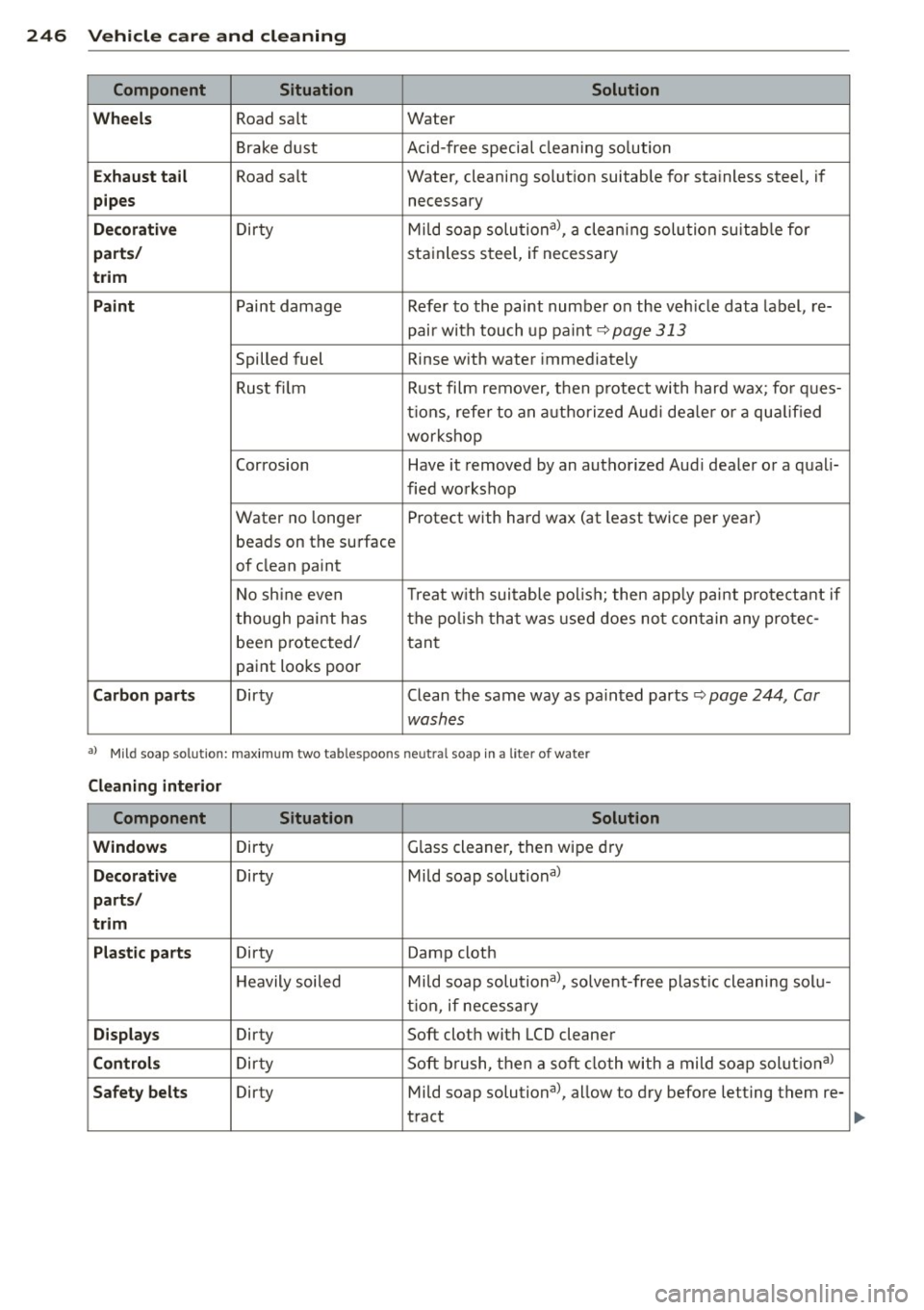
24 6 Vehicle care and cleaning
Component Situ ation Solution
Wheels
Road sa lt Water
Brake dust Acid-free special cleaning solution
Ex haust t ail Road salt Water, cleaning solut ion suitable for stainless steel, if
pipes necessary
Deco ra tiv e Dirty Mild soap
solutional, a cleaning solution su itab le for
parts/ sta inless steel, if necessary
trim
Paint
Paint damage Refer to the paint number on the veh icle data label, re-
pair with touch up paint ~
page 313
Spilled fuel Rinse with water immediately
Rust fi lm Rust film remover, then p rotect with hard wax; fo r ques-
tions, refe r to an a uthorized Audi deale r or a qua lified
workshop
Corrosion Have it removed by an authorized Audi dealer or a quali-
fied workshop
Water no longer Protect with hard wax (at least twice per year)
beads on the surface
of clean paint
No sh ine even Treat with suitable polish; then app ly pa int protectant if
though paint has the po lish that was used does not contain any protec-
been protected/ tant
paint looks poor
Carbon part s Dirty Clean tlhe same way as painted parts~ page 244, Car
washes
a ) M ild soap so lution: m aximu m two ta bles poons neut ral soap in a lite r of wate r
Cleaning int erior
Component Situation Solution
Windo ws
Dirty Glass cleaner, then wipe dry
D
ec orative Dirty Mild soap solutional
parts/
trim
Pla st ic pa rts
Dirty Damp cloth
Heavily soiled Mi ld soap solutional, solvent-free plast ic cleaning solu-
t ion, if necessary
D ispla ys Dirty Soft cloth with LCD cleaner
Co ntr ols Dirty Soft brush, then a soft cloth with a mild soap
solutional
S afet y bel ts Dirty Mild soap solutional, allow to dry before letting them re-
tract
Page 249 of 340
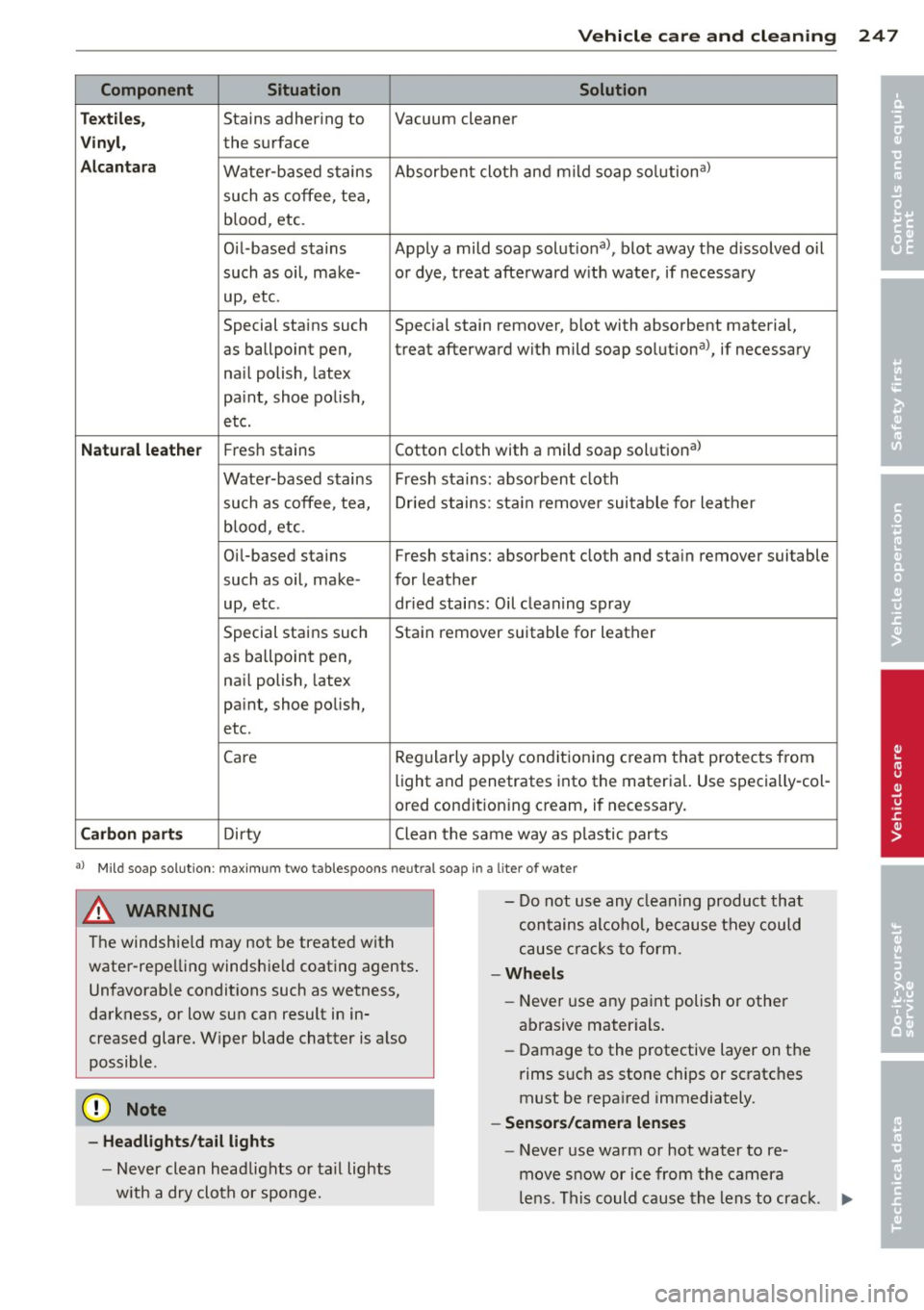
Vehicle care and cleaning 247
Component Situation Solution
Te xtile s,
Stains adhering to Vacuum cleaner
Vinyl, the surface
Alcantara Water-based stains Absorbent cloth and mild soap
solutional
such as coffee, tea, blood, etc.
Oil-based stains Apply a mild soap solutiona l, blot away the d issolved oil
such as oil, make- or dye, treat afterward w ith water, if necessary
up, etc.
Special stains such Special stain remover, b lot with absorbent material,
as ballpoint pen, treat afterward with mild soap solutiona l, if necessary
na il polish, latex
pa int, shoe polish,
etc.
Natural leather Fresh stains Cotton cloth with a mild soap solutiona l
Water-based stains Fresh sta ins: absorbent cloth
such as coffee, tea, Dried stains: stain remover suitable for leather
blood , etc .
Oil-based stains Fresh stains: absorbent cloth and stain remover suitable
such as oil, make- for leather
up , etc . dried sta ins: Oil cleaning spray
Special stains such Sta in remover suitable for leather
as ballpo int pen,
nai l polish, latex
paint, shoe polish,
etc.
Care Regularly apply conditioning cream that protects from
light and penetrates
into the material. Use specially-col-
ored conditioning cream, if necessary.
Carbon parts Dirty Clean the same way as plastic parts
al Mil d soap so lution: m axim um two ta bles poo ns neu tral soa p in a lite r of water
& WARNING
The windshie ld may not be treated with
water-repelling windshie ld coating agents .
Unfavorab le conditions such as wetness,
darkness, or low sun can result in in
creased glare. W iper blade chatter is also
possible.
- Headlights/tail lights
- Never clean headlights or tail lights
w ith a dry cloth or sponge. -
Do not use any cleaning product that
contains alcohol, because they could
cause cracks to form.
-Wheels
-Never use any paint polish or other
abrasive mater ials.
- Damage to the protective layer on the
rims such as stone chips or scratches
must be repaired immediately .
-Sensors/camera lenses
- Never use warm or hot water to re-
move snow or ice from the camera
len s. This could cause the lens to crack .
IJII>
•
•
Page 253 of 340
Winter operation
At temperatures below 20° F (-7° C), Diesel
fuel No.
2 loses its fluidity due to wax separa
tion, which may clog the fuel filter or tank fil
ter and keep the engine from running .
To help the filter from being clogged by wax,
the fuel filter in your vehicle is automatically
preheated. Preheating the fuel filter makes
operation of your vehicle possible with Diesel
fuel No . 2 down to -10° F (-24° C).
If you expect temperatures below 5° F
(-15° C) ask your fuel dealer whether their
Diese l fuel No. 2 is sufficiently winterized for
the prevailing and expected temperatures.
If not winterized or insufficiently winterized
Diesel fuel has already thickened to the extent
that the engine will not start, warm the vehi
cle up by leaving it in a heated garage.
It is normal that the engine noise leve l (die
seling) is louder during the warm-up period in
winter.
It is also norma l when whitish-blue
smoke comes out of the tailpipe after start ing
and during warm-up . The amount of smoke
depends on the outs ide temperature.
Do not let your Diese l engine id le unnecessari
ly after a cold start. Driving off slowly will
shorten the warm-up period .
A WARNING
-Never use "starting assist fluids." They
may be potent ially explosive or cause a
"run-away" engine condition. This could
result in serious engine damage and per
sonal injury.
- Never use fuel line anti-freeze offered for
gasoline engines .
0 Note
- Refueling with gasoline when your vehi
cle has a diesel engine can cause very se
rious and expens ive engine and fuel sys
tem damage that is not covered by any
A udi Limited Warranty.
- If you put any amou nt of incorrect fuel in
the fuel tank, do not start the engine un-
-
Fuel supply and filling your fuel tank 251
der any circumstances. Immediately con
tact the nearest authorized Audi dea ler
or authorized Audi Service Fac ility for as
sistance. These fuels contain substances
that can severely damage the fuel sys
tem and the engine if the engine is start
ed .
- Veh icles with diesel engines must never
be refueled or driven with gasoline, kero
sene, heating oil, or other non-specified
fuels that have not been expressly ap proved for use with the diesel engine.
Other kinds of fuel can cause serious
damage to the fuel system and the en
gine that is not covered by any Audi Lim
ited Warranty.
- If Diesel fuel should get on any rubber
hose, it must be wiped off immediately.
Then wash the contaminated hose por
tion with soap and warm water. Do not
allow D iesel fuel to remain on connect
ing hoses . They may develop leaks and
cause serious damage.
Fuel tank
Fuel filler neck
The fuel filler neck is located on the right rear
side panel behind the fuel filler flap.
If the power locking system shou ld fai l, you
can still open the flap manually -for detailed
instructions see¢
page 254.
You can find the fuel tank capacity of your ve
hicle inc::>
page 315.
The label on the inside of the fuel filler flap
tells you the correct fuel for your veh icle. For
more information abo ut fuel specifications,
see c::>
page 249.
Your vehicle fuel tank has an on-board refuel
ling vapor recovery system. This feature helps
to prevent fue l vapors from escaping from the
tank and pollut ing the environment while you
refuel yo ur vehicle. In order to fill the tank
properly while protecting the environment,
please follow this refueling procedure careful-
~-~
•
•