Towing AUDI Q7 2014 Owner´s Manual
[x] Cancel search | Manufacturer: AUDI, Model Year: 2014, Model line: Q7, Model: AUDI Q7 2014Pages: 340, PDF Size: 85.02 MB
Page 299 of 340
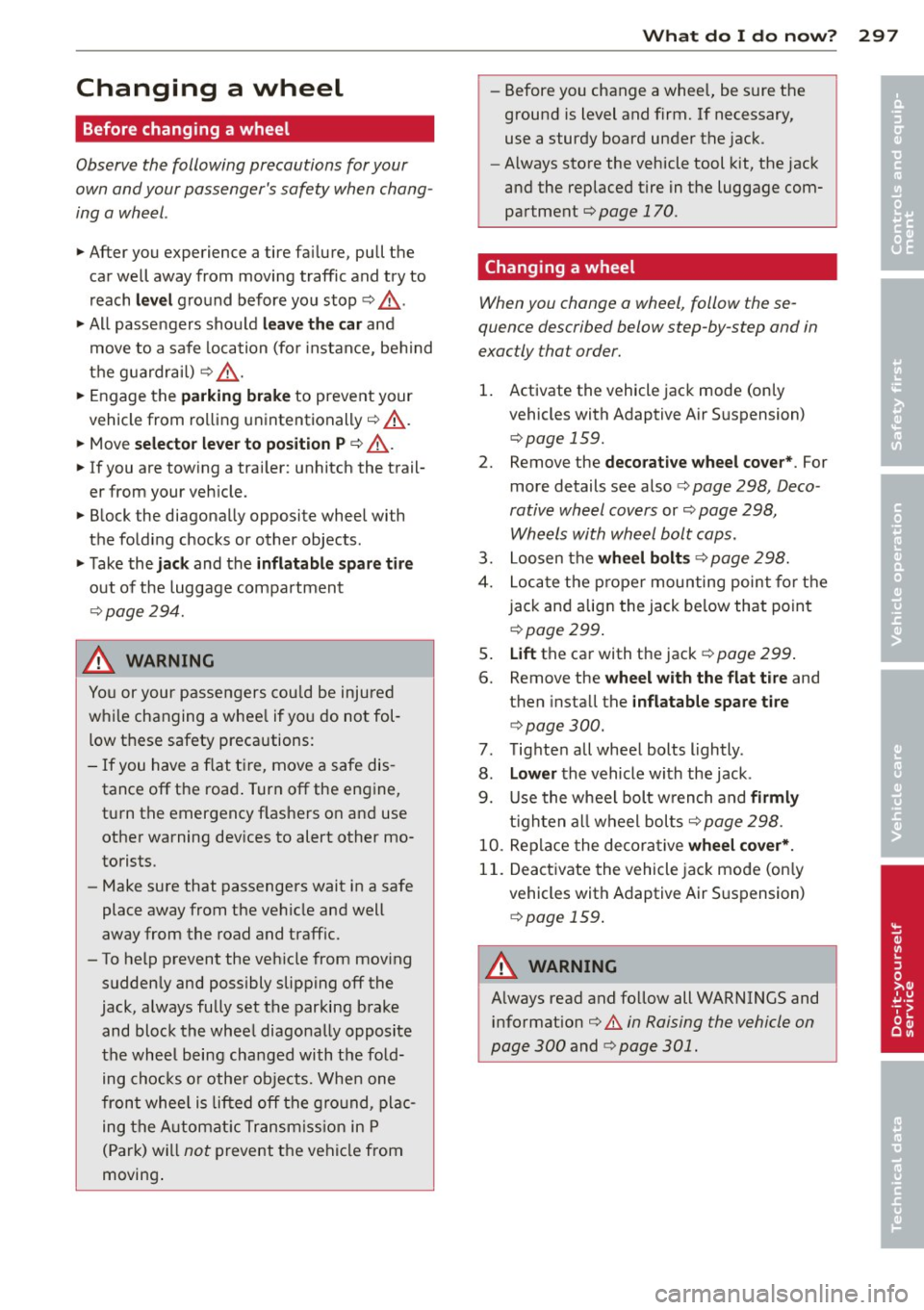
Changing a wheel
Before changing a wheel
Observe the following precautions for your
own and your passenger's safety when chang
ing a wheel .
.,. After you experience a tire fa ilure, pull the
car well away from moving traffic and try to
reach
level gro und before you stop¢.&_ .
.. All passengers should
leav e the car and
move to a safe location (fo r instan ce, be hind
the guardra il) ¢.&_ .
.,. Engage the
parkin g brake to prevent your
vehicle from ro lling unintentionally ¢.&_ .
.. Move
selecto r le ver to p osition P ¢ .&_ .
1> Ifyou are towing a trai ler: unhitch the trail
er from your veh icle.
.,. Block the diagonally opposite wheel with
the folding chocks or other objects .
.. Take the
jack and the inflatab le spare tire
out of the luggage compartment
¢ page 294.
& WARNING
You or your passengers cou ld be injured
while changing a whee l if yo u do not fol
low these safety precautions:
- If you have a flat t ire, move a safe dis
tance off the road . Turn off the eng ine,
t ur n the emergency flashers o n and use
other warning devices to alert other mo
torists .
- Make sure that passengers wait in a safe
place away from the vehicle and well
away from the road and traffic.
- To he lp prevent the veh icle from mov ing
sudden ly and possibly slipping off the
jack, always fully set the parking b rake
and block the whee l diagonally opposite
the wheel being cha nged with the fo ld
ing chocks or othe r objects. When one
front whee l is lifted off the g ro und, plac
ing the A utomat ic Transm iss ion in P
(Park) wi ll
not prevent the vehicle from
moving .
-
What do I do now? 297
-Before you change a whee l, be sure the
ground is level and firm. If necessary,
use a sturdy board under the jack.
- Always store the vehicle tool kit, the jack
and the replaced tire in the luggage com
partment
<=:>page 170 .
Changing a wheel
When you change a wheel , follow these
quence described below step-by-step and in
exactly that order.
1. Activate the vehicle jack mode (only
vehicles with Adaptive Air S uspension)
¢ page 159 .
2. Remove the decorati ve wheel co ver* . For
more details see also <=:>
page 298, Deco
rative wheel covers
or <=:> page 298,
Wheels with wheel bolt caps .
3. Loosen the wheel bolt s¢ page 298 .
4. Loca te the p roper mounting point for the
jack and align the jack be low that point
¢ page 299.
5. Lift the car with the jack Q page 299 .
6. Remove the wheel with the flat ti re and
then install the
inflatable spare tire
¢ page 300.
7. Tig hte n all wheel bolts lightly.
8 .
Lowe r the vehicle with the jack .
9. Use the wheel bolt w rench and
firmly
t ighten all wheel bolts¢ page 298 .
10. Replace the decora tive whe el co ver* .
11. Deactivate the vehicle jack mode (on ly
vehicles with Adaptive Air S uspension)
¢ page 159 .
A WARNING
Always read and follow all WARNINGS and
informat ion<=:>
& in Raising the vehicle on
page 300
and <=:> page 301.
•
•
Page 309 of 340

Emergency situations
General
This chapter is intended for trained emer
gency crews and working personnel who have the necessary tools and equipment to
perform these operations.
Starting by pushing or
towing
(D Note
Your v ehicl e is e quipped w ith an automatic
tra nsm iss io n. Cons eque ntly, the e ngine
cann ot be started by pus hing o r tow ing.
Starting with jumper
cables
If necessary, the engine can be started by
connecting it to the battery of another vehi
cle.
If th e engine shou ld fail to start because of a
d ischarged o r weak battery, the battery can be
connected to the battery of
another veh icle,
usi ng a
pair of jumper cables to start the en
gine .
Jumper c ables
Use only jumper cab les of sufficiently large
cross section to carry the starter cur rent safe
l y. Refer to the man ufacturer's specifications.
Use only jumper cables with
insulated te rm i
na l clamps w hich are d istinctly mar ked:
plus(+ ) cable in mos t ca ses co lore d red
minus(-) cable
i n most cases colored black .
A WARNING
Batteries con tai n elec trici ty, a cid, and gas.
Any o f these c an caus e ve ry ser ious or f atal
injury . Follow the instruc tions below fo r
safe han dling of your veh icle's battery .
- Alw ays s hield y our eyes and a void le an
ing over the batte ry w henever possib le .
Emergency situations 307
- A discharged battery can freeze at tem
pe rat ures just below 32 °F (0 °C). Before
connecting a jumpe r cable, you must
thaw the frozen battery c omp lete ly, ot h
e rwise it could explode.
- Do not allow battery acid to co ntact eyes
or skin . Fl ush any con tacted area wi th
wat er immediately .
- Imp roper use of a booster battery to
s tart a vehicle may cause an ex plosion.
- Vehicle batter ies generate expl osive gas
es. Keep sparks, flame and lighted c iga
rettes away from ba tte ries.
- Do not t ry to jump start a ny ve hicle w it h
a low ac id leve l in the battery.
- The voltage of the booste r battery m ust
also have a 12-Vo lt rat ing. T he capac ity
(Ah) of the booste r batt ery sho uld not b e
lowe r than that of th e discharged bat
t ery. Use o f batt eries of d iffe ren t vol tage
or su bstan tia lly differen t "Ah" rat ing
may cause an exp losion and pers onal in
jury .
- N ever ch arge a fr ozen batt ery. Gas t ra p
pe d in the ice may c ause an ex plosion .
- N ev e r ch arge o r use a batt ery th at h as
been fro zen . Th e batte ry case may have
be weake ned.
- U se o f batter ies of di ffere nt vol tage or
substantially differen t ca pa city (Ah) rat
i ng may cause an exp losion and injury .
T he ca pa c ity (Ah) of the booster battery
should not be lower than that of the dis
charged battery.
- Before you check anything in the engine
compa rtment, always read an d heed a ll
WARNINGS
c::;,page 257.
(D Note
-App lyi ng a hi gher vo ltage booste r ba t
t ery wi ll cause expens ive damage to sen
sit ive e lectronic components, such as
cont ro l units, relays, rad io , etc.
- There must be no electrical c ontact be
tween the vehicles as otherw ise current
co uld already start to f low as soon as t he
posi tive(+) terminals a re con nect ed. ..,. •
•
Page 311 of 340
-Jumper cables must be long enough so
that the vehicles do not t ouch.
- W hen connecting jumper ca bles, make
sure that they cannot get caught in any
moving parts in the eng ine compart
ment.
- Before you check anything in the engine
compartment, always read and heed all
WARNINGS
Q page 257.
(D Note
Improper hook-up of jumper cables can ru
in the generator.
- Always connect POSITIVE( +) to POSI
TIVE(+), and NEGATIVE(-) to NEGATIVE
( - ) ground post of the battery manager
control unit.
- Check that all screw plugs on the battery
cells are screwed in firmly. If not, tighten plugs prior to connecting clamp on nega
tive battery terminal.
- Please note that the procedure for con
nect ing a jumper cable as described
above applies spec ifically to the case of
your vehicle be ing jump started . When
you are giving a jump start to another ve
hi cle, do
not connec t the negat ive (-) ca
ble to the negat ive( -) term inal on the
discharged battery ©¢
fig. 2 72. In
stead, securely connect the negative( -)
cable to e ither a solid metal component
that is firmly bolted to the engine block
or to the engine block itse lf. If the bat
tery that is being charged does not vent
to the outside, escaping battery gas
could ignite and exp lode!
Em erg en cy si tuation s 309
Emergency towing
with commercial tow
truck
General hints
Your Audi requires special handling for tow
ing.
T he following information is to be used by
commercial tow t ruck operators who know
how to operate their equipment safely.
- Never tow your Audi , towing will cause
damage to the engine a nd transmi ssion.
- Never wrap th e safet y chain s or winch c a
ble s around th e brak e lin es.
- To prevent unne ce ss ary dam age, your Aud i
mu st be t ransp orted with a flat bed truck .
- To load th e vehi cle on to the fl at bed, us e
the t owing loop found in the vehicle t ool s
and atta ch to the front or rear anch o rage
¢ page 310 and Qpage 310 .
A WARNING
A vehicle being towed is not safe for pas
sengers. Never allow anyone to ride in a
vehicle be ing towed, for any reason.
-
•
•
Page 312 of 340
310 Emergency situations
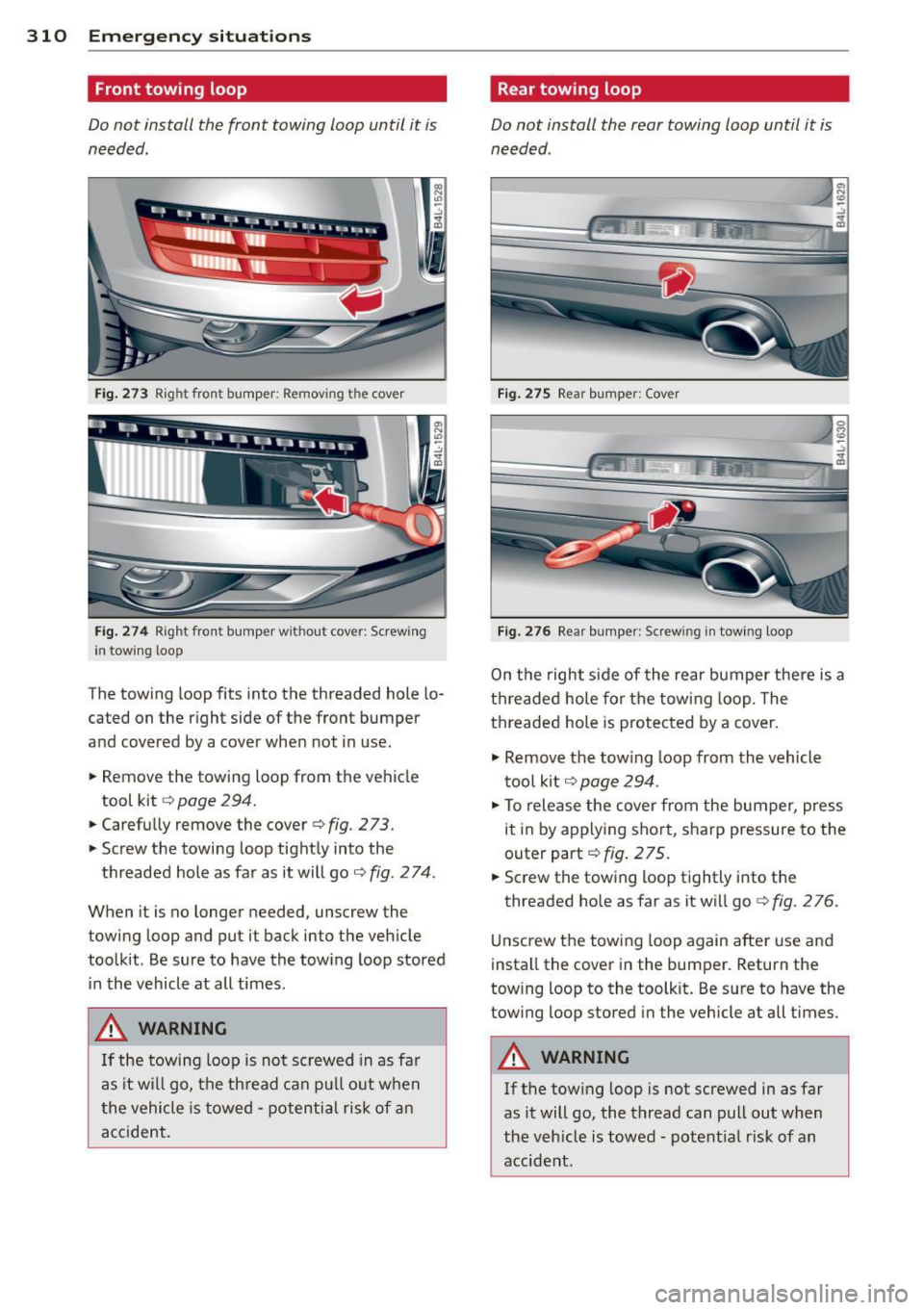
Front towing loop
Do not install the front towing loop until it is
needed.
Fig. 273 Right fron t bu mpe r: Remov ing t he cove r
Fig. 27 4 Righ t fron t bumpe r w it h out cove r: Screw ing
i n tow ing loo p
The towing loop fits into the threaded hole lo
cated on the r ight side of the front bumper
a nd covered by a cover whe n not in use.
• Remove the towing loop from the vehicle
tool kit
Q page 294.
• Carefully remove the cover q fig. 273.
• Screw the towi ng loop tightly into the
threaded hole as fa r as it will go
q fig . 274 .
When it is no longer needed , unscrew the
towing loop and put it back into the vehicle
too lkit. Be sure to have the tow ing loop stored
i n the vehicle at all times .
A WARNING
If the towing loop is not scr ewed in as far
as it w ill go, the th read ca n pul l o ut w hen
t he vehicle is towed -potenti al risk of an
a cc ide nt.
Rear towing loop
Do not install the rear towing loop until it is
needed .
Fig . 275 Rea r bu mper: Cove r
Fig. 27 6 Rear bumpe r: Sc rew ing in tow ing loop
On t he right s ide of the rear bumper there is a
t hr eaded hole for t he towing loop. The
t h readed hole is protec ted by a cover.
• Remove th e tow ing loop from th e vehicl e
t oo l kit
q page 294 .
• To release the cover from the bumper, press
it in by app ly ing short, sharp pressure to the
outer part
q fig . 2 75.
• Screw the tow ing loop t ightly i nto the
threaded ho le as far as it wi ll go
q fig. 2 76.
U nscrew t he towing loop again afte r use and
insta ll the cover in the bumper. Return the
tow ing loop to the toolkit . Be su re to have the
towing loop stored in the vehicle at a ll times.
A WARNING
If the tow ing lo op is not screwed in as far
as it will go, the thread can pull ou t when
the veh icle is towed -potent ial ris k of an
accident.
Page 316 of 340
314 Technical Dat a
designated seating position) and luggage
weight¢ .&,.
Gross Axle W eight Rating
The Gross Axle Weight Rating is the maximum
l oad that can be applied at each axle of the
vehicle ¢Lr!, .
Vehicle capacit y weight
The vehicle capac ity we ight (max. load) is list
ed on the driver's side B-p illar.
A WARNING
- T he Gross Vehicle Weight Rat ing for your
vehicle, fo und on the safety compliance
label on the driver's side B -pillar, must
never be exceeded under any circumstan
ces. Exceeding the Gross Vehicle We ight
Rating of your vehicle is likely to damage
your vehicle, and such damage will not
be covered by your Lim ited New Vehicle
Warranty. Exceeding the Gross Vehicle
We ight Rating will also change the per
formance and handling cha racte rist ics of
yo ur vehicle, which cou ld cause a crash
result ing in se rious in jury or death.
- T he Gross Veh icle Weight Rat ing fo r yo ur
vehicle would be exceeded if yo ur vehicle
is simultaneo us ly equipped with Panor
amic sliding sunroo f; th ird-row seating;
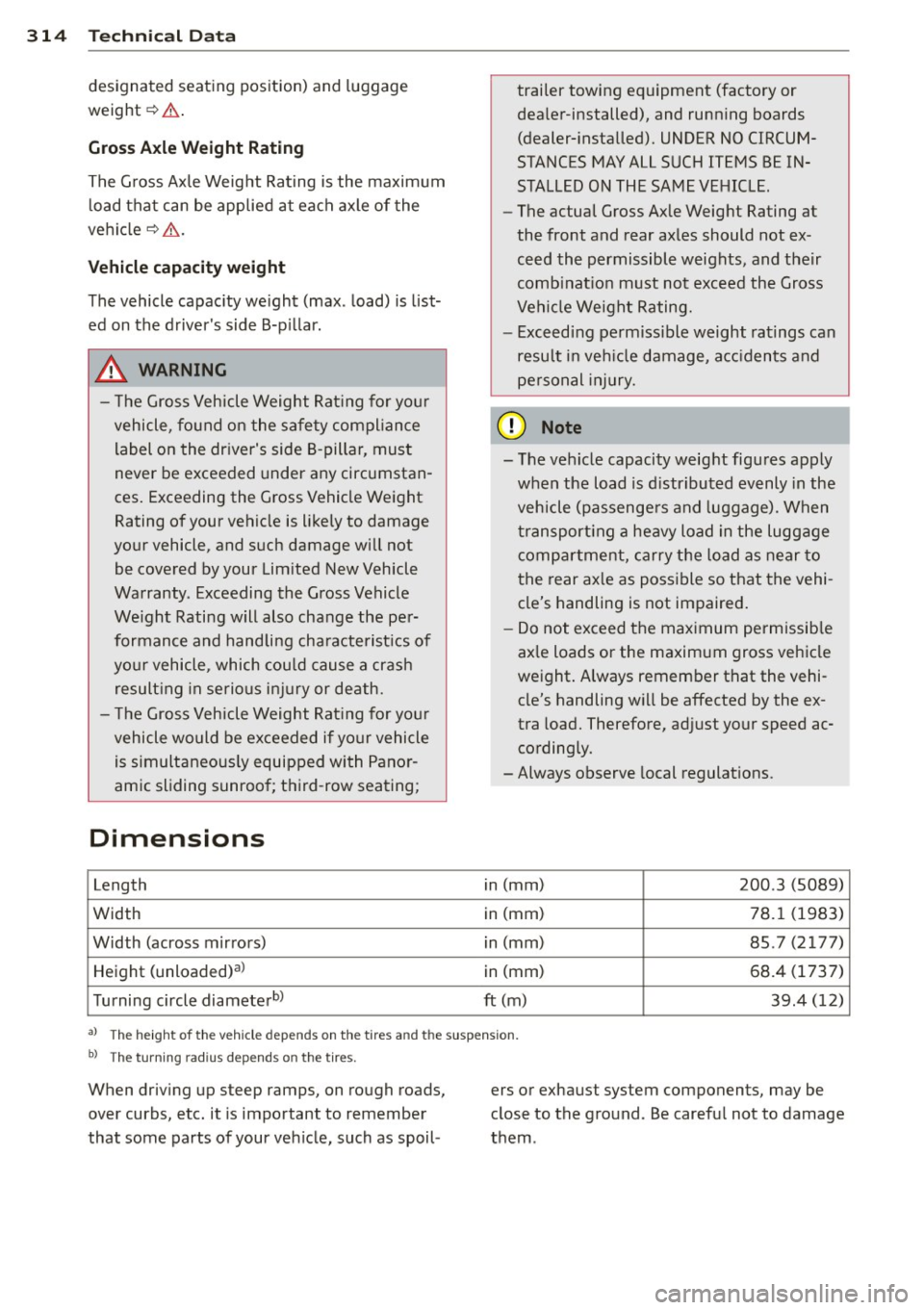
Dimensions
Length
Width
Width (across mirrors) Height (unloaded) al
Turning circle diamete rbl trailer towing
equipment (factory or
dea le r-installed), and running boards
(dealer-installed). UNDER NO CIRCUM
STANCES MAY ALL SUCH ITEMS BE IN
STA LLED ON THE SAME VE HICLE .
- The actual Gross Ax le Weig ht Rating at
the front and rear ax les should not ex
ceed the permissible weights, and the ir
comb inat io n must not exceed the Gross
Vehi cle Weight Rating.
- Exceeding permiss ible weight ratings can
result i n ve hicl e damage, a ccidents and
personal inj ury.
....--
CD Note
- The vehicle capacity weight figu res apply
when the load is d istr ibuted evenly in the
vehicle (passenge rs and luggage). When
t ransport ing a heavy load in the lugg age
compar tment, carry the load as near to
t he rear ax le as possible so that the vehi
cle's handling is not impaired.
- Do not exceed the maximum permissib le
ax le loads or the maximum gross vehicle
we ight . A lways remember that the vehi
cle's handling w ill be affected by the ex
tra load. Therefore, ad just your speed ac
cordingly.
- Always observe local regulat ions.
in (mm)
200 .3 (5089)
in (mm) 78.1 (1983)
in (mm) 85 .7 (2 177)
in (mm) 68.4 (1737)
ft (m) 39 .4 ( 12)
al The he ight of t he ve hicle depends on the tires and t he su spension.
b l The turning radius dep ends on th e tir es.
When driv ing up steep ramps, on rough roads,
over curbs, etc. it is important to remembe r
that some parts of your ve hicle, such as spoil- ers or exhaust
system components, may be
close to the ground . Be careful not to damage
them .
1
Page 318 of 340
316 Consumer Information
Consumer Information
Warranty coverages
You r Audi is covered by the following war
ranties:
- New Vehicle Limited Warranty
- Limited Warranty Against Corrosion Perfo-
ration
- Emissions Control System Warranty
- Emissions Performance Warranty
- California Emissions Control Warranty (USA
vehicles only)
- California Emissions Performance Warranty
(USA vehicles only)
Detailed information regarding your warran
ties can be found in your
Warranty & Mainte
nance booklet .
Operating your vehicle
outside the U.S.A. or
Canada
Government regu lations in the United States
and Canada require that automobiles meet
specific emission regulations and safety
standards. Therefore, veh icles built for the
U.S.A . and Canada differ from vehicles sold in
other countries .
If you p lan to take your vehicle outside the
continental limits of the United States or Can
ada, there is the possibility that:
- unleaded fuels for vehicles with cata lytic
converter may not be available;
- fuel may have a considerably lowe r octane
rating. Improper fuel may cause engine
damage ;
- service may be inadequate due to lack of
proper service facilities, tools or testing
equipment ;
- replacement pa rts may not be readily availa
ble.
- Navigation systems for vehicles built for the
U.S.A. and Canada will not necessar ily work
in Europe, and may not work in other coun
tries outside North America .
(D Note
Audi cannot be responsible for mechanical
damage that could result from inadequate
fuel, service or parts availability.
Audi Service Repair Manuals and Literature
Audi Official Factory Service Manuals and Lit
erature are published as soon as possible after
model introduction. Service Manuals and liter
ature are available to order from the Audi
T echnical Literature Ordering Center at:
www.audi.techliterature.com
Maintenance
General
Your vehicle has been designed to help keep
maintenance requirements to a minimum.
However, a certain amount of regular mainte
nance is still necessary to assure your vehicle's
s afety, economy and rel iability. For detailed
vehicle maintenance consult your Warranty &
Maintenance booklet.
Under difficult operating conditions, for ex
ample at extremely low outside temperatures,
i n very dusty regions , when towing a trailer
very frequently, etc., some service work
should be performed between the intervals
specified. This applies particularly to:
- oil changes, and
- cleaning or replacing the air filter .
(® For the sake of the environment
By regularly maintaining your vehicle, you
help make sure that emission standards
are maintained, thus minimizing adverse
effects on the environment.
Important considerations for you and
your vehicle
The increasing use of electronics, sophisticat
ed fuel injection and emission contro l sys-
tems, and the genera lly increasing technical
liJJ,
Page 323 of 340
A
Accessories
Adaptive A ir Suspension . .. .. .. .. .. .. .
Cargo mode in the MMI .. .. .. .. .. .. . 318
155
160
Controls ... ............. .. .. .. .. . 155
Description .............. .... .. ... 155
H igh level . ................. ... ... 155
Highway level ..................... 155
Instrument cluster display . . . . . . . . . . 158
Jacking mode when changing a flat tire 159
Low level . . . . . . . . . . . . . . . . . . . . . . . . . 155
Normal level ............. .... .. ... 155
Segment display .............. .... 157
Sett ing the driving modes .. .. .. .. .. . 157
Trailer towing mode . . . . . . . . . . . . . . . . 159
Using switch for cargo mode .. .. .. .. . 160
Warning/indicator lights . .. .. .. .. .. .. 17
Adaptive cruise control ............. .. 113
Changing speed ..... ..... .. .. .. .. . 117
C leaning the sensor ....... .. .. .. .. . 245
Driver information ........ .. .. .. .. . 120
Driver intervention prompt . .. .. .. .. .
Driving in traffic ................ .. .
Driving program ................ .. .
Error messages .................. .
Open road .. ............. .... .. .. .
Override 124
114
124
122 114
114
Request for driver to assume control . . 114
Save speed . . . . . . . . . . . . . . . . . . . . . . . 116
Sett ing distance ..... ..... .. .. .. .. . 118
Settings . .. ............. .... .. .. . 124
Sett ing t ime interval ...... .. .. .. .. . 118
Specia l dr iv ing s ituations .. .. .. .. .. . 125
Status messages ................. . 122
Switching on and
off ......... ... .. . 116
System limits ................ .... . 125
Temporarily turning
off .... .. .. .. .. . 118
warning/indicator lights ... .. .. .. .. . 121
Adaptive light ................ ... .... 59
defective . . . . . . . . . . . . . . . . . . . . . . . . . . 3 7
AdBlue .. .. .. ................. .. ... 254
Filling 255
Messages in the instrument cluster dis-
p lay ... .. .. .. ................ .... 254
Index 321
Adding
E . l ngine coo ant ..... ............... 266
Engine oil ..... .. .. ............... 263
Windshie ld washer fluid .......... .. 272
Additional accessor ies
Additives Engine oil
Adjusting 318
263
Instrument cluster illumination .. .. .. . 13
Steering column electrically ..... .. .. 103
Steering column manually .......... 103
Adjusting front seats . . . . . . . . . . . . . . . . . 72
Airbag Warning/ind icator lights ........ .. .. . 16
Airbag system . . . . . . . . . . . . . . . . . 183, 200
Advanced Airbag System .. ... ... .. .. 187
Advanced Airbag System components . 190
Care ........ .. .. ................. 197
Children .. .. .. .. .... ........... .. 205
Child restraints ... .. ............... 206
Components (front airbags) ......... 190
Danger of fitting a chi ld safety seat on
the front passenger seat ........ .. .. 185
Disposal .. .. .. .. .... ........... .. 197
Front airbags .. .. ............ 187,188
How do the front airbags work? ...... 192
How many airbags does my vehicle
have? ....... ... .. ............... 190
How the Advanced Airbag System com-
ponents work together ......... .... 191
Important things to know .......... . 183
Indicator light ..... ............... 194
Monitor ing . ..... ................. 194
PASS ENGER AIR BAG OFF light ... .. .. 194
Repairs ... .. .. .. .... ........... .. 197
Safety instructions ................. 196
Side airbags ..... .. ..... .......... 198
Side curtain airbags .. .. .. ... ... .... 201
Weight-sensing mat .. ... ... ... .. .. 205
When must the system be inspected? . 194
Air conditioning
refer to Climate controls . . . . . . . . . . . . . 92
Air distribution Climate controls .. ................. . 95
Four- zone automatic comfort air condi-
tioning . .. .. .. .. .. ............... 100
Air pollutants filter Climate controls .... .............. .. 92
•
•
Page 327 of 340
Doors
Power child saf ety lock . ... .. .. .. .. ..
48
Dr iver information system ... .. .. .. .. .. 2 1
Di gita l speedomete r ...... .. .. .. .. .. 22
D river info rmation messages . . . . . . . . . 30
Open door or rear lid warning . . . . . . . . . 22
Outside temperature display . ... .. .. .. 22
Sound system display .. ... .. .. .. .. .. 2 1
D river seat
refer to Seat ing pos it ion ... .. .. .. .. . 165
Driver's seat . . . . . . . . . . . . . . . . . . . . . . . . 73
Driver's seat memory . . . . . . . . . . . . . . . . . 7 4
Activating remote control key . .. .. .. ..
75
Recall ing a seat posit ion . . . . . . . . . . . . . 7 4
Sto ring a seat position . . . . . . . . . . . . . . . 7 4
D riving messages . . . . . . . . . . . . . . . . . . . . 30
Driving mode
refer to Adaptive Air Suspe nsion . 155, 1 57
Driving offroad
Driving through water ......... ... .. 238
Driving tips .... ........... ... ... ..
237
Rule s of behav io r ............ .. .... 23 7
S and and m ud ........... .... .. .. . 238
Snow-covered groun d ..... .. .. .. .. .
238
Unpaved roads ........... .... .. ... 238
Dr iving safe ly .......... ...... .... ..
164
Driving through water ... ... .. .. .. .. . 238
D riving t ime . . . . . . . . . . . . . . . . . . . . . . . .
24
Duplicate key . . . . . . . . . . . . . . . . . . . . . . . 38
D ust filter
Climate controls . . . . . . . . . . . . . . . . . . . .
92
E
E asy en try featu re .. ..... ... .. .. .. .. . 104
Efficiency program . . . . . . . . . . . . . . . . . . . 26
Fue l economy messages . ...... ... ... 27
M emory levels . . . . . . . . . . . . . . . . . . . . . 25
Othe r equipmen t ......... .. .. .. .. .. 2 7
Electric seat adjustment
refer to Power seat . . . . . . . . . . . . . . . . . 73
Electro nic differential lock (EDL) . ... .. . 224
Warn ing/ indicator lights . . . . . . . . . 16, 18
Ele ctr onic immobili ze r ...... .. .. .. .. .. 40
Electronic power co ntrol
( E PC) wa rn ing/indicator light ... ... ...
15
Electronic speed limiter . . . . . . . . . . . . . . . 28
Inde x 325
Electronic Stabilization Cont ro l (E SC) ... 224
Hill descent contro l ..... .... ... .. .. 225 •
Offroad mode .. .. .. . .. ... .... ... .. 225 •
Warning/ind icator lights .......... .. . 16
Emerge ncy flashe r . . . . . . . . . . . . . . . . . . . 60
Wa rning/ind icator lights ..... ... .. .. . 16
Emergency locking of doors ............ 45
Emergency operation
Rear lid . .. .. .. .. .. ............... .
48
Emergency starting . .. .. ..... ... .. .. 3 0 7
Emerge ncy towing ... . .. .. .. ... ... .. 309
Energy management ... .. .... ... .. .. 229
Battery power . .. .... ........... .. 230
Driver notification ................. 230
Engine
Compartment .... .. . .. .. ..... ... ..
259
Coolant ... .. .... .. . .. .. ..... ... .. 264
Data ..... .. .. .. ... ............ .. 315
Hood ..... .. .. .. ................. 257
Start ing . . . . . . . . . . . . . . . . . . . . 105, 106
Starting with jumpe r cables ........ . 307
Stopping ........ .. ............... 106
Engine compartment
Safety instr uctions .. ........... .... 257
Work ing the eng ine compartment .. ..
257
Engine coolant system . .. ..... ... .. .. 264
Adding coo lant ..... . .. .. ..... ... .. 266
Checking coolant level .............. 265
Checking the engine coolant level ... .. 265
Malfunction . . . . . . . . . . . . . . . . . . . . . . . 32
Radiator fan ..... .. ............... 267
Engine coolant temperature
Temperat ure gauge ............ .... .
10
Engine hood
Closing ... .. .... .. . .. .. ..... ... ..
2 57
How to re lease the hood ..... ... .. .. 257
Engine o il ..... ... .. ............... 259
Adding ... .. .. .. ............... .. 263
Addi tives .... .. ...... ........... ..
2 63
Changi ng ... .. .... .. ... ..... ... .. 263
Checking the engine oil leve l .. ... .. ..
262
Consumption . ..... . .. .. ..... ... .. 261
Ind ications and conditions requir ing ex-
tra checking . .. .. ............... ..
262
Oil grades . .. .. .. ................. 259
Recommended oil check intervals . .. .. 262
Spec ificat io n and viscosity .......... . 259
Page 335 of 340
Synchronization
Climat e controls ... .... ... .. .. .. ... 100
Four -zone automatic comfort a ir cond i-
t ioning .. .. ............. .... .. ... 101
Synchron izing clima te con trol .. .. .. .. .. 93
T
Tac home ter . . . . . . . . . . . . . . . . . . . . . . . . . 11
Ta il lights
C leaning . ................ ...... .. 245
Tank flap Unlocking the fue l filler flap by hand .. 254
TO I clea n diese l
refer to Ad Blue ........... .... .. .. . 254
T echnica l data ................ ... ... 313
Technica l modifications .. ... .. .. .. .. . 3 19
Temperature Clima te con trols . . . . . . . . . . . . . . . . . . . . 95
F ou r-zone au toma tic comfo rt air cond i-
tioning .... .. .. ... . .... ... .. .. .... 99
Setting for the d river 's and front pas-
senger 's side . ........... .. .. .. .... 95
Tethe r anchors ............ .... .. .. . 22 1
T ethe r strap . .... .... ... .. .. .. .. .. . 221
Textiles Cleaning ... .. .. .. .. .... ... .. .. ... 247
The first 1,000 mi les (1 ,500 km) and after-
wards . .... .. ................. .. ... 23 2
T ie -down r ings ............. ... ... ... 81
Tie -downs . . . . . . . . . . . . . . . . . . . . . . . . . 171
T ips fo r the env ironme nt
Saving fue l . . . . . . . . . . . . . . . . . . . . . . . . 85
Using the air condi tioner only when nec-
essary ..... .. .... .. .... ... .. .. .... 98
tiptronic Automatic S hift Lock (ASL) . .. .. .. .. . 138
D riving .... ................. .. ... 139
E mergency mode ......... .... .. .. . 141
H ill descent control .... ... .. .. .. .. . 140
Kick-down .. .. .... .... ... .. .. .. ... 141
M anual shift program .. ... .. .. .. .. . 1 40
Selecto r lever . . . . . . . . . . . . . . . . . . . . . 13 7
t iptronic (au tomati c transmission) .. .. . 13 7
T ire pressure ............... ... ... .. 279
Tire pressure monitoring system . ... .. . 29 1
Loss of air pressure . . . . . . . . . . . . 18, 292
Inde x 333
Malfunction ........ .. .. ..... ... .. 292
Resetting tire pressures . ..... ... .. .. 293
•
Tires ....... .. .. .. ................. 273 •
Se rv ice life . . . . . . . . . . . . . . . . . . . . . . . 283
speed r ating lette r code ........ .... 28 5
T ire manu fac turing date ..... ... .. .. 28 5
Tire specifications . .. .. ..... ... .. .. 285
Tread depth ... .. .. .. .. ...... ... .. 283
U niform tire quality grading ..... .. .. 287
Winter tires . .. .. ................. 288
T ires/Wheels
Low aspect ratio tires . .. ..... ... .. .. 290
Tire pressure monitoring system . 18, 291
T ires and veh icle load lim its ....... .. .. 281
Tires and wheels Checking t ire pressure ............. . 279
Cold t ir e i nflation pressure ......... . 27 7
D imens ions .. .. .. .. . ... ...... ... .. 284
General notes .. .. ................. 273
G lossary of tire and loading term inolo-
gy · · · .. .. .. .... ... .. .. ..... ... .. 2 74
New ti res and wheels . .. ..... ... .. .. 284
Rep lacing ....... .. . .. .. ..... ... .. 285
Snow cha ins . .. .. ................. 289
Tires and veh icle load limits ....... .. 281
Wheel bo lts . .. .. ... ... ...... ..... 290
Winter tires ...... ................ 288
T ire service life .. .. .. . ... ...... ... .. 283
T oo ls ...... .. .. .. .... ............. 294
Torn or frayed safety belts ........ .... 177
T owing
Front eye let ..... .. . .. .. ..... ... .. 310
Rea r eyelet . ... .. .. .. .. .. .... ... .. 310
Tow truck procedures ............... 309
T PM S
T ire pressure monitoring system ... .. 292
T ra iler tow ing ... .. .. . .. .... .... .. .. 240
Operati ng instructions .......... .. .. 241
P a rking system s .. ................. 153
T echnical requiremen ts . . . . . . . . 24 0, 242
T ongue load ....... . .. .. ..... ... .. 241
Trai ler towing tips . .. .. ..... ... .. .. 242
T ra iler turn signal assembly
Warning/ind icator lights ............ . 17
Transmission .. .. .. ................. 137
Malfunction ( indicator light) ........ .
141
Tran sport Canada . . . . . . . . . . . . . . . . . . . 172