check engine AUDI Q7 2014 Owner´s Manual
[x] Cancel search | Manufacturer: AUDI, Model Year: 2014, Model line: Q7, Model: AUDI Q7 2014Pages: 340, PDF Size: 85.02 MB
Page 142 of 340
140 Automatic transmission
-Never hold the vehicle on an incline with
a slipping clutch. The clutch opens auto
matically when it becomes too hot from
the overload. An indicator lamp
[O] illu
minates and a driver message appears
c!;> page 141 when the clutch is overload
ed.
- If the engine must remain running, never
have any driving position engaged when
checking under the hood. Make sure the
selector lever has securely engaged and
is locked in P with the parking brake
firmly set¢
page 257. Otherwise, any
increase in engine speed may set the ve
hicle in motion, even with the parking
brake applied.
(D Note
- When stopping on an incline, do not try
to hold the vehicle in place by pressing
the accelerator peda l while a driving gear
is selected. This can cause the transmis
sion to overheat and can damage it. Acti
vate the park ing brake or press the brake
pedal to prevent the vehicle from rolling.
- Allowing the vehicle to roll when the en
gine is stopped and the selector lever is
in
N will damage the transmiss ion be
cause it is not lubricated under those cir
cumstances.
Hill descent control
The hill descent control system assists the
driver when driving down declines.
H ill descent control is activated when these
lector lever is in D/S and you press the brake
pedal. The transmission automatically selects
a gear that is suitab le for the incline. Hill de
scent control tries to maintain the speed ach
ieved at the time of braking, within physical
and technical limitations . It may st ill be nec
essary to adjust the speed with the brakes.
Hill descent control switches off once the de
cline levels out or you press the accelerator pedal. When the speed
is set in the cruise control
system
c!;>page 111, hill descent control is al
so activated.
A WARNING
--
Hill descent control cannot overcome
physical limitations, so it may not be able
to maintain a constant speed under all
conditions. Always be ready to apply the brakes.
· Manual shift program
Using the manual shift program you can
manually select gears.
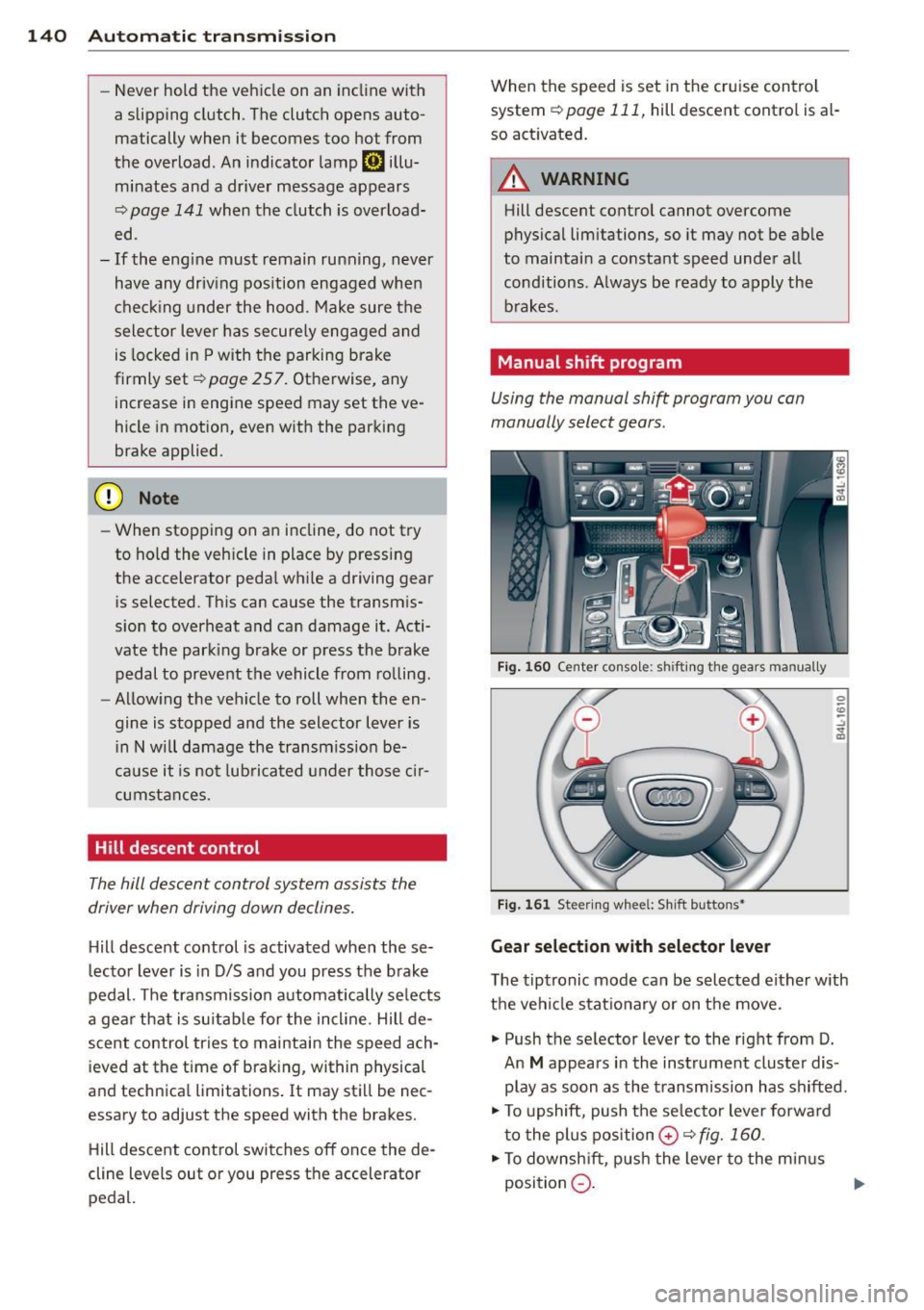
Fig. 160 Center console: shift ing the gears manually
Fig. 161 Steering wheel: Sh ift buttons•
Gear selection with selector lever
The tiptronic mode can be selected either with
the vehicle stationary or on the move.
.,. Push the selector lever to the right from D.
An
M appears in the instrument cluster dis
play as soon as the transmission has shifted .
.,. To upshift, push the se lecto r lever forward
to the plus position
0 c!;> fig. 160 .
.,. To downshift, push the lever to the minus
position
Q . 1J>-
Page 163 of 340

Homelink
Universal remote
control
Description
Applies to vehicles: with Home link
The HomeLink universal remote control can
be programmed with the remote control for
devices that are already present.
With Home Link, you can control devices such
as the garage door, security systems, house
lights , etc. comfortably from the inside of you
vehicle.
Homelink makes it possible for you to rep lace
three different remote controls from devices
in your home with one universal remote. This
feature works for most garage door and exte
rior door motor signals. Programming the in
dividual remote control for your remote con
trol takes place on the left side of the front bumper. There is a control module attached at
this location .
A one-time programming of the sensor must be performed before you are able to use sys
tems with Homelink. If the system does not activate after performing the one-time pro
gramming, check whether the system uses a rolling code
¢ page 163 .
A WARNING
-Never use the Homelink transmitter
with any garage door opener that does
have not the safety stop and reverse fea
ture as required by federa l safety stand
ards. This includes any garage door open
er model manufactured before April 1,
1982.
- A garage door opener which cannot de
tect an object, signaling the door to stop
and reverse does not meet current feder
al safety standards . Using a garage door
opener without these features increases
risk of serious injury or death.
Homelink 161
- For safety reasons never release the
parking brake or start the engine while
anyone is standing in front of the vehicle .
- A garage door or an estate gate may
sometimes be set in motion when the
Homelink remote control is being pro
grammed. If the device is repeatedly ac
tivated, th is can overstrain motor and
damage its electrical components - an
overheated mo to r i s a fire hazard!
- To avoid possib le injuries or property
damage, please always make abso lutely
certa in that no persons or objects are lo
cated in the range of motion of any
equipment being operated.
(0 Tips
- If you would like more information on
Homelink, where to purchase the Home
Link compat ible products, or would like
to purchase the Home Link Home Light
ing Package, please call toll-free :
1-800-355-3515.
- For Declaration of Compliance to United
States FCC and Industry Canada regula
tions
¢page 319.
-For security reasons, we recommend that
you clear the programmed buttons be
fore selling the vehicle.
Operation
App lies to vehicles : with Homeli nk
111111 111111
-
Fig. 191 Headl iner: controls
Req uirement: The buttons must be program
med
<:!)page 162.
Page 228 of 340
226 Intelligent technology
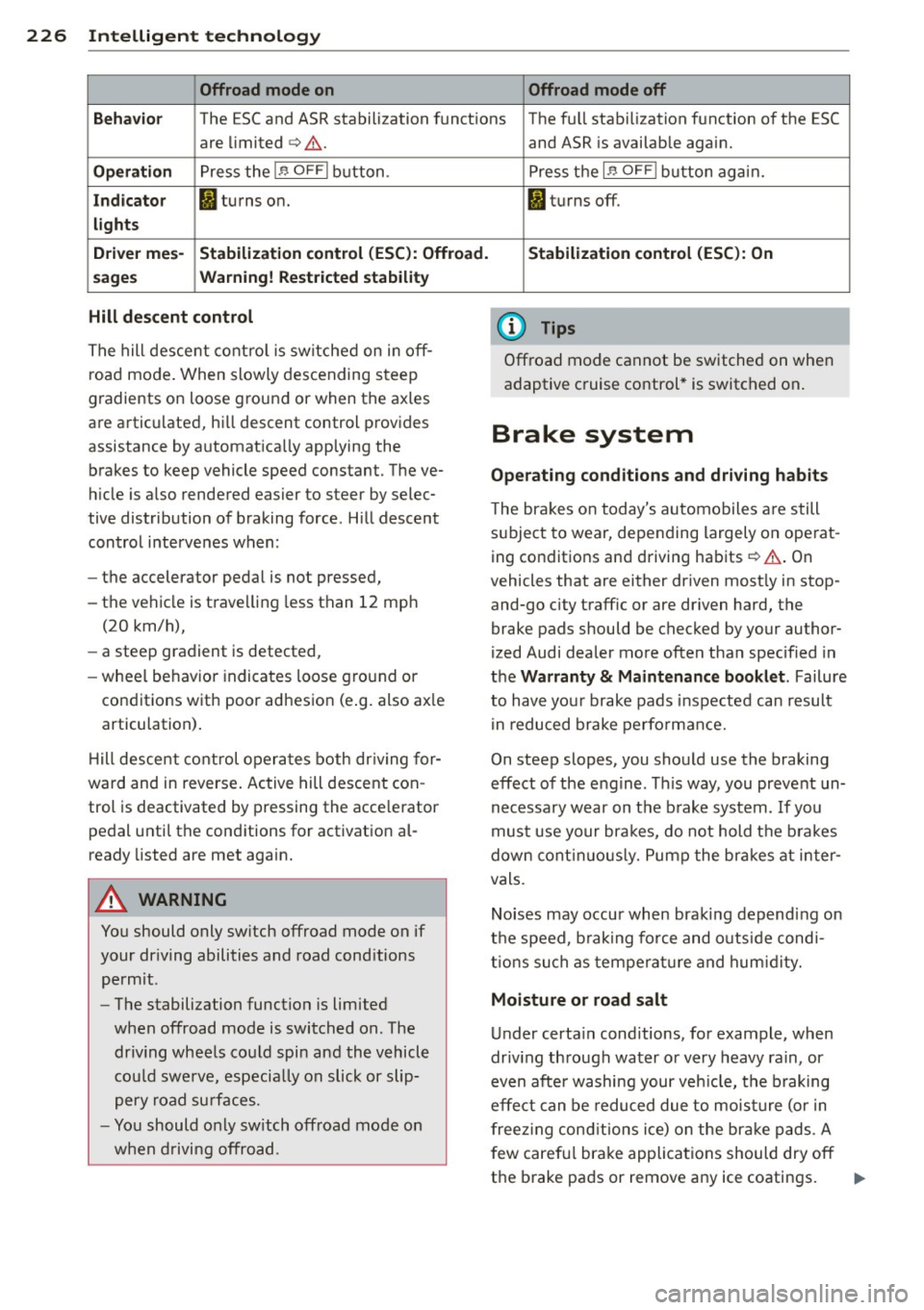
Offroad mode on Offroad mode off
Behavio r
The ESC and ASR stabilization functions The fu ll stabilization function of the ESC
are limited
c> Li::,. .
Operation Press the 1.$ OFFI button.
Indicator fl turns on.
lights
D rive r mes-
Stabilization control (ESC): Offroad.
sages Warning! Rest ricted stability
Hill descent control
The hill descent control is switched on in off
road mode. When slowly descending steep
gradients on loose ground or when the axles
are articulated, h ill descent control provides
assistance by automatically applying the
brakes to keep vehicle speed constant. The ve
h icle is also rendered easier to steer by selec
tive distribution of braking force . Hill descent
control intervenes when:
- the accelerator pedal is not pressed,
- the vehicle is trave lling less than 12 mph
(20 km/h),
- a steep gradient is detected,
-wheel behavio r indicates loose ground or
conditions with poor adhesion (e .g. also ax le
articulation) .
H ill descent control operates both driving for
ward and in reverse . Active hill descent con
trol is deactivated by pressing the accelerator
pedal until the conditions for activation al
ready listed are met again.
A WARNING
You should only switch offroad mode on if
your dr iving abilities and road cond itions
permit.
- The stabilization function is limited
when offroad mode is switched on. The
dr iv ing wheels could spin and the vehicle
cou ld swerve, especially on slick or slip
pery road surfaces.
- You should only sw itch offroad mode on
when driving offroad. and ASR
is available again.
Press the
1 .$ OF FI button again.
fl turns off.
Stabilization control (ESC): On
(D Tips
Offroad mode cannot be switched on when
adaptive cruise control* is switched on .
Brake system
Operating conditions and driving habits
The brakes on today's automobiles are still
subject to wear, depending largely on operat
ing conditions and driving habits
c> Li::,. . On
vehicles that are either driven most ly in stop
and-go city traffic or are dr iven hard, the
brake pads should be checked by your author
ized Audi dealer more often than specified in
the Warranty & Maintenance booklet . Failure
to have your brake pads inspected can result
in reduced brake performance.
On steep slopes, you should use the braking
effect of the engine . This way, you prevent un
necessary wear on the brake system .
If you
must use your brakes, do not hold the brakes
down continuously. Pump the brakes at inter
vals.
Noises may occur when braking depending on
the speed, b raking force and outs ide cond i
tions such as temperature and humidity.
Moisture or road salt
Under certain conditions, for example, when
driv ing through water or very heavy rain, or
even after washing your veh icle, the braking
effect can be reduced due to moisture (or in
freezing conditions ice) on the bra ke pads. A
f ew careful brake applications should dry off
the brake pads or remove any ice coatings.
jll,,
Page 230 of 340
228 Intellig ent technol ogy
- Never let the vehicle ro ll to a stop with
the engine shut off.
- If the brake booster is not working, the
brake pedal must be pressed considera
bly harder to make up for the lack of
booster assistance.
Servotronic - advanced
power steering system
The power steering systems uses the power of
the running engine to allow precise steering
with little effort.
The advanced Servotronic power steering sys
tem senses the road speed and electronically
adjusts powe r assistance to provide comforta
b le and safe steering response exact ly match
ed to the vehicle speed.
Power steering w ill not work if the eng ine is
off. As a result, the steering wheel w ill be hard
to turn.
The power steering fluid level is checked dur
ing the scheduled ma intenance serv ices .
@ Note
If the re is an electronic malfunct ion, ser
votronic
w ill still function like a conven
tional power steer ing system, p roviding a
constant steer ing support force that is no
longer proportionate to the vehicle speed .
This is most noticeab le when turning the
steering whee l at low speeds (for examp le
when parking), -more effort will be re
quired than usual.
- Be aware of the different than usua l
steering response and adjust your steer i ng force accord ingly.
- Have the prob lem checked and set right
by an Aud i dealer as soon as possible.
- When the engine is running , never hold
the steering whee l turned all the way to
the right or to the left for longer than
15
seconds . The power steer ing pump w ill
overheat the hydraulic flu id if you keep holding the steering wheel turned all the
way . This is likely to damage the power
steering system.
- If the powe r stee ring system sho uld fail
entirely, or if the engine is not running
(for example, whi le be ing towed), you
will still be able to steer the ve hicle.
However,
considerably more effort will
be required to do so .
- If the power steering system should
have a leak, or is not functioning proper
ly, contact your author ized Audi dealer
immediately .
- The power steering system requ ires a
specially formulated hyd ra ulic fluid . The
powe r stee ring reservoir is the one locat
ed farthest to the rear on the left s ide of
the engine comp artment r=;,
page 259.
T he correct fluid level in the reservoir is
important for proper functioning of the
power steering .
Driving with your
quattro
With all-wheel drive , all four wheels are driv
en .
Gen eral information
With all-wheel drive, power is distributed to
all four wheels. This happens au toma tically
depending on your driving style and the road
condit ions at the time . See also r=;,
page 224 .
Winter tire s
When driving in the winter, yo ur vehicle with
a ll-wheel drive has an advantage, even wi th
regular tires . In winter road conditions it may
be advisable to mount winter tires (or all -sea
son tires) for improved dr iveability and brak
ing : these tires must be mounted o n
all four
wheels. See also r=;, page 288, Winter tires.
Tire chains
Where tire chains are mandatory on certain
roads, this normally also appl ies to veh icles
with all-wheel driver=;,
page 289, Snow
chains .
Page 237 of 340
Reducing unnecessary idling
Even when your car is just idling it burns up
fuel.
11-Shut the engine off when you are not driving
the vehicle.
11-Do not warm up the vehicle by letting the
engine run at idle .
It makes sense to shut
off the engine in traffic
jams, when waiting for trains to pass at rail
road cross ings, or at traffic lights that have
long waits on red. Turning the engine
off for
just 30-40 seconds saves more fuel than is
burned starting the engine again.
It takes a long time for the engine to warm up
fully when it is running at idle. However, wear
and noxious emissions are especially high
when the engine is warming up. So you should
drive away as soon as you start the engine and
avoid running at high rpms while the engine is
still warming up .
(D Note
Do not leave engine idling unattended af
ter starting. If warning lights should come
on to indicate improper operation, they
wou ld go unheeded. Extended idling also
produces heat, which cou ld result in over
heating or other damage to the vehicle or
other property .
Regular maintenance
A badly tuned engine unnecessarily wastes a lot of fuel .
11-Have your vehicle serviced at regular inter-
vals.
By having your vehicle regularly serviced by an
authorized Audi dealer helps to ensure that it
runs properly and economically. The condition
of your vehicle not only affects its safe ty and
ab ility to hold its value, it also affects fuel
consumption .
Check your oil each time you fill your tank.
Driving and environment 235
The amount of oil used is re lated to engine
load and speed.
It is normal for the oil consumption of a new
engine to reach its lowest value after a certain
mileage has been driven.
You must drive your vehicle about 3,000 miles
(S,000 kilometers) before you can properly
assess oil consumpt ion.
This also app lies to fue l consumption and en
gine output.
(D Note
- Have your veh icle ma inta ined properly
and in accordance with the service rec
ommendations in your Warranty
& Main
t enance booklet. Lack of prop er mainte
nance as well as improper use of the ve
hicle will impair the function of the
emission cont ro l system and could lead
to damage.
- Do not alter or remove any component of
the Emission Control System unless ap
proved by the manufacturer.
- Do not alter or remove any device, such
as heat shields, switches, ignition wires,
valves, which are designed to protect
your vehicle's Emission Control System and other important vehicle compo
nents.
Fewer short trips
Fuel consumption will always be relatively
high on short trips .
11-Try to avoid driv ing short distances w ith a
cold engine.
T he engine and cata lytic converter have to
reach their optimal operating temperature to
reduce fuel consumpt ion and noxious emis
s ions effectively .
Just after starting, a co ld engine in a mid-size
car on ly achieves a fuel economy of 6-8 mi les
per gallon (30-40 l/l00km). After about a
half a mile, fuel economy climbs to 12 mpg
(20 l/100 km). After about
2 .5 miles (4 km), liJI,
•
•
Page 239 of 340

Driving off road
Driving in difficult road
conditions and offroad
General information
The operation of the E lectronic Stabilization
Control (ESC) is expanded fo r operation away
from paved roads. In situations where slip or a
differential lock ing funct ion is required, the
offroad mode can be activated
c:::> page 224.
Hill descent control is a lso ava ilable in the off
road mode, which automat ically brakes the
ve hicl e and thereby keeps speed consta nt
when differe nt w heel speeds a re detected
when descending a hill
c:::> page 226. Your A ud i
a lso has permanent a ll-wheel drive in addi
tion.
H oweve r, your Aud i is not a pure off road ve hi
cle . It was not built for d riving unde r extreme
conditions, e.g. for trips that are in the nat ure
of an expedition .
Drive only on road s and offro ad sections
which match the de sign of y our vehicl e and
you r abilitie s as a dri ver. Ne ver t ake ri sks!
Before driving offroad
- Check the eng ine oi l level, t ire pressu re ,
coolant level , and the fluid level in the w ind
shield washe r reservo ir.
- Stow luggage items a nd other objects in the
l uggage compartment, and sec ure t hem
against s lid ing aro und .
After driving offroad
- After trips off road, remove any twigs and
othe r foreign objects from the grill , the un
derbody and the wheels. Pay spec ia l atten
t ion to fore ign ob jects (stones) which have
become lodged in t he tire tre ad.
- Clean t he body and the vehicle unders ide,
and inspect the veh icle for possible damage.
- Clean dirty w indows , headlamp lenses, rear
li gh ts, and license plates .
- Perfo rm a brake check (particularly after
t ravell ing throug h water) .
Driving off road 237
A WARNING
-Drive especially attentively and plan
ahead in diff icu lt road conditions and
when off road. Excessive speed o r inco r
rect maneuve rs can cause injuries and
damage to the vehicle.
-
- Always adapt your speed and driving
style to road, offroad, t raff ic, and weath
e r condition s. D rive e spe cially slowly off
road when yo ur view is restricted.
- Please be aware that in offroad mode,
pa rti cularly on a smoo th and s lippery
road, the whee ls may have an increased
tendency to spin and the vehicle may
break away -danger of skidding!
- Stability is limited in the offroad mode .
@ For the sake of the environment
Avoid damage to the environment and re
spect na ture .
@ Tips
Only d rive where it is permitted and stay
on marked roads and paths.
Explanation of some technical terms
T he following data refer to ideal cond itions .
Depend ing on ve hicle load and gro und condi
tions and the environment, the numbers may
vary .
It is the driver's responsibility to decide
whether a veh icle can overcome a specific sit
uat ion
c:::> &, .
Gradient angle
The number o f meters in altitude ga ined over
a distance of 109.4 ya rds or 100 meters
(grade) are given as a percentage o r degrees.
Information about the gradient the vehicle
can climb under its own power (depends in
part on the road surface and engine power).
Max imum perm itted grade : 31
°
Lat eral angle (slo pe of veh icle )
Indicates the angle up to which the vehicle
can be driven diagona lly or across the fall line
on a slope without the vehicle tipp ing over
IJll,
•
•
Page 241 of 340
If the vehicle threaten s to tip o ver when
d riv ing across a slope , you mu st imm ediate
ly steer downhill in the di rection of the
slope.
D o not park your vehicle on steep slopes or
grades .
To reduce the risk of t ipping over, dr ive on
slopes in the d irection o f the downward slope
(fa ll line) -
not cro sswi se.
~ WARNING
After driving through water, m ud, slush,
etc., the brakes may be slow to take effect
because of wet brake rotors and pads. Dry
the brakes first by braking carefully to re
store the full braking effect.
(D Note
-
Vehicle components such as the engine,
transmiss ion, suspension or electrical sys
tem can be severely damaged by driving
through water.
{l) Tips
- Check the depth of the wate r before dr iv
i ng through it.
- Do not stop the veh icle, dr ive in reverse
or switc h the engine off when driving
t h rough water.
- Keep in mind that oncoming vehicles may create waves that raise the water
leve l and make it too deep for your vehi
cle to drive through safely.
- Avoid dr iving through sa lt water because
i t can cause corrosion.
Driving off road 239
•
•
Page 243 of 340
Weight Rating will also change the per
formance and handling characteristics of
your vehicle, which could cause a crash resulting in serious injury or death .
- The Gross Vehicle Weight Rating for your
vehicle would be exceeded if your vehicle
is simultaneously equipped with Panor
amic sliding sunroof; third-row seating;
trailer towing equipment (factory or
dealer-installed), and running boards
(dealer-installed) . UNDER NO CIRCUM
STANCES MAY ALL SUCH ITEMS BE IN
STALLED ON THE SAME VEHICLE.
Operating instructions
MAX 6.9"
MAX175mm
E
1/1 E 1/1 ... a)
m
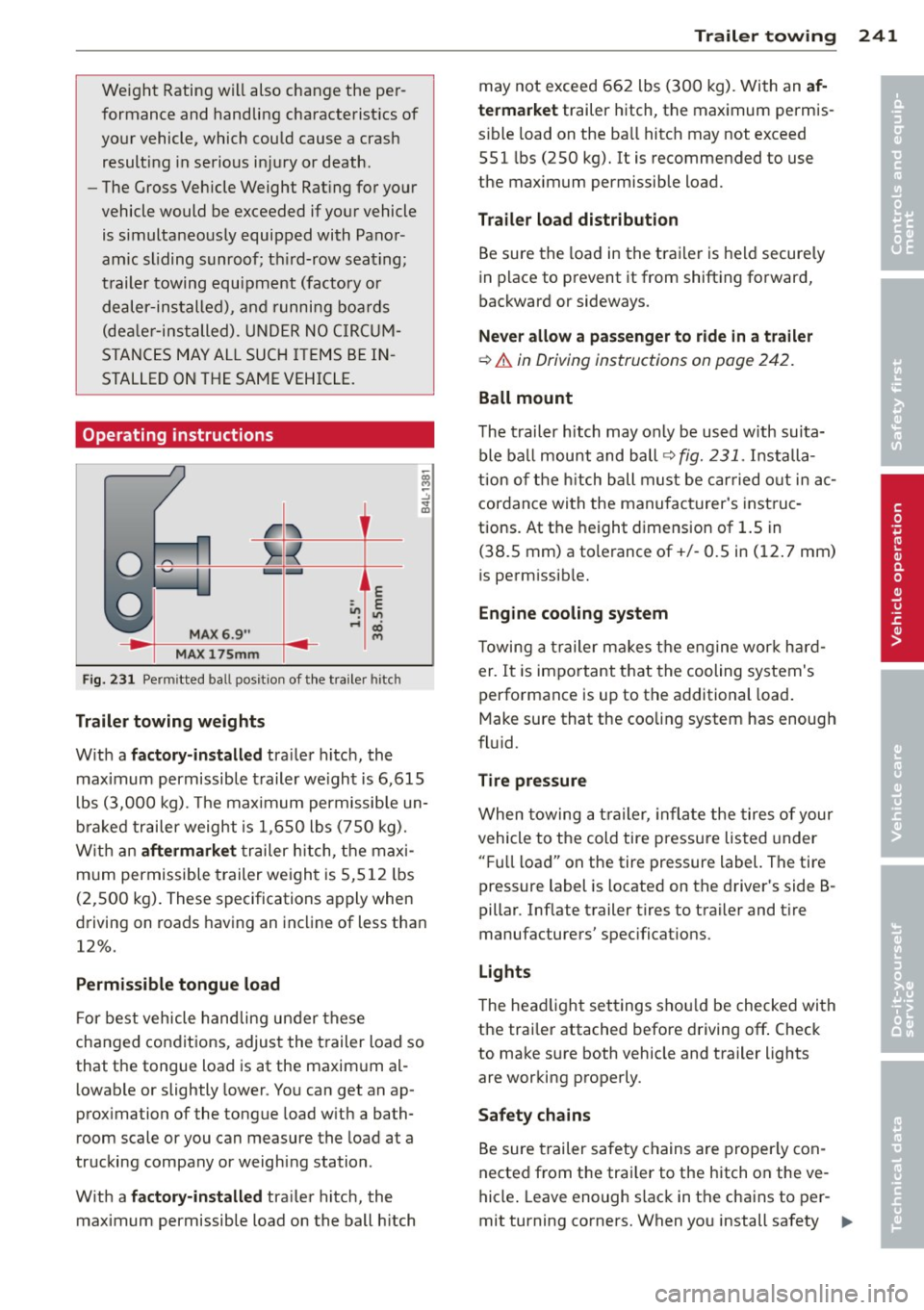
Fig. 231 Perm itted ba ll posit ion of the trailer hitch
Trailer towing weights
With a factory-installed trailer hitch, the
maximum permissible trailer weight is 6,615
lbs (3,000 kg). The maximum permissible un
braked trailer weight is 1,650 lbs (750 kg).
With an
aftermarket trailer hitch, the maxi
mum permissible trailer weight is 5,512 lbs
(2,500 kg). These specifications apply when
driving on roads having an incline of less than
12%.
Permissible tongue load
For best vehicle handling under these
changed cond itions, adjust the trailer load so
that the tongue load is at the maximum al
lowable or slightly lower. You can get an ap
proximation of the tongue load with a bath
room scale or you can measure the load at a
trucking company or weighing station .
With a
factory-installed trailer hitch, the
maximum permissible load on the ball hitch Trailer towing 241
may not exceed 662 lbs (300 kg). With an
af
termarket
trailer hitch, the maximum permis
sible load on the ball hitch may not exceed
551 lbs (250 kg).
It is recommended to use
the maximum permissible load.
Trailer load distribution
Be sure the load in the trailer is held securely
in place to prevent it from shifting forward,
backward or sideways.
Never allow a passenger to ride in a trailer
¢ .& in Driving instructions on page 242.
Ball mount
The trailer hitch may only be used with suita
ble ball mount and ball ¢
fig. 231. Installa
tion of the hitch ball must be carried out in ac
cordance with the manufacturer's instruc
tions. At the height dimension of 1.5 in
(38.S mm) a tolerance of+/- 0.5 in (12. 7 mm)
is permissible.
Engine cooling system
Towing a trailer makes the engine work hard
er . It is important that the cooling system's
performance is up to the additional load.
Make sure that the cooling system has enough
fluid .
Tire pressure
When towing a trailer, inflate the tires of your
vehicle to the cold tire pressure listed under
"Full load" on the tire pressure label. The tire
pressure label is located on the driver's side B
pillar . Inflate trailer tires to trailer and tire
manufacturers' specifications .
Lights
The headlight settings should be checked with
the trailer attached before driving
off. Check
to make sure both vehicle and trailer lights
are working properly .
Safety chains
Be sure trailer safety chains are properly con
nected from the trailer to the hitch on the
ve
hicle. Leave enough slack in the chains to per
mit turning corners. When you install safety
Ill-
•
•
Page 252 of 340
250 Fuel supply and filling your fuel tank
-Blend must contain not more than 15%
MTBE.
Seasonally adjusted gasoline
Many gasoline grades are blended to perform
especially well for winter or summer driving. During seasonal change-over, we suggest that
you fill up at busy gas stations where the sea
sonal adjustment is more likely to be made in
time.
(CT) Note
- Methanol fuels which do not meet these
requirements may cause corrosion and
damage to plastic and rubber compo
nents in the fuel system.
- Do not use fuels that fail to meet the
specified criteria in this chapter.
- If you are unable to determine whether
or not a particular fuel blend meets the
specifications, ask your service station or
its fuel supplier.
- Do not use fuel for which the contents cannot be identified.
- Fuel system damage and performance
problems resulting from the use of fuels
different from those specified are not
the responsibility of Audi and are not
covered under the New Vehicle or the
Emission Control System Warranties.
- If you experience a loss of fuel economy
or driveability and performance prob lems due to the use of one of these fuel
blends, we recommend that you switch
to unblended fuel.
Gasoline additives
Applies to vehicles: with gasoline engine
A major concern among many auto manufac
turers is carbon deposit build-up caused by
the type of gasoline you use.
Although gasoline grades differ from one manufacturer to another, they have certain
things in common. All gasoline grades contain
substances that can cause deposits to collect
on vital engine parts, such as fuel injectors
and intake valves. Although most gasoline brands include additives to keep engine and
fuel systems clean, they are not equally effec
tive.
Audi recommends using TOP TIER Detergent
Gasoline. For more information on TOP TIER
Detergent Gasoline, please go to the official
website (www.toptiergas.com).
After an extended period of using inadequate
fuels, carbon deposit build-ups can rob your
engine of peak performance.
(D Note
Damage or malfunction due to poor fuel
quality is not covered by the Audi New Ve
hicle Limited Warranty.
Diesel fuel
Applies to vehicles: with diesel engine
Always use ULSD (Ultra Low Sulfur Diesel) sul
fur content 15 ppm or less.
The ULSD (Ultra Low Sulfur Diesel) meets the
ASTM-D-975 (grade 2).
Diesel fuel with a higher concentration than
ULSD-Diesel No. 2 ASTM D975 and Bio-die
sel with a higher concentration than 5
% like
811, 820 or 8100 are strictly prohibited.
Service station fuel pumps are labeled with
the correct fuel information for easy recogni
tion by the user. If the diesel fuel pump is not
labeled ask the station operator what fuel is
being dispensed before filling up your vehicle.
Service stations offering Diesel fuel are gener
ally located on truck routes or major high
ways. Directories of Diesel fuel stations are usually available at Diesel fuel stations.
Some states in the USA require permits to
purchase Diesel fuel. Check with your State
Motor Vehicle Department.
Diesel fuel may not be available outside the
USA and Canada. Be sure to check before trav-
eling to other countries.
ll-
Page 254 of 340

252 Fuel supply and filling your fuel tank
_&. WARNING
Under normal operating conditions, never
carry additional fuel containers in your car .
Gas canisters and other containers used to
transport fuel can be dangerous. Such con
tainers, full or empty, may leak and could
cause afire in a collision. If you must
transport fuel to use for your lawn mower,
snow blower, etc., be very careful and al
ways observe local and state laws regard
ing the use, transportat ion and storage of
such fuel containers. Make certain the con
tainer meets industry standards (ANSI/
ASTM F8S2 -86).
(D Note
Never drive your vehicle until the fuel tank
is completely empty. The irregular supp ly
of fuel can cause misfiring . Gasoline could
enter the exhaust system and damage the
catalyt ic converter.
Refuelling
Fig . 232 Right rear vehicle side : Open ing t he fue l filler
fl ap
Fig. 233 Fu el cap hooked on the opened fue l filler fl ap
When adding fuel, the ignition and any cellu
lar phones in the vehicle must be switched
off . When activating the central locking, the fuel
filler flap is automatically unlocked or
locked. Refuel the vehicle with the ignition
turned
off.
Taking the fuel cap off
.,. To open the fue l filler f lap, press on the left
side of the flap¢
fig. 232 -arrow-.
.,. Unscrew fue l filler cap counter-clockwise
and hang it on the fuel filler flap ¢
fig. 233.
.,. Check the label on the inside of the fuel fill
er flap to determine if the vehicle must be
fueled with gasoline or diesel fuel.
Refuelling procedure
.,. Insert the fuel nozzle from the gasoline
pump into the fuel filler neck as far as it wi ll
go .
.,. Select a medium refuelling rate so that the
nozzle switches off automatically when the
tank is fu ll.
Putting the fuel cap back on
.,. After filling your tank, twist the fuel filler
cap clockwise as far as it wi ll go.
.,. Close the fuel filler flap.
T o avoid fuel spilling or evaporating from the
fuel tank always close fuel filler cap proper ly
and completely. An improperly closed fuel fill
er cap may also cause the MIL lamp¢
page 27
to come on (only vehicles with gasoline en
gine) .
_&. WARNING
Improper refueling or handling of fuel can
cause fire, explosion and severe burns.
- Fuel is highly flammable and can cause
severe bu rns and other injuries.
- Failure to shut the engine off while refu
eling and/or to insert the pump nozzle
fu lly into the fuel filler neck could cause
fuel to spray out of filler neck or to over
f low . Fu el spray and overflowing fue l can
cause a fire.
- Never use a cellular telephone while re
fue ling. The electromagnetic radiat ion
can cause sparks that can ignite fuel va
pors and cause a fire .