check engine light AUDI Q7 2014 Owner´s Manual
[x] Cancel search | Manufacturer: AUDI, Model Year: 2014, Model line: Q7, Model: AUDI Q7 2014Pages: 340, PDF Size: 85.02 MB
Page 259 of 340

Checking and filling Engine hood
Releasing the engine hood
The engine hood is released from inside the
vehicle .
Fig. 23 9 Drive r's s id e footw ell: eng in e hood relea se
l e v e r
"' Open the driver's door .
"' Pull the release lever on the left under the
instrument panel
i=> fig . 239 in the d irection
of the arrow .
The hood pops up slight ly under spring pres
sure.
Opening the engine hood
F ig . 2 40 Relea se le ve r u nde r the e ngin e hood
Before opening the engi ne hood, make sure
that the windshie ld wipers are flat against the
windshie ld. Otherwise, they cou ld damage the
pain t on the hood.
"' Lift the hood slight ly ¢
_A .
"' Pull up on the release under the hood
¢ fig . 240. This releases the catch.
"' Open the hood all the way . Checkin
g and fillin g 257
A WARNING
Hot engine coolant can burn you.
- To reduce the risk of being burned, never open the hood if you see or hear steam
or coo lant escaping from the eng ine
compartment . Wait unt il no steam or
coolant can be seen or heard before care
fu lly opening the hood.
Closing the engine hood
"' Pull the hood down until the pressure from
the stru ts is reduced.
"' Let the hood
drop down and latch in p lace.
Do not try to push it shut ; it may fail to en
gage ¢_& .
A WARNING
--
A hood that is not completely latched
could fly up and b lock your view while dr iv
i n g.
- When you close the engine hood, check it
to make sure the safety catch has p roper
ly engaged . The hood shou ld be flush
with the surround ing vehicle body parts.
- If you notice while driv ing that the hood
is not secured prope rly, stop at once and
close it .
Working in the engine compartment
Be especially careful whenever you work in
the engine compartment.
Whene ver you must perform any wo rk in the
eng ine compartment, for e xample checking
and filling different fluids, there is a risk of injury, burns and accidents. To pr event per
sonal injury always observe the following
WARNINGS . The engine compartment of an y
vehicle i s a hazardou s area
¢ Lh, .
A WARNING ~
To help avoid injury, befo re yo u check any
thing under the hood:
- Tu rn off the engi ne.
- Remove the igni tion key.
Page 261 of 340
Checking and fillin g 259
Engine compartment
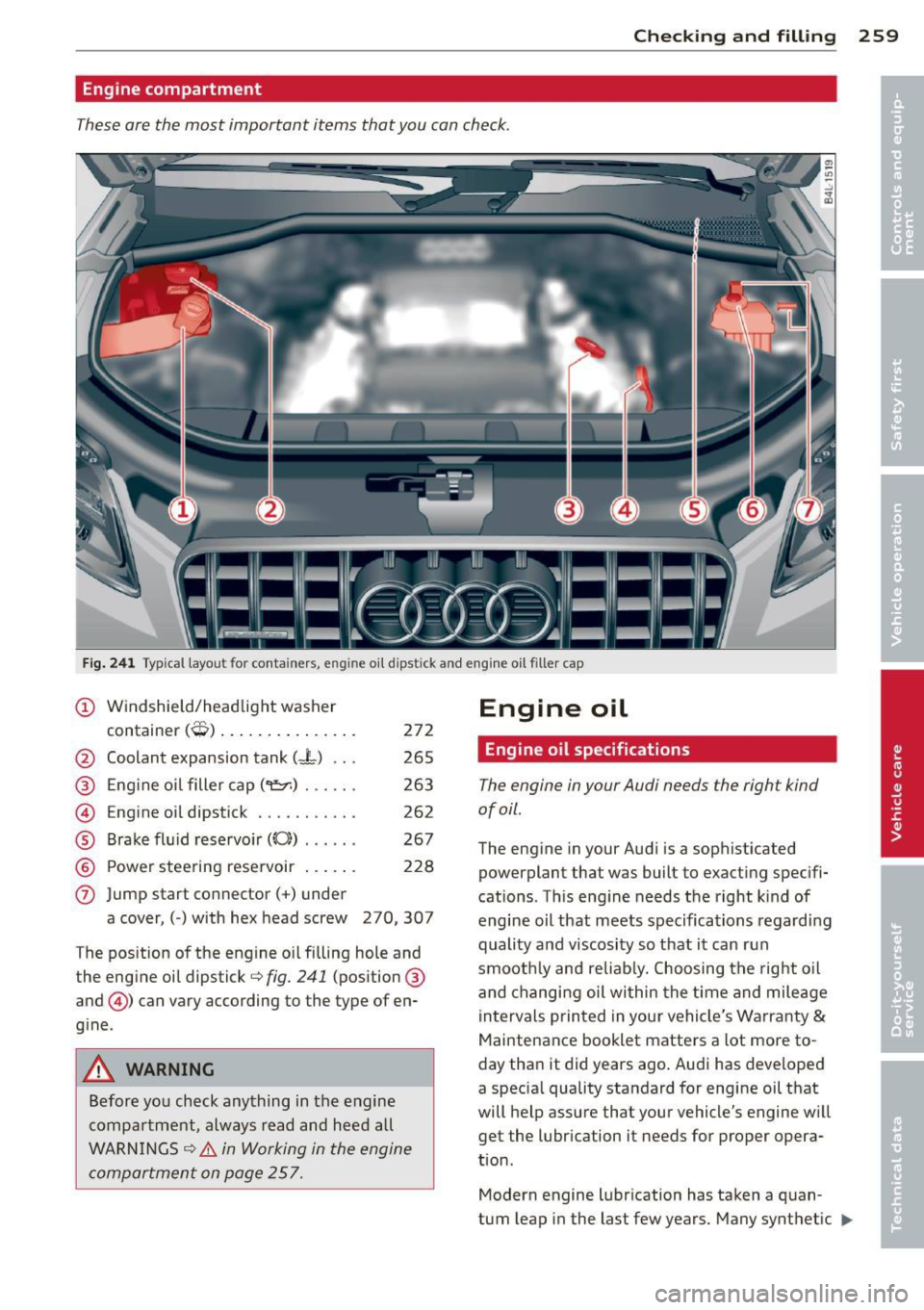
These are the most important items that you can check .
Fig. 2 41 Typ ical layout for conta iners, e ngin e oi l dipst ick and engine oi l fille r cap
(D Windshield/headlight washer
t .
(~) con ainer ,.,., ....... ... .. .. .
@ Coolant expansion tank (-L) .. .
®
@
®
®
(f)
Eng ine oi l filler cap ("1:::r.) ..... •
Engine oi l dipstick .. .... .... .
Brake fluid reservo ir
(0)) ..... .
Power stee ring reservoir ... .. .
Jump start connector(+) under 272
265
263
262
267
228
a cover, (-) with hex head screw 270, 307
The pos ition of the engine o il filling hole and
the eng ine oil dipstick¢
fig. 241 (position @
and @) can
vary according to the type of en
g ine.
A WARNING
Before you check anything in the engine
compartment, always read and heed all
WARN INGS ¢.&.
in Working in the engine
compartment on page 257.
Engine oil
Engine oil specifications
The engine in your Audi needs the right kind
of oil.
The engine in your Audi is a sophisticated
powerplant that was built to exacting spec ifi
cations . Th is eng ine needs the right k ind of
engine oil that meets specifications regardi ng
quality and viscosity so that it can run
smooth ly and reliab ly. Choosing the right o il
and changing oil within the time and mileage
intervals printed in your vehicle's Warranty
&
Maintenance booklet matters a lot more to
day than it did years ago . Audi has deve loped
a spec ia l quality standard for engine oil that
will help assure that your vehicle's engine w ill
get the lubrication it needs for proper opera
tion.
Modern engine lubrication has taken a quan
tum leap in the last few years. Many synthetic
IIJ>,
Page 263 of 340
VW 502 00 (vehicles with gasoline engine) or
VW
507 00 (vehicles with diesel engine).
C han gin g the en gin e o il
The engine oil and oil filter must be changed
according to the m ileage (ki lomete rs) and
time inte rva ls specified in your vehicle 's War
r anty
& M aintenance booklet. Do not ex ceed
t hese intervals -harmf ul depos its from old
engine oi l can reduce engine performance and
can lead to expensive engine repairs.
Changing the o il at the recommended inte r
va ls is so very important because the lub ric at
ing p roperties o f oi l decrease grad ually during
norma l vehicle use . If you are not sure when
you have yo ur oi l changed, ask your a uthor
ized A udi Service Advisor.
Unde r some ci rc u mstances the engine o il
should even be changed more frequently.
Change o il more often if you drive mostly
short distances, operate the vehicle in dusty
areas or mostly under stop-and-go traffic con
d itions, or when you use your vehicle where
temperatures stay below freezing po int for
l ong periods .
Detergent addit ives in the o il w ill make fresh
oil look dark after the eng ine has been run
ni ng fo r a short time . This is no rmal and is not
a reason to change the o il mo re often than
r ec om mended.
Damage or malfun ctions due to lack of
maintenance
It is essential that yo u change your oil at the
recommended interva ls using only engine oil
that complies with Audi oi l standard
VW
502 00 (vehicles with gasoli ne engine) or
VW
507 00 (veh icles with diesel engine) . You r
Lim ited New Vehicle Wa rra nty does not cove r
damage or m alfu nct ions due to f ailure to fol
l ow recommended maintenance and use re
q uir ements as set forth in the A udi Owner's
M anual and Warranty
& M aintenance book let.
Your dea ler will have to deny warranty cover
age un less you present to the dea ler proof in
the form of Service or Repa ir Orders that all
Checkin g and fillin g 261
scheduled maintenance was performed in a
timely manner.
· Engine oil consumption
To provide effective l ubr ication and cooling for
interna l eng ine parts, all interna l combustion
engines use some oi l. Oi l consumption varies
from eng ine to engine and may change over
the life of the engine . Engines tend to use
more o il du ring the b reak-in period tha n they
do afterward, when o il cons umption has sta
bilized. Depend ing on the way the vehicle is
driven and the operating conditions, oil con
s u mption can be up to
1 quart per 1,200
miles (l liter per 2,000 km) . Consumption
may be higher within the first
3,000 m iles
(5,000 km) .
U nder normal conditions , the rate of oi l con
s u mption depends on oi l quality as well as vis
cosity, engine speed (rpm), outs ide tempera
ture, road conditions, the amount of oil dilu
tion caused by condensed water or fue l resi
due, and ox idat ion of the o il. Oi l consumption
may increas e with eng ine wear over time, un
t il rep lacement of worn engine pa rts may be
come ne cessa ry.
Because of all these var iables, there is no
standard o r "n orma l" rate of o il cons umption .
We urge you to check the engine oil level at
regular interval s, preferably every time y ou
fill the fuel t ank, and always before a long
trip .
The oil pres sure warning light. i s not an
indicator of low engine oil level. If the warn
ing light does not go out after starting, or
flashes while dr iving (above 1500 rpm), a
buzzer will sound. It indicate s that the oil
pressure is too low . Stop the engine immedi
ately , check the engine oil level and add oil if
necessa ry. If the engine oil level is normal,
but the l ight continues to fla sh, do not keep
driving or let the engine idle, as damage may
occur .
IIJ,
•
•
Page 267 of 340

For year-round driv ing, antifreeze is added at
the factory for temperatures down to:
- - 31 °F (- 35 °C) USA
- - 40 °F ( - 40 °C) Canada .
If you mus t add coolant, use a mixture of wa
ter and coolant additive. Mixing the coolant
additive with distilled water is recommended .
A WARNING
-
Before you check anything in the engine
compartment, always read and heed all
WARNINGS ¢
A in Working in the engine
compartment on page 257.
(D Note
-Before winter sets in, have the coolant
checked to see if the coolant additive in
your vehicle is sufficient to meet the cli
mate conditions. This is especially impor
tant if you live in a region where the win
ter is extremely cold.
If necessary, in
crease the proportion of coolant additive
to 60%.
- When adding coolant additive to your
cooling system, remember:
- We recommend using only coolant ad
ditive Gl2++ or G13 for your vehicle.
This coolant additive is available at au
thorized Audi dealers. Other types of
antifreeze can significantly reduce cor
rosion protection . The resulting corro
sion can cause a loss of coolant and se
rious engine damage.
- Do not add any type of radiator leak seal
ant to your vehicle's engine coolant.
Adding radiator repair fluid may adverse
ly affect the function and performance of
your cooling system and could result in damage not covered by your New Vehicle
Limited Warranty.
Checking and filling 265
Checking the engine coolant level
T he engine coolant level can be checked with
a quick glance.
Fig. 245 En gin e compar tment: Coolant expansion tank
Before you check anything in the engine com
partment,
always read and heed all WARN
INGS ¢ A in Working in the engine comport
ment on page 257 .
.,. Park your vehicle on a level surface.
.,. Turn
off the ignition .
.,. Let the engine cool down.
.,. Place a thick rag over the coolant expans ion
tank ¢
fig. 245, c> page 259, fig. 241 and
carefully twist the cap counter-clockwise
¢,&. .
.,. Read the engine coolant level in the open
coolant expansion tank. With a cold engine,
the coolant level should be between the
"min " and "max" markings. When the en
gine is warm, the level may be slightly
above
the "max" marking.
The location of the coolant expansion tank
can be seen in the engine compartment illus
tration
¢ page 259 .
To obtain an accurate reading, the engine
must be switched
off.
The expansion tank in your vehicle is equipped
with an electric coolant level sensor .
When the coolant level is too low, the warning
light in the Auto-Check System¢
page 32 will
blink until you add coolant and the level has
been restored to normal. Even though there is
an electric coolant level sensor, we still rec ommend you check the coolant level from
time to time .
Page 268 of 340
26 6 Ch eck ing and filling
Coolant lo ss
Coolant loss may indicate a l ea k in t he cooling
system. In the event of coolant loss, the cool
ing system should be inspected immediately
by your authorized Audi dealer. It is not
enough merely to add coolant.
I n a
se ale d system, losses can occur only if
the boiling point of the coolant is exceeded as
a result of overheating.
A WARNING
The cooling system is under pressure and
can get very hot. Reduce the risk of scald
ing from hot coolant by following these
steps .
- Turn off the engine and allow it to cool
down.
- Protect your face, hands and arms from
escaping fluid and steam by covering the
cap with a large, thick rag .
- Turn the cap slowly and very carefully in
a counter -clockwise direction wh ile ap
plying light, downward pressure on the
top of the cap .
- To avoid being burned, do not spill ant i
freeze or coolant on the exhaust system
or hot eng ine parts. Under certain condi
t ions, the ethy lene g lycol in engine cool
an t can ca tch f ire.
0 Note
Do not add any type of radiator leak seal
ant to your vehicle's eng ine coolant. Add
ing radiato r repair fluid may adve rsely af
fect the function and performance of your
cooling system and could res ult in damage
not covered by your New Vehicle Limited
Warranty .
Adding coolant
Be very careful when adding engine coolant.
Before you check anything i n the engine com
pa rtmen t,
a lwa ys rea d and h eed all WARN
INGS c:::> A in Working in the engine compart
ment on page 257.
.. Tu rn off the engine .
.. Let the engine cool down.
.. Place a thick rag over the coo lant expansion
tank
c> page 265 , fig. 245 and car efully
twist the cap counter-clockwise c> ,&. .
.. Add coo lant m ixed in the correct rat io
c:::> page 264, Coolant.
.. Twist the cap on again tightly.
Replacement engine coolant must conform to
exact spec ificat ions
c> page 264, Coolant.
We recommend using only coo lant additive
G12 ++, G13 or in an emergency G12 +. Do
not
use a different add itive. In an emergency use
plain water until you can get the correct addi
t ive and can restore the correct ratio . This
shou ld be done as soon as poss ib le.
If you have lost a considerable amount of
coolant, then you should add cold ant ifreeze
and co ld water only when the eng ine is cold .
Always use
new engine coolant when refilling.
Do not fi ll coolant above the "MAX" mark. Ex
cess coolant will be forc ed out through the
pressure relief valve in the cap when the en
gine becomes hot.
A WARNING
- The cooling system is under pressure and
can get very hot. Reduce the risk of
scalding from hot coolant by following
these steps.
- Turn off the engine and allow it to coo l
down.
- Protect your face, hands and arms from
escaping fluid and steam by covering
the cap with a large, th ick rag.
- Turn the cap s low ly and very carefully
in a counter-clockwise direction while
applying light, downward pressure on
the top of the cap.
- To avoid being burned, do not spill an
tifreeze or coolant on the exhaust sys
tem or hot engine parts. Under certain
cond it ions, the ethylene g lycol in en
gine coolant can catch fire .
Page 269 of 340
-Antifreeze is poisonous . Always store an
t ifreeze in its or iginal container and well
out of the reach of children.
- If you drain the coolant, it must be
caught and safely stored in a proper con
tainer clearly marked "poison".
(D Note
- Coolant pollutes the environment and
could cause an engine fire. Excess coo l
ant will be forced out through the pres
sure re lief va lve in the cap when the en
gine becomes hot.
- If, in an emergency, only water can be
added, the correct ratio between water
and antifreeze ¢
page 264 must be re
stored as soon as possib le.
@ For the sake of the environment
Drained coolant should not be reused. Al
ways dispose of used coolant while observ ing all environmental regulations .
Radiator fan
The radiator fan switches on automatically by
itself
The radiator fan is driven by the engine via the
V-belt . The viscous clutch regulates the speed
of the fan accord ing to the temperature of the
coolant .
An auxiliary electric radiator fan* switches on
and off depending on coolant temperature
and other vehicle operating conditions .
After you switch the engine off, the auxilia ry
fan can continue running for up to 10 minutes
- even with the ignition off. It can even switch
on again later by itself¢& , if
- the temperature of the engine coolant rises due to the heat build-up from the engine in
the engine compartment, or
- the engine compartment hea ts up because
the vehicle is parked in intense sunlight .
Checking and fillin g 267
A WARNING
-To reduce the risk of personal injury nev
er touch the rad iator fan.
- The auxiliary electric fan is temperature
controlled and can switch on suddenly
even when the engine is not running .
- The auxiliary radiator fan switches on au
tomatically when the engine coolant reaches a certain temperature and will
continue to run until the coo lant temper
ature drops.
Brake fluid
Checking brake fluid level
The brak e fluid lev el can be check ed with a
quick glance.
N
N
-N ,.
:8
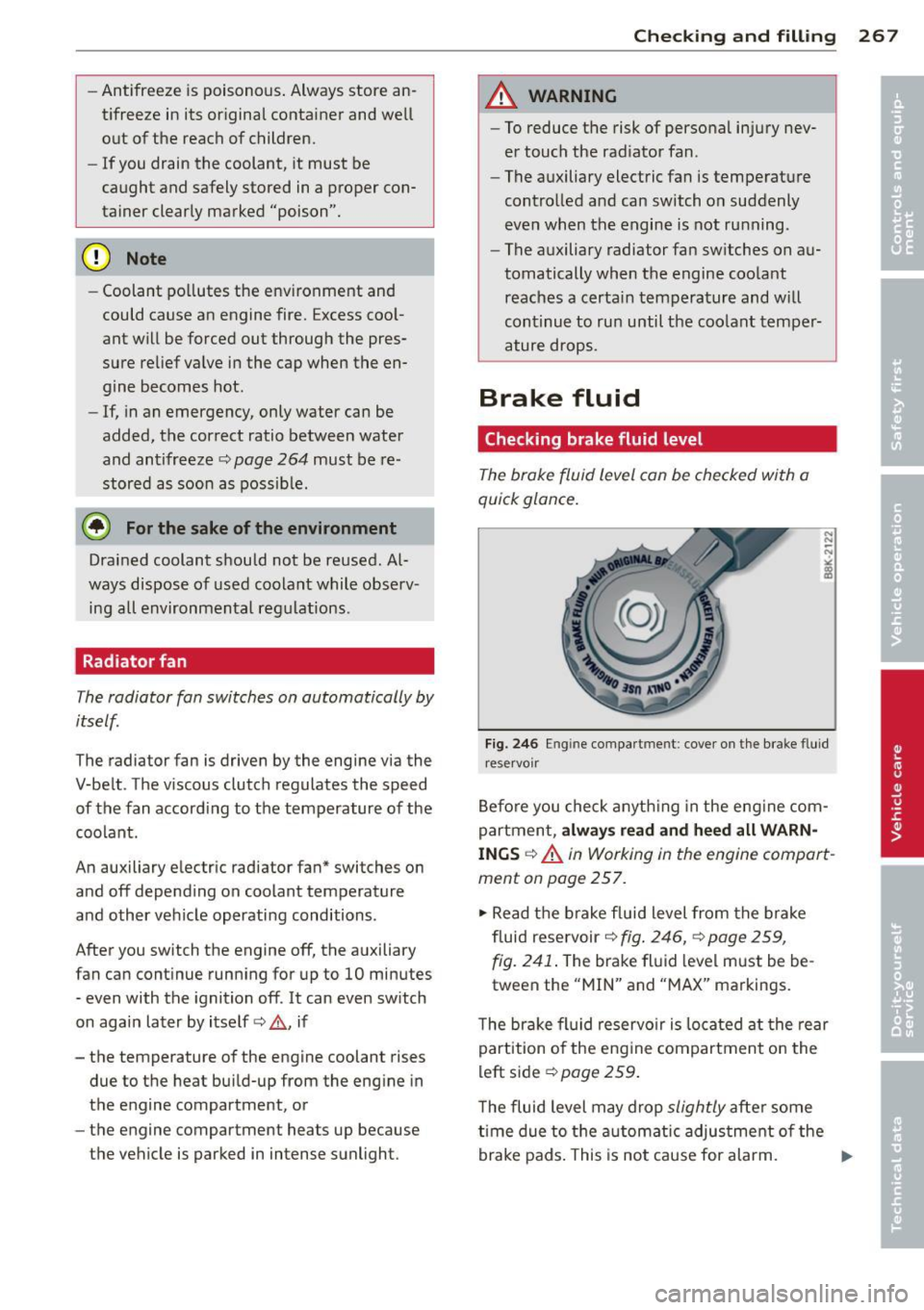
Fi g. 246 En gin e compa rtm en t: cover o n the bra ke fluid
reservoir
Before you check anything in the eng ine com
partment ,
always read and heed all WARN
INGS ¢ A in Working in the engine compart
ment on page 257.
.,. Read the brake fluid level from the brake
fluid reservoir ¢
fig. 246, ¢ page 259,
fig. 241.
The brake fluid level must be be
tween the "MIN" and "MAX" markings .
The brake fluid reservoir is located at the rear
partition of the eng ine compartment on the
left side ¢
page 259.
The fluid level may drop slightly after some
time due to the automatic adjustment of the
brake pads. This is not cause for alarm. ..,_
Page 271 of 340
Disconne cting the batt ery t erminals
Some vehicle functions (power w indow regu
l ators, for example) are lost if the battery ter
minals are disconnected . These functions have
to be re learned after the battery terminals are
connected again. To prevent this, the battery
should only be disconnected from the vehicle
electrical system when absolutely necessary
for repairs .
Vehicle s not driven fo r lo ng period s
If you do not drive your vehicle over a period
of several days or weeks, electrical compo
nents are gradually cut back or switched off .
This reduces energy consumption and main
tains starting capab ility over a longer per iod
¢ page 229 .
Take into consideration that when you unlock
your vehicle, some convenience functions,
such as the inter ior lights or the power seat
adjustment, may not be available . The con
ve nience funct ions w ill be available again
when yo u turn on the ignition and start the
engine.
Winter op eration
During the winter months, battery capacity
tends to decrease as tempe ratures d rop . This
i s because more powe r is also consumed while
start ing, and the headl ights, rea r window de
fogger, etc., are used more often.
Avo id unnecessary power consumption, par
ticularly in c ity t raffic or when t rave ling on ly
short d istances. Let you r autho rized Aud i
dealer check the capacity of the vehicle bat
tery before winter sets in ¢
page 270. A we ll
charged battery wi ll not only prevent starting
prob lems when the weather is cold, but will
also last longer .
If your vehicle is left standing for severa l
weeks at extremely low temperat ures, the
veh icle battery should be removed and
stored where it will not freeze. This will
prevent it from bei ng damaged and hav ing
to be replaced.
Checkin g and fillin g 269
Working on the battery
Be especially careful when working on or near
the battery.
The battery is located under the driver 's seat.
Before you check anyth ing under the dr iver's
seat,
read and h eed all WARNINGS G &_ .
Always heed the safety warnings , when work
ing on the vehicle battery or the vehicle e lec
trical system to prevent injury .
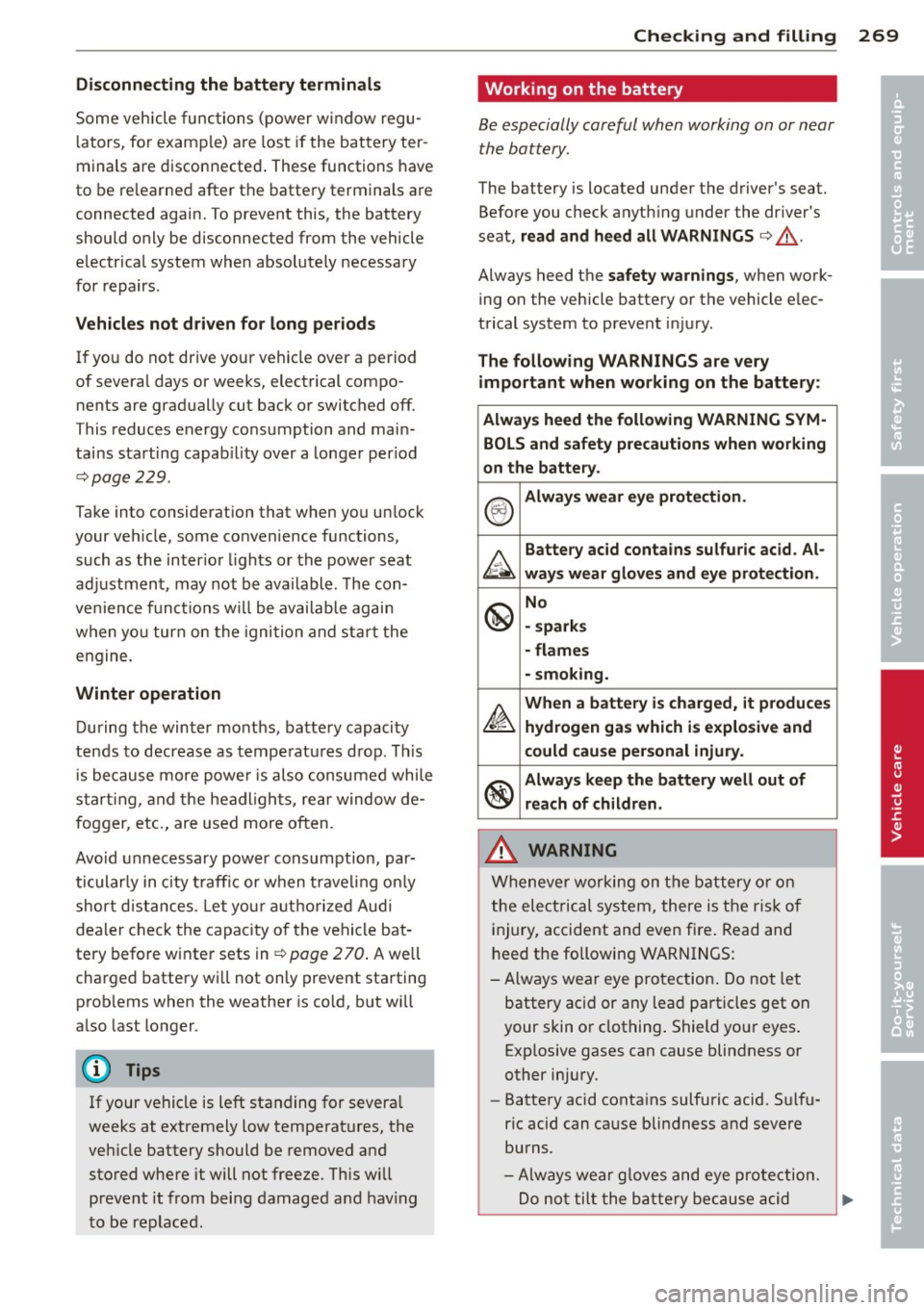
The following WARNINGS are ver y
important when working on the batter y:
Alway s heed the following WARN IN G SY M-
BOLS a nd safety p re caution s when working
on the battery .
®
Alway s wear e ye prote ction.
&
Bat te ry acid contains s ulfuric acid. Al-
ways w ear glov es and ey e prot ect ion .
@
No
-spar ks
- flames
- smo kin g.
A
When a batt ery i s charged , it produ ce s
hydro gen g as whi ch i s explo sive and
c o uld cau se pe rsonal injur y.
®
Alw ays k eep th e batt ery w ell out of
reac h of chi ldr en .
.8, WARNING
Whenever working on the battery or on
the electrical system, there is the risk of
injury, accident and even fire . Read and
heed the following WARNINGS:
- Always wear eye protection. Do not let
battery ac id or any lead particles get on
your skin or clothing . Shield you r eyes .
Exp losive gases can cause blindness or
other injury.
- Battery acid contains sulfuric acid. Sulfu
ric acid can cause blindness and severe
burns.
- Always wear g loves and eye protection.
-
Do no t tilt the ba ttery because acid .,. •
•
Page 272 of 340
2 70 Checking and filling
could leak out of the ventilation
openings.
- If you get battery acid in your eyes or
on your skin, immediately rinse with
cold water for several minutes and get
medical attention.
- If you should ingest any battery acid,
seek medical attention immediately.
- Do not expose the battery to an open
flame, electric sparks or an open light.
- Do not smoke.
- Do not interchange the positive and neg-
ative cables.
- When working on the battery , be sure
not to short-circuit the terminals with
tools or other metal objects. This would
cause the battery to heat up very quickly,
which could lead to damage or explosion
and personal injury.
- When a battery is charged, it produces
hydrogen gas which is explosive and
could cause personal injury .
- Always keep the battery well out of the
reach of children .
- Before work is done on the electrical sys
tem, disconnect the negative ground ca
ble .
- Before performing any work on the elec
trical system, switch off the engine and
ignition as well as any electrical equip
ment. The negative cable on the battery
must be disconnected. If you are just go
ing to replace a light bulb, then it is
enough to switch off the lights.
- Before disconnecting the battery, switch
off the anti-theft alarm system! Other
wise you will set off the alarm.
- When disconnecting the battery, first
disconnect the negative cable and then
the positive cable .
- Before reconnecting the battery, make
sure all electrical consumers are switch
ed off. Reconnect the positive cable first
and then the negative cable. Never inter
change the cables -this could start a fire!
- Never charge a frozen or a thawed-out
battery. It could explode! If a battery has
frozen, then it must be replaced. A dis- charged battery can freeze over at 32
°F
(0 oc).
-Make sure the vent hose is always attach
ed to the opening on the side of the bat
tery .
- Never use batteries which are damaged.
There is the danger of an explosion! Al
ways replace a damaged battery.
A WARNING
-
California Proposition 65 Warning:
- Battery posts, terminals and related ac
cessories contain lead and lead com
pounds, chemicals known to the State of
California to cause cancer and reproduc
tive problems. Wash hands after han
dling.
(D Note
- Do not disconnect the vehicle battery
when the ignition is switched on or when
the engine is running, otherwise, you will
damage electronic components in the
electrical system.
- If your vehicle is going to stand for a
long period of ti me without being driven,
protect the battery from "freezing", oth
erwise it will be damaged and will then
have to be replaced.
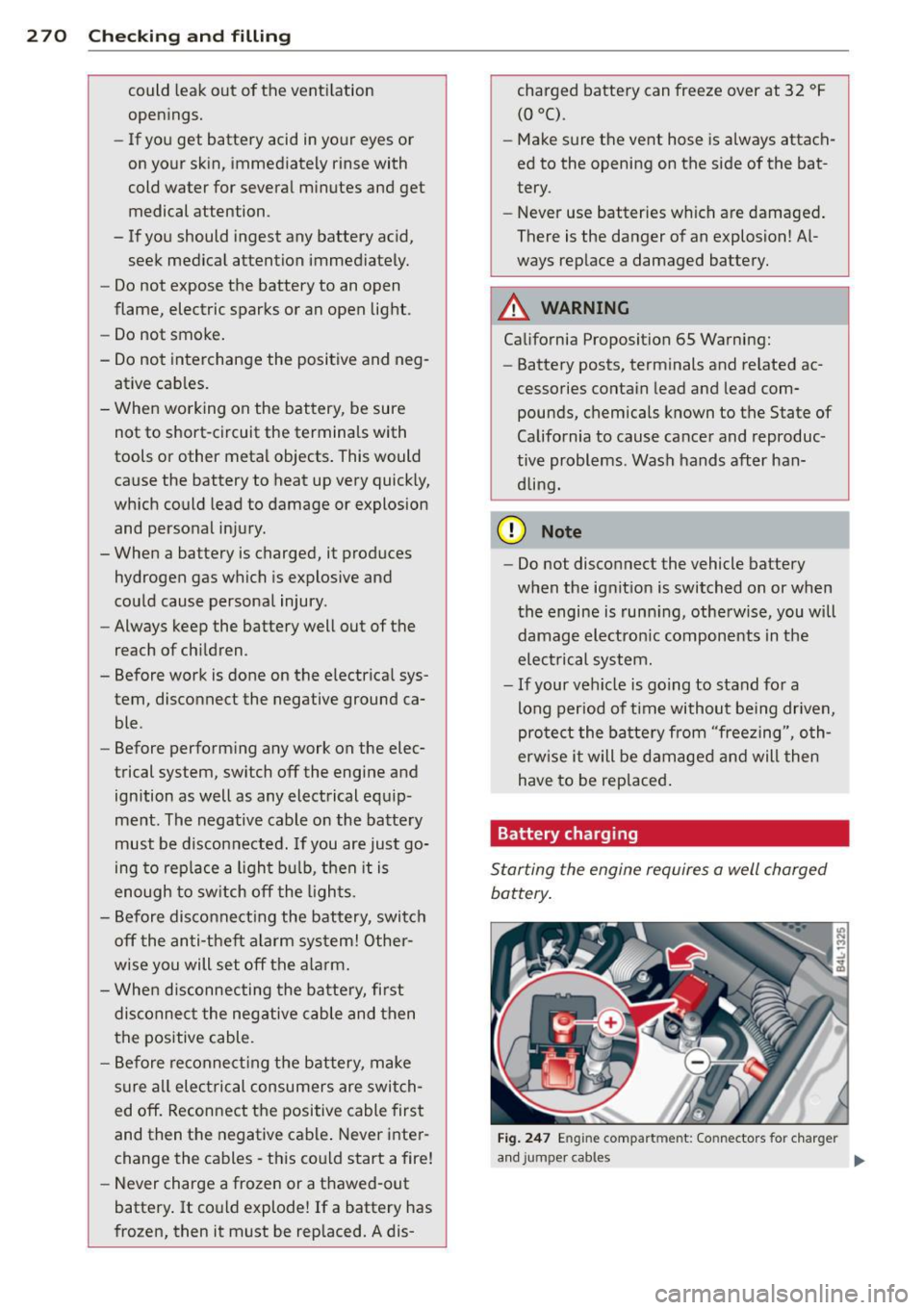
Battery charging
Starting the engine requires a well charged
battery.
Fig. 247 E ngin e compart men t: Co nnectors fo r charger
and j umper cab les
Ill>
Page 274 of 340

272 Ch eck ing and filling
Battery replacement
The new battery must have the same specifi
cations and dimensions as the original equip
ment battery.
Intelligen t energy management in your veh i
cle is respons ible for d istributing the e lectr i
cal en ergy throughout your vehicle
¢
page 229. T he intell igent e nergy manage
ment system w ill keep the eng ine battery
cha rged better then vehicles w ithout this sys
tem . To make sure the additional e lectrica l en
ergy is availab le once again after you have
changed the battery, we recommend that you install batteries of the same type and manu
facture only (the same as those installed at
the time your vehicle was delivered). Specifi
cations are listed on the battery hous ing . Your
author ized dealer must code the battery in
the ene rgy management system to enable you
to use the energy management f unct ions co r
rectly after replac ing the battery.
If it is not poss ible to use a battery of this
type, the new battery must have the same ca
pac ity, voltage (12 volts), amperage , con
struction and plug seal ing.
When insta lling the battery, make sure the ig
n it ion and all e lectr ica l consumers a re turned
off.
Q;) Note
Make sure the venti lation hose on the s ide
of the battery is connected, otherwise
fumes or battery ac id can leak o ut.
@ For the sake of the environment
Because of the problem of proper d isposa l
of a battery, we recommend your autho r
i z ed Audi dealer change the ba tte ry for
you. Bat teries con tain s ulfu ric ac id and
lead and m ust always be disposed of prop
erly in compliance with all environmental
reg ulations. Disposing of vehicle batteries
improper ly is very dangerous to the envi
ronment.
Windshield/headlight
washer container
F ig . 24 8 Eng in e compar tment : cover on t he wi nds hield
and headl ig ht* washe r flu id reservoi r
The washer fluid co nta iner is marked w ith the
symbol Won its cap ¢
fig. 248, ¢ page 259,
fig. 241 .
.. Before you check anything in the engine
compartment,
alwa ys read and he ed all
W ARNING S
¢ & in Working in the engine
compartment on page 257 .
.. Lift the fille r cap tongue to add washer flu
id. You can fi ll the container to the top.
.. Press the cap back onto the fi ller neck afte r
fi lling the container.
You can find the reservo ir
capacity in the table
in
¢ page 315.
Clean water should be used when filling up . If
poss ible, use soft water to prevent scaling on
the washer jets. A lways add a glass clea ne r
so lution (with frost prote ction in the winter).
0 Note
Do not mix engine coolant antifreeze o r
any other additives to fill up the wind
s hi eld washer rese rvoir.
Page 309 of 340

Emergency situations
General
This chapter is intended for trained emer
gency crews and working personnel who have the necessary tools and equipment to
perform these operations.
Starting by pushing or
towing
(D Note
Your v ehicl e is e quipped w ith an automatic
tra nsm iss io n. Cons eque ntly, the e ngine
cann ot be started by pus hing o r tow ing.
Starting with jumper
cables
If necessary, the engine can be started by
connecting it to the battery of another vehi
cle.
If th e engine shou ld fail to start because of a
d ischarged o r weak battery, the battery can be
connected to the battery of
another veh icle,
usi ng a
pair of jumper cables to start the en
gine .
Jumper c ables
Use only jumper cab les of sufficiently large
cross section to carry the starter cur rent safe
l y. Refer to the man ufacturer's specifications.
Use only jumper cables with
insulated te rm i
na l clamps w hich are d istinctly mar ked:
plus(+ ) cable in mos t ca ses co lore d red
minus(-) cable
i n most cases colored black .
A WARNING
Batteries con tai n elec trici ty, a cid, and gas.
Any o f these c an caus e ve ry ser ious or f atal
injury . Follow the instruc tions below fo r
safe han dling of your veh icle's battery .
- Alw ays s hield y our eyes and a void le an
ing over the batte ry w henever possib le .
Emergency situations 307
- A discharged battery can freeze at tem
pe rat ures just below 32 °F (0 °C). Before
connecting a jumpe r cable, you must
thaw the frozen battery c omp lete ly, ot h
e rwise it could explode.
- Do not allow battery acid to co ntact eyes
or skin . Fl ush any con tacted area wi th
wat er immediately .
- Imp roper use of a booster battery to
s tart a vehicle may cause an ex plosion.
- Vehicle batter ies generate expl osive gas
es. Keep sparks, flame and lighted c iga
rettes away from ba tte ries.
- Do not t ry to jump start a ny ve hicle w it h
a low ac id leve l in the battery.
- The voltage of the booste r battery m ust
also have a 12-Vo lt rat ing. T he capac ity
(Ah) of the booste r batt ery sho uld not b e
lowe r than that of th e discharged bat
t ery. Use o f batt eries of d iffe ren t vol tage
or su bstan tia lly differen t "Ah" rat ing
may cause an exp losion and pers onal in
jury .
- N ever ch arge a fr ozen batt ery. Gas t ra p
pe d in the ice may c ause an ex plosion .
- N ev e r ch arge o r use a batt ery th at h as
been fro zen . Th e batte ry case may have
be weake ned.
- U se o f batter ies of di ffere nt vol tage or
substantially differen t ca pa city (Ah) rat
i ng may cause an exp losion and injury .
T he ca pa c ity (Ah) of the booster battery
should not be lower than that of the dis
charged battery.
- Before you check anything in the engine
compa rtment, always read an d heed a ll
WARNINGS
c::;,page 257.
(D Note
-App lyi ng a hi gher vo ltage booste r ba t
t ery wi ll cause expens ive damage to sen
sit ive e lectronic components, such as
cont ro l units, relays, rad io , etc.
- There must be no electrical c ontact be
tween the vehicles as otherw ise current
co uld already start to f low as soon as t he
posi tive(+) terminals a re con nect ed. ..,. •
•