window AUDI Q7 2014 Owner´s Manual
[x] Cancel search | Manufacturer: AUDI, Model Year: 2014, Model line: Q7, Model: AUDI Q7 2014Pages: 340, PDF Size: 85.02 MB
Page 98 of 340
96 Warm and cold
The temperature should be set to 72 ° F
(22 °C) o r higher . Temperat ure is contro lled
automatically. The maximum amount of a ir
flows mainly from the vents below the wind
shield.
To defog the rear side windows, the air vents in the doo r pillars sho uld be open and di rect
ed at the windows .
Manual air recirculation ~
Air recirculation prevents exhaust fumes or
other pollution from entering the vehicle.
Turning on air recirculation
> P ress the l= I button ¢ A
Turning off air recirculation
> Press the~ button agai n, or
> press the IAU TO I button, or
> press th e ~ button.
In the a ir recirculation mode, the air in the
passenger compa rtme nt is recirculated and
fil tered to prevent exhaust fumes and other
pollu tion from en teri ng the veh icle . We rec
ommend that you use the manu al air recircu
l ation under the following conditions :
- when d riving through tunne ls
- in a traffic jam .
A WARNING
Do not use the air reci rc u lat io n mode for
e xte nded per io d s of t i me . T he windows
co uld fo g up since no fres h air ca n e nter
t he vehicle.
If the windows fog up, press
t he air recircu lation button aga in imme di-
-
ately to switch off the air recirculation
f u nction or select defrost.
Rear window defogger~
The rear window defogger clears the rear win
dow of condensation .
> Press the OW button to tur n t he rear window
defogger on and off.
T he rea r window defogger wo rks on ly when
t h e engine is runn ing. The light in t he sw itch
will illumina te when the defogger is on.
T he rea r window defogg er w ill sw itch off au
tomat ica lly afte r a short time. The t ime the
r ear w indow de fogger rema ins o n w ill va ry de
pending on the o utside tempera ture.
At very low outs id e temperatures, the rear
window defogger ca n be sw itched on co nti nu
o usly by pushing the
OW button for more t han
2 seconds . This rema ins stored un til the ign i
t ion is switc hed off.
A rear w indow defogge r th at was switched on
also remains s tore d for 15 m inu tes after the
ignition is sw itche d off . If the engine is re
started withi n these 15 m in utes, the rear win
dow defogger is a lso activated, depending on
o utside temperat ure . With a vehicle that is
parked for a short time, the rear window de
fogger does no t need to be manually activat
ed again .
@ For the sake of the environment
Turn the defogger off when the rear win
dow is clear. When you save electric ity, you
save fue l.
Page 99 of 340
Warm and cold 9 7
Air outlets
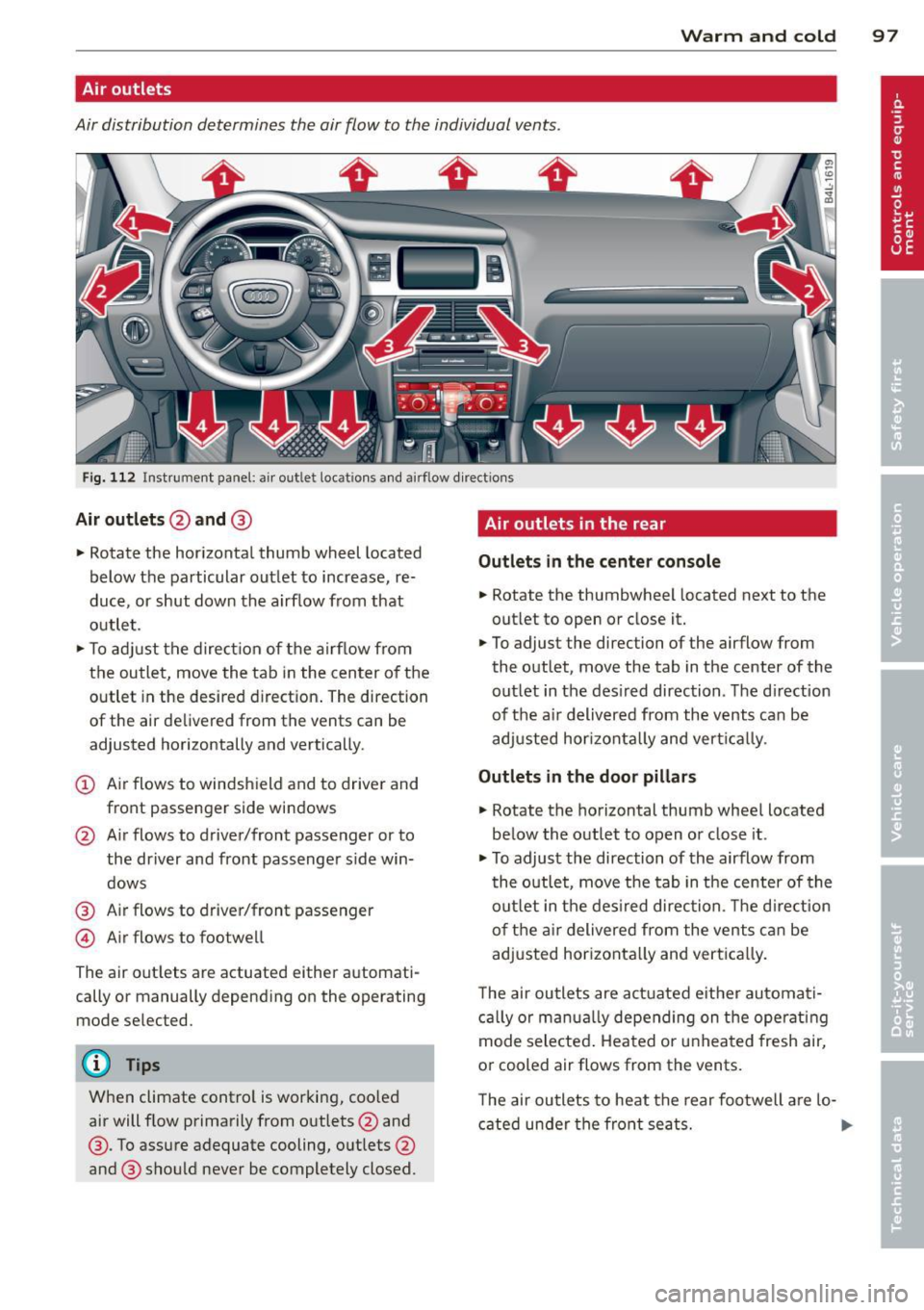
Air distribution determines the air flow to the individual vents .
Fig. 112 Instru ment pane l: a ir outle t loca tion s and a irfl ow d irection s
Air outlets @and @
~ Rotate the hor izonta l thumb wheel located
below the particular outlet to increase, re
duce , or shut down the airflow from that
outlet.
~ T o adj ust the d irect ion of the airflow from
the outlet, move the tab i n the center of the
outlet in the desired di rect ion . The direction
of the air de livered from the vents can be
adjusted horizontally and vertically .
(D Air flows to windshield and to driver and
front passenger side windows
@ Air flows to driver/front passenger or to
the driver and front passenger s ide win
dows
@ Air flows to driver/front passenger
© Air flow s to footwell
The air out lets are actuated either automati
cally or manually depend ing on the operating
mode selected.
@ Tips
When climate contro l is working, coo led
air will flow primarily from outlets @and
@ . To assure adequate cooling, o utlets @
and @ should never be completely closed.
Air outlets in the rear
Outl ets i n the cent er con sole
~ Rotate the thumbwheel located next to the
outlet to open or close it.
~ To ad just the direc tion o f the airflow from
the outlet , move the tab in the center of the
outlet in the des ired direction . The d irection
of the a ir delivered from the v ents can be
adjusted hor izonta lly and ver tically .
Outlets in the door pill ars
~ Rotate the horizontal thumb whee l located
be low the outlet to open or close it .
~ To adjust the direction of the airflow from
the outlet, move the tab in the center of the
out let in the des ired direction. The d irect ion
of the a ir delivered from the vents ca n be
adjusted horizonta lly and ver tica lly.
T he air outlets are actuated e ither automati
ca lly or ma nua lly depending on the operat ing
mode selected . Heated o r unheated fresh air,
o r cooled air flows from the vents.
T he air outlets to heat the rear footwell a re lo-
cated under the fron t seats. ..,.
Page 102 of 340
100 Warm and cold
Rear air distribution ~
Applies to vehicles: wit h fou r-zone a utomat ic comfort a ir
co ndit io ning
The automatically controlled air distribution
con be changed manually.
., Press the [a button.
., Rotate the regulator to the desired setting.
You can adjust the air circulation so that air
flows from specific vents.
- In position
:J, all air flows from the vents in
the center console and the outlets to the
door pillars.
- In position
:0, air flows from the outlets in
the door pillars.
- In position~, air flows from the outlets un-
der the front seats.
There are additional combinations available to
adjust air distribution as needed.
To regulate air distribution automatically,
switch to IAUTOI.
Basic settings
General
The basic climate control settings con be ad
justed in the MMI.
., Select : I CAR ! function button > AC control
button . Or
., Select : ICAR !function button>
Car systems*
control button > AC.
The following functions can be selected:
- Auto recirculation
r::;, page 100
-Synchronization r::;, page 100
- Supplementary heater* c;,poge 101
- Rear operation* c;,poge 101
Automatic recirculation mode '
An air quality sensor detects increased con
centrations of pollutants in the outside air
and automatically switches to recirculation
mode .
We recommend that you always keep auto
matic air recirculation ON to prevent polluted
outside air from entering the vehicle interior.
If the
air quality sensor located in the air con
ditioning system detects polluted outside air,
the sensor decides whether the air pollution
can be reduced by the factory-installed pollu
tant filter or whether it is necessary to switch
to air recirculation. With heavy concentrations
of pollutants, the air conditioning system is
switched automatically to recirculation mode
and the supply of outside air is blocked. As
soon as the concentration of pollutants in the
outside air drops, fresh air is supplied to the
vehicle interior again.
In the event that the windows fog up during
automatic air recirculation, you must press
the® button immediately .
Under certain operating conditions, automatic
air recirculation is switched off automatically.
With outside temperatures below about SO °F
(+10 °(), automatic air recirculation is limited
to 30 seconds. With outside temperatures be low about 30 °F
( - 1 °() and with the air condi
tioner switched off, the automatic air recircu lation is limited to 15 seconds.
Synchronization
One climate control setting for the driver and
front passenger seats .
With synchronization active, the driver's set
tings are adopted for the passenger or vice
versa. All the other settings that were made
are transferred to the other seat . This in
cludes all the climate control settings, except
for the seat heating/ventilation* .
If a different setting is selected at a
"synchronized seat ", synchronization is can
celled.
Page 166 of 340
164 Driving Safel y
Driving Safely
General notes
Safe driving habits
Please remember -safety first!
This chapter contains important information,
tips, instructions and warnings that you need
to read and observe for your own safety, the
safety of your passengers and others . We have
summarized here what you need to know
about safety belts, a irbags, ch ild restra ints as
well as child safety. Your safety is for us
priori
ty number 1.
Always observe the info rmat ion
and warn ings in th is sect ion -fo r yo ur own
safety as well as that of your passengers .
The information in this se ction app lies to all
model ve rsions of your veh icle . Some of the
feat ures desc ribed in this sec tions may be
standard equipment on some models, or may
be optional equipment on others . If you are
not sure, ask your authorized Aud i dealer.
A WARNING
- Always make sure that you follow the in
struct ions and heed the WARNINGS in
this manual. It is in your interest and in
the inte rest of you r passengers.
- Always keep all of the Owner's Literature
man uals in your Audi when you lend or
sell your veh icle so that this impo rtant
information will a lways be availab le to
the drive r and pas sengers.
- Always keep the Owner's Literature han
dy so tha t you can find it easily if yo u
have ques tions.
Safety equipment
The safety features are part of the occupant
restraint system and work together to help
redu ce the risk of injury in a wide variety of
accident situations.
Your safety and the safety of you r passenge rs
should not be left to chance. Advances in
technology have made a varie ty o f fea tures
avai la bl e to he lp re duce the risk of inj ury in an accident
. The following is a list of just a few of
the safety features in your Audi:
- sophis tic ated s afety be lts for d rive r and a ll
passenger sea ting pos it ions,
- be lt te nsione rs fo r th e fro nt sea ts a nd the
ou ter sea ting posit ions in the second row
seating,
- be lt h eight adjustment fo r th e front sea ts
an d the o ute r seat ing pos itions in the sec
ond row seating,
- he ad restra ints for e ach sea ting pos ition,
- fro nt airbags,
- side airbags in the fro nt seats and the outer
seating positions in the second row seat ing*,
- side curta in ai rbags,
- specia l LATCH anchorages for child re-
st raints,
- ad justab le steering colum n.
These individual safety features, can work to gether as a system to he lp protect you and
your passengers in a wide range of accidents .
These features cannot work as a system if
they are not always correctly adjusted and cor rectly used .
Safety is everybody's responsibil ity!
Important things to do before driving
Safety is everybody 's job! Vehicle and occu
pant safety always depends on the informed
and careful driver.
Fo r yo ur safety and the safety of your passen
gers,
before driving always:
.. Ma ke s ure t hat all lights and sign als are op
erati ng correctly .
.. Make s ure t hat the tire pressure is correct.
.. Make s ure that all windows are clean and af
ford good vis ibility to the outs ide.
.. Secure all luggage and other items carefu lly
¢ page 88.
.. Make s ure that nothing can inte rfere with
the peda ls.
.. Adj ust fron t seat, head restraint and m irrors
correc tly fo r you r height . .,.
Page 170 of 340
168 Driving Safely
• Adjust the head restraints so the upper edge
is as even as possible with the top of your
head. If that is not possib le, try to adjust
the head restraint so that it is as close to
this position as possible
Q fig . 194.
• If there are passengers in rear seat, fo ld the
head restraints up on the occupied seats or
s lide the cent er head restra int upward at
least to the next notch.
Adjusting head restraints
Q page 77 .
A WARNING
All seats are equipped with head re
straints. Dr iv ing without head restraints or
w ith head restra ints tha t are not properly
adjusted incre ases the risk of ser io us or fa
t al neck injury dramat ically. To help reduce
the risk of inju ry:
- Always drive with the he ad restraints in
place and proper ly adjusted.
- E very pe rson in the veh icle must have a
properly ad justed head restra int .
- Alw ays m ake su re e ach pe rso n i n the ve
hicle proper ly adjusts the ir head re
st raint . Ad just the head restrain ts so the
upper edge is as even as possi ble wit h
the top of your head . If that is not possi
ble, try to adjust the head restra int so
that it is as close to this position as pos
sible .
- Never attempt to adjust head rest raint
wh ile driving. If you have driven off and
must adjust the dr ive r head rest for any
reason, first stop the vehicle safe ly be
fore attempting to adjust the head re
s t rain t.
- Children must always be properly re
stra ined in a ch ild restrai nt tha t is appro
pr iate for their age a nd s ize
Q page 204.
Examples of improper seating positions
The occupant restraint system can only re
duce the risk of injury if vehicle occupants are
properly sea ted.
Imp roper sea ting posit ions can ca use serio us
in ju ry or death . Safe ty belts can on ly work when they are properly positioned on the
body. Improper seating positions red uce the
effectiveness of safety belts and wi ll even in
crease the r isk of injury and death by moving
the safety belt to crit ica l areas of the body.
Improper seating positions a lso inc rease the
risk of ser ious in jury and death when an a ir
bag dep loys and str ikes an occupant w ho is
not in the p roper seating posi tion. A dr iver is
responsible fo r the s afety of all ve hicle occu
pan ts and espec ially for child ren . There fore :
• Never allow anyone to assume an incor rect
seating posi tion when the vehicle is bei ng
used
Q .&, .
The following bulle tins list o nly some sample
pos it ions that w ill increase the r isk of serious
i njury and dea th. O ur hope is that t hese exam
ples will ma ke yo u more aware o f seat ing po
s itions that are dangerous .
Therefore, whenever the vehicle is
moving:
- never sta nd up in t he vehicle
- neve r sta nd on the seats
- neve r kneel on the seats
- neve r ride wit h the seatback reclined
- never lie down on the rear seat
- neve r lean up against the instrument panel
- neve r sit on the edge of the seat
- neve r sit sideways
- neve r lean out t he window
- neve r put your feet out the window
- never put your feet on the instrument panel
- never rest your feet on the seat cush ion or
back of the seat
- never ride in the footwell
- neve r ride in the ca rgo a rea
A WARNING ._
Improper seating posit ions increase the
risk of ser ious persona l injury and death
whenever a vehicle is being used.
-Always make sure that all vehicle occ u-
pants stay in a proper seating position
and are p roperly rest rained whenever the
veh icle is being used .
-
Page 172 of 340
1 7 0 Dr iving Safel y
Stowing luggage
Loading the luggage compartment
All luggage and other objects must be prop
erly stowed and secured in the luggage com
partment.
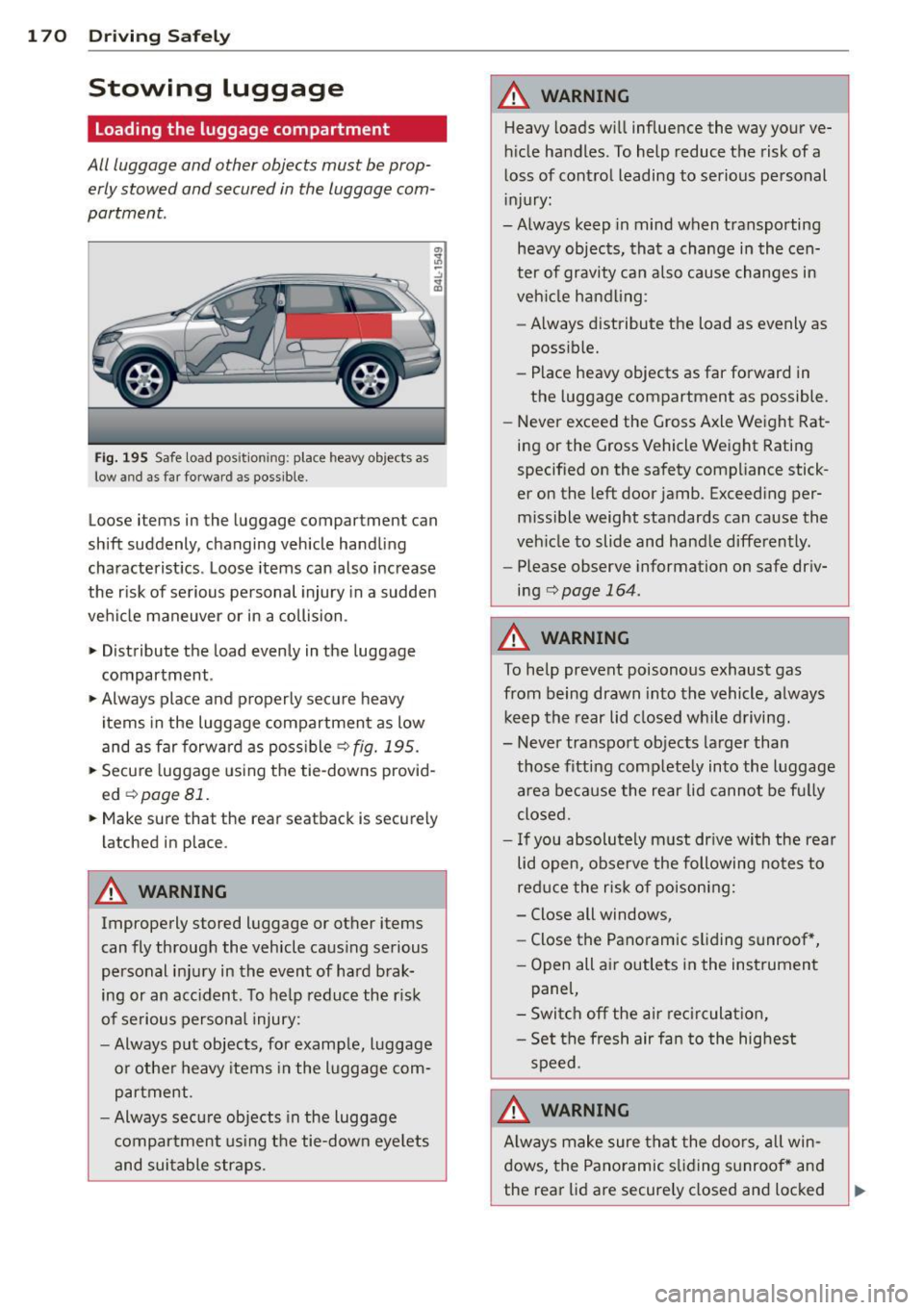
Fig . 195 Safe load position ing: place heavy objects as
low a nd as far forward as possible.
Loose items in the luggage compartment can
shift suddenly, changing vehicle handling
characteristics . Loose items can also increase
the r isk of serious personal injury in a sudden
vehicle maneuver or in a collision .
,. Distribute the load evenly in the luggage
compartment .
,. Always place and properly secure heavy
items in the luggage compartment as low
and as far forward as possible
¢fig. 195.
,. Secure luggage using the tie-downs provid
ed
¢ page Bl.
,. Make sure that the rear seatback is securely
l atched in place .
A WARNING
Improperly stored luggage or other items
can fly through the vehicle caus ing serious
personal inj ury in the event of hard brak
ing or an acc ident. To help reduce the r isk
of serious personal injury :
- Always put objects, for example, luggage
or other heavy items in the luggage com
partment.
- Always secu re objects in the luggage
compartment using the tie-down eyelets
and suitable straps.
A WARNING
-Heavy loads wi ll influence the way your ve-
hicle handles. To help reduce the risk of a
loss of control leading to serious personal
in jury:
-Always keep in mind when transporting
heavy objects, that a change in the cen
ter of gravity can also cause changes in
veh icle handling:
- Always distribute the load as evenly as
possible.
- Place heavy objects as far forward in
the luggage compartment as possible.
- Never exceed the Gross Axle Weight Rat
ing or the Gross Vehicle Weight Rating
specified on the safety compliance stick
er on the left door jamb. Exceeding per
missible weight standards can cause the
veh icle to slide and handle differently.
- Please observe information on safe driv
ing
r=;,page 164.
A WARNING
-
To help prevent poisonous exhaust gas
from being drawn into the vehicle, a lways
keep the rear lid closed while driving.
- Never transport objects larger than
those fitting comp letely into the luggage
area because the rear lid cannot be fully
closed.
- If you absolutely m ust dr ive with the rear
lid open, observe the following notes to
reduce the risk of poisoning:
- Close all windows,
- Close the Panoramic sliding sunroof *,
- Open all air outlets in the instrument
pane l,
- Switch off the air recirculat ion,
- Set the fresh air fan to the highest
speed.
A WARNING
A lways make sure that the doors, all win
dows, the Panoramic sliding sunroof * and
the rear lid are securely closed and locked
-
Page 173 of 340
to reduce the risk of inj ury when the vehi
cle is not be ing used.
- After closing the rear lid, always make
sure that it is properly closed and locked.
- Never leave your vehicle unattended es
pecially with the rear lid left open . A
child could crawl into the vehicle through
the luggage compartment and close the
rear lid becoming trapped and unable to
get out . Be ing trapped in a vehicle can
lead to serious persona l injury .
- Never let children play in or around the vehicle .
- Never let passengers r ide in the luggage
compartment . Veh icle occupants must
always be properly restrained in one of
the vehicle's seating positions.
(D Tips
- Air c irculation helps to reduce window
fogging . Sta le air escapes to the outside
th rough vents in the trim pane l. Be sure
to keep these slots free and open .
-The t ire pressure must correspond to the
load. The t ire pressure is shown on the
tire p ress ure label. The tire pressure la
bel is located on the d river's s ide B-pi llar.
The t ire pressure label lists the recom
mended cold tire inflat ion pressures for
the vehicle at its maximum capacity
weight and the tires that were on your
vehicle at the time it was manufactured .
For recommended t ire pressures for nor
mal load conditions, please see chapter
c:> page277 .
Tie-downs
The luggage compartment is equipped with
four tie-downs to secure luggage and other
items .
Use the tie-downs to secure your cargo prop
erly
c:> page 1 70, Loading the luggage com
partment.
In a coll is ion, the l aws of phys ics mean that
even smaller items that are loose in the vehi
cle will become heavy missiles that can cause
Dr iving S afel y 171
serious injury. Items in the veh icle possess en
ergy which vary with vehicle speed and th e
weight of the item . Vehicle speed is the most
s ignificant factor.
For example, in a fronta l collision at a speed
of 30 mph (48 km/h), the forces acting on a
10 -lb (5 kg) object are about 20 times the
normal weight of the item. This means th at
the weigh t of the item would suddenly be
about 200 lbs. (90 kg) . You can imagine the
i njur ies that a 200 lbs . (90 kg) item flying
freely th rough the passenger compartment
could cause in a co llision like this.
A WARNING
Weak, damaged or improper straps used
to secure items to tie-downs can fail dur
ing hard braking or in a collision and cause
serious personal injury.
-Always use s uitable mount ing straps and
properly secu re items to the tie-downs in
the l uggage compartment to he lp pre
vent items from shift ing or f lying fo r
ward as dangerous missiles.
- When the rear seat backrest is folded
down, a lways use suitable mounting
straps and properly secure items to the
tie-downs in the luggage compartment
to help p revent items from fly ing for
ward as dangerous missiles into the pas
senger compartment .
- Never attach a chi ld safety seat tether
strap to a t ie-down .
Reporting Safety
Defects
Applicable to U.S.A.
If yo u b elieve that your vehicle
ha s a defec t w hi ch could cau se
a c rash or co uld cause i njur y or
d ea th, you sh ould imm ediat ely
inform th e National Hi ghwa y
Tr affi c Sa fet y Admini strati on ..,.
•
•
Page 179 of 340
forces on the body more "tolerable" and less likely to cause injury.
Although these examples are based on a fron
tal collision , safety belts can also substantial
ly reduce the risk of injury in other kinds of
crashes. So, whether you're on a long trip or
just going to the corner store, always buckle
up and make sure others do, too. Accident sta
tistics show that vehicle occupants properly
wearing safety belts have a lower risk of being
injured and a much better chance of surviving
an accident . Properly using safety belts also
greatly increases the ability of the supplemen
tal airbags to do their job in a collision. For
this reason, wearing a safety belt is legally re
quired in most countries including much of
the United States and Canada.
Although your Audi is equipped with airbags ,
you still have to wear the safety belts provid
ed. Front airbags, for example, are activated
only in some frontal collisions. The front air
bags are not activated in all frontal collisions,
in side and rear collisions, in roll overs or in
cases where there is not enough deceleration
through impact to the front of the vehicle .
The same goes for the other airbag systems in
your Audi. So, always wear your safety belt
and make sure everybody in your vehicle is
properly restrained!
Important safety instructions about
safety belts
Safety belts must always be correctly posi
tioned across the strongest bones of your
body.
.,. Always wear safety belts as illustrated and
described in this chapter.
.,. Make sure that your safety belts are always
ready for use and are not damaged.
A WARNING
Not wearing safety belts or wearing them
improperly increases the risk of serious
personal injury and death. Safety belts can
work only when used correctly .
Safety belts 177
-Always fasten your safety belts correctly
before driving off and make sure all pas
sengers are correctly restrained.
- For maximum protection, safety belts
must always be positioned properly on
the body .
- Never strap more than one person, in cluding small children, into any belt .
- Never place a safety belt over a child sit
ting on your lap.
- Always keep feet in the footwell in front
of the seat while the vehicle is being driv
en.
- Never let any person ride with their feet
on the instrument panel or sticking out
the window or on the seat.
- Never remove a safety belt while the ve hicle is moving. Doing so will increase
your risk of being injured or killed .
- Never wear belts twisted.
- Never wear belts over rigid or breakable
objects in or on your clothing, such as
eye glasses, pens, keys, etc., as these
may cause injury.
- Never allow safety belts to become dam aged by being caught in door or seat
hardware .
- Do not wear the shoulder part of the belt
under your arm or otherwise out of posi
tion .
- Several layers of heavy clothing may in
terfere with correct positioning of belts
and reduce the overall effectiveness of
the system .
- Always keep belt buckles free of anything
that may prevent the buckle from latch
ing securely .
- Never use comfort clips or devices that
create slack in the shoulder belt. Howev
er, special clips may be required for the
proper use of some child restraint sys
tems .
- Torn or frayed safety belts can tear, and
damaged belt hardware can break in an
accident. Inspect belts regularly. If web-
bing, bindings, buckles, or retractors are .,..
L,_ _______________ _J
•
•
Page 196 of 340
194 Airbag sys te m
aw ay by ge tting out of the vehicle or
o pening windows or doors.
- If you are in a collision in which airbags
deploy, wash your hands and face with
mild soap and water before eating.
- Be careful not to get the dust into your
eyes, or into any cuts or scratches.
- If the residue should get into your eyes,
flush them with water.
Monitoring the
Advanced Airbag
System
Airbag monitoring indicator light
Two separate indicators monitor the function
of the Advanced Airbag System: the airbag
monitoring indicator Light and the
PASSEN
GER AIR BAG OFF
light.
The Advanced Airbag System (including the
e lectronic control un it, sensor circuits and sys
tem wiring) is monitored cont inuously to
make sure that it is functioning properly
whenever the ignit ion is on . Each t ime you
turn on the ignition, the airbag monitoring in
d icator light
I will come on fo r a few seconds
(self diagno stics) .
The system mu st be inspected when the
indicator light
I :
- does not come on when the ignit io n is
switched on
- does not go out a few seconds after you
have swi tched on the ign ition, o r
- comes on while driving
If an airbag system malfunct ion is detected,
the ind icator light will fi rst start flash ing to
catch the driver's attention and then stay on
continuously to serve as a constant reminder
to have the system inspected immediately .
If a malfunction occurs that turns the front
a ir bag on the passenger side off, the
PAS SEN
GER AIR BAG OFF
li ght w ill come on and stay
on whenever the ignition is on.
A WARNING
An a irbag system that is not functioning
properly cannot provide supplemental pro
tection in a frontal crash.
- If the airbag ind icator light¢
page 16
comes when the veh icle is being used,
have the system inspected immediately
by your authori zed Audi dealer. It is pos
sib le that the airbag will infla te when it
is not supposed to, or will not infla te
when it should .
PASSENGER AIR BAG OFF light
-
.r--------------,
------------------
Fig. 210 Sect io n from the instru men t pa nel: PASS EN
GER AIR BAG OFF lig ht
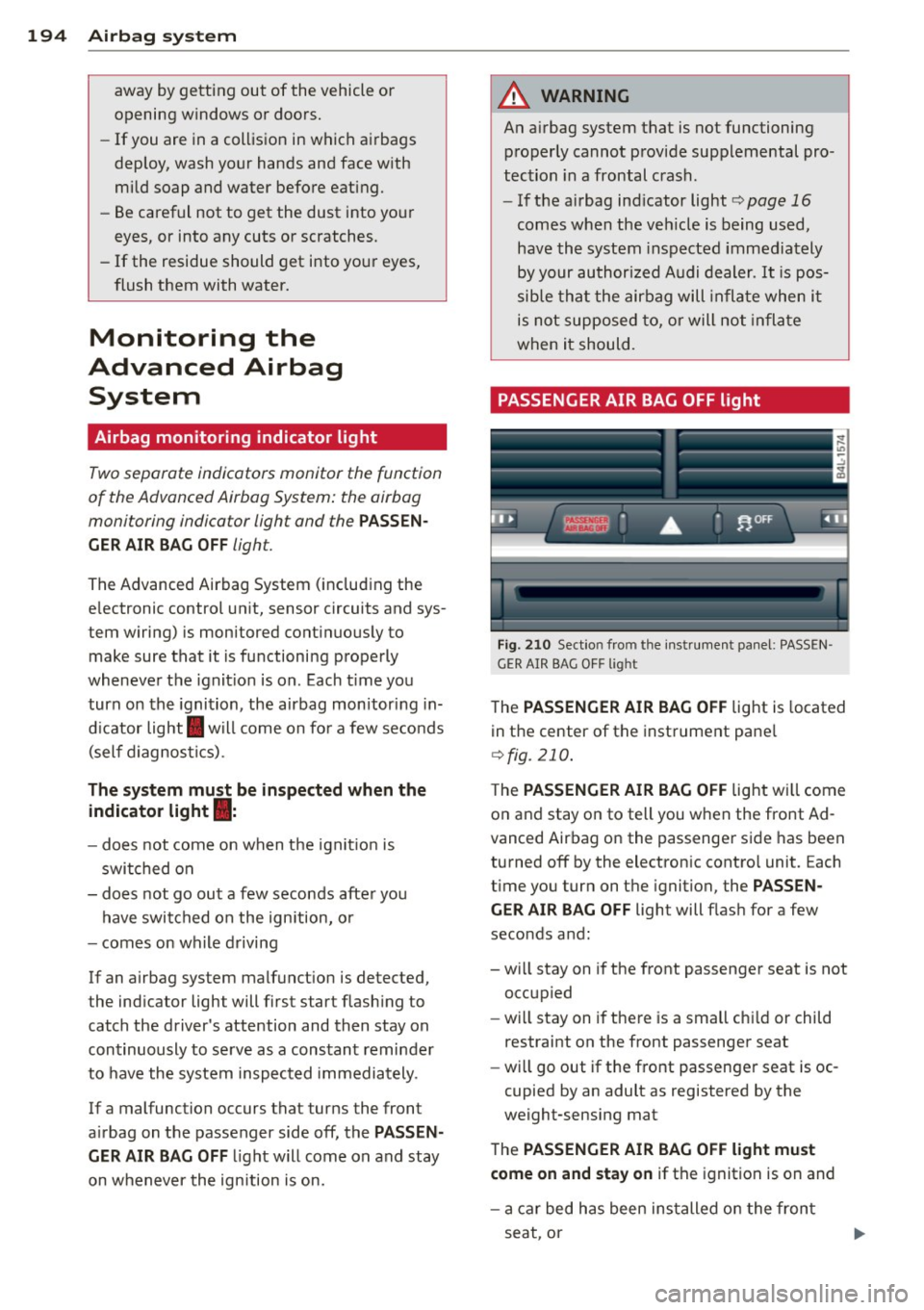
The PASSENGER AIR BAG OFF light is located
in the center of the instrument pane l
¢fig . 210.
T he PAS SENGER AIR BAG OFF light wi ll come
on and stay on to tell you w hen the front Ad
vanced Airbag on the passenger side has been
turned off by the electron ic contro l unit. Each
t ime you turn on t he ignition, the
PASSEN
GER AIR BAG OFF
light will flas h for a few
seconds and:
- w ill stay on if the front passenger seat is not
occupied
- will stay on i f the re is a small chi ld or child
restraint on the front passenger seat
- will go out if the front passenger seat is oc
cupied by an adult as registered by the
weight-sensing mat
T he
PASSENGER AIR BAG OFF light must
come on and sta y on
if the ignition is on and
- a car bed has been ins talled on the fron t
seat, or
Page 202 of 340
200 Airbag system
How supplemental side airbags work
Side airbags deploy instantly and con help re
duce the risk of upper torso injuries for occu
pants who ore properly restrained.
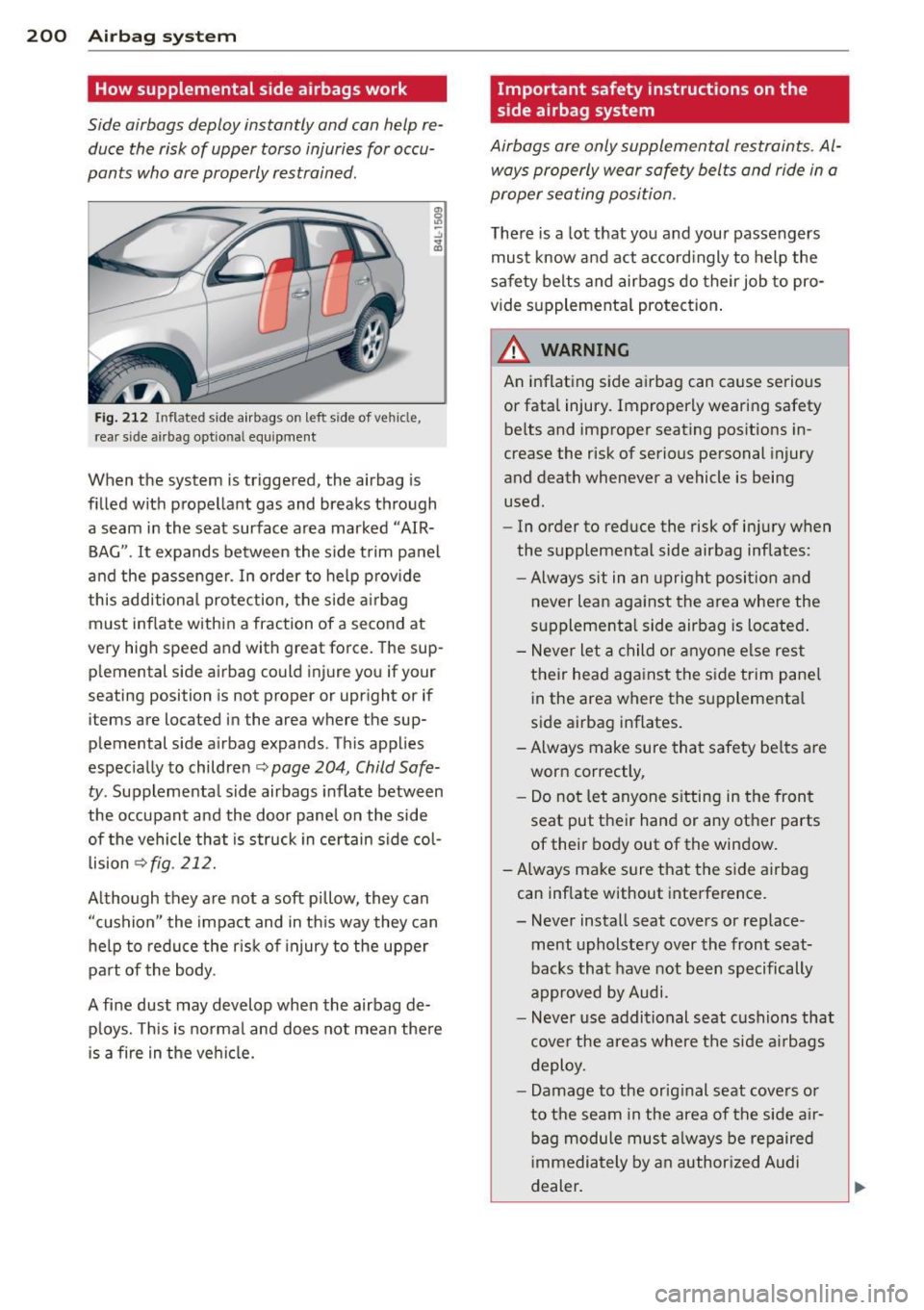
Fig. 212 Infl ated sid e airbags o n left side of vehicle,
r ea r sid e airbag optional equipment
ID
When the system is triggered, the airbag is
filled with propellant gas and breaks through
a seam in the seat surface area marked "AIR
BAG".
It expands between the side trim panel
and the passenger . In order to help provide
this additional protection, the side airbag must inflate within a fraction of a second at
very high speed and with great force. The sup
plemental side airbag could injure you if your
seating position is not proper or upright or if
items are located in the area where the sup
plemental side airbag expands . T hi s applies
especially to children
c::> page 204, Child Safe
ty .
Supplemental side airbags inflate between
the occupant and the door panel on the side of the vehicle that is struck in certain side col
lision
c::> fig . 212.
Although they are not a soft pillow, they can
"cushion" the impact and in this way they can
help to reduce the risk of injury to the upper
part of the body.
A fine dust may develop when the airbag de ploys. This is normal and does not mean there
is a fire in the vehicle.
Important safety instructions on the
side airbag system
Airbags ore only supplemental restraints. Al
ways properly wear safety belts and ride in a
proper seating position.
There is a lot that you and your passengers
must know and act accordingly to help the
safety belts and airbags do their job to pro
vide supplemental protection.
A WARNING
An inflating side airbag can cause serious
or fatal injury. Improperly wearing safety belts and improper seating positions in
crease the risk of serious personal injury
and death whenever a vehicle is being
used.
- In order to reduce the risk of injury when
the supplemental side airbag inflates:
- Always sit in an upright position and
never lean against the area where the
supplemental side airbag is located.
- Never let a child or anyone else rest
their head against the side trim panel
in the area where the supplemental
side airbag inflates.
-Always make sure that safety belts are worn correctly,
- Do not let anyone sitting in the front
seat put their hand or any other parts
of their body out of the window.
-Always make sure that the side airbag can inflate without interference.
- Never install seat covers or replace
ment upholstery over the front seat
backs that have not been specifically
approved by Audi.
- Never use additional seat cushions that
cover the areas where the side airbags
deploy.
- Damage to the original seat covers or
to the seam in the area of the side air
bag module must always be repaired
immediately by an authorized Audi
dealer.