ignition AUDI Q7 2014 Owner´s Manual
[x] Cancel search | Manufacturer: AUDI, Model Year: 2014, Model line: Q7, Model: AUDI Q7 2014Pages: 340, PDF Size: 85.02 MB
Page 197 of 340
-a rearward-facing child restraint has been
installed on the front passenger seat, or
- a forward -facing child restraint has been in
stalled on the front passenger seat, or
- the weight registered on the front passen
ger seat is equa l to or less than the com
bined weight of a typical 1 year-old restrain
ed in one of the rear-facing or forward-fac
ing infant restraints listed in Federal Motor
Vehicle Safety Standard 208 w ith which the
Advanced Airbag System in your vehicle was
certified .
If the front passenger seat is not occupied,
the front airbag will not deploy, and the
PAS ·
SENGER AIR BAG OFF
light will stay on. Nev
er install a rearward-facing child restra int on
the front passenger seat, the safest place for
a child in any kind of child restraint is at one
of the seating positions on the rear seat
¢ page 185, Child restraints on the front seat
- some important things to know
and
¢ page 204, Child Safety.
If the PASSENGER AIR BAG OFF light comes
on
when one of the conditions listed above is
met, be sure to check the light regularly to
make certain that the
PASSENGER AIR BAG
OFF
li ght stays on continuous ly whenever the
ignition is on. If the
PASSENGER AIR BAG
OFF
light does not appear on and does not
stay on all the time, stop as soon as it is safe
to do so and
- reactivate the system by turning the ignition
off and then turning it on again;
- remove and reinstall the chi ld restraint .
Make sure that the child restraint is properly
installed and that the safety be lt for the
front passenger seat has been correctly
routed through the child restraint as descri
bed in the chi ld restraint manufacturer's in
st ructio ns;
- make sure that the convert ible locking fea
ture on the safety belt for the front passen
ger seat has been activated and that the
sa fety belt has been pulled tight. The belt
must not be loose or have loops of slack so
that the sensor below the safety belt latch
on the seat can do its job
¢ page 214.
Airbag system 195
-make sure that things that may increase the
weight of the child and chi ld safety seat are
not being transported on the front passen
ger seat;
- make s ure that the safety belt tension sen
sor is not blocked. Shake the safety belt
latch on the front passenger seatback and
forth;
- If a strap or tether is be ing used to tie the
child safety seat to the front passenger
seat, make sure that it is not so tight that it
causes the weight-sensing mat to measure
more weight than is actually on the seat.
If the PASSENGER AIR BAG OFF light still
does not come on
and does not stay on con
t inu ously (when the ignition is switched on),
- take the child restraint off the front passen-
ger seat and install it proper ly at one of the
rear seat positions . Have the airbag system
inspected by you r authorized Aud i dealer
immed iate ly.
- move the ch ild to a rear seat position and
make sure that the child is properly restra in
ed in a child restraint that is appropriate for
its size and age.
The
PASSENGER AIR BAG OFF light should
NOT come on when the ignition is on and an
adult is s itting in a proper seating position on
the front passenger seat. If the
PASSENGER
AIR BAG OFF
light comes on and stays on or
flashes for about 5 seconds wh ile driving, un
der these circumstances, make sure that:
- the adult on the front passenger seat is
properly seated on the cente r of the seat
cushion with his or her back up against the
backrest and the backrest is not reclined
¢ page 165, Proper occupant seating posi
tions,
- the adult is not taking weight off the seat by
holding on to the passenger assist handle
above the front passenger door or support
ing their weight on the armrest,
- the safety be lt is being properly worn and
that there is not a lot of slack in the safety
be lt webb ing, .,..
•
•
Page 204 of 340
202 Airbag system
inflates in side impacts and only when the ve
hicle acceleration registered by the control
unit is high enough. If this rate is below the
reference value programmed into the contro l
unit, the side airbags will not be triggered,
even though the car may be badly damaged as
a result of the collision . It is not possible to
define an airbag triggering range that will
cover every possible angle of impact, since the
circ umstances w ill vary cons iderably between
one co llision and another. Important factors
include, for examp le, the nat ure (hard or soft)
of the impacting object, the angle of impact,
vehicle speed, etc. c:>
page 202, How side cur
tain airbags work.
Aside from their normal safety function, safe
ty belts work to he lp keep the driver or front
passenger in position in the event of a co lli
sion so that the side curta in airbags can pro
vide protection.
The airbag system is not a substitute for your
safety belt. Rather, it is part of the overall oc
cupant restraint system in your ve hicle. Al
ways remember that the airbag system can
only help to protect you if you are wearing
your safety belt a nd wear ing it prope rly. Th is
is ano ther reason why you shou ld a lways wear
your safety bel ts, not just beca use the law re
qu ires you to do soc:>
page 174, General
notes.
It is important to remember that whi le the
side curta in a irbag system is des igned to he lp
redu ce the like lihood of serious injuries, othe r
injuries, fo r example, swell ing, bruising, and
minor abrasions can also be associated wit h
these airbags upon deployment. Remember
too, these a irbags w ill deploy on ly once and
only in certain kinds of accidents -your safety
be lts are a lways there to offer protection .
The side curtain airbag system basically
con sists of :
-The electronic control module and external
side impact sensors
- The side curtain airbags above the front and rear side w indows - The airbag indicator light in the instrument
panel
T he airbag system is mon itore d elec tronically
to make certain i t is func tioning properly at all
times . Each t ime you turn on the ignition, the
airbag system indicator light will come on for
a few seconds (sel f diagnostics).
The side curtain airbag is not activated:
- if the ignition is turned off
- in side co llision s when the accele ration
meas ured by the sensor is too low
- in rear-end col lisions .
A WARNING
-Safety belts and the airbag system will
only provide pro te ction when occupant s
are i n the proper seating posi tion
<=>page 72, General recommendations.
- If th e airbag ind ica tor light <=>page 16
comes when the veh icle is being used,
have the system inspected immediately
by your authorized A udi dealer. It is pos
sible that the airbag will inflate when it
is not supposed to, or will not inflate
when it should .
How side curtain airbags work
Side curtain airbags can work together with
side airbags to help reduce the risk of head
and upper torso injuries for occupants who
are properly restrained .
Fig. 2 14 Illust rat ion of p rincip le : I n flated side curtai n
airbags o n th e left side
The side curtain airbags inflate between the
occupant and the windows on the s ide of the
IJ>
Page 207 of 340
-Always install rear-facing child safety
seats on the rear seat.
- If you must install a rearward facing
child safety seat on the front passenger
seat in exceptional circumstances and
the
PASSENGER AIR BAG OFF light does
not come on and stay on, immediately
install the rear-facing child safety seat in
a rear seating position and have the air
bag system inspected immediately by
your Audi dealer.
_& WARNING
If, in exceptional circumstances, you must
install a forward-facing child restraint on
the front passenger's seat:
- Always make sure the forward-facing
seat has been designed and certified by its manufacturer for use on a front seat
with a passenger front and side airbag.
- Always follow the manufacturer's in
structions provided with the child safety
seat or carrier.
- Always move the passenger seat into its
rearmost position in the seat's fore and
aft adjustment range, as far away from
the airbag as possible before installing
the child restraint. The backrest must be
adjusted to an upright position .
- Always make sure that the
PASSENGER
AIR BAG OFF
light comes on and stays
on all the time whenever the ignition is
switched on.
(D Tips
Always replace child restraints that were
installed in a vehicle during a crash. Dam
age to a child restraint that is not visible
could cause it to fail in another collision
situation.
Advanced front airbag system and children
Your vehicle is equipped with an "Advanced
Airbag System" in compliance with United
States Federal Motor Vehicle Safety Standard
Child Safety 205
(FMVSS) 208 as applicable at the time your
vehicle was manufactured.
The Advanced Airbag system in your vehicle
has been certified to meet the "low-risk" re
quirements for 3- and 6-year old children on
the passenger side and small adults on the driver side. The low risk deployment criteria
are intended to reduce the risk of injury
through interaction with the airbag that can
occur, for example, by being too close to the
steering wheel and instrument panel when
the airbag inflates . In addition, the system
has been certified to comply with the "sup
pression" requirements of the Safety Stand
ard, to turn off the front airbag for infants up
to 12 months who are restrained on the front
passenger seat in child restraints that are list
ed in the Standard.
Even though your vehicle is equipped with an
Advanced Airbag system, all children, espe cially those 12 years and younger, should al
ways ride in the back seat properly restrained
for their age and size. The airbag on the pas
senger side makes the front seat a potentially dangerous place for a child to ride . The front
seat is not the safest place for a child in a for
ward-facing child safety seat. It can be a very
dangerous place for an infant or a larger child
in a rearward-facing seat .
Advanced Airbags and the weight
sensing mat in the front seat
The Advanced Airbag System in your vehicle
detects the presence of an infant or child in a
child restraint on the front passenger seat us
ing the weight -sensing mat in the seat cush
ion and the sensor below the safety belt latch
on the front passenger seat that measures the
tension on the safety belt.
The weight -sensing mat measures total
weight of the child and the child safety seat
and a child blanket on the front passenger seat. The weight on the front passenger seat
is related to the design of the child restraint
and its "footprint", the size and shape of the
bottom of the child restraint as it sits on the ..,.
•
•
Page 209 of 340
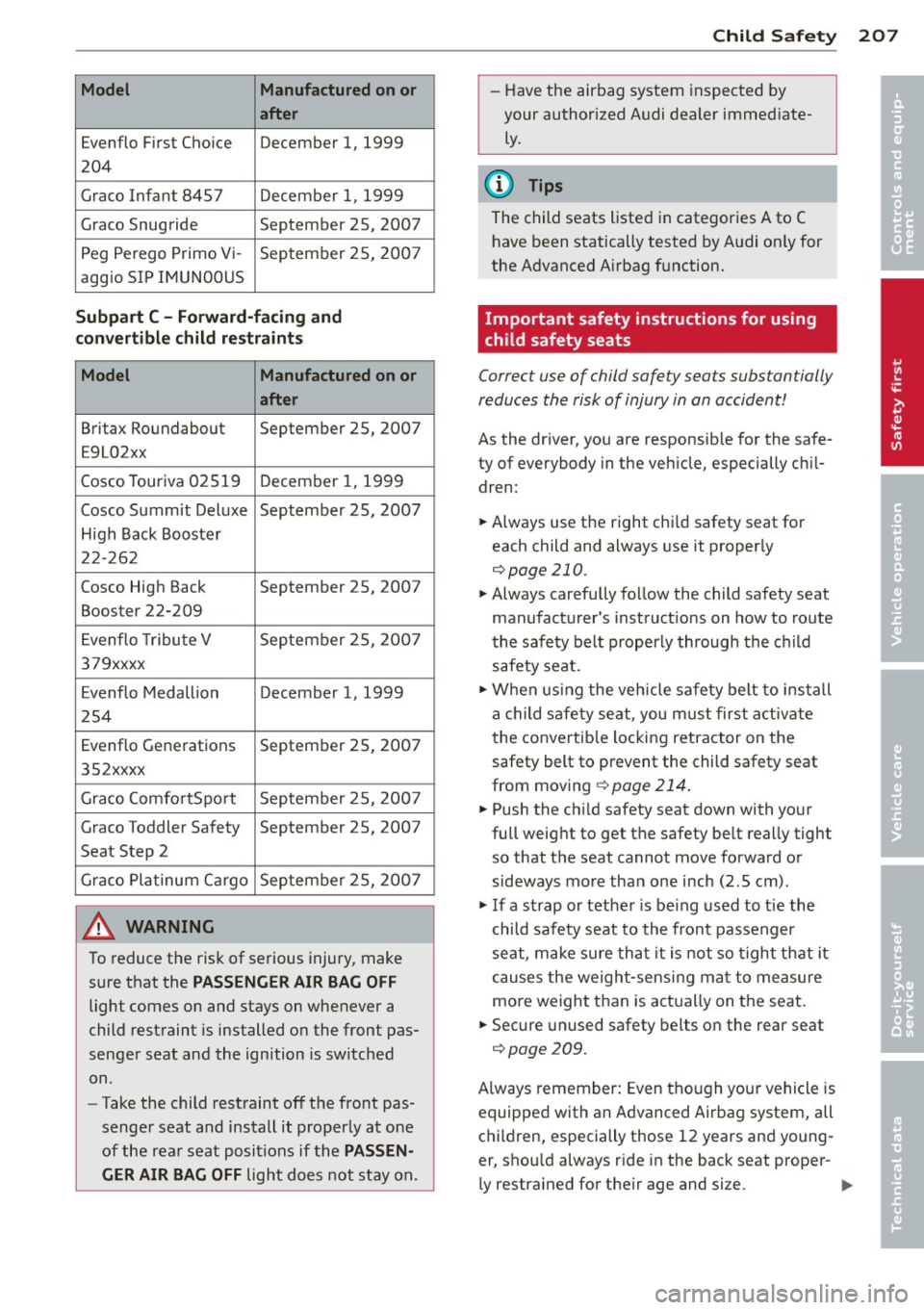
Model Manufactured on or
after
Evenflo First Choice December 1, 1999
204
Graco Infant 8457 December 1, 1999
Graco Snugride September 25, 2007
Peg Perego Primo Vi- September 25, 2007
aggio SIP IMUN00US
Subpart C - Forward-facing and
convertible child restraints
Model Manufactured on or
after
Britax Roundabout September 25, 2007
E9L02xx
Cosco Touriva 02519 December 1, 1999
Cosco Summit Deluxe September 25, 2007
H igh Back Booster
22-262
Cosco High Back September 25, 2007
Booster 22-209
Evenflo Tribute V September 25, 2007
379xxxx
Evenflo Medallion December 1, 1999
254
Evenflo Generations September 25, 2007
352xxxx
Graco Comfo rtSport September 25, 2007
Graco Toddler Safety September 25, 2007
Seat Step 2
Graco Platinum Cargo September 25, 2007
A WARNING
To reduce the risk of serious injury, make
sure that the
PASSENGER AIR BAG OFF
light comes on and stays on whenever a
child restraint is installed on the front pas
senger seat and the ignition is switched
on.
- Take the child restraint off the front pas
senger seat and install it properly at one
of the rear seat positions if the
PASSEN
GER AIR BAG OFF
light does not stay on.
Child Safety 207
-Have the airbag system inspected by
your author ized Audi dealer immed iate
ly.
@ Tips
The child seats listed in categories A to C
have been statically tested by Audi on ly for
the Advanced Airbag function.
Important safety instructions for using
child safety seats
Correct use of child safety seats substantially
reduces the risk of injury in an accident!
As the driver, you are responsib le for the safe
ty of everybody in the veh icle, especially ch il
dren:
... Always use the right chi ld safety seat for
each child and always use it properly
¢page 210.
... Always carefully follow the child safety seat
manufacturer's instruct ions on how to route
the safety belt properly through the child
safety sea t .
... When using the vehicle safety belt to install
a child safety seat, you must first activate
t he convertible locking retractor on the
safety belt to prevent the child safety seat
from moving
¢ page 214.
... Push the ch ild safety seat down with yo ur
full weight to get the safety belt really tight
so that the seat cannot move forward or
sideways more than one inch (2 .5 cm) .
... If a strap or tether is be ing used to tie the
child safety seat to the front passenger
seat, make sure that it is not so tight that it
causes the weight-sens ing mat to measure
more weight than is actually on the seat.
... Secure unused safety belts on the rear seat
¢page 209.
Always remember: Even though your vehicle is
equipped with an Advanced Airbag system, all
c hild ren, especially those 12 years and young
er, shou ld always r ide in the back seat proper-
ly restrained for the ir age and size. ..,. •
•
Page 211 of 340
as possible before installing the child
restraint.
- Always make sure that nothing pre
vents the front passenger's seat from
be ing moved to the rearmost position
in its fore and aft adjustment range.
- Always make sure that the backrest is
in the upr ight position.
- Always buck le the child safety seat firmly
in place even if a child is not sitting in it.
A loose ch ild safety seat can fly around
dur ing a sudden stop or in a col lision .
- Always read and heed all WARNINGS
whenever using a child restrained in ave
hicle is being used¢
page 174, Safety
belts,¢ page 183, Airbag system
and
¢ page 204, Child Safety.
A WARNING
To reduce t he ris k of serious injury, make
sure that the
PASSENGER AIR BAG OFF
light comes on and stays on whenever a
child rest raint is installed on the front pas
senger seat and the ignition is switc hed
on.
- Take the child restraint off t he fro nt pas
senger seat and install it properly at one of the rear seat positions if the
PASSEN ·
GER AIR BAG OFF
light does not stay on.
- Have the airbag system inspected by
your authorized Aud i dealer immediate
ly.
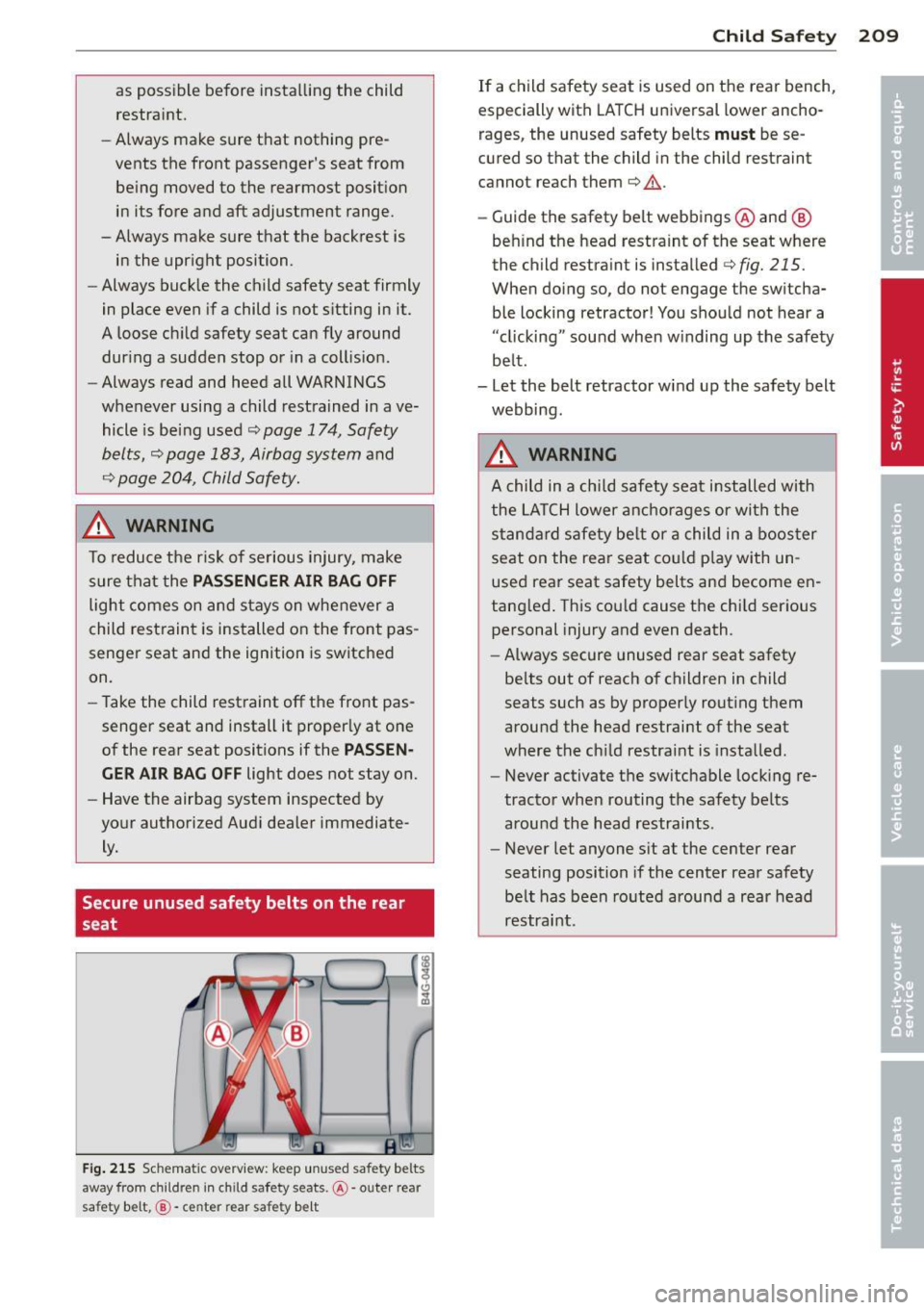
Secure unused safety belts on the rear
seat
F ig. 21 5 Schematic overv iew : keep un used safety belts
away from children in child safety seats.@-oute r rear
safety belt,
@ -center rear safety belt
Child S afety 209
If a child safety seat is used on the rea r bench,
especially with LATCH universal lower ancho
rages, the unused safety belts
must be se
cured so that the child in the child restraint
cannot reach them¢&.
- Guide the safety belt webbings @and @
beh ind the head restraint of the seat where
the child restra int is insta lled ¢
fig. 215.
When doing so, do not engage the switcha
ble locking retracto r! You shou ld not hear a
"cl icking" sound when w inding up the safety
be lt .
- Let the belt retractor wind up the safety belt
webbing.
A WARNING
A child in a chi ld safety seat i nstalled with
the LA TCH lower ancho rages or with the
standard s afety be lt or a child in a boos ter
seat on the rea r seat co uld p lay with un
use d rea r seat safety belts and become en
tang led . This could cause t he chi ld ser ious
personal injury and even death.
- Always secure unused rear seat safety
be lts out of reach of children in child
seats such as by proper ly rout ing t hem
around the head restrai nt of the seat
where the ch ild restraint is installed.
- Never activate t he switchable l ock ing re
tracto r when routing the safety be lts
arou nd the head restraints.
- Never let anyone s it at the center rear
seating position if the center rea r safety
be lt has been routed around a rear head
restraint.
Page 214 of 340
212 Child Safety
to the backrest on the vehicle seat. Ad
just or remove the rear seat head restraint if it is difficult to install the
child seat with the head restraint in place
<=> page 78 . Install the head restraint
again immediately once the child seat is
removed. Driving without head restraints
or with head restraints that are not prop erly adjusted increases the risk of serious
or fatal neck injury dramatically.
- Always read and heed all WARNINGS
whenever using a child restrained in ave
hicle is being used<=>
page 174, Safety
belts,
<=> page 183, Airbag system and
i=> page 204, Important things to know.
A WARNING
If exceptional circumstances require the
use of a forward-facing child restraint on
the front passenger's seat, the child's safe
ty and well-being require that the follow ing special precautions be taken:
- Make sure the forward-facing seat has
been designed and certified by its manu
facturer for use on a front seat with a passenger front and side airbag.
-A lways follow the manufacturer's in
structions provided with the child safety
seat or infant carrier.
- Always move the front passenger seat in
to the rearmost position of the passen
ger seat's fore and aft adjustment range, and as far away from the airbag as possi
ble before installing the child restraint.
- Always make sure that nothing prevents
the front passenger's seat from being
moved to the rearmost position in its
fore and aft adjustment range.
- Always make sure the backrest is in an
upright position.
- Make sure that the
PASSENGER AIR BAG
OFF
light comes on and stays on all the
time whenever the ignition is switched
on.
- If the light does not stay on, perform the
checks
<=> page 194, Monitoring the Ad
vanced Airbag System.
-
- Take the child restraint off the front pas
senger seat and install it properly at one
of the rear seat positions if the
PASSEN
GER AIR BAG OFF
light does not stay on
whenever the ignition is switched on.
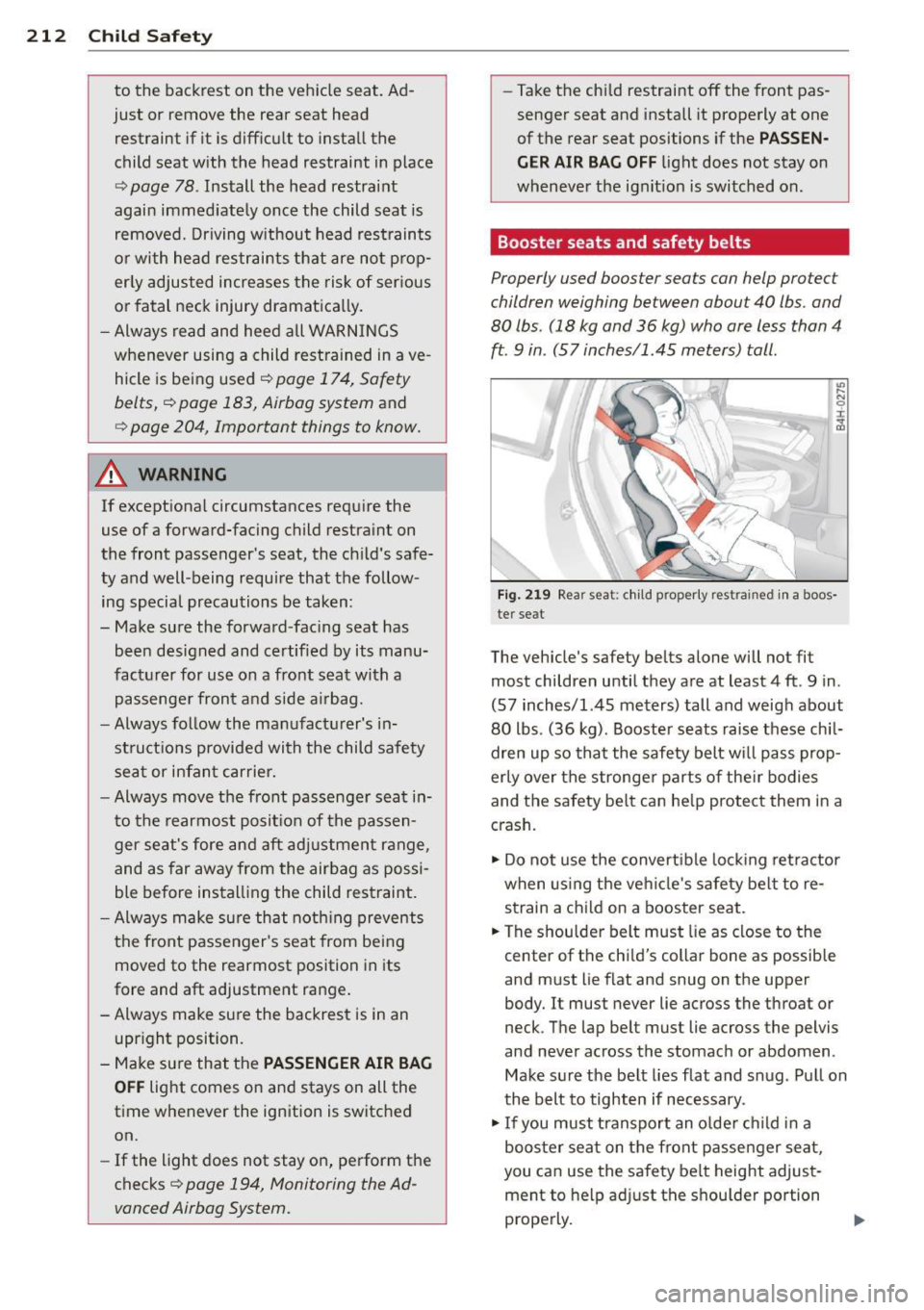
Booster seats and safety belts
Properly used booster seats can help protect
children weighing between about 40 lbs. and
80 lbs. (18 kg and 36 kg) who are less than 4
ft.
9 in . (57 inches/1 .45 meters) tall.
"' ....
"' 0 ±
o5
Fig. 219 Rear seat: c hild properly restrained in a boos
te r seat
The vehicle 's safety belts alone will not fit
most children until they are at least 4 ft. 9 in .
(57 inches/1.45 meters) tall and weigh about
80 lbs. (36 kg). Booster seats raise these chil
dren up so that the safety belt will pass prop
erly over the stronger parts of their bodies
and the safety belt can help protect them in a
crash.
.,. Do not use the convertible locking retractor
when using the vehicle's safety belt to re
strain a child on a booster seat.
.. The shoulder belt must lie as close to the
center of the child's collar bone as possible
and must lie flat and snug on the upper
body. It must never lie across the throat or
neck . The lap be lt must lie across the pelvis
and never across the stomach or abdomen .
Make sure the belt lies flat and snug. Pull on
the belt to tighten if necessary .
.,. If you must transport an older child in a
booster seat on the front passenger seat,
you can use the safety belt height adjust
ment to help adjust the shoulder portion
properly.
Page 216 of 340
214 Child Saf ety
- Childre n on the front seat of any car,
even with Advanced A irba gs, can be seri
ous ly injured or even killed when an a ir
bag inflates .
- Never let a child stand or knee l on any
seat, for exam ple the front seat.
- Never let a child ride in the cargo area of your vehicle .
- Always remember that a chi ld leaning
forward, sitt ing s ideways or out of posi
t ion in any way during an acc ident can be
struck by a deploying airbag . This will re
sult in serious personal injury or death .
- If you must install a booster seat on the
front passenger seat because of excep
t ional circumstances the
PASSENGER
AIR BAG OFF
light must come on and
stay on, whenever the ignition is sw itch
ed on.
- If the
PASSENGER AIR BAG OFF light
does not come on and stay on, perform
the checks described¢
page 194, Moni
toring the Advanced Airbag System.
- T ake the child restrain t off the front pas
senger seat and install it properly at one
of the rear seat positions if the
PASSEN
GER AIR BAG O FF
light does not stay on
whenever the ignition is switched on.
- Always read and heed all WARNINGS
whenever using a child restrained in ave
hicle is being used
¢page 174, Safety
belts,
c:::;, page 183, Airbag system and
c:::;, page 204, Important things to know.
Installing a child safety
seat
Securing a child safety seat using a
safety belt
Safety belts for the rear seats and the front
passenger can be locked with the convertible locking retractor to properly secure child
safety seats .
The safety belts emergency locking retractors
for the rear seats safety belts and for the
front passenger's seat safety belt have a con
ve rtible locking retracto r fo r child restra ints . T
he safety belt m ust be locked so that be lt
webbing cannot unree l. The retractor can be
activated to lock the safety belt and prevent
the safety belt webbing from loosening up
during norma l dr iving. A child safety seat can
o n ly be properly insta lled when the safety belt
i s loc ked so that the child and child safety
sea t w ill stay in place .
Always remember: Even tho ugh your vehicle is
equipped with an Advanced Airbag system, all
c h ildren, especially those 12 years and young
er, shou ld always r ide in the back seat prope r
l y restra ined fo r the ir age and size.
_& WARNING
Imp ro perly ins talled ch ild safety sea ts in
crease the risk of serious pe rsonal injury
and death in a co llision.
- Always make s ure that the safe ty belt re
trac to r i s loc ked when insta lling a child
safety seat . An un locked safety belt re
tracto r cannot hold the child safety seat
in place dur ing norma l driving or in a
crash.
- Always buckle the child sa fety seat firmly
in place even if a ch ild is not sitt ing in it.
A loose child safety seat can fly around du ring a sudden stop or in a collision.
- Always make sure that the rear seat
backrest to wh ich the center rear safety
be lt is attached is securely latched when
eve r the rea r center safety belt is being
used to secure a c hild restra int.
- If the backrest is not securely la tched,
the child and the child restraint will be
thrown forward togethe r with t he back
rest and will strike part s of the vehicle
interior. The child can be seriously in
jured or killed.
- Never inst all rear-facing child s afety
seats or in fant ca rrie rs on the front pas
senger seat . A child will be serious ly in
jured and can be killed when the passen ger airbag in flates.
- The inflating air bag will h it the ch ild
safety seat or infant carrier with great
force and will smash the child safety seat ..,.
Page 217 of 340
and child against the backrest, center
armrest, door or roof.
- Always install rear-facing child safety
seats or infant carriers on the rear seat.
- Forward-facing child safety seats or in
fant carriers installed on the front pas
senger's seat may interfere with the de
ployment of the airbag and cause serious
injury to the child.
- It is safer to install a forward-facing
child safety seat on the rear seat .
- Always read and heed all WARNINGS whenever using a child restrained in ave
hicle is being used¢
page 204 . Special
precautions apply when installing a child
safety seat on the front passenger seat
¢ page 185, Child restraints on the front
seat -some important things to know.
A WARNING
Always take special precautions if you
must install a forward or rearward-facing
child restraint on the front passenger's
seat in exceptional situations:
-Whenever a forward or rearward-facing
child restraint is installed on the front
passenger seat, the
PASSENGER AIR
BAG OFF
light must come on and stay on
whenever the ignition is switched on.
- If the
PASSENGER AIR BAG OFF light
does not come on and stay on, perform
the checks described¢
page 194, Moni
toring the Advanced Airbag System.
- Take the child restraint off the front pas
senger seat and install it properly at one
of the rear seat positions if the
PASSEN
GER AIR BAG OFF
light does not stay on
whenever the ignition is switched on.
- Improper installation of child restraints
can reduce their effectiveness or even
prevent them from providing any protec
tion.
- An improperly installed child restraint
can interfere with the airbag as it de
ploys and seriously injure or even kill the
child.
Child Safety 215
- Always carefully follow the manufactur
er's instructions provided with the child
safety seat or carrier.
- Never place additional items on the seat
that can increase the total weight regis
tered by the weight-sensing mat and can
cause injury in a crash .
A WARNING
Forward-facing child restraints:
- Always make sure the forward-facing
seat has been designed and certified by its manufacturer for use on a front seat
with a passenger front and side airbag.
- Never put the forward-facing child re straint up, against or very near the in
strument panel.
- Always move the passenger seat into its rearmost position in the seat's fore and
aft adjustment range, as far away from
the airbag as possible before installing
the forward-facing child restraint. The
backrest must be adjusted to an upright
position.
- Make sure that the PASSENGER AIR BAG
OFF
light comes on and stays on all the
time whenever the ignition is switched
on .
A WARNING
Rearward-facing child restraints:
- A child in a rearward-facing child safety
seat installed on the front passenger
seat will be seriously injured and can be killed if the front airbag inflates -even
with an Advanced Airbag System.
- The inflating airbag will hit the child
safety seat or infant carrier with great
force and will smash the child safety seat
and child against the backrest, center
armrest, door or roof .
-Always be especially careful if you must
install a rearward facing child safety seat
on the front passenger seat in exception-
al circumstances. .,.
•
•
Page 218 of 340
216 Child Safety
-A tight tether strap on a rearward-facing
child restraint attached to the front pas
senger seat can put too much pressure on the weight-mat in the seat and regis
ter a heavier weight in the Advanced Air
bag System. The heavier weight regis
tered can make the system work as
though an adult were on the seat and de
ploy the Advanced Airbag when it must
be suppressed causing serious or even
fatal injury to the child.
- Make sure that the
PASSENGER AIR BAG
OFF
light comes on and stays on all the
time whenever the ignition is switched
on.
- If the
PASSENGER AIR BAG OFF light
does not come on and stay on, immedi
ately install the rear-facing child safety
seat in a rear seating position and have
the airbag system inspected by your Audi dealer.
Activating the convertible locking
retractor
Use the convertible locking retractor to se
cure a child restraint.
Always heed the child safety seat manufactur
er's instructions when installing a child re
straint in your vehicle. To activate the conver
tible locking retractor:
• Place the child restraint on a seat, prefera
bly on the rear seat.
• Slowly pull the belt
all the way out.
• Route it around or through the child re
straint belt path¢,&.
• Push the child safety seat down with your
full weight to get the safety belt really tight.
• Insert the belt tongue into the buckle for
that seating position.
• Guide the safety belt back into the retractor
until the belt lies flat and snug on the child
safety seat.
• You should hear a "clicking" noise as the
belt winds back into the inertia reel. Test the
convertible locking retractor by pulling on
the belt . You should no longer be able to pull the belt out of the retractor.
The con
vertible locking retractor is now activated.
• Make sure that the red release button is fac
ing away from the child restraint so that it
can be unbuckled quickly.
• Pull on the belt to make sure the safety belt
is properly tight and fastened so that the
seat cannot move forward or sideways more
than one inch (2 .5 cm).
_&. WARNING
-
Using the wrong child restraint or an im
properly installed child restraint can cause
serious personal injury or death in a crash.
- Always make sure that the safety belt re-
tractor is locked when installing a child
safety seat. An unlocked safety belt re
tractor cannot hold the child safety seat
in place during normal driving or in a
crash.
- Always buckle the child safety seat firmly
in place even if a child is not sitting in it.
A loose child safety seat can fly around
during a sudden stop or in a crash.
- Always make sure the seat backrest to
which the child restraint is installed is in
an upright position and securely latched
into place and cannot fold forward . Oth
erwise, the seatback with the child safety
seat attached to it could fly forward in
the event of an accident or other emer
gency situation.
- Always read and heed all WARNINGS
whenever using a child restrained in ave
hicle is being used~
page 204. Special
precautions apply when installing a child
safety seat on the front passenger seat
¢ page 185, Child restraints on the front
seat -some important things to know .
Page 232 of 340
230 Intellig ent technol ogy
What you should know
The highest priority is given to maintaining
starting capability.
The battery is severely taxed in short-distance
driving, in city traffic and during the cold time
of year. Abundant electr ical energy is re
qu ired, but only a little is generated. It is also
cr itical if the e ngine is not running and elect ri
cal components a re turned on. In th is in
stance energy is being consumed but none is being generated .
I t is in precisely these situations that you w ill
notice energy management actively regulat
ing the distrib ution of energy.
Vehicle stand s for an ext ende d period
If you do not drive your vehicle over a period
of several days or weeks, electrical compo
nents are gradually cut back o r switched off .
This reduces energy cons umption and main
tains starting capab ility
over a longer period.
Take into consideration that when you un lock
your ve hicle, some convenience functions,
such as the interior ligh ts or the power seat
ad justmen t, may not be available. The con
venience functions will be available again
when you turn on the ignition and start the
engine.
With the engine turned off
I f you listen to the radio, for example, with
the eng ine turned off or use other MM I func
tions, the battery is being discharged .
I f sta rting capability is jeopa rdized due to en
e rgy consumpt ion, the follow ing warning ap
pears in the MMI disp lay:
Ple ase s tart engin e, otherwi se system will
s wit ch off in 3 minute s.
The warning ind icates that the system will be
turned off automatically after 3 m inutes .
If
you wish to cont inue us ing the functions, you
have to start the engine.
With the eng in e runnin g
Although e lectrical energy is gene rated when
the vehicle is being driven, the battery can be
come discharged. This happens mostly when
little energy is being generated and a great
deal consumed and the battery's state of
charge is not optimal.
To bring the energy balance back into equili brium, consumers which req uire especially
large amounts of energy are temporar ily cut
back or sw itched off. Heat ing systems in par
t icular require a great deal of energy. If you
notice, for example, that the heated seats* or
the heated rear window are not heating, they
have been tempora rily cut back or switched
off . These systems w ill be available again as
soon as t he energy balance has been restored.
You w ill also notice that engine id le speed has
been increased slightly . T h is is normal and not
a cause for con cern. By inc reas ing engine id le
speed the additional energy required is gener
ated and the battery is charged.
Driver notification in the instrument
cluster display
If battery power drops into the range where it
can limit the ability of the engine to start, this
is shown in the instrument cluster display
with the fo llow ing driver message:
(•) low batte ry charge: bat tery w ill be
ch arg ed whil e dri ving
This notificat ion reminds you that the starting
capability of the engine may be lim ited. As
soon as you start dr iv ing again, the battery
will be recharged and the not ificat io n will go
out .
Driver notific ation app ear s a nd goe s out
again
If this driver notification appears after the ig
nition is turned on or wh ile driving and it goes
out again after a while, the battery has been
adequately recharged. .,.