ABS AUDI Q7 2015 Owner´s Manual
[x] Cancel search | Manufacturer: AUDI, Model Year: 2015, Model line: Q7, Model: AUDI Q7 2015Pages: 350, PDF Size: 86 MB
Page 177 of 350
M
"' 0 ..J
"". rl I.O
"' rl
"' rl
What happens to occupants not wearing
safety belts?
In crashes unbelted occupants cannot stop themselves from flying forward and being in
jured or killed. Always wear your safety belts!
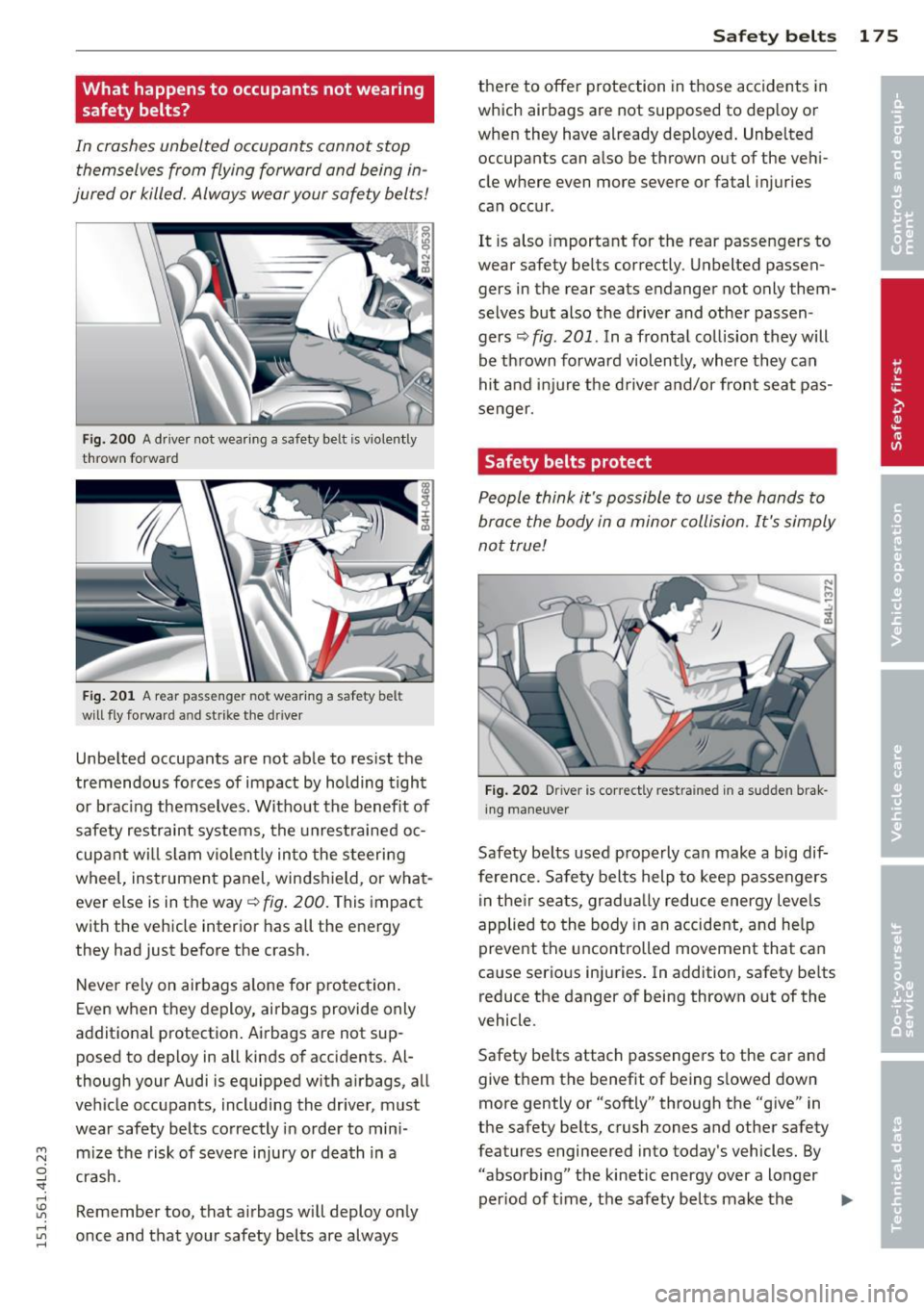
Fig. 200 A driver not wearing a safety belt is violently
thrown forward
Fig. 201 A r ear p assen ger n ot wearin g a safety belt
will fly forwar d an d st rike the driver
Unbelted occupants are not able to resist the
tremendous forces of impact by holding tight
or brac ing themselves. W ithout the benefit of
safety restraint systems, the unrestrained oc
cupant will slam vio lent ly into the steering
wheel, instrument panel, windshield , or what
ever else is in the way ¢
fig. 200. This impact
with the vehicle interior has all the energy
they had just before the crash.
Never rely on airbags alone for protection.
Even when they deploy, airbags provide only
additional protection. Airbags are not sup posed to deploy in all kinds of accidents. Al
though your Audi is equipped with airbags, all
vehicle occupants, including the driver , must
wear safety belts correctly in order to mini
mize the risk of severe injury or death in a
crash .
Remember too, that airbags will deploy only
once and that your safety belts are always
Safety belts 175
there to offer protection in those accidents in
which airbags are not supposed to deploy or
when they have already deployed. Unbelted
occupants can a lso be thrown out of the vehi
cle where even more severe or fatal injuries
can occur .
It is also important for the rear passengers to
wear safety belts correctly . Unbelted passen
gers in the rear seats endanger not only them
selves but also the driver and other passen
gers ¢
fig. 201. In a frontal collision they will
be thrown forward violently, where they can
hit and injure the driver and/or front seat pas
senger.
Safety belts protect
People think it's possible to use the hands to
brace the body in a minor collision. It's simply
not true!
Fig. 202 D river is correctly rest ra in ed in a sud den brak
ing maneuver
Safety belts used properly can make a big dif
ference. Safety belts help to keep passengers
in their seats, gradua lly reduce energy levels
applied to the body in an accident, and help
prevent the uncontrolled movement that can
cause serious injuries. In addition, safety belts
reduce the danger of being thrown out of the
vehicle.
Safety belts attach passengers to the car and
give them the benefit of being slowed down
more gently or "softly" through the "give" in
the safety belts, crush zones and other safety
features engineered into today's vehicles. By
"absorbing" the kinetic energy over a longer
period of time, the safety belts make the
liJl,
Page 188 of 350
186 Airbag system
prevent them from providing any
protection.
- An improperly installed child restraint
can interfere with the airbag as it de
ploys and serious ly injure or even kill the
child -even with an Advanced Airbag
System .
- Always carefully follow the manufactur
er's instructions provided with the child
safety seat or carrier.
- Never place additional items on the seat
that can increase the total weight regis
tered by the weight-se nsing mat and can
cause injury in a crash.
Front airbags
Description of front airbags
The airbag system can provide supplemental
protection to properly restrained front seat
occupants.
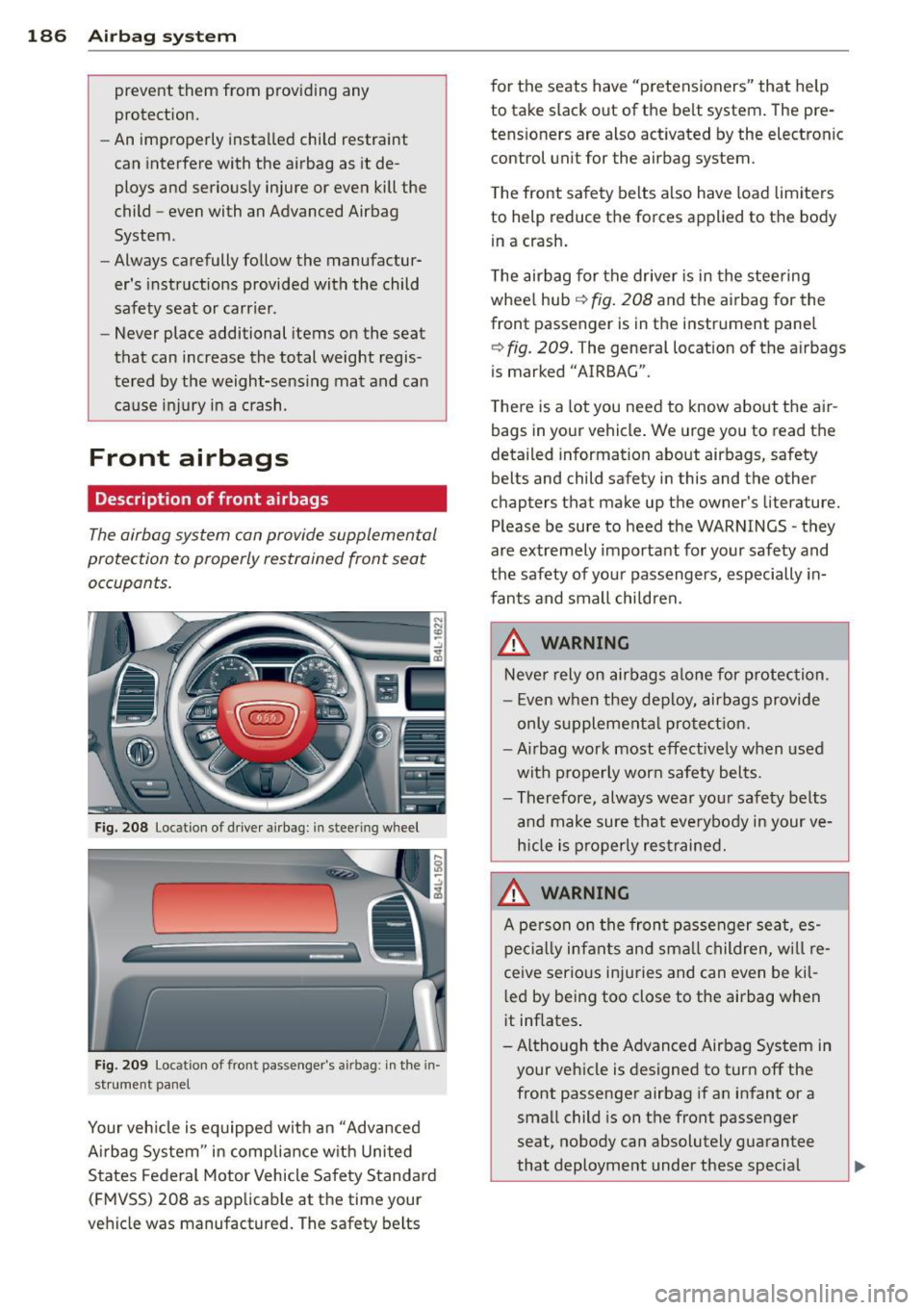
Fig. 2 08 Locat ion of dr ive r air bag : in stee ring wheel
Fig. 2 09 Locat ion of front passenger's a irbag: in the in
st rument panel
Your veh icle is equipped with an "Advanced
A irbag System" in complia nce w ith United
States Federal Motor Vehicle Safety Standard
( FM VSS) 208 as app licab le at the time your
veh icle was manufactured. The safety belts f
or the seats have "pretensioners" that help
to take slack out of t he belt system . The pre
tens ioners are also act ivated by the electronic
control unit for the airbag system.
T he front safety be lts also have load limiters
to help reduce the forces applied to the body
i n a crash .
T he airbag for the drive r is in the stee ring
whee l hub ¢
fig. 208 and the airbag for the
front passenger is in the instr ument panel
~ fig. 209 . The general locat ion of the a irbags
is marked "AIRBAG".
T here is a lot you nee d to know about the ai r
bags in your vehicle . We urge you to read the
detailed information about airbags, safety
belts and child safety in this and the other
chapters that make up the owner's literature.
P lease be sure to heed the WARNINGS -they
are extremely importa nt for your safety and
the safety of you r passengers, especially in
fants and small chi ldren.
_&. WARNING
Neve r rely on airbags alo ne for p rotection.
- E ven w hen they deploy, airbags provide
only supplement al pro tectio n.
- Airbag work most effect ive ly when used
with p roperly wor n safety bel ts.
- Therefore, always wea r you r safety belts
a nd make sure tha t eve rybody in your ve
h icle is properly res trained.
_&. WARNING
A pe rso n on the fron t passenger seat, es
pe cial ly infa nts and sm all ch ildren, w ill re
ceive serio us inju ries and can even be kil-
l ed by being too close to the airbag when
it inflates .
- A lthough t he Advanced Airbag System in
your veh icle is des igned to tur n off the
front passenge r airbag if an infant or a
small child is on the front passenger
seat, nobody can absolutely guarantee
-
that deployme nt under these special ..,
Page 190 of 350
188 Airbag sys tem
If the tota l weight on the front passenger
seat is more than that of a typical 1 year-o ld,
but less than the weight of a small adu lt, the
front airbag on the passenger side may deploy (the
PASSENGER AIR BAG OFF light does not
come on).
For e xample , the airbag m ay deploy if :
-a small child that is heavier than a typical 1
year-o ld child is on the front passenger seat
(regardless of whether the child is in one of
the chi ld safety seats listed
¢ page 205),
-a chi ld who has outgrown child restraints is
on the front passenger seat.
If the front passenger airbag is turned off, the
PASSENGER AIR BAG OFF light in the center
of the instrument pane l w ill come on and stay
on.
The front airb ag on the passenger side may
not deploy (the PASSENGER AIR BAG OFF
light does not ill uminate and stay lit) if:
- a small adu lt o r teenager is o n the front pas
senger se at
- a passenger who is not sitt ing upr ight w it h
their back against a non-reclined backrest
with their feet on the veh icle floo r in front
of the seat is on the front passenge r seat .
I f the front passenge r airbag deploys, the
F ederal Standa rd requires the airbag to meet
the " low ris k'' deployment criter ia to help re
d uce the risk of inj ury through interaction
with the airbag. "Low risk" deployment occurs
in those crashes that take place at lower de
celerations as defined in the electronic control un it.
¢ page 193
Always remember: Even tho ugh yo ur vehicle
is equipped with Advanced Airbags, the safest
p lace for children is properly restrained on the
back seat. Please be sure to read the impor
tant information i n the sect ions that follow
and be sure to heed a ll of the WARNINGS.
A WARNING
To reduce the risk of injury when an airbag
inf lates, a lways wear safety belts prope rly. -
If you are unrestra ined, leaning forward,
sitt ing s ideways or o ut of pos ition in any
way, your risk of injury is m uch higher.
- You will a lso receive serious injuries and
could even be killed if yo u are up aga inst
the airbag or too close to it when it in
f lates -eve n w it h an Advanced A irbag
¢page 182.
A WARNING "---
A child in a rearward-fac ing ch ild safety
seat installed on the front passenger seat
will be serious ly inju red and ca n be killed if
the front air bag infla tes -even with an Ad
vanced A irbag System.
- Al tho ugh t he Advanced Airbag Sys tem in
your veh icle is designe d to tur n off the
front airbag when a rearward -facing
child restraint has been insta lled on the
front passenger seat, nobody can abso lutely g uarantee that dep loyment is im
possible in all conceivable situations that
may happen dur ing the usefu l life of your
veh icle.
- The inflating airbag will h it the c hild
safety seat or i nfant carrier with great
force and will smash the child safety seat
a nd child aga inst the bac krest, center
armrest, doo r, or roof.
- Always install rea rward-fac ing ch ild re
s traint s on the rear seat.
- If you must ins tall a rearwa rd fac ing
child safety seat on the fro nt passenger
seat because of exceptiona l circu mstan
ces and t he
PASSENGER AIR BAG OFF
light does not come on an d stay on, im
mediately insta ll the rear-facing c hild
safety seat in a rear seating position and
have the airbag system inspected by your
author ized Audi dealer.
A WARNING
-If, in except io nal circumstances, you m ust
i nstall a forward-facing child restraint on
the front passenge r's seat:
II--
Page 199 of 350

M
"' 0 ..J
"". rl I.O
"' rl
"' rl
@ For the sake of the environment
Undep loyed airbag modu les and preten
sioners might be classified as Perchlorate Material -special handling may app ly, see
www.dtsc.ca.gov/hazardouswaste/per chlorate. When the vehicle or parts of the
restraint system including airbag modules
and safety belts w ith pretens ioners are
scrapped, a ll applicable laws and regula
tions must be observed. Your authori zed
Aud i dea ler is familiar w ith these require
ments and we recommend that you have
your dea ler perform this service for you.
Other things that can affect Advanced
Airbag performance
Changing the vehicle's suspension system can
change the way that the Advanced A irbag Sys
tem pe rforms in a crash. For example, us ing
tire-r im combinations not approved by Aud i,
l owering the vehicle, changing the stiffness of
the suspension, including the springs, suspen
sion struts, shock absorbers etc. can change
the forces that are measured by the airbag
sensors and sent to the electronic control
unit. Some suspension changes can, for exam
ple, increase the force levels measured by the
se nsors and make the airbag system deploy in
crashes in wh ic h it would not dep loy if the
changes had not been made. Other k inds of
changes may reduce the force levels meas
ured by the sensors and prevent the airbag
from deploying when it sho uld .
A WARNING
Changing the vehicle's suspension includ
ing use of unapproved tire-rim combina
tions can change Advanced Airbag per
formance and increase the risk of serious personal injury in a crash.
- Never install suspens ion components
that do not have the same performance characteristics as the components origi
nally installed on you r vehicle.
- Never use tire- rim combinat ions that
have not been approved by A udi.
A irba g sy stem 19 7
A WARNING
Items stored between the safety be lt
buckle and the center console can cause
the sensors in the b uckle to send the
wrong informa tion to the e lectronic con
trol module and prevent the Advan ced Air
bag System from wo rking properly.
- Always ma ke sure that nothing can inter
fe re with the safety belt buckles and that
they are not obs truc ted.
Side airbags
Description of side airbags
The airbag system can provide supplemental
protection to properly restrained occupants.
Fi g. 212 Side airbag location in t he drive r's seat
The side airbags are located in the sides of the
front seat backrests~ fig. 212 and the rear
backrest* facing the doors . They are identified
by the wo rd "AIRBAG".
Th e side a irbag sy stem ba sic ally consi st s of :
-the electron ic control module and external
side impact sensors
- the two side airbags located in the s ides of
the front backrests
- two rear side airbags (as an ordered option)
- the airbag warn ing light in the instrument
cl uster .
T he airbag system is mon itored e lec tronically
t o m ake ce rtain that it is f unction ing pro perly
at all times . Each time you turn on the ig ni
tion, the airbag system indicator light will
come on for a few seconds (self diagnostics) . ..,.
Page 225 of 350

M N
0 ...J
'SI: ,...., \!) 1.1'1 ,...., 1.1'1 ,....,
Intelligent technology Notice about data
recorded by vehicle
control modules
Your vehicle is not equipped with an Event Da
ta Recorder (EDR), installed by some manu
facturers for the express purpose of capturing
data for retrieval after an accident or crash
event. EDRs are sometimes called "crash re
corders".
Some state laws restrict the retr ieval or down
loading of data stored by EDRs that were in
stalled in a vehicle for the express purpose of
retrieving data after an accident or crash
event without the owner's consent.
Although your vehicle is not equipped with an
EDR, it is equipped with a number of electron
ic control modules for various vehicle systems
such as, for example, engine function, emis
sion control, as well as for the airbags and
safety belts.
These electronic control modules also record
vehicle-related data during norma l vehicle op
eration for diagnostic and repair purposes.
The recording capacity of the electronic con
trol modules is limited to data (no sound is re
corded) and only a small amount of data is ac
tually recorded over a very limited period of
time and stored when a system fault or other
condition is sensed by a control unit. Some of
the data then stored may relate to vehicle
speed, direction, braking as we ll as restraint
system use and performance in the event of a
crash or other condition. Stored data can only be read and downloaded with special equip
ment.
Electronic Stabilization
Control (ESC)
Description
The Electronic Stabilization Control (ESC) rein
forces driver safety. It reduces the risk of slip
ping and improves driving stability. ESC de
tects critical s ituations such as the vehicle
Intelligent technology 223
oversteering and understeering or the whee ls
spinning . The vehicle is stabilized by applying
the brakes or reducing eng ine torque . Once
the ESC is active, the indicator light
GI blinks
in the instrument cluster.
The following systems are integrated in the
ESC:
Anti-lock brake system (ABS)
ABS prevents the wheels from locking up
when brak ing. The vehicle can sti ll be steered
even during hard braking. Apply steady pres
sure to the brake peda l. Do not pump the ped
al. A pulsing in the brake pedal indicates that
the system is helping you to brake the vehicle.
Brake assist system
The brake assist system can decrease braking
distance.
It increases braking power when the
driver presses the brake peda l quickly in emer
gency situations. You must press and hold the
brake pedal until the situation is over. In
vehicles with adaptive cruise control*, the
brake assist system is more sensitive if the
distance detected to the vehicle ahead is too
small.
Anti-slip regulation (ASR)
ASR reduces engine power when the drive
wheels begin to spin and adapts the force to
the road conditions. This makes it easier to
start, accelerate and dr ive up hi lls.
Electronic differential lock (EDL)
The EDL brakes wheels that are spinning and
transfers the drive power to the other wheels.
This function is not available at higher speeds .
In extreme cases, EDL automatically switches
off to help keep the brake on the braked wheel
from overheating. EDL will switch on again au
tomatically when conditions have returned to
normal.
A WARNING
- The ESC and its integrated systems can
not overcome the laws of physics. This is
especially important on slippery or wet
~
•
•
Page 226 of 350
224 Intellig ent technol ogy
roads . If the systems begin acting to sta
bilize your vehicle, you should immedi
ately change your speed to match the
road and traff ic conditions. Do not let
the inc reased safety prov ided by these
systems tempt you to take r isks. Doing
so w ill increase the risk of a loss of vehi
cl e con tro l, coll is ion and serio us personal
injuries.
- Always adapt you r speed to road, traff ic
and weather condit ions. The risk of los
ing contro l of the veh icle increases when
driv ing too fast, especia lly t hrough
c u rves and on slippery or wet roads, and
when driving too close to vehicles up
ahead. The ESC and its integrated sys
tems cannot always prevent collisions -
there is still a r isk of accidents!
- Always acce lerate with special care on
even, smooth surfaces such as those that
Switching on/off
are wet or covered with ice and snow.
The drive wheels can spin even w ith
these assistance systems that cannot al
ways help to reduce the risk of loss of ve
h icle control.
(D Tips
- ABS and ASR only work correctly when
all four wheels are equipped with identi
cal tires. D ifferent tire sizes can lead to a
reduction in engine power.
- You may hear noises when the systems
descr ibed are working.
- If the ind icator light
DJ or fil (USA
mode ls)/ ti] (Canada models) appears,
there may be a malfunction
<:;> page 16,
<:;>page 18.
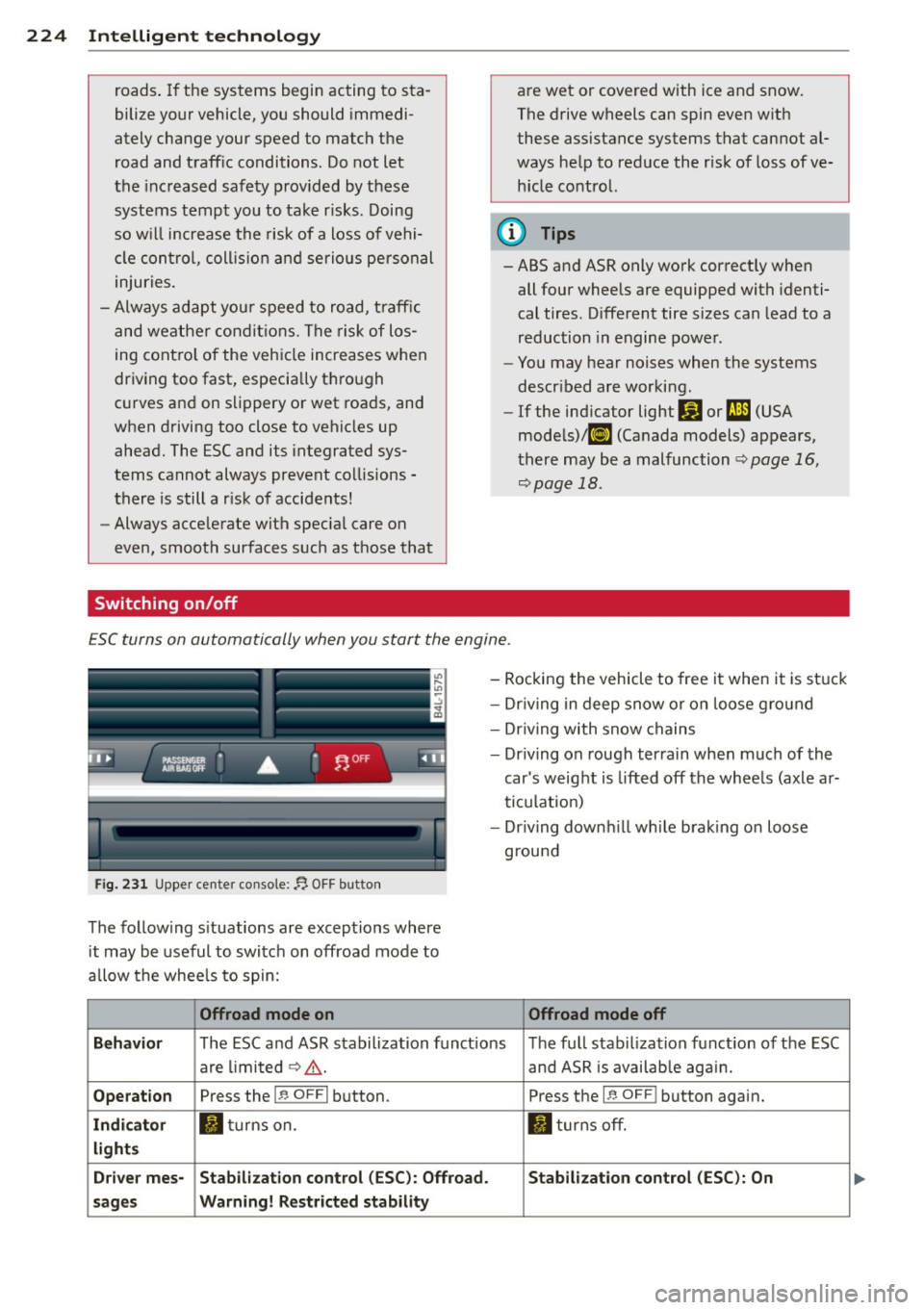
ESC turns on automatically when you start the engine .
,.-------------.,
------------------
Fig. 231 Upper cente r console: f'J OFF button
The follow ing s ituations are exceptions where
it may be useful to switch on offroad mode to
a llow the whee ls to spin:
Offroad mode on
- Rocking the vehicle to free it when it is st uck
- Dr iving in deep snow or on loose ground
- Dr iving with snow chains
- Dr iving on rough terrain when much of the
car's weight is lifted off the whee ls (axle ar
ticulation)
- Dr iving downh ill wh ile brak ing on loose
ground
Offroad mode off
Beha vior
The ESC and ASR stabilization funct ions The fu ll stab ilization funct ion of the ESC
are limited <:;>,&..
and ASR is availab le agai n.
Operat ion Press the I~ O FFI button . Press the I~ OFFI button again.
Indi ca to r IJ tu rnson. II turns off.
li g ht s
D riv er m es- Stabil izat ion cont rol (ES C): O ffroad. S tabil ization contro l (ESC) : On
sa ges Warning! R estricted st ab ility
Page 240 of 350
238 Trailer towing
Trailer towing
Driving with a trailer
General information
Your Audi was designed primarily for passen
ger transportation .
If you plan to tow a trailer, p lease remember
that the additional load will affect durability,
economy and performance .
Trailer towing not on ly places more stress on
the vehicle, it also calls for more concentra
tion from the driver.
For this reason, always follow the operating
and driving instructions provided and use
common sense.
@ Note
If you are going to tow a trai ler, you must
activate the trailer operation mode
c:::> page 161, Towing a trailer.
Technical requirements
Trailer hitch
Use a weight-carrying hitch conforming to the
gross trailer weight. The hitch must be suita ble for your vehicle and trailer and must be
mounted securely on the vehicle's chassis at a
technically sound location . Use only a trailer
hitch with a removable ball mount. Always
check with the trailer hitch manufacturer to
make sure that you are using the cor rect
hitch.
Do not use a bumper hitch.
The hitch must be installed in such a way that
it does not interfere with the impact-absorb
ing bumper system. No modifications should
be made to the vehicle exhaust and brake sys
tems. From time to time, check that all hitch
mounting bolts remain securely fastened.
When you are not towing a trailer, remove the
trai ler hitch ball mount. This prevents the
hitch from causing damage should your vehi
cle be struck from behind
c:::> A.
Trailer brakes
If your trailer is equipped with a brakin g sys
tem, check to be sure that it conforms to all
regulations.
T he trailer hydraulic brake system must not be
directly connected to the vehicle's hydraulic
brake system
c:::> A .
Safety chains
Always use safety chains between your veh icle
and the tra iler.
Trailer lights
Trailer lights must meet all regulations. Be
sure to check with your authorized Audi dealer
for correct wiring, sw itches, and relays.
Mirrors
If you are unable to see the traffic behind you
using the regular outside mirrors, then you
must install extended mirrors.
It is important
that you always have clear v is ion to the rear .
A WARNING ,-
- If a trailer has electrical brakes please
note that these brakes are not activated
by the factory-fitted control unit -risk of
accident!
- Afte r removing the trailer hitch, do not
store it in yo ur vehicle. In case of sudden
braking, the hitch could fly forward and
injure you or your passengers.
- Never install a "weight distributing" or
"load equalizing" trailer hitch on your ve
hicle. The vehicle was not designed for
these kinds of trailer hitches. The hitch
attachment can fail, causing the trailer
to tear loose from the vehicle.
- The Gross Vehicle Weight Rating for your
vehicle, found on the safety compliance
label on the driver's side B-pillar, must
never be exceeded under any circumstan
ces. Exceeding the Gross Vehicle Weight
Rating of your vehicle is likely to damage
your vehicle, and such damage will not
be covered by your Limited New Vehicle
-
Warranty. Exceeding the Gross Vehicle ~
Page 243 of 350
M N
0 ...J
'SI: ,...., \!) 1.1'1 ,...., 1.1'1 ,....,
have become completely familiar with the way
your vehicle-trailer combination behaves and responds.
Backing up is difficu lt and requires practice.
Backing up with a trai ler genera lly requires
steering action opposite to that when backing up your vehicle without a trailer .
Maintain a greater distance between your ve
hicle and the one in front of you. You will need
more room to stop . To compensate for the
trai ler, you will need a larger than norma l
turning radius.
When passing, remember that you cannot ac
celerate as fast as you normally would be
cause of the added load . Make sure you have
enough room to pass. After passing, allow plenty of room for your tra iler before chang
ing lanes again .
Avoid jerky starts, sharp turns or rapid lane
changes.
@ Tips
- Do not tow a traile r during the break-in
period of your vehicle.
- If you tow a trailer, your A udi may re
quire more frequent maintenance due to
the extra load
¢ page 326.
Parking on a slope
Do not park on a slope with a trailer. If it can
not be avoided, do so only after doing the fol
lowing:
When parking:
.. Apply the foot brake .
.. Have someone place chocks under both the
vehicle and the trai ler wheels .
.. With chocks in place, slowly re lease the
brakes until the wheel chocks absorb the
load .
.. Turn the wheels towards the curb .
.. Apply the parking brake.
.. Move the selector lever to P.
When restarting after parking:
.. Apply the foot brake.
Trailer towing 241
.. Start the engine.
.. Move the selector lever to D.
.. Release the parking brake and s low ly pull
out and away from the wheel chocks.
.. Stop and have someone retr ieve the wheel
chocks.
(D Tips
If you move the selector lever of the auto
matic transmission to P before applying
the parking brake and before blocking the
whee ls, you may have to use more force
l ater to move the lever out of the
P posi
tion.
•
•
Page 247 of 350
M N
0 ...J
'SI: ,...., \!) 1.1"1 ,...., 1.1"1 ,....,
Vehicl e ca re a nd cl eanin g 245
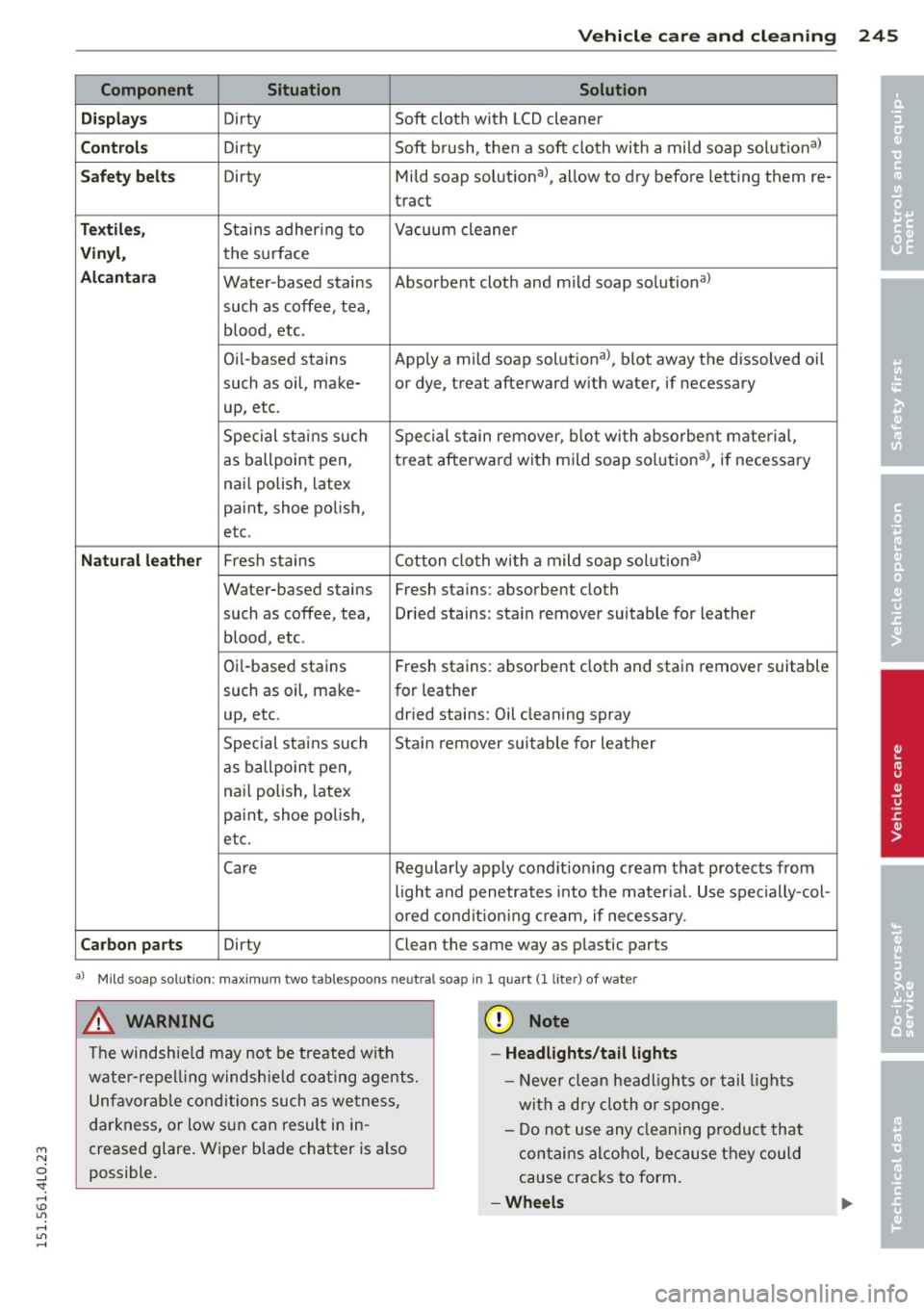
Component Situ ation Solution
Dis plays
Dirty Soft cloth with LCD cleaner
Co nt rols Dirty Soft
brus.h, then a soft cloth with a mild soap solut iona)
Sa fety belts Dirty Mild soap solutional, allow to dry before letting them re-
tract
Te xtiles, Stains adher ing to Vacuum cleaner
V in yl, the surface
Alcant ara Water -based stains Absorbent cloth and mild soap solutiona>
such as coffee, tea,
blood, etc.
Oil-based stains Apply a mild soap solutiona), blot away the dissolved oil
such as oil, make- or dye, treat afterward with water, if necessary
up, etc.
Special stains such Special
stain remover, blot with absorbent material,
as ballpoint pen, treat afterward with mild soap solution a>, if necessary
nai l polish , latex
pa int, shoe polish,
etc.
N at ur al lea ther Fresh stains Cotton cloth
with a mild soap solutiona)
Water-based stains Fresh stains: absorbent cloth
such as coffee, tea, Dried stains: sta in remover suitable for leather
blood, etc.
Oi l-based stains Fresh stains: absorbent cloth and stain remover suitable
such as oil, make- for leather
up, etc. dried stains: Oil cleaning spray
Special sta ins such Sta in remover suitable for leather
as ballpoint pen,
nai l polish , latex
paint, shoe polish,
etc.
Care Regularly apply condit ion ing cream that protects from
light and penetrates into the mater ial. Use specially-col-
ored condit ion ing c ream, if necessary.
Carb on pa rt s Dirty Clean the same way as plastic parts
al Mild soap solution: maximum two tablespoons neutral soap in 1 quart (1 liter) of water
_&. WARNING
The windshield may not be treated with
wate r-repelling windsh ie ld coating agents.
Unfavorab le conditions such as wetness,
darkness, or low sun can result in in
creased glare . Wiper blade chatter is also
possible.
-
@ Note
- Headl ight s/ta il ligh ts
- Neve r clean headlights or tail lights
with a dry cloth or sponge .
- Do not use any cleaning product that
contains alcohol, because they could
cause cracks to form .
-Wheels
•
•
Page 268 of 350
26 6 Ch eck ing and filling
If the brake fluid level falls considerably be
low the "MIN" mark, the brake warning/indi
cator light (U .S . mode ls:
11111 , Canadian
models: .) will come on
<=> page 19 and
<=> page 32. Do not continue to operate the ve
h icle . The complete brake system should be
thoroughly checked by an authorized Aud i
dea ler or qualified workshop and the cause
corrected. If the brake fluid level is too low,
the brake warning/indicator light will illum i
nate . Contact an authorized Aud i dealer
im
m ediatel y.
@ Tips
The brake fluid rese rvoir is located unde r
neath the cove r.
Changing brake fluid
Hove the broke fluid changed by on experi
enced technician.
Brake fluid absorbs moisture from the a ir . If
the water content in the brake fluid is too
h igh , corrosion in the brake system may result
after a per iod of t ime. The bo iling po int of the
brake fluid wi ll also decrease considerably and
decrease braking performance.
Therefore, the brake flu id must be changed
e ver y tw o year s. Always use new b rake fluid
which conforms to Federal Motor Vehicle
Standard "FMVSS 1 16 DO T 4".
The brake flu id reservo ir can be difficult to
reach, therefore, we recommend that you
have the brake f luid changed by you r author
ized
Audi dea ler. Your dea ler has the correct
too ls, the right brake fluid and the know -how
to do this for you.
A WARNING
- Brake fluid is poisonous . It must be stor
ed only i n the closed orig inal container
o ut of the reach of children!
- Brake fa ilure can result from old or inap
propriate b rake fluid. Observe these pre
caut ions: -
Use only brake fluid that meets SAE
specification
J 1703 and conforms to
Federa l Motor Vehicle Standard 116.
Always check with your authorized Audi
dealer to make sure you are using the
correct brake fluid . The correct type of
brake f lu id is also ind icated on the
brake flu id reservoir.
- T he brake fluid must be new. Heavy use
of the bra kes ca n cause a vapo r lock if
the b rake fluid is left in the system too
l ong . This can seriously affect the effi
c iency of the brakes as well as your
safety. This co uld resu lt in an accident.
(D Note
Bra ke fluid will damage the paint of you r
vehicle .
(® For the sake of the environment
Because of the p rob lem of p roper disposal
of b ra ke fluid as well as the spec ial too ls
r equired and the necessary expertise, we
re commend that yo u have the brake fluid
changed by yo ur authorized Aud i dea ler.
Battery
General information
U nder normal ope rat ing cond itions , the bat
tery in yo ur Audi does not need any ma inte
nance. With
high o utside tempe ra tur es or
l ong dai ly drives we recommend that you have
the e lectrolyte level checked by an authorized
Audi dealer or qualif ied workshop. The elec
trolyte level should also be checked each time
the battery is charged
<=> page 268.
Have the battery checked when yo u take your
vehicle in for service. You are well advised to replace a battery that is o lder than 5 years .
With certain types of airbag deployment, the battery is disconnected from the veh icle elec
trical system for safety reasons<=>.&
in Re
pair , core and disposal of the airbags on
page 196.
~