ABS AUDI Q7 2015 Owner´s Manual
[x] Cancel search | Manufacturer: AUDI, Model Year: 2015, Model line: Q7, Model: AUDI Q7 2015Pages: 350, PDF Size: 86 MB
Page 269 of 350
M N
0 ...J
'SI: ,...., \!) ..,.,
,...., ..,., ,....,
Disconne cting the batt ery t erminals
Some vehicle functions (power w indow regu
l ators, for example) are lost if the battery ter
minals are disconnected . These functions have
to be re learned after the battery terminals are
connected again. To prevent this, the battery
should only be disconnected from the vehicle
electrical system when absolutely necessary
for repairs .
Vehicle s not driven fo r lo ng period s
If you do not drive your vehicle over a period
of several days or weeks, electrical compo
nents are gradually cut back or switched off .
This reduces energy consumption and main
tains starting capab ility over a longer per iod
¢ page 228 .
Take into consideration that when you unlock
your vehicle, some convenience functions,
such as the inter ior lights or the power seat
adjustment, may not be available . The con
ve nience funct ions w ill be available again
when yo u turn on the ignition and start the
engine.
Winter op eration
During the winter months, battery capacity
tends to decrease as tempe ratures d rop . This
i s because more powe r is also consumed while
start ing, and the headl ights, rea r window de
fogger, etc., are used more often.
Avo id unnecessary power consumption, par
ticularly in c ity t raffic or when t rave ling on ly
short d istances. Let you r autho rized Aud i
dealer check the capacity of the vehicle bat
tery before winter sets in ¢
page 268. A well
charged battery wi ll not only prevent starting
prob lems when the weather is cold, but will
also last longer .
If your vehicle is left standing for severa l
weeks at extremely low temperat ures, the
veh icle battery should be removed and
stored where it will not freeze. This will
prevent it from bei ng damaged and hav ing
to be replaced.
Checkin g and fillin g 267
Working on the battery
Be especially careful when working on or near
the battery.
The battery is located under the driver 's seat.
Before you check anyth ing under the dr iver's
seat,
read and h eed all WARNINGS G &_ .
Always heed the safety warnings , when work
ing on the vehicle battery or the vehicle e lec
trical system to prevent injury .
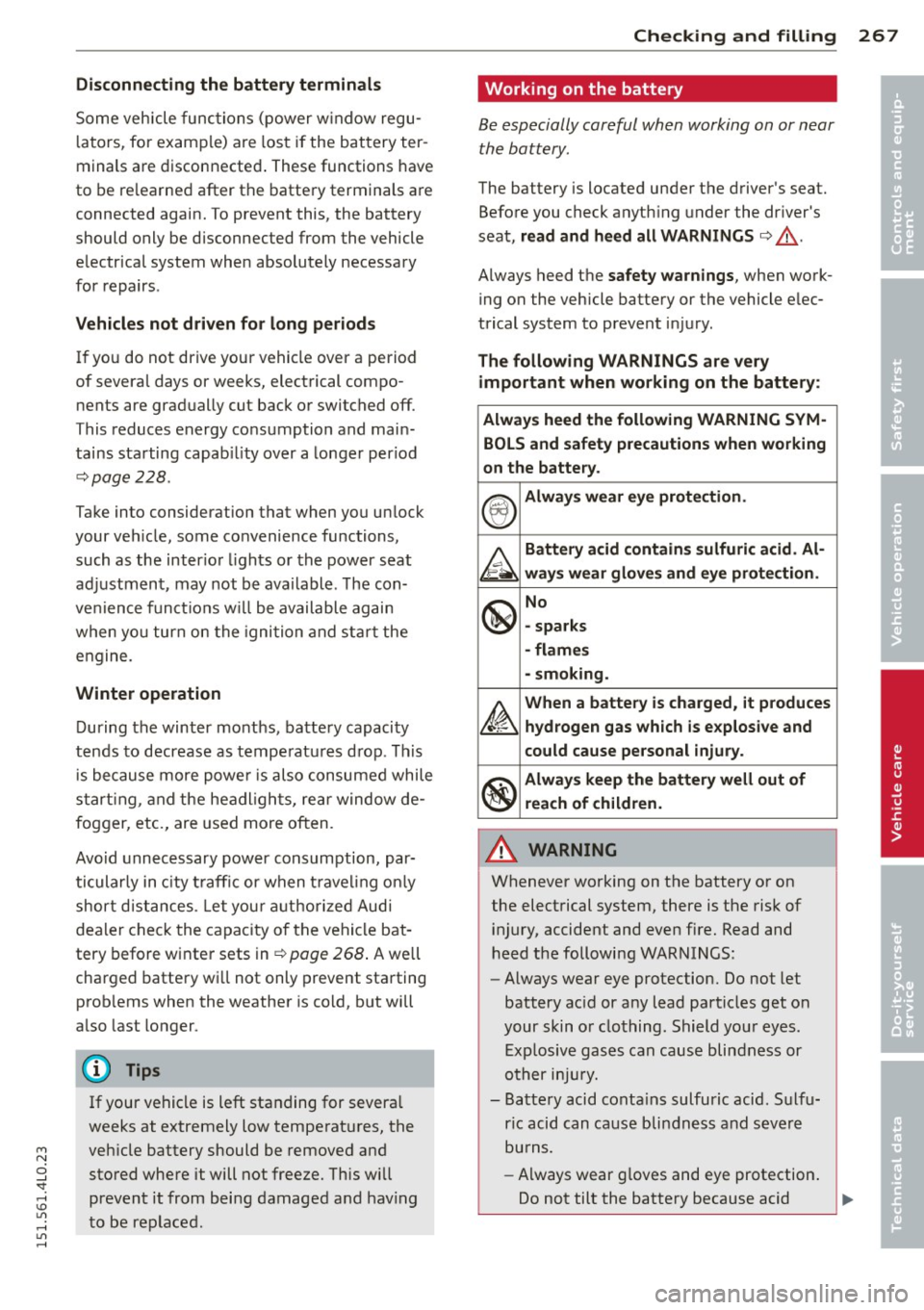
The following WARNINGS are ver y
important when working on the batter y:
Alway s heed the following WARN IN G SY M-
BOLS a nd safety p re caution s when working
on the battery .
®
Alway s wear e ye prote ction.
~
Batt ery acid contain s sulfuric acid. Al -
w ay s we ar gloves and eye prot ection.
@
No
-spa rk s
- flam es
- smoking .
~
When a b atter y is ch arged , it produces
h y drogen g as w hic h is e xplosi ve and
could cause pe rsonal injur y.
®
Alw ays keep the batt ery well out of
r e a ch of childr en.
A WARNING
Whenever working on the battery or on
the electrical system, there is the risk of
injury, accident and even fire. Read and
heed the following WARNINGS:
- Always wear eye protection. Do not let
battery ac id or any lead particles get on
your skin or clothing. Shield your eyes.
Exp losive gases can cause blindness or
other inju ry.
- Battery acid conta ins sulfuric acid. Sulfu
ric acid can cause blindness and severe
bu rns.
- Always wear g loves and eye protection.
Do not tilt the battery because acid
~
•
•
Page 304 of 350

302 Tire s and whee ls
Tire pressure indicator appears
The tire pressure indicator in the instrument
cluster informs you if the tire pressure is too
low or if there is a system malfunction.
F ig . 255 D isp lay: underinflation warn ing
Using the ABS sensors, the tire pressure moni
toring system compares the tire tread circum
ference and vibration characteristics of the in
d iv idual tires. If the pressure decreases in one
or more tires, this is indicated in the instru ment cluster with a
RE warning symbol and a
message ¢
fig. 255 . The dr iver message in the
d isplay goes out after 5 seconds . The dr iver
message can be displayed again by pressing
the
! CHECK I button. If only one tire is affect
ed, the display will indica te its pos ition.
The tire pressure monitoring must be reset via MMI each time the pressures are adjusted (e.
g. when switch ing between partial and full
l oad pressure) or after changing or replac ing a
tire on your vehicle¢
page 303. The TPMS in
dicator only monitors the tire pressure that
you have previously stored. You can find the
recommended tire pressures for your vehicle
on the label on dr iver's side 8-pillar
¢page 278.
Tire tread circumference and vibration charac
teristics can change and cause a tire pressure
warn ing if:
- the tire pressure in one or more tires is too
l ow,
- the tire has st ructural damage,
- the tire pressure was changed, whee ls rotat-
ed o r replaced but the TPMS was not reset
¢ page 303,
-the sp are tire* is mounted.
Warn ing symbo ls
RE Loss of pressure in at least one tire¢,&..
Check the tire or tires and rep lace or repa ir if
necessary . The
RE indicator light in the instru
ment cluster also illuminates
¢ page 14.
Check/correct the pressures of all four tires
and reset TPMS via MMI.
[m'El (T ire Pressure Monitoring System) Tire
pre ssure: System m alfunction!. If [m'El ap
pears after switching the ignition on or while
driving and the
RE i ndicator light in the in
strument cluster bli nks for approx imately one
minute and then stays on, there is a system
malfunction . Attempt to store the correct tire
pressure
¢ page 303. If the indicator light
does not tu rn off or if it t urn s on sho rtly
thereafte r, immediately d rive yo ur vehicle to
an a uthorized Audi dea ler or a uthorized repair
facility to have the malfunction corrected.
A WARNING ......_
- If the tire pressure ind icator appears in
the instrument cluster display, one or
more of your t ires is sign ificant ly under
inflated . Reduce your speed immediately
and avoid any hard steer ing or b raking
maneuvers. Stop as soon as possib le and
check the tires and their pressu res. In
flate the ti re p ressu re to the proper pres
sure as indicated on the vehicle's tire
pressure labe l
r=:>page 278. Driving on a
sign ificantly under-inflated tire causes
the t ire to overheat and can lead to tire
fa ilure. Under-inflation also is likely to
impair the vehicle's handl ing and stop
p ing ability .
- The driver is responsible for maintaining
the correct tire pressures. You must
check the tire pressures regu larly.
- Under certain conditions (such as a spor
ty driv ing style, winter conditions or un
paved roads), the pressure monitor indi
cator may be delayed .
-Ask you r aut horized Aud i dea ler if run
flat t ires may be used on you r vehicle.
Page 306 of 350
304 What do I do now?
What do I do now?
Jack, tools and
inflatable spare tire
Tools
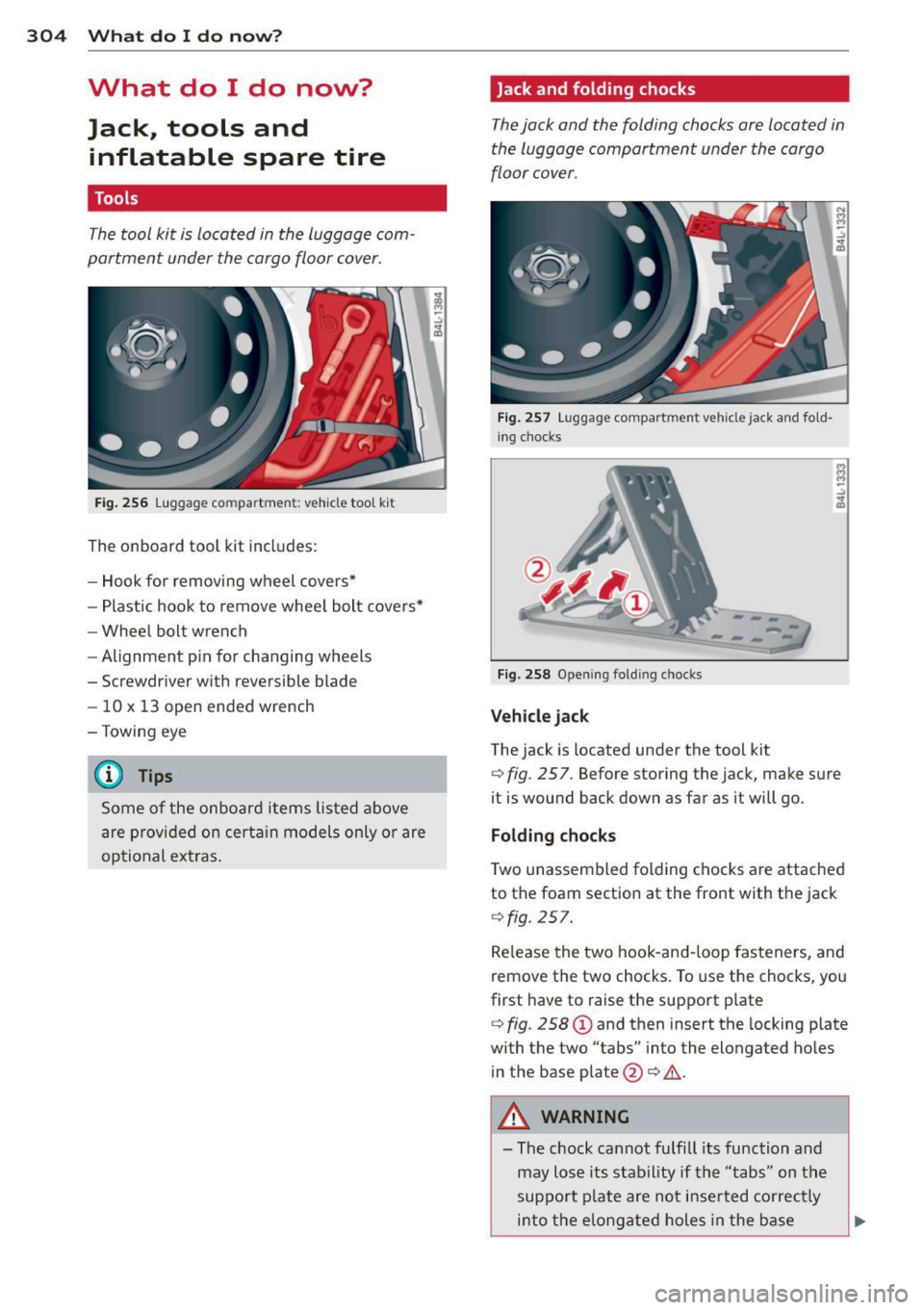
The tool kit is located in the luggage com
partment under the cargo floor cover.
Fig . 256 Luggage compartmen t: vehicle too l kit
The onboard tool kit includes:
- Hook for removing wheel covers*
- Plastic hook to remove wheel bolt covers*
- Wheel bolt wrench
- Alignment p in for changing wheels
- Screwdriver with reversible blade
- 10 x 13 open ended wrench
-Towing eye
(D Tips
Some of the onboard items listed above
are provided on certa in models only or are
optional extras .
Jack and folding chocks
The jack and the folding chocks are located in
the luggage compartment under the cargo
floor cover.
Fig. 257 Luggage compartment veh icle jack and fo ld
ing chocks
-----........ -
Fig. 258 Opening fold ing chocks
Vehicle jack
The jack is located under the tool kit
<=>fig . 257. Before storing the jack, make sure
it is wound back down as far as it will go.
Folding chocks
Two unassembled fo lding chocks are attached
to the foam section at the front with the jack
<=> fig. 257.
Release the two hook-and-loop fasteners, and
remove the two chocks. To use the chocks, you
first have to raise the support plate
<=> fig. 258 (!) and then insert the locking plate
with the two "tabs" into the elongated holes
in the base plate@<=>&. .
A WARNING
-- The chock cannot fulfill its function and
may lose its stability if the "tabs" on the
support plate are not inserted correctly
into the elongated holes in the base
Page 307 of 350
M
"' 0 _,
"". rl I.O
"' rl
"' rl
plate. If this hap pens , the vehicle may
start to m ove whi le a whee l is being
changed.
- Never use the folding chocks if they are
damaged or i f they have not been assem
bled correct ly.
A WARNING
Improper use of the vehicle jack can cause
ser ious personal injuries.
- Never use the jack supplied with your
Audi on another vehicle, particularly on a heavier one. The jack is only suitable for
use on the vehicle it came w ith .
- Us ing a bumper jack to raise the vehicle
will damage the bumper system. The
jack may slip, causing i njury.
- Never support your vehicle on cinder bloc ks, b ricks or other objects. Th ese
may not be able to support the load and
cou ld cause injury when they fail.
- Never start or run t he engine while the
vehicle is suppor ted by the jack.
- If you must wo rk under the vehicle, al
ways use safety stand s spe cifically de
signed for this purpose.
- Always make sure the inflatable spare
tir e a nd even a f lat t ire are se cured in
place and not loose, ot herwise they
cou ld fly forward, causing personal inj ury
to passengers in the veh icle in an acc i
dent or sudden mane uver.
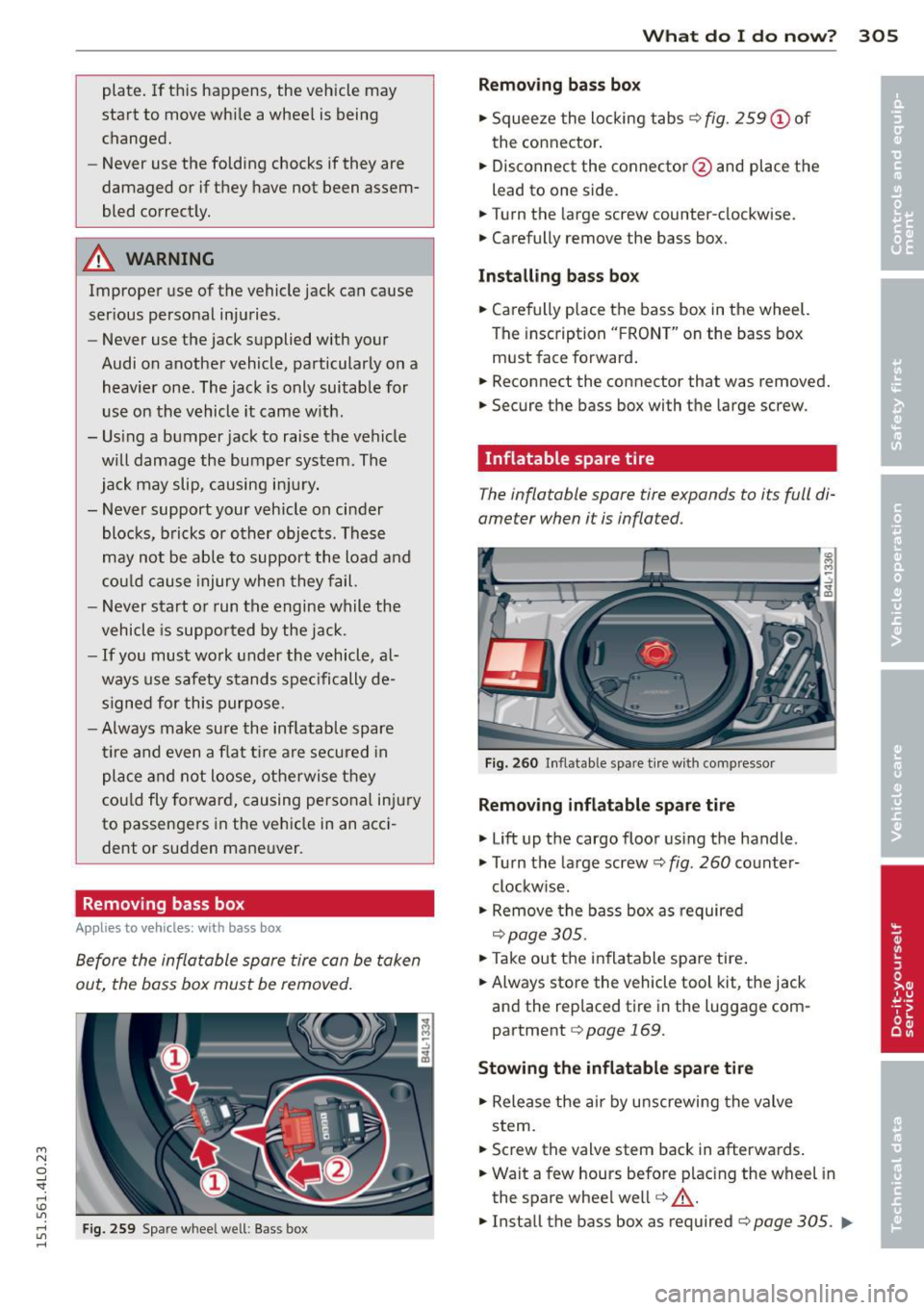
Removing bass box
Applies to vehicles: with bass box
Before the inflatable spare tire can be taken
out, the bass box must be removed .
Fig . 259 Spare wheel well: Bass box
What do I do now ? 305
Removing bass box
.,. Squee ze the locking tabs ~ fig . 259 (D of
the conne ctor .
.,. Disconnect the connector @and place the
lead to one side.
.,. Turn the large screw counter-clockwise .
.,. Carefully remove the bass box.
Installing bass bo x
.,. Carefully p lace the bass box in the wheel.
The inscription "F RO NT" on the bass box
must face forward .
.,. Reconnect the connector that was removed.
.,. Secure the bass box with the large screw .
Inflatable spare tire
The inflatable spare tire expands to its full di
ameter when it is inflated.
Fig. 2 60 In flatable spare tir e w ith compressor
Removing inflatable spare tire
.,. Lift up the cargo floo r us ing the handle .
"' Turn the large screw
9 fig . 260 counte r-
clockw ise.
"' Remove the bass box as required
¢ page 305 .
.,. Take out the in flatable spare tire .
.,. Always store the vehicle tool kit, the jack
and the replaced tire in the luggage com
partment
9 page 169.
Stowing the inflatable spare t ire
"' Release the ai r by u nscrewing the valve
stem .
.,. Screw the valve stem back in afterwards .
.,. Wait a few hours before p lac ing the wheel in
the spare wheel we ll¢ ,& .
"' Install the bass box as required ¢
page 305 . ..,_
Page 346 of 350
34 4 Index
Trip computer
Fuel consumption . . . . . . . . . . . . . . . . . . 24
Mi leage . ... ... ... .... ... .. .. .... .. 24
Sing le-tr ip memory ....... .. .. .... .. 25
Total-trip memory . . . . . . . . . . . . . . . . . . 25
Trip odomete r ... . ...... ... .. .. .... .. 12
What does it mean when dEF appears in
the trip odometer disp lay? ... .. .. .. . . 12
T runk
refer to Rear lid . . . . . . . . . . . . . . . . 45, 46
Turn ing rear air conditioning on/off
Four-zone automatic comfort a ir condi-
tioning .. .. .. . .......... .. .. .... . 10 1
Turn signals .... ........... .. .. .... .. 63
War ning/ indicator lights ... .. .. .. .. . . 16
u
ULSD No. 2 (Diese l fuel) ..... .. .. .. .. . 249
Unfasten ing sa fe ty belts . . . . . . . . . . . . . 179
Unid irect iona l tires .......... ... .. .. . 272
Uniform tire quality grading ... .... .. . 297
Un lo ck ing
Powe r locking sw itch .... .. .. .. .. .. . . 44
Rear lid/trunk l id ......... .... .... .. 45
Remote control key . . . . . . . . . . . . . . . . . 43
Using the key . . . . . . . . . . . . . . . . . . . . . . 43
V
Va let key function
Activating and deactivating ... ... ... .. 41
Vanity mirror . . . . . . . . . . . . . . . . . . . . . . . . 65
Vehicle Care/clean ing ............ .. .. .... . 242
Vehicle ident ificat ion labe l ... .. .. .. .. . 323
Vehicle Identification N umber (VIN) ... . 323
Vehicle jack . . . . . . . . . . . . . . . . . . . 304, 309
Vehi cle literature . . . . . . . . . . . . . . . . . . . . . 5
Vehicle shut-down .......... ... .. .. . 232
Vent ilation
Climate controls . . . . . . . . . . . . . . . . . . . . 94
V in yl
C le a ning ... ... .......... .. .. .. .. . 24 5
w
Warning/ind icator lights . ..... .... . .. . 10
Adaptive Air Suspension . . . . . . . . . . . . . 17
Adaptive cruise control . ..... ... .. .. 123
Airbag system ... ................. . 16
Anti- lock brake system (ABS) . . . . . . . . . 18
Brake system ...... .... .... ... .. .. . 19
Cruise contro l . . . . . . . . . . . . . . . . . . . . . . 18
E lectronic power cont rol ... ...... ... . 15
El ectronic Stab ilization Contro l (ESC) .. . 16
G low p lug sys tem ............. .... . 15
Hig h beam .. .. .. ... .......... .. .. . 18
Malfunction Ind icator Lamp (M IL) .. .. . 17
Parking brake .... .. .... .... ... .. .. . 19
Safety be lt . . . . . . . . . . . . . . . . . . . . . . . . 18
Tire pressure monitoring system . . . . . . 18
Tra iler turn s ignal assembly ... .. .... . 17
Turn signals ... .. ... .. .. ... ..... .. . 16
Warning lights . . . . . . . . . . . . . . . . . . . . . . 14
Wa rranty coverages .... ... ...... .. .. 326
Washer reservo ir .... ........... .. .. 270
Wea r indica to r .. .. .. .... .... ... .. .. 289
We ights ....... ... ................ . 323
What happens if yo u wear your safety belt
too loose? .. .... .. ............. .... 178
What happens to unbelted o ccupants? .. 175
What impai rs driving safety? ....... ... 164
What shou ld I do after changing a
whee l? . .... .... .. ................. 285
Wh at shou ld I do after repla cing whee ls? 285
Wheel bolts Torque ....... ... ................ . 299
Wheels . ... .... .. ... .. ..... .... . .. 271
Checking t ire pressure .......... .. .. 282
Cleaning .. .... .. ... .......... .... 244
Co ld tire inflation pressure .. ... ... .. 278
General notes .. .. .......... ...... . 271
G lossary of tire and loading terminolo-
gy ... .. .. .. .. .. ............... .. 273
New t ires and whee ls ........... .... 291
T ires and veh icle loa d limits ..... .... 286
When must a safety be lt be replaced? .. 176
When must the airbag system be inspect -
ed? .... .... .... .. ................. 193
When should I adjus t the tire pressures? 285
When should I check the tire press ures? . 285