brake light AUDI Q7 2015 Owner´s Manual
[x] Cancel search | Manufacturer: AUDI, Model Year: 2015, Model line: Q7, Model: AUDI Q7 2015Pages: 350, PDF Size: 86 MB
Page 34 of 350
32 Driver in formation d isplay
turn off the eng ine. The coolant pump is
not working anymore -danger of damage
to the eng ine !
BRAKE/(©) Brake system malfunction
A malfunction in the brake system must be
repaired as soon as possible.
I f the warning/indicator light 1111 (USA
models) ;II (Canada mode ls) in the instru
ment cluster flashes, there is a brake system
mal function . By pressing the
I CHECK ! button,
you can bring up a dr iver message which ex
p la ins the ma lfu nction in more detail.
Stop veh icle and check brake fluid level
• Pull off the road.
• Stop the vehicle .
• Turnoff the engine.
• Check the brake fluid level¢
page 265.
• Co ntact your nearest a uthorized Audi dealer
or qualified workshop if necessary .
Warning! Fault in brake system. Contact
workshop
• Drive carefu lly to the nearest a uthorized
Audi dealer or qualified workshop and have
the malfunction corrected ¢
&.
If t he ABS system malfunctions, the ABS
warn ing/ indicato r light illum inates together
wi th the brake system malfunction warning/
i ndicato r light ¢& .
A WARNING
-Always obse rve the wa rni ngs in
¢
page 2 56, be fo re opening the hoo d
a nd chec king t he b rake fluid.
- D riving with low b ra ke fluid is a safety
ha zar d. S top the car and get pro fession al
assistance .
-If the 1111 (U SA m odels)/ . (C anad a
mode ls) brake sy stem indica tor ligh t
t ur ns on together with the AB S and E SC
indicator lights, the ABS/ES C reg ulating
f unction may have failed . Fu nctions that
stabilize the ve hicle are no longer availa
ble. Th is could cause the vehicle to swerve and
inc rease the r is k of slidi ng.
Drive ca re fully to the nea rest authorized
Aud i dealer or other q ualified works hop
a nd have the ma lfu nction co rrected .
-L Engine cooling system malfunction
A malfunction in the engine cooling system
must be repaired as soon as possible.
When the. symbo l in the disp lay blinks,
then either the engine coo lant
temperature is
too high, o r the coolant
level is too low. An
additional driver message can also be dis
played by p ressing the
ICHECK I button:
Switch off engine and check coolant level
• Pull off t he ro ad.
• Stop the vehicle.
• Tur noff the engi ne .
• Chec k coolant leve l¢
page 263.
• Add coo lant if necessary ¢ page 264.
• Continue dr iv ing on ly after t he engine cool
ant warning/ind icat or light goes out.
• Contact your authorized Aud i dealer for as-
sis tance if necessa ry.
If the engi ne coo lant level is correct, then the
r adiator fan may be the cause of the malfunc
t ion.
If the . warning symbol (alternator mal
funct ion) also lights up on the inst rument
panel
¢ page 31, then the fa n be lt may be
damaged .
A WARNING
- If you r vehicle should bre ak down for
me chanical or other reasons, par k at a
s af e dis tance from mov ing tra ffic, turn
o ff the en gine and tu rn on the haza rd
war ning lights¢
page 63, Emergency
flasher .
-
-Never open the hood if you see o r hear
steam or coo la nt escaping from the en
g ine compartment -you r is k being scald
ed . Wait unt il you can no longer see o r
hear steam o r co olant escap ing.
Page 36 of 350
34 Driver in formation d isplay
An additional driver message can also be dis
p layed by pressing the
! CHECK I button:
Ignit ion lo ck d efec tive. C ontact w ork sh op !
.. Do
not turn the eng ine off .
.. Drive immed iate ly to an authorized Audi
dealer to have the ma lfunction co rrected .
If there is a malfunction in the electronic igni
tion lock, the ign ition cannot be turned off .
Drive immediately to an authorized Audi dea l
e r to have the cause of the ma lfunction co r
rected.
On vehicles w ith Convenience key*, the engine
should not be sw itched off using the
! STOP !
button because the eng ine cannot be started
aga in after the ignition is switched off.
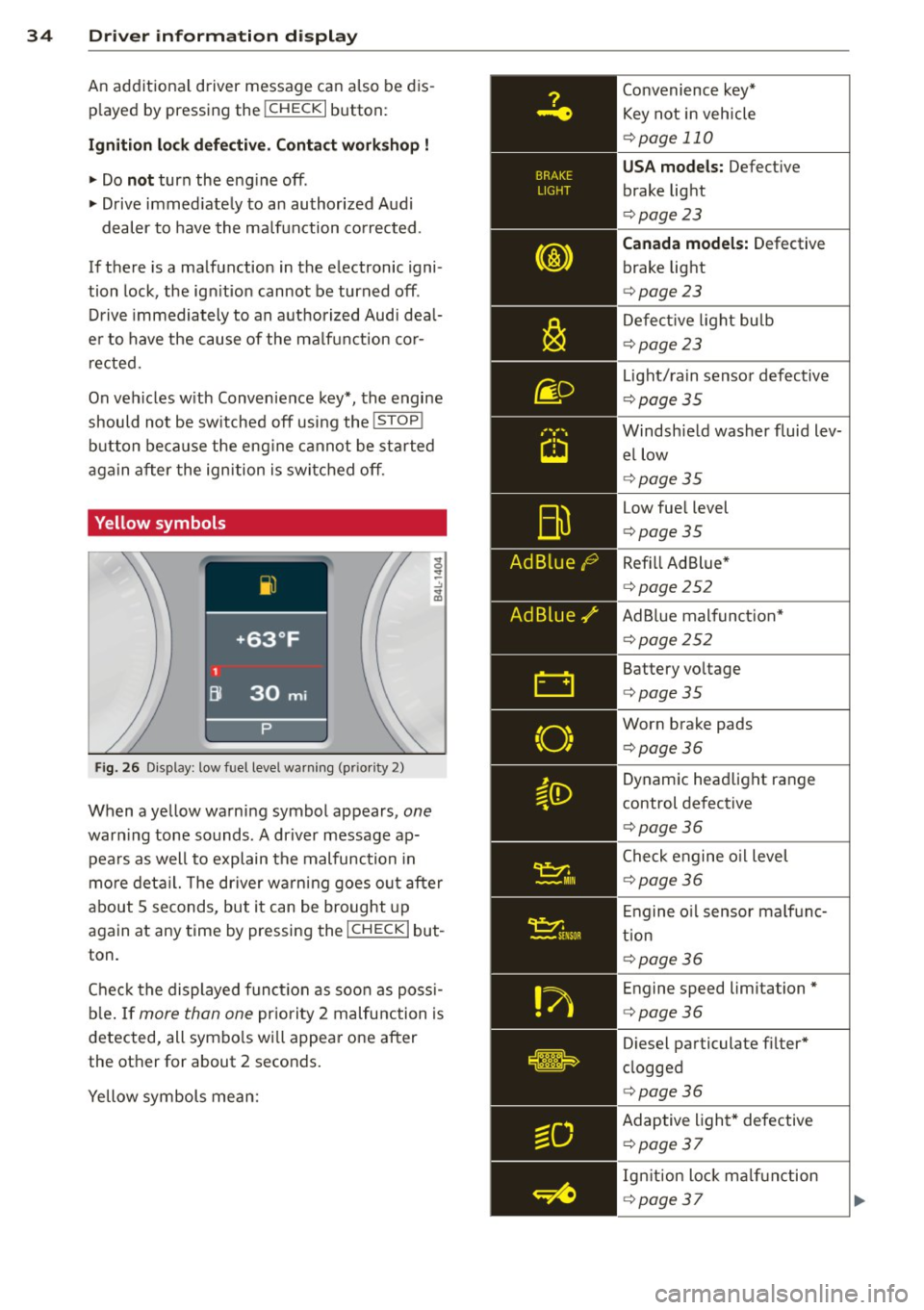
Yellow symbols
Fig. 26 Disp lay: low fuel level warning (p riority 2)
When a yel low warning symbol appears, one
warn ing tone sounds . A dr iver message ap
pea rs as well to explain the malfunc tion in
mo re deta il. The driver warning goes o ut after
about 5 seconds, but it can be brought up
again at any time by pressing the
I CHECK I but
ton .
Chec k the displayed funct ion as soon as poss i
b le . If
more than one pr iority 2 malfunction is
detected, all symbo ls wi ll appea r one after
the other for about 2 seconds.
Yellow symbols mean: Convenience key*
Key not in vehicle
¢
page 110
USA models: Defect ive
brake light
¢ page 23
Canada model s: Defective
brake light
¢ page 23
Defect ive light bulb
¢ page 23
Light/ra in sensor defective
¢ page35
Windsh ield washer fluid lev
el low
¢ page35
Low fue l level
¢page 35
Refill Ad Blue *
¢page 252
AdBlue malfunct ion*
¢ page252
Battery vo ltage
¢ page35
Worn brake pads
¢page36
Dynamic headlight range
control defective
¢ page36
Check engine o il level
¢ page 36
Engine o il sensor malf unc
tion
¢ page 36
Engine speed limitation*
¢page36
Diesel particulate f ilter*
clogged
¢ page36
Adaptive light * defective
¢ poge37
Ign ition lock ma lfunction
¢ page 37
Page 38 of 350
36 Driver in formation d isplay
(0 ) Worn brake pads
rlJ Br ake pa ds !
If the warn ing light illum inates, immediately
contact your authorized Audi dealer or quali
fied workshop to have all brake pads inspect
ed. On USA models the wa rning light
rlJ
comes on together wi th the warn ing ligh t
1111 -Both sets of b rake pads on an axle
must always be replaced at the same time .
A WARNING
Driving with bad brakes can cause a colli
sion and serious personal injury .
- If the warning light
rlJ and the warning
light
11111 ) with the message B rake
pads !
comes on in the instr ument cluster
display, immediately contact your au
thorized Aud i dealer or qualified work
shop to have all brake pads checked or
replaced if necessary .
~(]) Headlight range control
El Head light rang e control d efe ctiv e !
-
If the symbol illuminates, the dynamic head
light range control is no longer working prop
erly . Have the system checked and repaired at
your author ized Audi dealer.
'I=?; , Engine oil level
Ill Pleas e che ck oil l evel
When the symbol illuminates, check the en
gine o il level as soon as poss ible
¢ page 260 .
Top off the oil at you r earliest oppo rtunity
~ page 261.
't'.:r .., Engine oil sensor defective
• Oil l evel ! Sensor d efe ctive
If the symbol illuminates, contact your au
thor ized A udi dealer and have the o il sensor
i nspected. Un til you have th is done, check the
l ) - : USA mod els onl y
oil level each time you refue l just to be on the
safe side ¢
page 260.
!?' Engine speed limitation
Applies to vehicles: wit h engine speed li mitatio n
(Pl Do not e xceed ma x. engine speed of
XXXX rpm
The (Pl symbol illuminates when there is an
engine contro l malfunction. The indicator
li ght
GB in the instrument cluster also illumi
nates. The engine speed is limited to the
speed displayed in the driver informa tion sys
tem . Keep in mind that the engine speed w ill
not exceed the value d isplayed in the dr iver in
format ion system, for example when down
shifting.
Please go to an author ized Audi dealer or oth
er qualified workshop to have the malfunct ion
repaired.
~ Diesel particulate filter clogged
Applies to vehicles: wi th diese l eng ine a nd diese l par ticu
late filter
II Particulate filt er See o wner' s manua l
When the II symbol illuminates, you can a l
ter your driving style to ass ist the filter sel f
cleaning process . Drive for approximately 15
minutes with the selector lever in the S posi
t ion at a m inimum speed of 37 mph (60 km/
h) and an eng ine speed of approximately
2,000 RP M. T he temperat ure increase that
will res ult from this can burn off the soo t in
the fi lter . The symbol will switch off when the
cleaning is successful. After a successful
cleaning, there is no need to bring the car to
an authori zed dea ler or qualified workshop
because th is is part of normal vehicle opera
t ion .
If the symbol
II does not switch off, see your
authori zed dea ler or other qualified workshop
to have the problem corrected.
For more information on the diesel particu
l ate fi lter, refer to ¢
page 231.
Page 110 of 350
108 On the road
Starting and stopping
the engine
Starting the engine
The engine can only be started with your orig
inal Audi key.
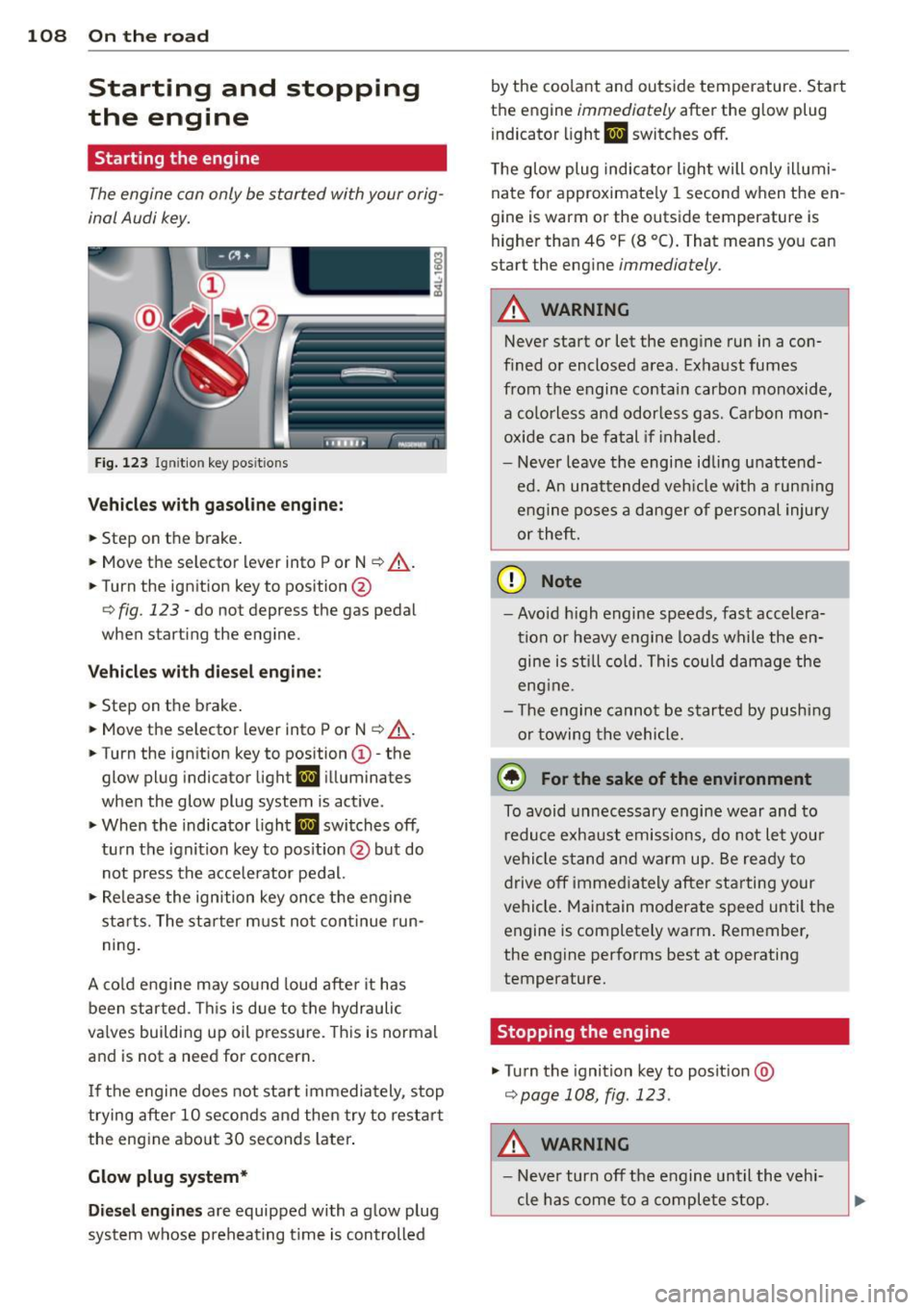
Fig. 123 I gni tion key positio ns
Vehicles with gasoline engine:
.. Step on the brake .
.. Move the selector lever into P or N
~ ,&. .
.. Tu rn the ignition key to position @
~ fig. 123 -do not depress the gas pedal
when starting the engine.
Vehicles with diesel engine:
.. Step on the brake .
.. Move the selector lever into P or N
~ ,&..
.. Turn the ign ition key to position ©- the
glow plug indicator light
II illuminates
when the glow plug system is act ive .
.. When the indicator l ight
II switches off,
turn the ignition key to pos it ion @ but do
not press the accelerator pedal.
.,. Re lease the ignition key once the engine
sta rts. The starter must not continue run
ning.
A cold engine may sound loud after it has
been started . This is due to the hydraulic
va lves building up oil pressure. This is normal
and is not a need for concern.
If the engine does not start immediately, stop
trying after 10 seconds and then try to restart
the engine abo ut 30 seconds later.
Glow plug system*
Diesel engines are equipped with a glow plug
system whose preheating t ime is controlled by the coo
lant and outs ide temperature . Start
the engine
immediately after the glow plug
indicator light
II switches off.
The glow plug indicator light will only illumi
nate for approximate ly 1 second when the en
gine is warm or the outside temperature is
higher than 46 °F (8 °C). That means you can
start the engine
immediately .
A WARNING
-Never start or let the engine run in a con-
fined or enclosed area. Exhaust fumes
from the engine contain carbon monoxide,
a colorless and odorless gas . Carbon mon
oxide can be fatal if in haled.
- Never leave the engine idling unattend
ed. An unattended veh icle w ith a runn ing
engine poses a danger of personal injury
or theft .
(D Note
- Avo id high engine speeds, fast accelera
tion or heavy engine loads while the en gine is still cold. This could damage the
eng ine .
- Th e engine cannot be started by pushing
or towing the vehicle .
@ For the sake of the environment
To avoid unnecessary engine wear and to
reduce exhaust emissions, do not let your
vehicle stand and warm up. Be ready to
drive off immediately after starting your
vehicle. Maintain moderate speed until the
engine is completely warm . Remember,
the engine performs best at operating
temperature.
· Stopping the engine
.,. Turn the ignition key to posit ion @
~page 108, fig . 123.
A WARNING
-
- Never turn off the engine until the vehi-
cle has come to a complete stop.
Page 111 of 350
M
"' 0 ..J
"". rl I.O
"' rl
"' rl
-The brake booster and servotronic on ly
work when the engine is running. With
the ignition turned off, you have to apply
more force when steering or braking .
S ince you cannot steer and stop normal
ly, this can lead to accidents and ser ious
injuries.
- The rad iator fan can continue to run for
up to 10 min utes even after you have
turned off the engine and removed the ign ition key. The radiator fan can also
turn on again if the engine coolant heats
up because of intense sunlight or heat
build -up in the engine compartment.
«I) Note
Do not stop the engine immed iate ly after
hard or extended dr iving. Keep the engine
running for approximately two minutes to
prevent excessive heat build-up .
Starting and stopping
the engine with
Convenience key
Starting the engine with the~
button
App lies to vehicles: with Convenie nce key
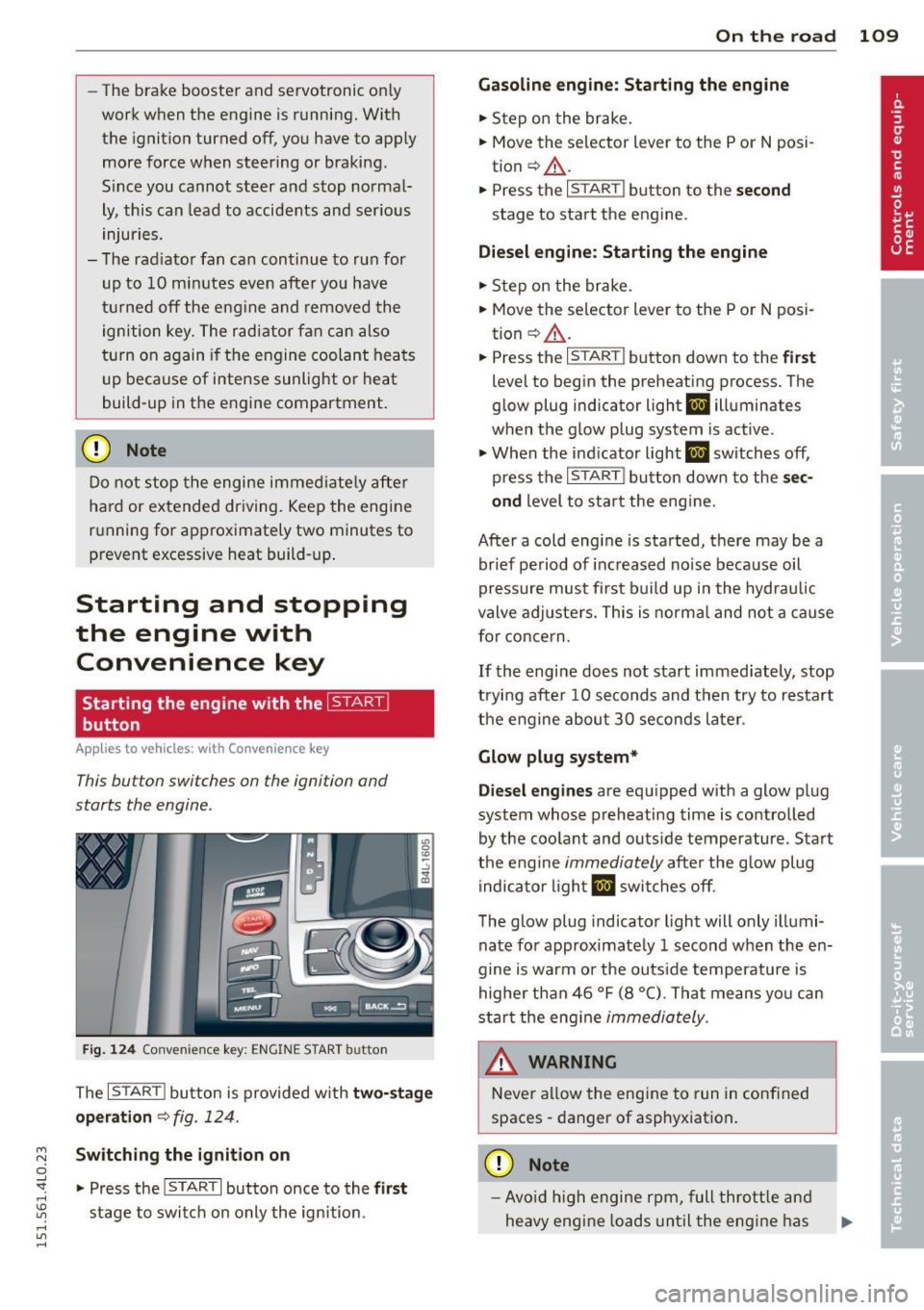
This bu tton swi tches on the ign ition and
starts the engine .
Fig. 124 Co nvenie nce k ey: ENG INE START b utton
The I STAR T! button is provided w ith two -sta ge
o p era tion
¢ fig. 124.
Sw itching the ignition on
.. Press the !STAR T I button once to the firs t
stage to switch on only the ign ition .
On th e road 109
Gasoline eng in e: St arting the engine
.. Step on the brake.
.. Move the s elector lever to the P or N posi
tion ¢.&, .
.. Press th e
r:: 1s =T:--:- A=RT= i button to the secon d
stage to start the engine .
Diesel en gine : Starting the engine
.. Step on the brake.
.. Move the selector lever to the P or N posi
tion ¢.&, .
.. Press th e
r:: 1s =T A c:--=RT= I button down to the first
level to begin the preheating process . The
glow plug indica tor light
II illum ina tes
when the glow plug sy stem is active .
.. When the ind icator light
II switches off,
press the
I ST ART ! button down to the se c
ond
level to star t the eng ine .
After a cold engine is started, there may be a br ief period of inc reased no ise because oil
pressure must first build up i n the hydraulic
valve adjuste rs. This is norma l and not a cause
for concern .
If the engine does not start immediately, stop
trying after 10 seconds and then try to restart
the engine abou t 30 seconds later .
Glow plug system*
Die sel engines
are equ ipped with a glow plug
system whose preheating time is controlled
by the coo lant and outs ide temperature . Start
the engine
immediately afte r the glow plug
indicator light
II swi tches off .
The glow plug indicator light will only illumi
nate fo r approximate ly 1 second when the en
gine is warm or the outs ide temperature is
highe r than 46 °F (8 °C) . That means yo u can
start the eng ine
immediately .
WARNING
Never allow the engine to run in confined
spaces -danger of asphyxiation .
(D Note
-Avo id h igh engine rpm, full thrott le and
heavy engine loads until the eng ine has
Page 114 of 350
112 On the road
The parking brake warning light. (USA)/ .
(CON) illuminates when the parking brake is
set and you switch on the ignition.
A WARNING
-
Always release the parking brake com
pletely. A partially engaged brake will
overheat the rear brakes, reduce their ef
fectiveness and cause excessive wear . This
could lead to brake failure and an accident .
(D Note
Only after the vehicle has come to com
plete stop, should you firmly set the park
ing brake and move the selector lever into
P.
Parking
• Press the brake pedal to stop the vehicle .
• Apply the parking brake firmly
r=,> page 111,
fig. 126 @.
• Move the selector lever to P.
.. Turn the engine off
r=,> _& .
.. When on inclines or declines, turn the steer
ing wheel so that the vehicle will roll into
the curb if it begins to move.
A WARNING
This is how you can reduce the risk of in
jury when leaving your vehicle.
- Never park the vehicle where it can come
in contact with dry grass, spilled fuel or
any other flammable materials.
- When parking on hills, always turn the
wheels so that the front wheels will first
roll into the curb, if the vehicle should
start to roll.
- Never allow anyone - especially small
children - to remain in the vehicle when
it is locked. Locked doors make it more
difficult for rescuers to access the pas
senger compartment in the event of an
emergency. Danger to life!
- Never leave children unsupervised in the
vehicle. Children could release the park
ing brake or move the gearshift lever out
-
of gear. The vehicle could start to roll
away and cause an accident.
- No matter what the season is, the tem
perature in a parked vehicle can reach
dangerous levels.
Q) Note
- Please exercise care when you park your
vehicle in parking areas with parking bar
riers or curbs. Parking barriers and curbs
vary in height and could damage your
bumper and related components as the
front of your vehicle moves over a barrier
or curb that is too high, as you park or as
you back out of a parking spot. In order
to be sure that no such damage can oc
cur, you may wish to stop short of having
the front tires of your car touch the park
ing barrier or curb.
- Please also exercise exceptional care
when you drive up or down steep ramps
or drive over curbs or other obstacles, for
which the vehicle is not designed, be
cause components of th@ vehicle close to
the ground, such as bumper covers,
spoilers and suspension and exhaust sys
tem components, may become dam
aged.
Starting on hills
Hill Hold makes it easier to start on hills.
The system is activated when the brake pedal
is depressed
for a few seconds . For this, the
vehicle must be standing in uphill driving di rection.
After releasing the brake pedal, the brake power is held for a
brief moment to prevent
the vehicle from rolling back when starting. At
this time, you can easily begin to move your
vehicle .
A WARNING
- If you did not begin moving immediately
after releasing the brake pedal, under
certain circumstances, the vehicle would
begin to roll backward. Depress the ..,.
Page 115 of 350
M
"'
brake pedal immediately or engage the
parking brake.
- Should the engine stall, depress the
brake pedal immediately or engage the
parking brake.
- In order to prevent the vehicle from roll
ing back unintentionally when starting in
stop-and-go traffic, keep the brake pedal
depressed for a few seconds before driv
ing off .
- When you leave the vehicle - even if only
briefly -, sw itch off the ignition and
make sure to remove the ignition key . Al
so engage the
park ing br ake to prevent
your vehicle from rolling u nintentionally.
Th is parti cularly applies if chi ldren are
left in the vehicle - danger of accident!
Cruise control
Switching the system on
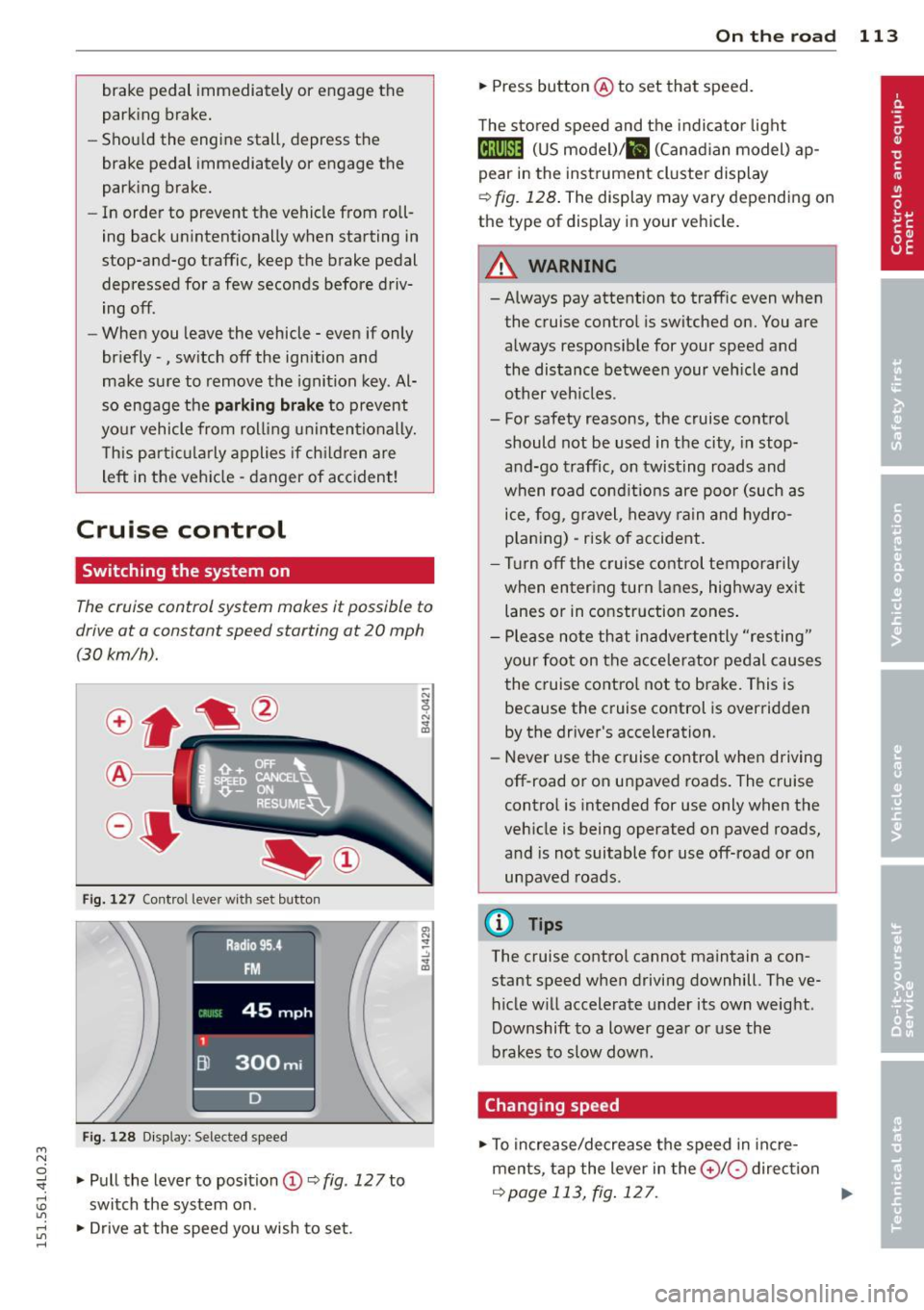
Th e cruise control syst em makes it possible to
drive at a constant speed starting at
20 mph
(30kmlh).
Fig. 127 Contro l leve r wi th s et button
Fig. 128 D is play: Selected speed
:3 .,. Pull the lever to position (D ~ fig. 127 to "". rl I.O
"' ,....,
"' rl
switch the system on .
.,. Drive at the speed you wish to set.
On th e road 113
.,. Press button @to set that speed.
The sto red speed and the indicator light
Ctj;\1)~14 (US model) ;&I (Canad ian model) ap
pear in the instrument cluster display
~ fig. 128 . The display may vary depending on
the type of display in your vehicle.
A WARNING
- Always pay attention to traffic even when
the cruise control is switched on. You are
always responsible for your speed and
the distance between your veh icle and
other veh icles .
- For safety reasons, the cruise control
should not be used in the city, in stop
and-go traffic, on twisting roads and
when road conditions are poor (such as
ice, fog , gravel, heavy rain and hydro
p laning) - risk of accident.
- Turn off the cruise control temporarily
when en ter ing turn lanes, highway exit
lanes or in construction zones .
- Please note that inadvertently "resting"
your foot on the accelerator pedal causes
the cruise control not to brake. This is because the cruise control is overridden
by the driver's acceleration.
- Never use the cruise control when driving
off-road o r on unpaved roads. The cruise
control is intended for use only when the
vehicle is being operated on paved roads,
and is not suitable for use off-road or on
unpaved roads .
(D Tips
The cruise control cannot maintain a con
stant speed when driving downhill. The ve
hicle will accelerate under its own weight .
Downshift to a lower gear or use the
brakes to slow down.
Changing speed
.,. To increase/decrease the speed in incre
ments, tap the lever in the
0 10 direction
~ page 113, fig . 127 . Ill>-
Page 120 of 350
118 Adapti ve crui se control
-Never drive with you r foot underneath
t h e brake pedal.
- Always read and heed the information
and WARNINGS
¢ .&. in Description on
page 115.
A WARNING
- Never rely on the distance control fea
ture of ACC alone to prevent rear-end col
lisions . Always be prepared to brake and
take evasive action to avoid collisions and other acc ident situations.
- Never allow the clos ing speed between
yo u and other vehicles to be so h igh that
the adaptive c ruise control may not be
able to slow your vehi cle safe ly. If clos
ing speed is too high, you m ust app ly the
brakes yourself to reduce the risk of a
rear-end crash.
(D Tips
Please note that t he amo un t of a ccelera
tion the adapt ive cr uise control uses de
pends on the Distance setting selected .
DISTANCE 1 g ives you acce lerat ion that is
dynamic and sporty. DISTANCE 4, on the
other hand, gives more moderate acce lera
tion. For more information about the time
intervals ¢
page 120 , How is the distance
(time interval) set? .
-Please note that if the adaptive cruise
control has begun braking the vehicle
and the d river chooses to brake the vehi
cle add itiona lly, t he b rakes may fee l
"h ard". This is simply due to the pressure
b uild- up of the initial b raking.
- Adaptive cruise control is sw itched off af
te r pressing the footbrake. The speed
saved u p this poin t can be resumed. To
res ume the saved speed, release the
b rake pedal and p ull th e control leve r to
ward you
¢ page 120 , Turning adaptive
cruise control off temporarily .
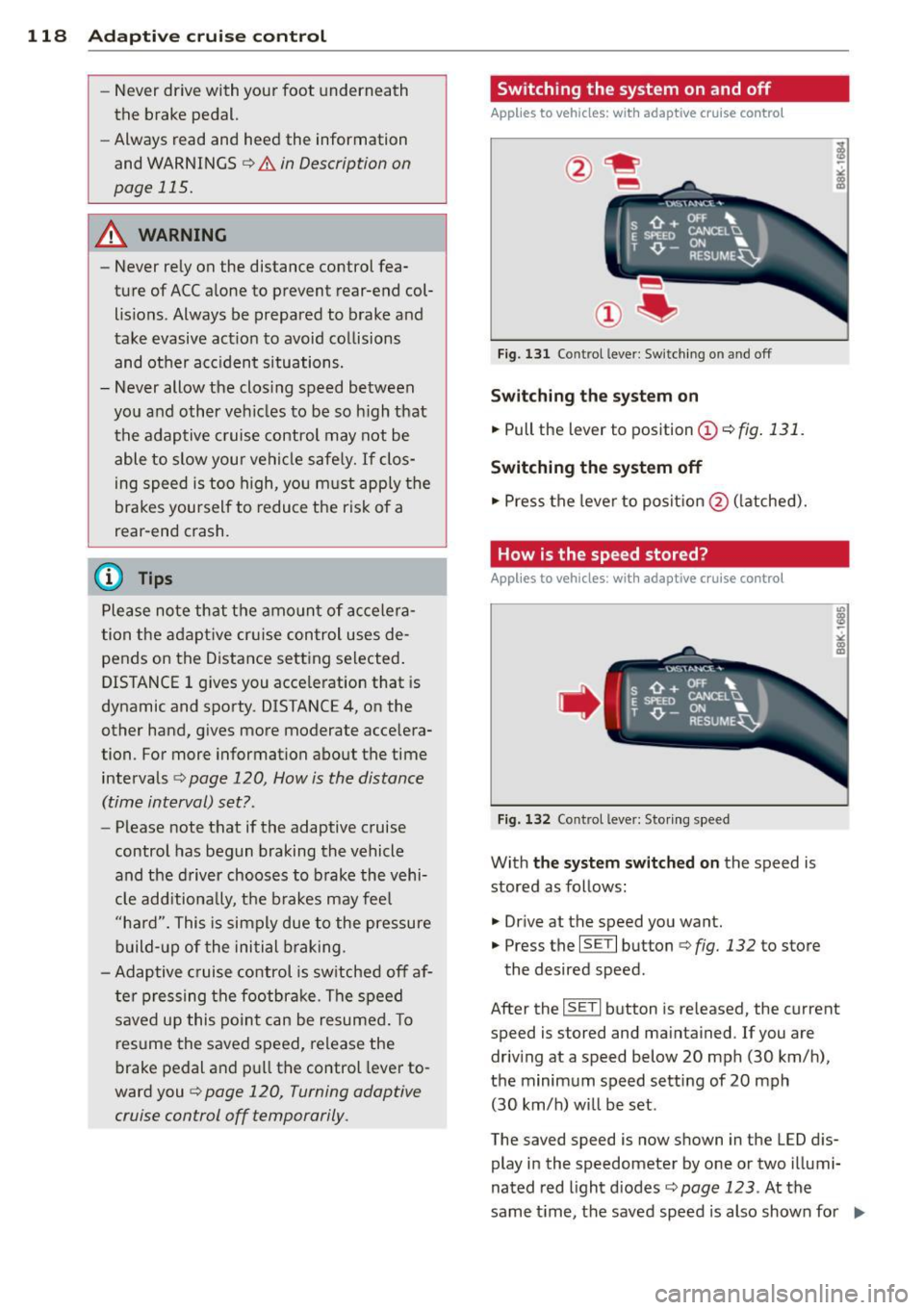
Switching the system on and off
Applies to vehicles: with adaptive cruise contro l
Fig. 131 Control lever: Sw itching on and off
S w itching the sy stem on
.,. Pull the lever to position © r::!) fig. 131 .
Switching the system off
.,. Pres s the lever to posit ion @ (latched).
How is the speed stored?
Applies to vehicles: wit h adaptive cruise contro l
,' ts ~:_" ';;;", ' , E Sl'EEO CANCELU
. T ,0. -ON ... . RESUME~
Fig. 1 32 Co ntrol lever: Storing s peed
With the sy stem switched on the speed is
stored as follows:
• Dr ive at the speed you want .
.,. Press the
ISE TI button ¢ fig. 132 to store
the desired speed.
After the
ISE TI button is re leased, the current
speed is stored and maintained . If you are
driv ing at a speed below 20 mph (30 km/ h),
the minimum speed setting of 20 mph
(30 km/h) will be set .
The saved speed is now shown in the LED d is
play in the speedometer by one or two illumi
nated red light d iodes
c::> page 123. At the
same time, the saved speed is also shown for ..,.
Page 122 of 350
120 Adaptive cruise control
Turning adaptive cruise control off
temporarily
Applies to vehicles: with adaptive cruise co ntrol
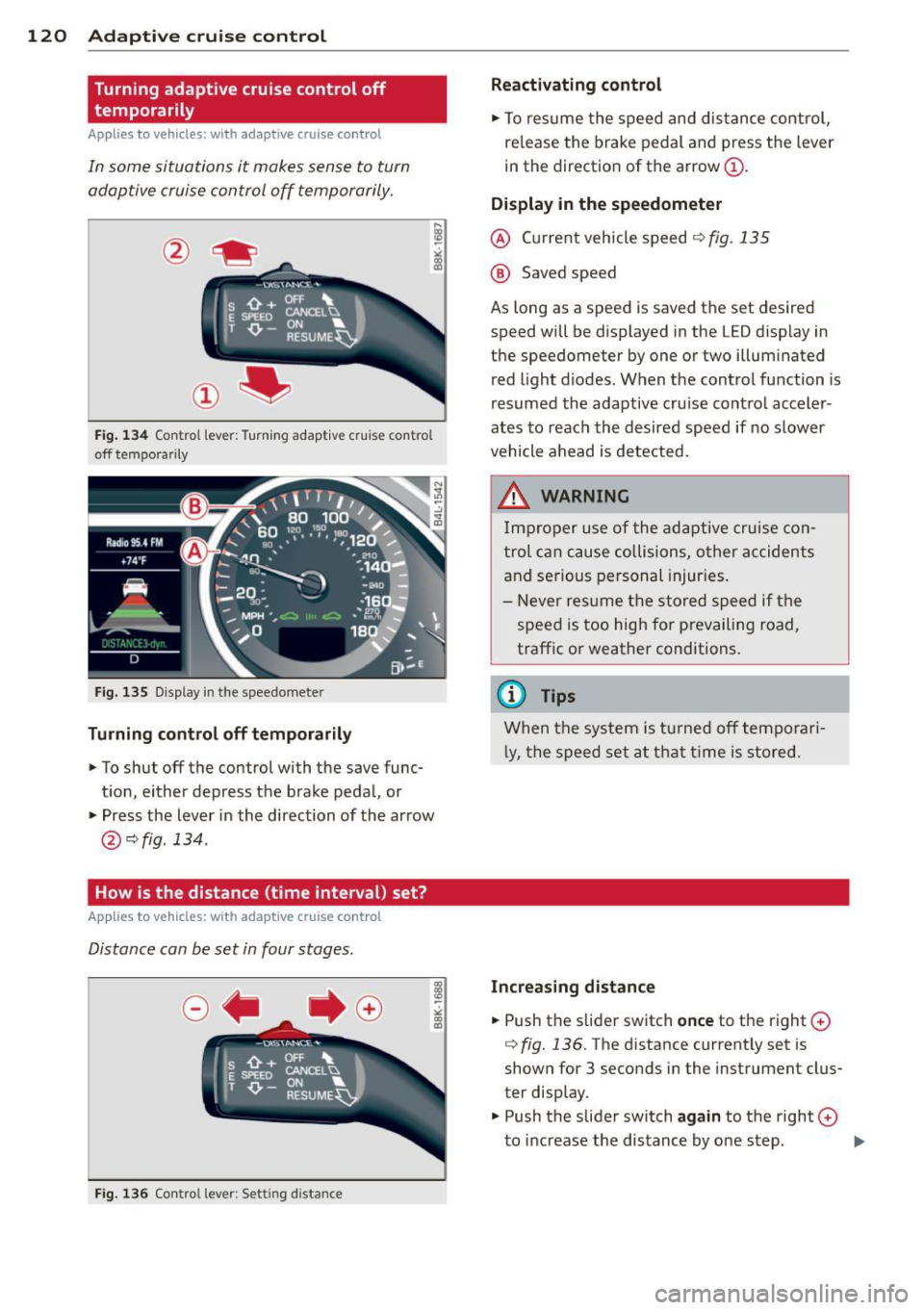
In some situations it makes sense to turn
adaptive cruise control off temporarily.
®
Fig. 134 Con tro l lever : Turning adaptive cruise co ntro l
off tempo rarily
Fig. 135 D isplay in the speedomete r
Turning control off temporarily
"To shut off the control with the save func
tion, either depress the brake pedal, or
" Press the lever in the direction of the arrow
@ qfig .134.
How is the distance (time interval) set?
Ap plies to vehicles: with adaptive cruise co ntrol
Distance can be set in four stages.
Fig. 136 Contro l lever: Setting d istance
Reactivating control
"To resume the speed and distance control,
release the brake pedal and press the lever
in the direction of the arrow@.
Display in the speedometer
@ Current vehicle speed~ fig. 135
@ Saved speed
As long as a speed is saved the set desired
speed will be displayed in the LED display in
the speedometer by one or two illuminated
red light diodes . When the control function is
resumed the adaptive cruise control acceler
ates to reach the desired speed if no slower
vehicle ahead is detected.
&_ WARNING
Improper use of the adaptive cruise con
trol can cause collisions, oth er accidents
and serious personal injuries.
- Never resume the stored speed if the
speed is too high for prevailing road,
traffic or weather conditions .
(0 Tips
When the system is turned off temporari
l y, the speed set at that time is stored.
Increasing distance
-
" Push the slider switch once to the right 0
q fig. 136 . The distance current ly set is
shown for 3 seconds in the instrument clus
ter display.
" Push the slider switch
again to the right 0
to increase the distance by one step. ..,.
Page 124 of 350
122 Adapti ve crui se control
A WARNING
Following ot her vehicles too closely in
creases the risk of a crash and serious per
sonal injury .
- Following other vehicles too closely, par
t icularly at higher speeds increases the
risk of collis ions and serious pe rsonal in
Jury.
- Setting short distances to the traffic
ahead reduces the time and distance
available to br ing you r vehicle to a safe
stop and makes i t even mo re ne cessary
to pay close attention to traffic.
- Always select a speed and distance to
traffic ahead that is safe and appropr iate
under the prevailing traff ic, road, weath
er and Lighting conditions .
- Never re ly on the dis tance control fea
ture of ACC a lone to p reven t rear -end col
lisions. Always be prepared to brake and
take evasive act ion to avoid co llisions
and other acc ident situations.
- Never allow the closing speed between
you and other vehicles to be so h igh that
the adaptive cruise control may not be
able to slow your vehicle safe ly. If clos
ing speed is too high, you must apply the
brakes yourself to reduce the risk of a
rear-end c rash.
- Always select a g reater following dis
tance to the veh icle ahead on wet roads
than o n dry roads.
- Always read and heed the information
and WARNI NGS
9 .&. in Description on
page 115.
(0 Tips
The distance setting is reset to the factory
default
DISTANCE 3 the next time the ig
nition is turned on.
Driver information
Displays in the instrument cluster
Applies to veh icles: w ith adaptive cruise contro l
Depending on the driving situation, driver in
formation is displayed in the instrument clus
ter .
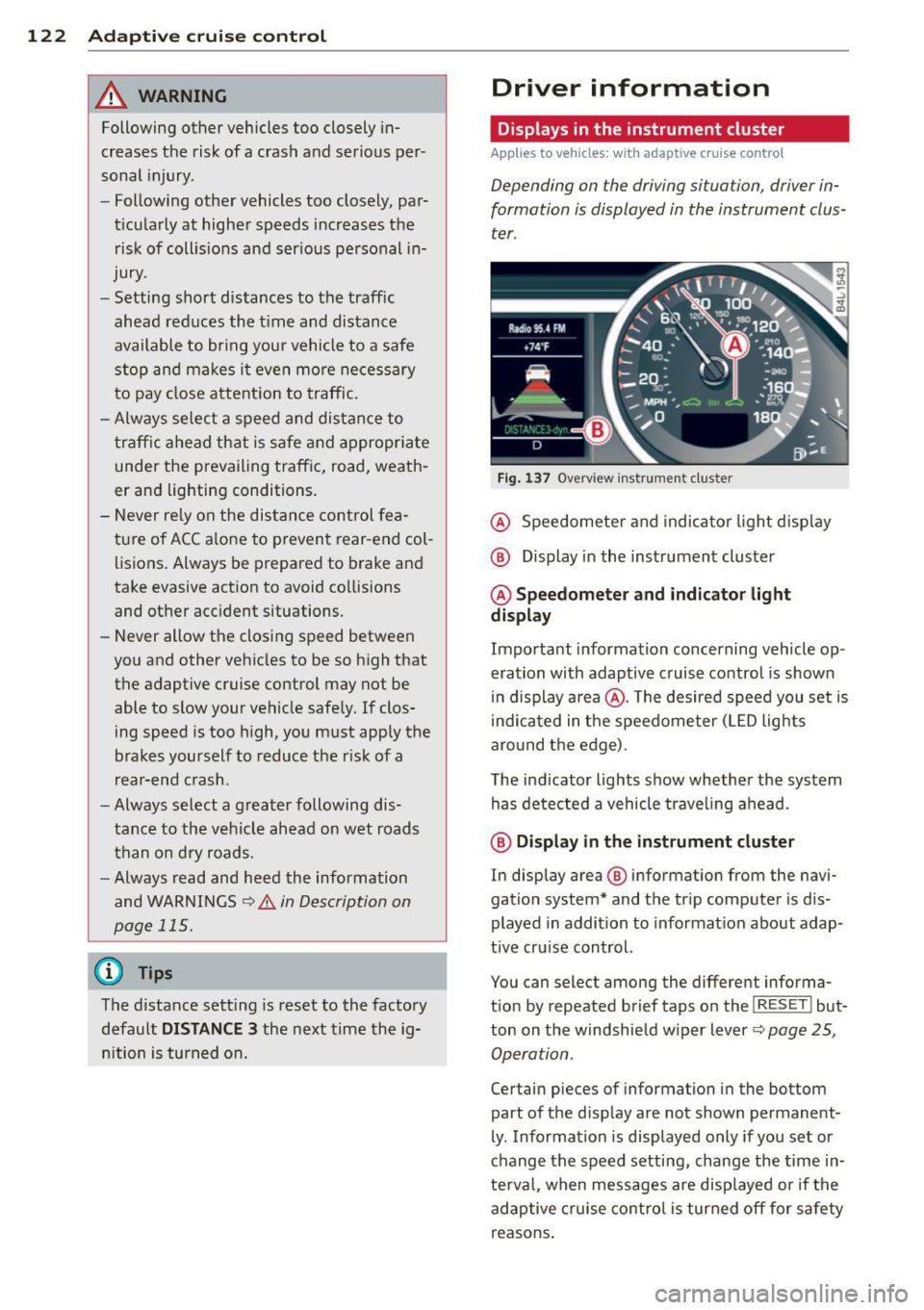
Fig . 1 37 Overv iew ins tr u me nt cluster
@ Speedometer and indica to r Li ght d isp lay
@ Display in the instrument cluster
@ Speedometer and indicato r light
display
Important information concerning vehicle op
eration with adaptive cruise control is shown
i n display a rea @. The desired speed you set is
i ndica ted in the speedome ter (LED lights
aro und t he ed ge).
T he ind icator Lights show whether the system
has detected a vehicle trave ling ahead .
@ Display in the in strument cluster
In display area@ information from the navi
gation system* and th e tr ip computer is dis
played in addition to informat ion about adap
t ive cru ise control.
You can select among the different informa
t io n by repeated brief taps o n the
I RESET I but
ton on the w indshie ld w iper Lever
9 page 25,
Operation .
Certain pieces of information in the bottom
part of the display are not shown permanent
ly . Information is displayed only if you set or
c h ange the speed setting, change the time in
te rva l, when messages are disp layed or if the
adaptive cruise co ntro l is turned
off for safety
r easons .