brakes AUDI Q7 2015 Owner´s Manual
[x] Cancel search | Manufacturer: AUDI, Model Year: 2015, Model line: Q7, Model: AUDI Q7 2015Pages: 350, PDF Size: 86 MB
Page 268 of 350
26 6 Ch eck ing and filling
If the brake fluid level falls considerably be
low the "MIN" mark, the brake warning/indi
cator light (U .S . mode ls:
11111 , Canadian
models: .) will come on
<=> page 19 and
<=> page 32. Do not continue to operate the ve
h icle . The complete brake system should be
thoroughly checked by an authorized Aud i
dea ler or qualified workshop and the cause
corrected. If the brake fluid level is too low,
the brake warning/indicator light will illum i
nate . Contact an authorized Aud i dealer
im
m ediatel y.
@ Tips
The brake fluid rese rvoir is located unde r
neath the cove r.
Changing brake fluid
Hove the broke fluid changed by on experi
enced technician.
Brake fluid absorbs moisture from the a ir . If
the water content in the brake fluid is too
h igh , corrosion in the brake system may result
after a per iod of t ime. The bo iling po int of the
brake fluid wi ll also decrease considerably and
decrease braking performance.
Therefore, the brake flu id must be changed
e ver y tw o year s. Always use new b rake fluid
which conforms to Federal Motor Vehicle
Standard "FMVSS 1 16 DO T 4".
The brake flu id reservo ir can be difficult to
reach, therefore, we recommend that you
have the brake f luid changed by you r author
ized
Audi dea ler. Your dea ler has the correct
too ls, the right brake fluid and the know -how
to do this for you.
A WARNING
- Brake fluid is poisonous . It must be stor
ed only i n the closed orig inal container
o ut of the reach of children!
- Brake fa ilure can result from old or inap
propriate b rake fluid. Observe these pre
caut ions: -
Use only brake fluid that meets SAE
specification
J 1703 and conforms to
Federa l Motor Vehicle Standard 116.
Always check with your authorized Audi
dealer to make sure you are using the
correct brake fluid . The correct type of
brake f lu id is also ind icated on the
brake flu id reservoir.
- T he brake fluid must be new. Heavy use
of the bra kes ca n cause a vapo r lock if
the b rake fluid is left in the system too
l ong . This can seriously affect the effi
c iency of the brakes as well as your
safety. This co uld resu lt in an accident.
(D Note
Bra ke fluid will damage the paint of you r
vehicle .
(® For the sake of the environment
Because of the p rob lem of p roper disposal
of b ra ke fluid as well as the spec ial too ls
r equired and the necessary expertise, we
re commend that yo u have the brake fluid
changed by yo ur authorized Aud i dea ler.
Battery
General information
U nder normal ope rat ing cond itions , the bat
tery in yo ur Audi does not need any ma inte
nance. With
high o utside tempe ra tur es or
l ong dai ly drives we recommend that you have
the e lectrolyte level checked by an authorized
Audi dealer or qualif ied workshop. The elec
trolyte level should also be checked each time
the battery is charged
<=> page 268.
Have the battery checked when yo u take your
vehicle in for service. You are well advised to replace a battery that is o lder than 5 years .
With certain types of airbag deployment, the battery is disconnected from the veh icle elec
trical system for safety reasons<=>.&
in Re
pair , core and disposal of the airbags on
page 196.
~
Page 275 of 350

M N
0 ...J
'SI: ,...., \!) 1.1'1 ,...., 1.1'1 ,....,
-If you notice unusual vibra
tion or if the vehicle pulls to one side when driving, al
ways stop as soon as it is safe to do so and check the
wheels and tires for dam age.
(D Note
-Please note that summer
and winter tires are de
signed for the conditions
that are typical in those sea
sons. Audi recommends using winter tires during the
winter months. Low tem peratures significantly de
crease the elasticity of
summer tires, which affects
traction and braking ability.
Tires and wheels 273
If summer tires are used in
very cold temperatures, cracks can form on the tread
bars, resulting in perma
nent tire damage that can
cause loud driving noise and unbalanced tires. Audi is not
responsible for this type of
damage.
-Burnished, polished or chromed rims must not be used in winter road condi
tions. The surface of the
rims does not have suffi
cient corrosion protection
for this and could be perma
nently damaged by road salt
or similar substances.
•
•
'
Glossary of tire and loading terminology
Accessory weight
means the combined weight (in
excess of those standard items
which may be replaced) of auto matic transmission, power
steering, power brakes, power
windows, power seats, radio, and heater, to the extent that
these items are available as fac
tory-installed equipment (whether installed or not).
Aspect ratio
means the ratio of the height to
the width of the tire in percent. Numbers of 55 or lower indi
cate a low sidewall for im
proved steering response and
better overall handling on dry
pavement.
Page 277 of 350

M N
0 ...J
'SI: ,...., \!) 1.1'1 ,...., 1.1'1 ,....,
Maximum load rating
means the load rating for a tire
at the maximum permissible in
flation pressure for that tire.
Maximum loaded vehicle
weight
means the sum of:
(a) Curb weight
(b) Accessory weight
(c) Vehicle capacity weight, and
(d) Production options weight
Maximum (permissible)
inflation pressure
means the maximum cold infla
tion pressure to which a tire
may be inflated. Also called
"maximum inflation pressure."
Normal occupant weight
means 150 lbs. (68 kilograms)
times the number of occupants seated in the vehicle up to the
total seating capacity of your
vehicle.
Occupant distribution
means distribution of occu pants in a vehicle.
Outer diameter
means the overall diameter of
an inflated new tire.
Tires and wheels 275
Overall width
means the linear distance be
tween the exteriors of the side
walls of an inflated tire, includ ing elevations due to labeling,
decorations, or protective bands or ribs.
Ply
means a layer of rubber-coated
parallel cords.
Production options weight
means the combined weight of
those installed regular produc
tion options weighing over 5 lbs. (2 . 3 kg) in excess of those
standard items which they re
place, not previously consid
ered in curb weight or accessory
weight, including heavy duty
brakes, ride levelers, roof rack,
heavy duty battery, and special
trim.
Radial ply tire
means a pneumatic tire in
which the ply cords that extend
to the beads are laid at sub stantially 90 degrees to the
centerline of the tread.
•
•
'
Page 284 of 350
282 Tires and wheels
all of the occupants and lug
gage or other cargo that the ve
hicle can carry. For the location
of the tire pressure label
¢fig. 250.
A WARNING
Overloading a vehicle can
cause loss of vehicle control,
a crash or other accident, se
rious personal injury, and
even death.
-Carrying more weight than your vehicle was designed
to carry will prevent the ve
hicle from handling properly
and increase the risk of a loss of vehicle control.
-The brakes on a vehicle that has been overloaded may
not be able to stop the vehi
cle within a safe distance.
-Tires on a vehicle that has
been overloaded can fail
suddenly causing loss of
control and a crash.
-Always make sure that the
total load being transported
- including the weight of a
trailer hitch and the tongue
weight of a loaded trailer -
does not make the vehicle heavier than the vehicle's Gross Vehicle Weight Rat
ing.
A WARNING -
-Incorrect tire pressures
and/or underinflation can
lead to a ser ious or fatal ac
cident .
-Incorrect tire pressures and/or underinflation cause increased tire wear and can
affect the handling of the
vehicle.
-Incorrect tire pressures and/or underinflation can
also lead to sudden tire fail
ure, including a blowout
and sudden deflation, caus ing loss of vehicle control.
Checking tire pressure
The correct tire pressure for the
tires originally installed on
your vehicle is listed on the tire
pressure label located on driv
er's side 8-pillar.
The recommended tire pres
sures are on the tire pressure
label and in the table
c;, page 2 78, Cold tire inflation
pressure.This
means that the
pressure must be checked and
adjusted when the tire has not .,.
Page 290 of 350
288 Tires and whee ls
- The brakes on a vehicle that
has been overloaded may
not be able to stop the vehi
cle within a safe distance.
-Tires on a vehicle that has been overloaded can fail
suddenly, including a blow
out and sudden deflation,
causing loss of control and a
crash.
-Always make sure that the total load being transported
- including the weight of a
trailer hitch and the tongue
weight of a loaded trailer -
does not make the vehicle
heavier than the vehicle's
Gross Vehicle Weight Rat
ing.
Determining correct load
limit
Use the example below to cal
culate the total weight of the
passengers and luggage or oth
er things that you plan to trans
port so that you can make sure
that your vehicle will not be
overloaded.
Steps for Determining Correct Load Limit
1 . Locate the statement "THE
COMBINED WEIGH T OF OC
CUPANTS AND CARGO
SHOULD NEVER EXCEED XXX KG OR XXX LBS"on your vehi
cle's placard (tire inflation
pressure label)
~ page 2 78,
fig . 250 .
2. Determine the combined
weight of the driver and pas
sengers that will be riding in
your vehicle .
3 . Subtract the combined
weight of the driver and pas
sengers from
"XXX" kilo
grams or
"XXX" pounds
shown on the sticker
~ page 278, fig. 250.
4. The resulting figure equals
the available amount of cargo and luggage load capaci
ty. For example, if the
"XXX"
amount equals 1400 lbs .
and there will be five 150 lbs. passengers in your vehi
cle, the amount of available
cargo and luggage load ca pacity is 650 lbs. (1400 -750
(5
X 150) = 650 lbs.)
5. Determine the combined weight of luggage and cargo .,..
Page 298 of 350
296 Tires and wheels
sure of their "previous histo-
and sudden deflation and
ry." Old used tires may have loss of control.
been damaged even though -Temperature grades apply
the damage cannot be seen to tires that are properly in-
that can lead to sudden tire flated and not over or un-
failure and loss of vehicle
derinflated.
control. -For technical reasons it is
-All four wheels must be fit-
not always possible to use
ted with radial tires of the wheels from other vehicles -
same type, size (rolling cir- in some cases not even
cumference) and the same wheels from the same vehi-
tread pattern. Driving with cle model.
different tires reduces vehi- -If you install wheel trim
cle handling and can lead to
discs on the vehicle wheels,
a loss of control. make sure that the air flow
-If the spare tire is not the to the brakes is not blocked.
same as the tires that are Reduced airflow to the
mounted on the vehicle -for
brakes can them to over-
example with winter tires -
heat, increasing stopping
only use the spare tire for a distances and causing a col-
short period of time and lision.
drive with extra care. Refit -Run flat tires may only be
the normal road wheel as used on vehicles that were
soon as safely possible. equipped with them at the
-Never drive faster than the
factory. The vehicle must
maximum speed for which have a chassis designed for
the tires on your vehicle are run flat tires. Incorrect use rated because tires that are of run flat tires can lead to
driven faster than their rat-
vehicle damage or acci-
ed speed can fail suddenly. dents. Check with an au-
-Overloading tires cause heat thorized Audi dealer or tire build-up, sudden tire fail- specialist to see if your vehi-
ure, including a blowout cle can be equipped with
..
Page 334 of 350
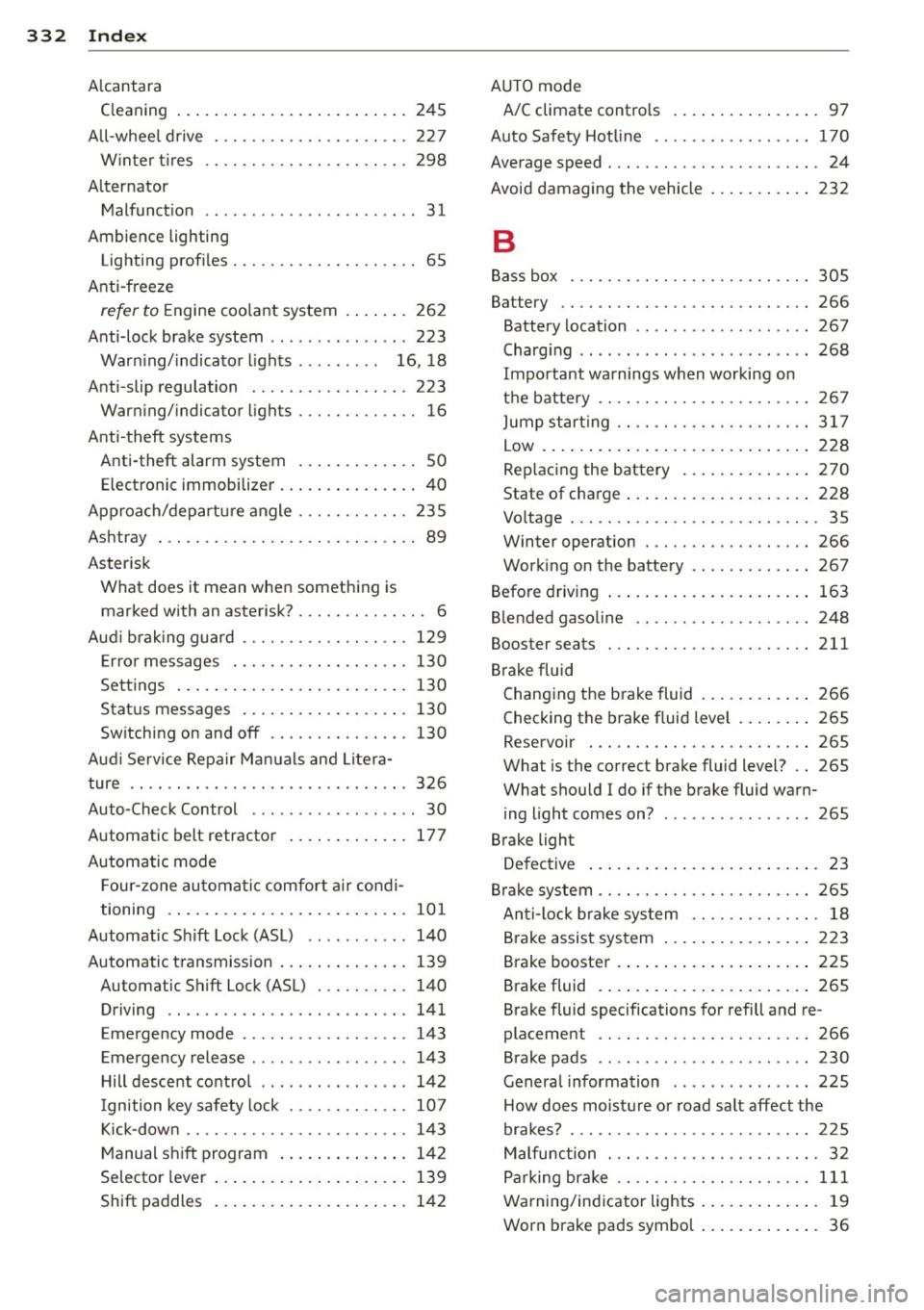
332 Index
Alcantara
C leaning 245
A ll-w heel drive . ........... .... .... . 227
Winter tir es
A lternator 298
Malfunction . . . . . . . . . . . . . . . . . . . . . . . 31
Ambience lighting Lighting profiles .......... .... .... .. 65
Anti -freeze
refer to Engine coo lant system ...... . 262
Anti-lock brake system ..... ... .. .. .. . 223
Warn ing/ indicator lights . . . . . . . . . 16, 18
Anti-slip regulation ........ .. .. .... . 223
Warn ing/ indicator lights ... .. .. .. .. .. 16
Anti-theft systems Anti-theft alarm system . . . . . . . . . . . . . 50
Electronic immobilizer ... .. .. .. .... . . 40
Approach/departure angle . .. .. .. .. .. . 235
Ashtray . .. ... ............ .. .. .. .. .. 89
Asterisk What does it mean when something is
marked with an asterisk? . . . . . . . . . . . . . . 6
Aud i b rak ing guard ....... .. .. .. .. .. . 129
Error messages .... ....... ... .... . 130
Settings . . . . . . . . . . . . . . . . . . . . . . . . . 130
Status messages . . . . . . . . . . . . . . . . . . 130
Switching on and off ...... .. .. .. .. . 130
Aud i Service Repair Man uals and Litera-
ture .. .. .. .. ............. .. .. .... . 326
Auto -Check Control . . . . . . . . . . . . . . . . . . 30
Automatic belt retractor ... ... .. .. ... 177
Automatic mode
F our-zone automatic comfort air condi-
tioning .... ... .. ..... ... .. .. .... . 101
Automatic Shift Lock (ASL) . . . . . . . . . . . 140
Automatic transmission ..... .. .. .... . 139
Automatic Shift Lock (ASL) . .. .. .. .. . 140
Driving .. ................. .. .... . 141
Emergency mode . . . . . . . . . . . . . . . . . . 143
Emergency release ......... ... .. .. . 143
H ill descent contro l ........ ... .. ... 142
I gn ition key safety lock .... .. .. .. .. . 107
Kick-down . . . . . . . . . . . . . . . . . . . . . . . . 143
M anual s hift program ......... .. .. . 1 42
Selector lever ........... ... .. .... . 139
Shift paddles . . . . . . . . . . . . . . . . . . . . . 142 AUTO mode
A/C climate controls ... ..... ... .. .. . 97
Auto Safety Hot line ............. .... 170
Average speed . . . . . . . . . . . . . . . . . . . . . . . 24
Avoid damaging the vehicle .... ... .. .. 232
B
Bass box
Battery .... .. .. .. .. ........... ... .
Battery location .. ................ .
Charg ing ... ... .. .. ... ........... .
Impo rtant warnings when working on
the battery .... .. ............. ... . 30S
266
267
268
267
Jump start ing .. .. ... .......... .. .. 317
Low .. .. .. .... .. ... .. ..... ... .. .. 228
Replacing the battery ... .... ... .. .. 270
State of charge ... .. ... ......... ... 228
Voltage ... .... ................... . 35
Winter operation . ............. .... 266
Working on the battery .. .... ... .. .. 267
Before driving ..... ... .. ..... .... . .. 163
B lended gasoline .. ................ . 248
Booster seats . . . . . . . . . . . . . . . . . . . . . . 211
Brake fluid
Changing the brake fluid ..... ... .. .. 266
Checking the brake fluid level . ... .. .. 265
Reservoir ... .. .. .. .... .... .... ... 265
What is the correct brake fluid level? .. 265
What shou ld I do if the brake fluid warn-
ing light comes on? .... .. ... ... .. .. 265
Brake light Defective . . . . . . . . . . . . . . . . . . . . . . . . . 23
Brake system .... ... .............. .. 265
Anti- lock brake system . . . . . . . . . . . . . . 18
Brake assist system ..... .... ... .. .. 223
Brake booster .... ... .. ..... .... . .. 225
Brake fluid . ..... ... .. ..... ... .. .. 265
Brake fluid specifications for refill and re-
placement .... .. ............. .... 266
Brake pads .. .. .. ..... ........... . 230
General information .............. . 225
How does moisture or road sa lt affect the
brakes? . .. .. .. .. ............. .. .. 225
Malfunction . . . . . . . . . . . . . . . . . . . . . . . 32
Parking brake .. .. ... .......... .. .. 111
Warning/indicator lights ..... ... .. .. . 19
Worn brake pads symbo l . . . . . . . . . . . . . 36