brake AUDI Q7 2015 Owner´s Manual
[x] Cancel search | Manufacturer: AUDI, Model Year: 2015, Model line: Q7, Model: AUDI Q7 2015Pages: 350, PDF Size: 86 MB
Page 240 of 350
238 Trailer towing
Trailer towing
Driving with a trailer
General information
Your Audi was designed primarily for passen
ger transportation .
If you plan to tow a trailer, p lease remember
that the additional load will affect durability,
economy and performance .
Trailer towing not on ly places more stress on
the vehicle, it also calls for more concentra
tion from the driver.
For this reason, always follow the operating
and driving instructions provided and use
common sense.
@ Note
If you are going to tow a trai ler, you must
activate the trailer operation mode
c:::> page 161, Towing a trailer.
Technical requirements
Trailer hitch
Use a weight-carrying hitch conforming to the
gross trailer weight. The hitch must be suita ble for your vehicle and trailer and must be
mounted securely on the vehicle's chassis at a
technically sound location . Use only a trailer
hitch with a removable ball mount. Always
check with the trailer hitch manufacturer to
make sure that you are using the cor rect
hitch.
Do not use a bumper hitch.
The hitch must be installed in such a way that
it does not interfere with the impact-absorb
ing bumper system. No modifications should
be made to the vehicle exhaust and brake sys
tems. From time to time, check that all hitch
mounting bolts remain securely fastened.
When you are not towing a trailer, remove the
trai ler hitch ball mount. This prevents the
hitch from causing damage should your vehi
cle be struck from behind
c:::> A.
Trailer brakes
If your trailer is equipped with a brakin g sys
tem, check to be sure that it conforms to all
regulations.
T he trailer hydraulic brake system must not be
directly connected to the vehicle's hydraulic
brake system
c:::> A .
Safety chains
Always use safety chains between your veh icle
and the tra iler.
Trailer lights
Trailer lights must meet all regulations. Be
sure to check with your authorized Audi dealer
for correct wiring, sw itches, and relays.
Mirrors
If you are unable to see the traffic behind you
using the regular outside mirrors, then you
must install extended mirrors.
It is important
that you always have clear v is ion to the rear .
A WARNING ,-
- If a trailer has electrical brakes please
note that these brakes are not activated
by the factory-fitted control unit -risk of
accident!
- Afte r removing the trailer hitch, do not
store it in yo ur vehicle. In case of sudden
braking, the hitch could fly forward and
injure you or your passengers.
- Never install a "weight distributing" or
"load equalizing" trailer hitch on your ve
hicle. The vehicle was not designed for
these kinds of trailer hitches. The hitch
attachment can fail, causing the trailer
to tear loose from the vehicle.
- The Gross Vehicle Weight Rating for your
vehicle, found on the safety compliance
label on the driver's side B-pillar, must
never be exceeded under any circumstan
ces. Exceeding the Gross Vehicle Weight
Rating of your vehicle is likely to damage
your vehicle, and such damage will not
be covered by your Limited New Vehicle
-
Warranty. Exceeding the Gross Vehicle ~
Page 241 of 350
M N
0 ...J
'SI: ,...., \!) 1.1'1 ,...., 1.1'1 ,....,
Weight Rating will also change the per
formance and handling characteristics of
your vehicle, which could cause a crash result ing in serious injury or death .
- The Gross Vehicle Weight Rat ing for your
vehicle would be exceeded if your vehicle is simultaneously equipped with Panor
amic sliding sunroof; th ird-row seating;
trailer towing equipment (factory or
dealer-installed), and running boards
(dea ler-installed) . UNDER NO CIRCUM
STANCES MAY ALL SUCH ITEMS BE IN
STALLED ON THE SAME VEHICLE.
Operating instructions
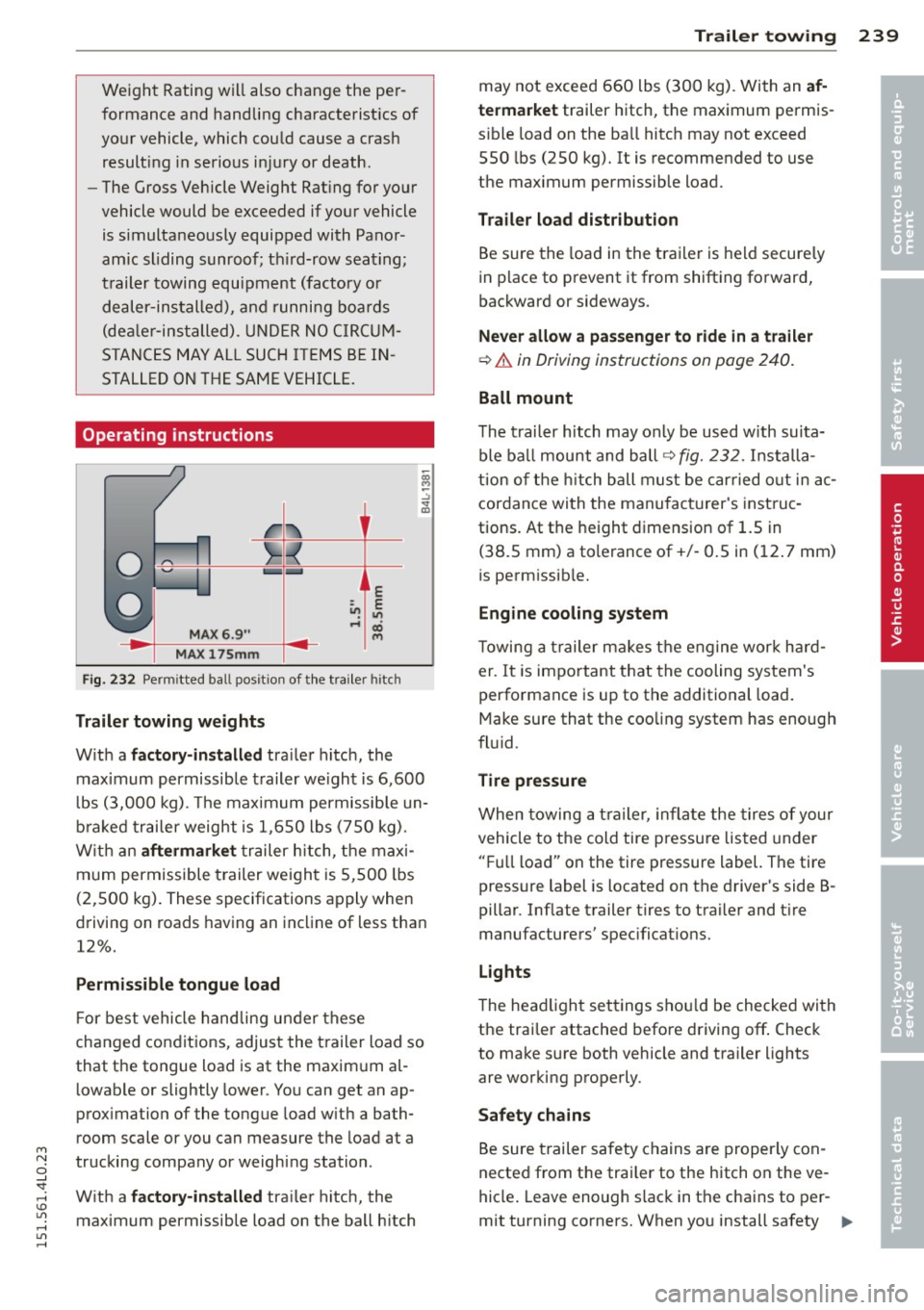
MAX 6.9"
MAX175mm
E
1/1 E 1/1 ... a)
m
Fig. 232 Perm itted ba ll posit ion of t he tra iler hitch
Trailer towing weights
W ith a factory-installed tra iler hitch, the
maximum permissible trailer we ight is 6,600
l bs (3,000 kg). The maximum permissible un
braked trailer weight is 1,650 lbs (750 kg).
With an
aftermarket trailer hitch, the maxi
mum permissible t railer we ight is 5,500 lbs
(2,500 kg). These specifications apply when
driving on roads having an incline of less than
12%.
Permissible tongue load
For best vehicle handling under these
changed cond itions, adjust the trailer load so
that the tongue load is at the maximum al
l owable or slightly lower. You can get an ap
prox imation of the tongue load with a bath
room scale or you can measure the load at a
trucking company or weighing station .
With a
factory-installed tra iler hitch, the
maximum permissible load on the ball hitch
Trailer towing 239
may not exceed 660 lbs (300 kg). With an af
termarket
trailer hitch, the maximum permis
s ib le load on the ba ll hitch may not exceed
550 lbs (250 kg).
It is recommended to use
the maximum permissible load.
Trailer load distribution
Be sure the load in the trailer is held secure ly
in place to prevent it from shifting forward,
backward or sideways.
Never allow a passenger to ride in a trailer
¢.& in Driving instructions on page 240.
Ball mount
The trailer hitch may only be used w ith suita
ble ball mount and ball ¢
fig. 232. Installa
t ion of the hitch ball must be carried out in ac
cordance with the manufacturer's instruc
tions. At the height dimension of 1.5 in
(38.5 mm) a tolerance of+/- 0.5 in (12 . 7 mm)
is perm issib le.
Engine cooling system
Towing a trailer makes the engine work hard
er . It is important that the cooling system's
performance is up to the additional load .
Make sure that the cooling system has enough
fluid .
Tire pressure
When towing a tra iler, inflate the tires of your
vehicle to the cold tire pressure listed under
" Full load" on the tire pressure label. The tire
pressure label is located on the driver's side B
pillar . Inf late trailer tires to trai ler and t ire
manufacturers' spec ificat ions .
Lights
The headlight settings sho uld be checked with
the trailer attached before driving
off . Check
to make sure both vehicle and trailer lights
are working properly .
Safety chains
Be sure trailer safety chains are properly con
nected from the trailer to the hitch on the
ve
hicle . Leave enough slack in the chains to per
mit turning corners. When you install safety
Ill-
•
•
Page 242 of 350
24 0 Trailer towing
chains, make sure they wi ll not drag on the
road when you are driving .
The cha ins shou ld cross under the tra ile r
tongue to prevent it from dropping in case of
separation from the hitch.
0 Note
If you are going to tow a tra ile r, you must
activa te the trailer operation mode
~ page 161, Towing a trailer.
Driving instructions
Driving with a trailer always requires extra
cor e and consid eration.
To obta in the best poss ible handling of vehicle
and tra ile r, p le ase no te the following:
.. Do not tow a loaded tra iler when your car it
self is not loaded.
.,. Be especia lly careful when pass ing othe r
vehicles .
.. Observe speed limits.
.. Do not driv e at the maximum p ermissible
speed.
.. Always apply brakes early.
.. Monitor the temperature gauge.
Weight di stributio n
Towing a loaded trai ler with an empty ca r re
sults in a high ly unstable distribution of
weight . If this cannot be avoided, drive at very
l ow speeds only to avoid the risk of losing
steering control.
A "balanced" rig is eas ier to operate and con
trol. This means that the tow vehicle should
be loaded to the extent possible and permiss i
ble, while keeping the trailer as light as possi
b le under the circumstances. Whenever possi
b le, transfer some cargo to the luggage com
pa rtment of the tow veh icle wh ile observing
tongue load requirements and vehicle loading
considerations .
Speed
The higher the speed, the more difficult it be
comes for the driver to control the rig . Do not
drive at the maximum permiss ible speed . Re- duce your speed even more i
f load, weather or
wind conditions are unfavorable - particularly
when going downhill.
Red uce veh icle speed
immediately if the trail
er shows the slightest s ign of sway ing.
Do not
t ry to stop the swa ying by acceleratin g.
Observe speed limits. In some a reas, speeds
f or vehicles tow ing tra ile rs are lower than for
r egular vehicles.
Always apply brakes early. When driving down hill, shift into a lowe r gear to use the en
gine braking effect to s low the vehicle . U se o f
the brakes alone can cause them to overheat
and fail.
Coolant temperature
T he coo lant tempe ratu re gauge ~ page 10
must be observed caref ully. If the need le
moves close to the upper end of the scale, re
duce speed immediately and/or turn off the
air conditioner.
If the coolant temperature warn ing light in
the instr ume nt cluster starts flashing., pull
off the road , stop and let the engine
idle for
about two min utes to prevent heat build -up .
A WARNING "--
Anyone not proper ly restrained in a mov-
i ng vehicle is at a much greater risk in an
accident. Never let anyone ride in your car
who is not properly wearing the restraints
p rov ided by Audi .
Trailer towing tips
Important to know
Your vehicle handles d ifferently when towing
-
a trai ler because of the additional weight and
different weight distr ibut ion. Safety, perform
ance and economy will great ly depend on how
ca refully you load your tra iler and operate
yo ur rig .
Before you act ua lly tow your tra iler, practice
turning, stopping and backing up in an area
away from traffic. Keep pract ic ing unt il you
Page 243 of 350
M N
0 ...J
'SI: ,...., \!) 1.1'1 ,...., 1.1'1 ,....,
have become completely familiar with the way
your vehicle-trailer combination behaves and responds.
Backing up is difficu lt and requires practice.
Backing up with a trai ler genera lly requires
steering action opposite to that when backing up your vehicle without a trailer .
Maintain a greater distance between your ve
hicle and the one in front of you. You will need
more room to stop . To compensate for the
trai ler, you will need a larger than norma l
turning radius.
When passing, remember that you cannot ac
celerate as fast as you normally would be
cause of the added load . Make sure you have
enough room to pass. After passing, allow plenty of room for your tra iler before chang
ing lanes again .
Avoid jerky starts, sharp turns or rapid lane
changes.
@ Tips
- Do not tow a traile r during the break-in
period of your vehicle.
- If you tow a trailer, your A udi may re
quire more frequent maintenance due to
the extra load
¢ page 326.
Parking on a slope
Do not park on a slope with a trailer. If it can
not be avoided, do so only after doing the fol
lowing:
When parking:
.. Apply the foot brake .
.. Have someone place chocks under both the
vehicle and the trai ler wheels .
.. With chocks in place, slowly re lease the
brakes until the wheel chocks absorb the
load .
.. Turn the wheels towards the curb .
.. Apply the parking brake.
.. Move the selector lever to P.
When restarting after parking:
.. Apply the foot brake.
Trailer towing 241
.. Start the engine.
.. Move the selector lever to D.
.. Release the parking brake and s low ly pull
out and away from the wheel chocks.
.. Stop and have someone retr ieve the wheel
chocks.
(D Tips
If you move the selector lever of the auto
matic transmission to P before applying
the parking brake and before blocking the
whee ls, you may have to use more force
l ater to move the lever out of the
P posi
tion.
•
•
Page 245 of 350

M N
0 ...J
'SI: ,...., \!) ..,.,
,...., ..,., ,....,
Vehicl e ca re a nd cl eanin g 243
& WARNING
-Only wash the vehicle when the ignition
is off and follow the instructions from
the car wash operator to reduce the risk
of accidents.
- To reduce the risk of cuts, protect your
self from sharp meta l components when
washing the underbody or the inside of
the wheel housings.
- After washing the vehicle, the braking ef
fect may be delayed due to moisture on
the brake rotors or ice in the winter . The
brakes must be dried first with a few
careful brake applicat ions .
{[) Note
-If you wash the vehicle in an automatic
car wash, you must fold the exterior m ir
rors in to reduce the r isk of damage to
the mirrors . Power folding exterior m ir
ro rs* must only be folded in and out us
i ng the power folding function.
- Compare the track of your vehicle w ith
the d istance between the gu ide ra ils of
the faci lity- there is a risk of damage to
the wheels and tires.
- Compare the height and width of you r
vehicle with the he ight and width of the
tunnel at the facility. -
To prevent paint damage, do not wash
the vehicle in direct sunlight.
- To reduce the r isk o f damage to the sur
face, do not use insect removing spong
es, kitchen sponges or similar items.
- Matte finish painted vehicle compo
nents:
- To reduce the risk of damage to the
surface, do not use polishing agents or
ha rd wax .
- Never use car wash cycles that apply
protective wax.
It can destroy the
matte fin ish effect .
- Do not place any stickers o r magnet ic
signs on vehicle parts painted w ith
matte fin ish paint. The pai nt cou ld be
damaged when the stickers o r magnets
a re removed.
@ For the sake of the environment
Only wash the ve hicl e in facilities spe cially
designed for that purpose . This will red uce
the r is k of dirty water contam ina ted with
oil from entering the sewer system.
Cleaning and care information
When cle aning and caring for individua l vehi
cle components, refe r to the fo llowing tab les.
The information contained there is simply rec
ommendations. For questions or for compo -nents that are not listed,
re fer to an author
ized Audi dealer or a qualified workshop . Also
follow the information fo und in¢.& .
Cle aning ex terio r
Component Situation Solution
Wipe r bla des
Dirty c:> page 69, Cleaning windshield wiper blades
H eadligh ts/ Dirty Soft sponge with a m ild soap solutiona >
tail lights
S ensors /
Dirty Sensors: soft cloth with a so lvent-free cleaning product
camera l enses Came ra lenses : soft cloth with an alcohol -free cleaning
solution
Snow/ice Hand brush/solvent-free de-icing spray
•
•
Page 246 of 350
244 Vehicle care and cleaning
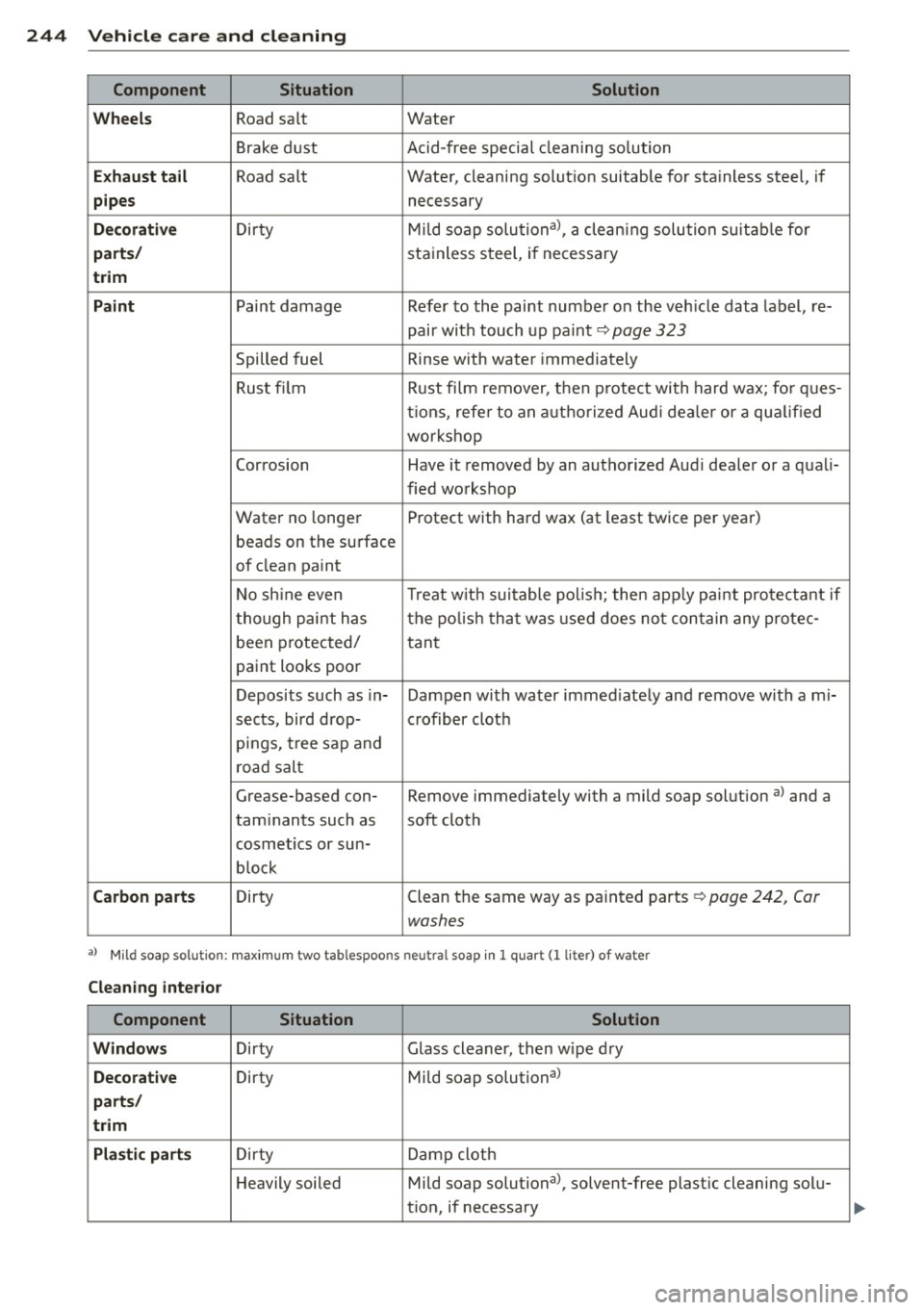
Component Situation Solution
Wheels
Road sa lt Water
Brake dust Acid-free special cleaning solution
Exhaust tail Road salt Water, cleaning solut ion suitable for sta inless steel, if
pipes necessary
Decorative Dirty Mild soap
solutional, a cleaning solution su itab le for
parts/ sta inless steel, if necessary
trim
Paint
Paint damage Refer to the paint number on the veh icle data label, re-
pair with touch up pa int¢
page 323
Spilled fuel Rinse with water immediately
Rust fi lm Rust film remover, then protect with hard wax; fo r ques-
tions, refer to an a uthorized Audi dea le r or a qualified
workshop
Corrosion Have it removed by an authorized Aud i dealer or a quali-
fied workshop
Water no longer Protect with hard wax (at least twice per year)
beads on the surface
of clean paint
No shine even Treat w ith suitable polish; then apply paint protectant if
though paint has the polish that was used does not con tain any protec-
been protected/
tant
paint looks poor
Deposits such as in- Dampen with water immed iately and remove with a mi-
sects, bird drop- crofiber cloth
pings, tree sap and
road salt
Grease-based con- Remove immediately with a mild soap solution al and a
tam inants such as soft cloth
cosmetics or sun- block
Carbon parts Dirty Clean tlhe same way as painted parts ¢ page 242, Car
washes
a) M ild soap sol utio n: max imum two tablespoo ns neut ral soap in 1 quart (l lit e r) of water
Cleaning interior
Component Situation Solution
Windows
Dirty Glass cleaner, then wipe dry
Decorative Dirty Mild soap solutiona)
parts/
trim
Plastic parts
Dirty Damp cloth
He avily soiled Mild soap solutional, solvent-free plastic cleaning solu-
t ion, if necessary
Page 259 of 350
M N
0 ...J
'SI: ,...., \!) 1.1'1 ,...., 1.1'1 ,....,
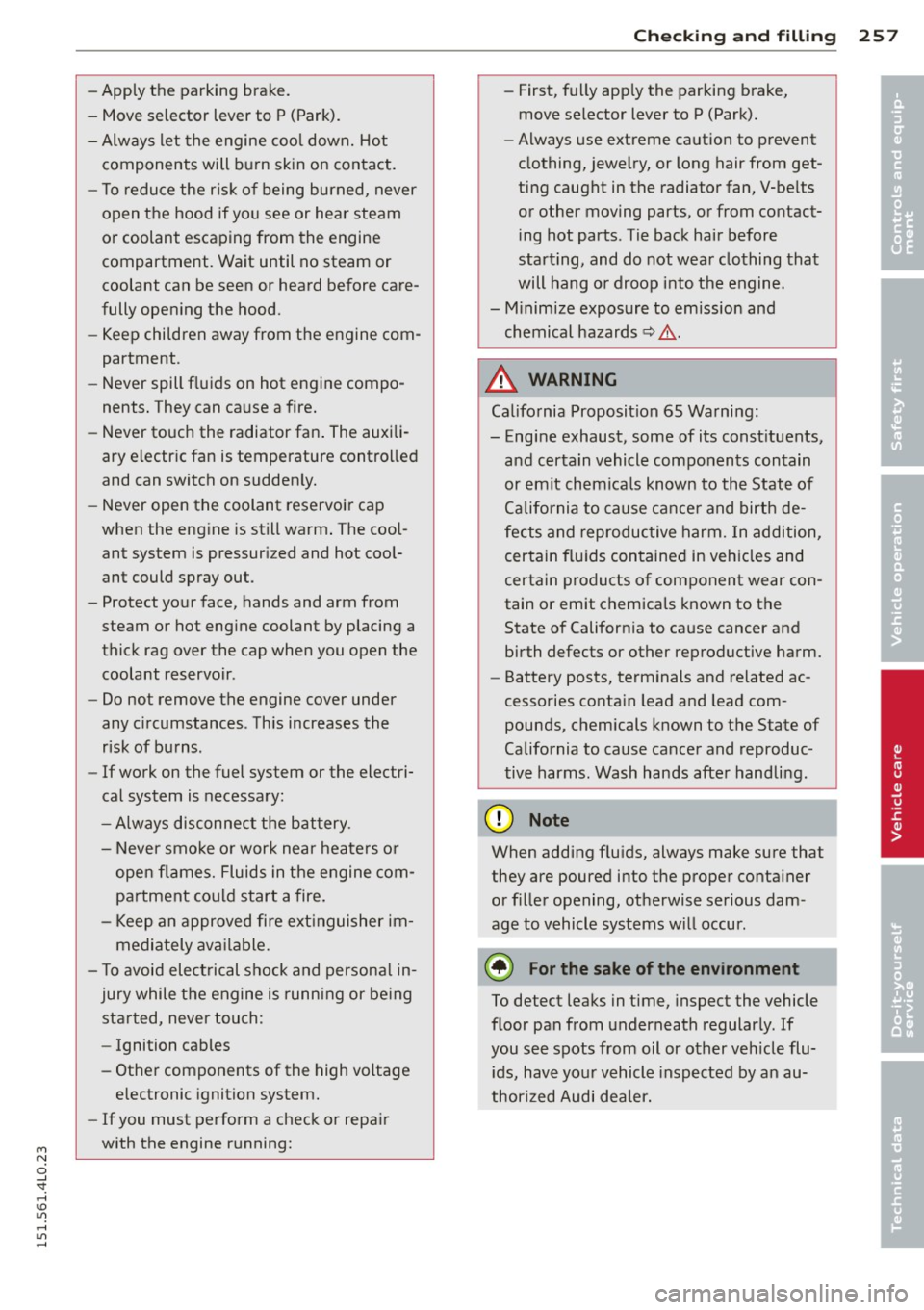
-Apply the parking brake.
- Move selector lever to P (Park).
- Always let the engine cool down. Hot
components will burn skin on contact.
- To reduce the risk of being burned, never
open the hood if you see or hear steam
or coolant escaping from the engine
compartment. Wait until no steam or
coolant can be seen or heard before care
fully opening the hood.
- Keep children away from the engine com
partment .
- Never spill fluids on hot engine compo
nents. They can cause a fire.
- Never touch the radiator fan. The auxili
ary electric fan is temperature controlled
and can switch on suddenly.
- Never open the coolant reservoir cap
when the engine is still warm. The cool
ant system is pressurized and hot cool
ant could spray out .
- Protect your face, hands and arm from
steam or hot engine coolant by placing a
thick rag over the cap when you open the
coolant reservoir .
- Do not remove the engine cover under
any circumstances . This increases the
risk of burns.
- If work on the fuel system or the electri
cal system is necessary:
- Always disconnect the battery .
- Never smoke or work near heaters or
open flames. Fluids in the engine com
partment could start a fire.
- Keep an approved fire extinguisher im
mediately available.
- To avoid electrical shock and personal in
jury while the engine is running or being
started, never touch:
- Ignition cables
- Other components of the high voltage
electronic ignition system.
- If you must perform a check or repair
with the engine running:
Checking and filling 257
- First, fully apply the parking brake,
move selector lever to P (Park).
- Always use extreme caution to prevent
clothing, jewelry, or long hair from get
ting caught in the radiator fan, V-belts
or other moving parts, or from contact
ing hot parts . Tie back hair before
starting, and do not wear clothing that
will hang or droop into the engine.
- Minimize exposure to emission and
chemical hazards~&. .
A WARNING
California Proposition 65 Warning:
- Engine exhaust, some of its constituents,
and certain vehicle components contain
or emit chemicals known to the State of
California to cause cancer and birth de
fects and reproductive harm. In addition,
certain fluids contained in vehicles and
certain products of component wear con
tain or emit chemicals known to the State of California to cause cancer and
birth defects or other reproductive harm.
- Battery posts, terminals and related ac
cessories contain lead and lead com
pounds, chemicals known to the State of
California to cause cancer and reproduc
tive harms. Wash hands after handling.
Q) Note
When adding fluids, always make sure that
they are poured into the proper container
or filler opening, otherwise serious dam
age to vehicle systems will occur .
@ For the sake of the environment
To detect leaks in time, inspect the vehicle
floor pan from underneath regularly . If
you see spots from oil or other vehicle flu ids, have your vehicle inspected by an au
thorized Audi dealer. •
•
Page 260 of 350

258 Checking and filling Engine compartment
These are the most important items that you can check .
Fig. 242 Typical layo ut for containers, engine oil di pstick and engin e oil fille r cap
(D W indshield/head light washer
t . (
;R ) con ainer ,.... .............. .
@ Coolant expansion tank (-L) .. .
@ Engin e oi l filler cap ('t".:r.) . .. .. .
©
®
®
(j)
Eng ine oil dipstick .......... .
Brake fluid reservoir
((0)) ..... .
Power steering reservoir ... .. .
Jump start connector( +) under 270
263
261
260
265
226
a cover,( ·) with hex head screw 268,317
The position of the engine o il fi lling hole and
the engine oil dipstick
r=;, fig. 242 (position ®
and @) can vary according to the type of en
gine .
_&. WARNING
Before you check anything in the engine
compartment, always read and heed all
WARNINGS ¢.&.
in Working in the engine
c ompartment on page 256.
-
Engine oil
Engine oil specifications
The engine oil used must conform to exact
specifications .
The service interva l disp lay in t he instrument
cluster of your vehicle will inform you when it
is time for an oil change . We recommend that
you have your oil changed by an authorized Audi Service Advisor.
If you have to top
off the oil between oil
changes, use the Audi o il quality standard
spec ified in the table.
Audi oil quality standard
Gasoline
VW 502 00 or
engine vw 504 00
Diesel vw 507 00
engine
Page 267 of 350
M
"' 0 ..J
"". rl I.O
"' rl
"' rl
-Antifreeze is poisonous . Always store an
t ifreeze in its or iginal container and well
out of the reach of children.
- If you drain the coolant, it must be
caught and safely stored in a proper con
tainer clearly marked "poison".
(D Note
- Coolant pollutes the environment and
could cause an engine fire. Excess coo l
ant will be forced out through the pres
sure re lief va lve in the cap when the en
gine becomes hot.
- If, in an emergency, only water can be
added, the correct ratio between water
and antifreeze ¢
page 262 must be re
stored as soon as possib le.
@ For the sake of the environment
Drained coolant should not be reused. Al
ways dispose of used coolant while observ ing all environmental regulations .
Radiator fan
The radiator fan switches on automatically by
itself
The radiator fan is driven by the engine via the
V-belt . The viscous clutch regulates the speed
of the fan accord ing to the temperature of the
coolant .
An auxiliary electric radiator fan* switches on
and off depending on coolant temperature
and other vehicle operating conditions .
After you switch the engine off, the auxilia ry
fan can continue running for up to 10 minutes
- even with the ignition off. It can even switch
on again later by itself¢& , if
- the temperature of the engine coolant rises due to the heat build-up from the engine in
the engine compartment, or
- the engine compartment hea ts up because
the vehicle is parked in intense sunlight .
Checking and fillin g 265
A WARNING
-To reduce the risk of personal injury nev
er touch the rad iator fan.
- The auxiliary electric fan is temperature
controlled and can switch on suddenly
even when the engine is not running .
- The auxiliary radiator fan switches on au
tomatically when the engine coolant reaches a certain temperature and will
continue to run until the coo lant temper
ature drops.
Brake fluid
Checking brake fluid level
The brak e fluid lev el can be check ed with a
quick glance.
N
N
-N ,.
:8
Fi g. 247 En gin e compa rtm en t: cover o n the bra ke fluid
reservoir
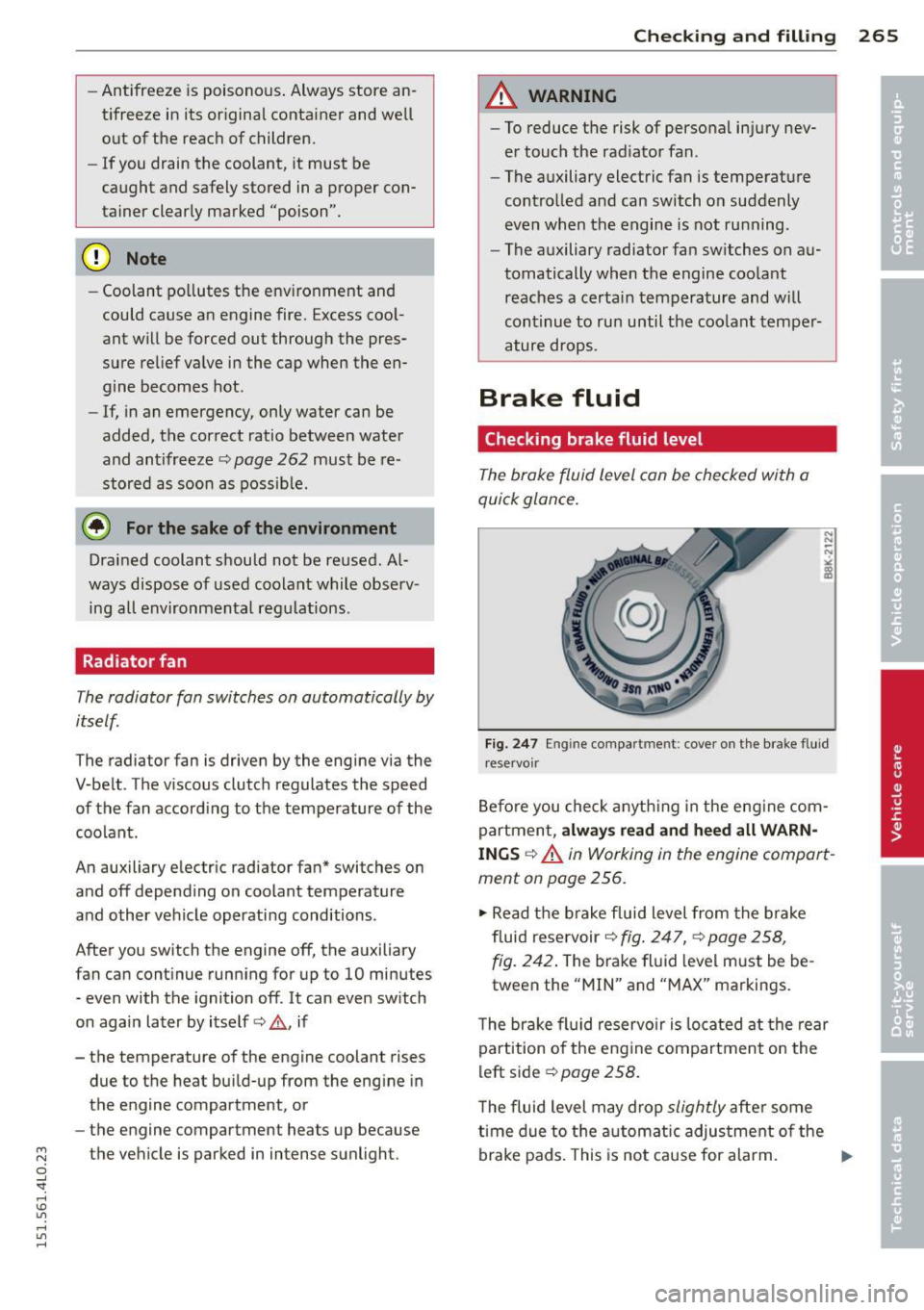
Before you check anything in the eng ine com
partment ,
always read and heed all WARN
INGS ¢ A in Working in the engine compart
ment on page 256.
.,. Read the brake fluid level from the brake
fluid reservoir ¢
fig. 247, ¢ page 258,
fig. 242.
The brake fluid level must be be
tween the "MIN" and "MAX" markings .
The brake fluid reservoir is located at the rear
partition of the eng ine compartment on the
left side ¢
page 258.
The fluid level may drop slightly after some
time due to t he automatic adjustment of the
brake pads. This is not cause for alarm. ..,_
Page 268 of 350
26 6 Ch eck ing and filling
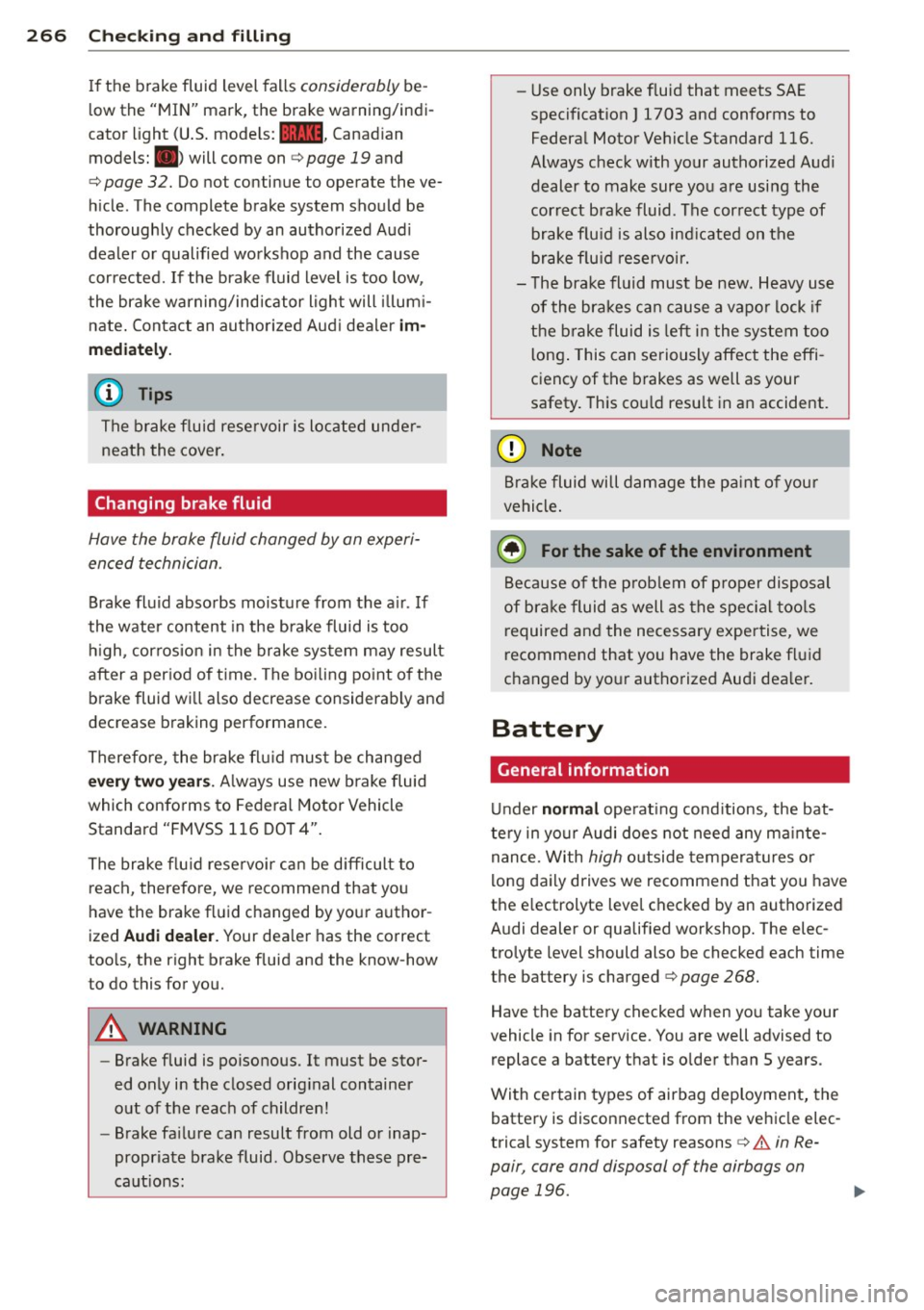
If the brake fluid level falls considerably be
low the "MIN" mark, the brake warning/indi
cator light (U .S . mode ls:
11111 , Canadian
models: .) will come on
<=> page 19 and
<=> page 32. Do not continue to operate the ve
h icle . The complete brake system should be
thoroughly checked by an authorized Aud i
dea ler or qualified workshop and the cause
corrected. If the brake fluid level is too low,
the brake warning/indicator light will illum i
nate . Contact an authorized Aud i dealer
im
m ediatel y.
@ Tips
The brake fluid rese rvoir is located unde r
neath the cove r.
Changing brake fluid
Hove the broke fluid changed by on experi
enced technician.
Brake fluid absorbs moisture from the a ir . If
the water content in the brake fluid is too
h igh , corrosion in the brake system may result
after a per iod of t ime. The bo iling po int of the
brake fluid wi ll also decrease considerably and
decrease braking performance.
Therefore, the brake flu id must be changed
e ver y tw o year s. Always use new b rake fluid
which conforms to Federal Motor Vehicle
Standard "FMVSS 1 16 DO T 4".
The brake flu id reservo ir can be difficult to
reach, therefore, we recommend that you
have the brake f luid changed by you r author
ized
Audi dea ler. Your dea ler has the correct
too ls, the right brake fluid and the know -how
to do this for you.
A WARNING
- Brake fluid is poisonous . It must be stor
ed only i n the closed orig inal container
o ut of the reach of children!
- Brake fa ilure can result from old or inap
propriate b rake fluid. Observe these pre
caut ions: -
Use only brake fluid that meets SAE
specification
J 1703 and conforms to
Federa l Motor Vehicle Standard 116.
Always check with your authorized Audi
dealer to make sure you are using the
correct brake fluid . The correct type of
brake f lu id is also ind icated on the
brake flu id reservoir.
- T he brake fluid must be new. Heavy use
of the bra kes ca n cause a vapo r lock if
the b rake fluid is left in the system too
l ong . This can seriously affect the effi
c iency of the brakes as well as your
safety. This co uld resu lt in an accident.
(D Note
Bra ke fluid will damage the paint of you r
vehicle .
(® For the sake of the environment
Because of the p rob lem of p roper disposal
of b ra ke fluid as well as the spec ial too ls
r equired and the necessary expertise, we
re commend that yo u have the brake fluid
changed by yo ur authorized Aud i dea ler.
Battery
General information
U nder normal ope rat ing cond itions , the bat
tery in yo ur Audi does not need any ma inte
nance. With
high o utside tempe ra tur es or
l ong dai ly drives we recommend that you have
the e lectrolyte level checked by an authorized
Audi dealer or qualif ied workshop. The elec
trolyte level should also be checked each time
the battery is charged
<=> page 268.
Have the battery checked when yo u take your
vehicle in for service. You are well advised to replace a battery that is o lder than 5 years .
With certain types of airbag deployment, the battery is disconnected from the veh icle elec
trical system for safety reasons<=>.&
in Re
pair , core and disposal of the airbags on
page 196.
~