rims AUDI Q7 2015 Owner´s Manual
[x] Cancel search | Manufacturer: AUDI, Model Year: 2015, Model line: Q7, Model: AUDI Q7 2015Pages: 350, PDF Size: 86 MB
Page 248 of 350
24 6 Vehicle care and cleaning
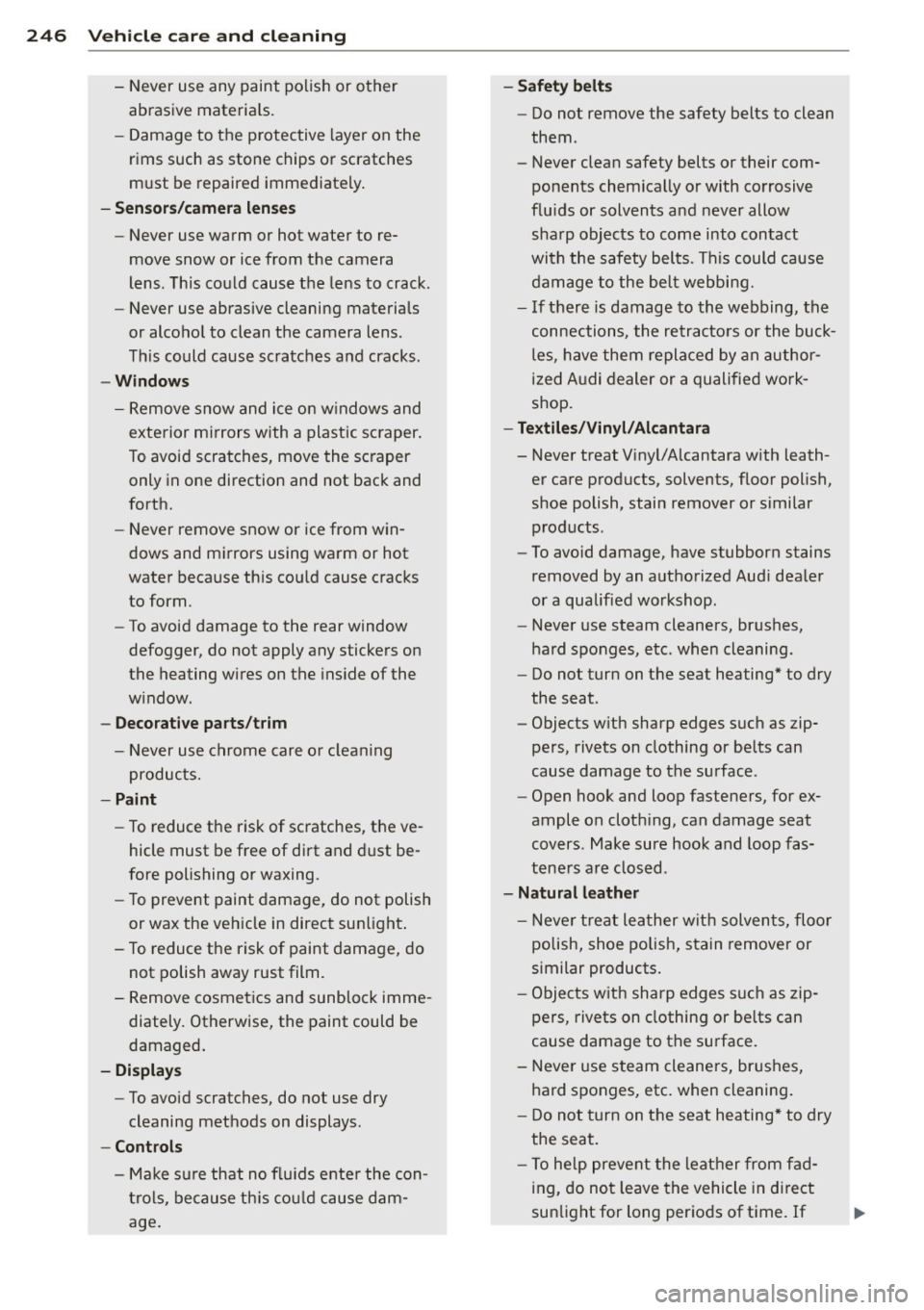
- Never use any paint polish or other
abrasive materia ls.
- Damage to the protective layer on the
rims such as stone chips or scratches
must be repaired immediately .
-Sen sors /cam era l ense s
- Never use warm or hot water to re-
move snow or ice from the camera
lens. This could cause the lens to crack.
- Never use abrasive cleaning materials
or alcohol to clean the camera lens.
Th is could cause scratches and cracks .
-Windows
- Remove snow and ice on w indows and
exte rior mirrors with a plastic scraper .
To avoid scratches, move the sc raper
only in one direction and not back and
forth.
- Never remove snow or ice from win
dows and m irrors using wa rm or hot
water because this cou ld cause cracks
to form.
- To avoid damage to the rear window
defogger, do not apply any sticke rs on
the heating wires on the ins ide of the
w indow.
- Decorati ve parts /trim
- Never use chrome care o r cleaning
products.
- Paint
- To reduce the risk of scratches, the ve-
hicle must be free of dirt and d ust be
fore polishing or waxing.
- To prevent paint damage, do not polish
or wax the veh icle in direct sun light .
- To reduce the risk of paint dama ge, do
not polish away rust film.
- Remove cosmet ics and sunblock imme
diately. Otherwise, the paint could be
damaged .
-Di splays
- To avoid scratches, do not use dry
cleaning methods on displays.
- Controls
- Ma ke s ure that no f lu ids ente r the con-
t rols, because th is co uld cause dam
age .
-Safety belts
- Do not remove the safety belts to clean
them.
- Never clean safety belts or their com
ponents chemically or with co rrosive
f lu ids or solvents and never allow
sha rp objects to come into contact
with the safety belts. This could cause
d amage to the bel t webbing.
- If there is damage to the webbing, the
connection s, the re tracto rs or the buck
les, have them repla ced by an author
ized A udi dealer or a qualified work
shop.
- Textile s/Viny l/Alcantara
- Never treat V inyl/Alcantara w ith leath-
er care products, solvents, floor polish,
shoe polish, stain remover or similar
p roducts.
- To avo id damage, have stubborn stains
removed by an autho rized Aud i dea le r
or a qualified workshop .
- Never use steam cleaners, brushes,
hard sponges, etc . w hen cleaning .
-Do not turn on t he seat heating* to dry
the seat.
- Objects w ith sharp edges s uch as zip
pers, rivets on clothing or be lts can
cause damage to the surface.
- Open hook and loop fasteners, for ex
ample on cloth ing, can damage seat
covers . Make sure hook and loop fas
tene rs are closed .
-Natural leather
- N eve r trea t le at her wit h solven ts, floo r
polish, shoe polish, stain remover or
similar products.
- Objects with sharp edges s uch as zip
pers, rivets on clothing or be lts can
cause damage to the su rface.
- Neve r use s team cleaners, br ushes,
hard sponges, etc . when cleaning .
- D o not turn on the seat heating * to dry
the seat.
- To help preve nt the leat her from f ad
ing, do no t leave the vehicle in d irect
sunlight for long per iods of t ime. If
Page 273 of 350
Tires and wheels
Tires
General notes
Tires may be the least appreci
ated and most abused parts of
a motor vehicle .
Tires may be the least appreci
ated and most abused parts of
a motor vehicle. Tires are, how
ever, one of the most important
parts of a vehicle, particularly
considering the comparatively
small patch of rubber on each
tire that assures that all-impor
tant contact between you, your
vehicle and the road.
Maintaining the correct tire
pressure, making sure that your
vehicle and its tires do not have
to carry more weight than they can safely handle, avoiding
damage from road hazards and
regularly inspecting tires for
damage including cuts, slashes
irregular wear and overall con
dition are the most important
things that you can do to help avoid sudden tire failure includ
ing tread separation and blow-
~ outs.
0 ...J
'SI: ,...., \!) 1.1'1 ,....,
"' ,....,
Tires and wheels 2 71
Avoiding damage
If you have to drive over a curb
or similar obstacle , drive very
slowly and as close as possible
at a right angle to the curb.
Always keep chemicals includ ing grease, oil, gasoline and
brake fluid off the tires.
Inspect the t ires regularly for
damage (cuts, cracks or blis
ters, etc.). Remove any foreign bodies embedded in the treads.
Storing tires
Mark tires when you remove
them to indicate the direction
of rotation. This ensures you to be able to mount them correct
ly when you reinstall them.
When removed, the wheels or
tires should be stored in a cool, dry and preferably dark place.
Store tires in a vertical position if they are not mounted on
rims, in a horizontal position if
they are mounted on rims.
New tires
New tires have to be broken in
¢ _&. .
The tread depth of new tires
may vary , according to the type .,.
•
•
'
Page 274 of 350
272 Tires a nd whee ls
and make of tire and the tread
pattern.
Hidden damage
Damage to tires and rims is of
ten not readily visible. If you notice unusua l vibration or the
vehicle pulls to one side, this may indicate that one of the
t ires has been damaged . The
tires must be checked immedi
ately by an authorized Audi
dealer or qualified workshop .
Unidirectional tires
A unidirectional tire can be
identified by arrows on the
sidewall, that point in the direc
tion the tire is designed to ro
tate. You must follow the speci
fied direction of rotation . This is
necessary so that these tires
can develop their optimum
characteristics regarding grip,
road noise, wear and hydro
planing resistance. For more in
format ion
c:> page 311 .
&_ WAR NIN G
New tires or tires that are
old, worn or damaged cannot
provide maximum control
and braking ability. -
New tires tend to be slip
pery and must be broken in .
To reduce the risk of losing
control, a collision and seri
ous personal injuries, drive
with special care for the
first 350 miles (560 km).
-Driv ing with worn or dam
aged tires can lead to loss of
control, sudden tire fa ilure,
including a blowout and
sudden deflation, crashes
and serious personal inju
ries. Have worn or damaged
tires replaced immediately.
-Tires age even if they are
not being used and can fail
suddenly, especially at high
speeds . Tires that are more
than 6 years old can only be
used in an emergency and
then with special care and
at low speed .
-Never mount used tires on your vehicle if you are not
sure of their "previous history." Old used tires may have
been damaged even though
the damage cannot be seen
that can lead to sudden tire
failure and loss of vehic le
control.
Page 275 of 350

M N
0 ...J
'SI: ,...., \!) 1.1'1 ,...., 1.1'1 ,....,
-If you notice unusual vibra
tion or if the vehicle pulls to one side when driving, al
ways stop as soon as it is safe to do so and check the
wheels and tires for dam age.
(D Note
-Please note that summer
and winter tires are de
signed for the conditions
that are typical in those sea
sons. Audi recommends using winter tires during the
winter months. Low tem peratures significantly de
crease the elasticity of
summer tires, which affects
traction and braking ability.
Tires and wheels 273
If summer tires are used in
very cold temperatures, cracks can form on the tread
bars, resulting in perma
nent tire damage that can
cause loud driving noise and unbalanced tires. Audi is not
responsible for this type of
damage.
-Burnished, polished or chromed rims must not be used in winter road condi
tions. The surface of the
rims does not have suffi
cient corrosion protection
for this and could be perma
nently damaged by road salt
or similar substances.
•
•
'
Glossary of tire and loading terminology
Accessory weight
means the combined weight (in
excess of those standard items
which may be replaced) of auto matic transmission, power
steering, power brakes, power
windows, power seats, radio, and heater, to the extent that
these items are available as fac
tory-installed equipment (whether installed or not).
Aspect ratio
means the ratio of the height to
the width of the tire in percent. Numbers of 55 or lower indi
cate a low sidewall for im
proved steering response and
better overall handling on dry
pavement.
Page 283 of 350
M N
0 ...J 'SI" ,...., \!) 1.1'1 ,...., 1.1'1 ,....,
Tires and wheels 281
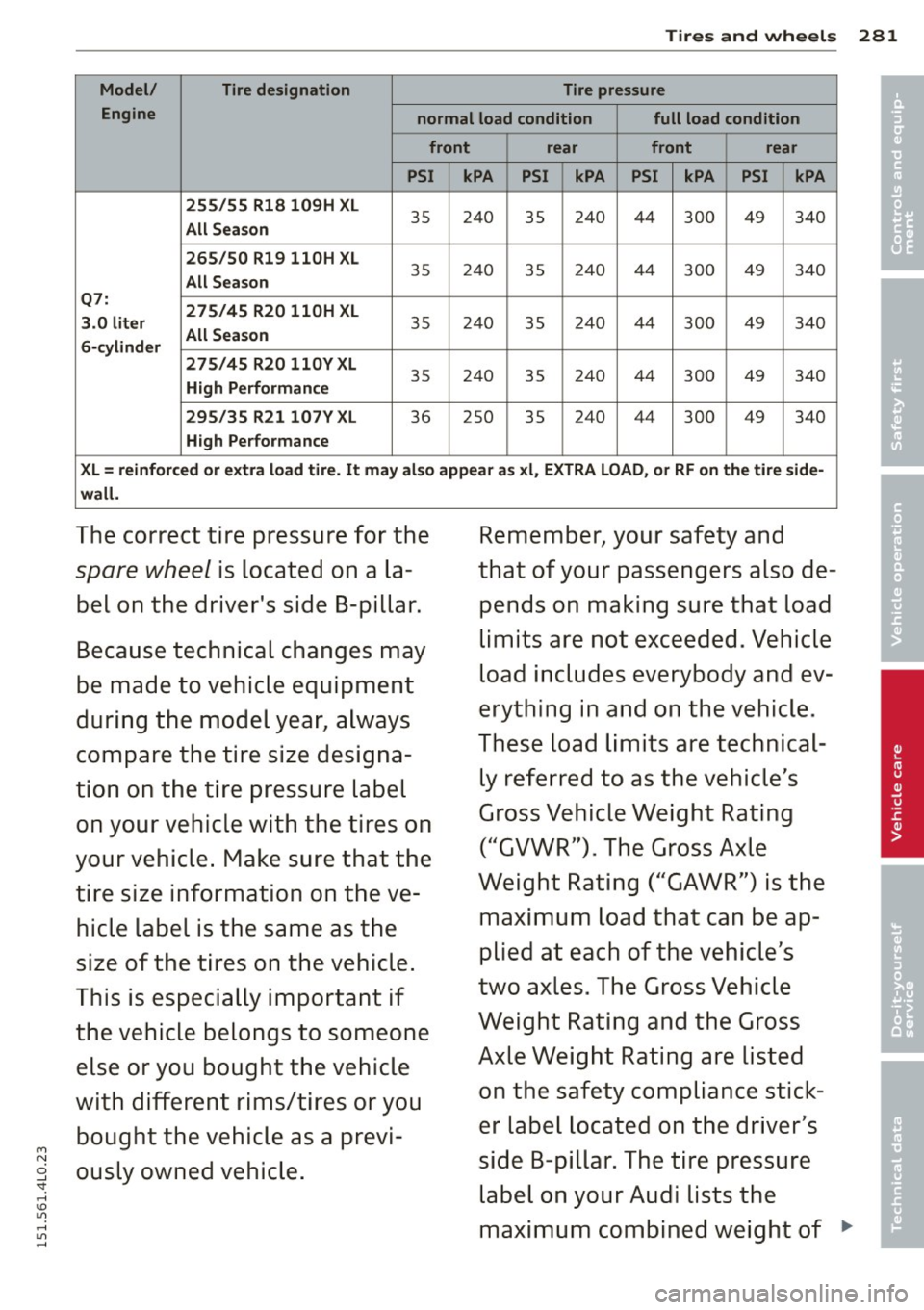
Model/ Tire designation Tire pressure
Engine normal load condition full load condition
front rear front rear
PSI kPA PSI kPA PSI kPA PSI
kPA
255/55 R18 109H XL
All Season
35 240
35 240 44
300 49 340
265/50 Rl9 llOH XL
All Season
35 240
35 240 44
300 49 340
Q7:
3.0 liter 275/45 R20 110H XL
All Season
35 240
35 240
44 300 49 340
6-cylinder
275/4S R20 llOY XL
High Performance
35 240 35 240 44 300 49 340
295/35 R21 107V XL 36 250 35 240
44
300 49 340
High Performance
XL~ reinforced or extra load tire. It may also appear as xl, EXTRA LOAD, or RF on the tire side-
wa .
The correct tire pressure for the
spare wheel is located on a la
bel on the driver's side B-pillar.
Because technical changes may
be made to vehicle equipment
during the model year, always
compare the tire size designa
tion on the tire pressure label on your vehicle with the tires on
your vehicle. Make sure that the tire size information on the ve
hicle label is the same as the
size of the tires on the vehicle.
This is especially important if
the vehicle belongs to someone
else or you bought the vehicle
with different rims/tires or you
bought the vehicle as a previ
ously owned vehicle. Remember, your safety and
that of your passengers also de pends on making sure that load
limits are not exceeded. Vehicle
load includes everybody and ev
erything in and on the vehicle.
These load limits are technical- ly referred to as the vehicle's
Gross Vehicle Weight Rating ("GVWR"). The Gross Axle
Weight Rating ("GAWR") is the maximum load that can be ap
plied at each of the vehicle's
two axles. The Gross Vehicle
Weight Rating and the Gross
Axle Weight Rating are listed on the safety compliance stick-
er label located on the driver's
side B-pillar. The tire pressure label on your Audi lists the
maximum combined weight of ""
•
•
'
Page 294 of 350
292 Tires and whee ls
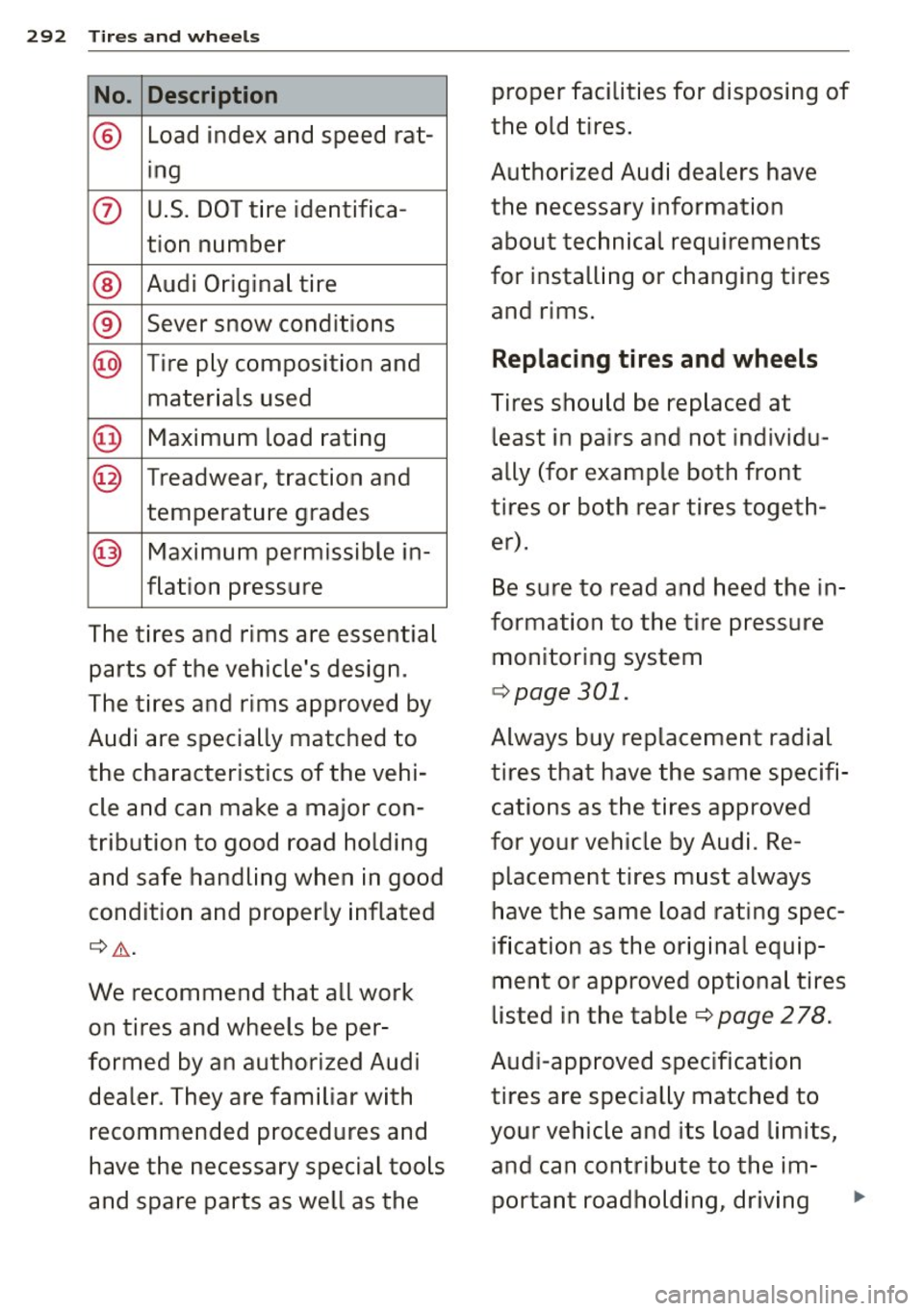
No . Description
® Load index and speed rat-
ing
(J) U .S. DOT tire identifica-
tion number
® Audi Original tire
® Sever snow conditions
@ Tire ply composition and
materials used
@ Maximum load rating
@ Treadwear, traction and
temperature grades
@ Maximum permissible in-
flation pressure
The tires and rims are essential
parts of the vehicle's design .
The tires and rims approved by
Audi are specially matched to
the characteristics of the vehi
cle and can make a major con
tribution to good road holding and safe handling when in good
condition and properly inflated
¢ ,&..
We recommend that all work
on tires and wheels be per
formed by an authorized Audi
dealer. They are familiar with
recommended p rocedures and
have the necessary special too ls
and spare parts as well as the proper facilities for disposing of
the old ti res.
Autho rized Audi dealers have
the necessary information
about technical requirements
for installing or changing tires
and rims .
Replacing tires and wheels
Tires sho uld be replaced at
least in pairs and not individu
ally (for example both front
tires or both rear tires togeth
er).
B e sure to read and heed the in
formation to the tire pressure
monitoring system
c::> page 301.
Always buy replacement radial
tires that have the same specifications as the tires approved
for your vehicle by Audi. Re
placeme nt tires m ust always
have the same load rating spec
ification as the orig inal equip
ment or approved optional tires
listed in the table c::>page
278.
Audi-approved spec ificat io n
tires are specially matched to
your vehicle and its load limits ,
and can contribute to the im- portant roadholding, driving .,.
Page 297 of 350
M N
0 ...J
'SI: ,...., \!) 1.1'1 ,...., 1.1'1 ,....,
recommend using only these
tires because they meet the highest standards regarding
safety and driving characteris
tics when used correctly. Your
authorized Audi dealer will
gladly provide you with more
information.
Tire ply composition and materials used
The number of plies indicates
the number of layers of rubber
coated fabric in the tire. In gen
eral, the greater the number of plies, the more weight a tire
can support. Tire manufactur
ers also must indicate the ma
terials in the tire, which include steel, nylon, polyester, and oth
ers .
Maximum Load Rating
This number indicates the max
imum load in kilograms and
pounds that can be carried by
the tire.
Tire quality grading for
treadwear, traction, and
temperature resistance
Tread wear , traction and tem
perature grades ¢
page 297.
Tires and wheels 295
Maximum Permissible
Inflation Pressure
This number is the greatest
amount of air pressure that
should ever be put in the tire under normal driving condi
tions.
A WARNING
- Using incorrect or unmatch
ed tires and/ or wheels or
improper tire and wheel
combinations can lead to
loss of control, collision and
serious personal injury.
-Always use tires, rims and wheel bolts that meet the specifications of original
factory-installed tires or
other combinations that have been specifically ap
proved by the vehicle manu
facturer.
-Tires age even if they are not being used and can fail
suddenly, especially at high speeds. Tires that are more
than 6 years old can only be
used in an emergency and
then with special care and at lower speeds.
-Never mount used tires on your vehicle if you are not
•
•
'
Page 299 of 350
M N
0 ...J
'SI: ,...., \!) 1.1'1 ,...., 1.1'1 ,....,
run flat tires. If run flat tires
are u sed , they must be in
stalled on all four wheels. Mixing tire types is not per
mitted.
(D Note
-For technical reasons, it is not generally possible to
use the wheel rims from
other vehicles. This can hold
true for wheels of the same
vehicle type.
- If the spare tire is different
from the tires that you have mounted on your vehicle
(for example winter tires or
wide profile tires), then use
the spare tire for a short pe riod of time only and drive
with extra care. Replace the
flat t ire with the tire match
ing the others on your vehi
cle as soon as possible.
- Never drive without the
valve stem cap. The valves
could get damaged .
@) For the sake of the environment
Dispose of old tires in accord
ance with the local require ments.
Tires and wheels
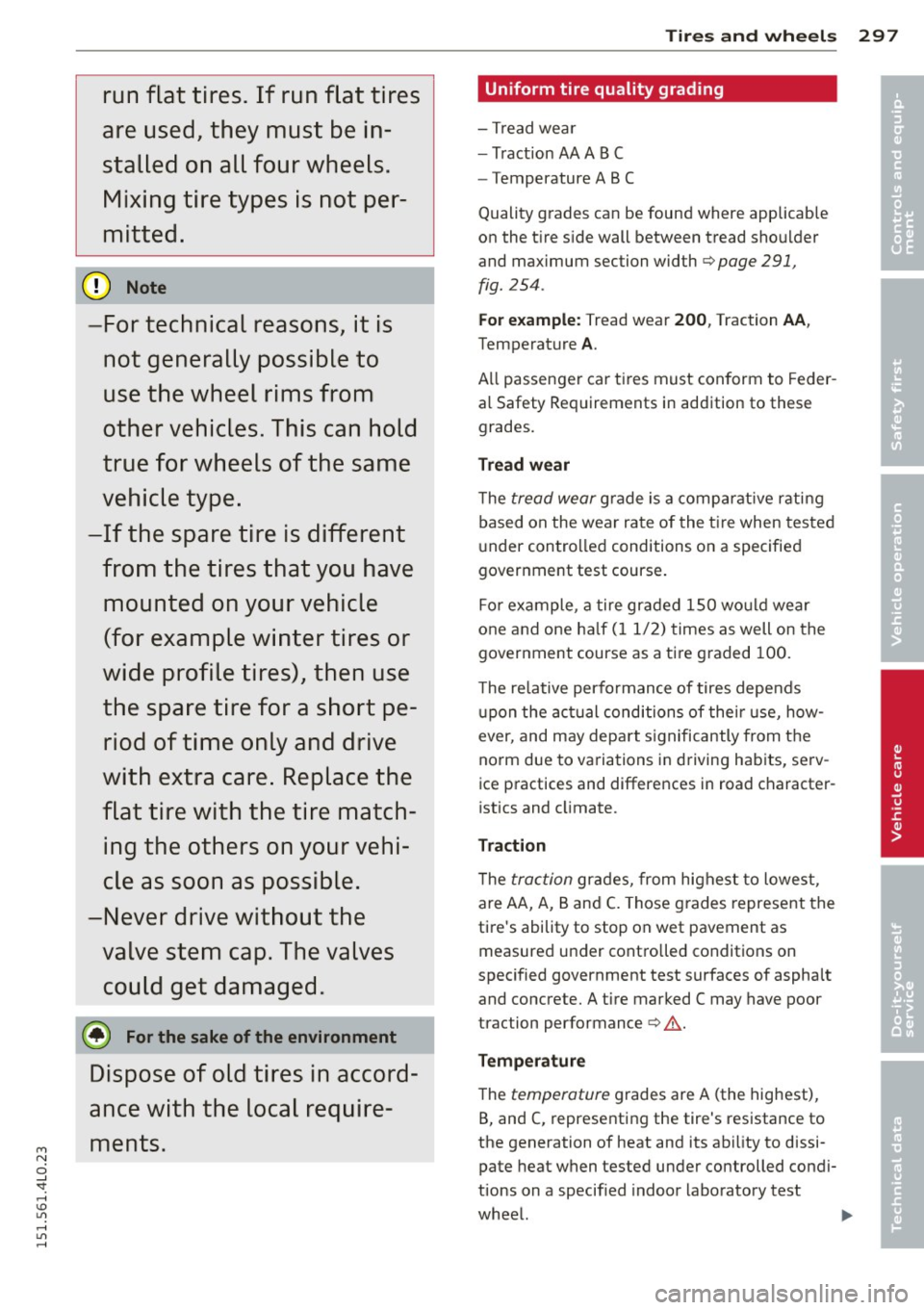
Uniform tire quality grading
- Tread wea r
- Traction AA A B C
- Temperature AB C
Quality g rades ca n be foun d where applicab le
on the t ire s ide wall between t read sho ulder
and maximum section width
c> page 291,
fig. 254 .
For example : Tread wear 200, Traction AA,
Temperat ure A .
All passenge r ca r tir es must con form to Feder
a l Safety Requ irements in add ition to these
grades.
Tread wear
T he tread wear g rade is a c omp arati ve rati ng
based on the wear ra te of the tire when tes te d
u nder con tro lled conditions o n a specifie d
government test course .
F o r ex ample , a tire gr aded 1S 0 wo uld wear
one a nd one h alf ( 11/ 2) times as well on the
governmen t course as a ti re g raded 100 .
T he re lative perfo rman ce of tires depe nds
up on the actu al c ondition s of the ir u se, how
ever, and m ay depa rt s ignificantly from t he
no rm due to va ria tions i n driving ha bits, se rv
ice p ractices and differences in road character
istics and cl imate.
Traction
T he trac tio n gr ad es, from hig hest to lowes t,
a re AA, A, Ban d
C. Those g rades represe nt the
ti re 's ability to stop on wet pavement as
measured u nder cont rolled conditions on
specified government test surfaces of aspha lt
and concrete. A t ire mar ked C may have poor
traction performance
c> ,&. .
Temperature
The temperature gr ades are A (the highest),
B, and C, represent in g the tire's resistance to
the generation of heat and its ab ility to d issi
pate heat when tested un der controlled condi
tions on a specif ied indoo r labo rato ry test
whee l.
297
•
•
Page 301 of 350
M N
0 ...J
'SI: ,...., \!) ..,.,
,...., ..,., ,....,
loss of control, crashes and serious per
sonal inj uries. Have worn or damaged tires
rep laced immediate ly.
- Winter tires have maximum speed rating
that may be lower than your veh icle's
maximum speed.
- Never drive faster than the speed for wh ich the winter or other tires installed
on your vehicle are rated.
A WARNING
Always adjust your driving to the road and traffic conditions . Never let the good ac
celeration of the winte r tires and all-whee l
drive temp t you into taking extra r is k s. Al
ways remembe r:
- When braking, an a ll-w heel driv e vehicle
hand les in the same way as a front dr ive
vehicle.
- Drive carefu lly and reduce your speed on
icy and slippery roads, even winter tires
c annot he lp un der blac k ice cond it ions.
@) For the sake of the environment
Use summe r tires when weathe r cond i
tions perm it. They are quieter, do not wea r
as quickly and red uce fue l consumption.
Snow chains
Snow chains may be fitted on ly to the rear
wheels, and only to certain tire sizes . Ask yo ur
authorized Audi dealer on whic h tire sizes
snow chains can be used.
The snow chains must have low -profile links
a nd must not be thicker than 0 .S3 inch
(13 .5 mm), including the lock.
Remove wheel cente r covers and tr im discs
before p utting snow chains on you r vehicle
~ 0 . For safety reasons cover caps must the n
be fitted over the whee l bolts. These are avail
ab le from authorized Audi dea lers.
A WARNING
Using the wrong snow chains for your vehi
cle or installing them incorrectly can in-
Tire s an d wheel s 2 99
crease the risk of loss of contro l leading to
serious personal injury.
- Snow chains are available in different
sizes. Always make sure to follow the in
structions prov ided by the snow chain
manufacturer.
- When driving with snow cha ins neve r
drive faster than the speed permitted for
your specific snow chains.
- Always observe local regulations.
([) Note
-Remove snow c hains be fore driving on
roads not covered with snow to avoid
damaging tires and wearing the snow
chains down unnecessarily.
- Snow chains, which come into direct con
tact with the whee l rim, can scratch or
damage it. Therefore, make sure that the
snow chains are s uitably covered. Check
t he pos itio n of the snow chains afte r
dr iving a few yards and co rrect if neces
sary. Fo llow the inst ruct io ns from the
s now chain ma nufa ct urer when do ing so.
- If the Adaptive Ai r Suspens io n* s hou ld
ma lfun ction, do not mount o r use snow
c h ains be cause the ve hicl e w il l be ex
t reme ly low. If you do d rive with snow
chains on while t he ve hicle is at this lev
el, the snow chains m ight seve rely dam
age the whee lhouse and other parts of
the vehicle.
(D Tips
Where snow chains are mandatory oncer
tain roads, th is normally a lso applies to
vehicles with all-wheel drive.
Wheel bolts
Wheel bolts must always be tightened to the
correct torque.
T he design of w heel bolts is matched to the
factory installed rims. If different rims a re fit
ted, the correct wheel bolts with the right length and correct ly shaped bolt heads must
be used. Th is ensures that wheels are fitted .,..
•
•
Page 313 of 350

M N
0 ...J
'SI: ,...., \!) ..,.,
,...., ..,., ,....,
(D Note
When removing or installing the wheel,
the rim could hit the bra ke rotor and dam
age the rotor . Wor k carefully and have a
second person help you.
- W hen mounting tires with
unidirectional
tread design
ma ke s ure the tread pat
tern is pointed the r ight way
<=> page 311.
-The wheel bolts should be clea n and easy
to tu rn. Check for d irt and corrosio n on
t h e mat ing su rfaces of both the whee l
and the hub. Remove a ll dirt from these
su rfaces before remo untin g t he wheel.
Tires with unidirectional tread design
Tires with unidirectional tread design must be
mounted with their tr ead pattern point ed in
the right dire ction.
Using a spare tire with a tread pattern
intended for use in a specific direction
W hen using a spa re tire w ith a t read patte rn
in te nded fo r use in a specific direction, p lease
n ot e t he followi ng:
- The direction of rotation is marked by an ar
row on the side of the tire.
- If the spare tire has to be installed in the in
correct di rection, use the spa re tire only
tem porarily si nce th e tir e will not be able to
a ch ieve i ts op timum pe rfo rm ance chara cter
is tics with reg ard to aq uaplani ng, noise and
wea r.
- W e recommend that you p ay pa rticular at
tent io n t o this fact du ring wet weathe r and
t h at you adjus t your spee d to matc h roa d
con dit ions.
- Re place the fla t tire w ith a new one and
have it installed on your vehicle as soon as
poss ible to restore the hand ling advantages
of a unid irect iona l tire.
What do I do now?
Notes on wheel changing
P lease read t he i nfo rmat ion c:> page 291, New
t ires and replacing tires and wheels
if y ou a r e
go ing to use a sp are tire w hich is different
from the ti res on yo ur vehicle.
After yo u cha nge a tire:
- Check the tire pressure on the spare imme
diately after installation .
- Have the wheel bolt tightening torque
checked with a torque wrench as soon as
possible by your authorized Audi dealer or
a qualified workshop.
- With steel and alloy wheel rims, the wheel
bolts are correctly tightened at a torque of 120 ft lb (160 Nm) .
- If you notice that the wheel bolts are cor
roded and difficult to turn while changing
a tire, they should be replaced before you
check the tightening torque.
- Repla ce the flat tire with a new one and
have it installed on your vehicle as s oon as
possible. Remount the wheel cover.
Until then, drive with extra care and at re
duced speeds .
&_ WARNING
-
- If yo u are goi ng to e quip yo u r ve hicl e
wit h tires o r rims whi ch di ffer from those
which were fac to ry installed, t hen be
sure to rea d the information
c:> page 2 91,
New tires and replacing tires and
wheels.
- Always make s ure the damaged wheel o r
even a flat tire and the jack and t ool kit
are prope rly secured in the luggage com
pa rtme nt and are not loose in the pas
senge r compartment .
- In an accident or sudden maneuver they
could fly forwa rd, inj uri ng a nyo ne in the
veh icle.
- Always sto re damaged wheel , jack a nd
too ls sec urely in the luggage compa rt
men t. Othe rwise, in a n accide nt o r sud
de n m aneuver they could fly forwa rd,
c a u sing i nju ry to passenger s in th e ve hi
cle.
311
•
•