spare wheel AUDI Q7 2015 Owner´s Manual
[x] Cancel search | Manufacturer: AUDI, Model Year: 2015, Model line: Q7, Model: AUDI Q7 2015Pages: 350, PDF Size: 86 MB
Page 5 of 350
M N
0 ...J
'SI: ,...., \!) 1.1'1 ,...., 1.1'1 ,....,
Error messages . . . . . . . . . . . . . . . . . . 155
Trailer hitch . . . . . . . . . . . . . . . . . . . . . 155
Adaptive Air Suspension .. .. . .
Air suspension and damping
S afet y fir st ... ...... ... .. .. .. . .
15 7
157
163
Driving Safely . . . . . . . . . . . . . . . . . 163
Gene ral notes ..... .... ... .. .. .. . .
Proper occupant seating posit ions . . .
Ped al area .. .. ............. .. .. . .
Stowing luggage ......... .... .. . .
Report ing Safety Defects ....... ... .
Safety belts ........... .... .. . .
General notes ............... .... .
Why safety belts? ............... .
Safety belts ..... ... ... .. .. .. .. . .
Safety bel t pretens ioners .. .. .. .. . .
Airbag system .......... ... ... .
Important things to know .. .. .. .. . .
Fr ont airbags ..... ..... .. .... .. . .
M on itoring the A dvanced Airbag
System .... .. ... .. ..... ... .. .. . .
Side airbags . ... ...... ... .. .. .. . .
Side curtain ai rbags .... ... .. .. .. . .
Child Safety .. .. .... ... .. .. .. . .
Important th ings to know . ... .. .. . .
Ch ild safety seats ......... .... .. . .
Instal ling a child safe ty seat .. .. .. . .
LATC H Lower ancho rages and tethers
for chi ldren .... .. ... ... .. .. .. .. . .
Addit ional Information
Vehicle operation ... .. .. .. .. . .
Intelligent technology .. .. . .. .
163
164
168
169
1 70
173 1 73
174
177
180
182
18 2
186
193
197
200
203
203
209
213
216
222
223
223
Not ice about data recorded by vehi cle
con trol mod ules . . . . . . . . . . . . . . . . . . 223
E lect ronic S tabiliz ation Control ( ESC) . 223
Brake system . . . . . . . . . . . . . . . . . . . . 225
Servotronic -advanced powe r steering
system . . . . . . . . . . . . . . . . . . . . . . . . . 226
Driving w ith your quattro . . . . . . . . . . 227
Energy management . . . . . . . . . . . . . . 228
Table of contents 3
Driving and environment . . . . .
230
The first 1,000 miles (1 ,500 km) and
afterwa rds . . . . . . . . . . . . . . . . . . . . . . 230
Catalytic co nverter . . . . . . . . . . . . . . . . 231
Diesel particulate filter . . . . . . . . . . . . 231
Avoid damaging the vehicle . . . . . . . . . 232
S h utting down veh icle . . . . . . . . . . . . . 232
Operate yo ur v ehicl e economically and
min imi ze poll ution .. . ............ .
Driving off road .............. .
D riv ing i n diff icult road conditions and
offroad . .. .. .. .. .... ........... .
Trailer towing .... .. .. ... ..... .
Drivi ng with a trailer ........... .. .
T rail er tow ing t ips .. . ............ .
Vehicle care ... .. .. ........... .
Vehicle care and cleaning .... .
Genera l informa tion . ... .... ... .. .
Car was hes . ..... .. . .. .. ..... ... .
Cleaning and care information ... .. .
Fuel supply and filling your
fuel tank ... .... .. . .. .. ..... ... .
Fuel supp ly . ... .. .. .. ... ..... ... .
Diesel f uel .. .. .. .... ........... .
Fuel tank .. .. .. .. ... ............ .
Se lective cata lytic reduction ....... .
Checking and filling .......... .
En gine hood . .... .... .... ... .... .
E n gine o il ... .. .. .. . .. .... .... .. .
Engine cooling system ............ .
Br ake fluid .. .. .. ............... .
B attery ... .. .. .. .. .. ........... .
Windsh ie ld /hea dligh t washer 2
32
235
2 35
238
2 38
2 40
2 42
2 4 2
2 4 2
242
243
2 4 8
248
249
250
252
256
256
258
262
2 65
2 66
container . . . . . . . . . . . . . . . . . . . . . . . 2 70
Tires and wheels . . . . . . . . . . . . . . 271
T ires . . . . . . . . . . . . . . . . . . . . . . . . . . . 2 71
Tire pressure monitoring system 301
Do-it-yourself service . . . . . . . . . 304
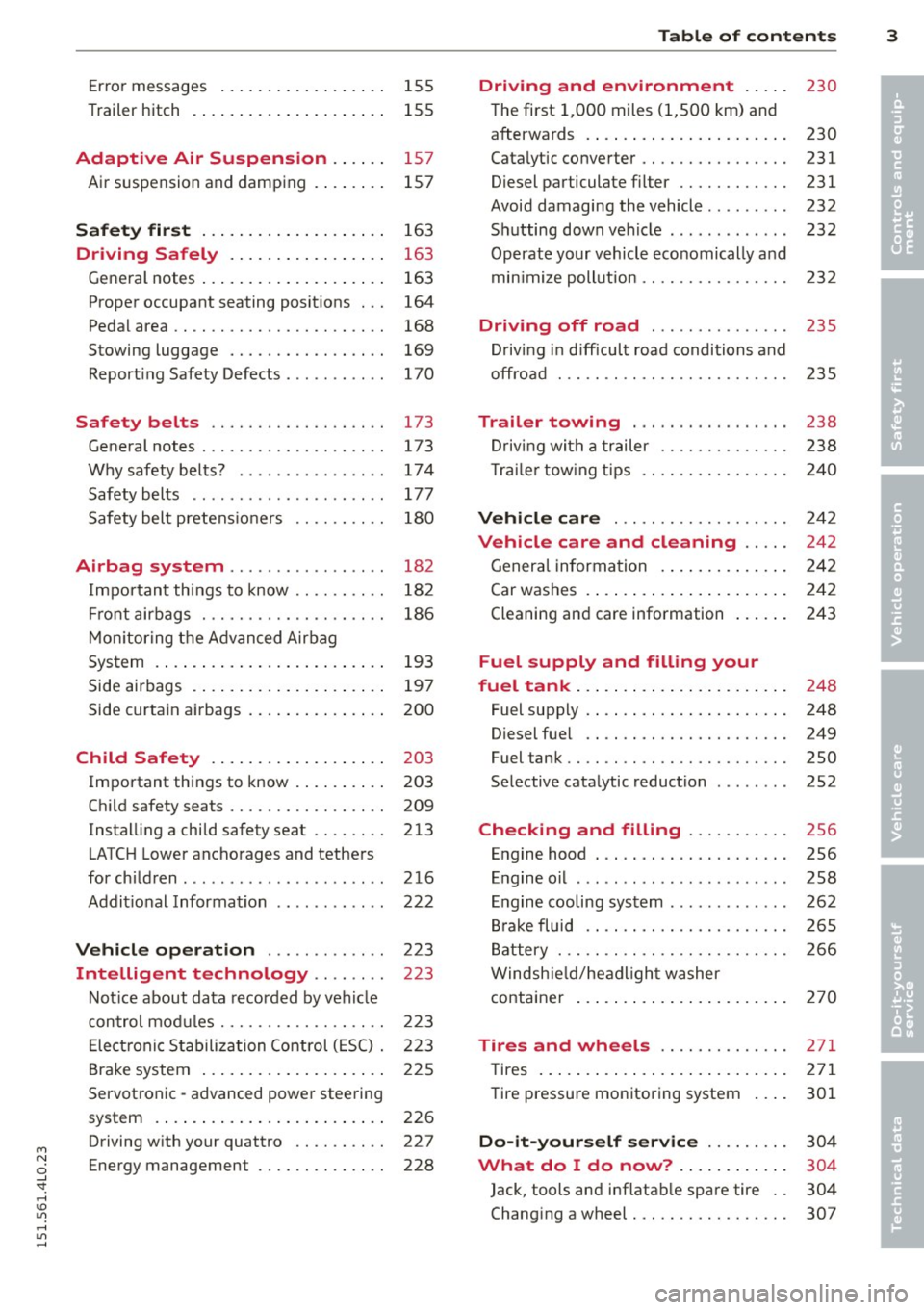
What do I do now? . . . . . . . . . . . . 304
Jack, too ls an d inf lata ble spare tire . . 304
Changi ng a wheel . . . . . . . . . . . . . . . . . 307
•
•
Page 283 of 350
M N
0 ...J 'SI" ,...., \!) 1.1'1 ,...., 1.1'1 ,....,
Tires and wheels 281
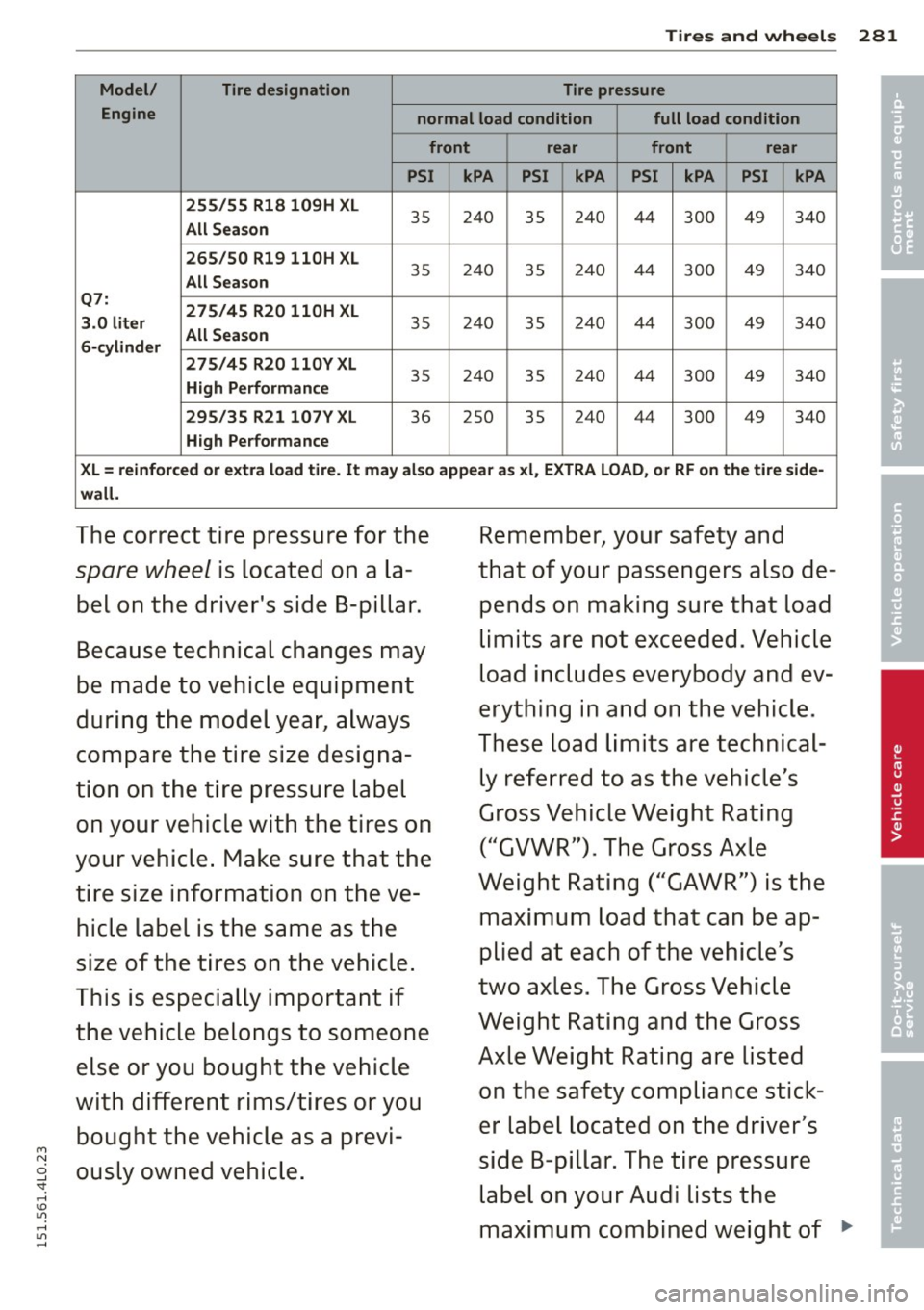
Model/ Tire designation Tire pressure
Engine normal load condition full load condition
front rear front rear
PSI kPA PSI kPA PSI kPA PSI
kPA
255/55 R18 109H XL
All Season
35 240
35 240 44
300 49 340
265/50 Rl9 llOH XL
All Season
35 240
35 240 44
300 49 340
Q7:
3.0 liter 275/45 R20 110H XL
All Season
35 240
35 240
44 300 49 340
6-cylinder
275/4S R20 llOY XL
High Performance
35 240 35 240 44 300 49 340
295/35 R21 107V XL 36 250 35 240
44
300 49 340
High Performance
XL~ reinforced or extra load tire. It may also appear as xl, EXTRA LOAD, or RF on the tire side-
wa .
The correct tire pressure for the
spare wheel is located on a la
bel on the driver's side B-pillar.
Because technical changes may
be made to vehicle equipment
during the model year, always
compare the tire size designa
tion on the tire pressure label on your vehicle with the tires on
your vehicle. Make sure that the tire size information on the ve
hicle label is the same as the
size of the tires on the vehicle.
This is especially important if
the vehicle belongs to someone
else or you bought the vehicle
with different rims/tires or you
bought the vehicle as a previ
ously owned vehicle. Remember, your safety and
that of your passengers also de pends on making sure that load
limits are not exceeded. Vehicle
load includes everybody and ev
erything in and on the vehicle.
These load limits are technical- ly referred to as the vehicle's
Gross Vehicle Weight Rating ("GVWR"). The Gross Axle
Weight Rating ("GAWR") is the maximum load that can be ap
plied at each of the vehicle's
two axles. The Gross Vehicle
Weight Rating and the Gross
Axle Weight Rating are listed on the safety compliance stick-
er label located on the driver's
side B-pillar. The tire pressure label on your Audi lists the
maximum combined weight of ""
•
•
'
Page 285 of 350
Tires and wheels 283
been driven for more than a It is usually not possible to see •
couple of miles (kilometers) at whether the radial tires used • '
low speeds during the previous today are underinflated just by
three hours . Air in the tires ex- looking at them.
pands when the tire heats up as Therefore, be sure to check tire
a result of internal friction as it pressures at least once a month
flexes in use. The tire pressure and always before going on a
is higher when the tire has long trip. Make sure to take the
warmed up than when it is number of people and the
"cold." amount of luggage into ac-
It is the inflation pressure in a count when adjusting tire pres-
"cold" tire that counts. There- sure for a trip - even one that
fore, you should never let air you would not consider to be out of a warm tire to match "long. " See ¢
page 286 , Tires
"Cold tire inflation pressure" and vehicle load limits for more
recommendations ¢
page 2 78. important information.
The tires would then be under- Always use an accurate tire
inflated and could fail sudden- pressure gauge when checking
ly. and adjusting inflation pres-
The tire pressure label on your sures. Check all of the tires and
Audi lists the recommended be sure not to forget the spare cold tire inflation pressures at tire . If the pressure in any tire is
maximum capacity for the new, too high when the tire is "cold,"
original equipment tires that let air out of the tire slowly
were on your vehicle at the time with the edge of the tire gauge it was manufactured. For the and keep checking the pressure
location of the label until you reach the pressure
¢
page 278, fig. 250. that is correct for the load (pas-
Most tires lose air naturally sengers and luggage) and kind
over time. They can also lose of driving you plan to do
.
....
M N some air if you drive over a pot-0 ..J
'SI:
hole or hit a curb while parking . .... \!) 1.1'1
.... 1.1'1 ....
Page 286 of 350
284 Tires and whee ls
If the pressure in any tire is too were on your vehicle at the
low, note the difference be- time it was manufactured . For
tween the pressure in the cold recommended tire pressures
tire and the pressure you need for normal load conditions, and add the air that you need to please see chapter
reach the correct pressure for
¢ page 278 .
the vehicle load (passengers
-Turn the valve stem cap coun-
and luggage) for the tires on ter-clockwise to remove it
your veh icle as listed on the on
from the tire valve.
your veh icle and in this manual
-Place the air pressure gauge
and the kind of driving you p lan
on the valve.
to do .
-The tire pressures should only
Never e xceed the maximum in -be checked and adjusted when
flation pressure listed on the the tires are cold . The slightly
ti re sidewall for any reason. raised pressures of warm tires
must not be reduced .
Remember that the vehicle
-Adjust the tire pressure to the
manufacturer, not the t ire man-
load you are carrying .
ufacturer, determines the car- -Reinstall the valve stem cap
rect t ire pressure for the tires
on the valve.
on your vehicle.
It is important to check the tire
When should I check the tire
pressure?
p ressure when the tires are
cold . The correct tire pressure is es-
-Read the required tire pres- pecially important at
high
speeds . The pressure should
sure from the tire pressure la- therefore be checked at least
bel. The tire pressure label is once a month and always be-
located on the driver's side B -
fore starting a journey . Do not
pi llar . The tire pressure label
forget to check the tire pres -
lists the recommended co ld
sure for the spare wheel.
..
tire inflation pressures for the
vehicle at its max imum capaci-
ty weight and the tires that
Page 294 of 350
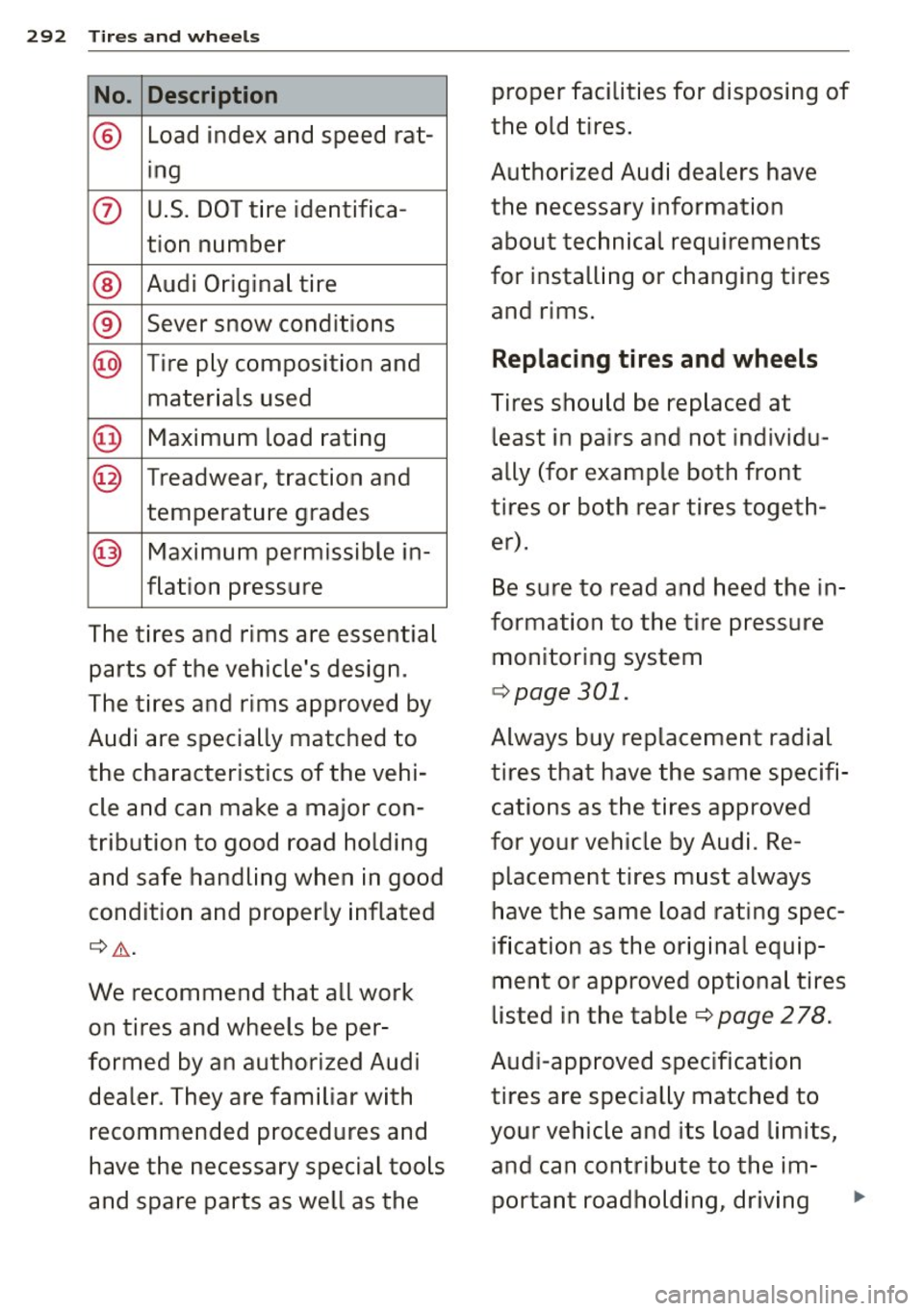
292 Tires and whee ls
No . Description
® Load index and speed rat-
ing
(J) U .S. DOT tire identifica-
tion number
® Audi Original tire
® Sever snow conditions
@ Tire ply composition and
materials used
@ Maximum load rating
@ Treadwear, traction and
temperature grades
@ Maximum permissible in-
flation pressure
The tires and rims are essential
parts of the vehicle's design .
The tires and rims approved by
Audi are specially matched to
the characteristics of the vehi
cle and can make a major con
tribution to good road holding and safe handling when in good
condition and properly inflated
¢ ,&..
We recommend that all work
on tires and wheels be per
formed by an authorized Audi
dealer. They are familiar with
recommended p rocedures and
have the necessary special too ls
and spare parts as well as the proper facilities for disposing of
the old ti res.
Autho rized Audi dealers have
the necessary information
about technical requirements
for installing or changing tires
and rims .
Replacing tires and wheels
Tires sho uld be replaced at
least in pairs and not individu
ally (for example both front
tires or both rear tires togeth
er).
B e sure to read and heed the in
formation to the tire pressure
monitoring system
c::> page 301.
Always buy replacement radial
tires that have the same specifications as the tires approved
for your vehicle by Audi. Re
placeme nt tires m ust always
have the same load rating spec
ification as the orig inal equip
ment or approved optional tires
listed in the table c::>page
278.
Audi-approved spec ificat io n
tires are specially matched to
your vehicle and its load limits ,
and can contribute to the im- portant roadholding, driving .,.
Page 298 of 350
296 Tires and wheels
sure of their "previous histo-
and sudden deflation and
ry." Old used tires may have loss of control.
been damaged even though -Temperature grades apply
the damage cannot be seen to tires that are properly in-
that can lead to sudden tire flated and not over or un-
failure and loss of vehicle
derinflated.
control. -For technical reasons it is
-All four wheels must be fit-
not always possible to use
ted with radial tires of the wheels from other vehicles -
same type, size (rolling cir- in some cases not even
cumference) and the same wheels from the same vehi-
tread pattern. Driving with cle model.
different tires reduces vehi- -If you install wheel trim
cle handling and can lead to
discs on the vehicle wheels,
a loss of control. make sure that the air flow
-If the spare tire is not the to the brakes is not blocked.
same as the tires that are Reduced airflow to the
mounted on the vehicle -for
brakes can them to over-
example with winter tires -
heat, increasing stopping
only use the spare tire for a distances and causing a col-
short period of time and lision.
drive with extra care. Refit -Run flat tires may only be
the normal road wheel as used on vehicles that were
soon as safely possible. equipped with them at the
-Never drive faster than the
factory. The vehicle must
maximum speed for which have a chassis designed for
the tires on your vehicle are run flat tires. Incorrect use rated because tires that are of run flat tires can lead to
driven faster than their rat-
vehicle damage or acci-
ed speed can fail suddenly. dents. Check with an au-
-Overloading tires cause heat thorized Audi dealer or tire build-up, sudden tire fail- specialist to see if your vehi-
ure, including a blowout cle can be equipped with
..
Page 299 of 350
M N
0 ...J
'SI: ,...., \!) 1.1'1 ,...., 1.1'1 ,....,
run flat tires. If run flat tires
are u sed , they must be in
stalled on all four wheels. Mixing tire types is not per
mitted.
(D Note
-For technical reasons, it is not generally possible to
use the wheel rims from
other vehicles. This can hold
true for wheels of the same
vehicle type.
- If the spare tire is different
from the tires that you have mounted on your vehicle
(for example winter tires or
wide profile tires), then use
the spare tire for a short pe riod of time only and drive
with extra care. Replace the
flat t ire with the tire match
ing the others on your vehi
cle as soon as possible.
- Never drive without the
valve stem cap. The valves
could get damaged .
@) For the sake of the environment
Dispose of old tires in accord
ance with the local require ments.
Tires and wheels
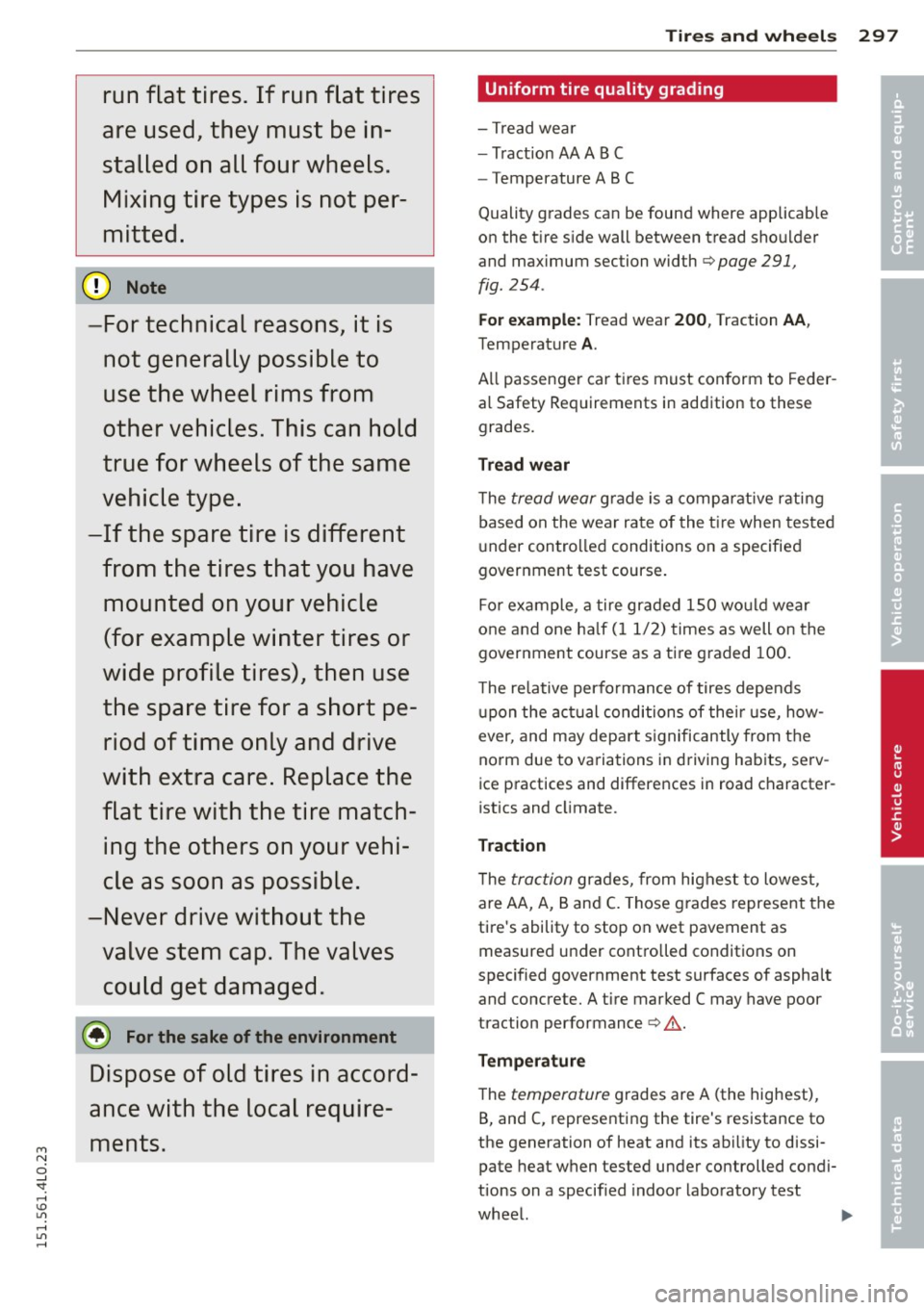
Uniform tire quality grading
- Tread wea r
- Traction AA A B C
- Temperature AB C
Quality g rades ca n be foun d where applicab le
on the t ire s ide wall between t read sho ulder
and maximum section width
c> page 291,
fig. 254 .
For example : Tread wear 200, Traction AA,
Temperat ure A .
All passenge r ca r tir es must con form to Feder
a l Safety Requ irements in add ition to these
grades.
Tread wear
T he tread wear g rade is a c omp arati ve rati ng
based on the wear ra te of the tire when tes te d
u nder con tro lled conditions o n a specifie d
government test course .
F o r ex ample , a tire gr aded 1S 0 wo uld wear
one a nd one h alf ( 11/ 2) times as well on the
governmen t course as a ti re g raded 100 .
T he re lative perfo rman ce of tires depe nds
up on the actu al c ondition s of the ir u se, how
ever, and m ay depa rt s ignificantly from t he
no rm due to va ria tions i n driving ha bits, se rv
ice p ractices and differences in road character
istics and cl imate.
Traction
T he trac tio n gr ad es, from hig hest to lowes t,
a re AA, A, Ban d
C. Those g rades represe nt the
ti re 's ability to stop on wet pavement as
measured u nder cont rolled conditions on
specified government test surfaces of aspha lt
and concrete. A t ire mar ked C may have poor
traction performance
c> ,&. .
Temperature
The temperature gr ades are A (the highest),
B, and C, represent in g the tire's resistance to
the generation of heat and its ab ility to d issi
pate heat when tested un der controlled condi
tions on a specif ied indoo r labo rato ry test
whee l.
297
•
•
Page 300 of 350
298 Tires and wheels
Sustained high temperature can cause the
materia l of the tire to degenerate and reduce
tire life, and excessive temperature can lead
to sudden tire failure<=>,& .
The grade C corresponds to a level of perform
ance which a ll passenger car tires must meet
under the Federa l Motor Veh icle Safety Stand
ard No.
109. Grades Band A represent higher
levels of performance on the laboratory test
wheel than the minimum required by law.
A WARNING
The traction grade assigned to this t ire is
based on stra ight-ahead braking traction
tests, and does not include acceleration,
cornering, hydroplanin g or peak traction
characteristics.
A WARNING ,.,.____
The temperature grade for this tire is es
tablished for a tire that is properly inflated
and not overloaded. Excessive speed, un
derinflation, or excessive loading, either
separately or in combination, can cause heat buildup and possible tire fa ilure.
Winter tires
Winter tires can improve vehicle handling on
snow and ice. At temperatures below 45 °F
(7 °C) we recommend changing to winter
tires .
In some heavy snow areas, loca l governments
may require true winter or "snow" tires, those
with very deeply cut tread. These t ires should
only be used in pairs and be installed on all
four wheels. Make sure you purchase snow
tires that are the same size and construct ion
type as the other tires on your ve hicle.
Your veh icle is equipped with all -wheel drive,
this will improve traction during w inter driv
i ng, even with the standard tires. However, we
strongly recommend that you always equip all
four whee ls on your veh icle w ith correctly fit
ted winter ti res or all-season tires, when win
ter road conditions are expected. This a lso im- proves the vehicle's
braking performance and
reduces stopping distances.
Summer tires provide less gr ip on ice and
snow.
Winter tires (snow tires) must always be fitted
on all four wheels.
Ask your authorized Audi dealer or qualified
workshop for perm itted
winter tire sizes . Use
only rad ial winter t ires .
Winter tires lose their effectiveness when the
tread is worn down to a depth of
0.157 inch
(4 mm).
Only drive w ith w inter t ires under winter con
ditions. Summer t ires handle better when
there is no snow or ice on the roads and the
temperature is above 45 °F (7 °() .
If you have a flat tire, see notes on spare
wheel<=>
page 291 .
Please always remember that winter tires may
have a lower speed rating than the tires origi
nally installed on your vehicle at the time it
was manufactured. Please see
<=>page 294,
Speed rating (letter code)
for a listing of the
speed rating letter codes and the maximum
speed at which the tires can be driven .
The speed rating letter code (<=>
page 2 76) is
on the side wall of the t ire
c> page 291.
A WARNING ,.___
Winter tires have maximum speed limits
that may be lower than your vehicle's max
imum speed. Always know the maximum
speed before driv in g off. Never drive faster
than the speed permitted for your specific
winter tires. This wi ll cause damage to the
tires leading to an accident and serious
personal injury to you and your passen
gers.
A WARNING
'----
Driving faster than the maximum speed
for which the winter tires on your vehicle were designed can cause t ire failure in
cluding a blowout and sudden deflation,
Page 303 of 350
M N
0 ...J
'SI: ,...., \!) 1.1'1 ,...., 1.1'1 ,....,
authorized Audi dealer. Replace a damaged
tire as soon as possible.
- Inspect your tires every 2 ,000 miles (3,000
km) for damage and wear. Damage is not a l
ways easy to see . Damage can lead to loss of
air and underinflation, which could eventu
ally cause tire failure. If you be lieve that a
t ire may have been damaged, replace the
t ire as soon as possible .
- These tires may wear more quick ly than oth
ers .
- Please also remember that, while these tires
deliver respons ive handling, they may ride
less comfortably and make more noise than
other cho ices .
Reduced perform ance in winte r/cold
s eason conditions
All tires are des igned for certai n purposes.
The low aspect ratio, ultra high pe rformance
tires orig inally installed on your veh icle are in
tended fo r max imum dry and wet road per
formance and handling . They are not s uitable
for cold, snowy or icy weather conditions. If
you drive under those circumstances, you should equip your vehicle with all-season or
winter tires, which offer better traction under those cond itions . We suggest you use the rec
ommended snow or all-season tires specified
for your vehicle, or their equ ivalent .
Refer to
c> page 298 for more detailed infor
mat ion regarding winter t ires.
Tire pressure
monitoring system
(D General notes
Each t ire, includ ing the spare (if provided),
should be checked monthly when cold and in
flated to the inflation pressure recommended
by the vehicle manufacturer on the vehicle
p lacard or tire inflation pressure label. (If your
ve hicl e has t ires of a different size than the
si ze ind icated on the vehicle p lacard or tire in
flation pressure label, yo u should determine
the proper tire inflation pressure for those
tires).
Tire s an d wheel s 301
As an added safety featu re, your veh icle has
been equipped with a tire pressure monitoring
system (TPMS) that illum inates a low tire
pressure telltale when one or more of your
tires is significantly under-inflated. According
ly, when the low tire pressure telltale illumi
nates, you should stop and check your tires as
soon as possib le, and inflate them to the
proper pressu re. Driving on a sign ifi cantly un
der- infla ted ti re causes the tire to overhea t
and can lead to tire fa ilure . Unde r-inflation al
so reduces fuel efficiency and tire tread life,
and may affect the vehicle's handling and
stopp ing ability.
Please note that the TPMS is not a substitute
for proper tire maintenance, and it is the driv
er's responsibility to maintain correct tire
pressure, even if under-inflation has not
reached the level to tr igger illuminat ion of the
TPMS low tire pressure tellta le.
Your vehicle has also been equipped with a
T PMS malfunction ind icator to ind icate when
the system is not operating properly . The
TPMS malfunction indicator is combined with
the low tire pressure telltale . Whe n the sys
tem detects a malfunction , the telltale will
flash for approximate ly one m inute and then
rema in continuously illum inated . Thi s se
quence will continue upon s ubseque nt vehicle
start-ups as long as the malfunct ion exists.
When the malfunction indicato r is illum inat
ed, the sys tem may not be ab le to detect or
s ignal low tire pressure as intended. TPMS
malfunctions may occur for a var iety of rea
sons, including the insta llation of rep lace
ment or a lternate tires or wheels on the vehi
cle that prevent the TPMS from functioning
properly. Always check the TPMS malfunction
telltale after rep lacing one or more tires or
whee ls on your vehicle to ensure that the re
placeme nt or alternate ti res and wheels allow
the TPMS to cont inue to funct ion p rope rly . •
•
Page 306 of 350
304 What do I do now?
What do I do now?
Jack, tools and
inflatable spare tire
Tools
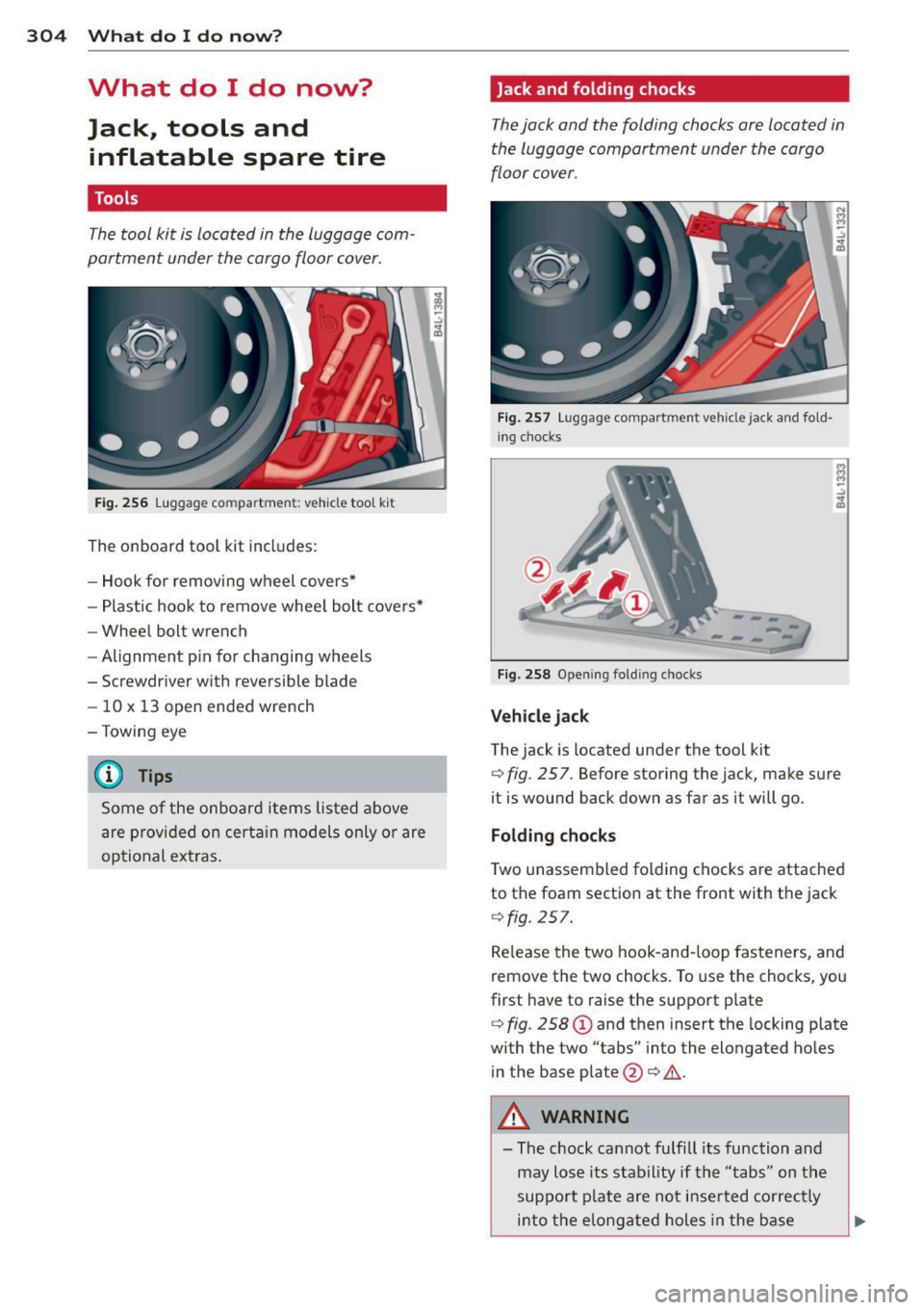
The tool kit is located in the luggage com
partment under the cargo floor cover.
Fig . 256 Luggage compartmen t: vehicle too l kit
The onboard tool kit includes:
- Hook for removing wheel covers*
- Plastic hook to remove wheel bolt covers*
- Wheel bolt wrench
- Alignment p in for changing wheels
- Screwdriver with reversible blade
- 10 x 13 open ended wrench
-Towing eye
(D Tips
Some of the onboard items listed above
are provided on certa in models only or are
optional extras .
Jack and folding chocks
The jack and the folding chocks are located in
the luggage compartment under the cargo
floor cover.
Fig. 257 Luggage compartment veh icle jack and fo ld
ing chocks
-----........ -
Fig. 258 Opening fold ing chocks
Vehicle jack
The jack is located under the tool kit
<=>fig . 257. Before storing the jack, make sure
it is wound back down as far as it will go.
Folding chocks
Two unassembled fo lding chocks are attached
to the foam section at the front with the jack
<=> fig. 257.
Release the two hook-and-loop fasteners, and
remove the two chocks. To use the chocks, you
first have to raise the support plate
<=> fig. 258 (!) and then insert the locking plate
with the two "tabs" into the elongated holes
in the base plate@<=>&. .
A WARNING
-- The chock cannot fulfill its function and
may lose its stability if the "tabs" on the
support plate are not inserted correctly
into the elongated holes in the base