ESP AUDI Q7 2017 Owner´s Manual
[x] Cancel search | Manufacturer: AUDI, Model Year: 2017, Model line: Q7, Model: AUDI Q7 2017Pages: 402, PDF Size: 100.39 MB
Page 310 of 402
Child safety
-Never put the forward-facing child restraint
up, against or very near the instrument pan
el.
- Always move the front passenger seat to
the highest position in the up and down ad
justment range and move it back to the
rearmost position in the seat's fore and aft
adjustment range, as far away from the air
bag as possible, before installing the for
ward-facing child restraint.
- Always make sure that the safety belt upper
anchorage is behind the child restraint and
not next to or in front of the child restraint
so that the safety belt will be properly posi
tioned.
- Make sure that the
PASSENGER AIR BAG
OFF~ ;
light comes on and stays on all the
time whenever the ignition is switched on.
A WARNING
Rearward-facing child restraints:
- A child in a rearward-facing child safety seat
installed on the front passenger seat will be
seriously injured and can be killed if the
front airbag inflates -even with an Ad
vanced Airbag System.
- The inflating airbag will hit the child safety
seat or infant carrier with great force and
will smash the child safety seat and child
against the backrest, center armrest, door
or roof .
- Always be especially careful if you must in
stall a rearward facing child safety seat on
the front passenger seat in exceptional cir
cumstances .
- Make sure that the
PASSENGER AIR BAG
OFF~;
light comes on and stays on all the
time whenever the ignition is switched on.
- If the
PASSENGER AIR BAG OFF~; light
does not come on and stay on, immediately
install the rear-facing child safety seat in a
rear seating position and have the airbag
system inspected by your Audi dealer .
308
· Activating the convertible locking retractor
Use the convertible locking retractor to secure a
child restraint.
Always heed the child safety seat manufacturer 's
instructions when installing a child restrain t in
your vehicle . To activate the convertible locking
retractor:
.. Place the child restraint on a seat, preferably
on the rear seat .
.. Slowly pull the belt
all the way out .
.. Route it around or through the child restraint
belt path
~ ,&. .
.. Push the child safety seat down with your full
weight to get the safety belt really tight.
.. Insert the belt tongue into the buckle for that
seating position.
.. Guide the safety belt back into the retractor un
til the belt lies flat and snug on the child safety
seat.
.. You should hear a "clicking" noise as the belt
winds back into the inertia reel. Test the con
vertible locking retractor by pulling on the belt.
You should no longer be able to putt the belt
out of the retractor. The convertible locking re
tractor is now activated .
.. Make sure that the red release button is facing
away from the child restraint so that it can be
unbuckled quickly.
.. Pull on the belt to make sure the safety belt is
properly tight and fastened so that the seat
cannot move forward or sideways more than
one inch (2 .5 cm) .
A WARNING
Using the wrong child restraint or an improp
erly installed child restraint can cause serious
personal injury or death in a crash.
- Always make sure that the safety belt re
tractor is locked when installing a child
safety seat. An unlocked safety belt retrac
tor cannot hold the child safety seat in place
during normal driving or in a crash.
- Always buckle the child safety seat firmly in
place even if a child is not sitting in it. A
loose child safety seat can fly around during
a sudden stop or in a crash.
Page 315 of 402
u co ,....,
N r-... N ,....,
0
0
:E: '
"' Release or deploy the tether st rap on the child
restraint acco rding to the child restraint manu
facturer's instructions .
"' Guide the upper tether strap under the rear
head restraint and into the rear cargo area
(raise the head restraint if necessary). For child
restra ints w ith V-tether straps, always make
sure that the head restraint guide rods do not
interfere with any part of the top tether strap .
"' Slide the tether st rap hook over the anchor
bracket.
"' Pull on the te ther strap hook so tha t the spring
catch of the hook engages.
"' Tighten the tether strap firmly fo llowing the
child restraint manufacturer's instructions .
Relea sing the te th er s trap
"' Loosen the tens ion following the child restraint
manufacturer's instructions .
"' Depress the spring catch on the hook and re
lease it from the anchorage.
@ Note
If you leave the chi ld restraint wi th the tether
strap firmly installed fo r several days, this
could leave a mark on the upholstery on the
seat cushion and backrest in the area where
the tether strap was installed. The upholstery
would also be permanently stretched around the tether strap . This applies especially to
leather seats .
Using tether straps on rearward-facing
child restraints
Current ly, few rear-facing chi ld restraint systems
come with a tether. Please read and heed the
child restraint system manufacturer's instruc
tions carefully to determine how to properly in stall the tether.
A WARNING
A child in a rearward-facing chi ld safety seat
installed on the front passenge r seat w ill be
ser iously injured and can be killed if the front
airbag inflates -even with an Advanced Air
bag System . Ch
ild
safety
- The inflating airbag will hit the chi ld safety
seat or infant carr ier with great force and
will smash the child safety seat and child aga inst the backrest, center armrest, or
door.
- If you must install a rearward facing child
safety seat on the front passenger seat be
cause of exceptional circumstances and the
PA SSENGER AIR BAG OFF ',,;; light does not
come on and stay on, immedia tely insta ll
the rea r-facing child safety seat in a rear
seating position and have the a irbag system
inspected by your Audi dealer .
Additional information
Sources of information about child
restraints and their use
T he re are a number of sources of additional in
format ion about ch ild rest raint selection, instal
lation and use :
N HT SA advises that the best ch ild safety seat is
the one that fits yo ur child and fits in your veh i
cle, and tha t you w ill u se correct ly and consis
tent ly.
T ry befo re yo u buy!
U.S Na tional H ighway Traffic Safety Admini stra
tion
Tel.: 1-888-327-4236 (TTY : 1-800-424-91S3)
http:/ /www.nhtsa.gov
http:/ /www.saferca r.gov
National SAFE KID S Camp aign
Tel.: (202) 662-0600
http://www.safekids.org
Safet y Belt Saf e U .S.A
Tel.: (800) 7 45 -SAFE (English)
Tel.: (800) 747-SANO (Spanish)
http://www.carseat.o rg
T rans port Canada Information Centre
Tel.: 1-800-333-0371 or call 1 -613 -998 -8616 if
you are in the Ottawa area
http://www.tc.gc.ca/ eng/ roadsafety/menu. htm
Audi Cu stom er Re lations
Tel.: (800) 822 -2834
313
Page 317 of 402
u co ...... N r-... N ...... 0
0
:E: '
adjustment is more likely to be made in time .
(D Note
-Methanol f uels which do not mee t these re
quirements may ca use corrosion and dam
age to plastic and rubber components in the
fuel system.
- Do not use fuels that fai l to meet the speci
fied criteria in this chapter.
- If you are unable to determine whether or not a particular fuel blend meets the speci
fications, ask your service station or its fuel
supplier.
- Do not use fuel for which the contents can
not be identif ied.
- Fuel system damage and performance prob
lems resulting from the use of fue ls differ
ent from those specified are not the respon
s ibility of Audi and are not covered under
the New Veh icle or the Emiss ion Control
System Wa rrant ies.
- If you experience a loss of fue l economy or
driveability and performance problems due
to the use of one of these fuel b lends, we
recommend that you switch to unblended
fuel.
Gasoline additives
Applies to: vehicles with gasol ine engine
A majo r concern among many auto manufactur
ers is carbon deposit build-up caused by the type
of gasoline you use.
A lthough gasoline grades d iffer from one manu
facturer to another, they have cer tain things in
common . A ll gasoline grades contain substances
that can cause deposits to collect on vita l engine
parts, such as fue l injectors and intake valves . Al
though most gasoline brands include additives to keep engine and fuel systems clean, they are not
equally effective.
Audi recommends using TOP TIER Detergent Gas
oline. For more informat ion on TOP TIER Deter
gent Gasoline, please go to the official website (www.toptiergas .com) .
Check ing and Filling
After an extended period o f using inadeq uate
fuels, bui lt-up ca rbon deposits can rob your en
gine of peak performance.
(D Note
- Damage or malfunction d ue to poor f uel
quality is no t covered by the Audi New Veh i
cle Lim ited Warranty .
- Do not add af termarket fuel addi tive prod
u cts to your fue l tank.
Diesel fuel
Applies to: vehicles with diesel engine
Always use U LSD (Ult ra Low Sulfur Diesel) No. 2.
T he ULSD No. 2 meets the AS TM 0975.
D iesel fuel w ith concentrations of b iod iesel h igh
er than 5
% such as Bl 1, B20 or B100 are st rict ly
prohib ited.
Service station fuel pumps are labeled with the
cor rect fuel i nformation for easy recogn ition by
the user. If the d iesel fue l pump is not labeled
as k t he station operator wha t fuel is being dis
pensed before fill ing up your vehi cle.
U LSD No . 2 may not be ava ilable outside the USA
and Canada. Be su re to check befo re t raveling to
othe r countr ies.
ULSD No . 2 can become thicker in very cold tem
peratures, and th is can impa ir the engine's start
ing and runn ing . Depend ing o n the season, gas
stations provide ULS D No. 2 that flows be tte r in
cold te mpe ra tures so that you can conti nue ope r
at ing your vehicle as usual.
(D Note
- Yo ur vehicle's diese l eng ine w as designed
so ley for use w ith ULS D No. 2. Therefo re,
never use gasoline, heating oil, other fuels
or flow improvers. These contain s ubstances
that will severely damage the fuel system
and the engine. Such damage will not be
covered by your New Vehicle Limited War
ranty.
- If you put any amount of incorrect fuel in
the fuel tank, do not start the engine under ..,_
315
Page 321 of 402
u (0 ...... N r--. N ...... 0
0
:E
Ad Blue left to drive the distance indicated in the
i nstr ument cluster . Fill the Ad Blue .
• Refill with at least x qt (l) AdBlue. No en·
gine start in
x mi (km ). See owner 's manual
This message appears when there is only eno ugh
Ad Blue lef t to d rive the distance indicated in the
i nstr ument cluster. Fill the Ad B lue. O therwise
the engine will not start again if you stop it once
the distance indicated has been driven .
• Refill with at least x qt (l) AdBlue . Engine
start n ot possibl e. See owner 's manual
This message appea rs when the Ad Blue tank is
empty. Fill the AdB lue. Otherwise you will not be
ab le to s tart the engine aga in once yo u stop it.
The AdBlue must be refilled when the amount in
the tank has reached the minimum level
¢ page 319, Preparation.
Incorrect filling /system ma lfunction
A message appears if the Ad Blue tank was filled
with a fluid other than AdBlue and the system
has detected that the tank was f illed incor rectly,
or if there is a system malfunction .
II Ad Blue: malfunct ion ! No engine start in
x mi (km ). Se e owner's manual
This message appears when it is only possible to
drive the d istance ind icated in the instrument
cluster . Drive to the nearest author ized Audi
dealer o r authorized Aud i Serv ice Facility to have
the malfunction corrected . Otherwise the engine
w ill not start again if you stop it once the d is
tance indicated has been dr iven .
• Ad Blu e: malfunction! No engine start poss i
ble . See owner' s manual
This message appears if the system has detected
that the tank was filled incorrectly or that there
is a malfunction. Drive immediately to the near
est autho rized Aud i dea ler or authorized Aud i
Service Facility to have the malfunction correct
ed. Othe rwise you will not be able to start the en
g ine again once you stop i t.
Checking and Filling
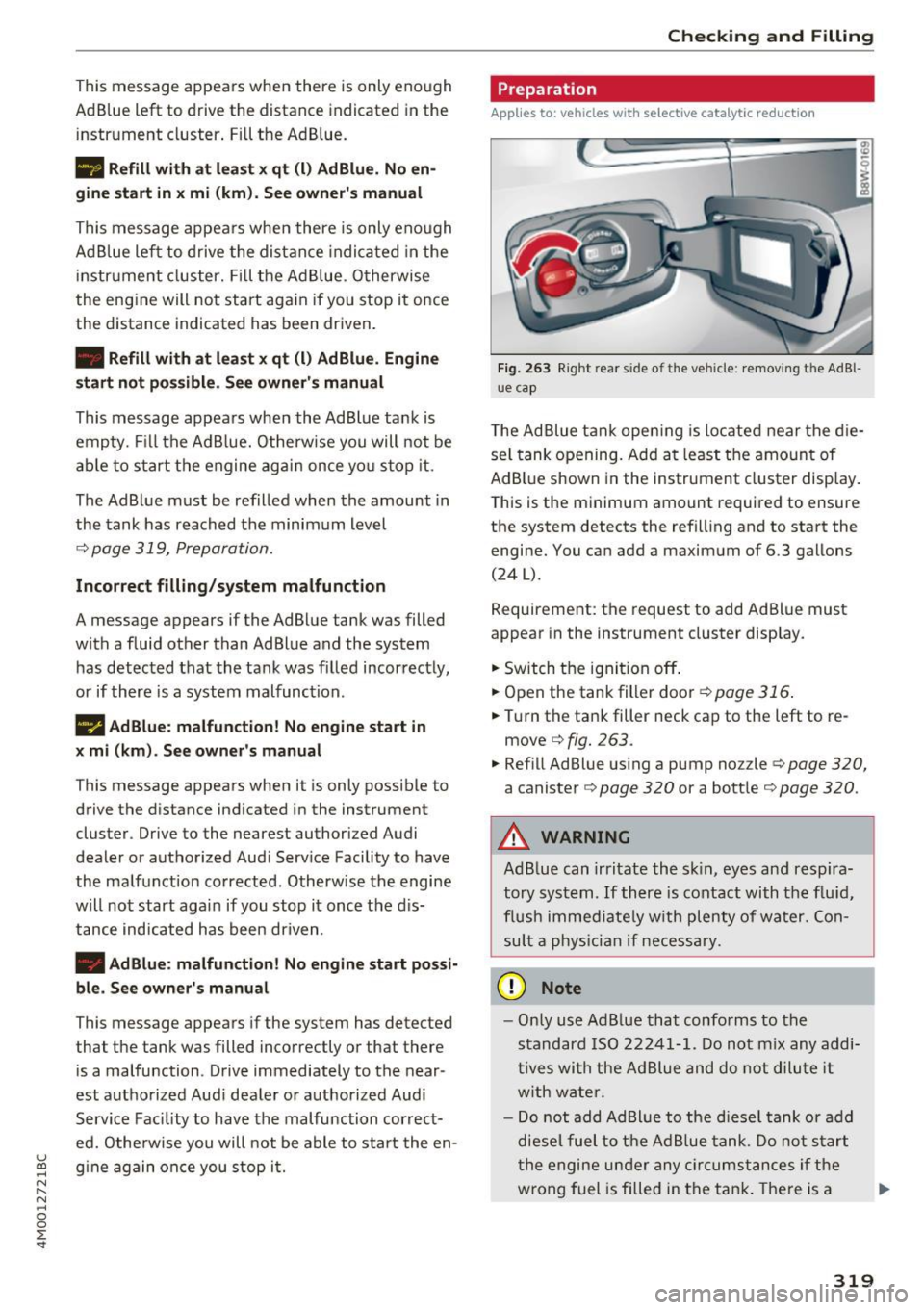
Preparation
Applies to: vehicles with selective cata lytic reduction
Fig. 263 Right rear s ide o f the ve hicle: removing t he Ad Bl
u e cap
The Ad Blue tank ope ning is located near the d ie
se l tank opening. Add at least the amount of
AdB lue shown in the instrument cluster display.
This is the minimum amount required to ensure
the system detects the refilling and to start the
engine. You can add a maximum of 6.3 gallons
(24 L).
Requirement: the request to add Ad Bl ue must
appear in the instrument cluster display.
.. Switch t he ignit ion off .
.. Open the tank filler door¢
page 316 .
.. Turn the ta nk filler neck cap to the left to re
move
¢fig . 263 .
.. Ref ill Ad Blue us ing a pump nozzle ¢ page 320,
a canister ¢ page 320 or a bott le ¢ page 320 .
A WARNING ,~ -Ad B lue can irritate the s kin, eyes and respira
tory sys tem.
If th ere is contact with t he flu id,
flus h immed iate ly w ith plenty of wa ter. Con
su lt a phys icia n if necessary .
(D Note
- Only use Ad Blue that conforms to the
standard ISO 22241-1. Do not m ix any addi
tives with the Ad Blue and do not dilu te it
w ith wate r.
- Do not add AdBl ue to the diesel tank or add
diese l fuel to t he A d Bl ue tank. Do not s tart
t he engine un de r any c ircumst ances if th e
wrong fuel is filled in the tan k. There is a
319
Page 330 of 402
Checking and Filling
areas, into open streams or down sewage
drains.
- Recycle used engine oil by taking it to a used
engine oil collection facility in your area, or
contact a service station .
Cooling system
Coolant
The engine cooling system is filled with a mixture
of pur ified water and coolant addit ive at the fa c
tory. This coolant must not be not changed.
The coolant leve l is monitored through the. in
d icator light~
page 26. Howeve r, we do recom
mend occasionally check ing the coo lant level
manually.
I f you must add coolant, use a m ixt ure of water
a nd coolant addit ive. M ixing the coolant additive
with d istilled water is recommended .
Coolant additive
The coolant addit ive is made of anti-freez ing and
corros ion protection agents. Only use the fo llow
ing coolant add it ives. These additives may be
mixed w ith each other.
Coolant additive Specification
G13
TL 774)
G12++ TL
774 G
The amount of coo lant additive that needs to be
mixed with water depends on the climate where
the vehicle will be operated. If the coolant addi
tive percentage is too low, the coolant can freeze
and damage the eng ine.
Coolant Freeze protec-
additive tion
Warm min .40% m in. -13 °F
reg ions max. 45% (-25 °()
Cold min. 50% max. -40 °F
reg ions max. 55% (-40 °C)
- Befo re the start of winter, have an author
i zed Audi dealer or authorized A udi Se rvice
Fac ility check if the coolant additive in your
328
vehicle matches the per cen tage appropriate
for the climate . This is especially important
when driving in colder climates.
- If the appro priate coo la nt additive is not
availab le in an eme rgency, do not add any
ot her additive. You could damage the en
gine. If this happens, only use water and re
store the correct mixture ratio with the
specified coolant add itive as soo n as poss i
ble.
- Only ref ill w ith new coolant.
- Radiator sealant must not be mixed with
the coolant.
Adding coolant
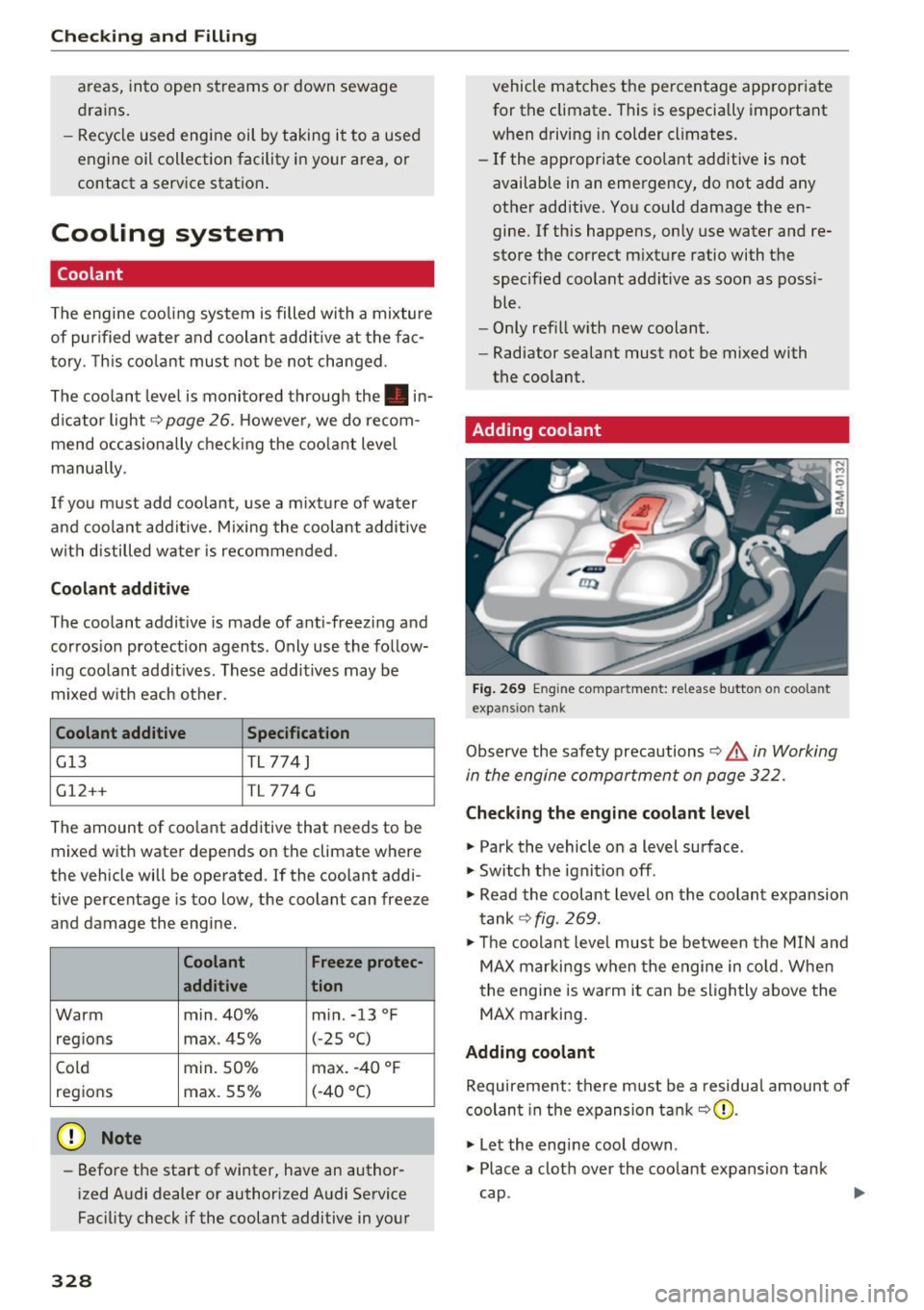
Fi g. 2 69 Engine compartment: re lease button on coolant
expansion tank
Observe the safety precautions ~.&, in Working
in the engine comportmen t on page 322.
Checking the engine coolant level
.. Park the vehicle on a level sur face .
.,. Switch the ignit io n off.
.,. Read the coolant level on the coolant expansion
tank
~ fig. 269.
.,. Th e coolan t level must be between the MIN and
MAX marki ngs when the engine in co ld. When
the engi ne is warm it can be sligh tly above the
MAX marking .
Adding coolant
Requirement: there must be a residua l amount of
coolan t in the expansion t ank
~CD -
.. Let the engi ne cool down .
.,. Place a clot h
over the coolant expansion tank
cap .
Page 333 of 402
u (0 ...... N r--. N ...... 0
0
:E
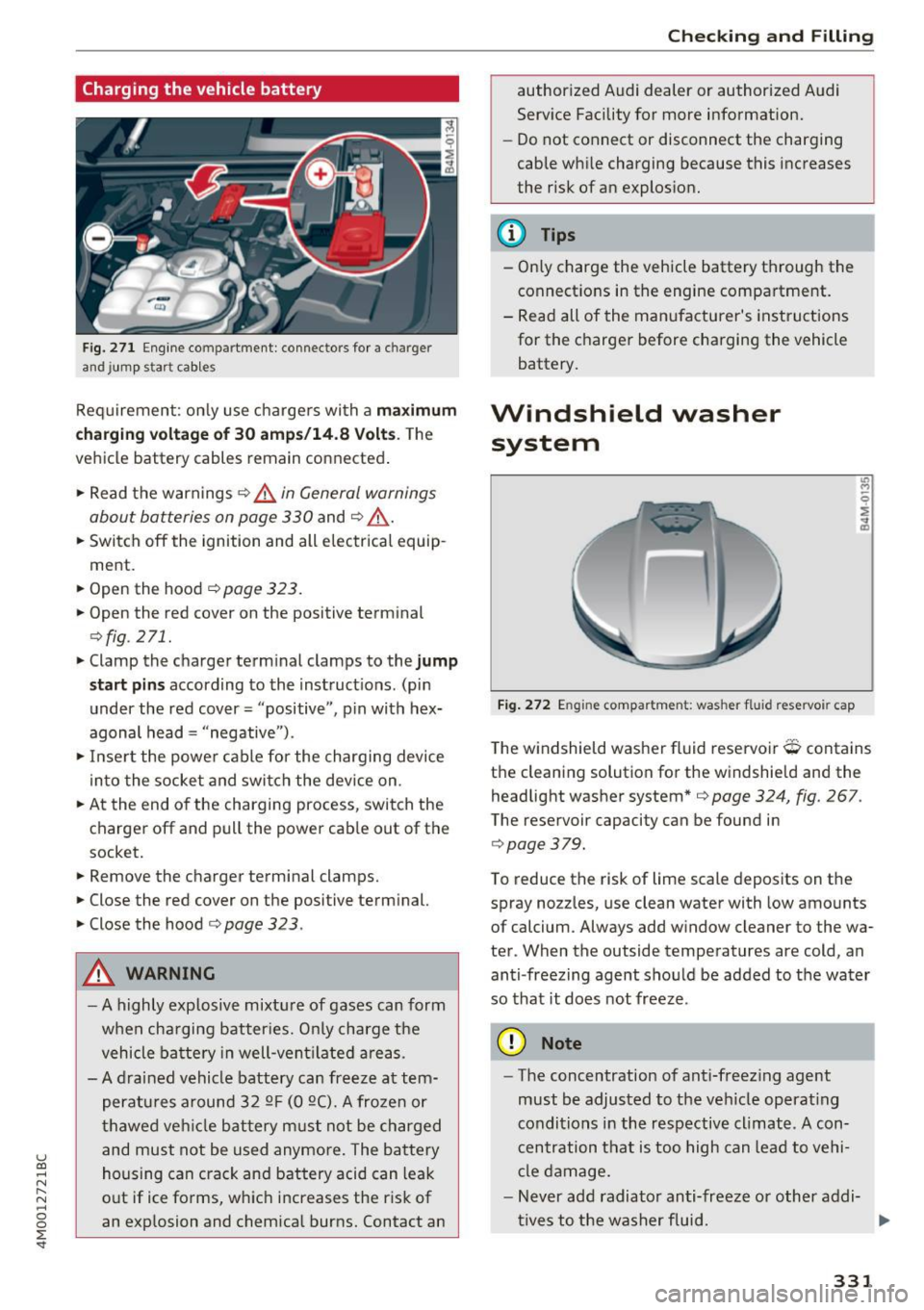
Fig. 271 Engine compartment : connec tor s for a charg er
and jump s ta rt cables
Requirement : only use chargers with a maximum
charging voltage of 30 amps/14.8 Volts.
The
vehicle battery cables remain connected .
.,. Read the warn ings ¢
& in General warnings
about batteries on page 330
and ¢ ,& .
.,. Switch off the ignition and all electrical equip
ment .
.,. Open the hood ¢
page 32 3 .
.,. Open the red cover on the positive terminal
¢ fig . 271 .
.,. Clamp the charger terminal clamps to the jump
start pins
according to the instructions . (pin
under the red cover = "positive", pin with hex
agonal head= "negative ") .
.,. Insert the power cable for the charging device
into the socket and switch the device on .
.,. At the end of the charging process, sw itch the
charger off and pull the power cable out of the
socket .
.,. Remove the charger terminal clamps.
.,. Close the red cover on the pos itive terminal.
.,. Close the hood ¢
page 323.
A WARNING
-A highly explosive mixture of gases can form
when charging batteries. Only charge the
vehicle battery in well-vent ilated areas.
-A drained vehicle battery can freeze at tem
peratures around 32 QF (0 QC). A frozen or
thawed vehicle battery must not be charged
and must not be used anymore. The battery
housing can crack and battery acid can leak
out if ice forms, which increases the risk of
an explosion and chemical burns. Contact an
Checking and Filling
authorized Audi dealer or authorized Audi
Service Facility for more information.
- Do not connect or disconnect the charging
cable while charging because this increases
the risk of an explosion.
@ Tips
- Only charge the vehicle battery through the
connections in the engine compartment.
- Read all of the manufacturer's instructions
for the charger before charging the vehicle
battery.
Windshield washer system
Fig. 272 E ngine compar tm ent: was her fluid re serv oir cap
The windshi eld washer fluid reservoir O contains
th e cleaning solution for the windshield and the
he adlight washer system*¢
page 324, fig. 26 7 .
The reservoir capacity can be found in
¢page 379.
To reduce th e risk of lime scal e deposits on the
spray no zzles, use clean water with low amounts
o f calcium. Alway s add window cleane r to the wa
ter . When the outside temperatures are cold, an
anti -freezing agent should be added to the water
so that it does not freeze.
(D Note
-The concentration of ant i-freezing agent
must be adjusted to the vehicle operating
conditions in the respective climate . A con
centration that is too high can lead to vehi-
cle damage.
- Never add radiator anti-freeze or other addi-
tives to the washer fluid. .,..
331
Page 334 of 402
Check ing and F illing
- Do not use a glass cleaner that contains
paint solvents, because this could damage
the pa int .
Service interval display
The service interval display detects when your ve
hicle is due for service.
Checking service int ervals
You can check the remaining distance or time un
til the next oil change or next inspection in the
Infotainment system .
.. Se lect in the Infotainment system: the
I MENU I
button
> Vehicle > left contro l button > Ser vice
& check s > Ser vice inte rval s.
Resetting the indicator
An author ized Audi dealer or author ized A udi
Serv ice Facility will rese t the serv ice interval d is
p lay after performing serv ice .
I f you have changed the oil yourself, you must re
set the oil change interva l.
.. Select in the Infotainment system: the!MENUI
button
> Vehicle > left contro l button > Service
& chec ks > Service interval s > Reset oil change
interval.
If an oil change or inspection is due, you can ac
cess it in the Infotainment system. The display
wo rks in two stages:
- Servic e reminde r: after a certain distance is
driven, a message appears in the inst rument
cluster d isp lay every time the ign ition is switch
ed on. The rema ining distance and t ime is d is
played br iefly.
- Service due : if your vehicle has reached a serv
ice i nterval, a message appears briefly after
swi tching the igni tion on.
(D Note
- Only reset the oil change indicato r if the oil
was changed.
- Fo llow ing the service i ntervals is c ritical to
maintain ing the service life a nd va lue of
you r vehicle, especia lly the engine. Even if
332
the mileage on the vehicle is low, do not ex
ceed the time for the next service .
Page 337 of 402
u
"' .... N
" N .... 0
0
l'. ...
® Mud and snow capability
"M/5" or "M+S" indicates the tire
has properties making it suitable
to drive in mud or snow.~ indi
cates a winter tire .
@ Composition of the tire cord
and materials
The number of plies indicates the
number of rubber ized fabric lay
ers in the t ire. In general : the
more layers, the more weight a
tire can carry . Tire manufacturers
must also specify the materials
used in the ti re . These incl ude
stee l, nylon, polyester and other
materials .
@Maximum permitted load
This number indicates the maxi
mum load in kilograms and
pounds that the tire can carry .
@ Uniform tire quality grade
standards for treadwear,
traction and temperature resistance
T readwear , traction and tempera
ture ranges¢
page 350.
@ Running direction
The arrows indicate the running
direction of un idirectional t ires .
You must always follow the speci- fied running direction
¢
page 365.
€3) Maximum permitted
inflation pressure
Wheels
T his number ind icates the max i
mum pressure to which a tire can
be inflated unde r normal operat
ing conditions.
Glossary of tire and loading
terminology
Accessory weight
means the combined we igh t (in
excess of those standard items
wh ich may be replaced) of auto
matic transmission, power steer
ing, power brakes, power win
dows, power seats, radio, and
heater, to the extent that these
items are availab le as factory-in
stalled equipment (whether in
stalled or not).
Aspect ratio
means the ratio of the height to
the w idth of the tire in percent .
Numbers of 55 or lower indicate a
low s idewall for improved steer
ing response and better overall
handling on dry pavement .
335
Page 342 of 402
Wheel s
Occupant loading and distri
bution for vehicle normal load
for various designated seat ing
capacit ies
Refer to the tire inflation pres
sure label ¢
page 343, fig . 276
for the number of seating posi
tions . Refer to the table¢
table
on page 345
for the number of
people that correspond to the ve
hicle normal load .
New tires or wheels
Audi recommends having all work
on tires or wheels performed by
an authorized Audi dealer or au
thorized Audi Service Facility .
These facilities have the proper knowledge and are equipped with
the required tools and replace
ment parts.
.,. New tires do not yet have the
optimum gripping properties. Drive carefully and at moderate
speeds for the first 350 miles (500 km) with new tires .
.,. Use tires of the same construc
tion, size (rolling circumference)
and as close to the same tread pattern as poss ible on all four
wheels .
340
.,.Do not replace tires individually .
At least replace both tires on the
same axle at the same time.
.,. Audi recommends that you use
Audi Original Tires. If you would
like to use different tires, please
note that the tires may perform
differently even if they are the
same size ¢
,&..
.,. If you would like to equip your
vehicle with a tire/rim combina
tion that is different from what
was installed at the factory, con
sult with an authorized Audi
dealer or authorized Audi Service Facility before making a pur
chase ¢&, .
If the spare t ire is different from
the regular tires installed on the
vehicle -for example, if winter
tires or wide tires are installed -
then only use the spare tire tem
porarily in case of emergency and
drive carefully while it is in use. It
should be replaced with a regular
tire as soon as possible.
On
all wheel drive vehicles, all
four wheels must be equipped
with tires that are the same brand and have the same construction
and tread pattern so tha t the
drive system is not damaged by .,.
Page 352 of 402

Wheels
After a heavy impact or damage, have the tires
and rims inspected or replaced immediately by
an authorized Audi dealer or authorized Audi
Service Facility.
Low-profile tires can wear out faster than stand
ard tires.
Summer tires are not suitable for cold weather ,
snow or black ice. If you are driving in these con
ditions, use winter or all season tires
¢ page 348.
Uniform tire quality grading
- Tread wear
-Traction AA A B C
- Temperature ABC
Quality grades can be found where applicable on
the tire side wall between tread shoulder and maximum section width
¢ page 333, fig. 273.
For example: Tread wear 200, Traction AA, Tem
perature
A .
All passenger car tires must conform to Federal
Safety Requirements in addition to these grades.
Tread wear
The tread wear grade is a comparative rating
based on the wear rate of the tire when tested
under controlled conditions on a specified
gov
ernment test course .
For example, a tire graded 150 would wear one
and one half
(1 1/2) times as well on the govern
ment course as a tire graded 100.
The relative performance of tires depends upon
the actual conditions of their use, however, and
may depart significantly from the norm due to
variations in driving habits, service practices and
differences in road characteristics and climate.
Traction
The traction grades, from highest to lowest, are
AA, A, Band
C. Those grades represent the tire 's
ability to stop on wet pavement as measured un
der controlled conditions on specified govern ment test surfaces of asphalt and concrete . A tire
350
marked C may have poor traction performance
¢_& .
Temperature
The temperature grades are A (the highest), B,
and C , representing the tire's resistance to the
generation of heat and its ability to dissipate
heat when tested under controlled conditions on
a specified indoor laboratory test wheel.
Sustained high temperature can cause the mate
rial of the tire to degenerate and reduce ti re life,
and excessive temperature can lead to sudden
tire failure ¢& .
The grade C corresponds to a level of perform
ance which all passenger car tires must meet un
der the Federal Motor Vehicle Safety Standard
No. 109. Grades Band A represent higher levels
of performance on the laboratory test wheel than
the minimum required by law.
A WARNING -
The traction grade assigned to this tire is
based on straight -ahead braking traction
tests, and does not include acceleration, cor
nering, hydroplaning or peak traction charac
teristics.
A WARNING
The temperature grade for this tire is estab
lished for a tire that is properly inflated and
not overloaded. Excessive speed, underinfla
tion, or excessive loading, either separately or
in combination, can cause heat buildup and
possible tire failure.
A WARNING
Temperature grades apply to tires that are properly inflated and not
over or underinflat
ed.
.
-