fuel AUDI Q7 2017 Owner´s Manual
[x] Cancel search | Manufacturer: AUDI, Model Year: 2017, Model line: Q7, Model: AUDI Q7 2017Pages: 402, PDF Size: 100.39 MB
Page 346 of 402
Wheels
-The tire must flex more if the tire pressure is too low or if
the vehicle speed or load are
too high . This heats the tire up
too much. This increases the
risk of an accident because it
can cause the tire to burst and
result in loss of vehicle con
trol.
-Incorrect tire pressure in creases tire wear and has a
negative effect on driving and
braking behavior, which in
creases the risk of an accident.
(D Note
Replace lost valve caps to re
duce the risk of damage to the
tire valves.
Tire pressure table
Please note that the information
contained in the following table
was correct at the time of print
ing, and the information is sub
ject to change. If there are differ
ences between this information
and the tire pressures specified
on the label on the driver's side 8-pillar, always follow the specifica
tion on the 8-pillar label
¢ page 343, fig. 275.
344
(i} For the sake of the environment
-Tire pressure that is too low
increases fuel consumption.
-Fuel consumption may also in
crease when driving with the
comfort tire pressure is se
lected .
(D Tips
Audi recommends using the
tire pressure specified for a
normal load
¢ table on
page 345
or for a full load
when the vehicle is partially loaded.
Make sure that the tire designa
tion on your tire matches the des ignation on the tire pressure label
and the tire pressure table.
The following table lists recom mended tire pressures in cold
tires according to the load and
the size of the tires installed.
Page 348 of 402
Wheels
&_ WARNING
Please note the important safe
ty precautions regarding tire
pressure¢
page 343 and load
limits¢
page 346.
Tires and vehicle load limits
There are limits to the amount of load or weight that any vehicle
and any tire can carry . A vehicle
that is overloaded will not handle
well and is more difficult to stop .
Overloading can not only lead to loss of vehicle control, but can al
so damage important parts of the
vehicle and can lead to sudden
tire failure, including a blowout
and sudden deflat ion that can
cause the vehicle to crash.
Your safety and that of your pas
sengers also depends on making
sure that load limits are not ex
ceeded. Vehicle load includes ev
erybody and everything in and on
the vehicle . These load limits a re
technically referred to as the vehi
cle's
Gross Vehicle Weight Rat
ing
("GVWR") .
The "GVWR" includes the weight of the basic vehicle, all factory in
stalled accessories, a full tan k of
fuel, oil, coolant and other fluids
3 4 6
plus maximum load. The maxi
mum load includes the number of
passengers that the veh icle is in
tended to carry ("seating capaci
ty") with an assumed weight o f
150 lbs (68 kg) for each passen
ger at a designated seat ing pos i
tion and the total weight of any luggage in the veh icle. If you tow
a trailer, the weight of the trailer
hitch and the tongue we ight of
the loaded trailer must be includ ed as part of the vehicle load.
The
Gross Axle Weight Rating
("GAWR") is the maximum load
that can be applied at each of the
vehicle's two axles .
The fact that there is an upper
limit to your vehicle's Gross Vehi
cle Weight Rating means that the
total weight of whatever is being
carried in the vehicle (inc luding
the weight of a trailer h itch and
the tongue weight of the loaded
trailer) is limited . The more pas
sengers in the vehicle or passen
gers who are heavier than the
standard weights assumed mean
that less weight can be carried as luggage .
The Gross Vehicle Weight Rating and the Gross Axle Weight Rat ing .,.
Page 351 of 402
u co ...... N r-... N ...... 0
0
:E: '
the tire t o burst.
- Always adapt yo ur drivi ng to the road and
traff ic conditions. Drive carefully and red uce
your speed on icy or slippery roads. Even
winter tires can lose traction on black ice.
@ For the sake of the environment
Reinstall summer ti res at the appropriate
time, because they provide better handling
when roads are free of snow and ice. Summer
tires cause less road noise, t ire wear and fuel
consumption.
(D Tips
You can also use all season tires instead of
w inter tires . Please note that in some coun
tries where w inter t ires are required, only
w inter t ires with the
die. symbol may be per
m itted.
Snow chains
Snow chains no t only imp rove the driving in wi n·
t er roa d cond itions, but a lso the brak ing.
" Only insta ll snow chains o n the
front wheels .
" Check and cor rect the sea ting of the snow
chains after dr iv ing a few feet, if necess ary. Fo l
low the ins truc tions from the ma nufa cturer .
" Note the maximum pe rmit ted speed w hen driv
ing with snow chains . Do not exce ed 30 mph
(SO km/h).
Use of snow chains is only pe rm itted with certain
rim/ti re combinations due to tec hnical reasons .
Chec k with an authorized A udi d ealer or author
ized A udi Service F acili ty to see if yo u may use
snow chains.
Use
fine-mesh snow chain s. They must not add
mo re t han 0.53 in (13 .5 mm) in height , including
the chain lock .
You mus t remove the snow c hains on roads with
out snow . Otherw ise, you could impair dr iving
abi lity and damage the tir es .
Wh eel s
A WARNING
Using incorrect snow chains or install ing snow
cha ins incorrectly can resu lt in loss of veh icle
control, which increases the risk of a n acci
dent.
(D Note
- Snow chains can damage the rims/wheel
cove rs* if the chains come into direct con
t act with them . Remove the wheel covers*
first . Use coa ted snow cha ins .
- Do not install and use snow c hains if the re is
a malfu nction in the a ir suspension*, be
cause the ve hicle height w ill be very low . If
yo u dr ive w ith snow chains anyway, the
w hee l ho usings and other ve hicle compo
nents can be seve rely damaged.
(0 Tips
When us ing snow chains, it m ay be usefu l to
swi tch the offroad mode o n
q page 149.
Low-profile tires
Applies to: vehicles with low-profile tires
Your vehicle is equipped with low -profi le tires* at
the factory . Compared to other tire/rim combina
tions, low-prof ile tires offer a w ider tread surface
and a larger rim diameter with shorter tire side
walls. This results in an agile dr iv ing style. How
ever, it may reduce the level of comfort and in
c rease road noise when driving on roads in poo r
cond it ion.
Low-profile t ires can become damaged more
quickly than standard tires when dr iving over
la rge bumps, potholes , manhole covers, speed
bumps and curbs. Therefo re, it is particularly im
po rtant to mainta in the co rrect ti re pressure
q poge 343.
To reduce the risk of damage to the tires and
r ims, drive very caref ully on poor roads.
Check your wheels regu larly every 2,000 mi
(3,000 km) for damage . For example, chec k for
bulges/cracks on the tires or deformations/
c racks on the rims . .,..
349
Page 353 of 402
u co ...... N r-... N ...... 0
0
:E: '
UJ General notes
Each tire, including t he spare (if provided),
should be checked monthly when cold and inflat
e d to the inflation pressure recommended by the
veh icle manufacturer on the vehicle placard or
tire inflat ion pressure label. (If your vehicle has
tires of a different size than the size indicated on
the veh icle placard or t ire inflation pressure la
be l, you shou ld determine the prope r ti re infla
tion pressure fo r those t ires) .
As an added safety feature , your veh icle has been
equ ipped w ith a t ire pressure monitoring system
(TPMS) that illuminates a low tire p ress ure te ll
tale whe n one or more of yo ur t ires is significant
l y under- infla ted . Accordingly, when the low tire
p ressure tellta le ill uminates, yo u should stop and
check your tires as soon as possible, and inflate
them to the proper press ure. Driving on a s ignifi
cantly under-inflated tire causes the tire to over
heat and can lead to t ire failure. Under-inflation
also reduces fuel efficiency and tire tread life,
and may affect the veh icle's handling and stop
p ing ability.
P lease note that the TPMS is not a substitute for
proper tire maintenance, and it is the driver's re
sponsib ility to ma inta in correct tire p ressure,
even if u nder-inflation has not reached t he leve l
to tr igger illum inat io n of the TPMS low tire p res
sure telltale.
Your veh icle has also been equ ipped w ith a TPMS
malfunct ion ind icator to indicate when the sys
tem is not operat ing properly. The TPMS ma l
f u nction indicator is combined w ith the low tire
p ressure tellta le. Whe n the system de tects a
mal function, the te lltale will flash fo r approxi
mate ly one min ute and then remain continuo usly
illum inated. This sequence will continue upon
subseq uent veh icle start-ups as long as the ma l
function ex ists .
When the malfunction indicator is ill uminated,
the system may not be ab le to detect or signa l
low tire press ure as intended. TPMS ma lfunctions
may occur for a var iety of reasons, including the
Wh eel s
insta llation o f replacement or alternate tires or
whee ls on the vehicle that prevent the TPMS
from functioning p roper ly . Always check the
TPMS ma lfunction te lltale after replac ing one or
more tires or wheels on your vehicle to ensure
that the rep lacement or a lternate tires a nd
wheels allow the TPMS to continue to fu nction
prope rly .
If the tire pressure monitoring indicator
appears
The tire pressure indicator in the instrument
cluster informs you if the tire pressure is too low
or if there is a system mo/function .
Using the ABS se nsors, the t ire pressu re moni to r
i ng system compares the tire tread circumfer
en ce and vibr ation character ist ics of the ind ividu
al tires . If the press ure changes in one o r more
t ires , th is is indicated in the instrument cluster
display with an indicato r light
[I] and a message.
If only one tire is affected, the location of that
t ire will be indicated.
T he tire press ures must be stored in the Infotain
ment system again each time the p ressures
change (switching between partial and full load
pressure) or after changing or replac ing a tire on
your vehicle
c:> page 352. The tire pressure mon i
tor ing system on ly mon itors the tire pressure you
have stored . Refer to the t ire pressu re label fo r
the re commended t ire pressu re fo r yo ur vehicle
c:> page 343, fig . 2 76.
T ire tread c irc umference and vibra tion characte r
ist ics can change and ca use a tire press ure wa rn
i ng if :
- the t ire pressure in one or more tires is too low
- the t ires have structural damage
- the t ire was rep laced or the t ire pressu re was
changed and it was not stored
c:> page 352
- tires that a re on ly pa rtially used are replaced
w ith new tires
Indicator lights
[I]-L oss of pressu re in at leas t one tire c:> ,&. .
Check the tires and replace or repair if necessary .
Check/correct the pressures of all four tires and .,.
351
Page 358 of 402
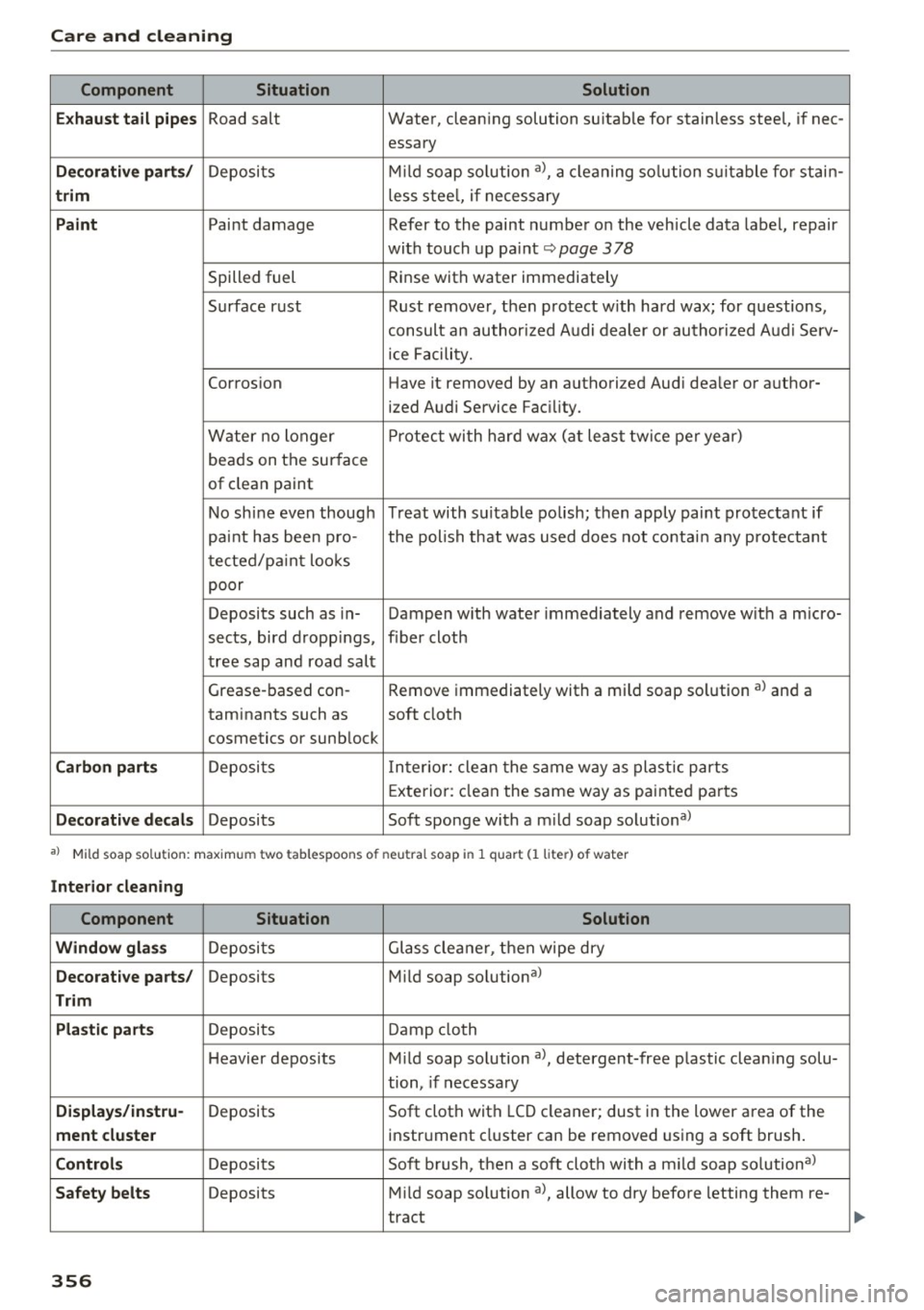
Care and cleaning
Component Situation Solution
E x haust tail p ipe s
Road salt Water, cleaning solution suitab le for stainless steel, if nee-
essary
D eco ra tiv e part s/ Deposits M
ild soap so lution a), a cleaning so lution s uitable fo r stain-
trim less stee l, if necessary
Paint Paint damage Refer to t he paint number on the vehicle data label, repair
with touch up paint ~
page 378
Spilled fuel Rinse with water
immediately
Surface rust Rust remover, then protect w ith hard wax; for questions,
consult an author ized A udi dealer or authorized Aud i Serv-
ice Facility.
Corros ion Have it removed by an authorized Audi dea ler or author-
ized Audi Service Facil ity.
Water no longer P
rotect wi th hard wax (at least tw ice per year)
beads on the sur face
of clean paint
No shine even though Treat wit h su itable polish; then apply paint protectant if
paint has been pro- the polish that was used does not conta in any protectant
tected/pa int looks
poor
Deposits such as in- Dampen w ith water immediately and remove w it h a micro-
sects, bird dropp ings, f iber cloth
tree sap and road salt
Grease-based con- Remove immediately with a mi ld soap so lution a) and a
taminants such as soft cloth
cosmetics or sunblock
Carbon parts Deposi ts Inter ior: clean the same way as plastic parts
E xterior : clean the same way as painted pa rts
Decorat iv e decal s Deposits Soft sponge with a mild soap solutiona l
a) Mi ld soap solution: maximum two tablespoons of neutral soap in 1 quar t Cl liter) of water
Interior cle aning
Component Situation Solution
Window gla ss
Deposits Glass cleaner, then wipe dry
Decorative parts / Deposits Mild soap solutiona>
Trim
Pla sti c parts
Deposits Damp cloth
Heavier deposits M ild soap solution al, detergent-free p lastic clean ing solu-
tion, if necessary
Di splay s/instru-Deposits Soft cloth with
LCD cleaner; dust in the lower area of the
ment cluste r instrument cluster can be removed using a soft brush .
Controls Deposits Soft brush, then a soft cloth with a m ild soap solutiona >
Safety belts Deposits Mild soap solution al, allow to dry before letting them re-
tract
356
Page 371 of 402
u co ...... N r-... N ...... 0
0
:E: '
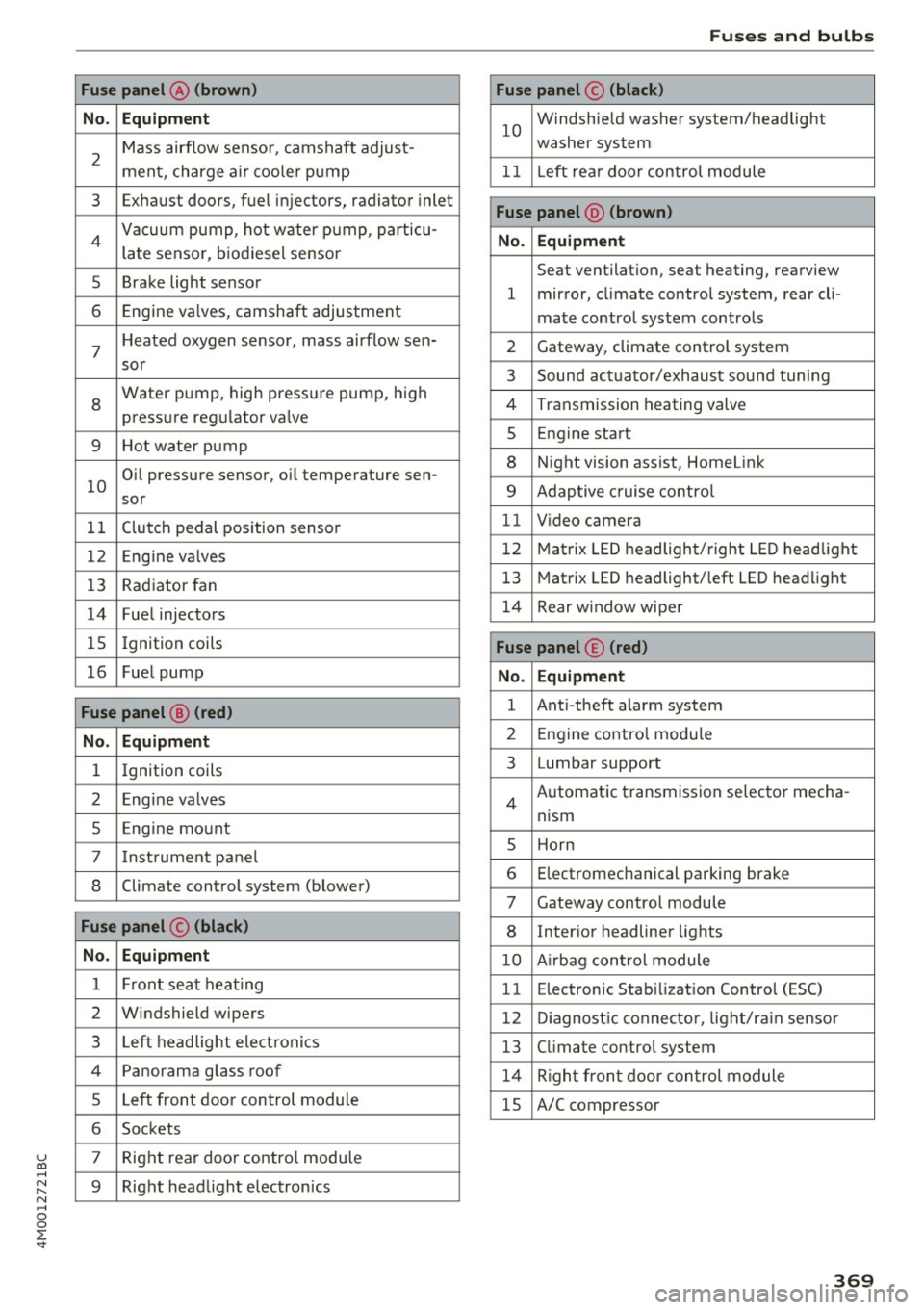
No . Equipment
2
Mass airflow sensor, camshaft adjust-
ment, charge air cooler pump
3 Exhaust doors, fuel injectors, radiator inlet
4 Vacuum pump, hot water pump, particu-
late sensor, biodiesel sensor
5 Brake light sensor
6 Engine va lves, camshaft adjustment
7
Heated oxygen sensor, mass airflow sen-
sor
8
Water pump, high pressure pump, high
pressure regulator va lve
9 Hot water pump
10
Oil pressure sensor, oil temperature sen-
sor
11 Clutch pedal position sensor
12 Engine valves
13 Radiator fan
14 Fuel injectors
15 Ignition coils
16 Fuel pump
Fuse panel @ (red)
No . Equipment
1 Ignition coils
2 Eng ine va lves
5 Engine mount
7 I nstrument pane l
8 Climate control system (blower)
Fuse panel © (black)
No. Equipment
1 Front seat heating
2 Windshield wipers
3 Left headlight electronics
4 Panorama glass roof
5 Left front door control module
6 Sockets
7 Right rear door contro l module
9 Right headlight electronics
Fuses and bulbs
Fuse panel© (black)
10
Windshie ld washer system/headlight
washer system
11 Left rear doo r contro l module
Fuse panel @ (brown)
No . Equipment
Seat ventilation, seat heating, rearview
1 mirror, cl imate control system, rear cli-
mate control system controls
2 Gateway, climate control system
3 Sound actuator/exhaust sound tuning
4 Transmission heating valve
s Engine start
8 Night vision assist, HomeLink
9 Adaptive cruise contro l
11 Video camera
12 Matrix LED headlight/right LED headlight
13 Matrix LED headlight/left LED headlight
14 Rear window wipe r
Fuse panel© (red)
No. Equipment
1 Anti-theft alarm system
2 Engine control module
3 Lumbar support
Automatic transmission selector mecha-
4
nism
s Horn
6 Electromechanical parking brake
7 Gateway control module
8 Inter ior headliner lights
10 A irbag control module
11 Electronic Stabilization Control (ESC)
12 Diagnostic connector, light/ra in sensor
13 Climate control system
14 Right front door control module
15 A/C compressor
369
Page 381 of 402

u co ,....,
N r-... N ,....,
0
0
:E: '
Gross Vehi cle We ight Rating
The G ross Veh icle Weight Rating (GVWR) , and
the Gross Axle Weight Rating (GAWR) for front
and rear ar e listed on a sticker on the driver's side
B-pillar.
The G ross Veh icle Weight Rating includes the
weight of the basic vehicle p lus full fuel tank, oi l
and coolant, p lus maximum load, which includes
passeng er w eight (150 lbs/68 kg p er designated
seating position) and luggage we ight
c:> A .
Gross Axle Weight Rating
The Gross Axle We ight Rating is the max imum
l oad that can be applied at each axle of the vehi
cle
c:> &, .
Vehicle capacity weight
The vehicle capac ity we ight (max . load) is listed
on the drive r's side 8-p illar.
& WARNING
-
- T he act ual Gross Ax le Weight Rating at the
front and rear axles sho uld not exceed the
permissible weights, and their combination
must not exceed the Gross Vehicle We ight
Rating.
- Exceedi ng perm iss ible weight ratings can
result in vehicle damage, acc idents and per
sonal injury .
Dimensions
Technical data
(D Note
- The vehicle capacity weig ht figures apply
when the load is d istributed evenly in the
vehicle (passengers and luggage) . When
transport ing a heavy load in the luggage
compartment, carry the load as near to the
rear axle as possible so that the vehicle's
hand ling is no t impa ired .
- Do not exceed the maximum perm iss ible
ax le loads or the maximum g ross ve hicle
we igh t. A lways remember that the vehi cle's
hand ling will be affected by the extra load.
T he refore, adjust your speed acco rd ingly.
- Always observe lo cal regulations.
Length (in (mm)) Width (in (mm ))
Width across the Height at curb
mirrors (in (mm )) weight (in (mm))
Q7 199
.6 (5069) 7 7.5 (1968) 8 7.1 ( 2212) 68.5 (1740)
Capacities
Approximate capaci-
ties
Fuel tank 2
2.5 gal (85 L)
Windsh ield and headlight washer system* 7.4 qt (7 L)
379
Page 382 of 402
Tech nical data
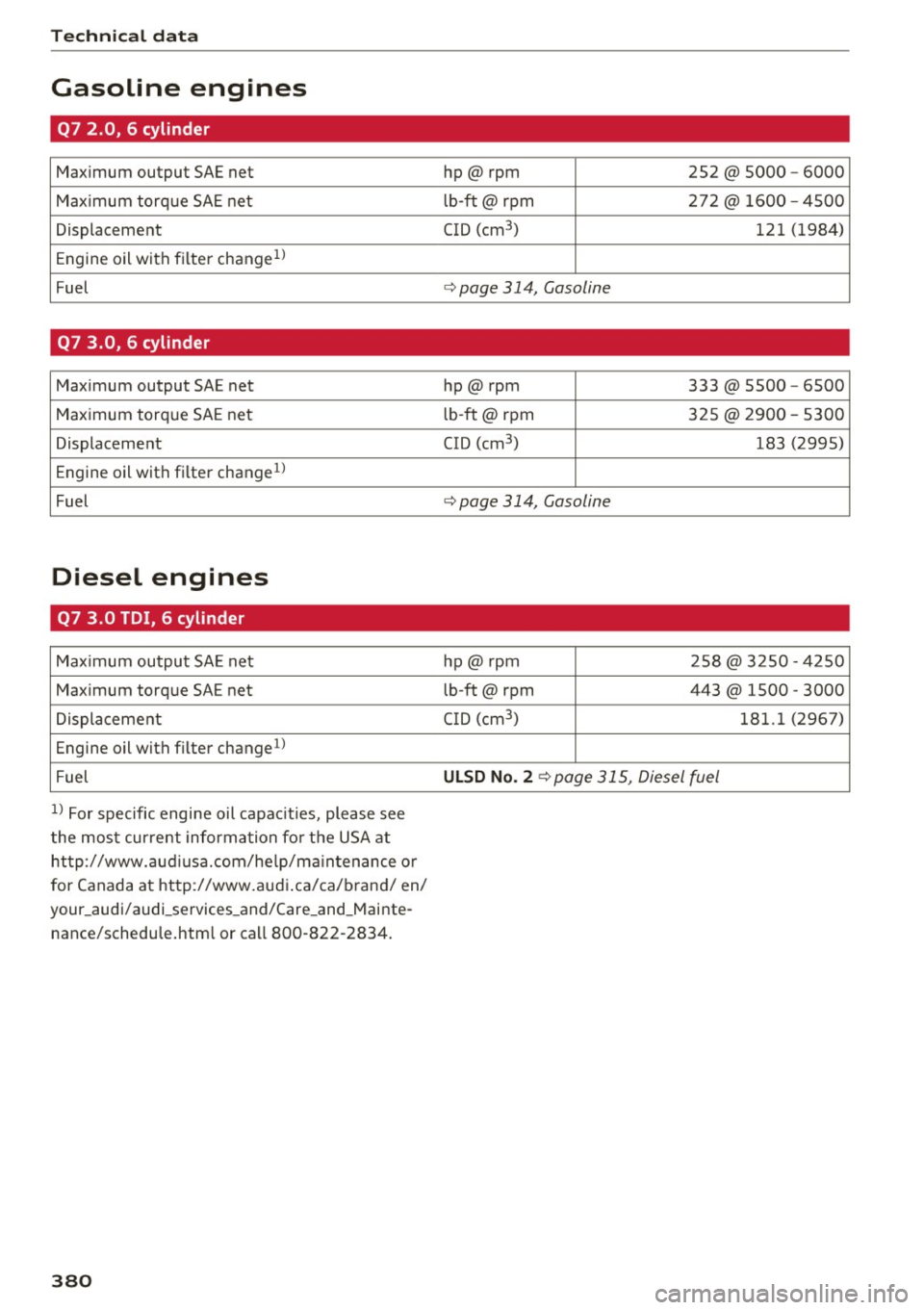
Gasoline engines
Q7 2.0, 6 cylinder
Maximum output SAE net
M ax im um torq ue SAE net
Displacement
Engine oil with filter change
1>
Fuel
Q7 3.0, 6 cylinder
Maximum output SAE net
Maximum torque SAE net
Displacement
Engine oil with fi lter change
1
)
Fuel
Diesel engines
Q7 3 .0 TOI, 6 cylinder
Maximum output SA E net
Maximum torq ue SAE net
Displacement
Engine oil with filter change
1
)
Fuel
l ) For specific engine oil capac ities, please see
the mos t cur rent informa tion fo r the USA at
http ://www. audi usa.com/he lp/ma in tenance o r
for Canada a t ht tp://www.aud i.ca/ca/brand/ en/
your _aud i/ aud i_ services _a nd/Ca re _and _M a i nte
na nce/ schedule.htm l or call 800-822 -2834.
380
hp@ rpm 252 @ 5000 -6000
lb-ft@ rpm 272@
1600 - 4500
CID (cm
3
) 121 (1984)
¢ page 314, Gasoline
hp@ rpm 333@ 5500 -6500
lb -ft@ rpm 325@ 2900 - 5300
CID (cm
3 ) 183 (2995)
¢ page 314, Gasoline
hp@ rpm 258@ 3250 -4250
lb -ft@ rpm 443@ 1500 -3000
C ID (cm
3
) 181.1 ( 296 7)
ULSD No . 2 ¢ page 315, Diesel fuel
Page 383 of 402
u co ...... N r-... N ...... 0
0
:E: '
Warranty coverages
Y our Audi is co vered b y the following war ran
tie s:
- New Vehicle Limited Warranty
- Limited Warranty Against Corrosion Perfora-
tion
- Emissions Control System Warranty
- Emissions Performance Warranty
- California Emissions Control Warranty (USA
vehicles only)
- California Emissions Performance Warranty
(USA vehicles only)
Detailed information regard ing your warranties
can be found in yo ur
W arranty & M ainten ance
bookl et.
Operating your vehicle
outside the U.S.A. or
Canada
Government reg ulations in the Un ited States and
Canada require that automobiles meet specific
emission regulations and safety standards.
Therefore, vehicles built for the U .S.A. and Cana
da d iffer from vehicles sold in other countries.
I f you p lan to take your vehicle outside the conti
nenta l limits of the United States or Canada,
there is the poss ibility that:
- u nleaded fue ls for vehicles with cata lytic con
verter may not be available;
- fuel may have a considerably lower octane rat
i ng . Imprope r fuel may ca use engine damage;
- service may be inadequate due to lack of p roper
service facilities, tools or testing eq uipment;
- r eplacement parts may not be readily ava ilable.
- Navigat ion systems for veh icles built for the
U .S .A . and Canada will not necessa rily work in
Eur ope, and may not wo rk in other countries
o utside of North Amer ica.
Consumer Inf ormation
(D Note
Audi cannot be respons ible for mechanical
damage that could resu lt from inadequate
fuel, service or parts ava ilability.
Audi Service Repair
Manuals and Literature
Audi Official Factory Service Manuals and L itera
ture are published as soon as poss ible after mod
el i ntroduction. Service Ma nua ls and literature
are avai lab le to order from the Audi Tec hni cal Lit
erature Orde ring Center at :
www.audi.t e chlit eratur e.com
Maintenance
General
Your vehicle has been designed to he lp keep
maintenance requirements to a min imum. How
ever, a certain amount of regular maintenance is
still necessary to assure your veh icle's safety,
economy and reliab ility . For detailed vehicle
maintenance consult your Wa rranty
& Mainte
nance boo klet .
Und er diff icult op erating condition s, for exam
ple at extremely low outside temperatures, in
very dusty regions, when towing a trai le r very fre
quently, etc., some se rvice work shou ld be pe r
fo rmed between the in terv als specified. This ap
plies particularly to:
- oil changes , and
- cleaning or replac ing the a ir filter .
(® For the sake of the environment
By regularly maintain ing your vehicle, you
help make sure that emiss ion standards are
maintai ned, thus min imizing adverse effects
on the environment .
Important considerations for you and your
vehicle
The increasing use of electronics, sophisticated
fuel injection and emission control systems, and
the genera lly increas ing techn ica l complexity of ""'
381
Page 385 of 402
u co ...... N r-... N ...... 0
0
:E: '
-Changing the engine settings wi ll adversely
affect emission leve ls. Th is is detrimental to
the env ironment and increases fuel con
sumption.
- Always observe environmental regu lations
when disposing of old engine o il, used brake
flu id, d irty engine coolant, spent batteries
or worn out tires .
- Undeployed airbag modules and pretension
ers might be classified as Perchlorate Mate
rial -spec ial handling may apply, see
www .dtsc.ca.gov/hazardouswaste/perchlo
rat e. When the vehicle or pa rts of the re
straint system including airbag modules
safety be lts with pretens ioners are scrap
ped, a ll applicab le laws and regulations
must be observed. Your a uthorized Audi
dealer is familiar with these requirements
and we recommend that you have your deal er perform this service for you.
Accessories and
technical changes
Additional accessories and parts replacement
Always consult on authori zed Audi dealer before
purchasing accessories.
Audi vehicles that are constructed w ith advanced
materials like Steel/Aluminum (Hybrid construc
tion), Aluminum (Audi Space Frame), and/or Alu minum/Carbon Fiber (Ultra Advanced Light
We ight Materials) are as unique as the ir drivers .
Therefore, the ava ilability of certain parts needed
for repair , restoration , or reconstruction wi ll be
restricted , or parts will be unava ilable, if the ve
hicle is not repaired at an a uthorized Audi colli
sion repair facility. This includes but is not limit
ed to structura l parts which require specialized
training and equipment to restore their crash
worthiness back to the original NHTSA and IIHS performance.
Your vehicle incorporates the latest safety design
features ensuring a high standard of active and passive safety.
Consumer Inf ormation
This safety could be compromised by non-ap
proved changes to the vehicle. For this reason, if
parts have to be rep laced, please observe the fol
lowing points when install ing additional accesso
ries:
Approved Audi accessories and genuine Audi parts are avai lab le from authorized Aud i dea lers.
T hese dea le rs also have the necessa ry facilities,
tools and trained specialists to install the parts
and accessories properly .
A WARNING
-Using the wrong spare parts or using non-ap-
proved accessories can cause damage to the
vehicle and serious personal injury.
- Use on ly accessories expressly approved by
Aud i and genuine Audi spare parts
- These parts and accessor ies have been spe
cially designed to be used on your vehicle.
- Do not use license plate brackets in the
front area that are different from the one
installed at the factory, or add additional
li
cense plate brackets.
- Never install accessor ies such as telephone
cradles or beverage holders on airbag covers
or w ith in the airbag deployment zones. Do
ing so will increase the risk of injury if a ir
bags are triggered in an accident!
- Before you check anyth ing in the engine
compartment, always read and heed all
WARNINGS
9poge 322.
(D Note
-If items other than genu ine Audi spare
parts, add -on equipment and accessory
items are used or if repair work is not per
formed according to specified methods, this
can result in seve re damage to your vehi
cle's engine and body (such as corrosion)
and adversely affect your vehicle's warranty.
- If emergency repa irs must be performed
elsewhere, have the vehicle exam ined by an
authorized Audi dealer as soon as possib le .
- The manufacturer cannot be held liable for
damage which occurs due to failure to com
ply with these stipulations .
383