brake AUDI Q7 2018 Owner´s Manual
[x] Cancel search | Manufacturer: AUDI, Model Year: 2018, Model line: Q7, Model: AUDI Q7 2018Pages: 398, PDF Size: 185.58 MB
Page 321 of 398
Cl a:, ...... N
" N ...... 0
0
::r -
Working in the engine compartment
Special care is required if you are working in the engine compartment
F or wo rk in th e en gine co mpartm en t, suc h as
ch eck ing and filli ng flu id s, th ere is a r isk o f in
jur y, sca lding, ac cident s, a nd b urn s. Fo r this
re aso n, follow all the warning s and gener al
s af ety pr ecau tions pr ovided in the f ollowin g in
f o rm ation . The engine comp artm en t is a d an
g ero us ar ea .
¢ ,&. .
A WARNING
- T urn the engine off.
- Swit ch the ign ition off.
- Set the parking brake .
- Select the "P" selector lever posit ion .
- Let the engine cool down.
- Never open the hood when there is steam or coolant escaping from the eng ine compart
ment, because there is a risk that you could
be burned . Wait until no steam or coolant is
escaping.
- Keep children away from the engine com
partment .
- Never spill flu ids on a hot engine. These flu
ids (such as the anti -freezing agent con
tained in the coolant) can ignite .
- Avoid short circu its in the electrical system .
- When working in the engine compartment,
remember that the radiator fan can sw itch
on even if the ign ition is switched off, which
increases the risk of injury .
- Never open the cap on the coolant expan
sion tank when the eng ine is warm. The
cooling system is under pressure .
- To protect your face, hands, and arms from hot steam or coolant, cover the cap with a
large cloth when opening.
- Do not remove the engine cover under any circumstances . This increases the risk of
burns.
- If tests need to be performed w ith the en
gine running, there is additional danger due
to moving components (such as the ribbed
Ch eck ing and F illing
be lt, alternator and radiator fan) and from
the high-voltage ignition system.
- Do not under any circumstances activate the
throttle inadvertently (for example, by hand
from the engine compartment) if the veh i
cle is stat ionary but the eng ine is running
and a gear is engaged . Otherwise, the veh i
cle will start to move immed iately and this
could result in an acc ident.
- Pay attent ion to the following warnings
when work on the fue l system is required :
- Do not smoke .
- Never wor k nea r open flames .
- Always have a working fi re extingu isher
nearby.
- All work on the battery or electrical system
in your veh icle can result in inju ries, chemi
cal burns, acc iden ts or bu rns . Because of
this, all work m ust be performed
onl y by an
authorized Audi dealer or authorized Audi
Service Facility.
- To reduce the risk o f electric shock and in
jury, never touch the following components
when the engine is running or is being start
ed:
- Ign it ion cable
- Other components in the electronic high -
voltage ign ition system
- If you must check or perform work on the
engine wh ile it is running:
- Set the parking brake first and then se lect
the "P" selector lever position .
- Always proceed w ith extreme caution so
that clothing, jewelry or long hair do not
become caught in the radiator fan, fan
belt or other moving components or do
not come into contact with hot compo
nents. Tie back long hair before beginning
work and do not wear clothing that can hang down into the engine .
- lim it your exposure to exhaust and chemi
cals to as short a time as possible
¢ ,&. .
A WARNING
California Proposition 65 Warning:
319
Page 323 of 398
a co ...... N r--. N ...... 0
0
:E '
could fly up while you are driv ing and ob
struct your vision.
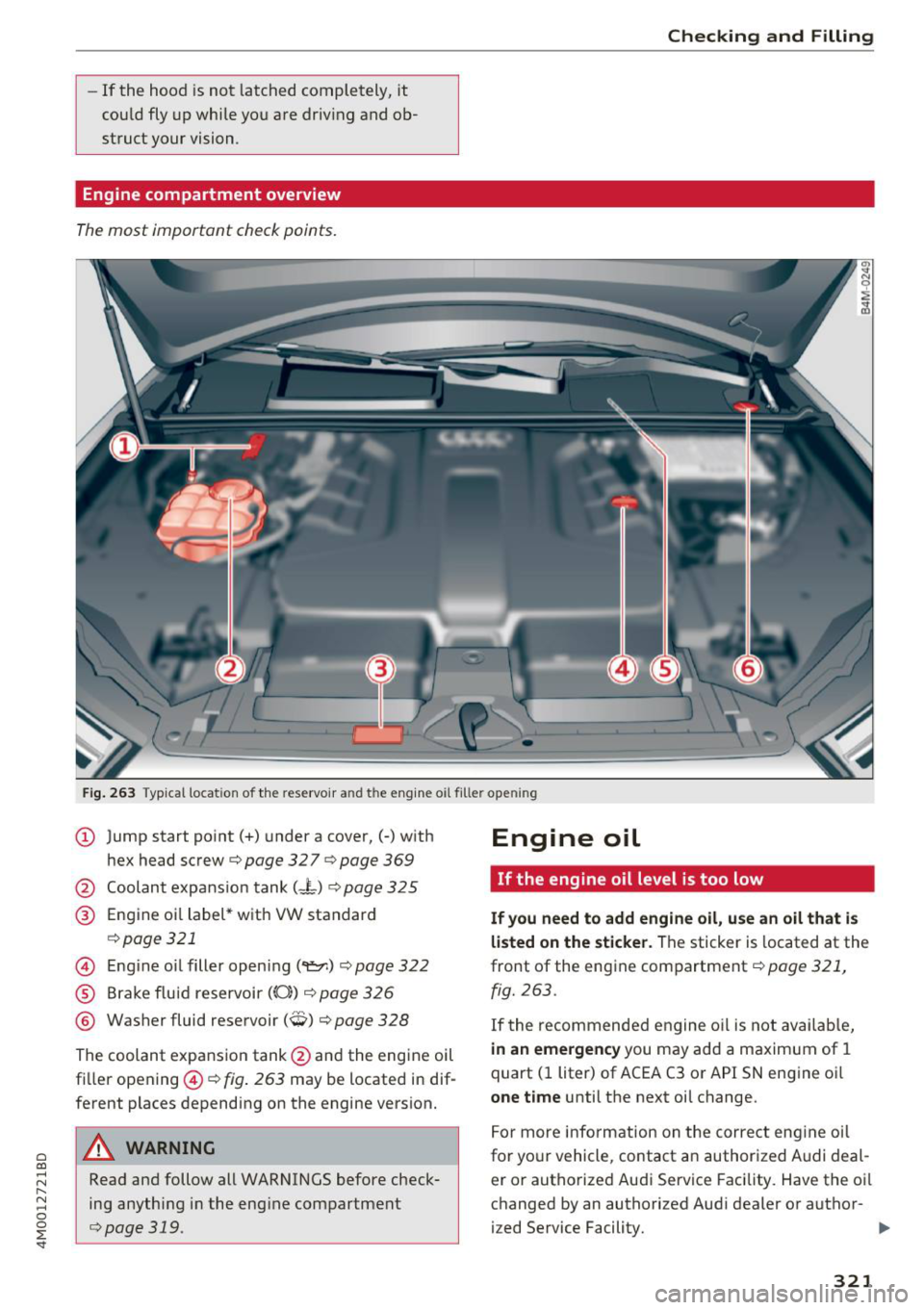
Engine compartment overview
The most important check points.
Chec king and Filling
Fig . 2 63 Typ ical location of the reservoir a nd t he eng ine o il filler ope ning
@ Jump start point(+) under a cover,(-) with
hex head screw
c::> page 32 7 c::> page 369
@ Coolant expans ion tank ( - L) c::> page 325
@ Engine oi l label * with VW standard
<=:> page 321
© Engine oil filler opening ('t=:r.) c::> page 322
® Brake f luid reservoir ((0)) c::> page 326
® Washer fluid reservoir (~) c::> page 328
The coolant expansion tank @and the engine oil
fi ller opening ©
c::> fig. 263 may be located in dif
ferent places depending on the engine version.
A WARNING
Read and follow all WARNINGS before check
ing anything in the eng ine compartment
c::> page 319.
Engine oil
If the engine oil level is too low
If you need to add engine oil, us e an oil that i s
li sted on the st icker.
The sticker is located at the
front of the engine compartment
c::> page 321 ,
fig. 263.
If the recommen ded engine o il is not avai lab le,
in an emergency you may add a maximum of 1
quart
( l liter) of ACEA C3 or API SN eng ine oi l
one time until the next oil change.
F or more i nformation on the correct eng ine oil
for yo ur vehicle, contact an author ized A udi deal
er or authorized Aud i Service Facility . Have the o il
c h anged by an authorized Audi dealer or author-
i z ed Service Facility.
ll>
321
Page 328 of 398
Checking and Filling
Brake fluid
N
N
~ N ,l: CX) al
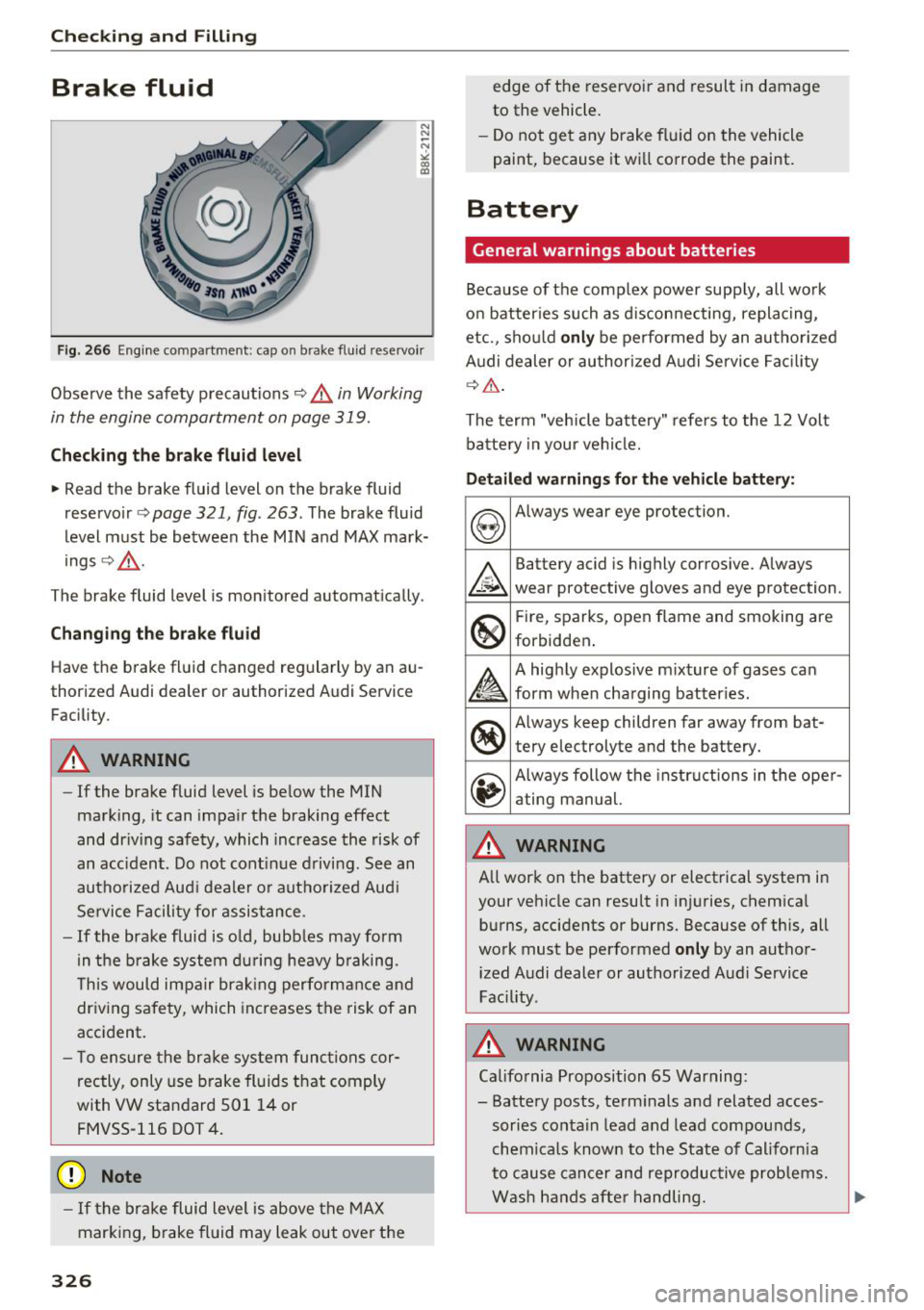
Fig. 266 Engine compartment: cap on brake flu id reservo ir
Observe the safety precautions c> .&. in Working
in the engine compartment on page 319.
Checking the br ake fluid l evel
~ Read the brake fluid level on the brake fluid
reservo ir
c> page 321, fig . 263 . The brake fluid
level must be between the MIN and MAX mark
ings
Q ,&. .
The brake fluid level is mon itored automat ically .
Chan ging the b ra ke fluid
Have the brake fluid changed regularly by an au
thorized Audi dealer or authorized Audi Servic e
Facility .
A WARNING
-If the brake fluid level is be low the MIN
marking, it can impair the braking effect
and dr iving safety, which increase the risk of
an accident. Do not cont inue d riving . See an
authorized Aud i dealer or autho rized Audi
Service Facility for assistance .
-If the brake fluid is o ld, bubbles may form
in the b rake system du ring heavy b raking.
T his would impair brak ing performance and
driving safety, which increases the risk of an
accident.
- T o ensure the brake system functions cor
rectly, only use brake fluids t hat comply
with VW standard 501 14 or
FMVSS-116 DOT 4 .
(D Note
-If the brake fluid level is above the MAX
mark ing, brake fluid may leak out over the
326
edge of the reservoi r and result in damage
to the vehicle.
- Do not get any brake fluid on the vehicle
paint, because it will corrode the paint.
Battery
General warnings about batteries
Because of the comp lex power supp ly, all wo rk
on batter ies such as d isconnecting, replacing,
etc., sho uld
onl y be performed by an autho rized
Audi dealer or au thorized A udi Servi ce Fac ility
Q _& .
The term "vehicle battery" refers to the 12 Volt
ba ttery in your vehicle.
Detail ed warnings for th e vehicle battery :
&
Battery acid is highly corros ive. Always
wear protective gloves and eye protection .
So
®
Fire, sparks, open flame and smoking are
forbidden .
£
A highly explosive m ixture of gases can
form when charging batter ies.
®
Always keep children far away from bat-
tery electrolyte and the battery.
~
Always follow the instructions in the oper -
ating manual.
A WARNING
All work on the battery or electrical system in
your vehicle can result in injuries, chemical burns, accidents or burns. Because of this, all
work must be performed
on ly by an author
ized Audi dealer or authorized Audi Service
Fac ility .
A WARNING
California Proposition 65 Warning:
- Battery posts, term inals and related acces
sories conta in lead and lead compounds,
chemicals known to the State of California
to cause cancer and reproductive problems.
Wash hands after handling.
~
Page 335 of 398
0 a, .... N
" N .... 0
0
l: ..
Glossary of tire and loading
terminology
Accessory weight
means the combined weight (in
excess of those standard items
which may be replaced) of auto matic transmission, power steer
ing, power brakes, power win
dows, power seats, radio, and
heater, to the extent that these
items a re available as factory- in
stalled equipment (whether i n
stalled or not) .
Aspect ratio
means the ratio of the height to
the width of the tire in percent .
Numbers of 55 or lower indicate a
low s idewall for improved steer
ing response and better overall
handling on dry pavement.
Bead
means the part of the tire that is
made of steel wires, wrapped or
reinforced by ply cords and that is
shaped to fit the rim .
Bead separation
means a breakdown of the bond
between components in the bead .
Wheel s
Cord
means the strands forming the
plies in the tire .
Cold tire inflation pressure
means the tire pressure recom
mended by the vehicle manufac
turer for a tire of a designated
size that has not been driven for more than a couple of miles (kilo
meters) at low speeds in the
three hour period before the tire pressure is measured or adjusted .
Curb weight
means the weight of a motor ve
hicle with standard equipment in
cluding the maximum capacity of
fuel, oil , and coolant, air condi
tioning and additional weight of
optional eq uipment .
Extra load tire
means a tire designed to operate
at higher loads and at highe r in
flation pressures than the corre
sponding standard tire . Extra load
tires may be identified as "X L",
"xl", "EXTRA LOAD", or "RF" on
the sidewall. .,.
333
Page 337 of 398
0 a, .... N
" N .... 0
0
l: ..
Production options weight
means the combined weight of
those installed regular production
options weighing over 5 lbs .
(2.3 kg) in excess of those stand
ard items which they replace, not
previously considered in curb
weight or accessory we ight, in
c luding heavy duty brakes, ride
levelers, roof rack, heavy duty
battery, and special trim .
Radial ply tire
means a pneumatic tire in which
the ply cords that extend to the beads are laid at substantially
90 degrees to the centerline of
the tread .
Recommended inflation
pressure
see ¢ page 333, Cold tire infla
tion pressure .
Reinforced tire
means a tire designed to operate
at higher loads and at h igher in
flat ion pressures than the corre
sponding standard tire. Rein
forced t ires may be identified as
"XL " "xl" "EXT RA LOA D" or "RF" , , ,
on the sidewall.
Wheels
Rim
means a metal support for a tire
or a tire and tube assembly upon
which the tire beads are seated .
Rim diameter
means nominal diameter of the
bead seat. If you change your
whee l size, you will have to pur
chase new tires to match the new
rim diameter .
Rim size designation
means rim diameter and width .
Rim width
means nominal distance between
rim flanges.
Sidewall
means that portion of a ti re be
tween the tread and bead.
Speed rating (letter code)
means the speed at which a tire is
designed to be driven for extend
ed periods of time . The rat ings
range from
93 mph (150 km/h)
to
186 mph (298 km/h) ¢ table
on page 331.
You may no t find
this info rmat ion on all tires be
cause it is not required by law.
T he speed rating letter code,
where applicable, is molded on
the tire sidewall and indicates t he
11>
335
Page 341 of 398
0
a:,
.... N
equipped with them at the
factory
r=> page 349.
-If you install wheel covers on
the vehicle, make sure they al low enough air circulation to
cool the brake system. If they
do not, this could increase the risk of an accident.
Tire wear/damage
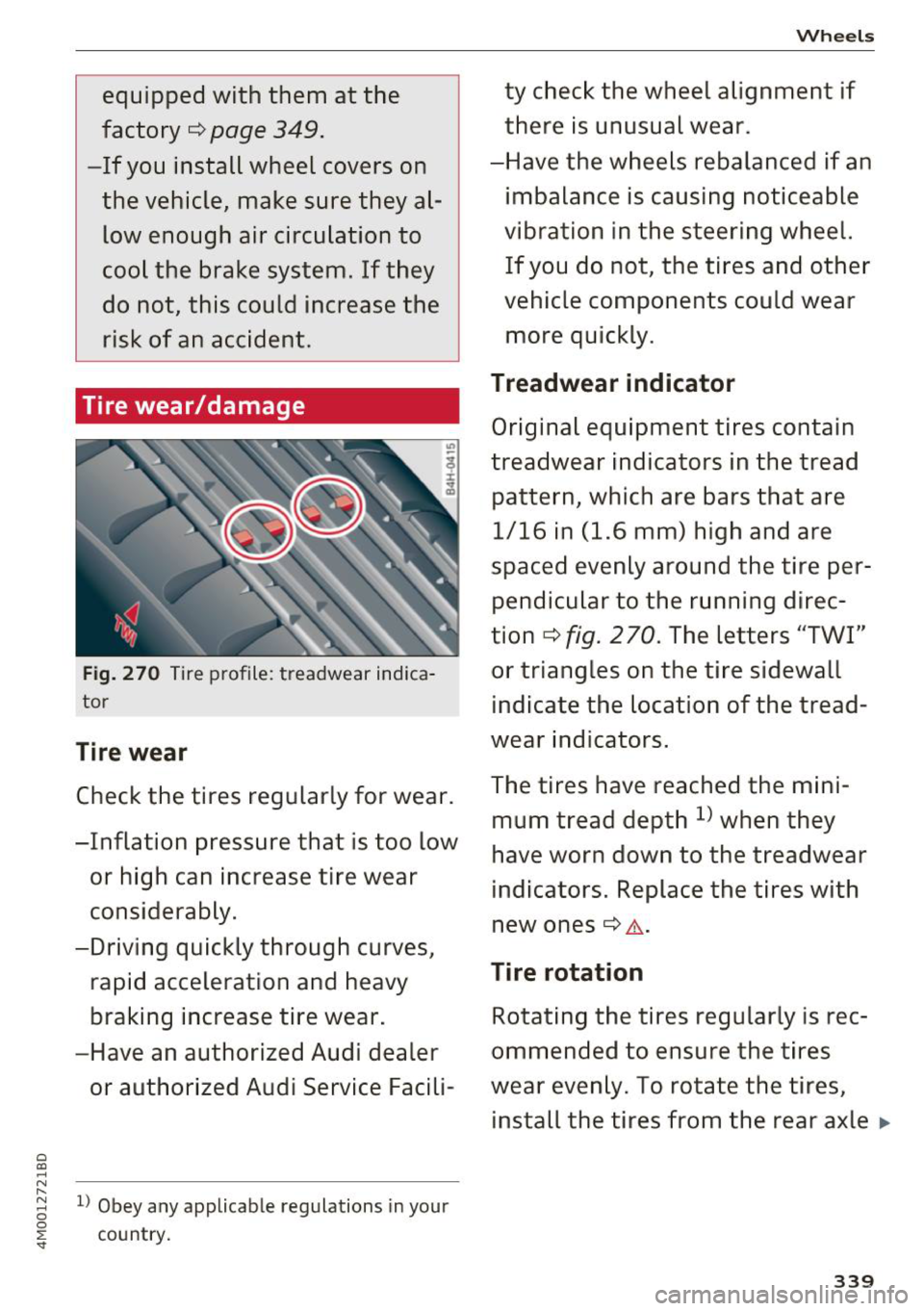
Fig. 270 Tire profile : treadwear indica
tor
Tire wear
Check the tires regularly for wear.
-Inflation pressure that is too low or high can increase tire wear
considerably.
-Driving quickly through curves, rapid acceleration and heavy
braking increase tire wear.
-Have an authorized Audi dealer or authorized Audi Service Facili-
"
8 l) Obey any applicable regulations in your
0 ~ country.
Wheels
ty check the wheel alignment if
there is unusual wear.
-Have the wheels rebalanced if an imbalance is causing noticeable
vibration in the steering wheel. If you do not, the tires and other
vehicle components could wear more quickly.
Treadwear indicator
Original equipment tires contain
treadwear indicators in the tread
pattern, which are bars that are 1/16 in (1.6 mm) high and are
spaced evenly around the tire per pendicular to the running direc
tion ¢
fig. 2 70. The letters "TWI"
or triangles on the tire sidewall indicate the location of the tread
wear indicators.
The tires have reached the mini mum tread depth
l) when they
have worn down to the treadwear
indicators. Replace the tires with
new ones¢ &.-
Tire rotation
Rotating the tires regularly is rec
ommended to ensure the tires
wear evenly. To rotate the tires, install the tires from the rear axle ..,.
339
Page 346 of 398
Wheels
are listed on the safety compli
ance sticker label located on the
driver's side B-pillar.
A WARNING ,-= · -
Overloading a vehicle can cause
loss of vehicle control, a crash
or other accident, serious per
sonal injury, and even death .
-Carrying more weight than your vehicle was designed to carry will prevent the vehicle
from handling properly and i ncrease the risk of the loss of
vehicle control.
-The brakes on a veh icle that
has been overloaded may not
be able to stop the vehicle
within a safe distance.
-Tires on a vehicle that has been overloaded can fail sud
denly, including a b lowout and
sudden deflation, causing loss
of contro l and a crash.
-Always make sure that the to tal load being transported -i nc luding the weight of a tra il
er hitch and the tongue
weight of a loaded trailer
does not make the vehicle
h eavier than the vehicle's
Gross Vehicle Weight Rating.
3 44
Determining correct load
limit
Use the example below to calcu
late the tota l weight of the pas
sengers and luggage or other
things that you plan to transport
so that you can make sure that
your vehicle will not be over load
ed.
Steps for Determining Correct Load Limit
1 . Locate the statement " TH E
COMBIN ED WE IGH T OF OCC U
PANTS AND CARGO SHOU LD
NEVER EXCEED XXX KG OR XXX
LBS" on your vehic le's placard
(tire inflation pressure label)
¢ page 340, fig . 272 .
2. Determine the combined
weight of the drive r and pas
sengers that will be riding in
your vehicle.
3. Subtract the combined weight
of the driver and passengers
from
"XXX" kilograms or "XXX"
pounds shown on the stick
er ¢
page 340, fig. 272 .
4. The resu lting figure equa ls the
available amount of cargo and
luggage load capacity . For ex
ample, if the "XXX" amount
eq uals 1400 lbs. and there will~
Page 354 of 398
Care and cl eaning
wash operator to reduce the risk of acci
dents.
- To reduce the risk of cuts, protect yourself
from sharp metal components when was h
ing the underbody or the inside of the wheel
housings .
- After washing the vehicle, the braking effect may be delayed due to mo isture on the
brake rotors or ice in the winter . This in
creases the risk of an acc ident . The brakes
must be d ried first w it h a few careful b rake
applications.
@ Note
- If you wash the ve hicle in an automatic car
wash, you must fold the exterior m irrors in
to reduce the risk of damage to the mirrors .
P ower folding exte rior m irrors* must o nly
be fo lded in and out using the powe r folding
f u nct io n.
- To reduce t he risk of damage to the rims
and t ires , compare the width be tween the
whee ls on your ve hicl e w it h t he distance be
tween the g uide rai ls in the car wash .
- To reduce t he risk of damage, compare the
height and width o f you r vehicle with the heig
ht and w idth of the inside o f the car
was h.
- T o red uce the risk of pa in t damage, do not
was h the vehicle in direct sun light .
- T o red uce the risk of d amage to the s urf ace,
do not use insect removing sponges, k itchen
sponges or similar items .
- Matte finish painted vehicle components:
- To reduce the r isk of damage to the sur-
face, do not use polis hing agents or hard
wax .
- Never use protective wax. It can destroy
the matte finish effect .
- Do not place any stickers or magnet ic
signs on vehicle parts painted with matte
finish paint . The paint cou ld be damaged
when the stickers or magnets are re
moved .
@ For the sake of the environment
Only wash the ve hicle in facilities spec ia lly de
s igned for that pu rpose . This will reduce the
r isk of dirty wate r contaminated with o il from
ente ring the sewe r system.
Cleaning and care information
W hen clea ning and ca ring for ind ividua l vehicle
components, refer to the fo llowing tables . The
information contained there is simply recom
m endations. Fo r qu estions or for compon ents t
h at are not listed, cons ult an autho rized Aud i
dealer or authorized A udi Service Fac ility. Also
fo llow the information fo und inc:>.&. .
Ext erior cleaning
Component Situation Solution
Windshield wiper
Deposits soft cloth with glass cleane r, c:> page 51
blades
Headlights /
Deposits Soft sponge with
a m ild soap solution a)
tail light s
S ensors /
Deposits Sensors: soft cloth with solvent -free cleaning solut ion
camera lenses Camera lenses: soft cloth w it h alcohol-free cleaning solu-
tion
Snow/ic e Hand brush/solv ent-free de -icing spray
Wheels Road salt Water
Brake dust Acid-free special cleaning solution
352
Page 359 of 398
a co ...... N r--. N ...... 0
0
:E '
General information
.. Par k the vehicle as far as poss ible from moving
traff ic in the event of a breakdown. In the event
of a flat tire, park the vehicle on a leve l surface .
It you are on a steep h ill, be especially careful.
.. Set the parking brake .
.. Switch the emergency flashe rs on.
.. Have the passengers exit the veh icle . They
sho uld move to a safe place, for example be
hind a guard rail.
& WARNING
Follow the steps g iven above. This is for your
protection and the for the safety of o ther driv
ers .
Equipment
Vehicle tool kit/tire mobility kit/vehicle
jack
App lies to: veh icles with the vehicle tool kit, tire mobili ty ki t
an d vehicle jac k
The vehicle tool kit, vehicle jack, tire mobility kit
and comp ressor are s to red in the luggage com
pa rtment unde r the cargo floor cove r. Lift the
cargo floor using the handle.
& WARNING
Impro per use of the vehicle jac k can ca use se
rious perso nal injuries.
- Never use the screw drive r hex he ad to
tigh ten whee l bolts, since the bol ts cannot
atta in the necessary tighten ing torque if you
use the hex head, potentially ca using an ac
c ident.
- The factory-supplied jack is i nten ded on ly
for your vehicle model. Under no circ um
stances should it be used to lift heavy
vehicles or other loads; you r isk injuring
yourself.
- Never start the engine whe n the vehicle is
ra ised, which could ca use a n accident.
- Support the veh icle secure ly with appropr i
ate stands if work is to be performed under-
Em ergen cy as sis tanc e
neath the vehicle; otherwise, there is a po
tential risk for injury.
- Never use the jack supplied with your Audi
on another vehicle, particularly on a heavier
one. The jack is only su itable for use on the
veh icle it came with.
(D Tips
The vehicle jack in your vehicle is mainte
nance-free.
Tire mobility kit
Preparation
.. Read a nd follow the important safety precau-
t ions
¢page 357 .
.. Set the park ing brake .
.. Select the "P" selector lever position .
.. Check if a repair with the tire mobility kit is pos
sible
¢ page 357.
Using the tire mobility kit
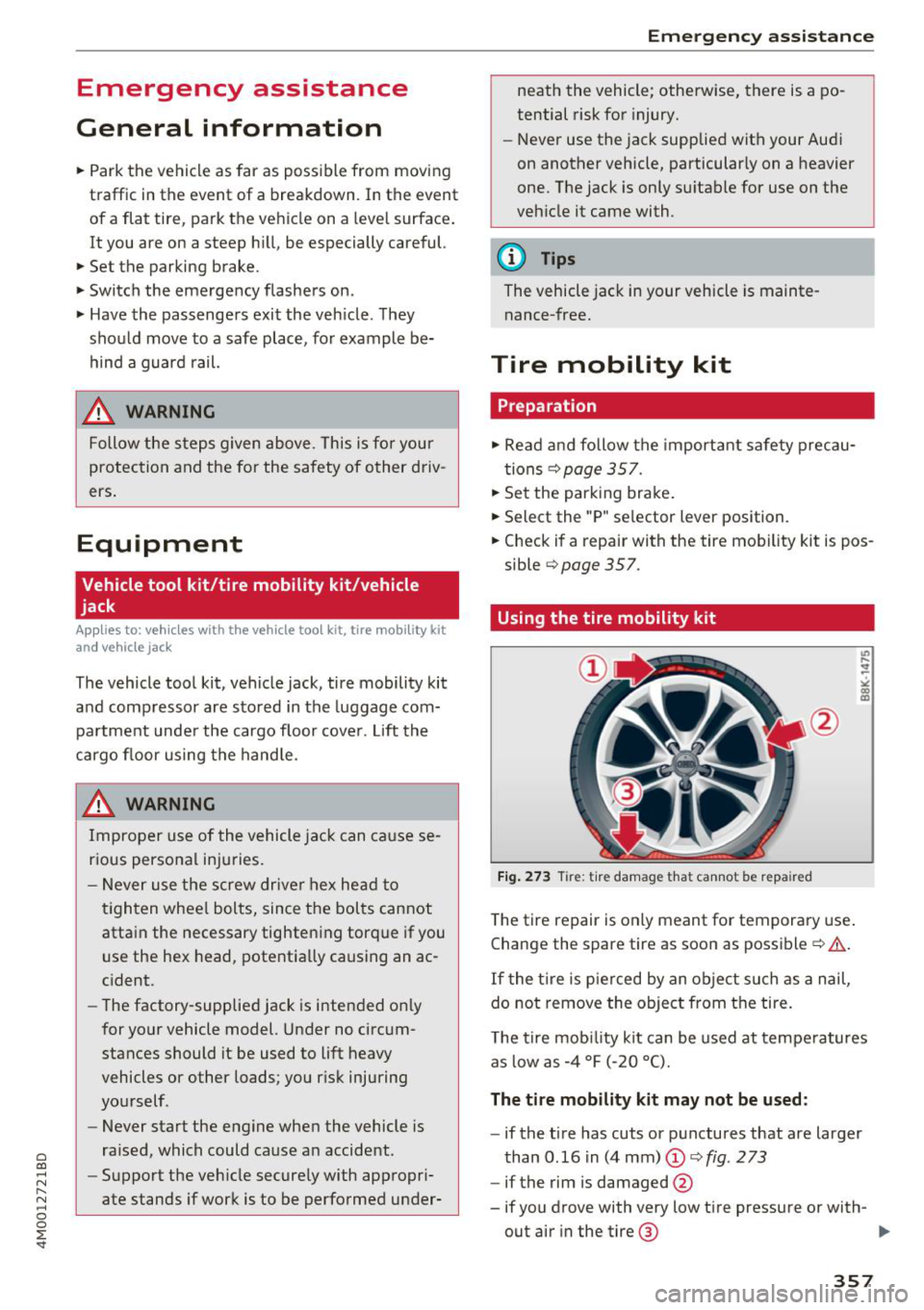
Fig. 273 Tire: tire damage t hat can not be repaired
T he tire repair is only meant for tempora ry use .
Change the spare tire as soon as possible¢& .
If the t ire is p ierced by an o bject su ch as a nail,
do no t r emove the object from the tire .
T he tire mob ility kit can be used at tempe ratures
as low as -4 °F (-20 °C).
The tire mobility kit may not be used:
- if the tire has cuts or p unctures that are larger
than 0.16 in (4 mm)
(D ¢ fig . 273
-if the rim is damaged @
- if you drove with very low t ire pressure or with-
out air in the tire @ ..,.
357
Page 361 of 398
Cl a:, ...... N
" N ,-1 0
0
::r '
reached after inflating for 6 minutes, then
the tire is too severely damaged. Do not
continue driving .
- If the t ire cannot be repaired with the tire
sealant, see an authorized Audi dealer or au
thorized Aud i Serv ice Facility for ass istance .
(D Tips
Do not operate the compressor for more than
six m inutes continuously, or it can overheat.
Once the compressor has cooled, you ca n con
tinue to use it .
Completing
"'Adhere the sticker that says "max . SO mph
(max. 80 km/h)" that is p rovided w it h the t ire
mobility kit within the dr ive r's fie ld of vision.
"' Stop the vehicle afte r driving for about 10 m i
nutes and check the tire pressure .
"' If the tire pressure is lower than 19 psi ( 130
kPA), then the tire is too severely damaged. Do
not cont inue driving.
A WARNING
Pay attent ion to the following after repair ing
the t ire :
- Do not drive faster than SO mph (80 km/h).
- Avoid hard acceleration, brak ing sharply,
and fast cornering.
- The vehicle may become more difficu lt to
contro l.
- If the tire is too severely damaged, see an
authorized Audi dealer or authorized Audi
Service Facility for assistance.
@ For the sake of the environment
You can give the used tire sealant bottle to an
authorized Audi dealer or authorized Audi
Service Facility for disposal.
(D Tips
Remember to obtain a new bottle of sea lant
from an authorized Audi dea ler or authorized
Audi Service Facility after repairing a tire.
Em ergenc y ass is tanc e
Replacing a wheel
Preparation
You must complete the preparation before
changing a tire .
"'Read and follow the impor tant safe ty precau-
tions
¢ page 357.
"'Set the park ing brake .
"' Select the "P" selector lever position .
"' When towing a tra iler : disconnect the trailer
from you r vehicle.
"' Lay out t he vehicle too l kit ¢
page 357 and the
spare tire.
"' Switch on wheel change mode* in the Infotain
ment syst em:
!MENUI button> V ehicle > left
control button >
S erv ic e & ch ecks > Air s uspen
s io n: w heel chang e.
"'Switch the ignit ion off.
The vehicle jack mod e* switches off automatica l
ly at speeds above 6 mph ( 10 km/h).
A WARNING "---
When us ing the ve hicle jack" on a road with a
steep hill or offroad, you must take extra pre
cautions to prevent the vehicle from rolling .
Use su itable objects to block the front and
back of t he wheel t hat is diagonal from the
whee l with the flat t ire.
A WARNING
You o r yo ur passenge rs could be injured while
changing a whee l if you do no t follow these
safety precautions :
- I f yo u have a flat tire, move a safe dis tance
off the road. Turn off the eng ine, turn the
emergency flashers on and use other warn
ing devices to a lert other motorists.
- Make sure that passengers wait in a safe place away from the vehicle and well away
from the road and traff ic.
- To he lp prevent the vehicle from moving
suddenly and possib ly slipping off the jack*,
a lways f ully set the park ing brake and block
the front and back of the wheel diagonally
opposite the wheel being changed. When
one front wheel is lifted off the ground,
~
359