child seat AUDI Q7 2020 Owner´s Manual
[x] Cancel search | Manufacturer: AUDI, Model Year: 2020, Model line: Q7, Model: AUDI Q7 2020Pages: 316, PDF Size: 113.87 MB
Page 78 of 316
Sitting correctly and safely
This can cause serious or fatal injuries for
the child and passengers.
— If children use an incorrect seating position
while driving, they have a higher risk of in-
jury during a sudden braking maneuver or
accident. This especially applies to children
in the front passenger's seat or children who
have their head near the side airbag deploy-
ment area, if the airbag system is deployed
during an accident. This incorrect seating
position can cause severe or even fatal inju-
ries.
— Make sure there is enough space in front of
the child in the child safety seat. If necessa-
ry, adjust the angle and position of the seat
in front of the child safety seat.
— If you are transporting a child in a rear-fac-
ing child safety seat in the rear of the vehi-
cle, remove the Audi Entertainment mobile
device from the backrest on the front seat to
reduce the risk of injury.
— The rear side of a forward-facing child safety
seat should be positioned as close as possi-
ble to the backrest on the vehicle seat. If the
head restraints make it difficult to install a
child safety seat, adjust or remove them if
necessary > page 64. Reinstall the head re-
straints immediately once the child safety
seat has been removed.
— Always make sure that the backrest on the
seat where the child safety seat is installed
is securely locked in place and cannot move
forward. Otherwise, the backrest where the
child safety seat is secured could move for-
ward in the event of an accident or other
emergency situation.
— NEVER use a rear-facing child safety seat on
a seat with an ACTIVATED FRONT AIRBAG;
this could cause DEATH or SERIOUS INJU-
RIES to a CHILD.
— Always secure child safety seats on the
rear seats. If exceptional circumstances re-
quire the child safety seat to be placed on
the front passenger's seat, then the front
passenger's airbag must be deactivated.
Always make sure that
PASSENGER AIR BAG OFF 4%; remains
on while driving. If
76
PASSENGER AIR BAG OFF #; does not
turn on, remove the child safety seat and
install it again according to the child safe-
ty seat manufacturer instructions. If
PASSENGER AIR BAG OFF %%; still
does not turn on, the front passenger's
seat must not be used. Drive to an author-
ized Audi dealer or authorized Audi Service
Facility and have the airbag system in-
spected.
— If you must use a forward-facing child safety
seat on the front passenger's seat, move the
seat as far back as possible so that it is as
far as possible from the front passenger's
airbag. While doing this, make sure the seat
can be adjusted all the way. A child in a child
safety seat on the front passenger's seat can
receive a severe impact if the front passeng-
er's airbag deploys, which increases the risk
of serious or fatal injury.
— Replace the child safety seat after an acci-
dent because there could be damage that is
not visible.
— Even if a child is not sitting in the child safe-
ty seat, the child safety seat must be se-
cured. An unsecured child safety seat may
be thrown through the vehicle interior dur-
ing sudden braking maneuvers or an acci-
dent.
Correct positioning for children
Always secure children in a child safety seat de-
signed for the body size, weight, and age of the
child.
You can secure child safety seats in your vehicle
using the lower LATCH anchors or the safety
belts. You can also secure child safety seats to
the top tether anchor. Depending on the child
safety seat, it may also be necessary to secure it
to the top tether anchor. In Canada, securing for-
ward-facing child safety seats to the top tether
anchors is required by law.
Always transport children in the rear seats
Accident statistics show that children that are se-
cured correctly in the rear seats are safer thanin >
Page 79 of 316
4M1012721BA
Sitting correctly and safely
front seats. Always transport children in suitable
child safety seats secured on the rear seats.
In exceptional circumstances: transporting
children in the front passenger's seat
If exceptional circumstances require the child
safety seat to be placed on the front passenger's
seat, then the front passenger's airbag must be
deactivated. Please note the important informa-
tion for this > page 73, Advanced airbag system.
If you must secure a forward-facing child safety
seat, move the front passenger's seat as far back
as possible so that it is as far as possible from the
front passenger's airbag. While doing this, make
sure the seat can be adjusted all the way.
Only switch to a larger child safety seat when
absolutely necessary
Switch to a larger child safety seat only when ab-
solutely necessary. Secure your child using a safe-
ty belt without a child safety seat only if all of the
following statements are true:
—The child is large enough to sit upright in the
seat
— The child is able to sit with his or her back rest-
ing completely on the seat backrest
—The child is able to sit with his or her knees
bent over the edge of the seat surface
—The child is able to sit with both of his or her
feet completely touching the floor in the foot-
well
—The lap portion of the safety belt lies flat and
securely over the hip area and never over the
stomach
— The shoulder portion of the safety belt lies flat
and securely over the center of the shoulder
and
the chest, and never under the arm, behind
the back, or over the neck or face.
—The child is able to maintain this seating posi-
tion throughout the entire trip
Read and follow the important information and
warnings regarding the correct use of safety belts
=> page 66.
@ Tips
— Child safety seats can also be secured to
seats with side airbags. In the event of an
accident, children can also be protected by
the side airbags if the child is correctly se-
cured in a suitable child safety seat that is
attached correctly.
— The lower LATCH anchors as well as the
safety belt may be required to correctly in-
stall some child safety seats. Using both at
the same time is permitted, provided that
the fastening systems or safety belts do not
impair those in an adjacent seating position.
—All child safety seats are constructed so that
they can be secured using the lap safety belt
in the vehicle.
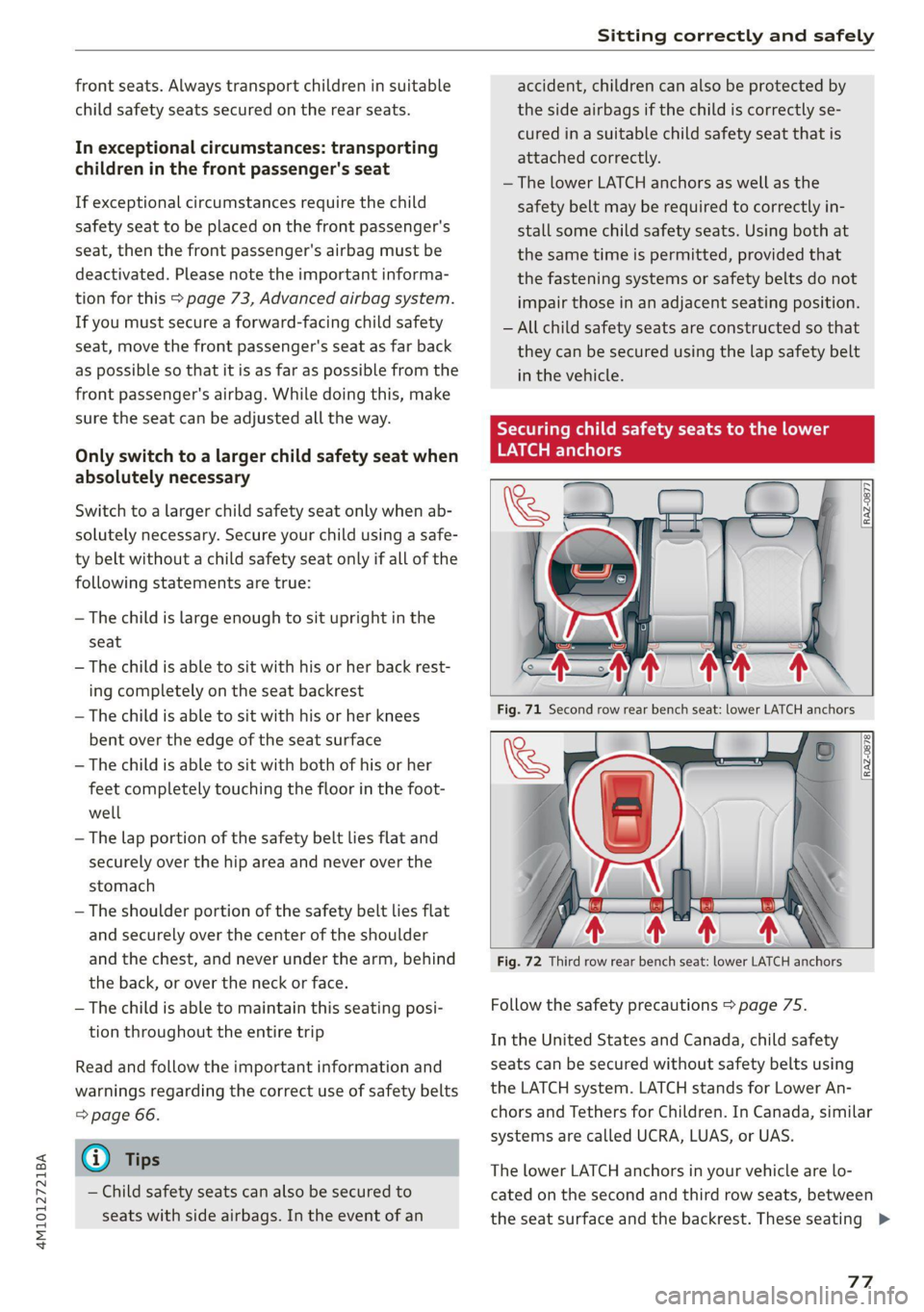
Securing child safety seats to the lower
LATCH anchors
RAZ-0877
RAZ-0878
Fig. 72 Third row rear bench seat: lower LATCH anchors
Follow the safety precautions > page 75.
In the United States and Canada, child safety
seats can be secured without safety belts using
the LATCH system. LATCH stands for Lower An-
chors and Tethers for Children. In Canada, similar
systems are called UCRA, LUAS, or UAS.
The lower LATCH anchors in your vehicle are lo-
cated on the second and third row seats, between
the seat surface and the backrest. These seating
77
>
Page 80 of 316
Sitting correctly and safely
locations each have two lower LATCH anchors
that can be used to secure a LATCH child safety
seat. The marked points with a symbol are locat-
ed on the cushions © fig. 71 or the covers
=> fig. 72 for the lower LATCH anchors. You can lo-
cate the LATCH anchors using the marking points.
» Applies to: vehicles with a rear bench seat that
can be moved forward/back: If you are securing
a child safety seat in the second row, move the
rear seat all the way back.
> Activate the child safety lock > page 40.
> If you are securing a child safety seat in the sec-
ond row, remove the cushion between the seat
surface and the backrest.
> If you are securing a child safety seat in the
third row, remove the cover on both LATCH an-
chors.
> If you secure a child safety seat to the rear seat,
secure any unused safety belts that are within
reach of the child > A\ in Securing child safety
seats with a safety belt on page 79.
> Secure the child safety seat according to the
child safety seat manufacturer instructions.
> Pull on the child safety seat to check if both
sides are engaged correctly in the LATCH an-
chors.
> If possible, also secure the child safety seat to
the respective top tether anchor on the seat
=>page 79.
ZA WARNING
The LATCH anchors in the vehicle are only de-
signed for child safety seats with the LATCH
system. To reduce the risk of serious or fatal
injury, never secure other child restraint sys-
tems, belts, or objects to the anchors.
@) Tips
The LATCH anchors are designed for a total
weight (child and child safety seat combined)
up to 65 lbs (29 kg). If the total weight is
greater than this, the child safety seat must
be secured with the vehicle safety belt.
78
Securing child safety seats with a safety
Pyia
Follow the safety precautions > page 75. The
front passenger’s seat is a dangerous location for
a child, even with an advanced airbag system. If
exceptional circumstances require the child safe-
ty seat to be placed on the front passenger's
seat, then the front passenger's airbag must be
deactivated. Please note the important informa-
tion for this > page 76, Correct positioning for
children and > page 73, Advanced airbag sys-
tem.
Securing child safety seats
> Applies to: vehicles with a rear bench seat that
can be moved forward/back: If you are securing
a child safety seat in the second row, move the
rear seat all the way back.
> Activate the child safety lock > page 40.
> If you secure a child safety seat to the rear seat,
secure any unused safety belts that are within
reach of the child > A\, > page 80.
> If you secure a child safety seat to the front
passenger's seat, adjust the front passenger's
seat to the highest position.
» Secure the child safety seat according to the
child safety seat manufacturer instructions.
> If necessary, activate the belt retractor lock
=> page 78, Activating the belt retractor lock.
> If the child safety seat is secured on the front
passenger's seat, adjust the front passenger's
seat backrest until it rests flat against the child
safety seat. Also make sure that the upper safe-
ty belt fixture is behind the child safety seat.
> If you secure a child safety seat on the rear
seat, also secure it to the correct top tether an-
chor if possible > page 79.
Activating the belt retractor lock
If you secure a child safety seat using the vehicle
safety belt, you must activate the belt retractor
lock. Follow the child safety seat manufacturer
instructions.
The
belt retractor lock prevents the safety belt
from becoming loose while driving, which could
result in the child safety seat no longer being ad-
equately secured.
Page 81 of 316
![AUDI Q7 2020 Owner´s Manual 4M1012721BA
Sitting correctly and safely
> Secure the child safety seat according to the WXe lel] ally securing a child safety seat to
child safety seat manufacturer instructions. the top tether](/img/6/40284/w960_40284-80.png "AUDI Q7 2020 Owner´s Manual 4M1012721BA
Sitting correctly and safely
> Secure the child safety seat according to the WXe lel] ally securing a child safety seat to
child safety seat manufacturer instructions. the top tether")
4M1012721BA
Sitting correctly and safely
> Secure the child safety seat according to the WXe lel] ally securing a child safety seat to
child safety seat manufacturer instructions. the top tether a
While doing so, pull out the safety belt. Insert
the safety belt into the belt latch that belongs
to that seat until it audibly locks.
> Pull the upper belt out completely and then al-
low it to retract. You will hear a clicking sound
while the belt is retracting. It will not be possi-
ble to pull the safety belt out any farther.
> Push the child safety seat into the seat and al-
low the belt to retract more.
> Make sure that the child safety seat cannot
move more than 1 inch (2.5 cm).
Deactivating the belt retractor lock
> Unbuckle the safety belt from the belt latch.
> Remove the child safety seat according to the
manufacturer instructions.
> Allow the safety belt to retract completely. The
belt retractor lock is deactivated.
ZA WARNING .
- Fig. 73 @ Second row rear bench seat / @ third row rear
—A safety belt that is not locked by the belt bench seat: top tether anchors for securing a child safety
retractor lock or a locking device cannot se- seat with an upper strap
cure a child safety seat while driving or in
the event of an accident, which increases the
risk of fatal injury. Always make sure the
belt retractor lock on the safety belt is acti-
vated if the child safety seat manufacturer
instructions require it.
— Due to the risk of fatal injury, never place a
rear-facing child safety seat on the front
passenger's seat when the front passenger's
airbag is switched on.
— For the child safety seat to offer the maxi-
mum protection, it is especially important
to route the vehicle safety belt correctly. Al- Follow the safety precautions > page 75.
ways follow the instructions from the child
safety seat manufacturer for routing the
safety belt correctly. Incorrectly fastened
safety belts can cause injuries, even during
minor accidents. > Move the head restraint behind the child safety
seat upward.
>» Secure the child safety seat according to the
child safety seat manufacturer instructions.
> Guide the upper belt on the child safety seat
under the head restraint or along both sides of >
RAZ.0186'
Fig. 74 Rear backrest: securing the upper belt to the top
tether anchor
There is a top tether anchor behind every seat in
the rear bench seat to additionally secure a child
safety seat with an upper belt.
79
Page 82 of 316

Sitting correctly and safely
it and toward the rear (depending on the child
safety seat model).
> Fasten the belt to the top tether anchor
> fig. 74. While doing this, make sure the belt
is not twisted and is not running over any sharp
edges.
> Pull the belt tightly so that the child safety seat
rests at the top of the seat backrest.
> If necessary, move the head restraint behind
the child safety seat downward.
> Activate the belt retractor lock on the fastened
safety belts. To do this, pull the upper belt out
completely and then allow it to retract. You will
hear a clicking sound while the belt is retract-
ing. It will not be possible to pull the safety
belt out any farther.
> Make sure the fastened safety belt does not
block access to the LATCH anchors. Otherwise,
it may not be possible to secure the child safety
seat to the LATCH anchors correctly.
Z\ WARNING
The top tether anchors in the vehicle are only
designed for child safety seats equipped with
an upper strap. To reduce the risk of serious or
fatal injury, never secure other child restraint
systems, belts, or objects to the anchors.
TTA emetic a mbm May
pres
Fig. 75 Second row rear bench seat: securing safety belts
that are not used
If a child safety seat is used on the rear bench
seat, the child must not be able to reach any
safety belts that are not being used. Secure safe-
ty belts that are within reach of the child.
> If you secure a child safety seat to the LATCH
anchors in the second row, fasten the safety
belt on the seat where the child safety seat is
installed using the seat's safety belt latch.
> If you secure a child safety seat to the LATCH
anchors in the third row, fasten the safety belt
on
the seat where the child safety seat is instal-
led using the seat's safety belt latch.
> If you secure a child safety seat to one of the
outer seats in the second row, fasten the safety
belt for the center seat in its latch.
80
Z\ WARNING
A child in a child safety seat could play with
the unused safety belts and then become en-
tangled in them, which increases the risk of
fatal injury. Always secure unused safety belts
so that they are not within reach of children in
child safety seats.
Page 83 of 316
4M1012721BA
Stowing and using
Stowing and using
Power sources
When the ignition is switched on, you may be
able to use multiple power sources for external
devices, depending on the vehicle equipment.
12 volt sockets
You can connect electrical accessories to the 12
volt sockets. The power usage must not exceed
120 watts.
The 12 volt sockets are labeled with the 12V
symbol. They are located in the front center con-
sole, in the rear* and on the side trim panel in the
luggage compartment*.
USB ports
Applies to: vehicles with USB input
You can charge mobile devices using the USB
ports. The USB ports are labeled with the «<> or
(4 symbol or CHARGE ONLY.
Z\ WARNING
—To reduce the risk of fatal injury, store all
connected devices securely when driving so
that they do not move around inside the ve-
hicle when braking or in the event of an acci-
dent.
— Incorrect usage can lead to serious injuries
or burns. To reduce the risk of injuries, never
leave children unattended in the vehicle
with the vehicle key.
® Note
— Read the operating manuals for the con-
nected devices.
—To reduce the risk of damage to the vehicle
electrical system, never attempt to charge
the vehicle battery by connecting accesso-
ries that provide power to the power sour-
ces.
— Do not connect any device whose network
class (voltage) does not match the network
class designed for the socket.
— Disconnect the connectors from the power
sources carefully to reduce the risk of dam-
aging them.
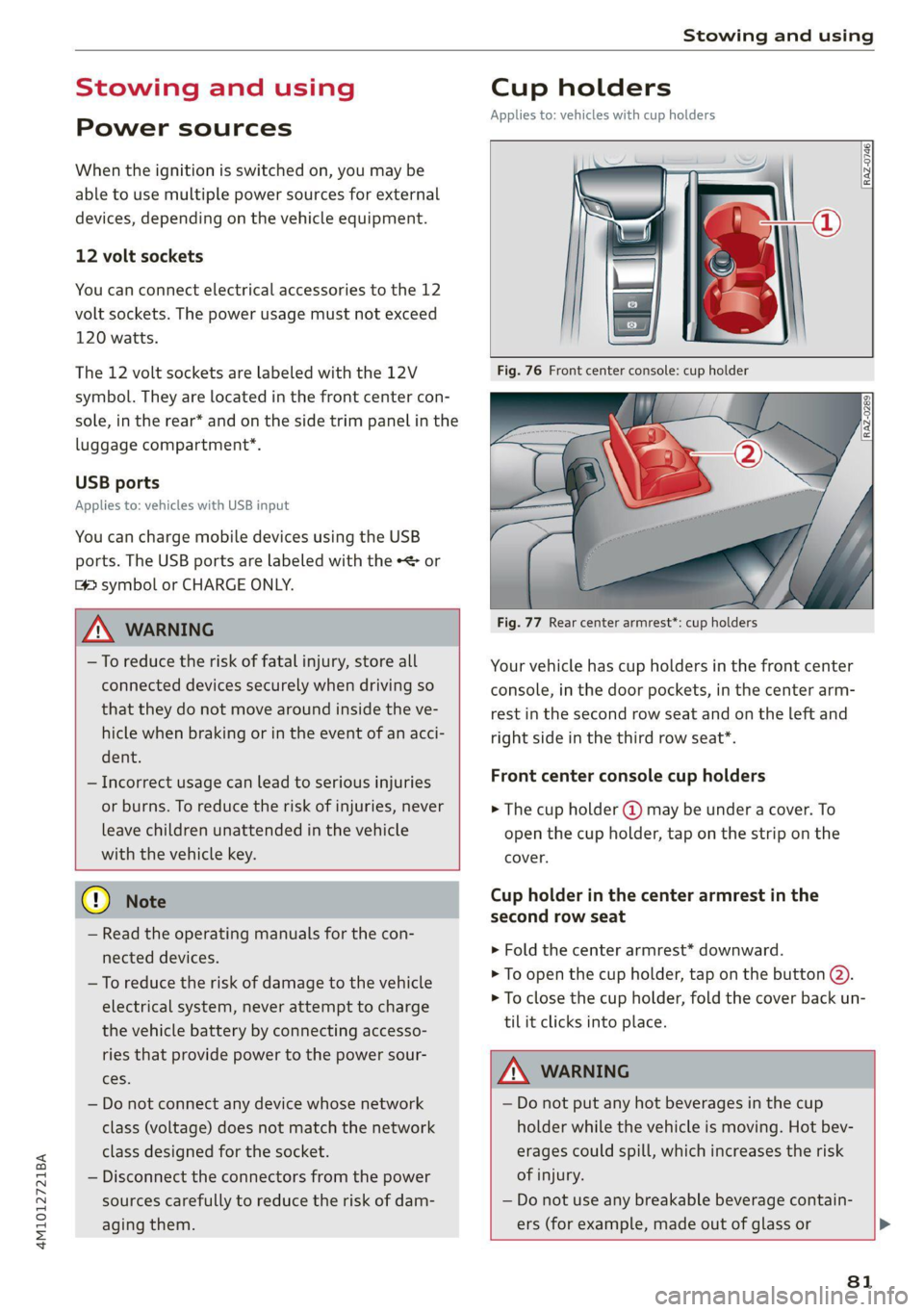
Cup holders
Applies to: vehicles with cup holders
RAZ-0746
Fig. 77 Rear center armrest*: cup holders
Your vehicle has cup holders in the front center
console, in the door pockets, in the center arm-
rest in the second row seat and on the left and
right side in the third row seat*.
Front center console cup holders
> The cup holder @) may be under a cover. To
open the cup holder, tap on the strip on the
cover.
Cup holder in the center armrest in the
second row seat
> Fold the center armrest* downward.
> To open the cup holder, tap on the button (2).
> To close the cup holder, fold the cover back un-
til it clicks into place.
Z\ WARNING
— Do not put any hot beverages in the cup
holder while the vehicle is moving. Hot bev-
erages could spill, which increases the risk
of injury.
— Do not use any breakable beverage contain-
ers (for example, made out of glass or >
81
Page 85 of 316
4M1012721BA
Stowing and using
— Never exceed the permitted axle and load
and vehicle weight > page 298.
— Never secure a child safety seat to the tie-
downs.
— Never leave your vehicle unattended, espe-
cially if the luggage compartment lid is
open. Children could enter the luggage com-
partment and close the luggage compart-
ment lid from the inside. This creates the
risk of fatal injury, since the children would
be locked in and may not be able to escape
by themselves.
— Do not allow children to play in or on the ve-
hicle. Close and lock the luggage compart-
ment lid as well as all other doors when you
leave the vehicle.
— Never transport passengers in the luggage
compartment. Every passenger must be cor-
rectly secured with the safety belts in the
vehicle > page 66.
— Be careful when releasing the backrest and
folding
it forward. To reduce the risk of be-
ing pinched, pay attention and check when
folding backrests forward.
— The backrest must be securely latched so
objects cannot slide forward out of the lug-
gage compartment during sudden braking.
— The backrest must be latched securely to en-
sure that the safety belt is protecting the
center seating position.
— Always pull forward on the backrest to make
sure it is check if it is correctly locked in
place.
— Applies to: vehicles with third row seats: To
reduce the risk of injury, the backrest on the
second row seats must be in the upright po-
sition and locked in place if there are pas-
sengers riding in the third row.
— Applies to: vehicles with third row seats:
When there are passengers riding in the
third row seats, remove the adjustable tie-
downs* and place the rail covers on the rails
to
reduce the risk of injuries.
CG) Note
—To reduce the risk of damage, move the rear
head restraints down > page 65 before fold-
ing the rear backrests forward.
— When folding the backrest forward, make
sure the outer safety belts are in the belt
guide recess so that they do not get pinched
in the backrest lock and damaged. Other ob-
jects should be removed from the rear
bench seat to protect the backrest from
damage.
— If you move the front seat back when the
rear seat backrest is folded forward, you
could damage the head restraints on the
rear seat.
— Make sure that the heating grid strips for
the rear window defogger are not damaged
by abrasive objects.
— Let the luggage compartment cover roll up
slowly to reduce the risk of damage.
@) Tips
— The tire pressure must be adapted to the
load > page 256.
— You can purchase straps at specialty stores.
83
Page 93 of 316
4M1012721BA
Warm and cold
Applies to: vehicles with 4-zone automatic cli-
mate control: You can press J in the rear control
panel multiple times to adjust the air distribution
based on the direction of the arrow.
® Defrosting
The windshield and side windows are defrosted
or cleared of condensation as quickly as possible.
Align the outer air vents with the side windows.
The maximum amount of air flows mainly from
the vents below the windshield. The windshield
defogger* is also switched on at low outside tem-
peratures. The ® button will flash. Recirculation
mode switches off. The temperature should be
set at +72°F (22°C) or higher. Depending on the
outside temperature, the A/C cooling mode may
automatically switch on.
& Rear window defogger
The rear window defogger only operates when
the engine is running. It switches off automati-
cally after 10 to 20 minutes, depending on the
outside temperature.
To prevent the rear window defogger from
switching off automatically, press and hold the
& button for more than three seconds. This is
stored until the ignition is switched off.
AUTO
<>/&S Recirculation mode
In recirculation mode, the air inside the vehicle is
circulated and filtered. This prevents the unfil-
tered air outside the vehicle from entering the
vehicle interior > A\.
Pressing the <> button switches recirculation
mode on or off manually.
‘AUTO
When switched on, automatic recirculation
controls the recirculation mode automatically.
You must press the {% button if fog forms on the
windows.
« Seat heating
Applies to: vehicles with heated seats
The seat heating temperature can be set at mul-
tiple levels. Press «/ once to switch on the highest
level. Press «) again to decrease the temperature
one level at a time. The seat heating is switched
off if the button is not illuminated.
*) Seat ventilation
Applies to: vehicles with seat ventilation
The seat ventilation intensity can be set to multi-
ple levels. Press ©) once to switch on the highest
level. Press 2) again to decrease the intensity one
level at a time. The seat ventilation is switched
off if the button is not illuminated.
@ Child safety lock*
If 8 turns on in the control panel in the rear*, the
child safety lock is active and operation is blocked
=> page 40.
Ionizer
Applies to: vehicles with ionizer
Hazardous particles and germs in the air may be
reduced through ionization. This helps to im-
prove the air quality for individuals in the passen-
ger compartment.
&* Fragrance
Applies to: vehicles with fragrance function
The fragrance function will dispense a scent in
the vehicle interior. It is dispensed through the
front outer vents. This will produce a pleasant
scent. The fragrance is time-delayed, especially
at low or high temperatures. You can adjust the
fragrance function > page 92.
Residual heat
The residual heat from the coolant is used to
heat the vehicle interior. To use this function,
press and hold the & button for more than two
seconds while the ignition is switched off. The
function switches off automatically after about
15 minutes.
ZX WARNING
— You should not use the recirculation mode
for an extended period of time, because no
fresh air is drawn in and the windows can
fog when cooling mode is switched off. This
increases the risk of an accident.
— Individuals with reduced sensitivity to pain
or temperature could develop burns when
using the seat heating* function. To reduce
the risk of injury, these individuals should
not use seat heating*.
91
Page 216 of 316
— Pull the cable out of the Audi music inter-
face carefully so that the USB ports are not
damaged.
— Use a USB extension cable to connect devi-
— For more information about the Audi music
interface and supported devices, check the
Audi database for mobile devices at www.
audi.com/mp3 or contact an authorized
Audi dealer or authorized Audi Service Fa-
cility.
ces that have an integrated USB connector
(such as a USB stick) to reduce the risk of
damage to your USB device and the Audi
Rear Seat Entertainment
music interface. preparation
— Extremely high or low temperatures that ‘mall inate
can occur inside vehicles can damage mobile Applies to: vehicles with Rear Seat Entertainment preparation
devices and/or impair their performance.
Never leave mobile devices in the vehicle in
extremely high or low temperatures.
The Rear Seat Entertainment preparation in-
cludes cables and a mount for Audi entertain-
ment mobile device in the driver's and front pas-
@ Tips senger's seat backrests.
— Always follow the information found in The suitable Audi entertainment mobile package
=> page 81. can be obtained from the Audi Genuine Accesso-
— When you switch the ignition off, the USB ries program.
ports are still supplied with power until the
energy management intervenes. AN WARNING
— Do not use an additional adapter cable or If you are transporting a child in a rear-facing
USB extension cable to connect mobile devi- child safety seat in the rear of the vehicle, re-
ces to the Audi music interface that already move the Audi entertainment mobile device
have a cable or that must be connected with from the backrest on the front seat to reduce
a USB adapter cable (> page 213, fig. 155). the risk of injury.
Using an additional adapter or US extension
cable may impair functionality. @) Note
— Functionality is not guaranteed for mobile
devices that do not conform to the USB 2.0
specification.
— USB hubs are not supported.
— Video playback through the Audi music in-
terface is not supported on Apple and MTP G) Tips
devices (such as smartphones).
— iPod or iPhone malfunctions also affect the
operation of the MMI. Reset your mobile de-
vice in these situations.
— Audi recommends updating the iPod or
iPhone software to the latest version. Refer
to your mobile device owner's manual for
more information.
Only use devices that are approved for the
Rear Seat Entertainment preparation. Unap-
proved equipment can cause damage to the
vehicle electrical system.
— Always read the chapter > page 292.
— The Rear Seat Entertainment preparation is
not intended to charge other electronic de-
vices.
— The USB adapter on the Audi music inter-
face will support iPod touch or iPhone devi-
ces from the 5th generation or newer with
the lightning connector.
214
Page 302 of 316

Index
Battery
Charging (12 Volt vehicle battery)....... 244
Vehicle battery (12 Volt)............... 242
Winter operation (12 Volt vehicle battery) . 242
Blinds
refer to Panoramic glass roof............ 41
Block TOUtC scan + « cesanin & meson © wanes a > ennaKes 194
Blowel’s « cscws 6 o snare a o aeons & H scaeens @ o tawens © « 90
Bluetooth
Audio player. .... 0.0.2.0... eee eee eee 211
Connecting acellphone............... 165
Deleting a device ...... 0.6. sec eeee eee 227
Device overview « ciccie « + cccvwse «6 ssesue «+ sere 226
Disconnecting adevice................ 227
Displaying profiles.................... 227
Searching fora device................. 227
Selecting adevice.................04. 227
Specifying’a favorite aes se css ye owes ae 227
Brake fluid
Checking the brake fluid level........... 241
Brake@Sicone 2 y sauoe « 2 aaeay g 2 aaeee oe marae 4 2 eee 102
Brrakerassist®. cvs « x saree « a sacnave a « amavens = « 112
Brake fluid... 2. eee eee eee 241
Emergency braking function............ 105
AO Besesos x 2 cnsoams oo sacaings wo wmmmitss os aims @ a1 sen 106
New brake pads............0 02.0 eee ee 103
Break-in security feature..............0-- 33
Breaking in
New brake pads..............---000-- 103
N@W tINGS's « & sreiae & & seen & 2 saver x weirs 8 253
Browser
refer to Mediacenter...............04. 216
Business. addressiis. «vias. won a & manna a io 195
Cc
California Proposition 65 Warning........ 234
Battery specific........... 0... e eee 243
CALLLISE,. success ot ewes os: ciara oo mean ea 169,171
CAMP ASiisie se wawis ow enn oH reMaSE Ww oweneRs a 8 119
Locations .......... 0... cece eee eee ee 120
Capacities
Fueltank...... 0.0.0... eee ee eee eee ee 297
Washer fluid reservoir..............005 297
CarGO:TlOOP x: « x eawn sz weme + o were oe eee ge 87
Cargo (Tatis = sciss < 2 sevon ¢ ¥ Sases ¢ Hae TE Be 87
Cargo net... cece eee cece eee eee 86
300
Car KO Yciie 2 veers eueenes eo eteneoe © 8 aeevnue ov ema 34
Car phone
Serial number (IMEI) .................. 175
SWItCHING OM sc, ¢ eee ss Geen se Ewes Be 175
Carwash... i.e cece eee eee 267
Catalytic converter.................000. 232
Cell phone
refer to Telephone.............0ee0ee- 165
Cell phone compartment
refer to Audi phone box............... 167
Central locking: < 2 ses s ewes se een sv es
NUTO:LOCKS 2 sac 2 wane 2 omom 0 3 eam x & eae
Convenience key
Convenience opening and closing......... Al
Luggage compartment lid............... 37
Mechanically unlocking and locking....... 33
MBSSA0ES < seus 2 5 aes 4 FOS oA aeOR 8 5 EE 32
Remote control key.............--00005 35
Setting... 2... cece cece eee eee
Vehicle key . .
Central locking switch..............20--. 32
Ceramic brakes................0000000 103
COEF CATO cn ws. setae oo annem 0 a aconeee 0 © ampere 295
Charging
refer to Power sourceS.........---.0000- 81
Charging the battery (mobile devices). 167, 213
Child safety lock
Climate control system controls inthe rear. 40
PoWer Wind OWSiies « ¢ awwa x 4 awe va aaron oe 40
REAR OOS a a 6 cnerevs 2 wrens o aamene wo © vee wo 40
Child safety:seats:. «2 cccee so ese ve eee 6 wane 75
Securing to the top tether anchor........ 79
Securing with a safety belt.............. 78
Securing with LATCH: ss ssi av sewers ¢ & anaes 77
Cleaning s savas « 2 cause @ s ears 5 2 oom 4 RoE 267
Cleaning Alcantara.............. eee eee 270
Cleaning artificial leather............... 270
Cleaning carbon components........ 269, 270
Cleaning controls...............002000. 270
Cleaning decorative parts/trim........... 269
Cleaning exhaust tail pipes.............. 269
Cleaning plastic parts................4.. 269
Cleaning textiles... coc. cries evens ee 270
Climate control system...............005 89
Climate control system controls in the rear
Child safety lock « wsccsss sass 6 eevee 2 wesees « 40