air condition AUDI R8 2007 User Guide
[x] Cancel search | Manufacturer: AUDI, Model Year: 2007, Model line: R8, Model: AUDI R8 2007Pages: 210, PDF Size: 8.1 MB
Page 112 of 210
Seat belts 110Important safety instructions for using seat belts
There are a number of safety points concerning the seat
belts which you should remember. This will help to reduce
the risk of injury in an accident.
WARNING
•
The seat belts can only provide maximum protection if the
seats are adjusted properly ⇒page 67, “Seats and storage”.
•
To ensure proper protection, it is important to wear the seat
belts in the correct position ⇒page 112, “How to wear seat belts
properly”. Ensure that the seat belts are worn exactly as recom-
mended in this chapter. Belts which are not worn properly can
increase the risk of injury in accidents considerably.
•
Do not allow the seat belt to become twisted or jammed, or to
rub on any sharp edges.
•
Never allow two passengers (even children) to share the same
seat belt. It is especially dangerous to place a seat belt over a child
sitting on your lap.
•
Do not wear the belt over hard or fragile objects (such as
glasses or pens, etc.) because this can cause injuries.
•
Loose, bulky clothing (such as an overcoat over a jacket)
impairs the proper fit and function of the belts.
•
The belts must be kept clean, otherwise the retractors may not
work properly ⇒page 150, “Seat belts”.
•
The slot in the seat belt buckle must not be blocked with paper
or other objects, as this can prevent the latch plate from engaging
properly.
•
The latch plate of the belt must always be engaged in the
correct buckle for that seat, otherwise the belt will not be fully
effective.
•
Check the condition of the seat belts at regular intervals. If you
notice that the belt webbing, fittings, retractor mechanism or buckle of any of the belts is damaged, the belt must be replaced
by a qualified workshop.
•
The seat belts must not be removed or modified in any way. Do
not attempt to repair a damaged belt yourself.
•
Seat belts which have been worn in an accident and stretched
must be replaced by a qualified workshop. The belt anchorages
should also be checked.
Forces acting in a collisionThe physical principles involved in a frontal impact
Very large forces are generated during a collision; these
forces have to be absorbed.
WARNING (continued)
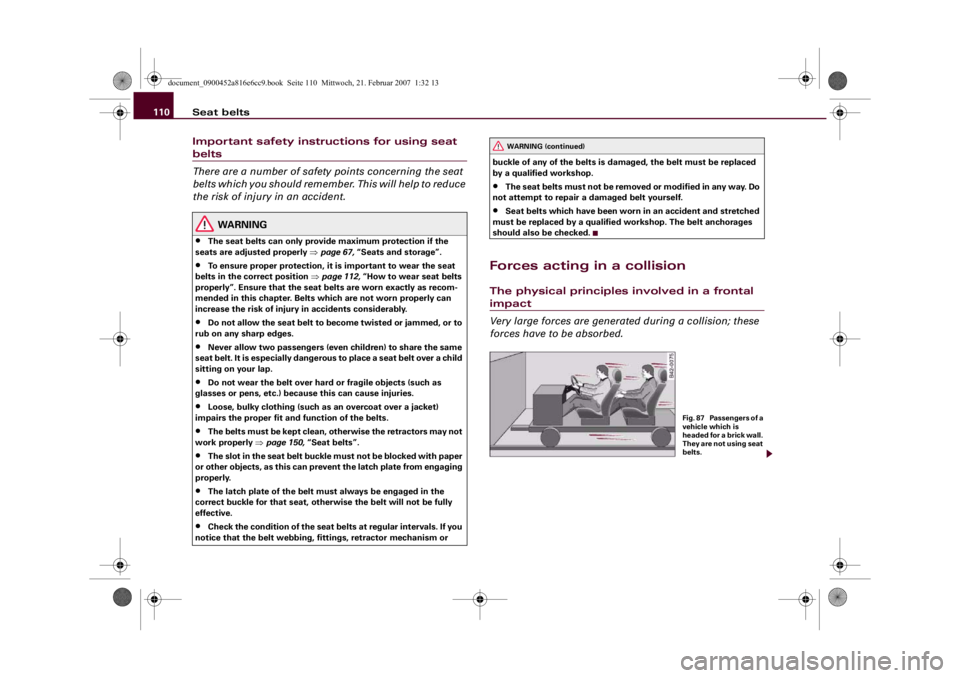
F i g . 8 7 P a s s e n g e r s o f a
vehicle which is
headed for a brick wall.
They are not using seat
belts.
document_0900452a816e6cc9.book Seite 110 Mittwoch, 21. Februar 2007 1:32 13
Page 119 of 210
Airbag system117
Controls
Safety
Driving tips
General maintenance
Self-help
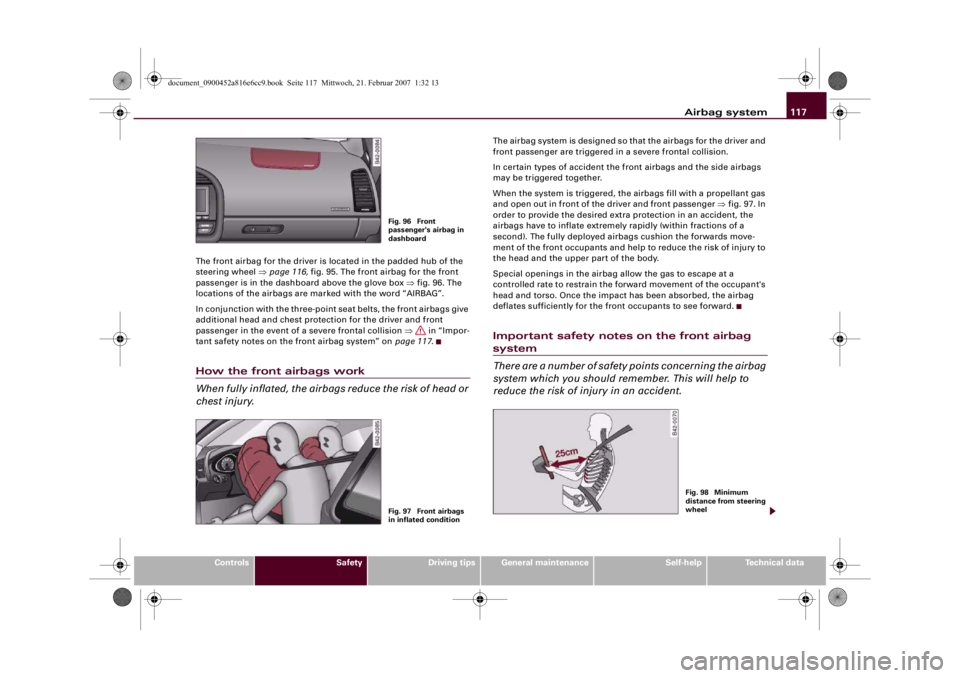
Technical data The front airbag for the driver is located in the padded hub of the
steering wheel ⇒page 116, fig. 95. The front airbag for the front
passenger is in the dashboard above the glove box ⇒fig. 96. The
locations of the airbags are marked with the word “AIRBAG”.
In conjunction with the three-point seat belts, the front airbags give
additional head and chest protection for the driver and front
passenger in the event of a severe frontal collision ⇒ in “Impor-
tant safety notes on the front airbag system” on page 117.
How the front airbags work
When fully inflated, the airbags reduce the risk of head or
chest injury.
The airbag system is designed so that the airbags for the driver and
front passenger are triggered in a severe frontal collision.
In certain types of accident the front airbags and the side airbags
may be triggered together.
When the system is triggered, the airbags fill with a propellant gas
and open out in front of the driver and front passenger ⇒fig. 97. In
order to provide the desired extra protection in an accident, the
airbags have to inflate extremely rapidly (within fractions of a
second). The fully deployed airbags cushion the forwards move-
ment of the front occupants and help to reduce the risk of injury to
the head and the upper part of the body.
Special openings in the airbag allow the gas to escape at a
controlled rate to restrain the forward movement of the occupant's
head and torso. Once the impact has been absorbed, the airbag
deflates sufficiently for the front occupants to see forward.Important safety notes on the front airbag system
There are a number of safety points concerning the airbag
system which you should remember. This will help to
reduce the risk of injury in an accident.
Fig. 96 Front
passenger's airbag in
dashboardFig. 97 Front airbags
in inflated condition
Fig. 98 Minimum
distance from steering
wheel
document_0900452a816e6cc9.book Seite 117 Mittwoch, 21. Februar 2007 1:32 13
Page 121 of 210
Airbag system119
Controls
Safety
Driving tips
General maintenance
Self-help
Technical data collision ⇒ in “Important safety notes on the side airbag system”
on page 119.
In a side collision the side airbags reduce the risk of injury to the
areas of the body facing the impact.
How the side airbags work
When fully inflated, the side airbags reduce the risk of
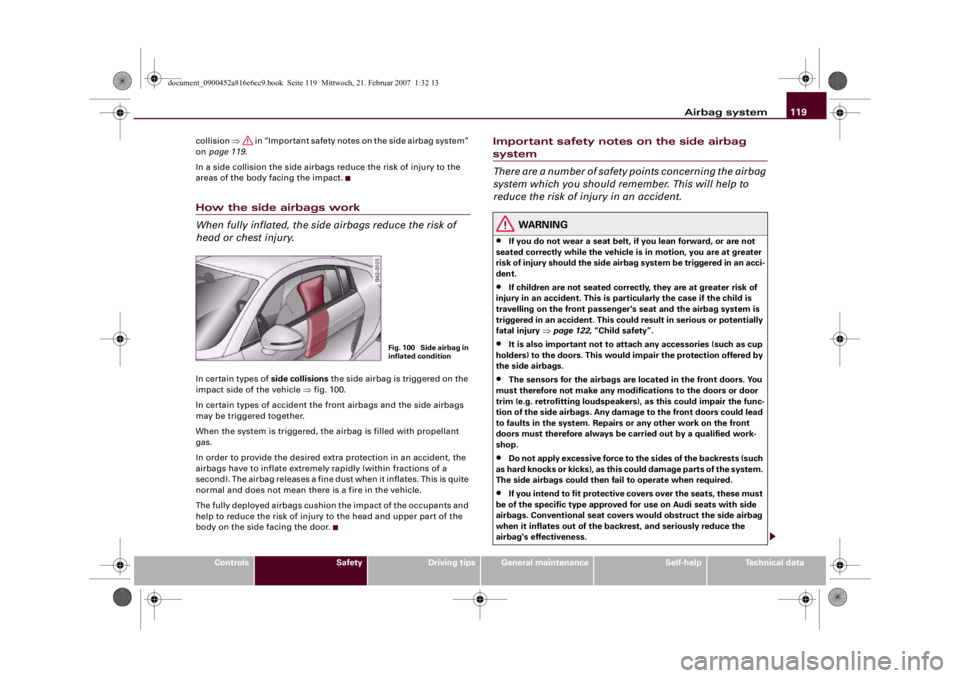
head or chest injury.In certain types of side collisions the side airbag is triggered on the
impact side of the vehicle ⇒fig. 100.
In certain types of accident the front airbags and the side airbags
may be triggered together.
When the system is triggered, the airbag is filled with propellant
gas.
In order to provide the desired extra protection in an accident, the
airbags have to inflate extremely rapidly (within fractions of a
second). The airbag releases a fine dust when it inflates. This is quite
normal and does not mean there is a fire in the vehicle.
The fully deployed airbags cushion the impact of the occupants and
help to reduce the risk of injury to the head and upper part of the
body on the side facing the door.
Important safety notes on the side airbag system
There are a number of safety points concerning the airbag
system which you should remember. This will help to
reduce the risk of injury in an accident.
WARNING
•
If you do not wear a seat belt, if you lean forward, or are not
seated correctly while the vehicle is in motion, you are at greater
risk of injury should the side airbag system be triggered in an acci-
dent.
•
If children are not seated correctly, they are at greater risk of
injury in an accident. This is particularly the case if the child is
travelling on the front passenger's seat and the airbag system is
triggered in an accident. This could result in serious or potentially
fatal injury ⇒page 122, “Child safety”.
•
It is also important not to attach any accessories (such as cup
holders) to the doors. This would impair the protection offered by
the side airbags.
•
The sensors for the airbags are located in the front doors. You
must therefore not make any modifications to the doors or door
trim (e.g. retrofitting loudspeakers), as this could impair the func-
tion of the side airbags. Any damage to the front doors could lead
to faults in the system. Repairs or any other work on the front
doors must therefore always be carried out by a qualified work-
shop.
•
Do not apply excessive force to the sides of the backrests (such
as hard knocks or kicks), as this could damage parts of the system.
The side airbags could then fail to operate when required.
•
If you intend to fit protective covers over the seats, these must
be of the specific type approved for use on Audi seats with side
airbags. Conventional seat covers would obstruct the side airbag
when it inflates out of the backrest, and seriously reduce the
airbag's effectiveness.
Fig. 100 Side airbag in
inflated condition
document_0900452a816e6cc9.book Seite 119 Mittwoch, 21. Februar 2007 1:32 13
Page 135 of 210

Intelligent technology133
Controls
Safety
Driving tips
General maintenance
Self-help
Technical data Switching off the ESP and traction control system
(ASR)
To switch off the ASR and ESP in certain situations (e.g. when
driving with snow chains, in deep snow, or on a loose surface, or
when rocking the car backwards and forwards to free it from mud)
press the button for longer than 3 seconds. The ESP warning
lamp will light up and the message ESP switched off will appear in
the driver information system display. You should only use this
feature if your driving ability and traffic conditions allow you to do
so safely.
Switching on the ESP/traction control system (ASR)
To activate the ASR/ESP, press the button again.
Overheating of the brakes
To prevent the disc brake of a braked wheel from overheating, the
EDL cuts out automatically on the wheel in question if subjected to
excessive loads. The car remains operational and will behave in the
same way as a car without EDL.
The EDL will switch on again automatically when the brake has
cooled down.
WARNING
•
The grip provided by the ESP, ABS, EDL and ASR systems is still
subject to the physical limits of adhesion. Always bear this in
mind, especially on wet or slippery roads. If you notice the
systems cutting in, you should reduce your speed immediately to
suit the road and traffic conditions. Do not let the extra safety
features tempt you into taking any risks when driving – this can
cause accidents.
•
Please remember that the accident risk always increases if you
drive too fast, especially in corners or on a slippery road, or if you
follow too close behind the vehicle in front of you. Please bear in
mind that even ESP, ABS, EDL and ASR cannot compensate for the
increased accident risk.
•
When accelerating on a uniformly slippery surface (for instance
all four wheels on ice or snow), press the accelerator gradually and
carefully. The driven wheels may otherwise start to spin (in spite
of the EDL), which would impair the car's stability and could lead
to an accident.
•
Please note that, when the traction control system (ASR) or
ASR/ESP is switched off, the driven wheels may start to spin,
causing the vehicle to lose grip, in particular on slippery or wet
roads - danger of skidding!Note
•
In the event of a malfunction in the rear spoiler system or in the
Audi magnetic ride, it may not be possible to switch off the traction
control system (ASR) or ASR/ESP, or the ASR/ESP may be reactivated
automatically from the deactivated status.
•
If a malfunction should occur in the EDL, this is indicated by a
warning lamp ⇒page 19.
•
Some racing circuits (e.g. with banked curves) can affect the
behaviour of the ESP.
ESP
ESP
WARNING (continued)
document_0900452a816e6cc9.book Seite 133 Mittwoch, 21. Februar 2007 1:32 13
Page 137 of 210

Intelligent technology135
Controls
Safety
Driving tips
General maintenance
Self-help
Technical data We ar
The rate of wear on the brake pads depends a great deal on how you
drive and the conditions in which the vehicle is operated. Negative
factors are, for instance, city traffic, frequent short trips or hard
driving with abrupt starts and stops.
Wet roads; road salt
When you are driving at a speed higher than 70 km/h and have the
windscreen wipers switched on (at or above intermittent setting 4)
the brake pads are very briefly brought into contact with the brake
discs. This automatic process which goes unnoticed by the driver is
carried out at regular intervals and is intended to improve braking
response in wet conditions.
In certain conditions, such as in heavy rain, or after washing the car
or driving through water, the full braking effect can be delayed by
moisture (or in winter by ice) on the discs and brake pads. The
brakes should be “dried” by pressing the pedal to restore full
braking effect.
The effectiveness of the brakes can also be temporarily reduced if
the car is driven for some distance without using the brakes when
there is a lot of salt on the road in winter. The layer of salt that accu-
mulates on the discs and pads can be removed with a few cautious
brake applications.
Corrosion
There may be a tendency for dirt to build up on the brake pads and
corrosion to form on the discs if the car is used infrequently, or if
you only drive low mileages without using the brakes very much.
If the brakes are not used frequently, or if corrosion has formed on
the discs, it is advisable to clean off the pads and discs by braking
firmly a few times from a moderately high speed ⇒.
Faults in the brake system
If the brake pedal travel should ever increase suddenly, this may
mean that one of the two brake circuits has failed. Drive immedi-
ately to the nearest qualified workshop and have the fault rectified. On the way to the dealer, be prepared to use more pressure on the
brake pedal and allow for longer stopping distances.
Low brake fluid level
Malfunctions can occur in the brake system if the brake fluid level is
too low. The brake fluid level is monitored electronically.
Brake servo
The brake servo amplifies the pressure you apply to the brake pedal.
It only works when the engine is running.
WARNING
•
When applying the brakes to clean off deposits on the pads and
discs, select a clear, dry road. Be sure not to inconvenience or
endanger other road users; do not risk an accident.
•
Never let the car coast with the engine switched off (this can
cause accidents).Caution
•
Never let the brakes “drag” by leaving your foot on the pedal
when you do not really intend to brake. This overheats the brakes,
resulting in longer stopping distances and greater wear.
•
Before driving down a long, steep gradient, it is advisable to
reduce speed and select a lower gear. In this way you will make use
of the engine braking effect and relieve the load on the brakes. If you
still have to use the brakes, it is better to brake firmly at intervals
than to apply the brakes continuously.Note
•
If the brake servo is out of action due to a malfunction, or if the
car has to be towed, you will have to press the brake pedal consid-
erably harder to make up for the lack of servo assistance.
•
If you wish to equip the car with accessories such as a front
spoiler or wheel covers, it is important that the flow of air to the
document_0900452a816e6cc9.book Seite 135 Mittwoch, 21. Februar 2007 1:32 13
Page 139 of 210

Intelligent technology137
Controls
Safety
Driving tips
General maintenance
Self-help
Technical data pery roads just because the car still has good acceleration in these
conditions (accident risk).
•
On wet roads bear in mind that the front wheels may start to
“aquaplane” and lose contact with the road if the car is driven too
fast. If this should happen, there will be no sudden increase in
engine speed to warn the driver, as with a front-wheel drive car. So
do not drive too fast in the wet: adjust your speed to suit the
conditions (accident risk).
Dry sump lubrication systemLarge lateral and longitudinal forces act on the engine and vehicle
when a sporty driving style is adopted. A dry sump system ensures
that the engine continues to be supplied with oil and lubricated
optimally under these conditions.
In a “normal” car, the oil is stored in the oil sump and is pumped
from there to the lubrication points inside the engine. The oil then
flows from there back into the oil sump. In extreme situations this
can cause air to be sucked into the oil pump with the result that the
oil pressure is no longer high enough.
In a dry sump lubrication system, the oil is stored in a separate oil
tank instead of the oil sump (which is “dry”). While one pump sends
oil to the engine, a second pump returns the oil from the engine to
the oil tank. The tall and slim shape of the oil tank means that the oil
pressure can be kept constant even in extreme conditions.
In addition, the oil sump is much lower on vehicles with dry sump
lubrication. This means that the engine can also be arranged lower
down for a lower centre of gravity and improved handling.
WARNING (continued)
document_0900452a816e6cc9.book Seite 137 Mittwoch, 21. Februar 2007 1:32 13
Page 141 of 210

Your vehicle and the environment139
Controls
Safety
Driving tips
General maintenance
Self-help
Technical data
Sporty drivingLetting the engine warm up and cool downYou can reduce the amount of wear and tear on your vehicle during
a sporty driving session simply by adopting a more restrained
driving style while the engine is warming up and cooling down.
You should allow the engine to warm up by keeping the engine
speed below 7000 rpm until the engine oil reaches at least 90 °C. In
addition, the tyres will not develop their full grip potential until they
have had a chance to warm up on the road.
Even though the engine continues to be cooled after you switch it
off, it is particularly important to give it time to cool down before
parking. The engine, brakes, exhaust system and gearbox will all
reach very high temperatures when you adopt a sporty driving style.
Before you park the vehicle, allow it to cool down to normal temper-
ature by driving at moderate rpm speeds for several miles.Driving on a racing circuitBefore you take your car out on a racing circuit, please ensure that
it is in perfect condition. You should check the tyre tread and brake
pads for wear. It's also a good idea to increase the tyre pressure by
0.3 bar.
The oil consumption may be slightly higher than “normal” when
driving on a racing circuit ⇒page 157.
You should always check your vehicle after driving hard. Are the
brake pads ok? Do you notice any problems with the tyres (e.g. tread
worn, blistering, etc.)? Are the air intakes free of leaves and
deposits? Is the oil level ok?
Your Audi R8 dealer will be glad to carry out an inspection before
and after you use the car on a racing circuit.
Note
•
Some racing circuits (e.g. with banked curves) can affect the
behaviour of the ESP.
•
Driving the car on a racing circuit places a heavy load on all parts
of the vehicle. This can result in increased wear and tear.
Environmental compatibilityEnvironmental protection is a top priority in the design, choice of
materials and production of your new Audi. Particular importance
has been attached to the following aspects:
Design measures for economical recycling•
Joints and connections designed for ease of dismantling
•
Modular construction to facilitate dismantling
•
Increased use of single-grade materials
•
Plastic parts and elastomers are labelled in accordance with ISO
1043, ISO 11469 and ISO 1629
Choice of materials
•
Nearly all materials used can be recycled
•
Similar types of plastics grouped together for easy recycling
•
Recycled materials used in manufacture
•
Reduced vapour emissions from plastics
•
CFC-free refrigerant in air conditioner
Compliance with the laws prohibiting the use of:
•
Cadmium
•
Asbestos
•
Lead
•
Mercury
•
Chrome VI
document_0900452a816e6cc9.book Seite 139 Mittwoch, 21. Februar 2007 1:32 13
Page 170 of 210
Wheels and tyres 168Tread wear indicators
The tread wear indicators show the condition of the tyre
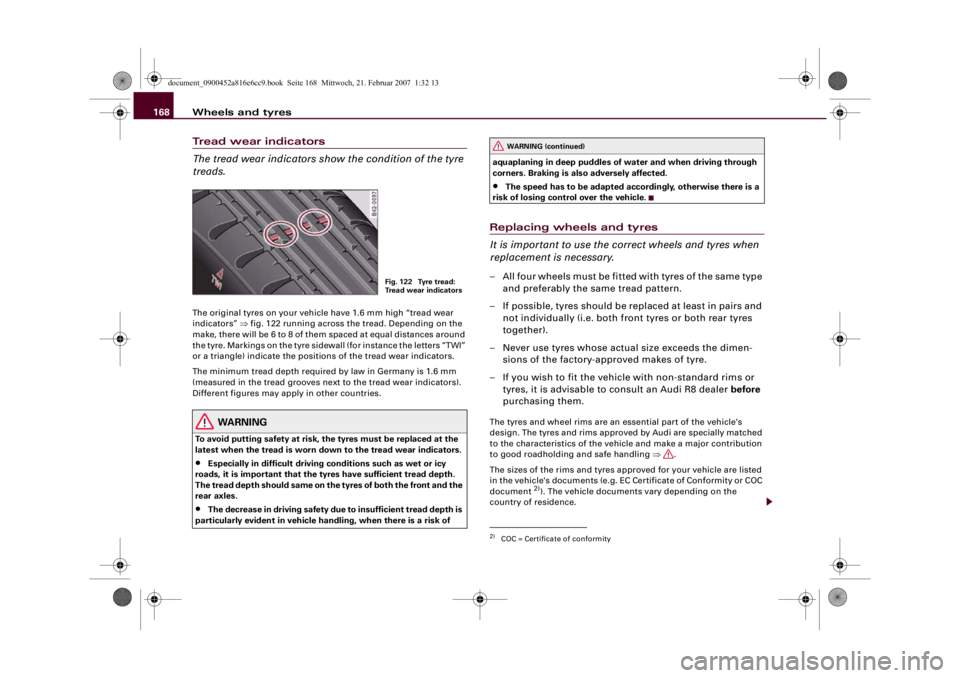
treads.The original tyres on your vehicle have 1.6 mm high “tread wear
indicators” ⇒fig. 122 running across the tread. Depending on the
make, there will be 6 to 8 of them spaced at equal distances around
the tyre. Markings on the tyre sidewall (for instance the letters “TWI”
or a triangle) indicate the positions of the tread wear indicators.
The minimum tread depth required by law in Germany is 1.6 mm
(measured in the tread grooves next to the tread wear indicators).
Different figures may apply in other countries.
WARNING
To avoid putting safety at risk, the tyres must be replaced at the
latest when the tread is worn down to the tread wear indicators.•
Especially in difficult driving conditions such as wet or icy
roads, it is important that the tyres have sufficient tread depth.
The tread depth should same on the tyres of both the front and the
rear axles.
•
The decrease in driving safety due to insufficient tread depth is
particularly evident in vehicle handling, when there is a risk of aquaplaning in deep puddles of water and when driving through
corners. Braking is also adversely affected.
•
The speed has to be adapted accordingly, otherwise there is a
risk of losing control over the vehicle.
Replacing wheels and tyres
It is important to use the correct wheels and tyres when
replacement is necessary.– All four wheels must be fitted with tyres of the same type
and preferably the same tread pattern.
– If possible, tyres should be replaced at least in pairs and
not individually (i.e. both front tyres or both rear tyres
together).
– Never use tyres whose actual size exceeds the dimen-
sions of the factory-approved makes of tyre.
– If you wish to fit the vehicle with non-standard rims or
tyres, it is advisable to consult an Audi R8 dealer before
purchasing them.The tyres and wheel rims are an essential part of the vehicle's
design. The tyres and rims approved by Audi are specially matched
to the characteristics of the vehicle and make a major contribution
to good roadholding and safe handling ⇒.
The sizes of the rims and tyres approved for your vehicle are listed
in the vehicle's documents (e.g. EC Certificate of Conformity or COC
document
2)). The vehicle documents vary depending on the
country of residence.
Fig. 122 Tyre tread:
Tr e a d w e a r i n d i c a t o r s
2)COC = Certificate of conformityWARNING (continued)
document_0900452a816e6cc9.book Seite 168 Mittwoch, 21. Februar 2007 1:32 13
Page 172 of 210

Wheels and tyres 170•
If wheel trims are fitted after the car is purchased, ensure that
there is an adequate flow of air for cooling the brakes.For the sake of the environment
Old tyres must be disposed of according to the laws in the country
concerned.
Note
•
Tyres with the “R0” mark are specially matched to your Audi. We
recommend that you use these tyres only. Your Audi R8 dealer or
specialist retailer will gladly provide you with further information.
•
Never mount used tyres if you are not sure of their previous
history.
•
For technical reasons it is not normally possible to use wheel
rims from other vehicles. In some cases this also applies to rims
from other vehicles of the same model.
Wheel bolts
The wheel bolts are designed to suit the rims on your car.The wheel bolts are matched to the rims. When installing different
wheels (for instance alloy wheels or wheels with winter tyres) it is
important to use the correct wheel bolts with the right length and
correctly shaped bolt heads. This is essential for the secure fit of the
wheels and for the proper function of the brake system.
Audi R8 dealers have full information on the technical requirements
when installing or changing tyres, rims or wheel trims.
The wheel bolts should be clean and turn easily.
A special adapter is required to turn the anti-theft wheel bolts*
⇒page 182.
Winter tyres
Winter tyres will significantly improve the car's handling
in winter road conditions.–Use only radial ply winter tyres.
– Winter tyres must be fitted on all four wheels.
– Only use winter tyres of the correct type approved for
your vehicle.
– Please note that the maximum permissible speed for
winter tyres may be lower than for summer tyres.
– Also note that winter tyres are no longer effective when
the tread is worn down.
– After fitting the wheels you must always check the tyre
pressures. The correct tyre pressures are listed on the
sticker on the driver's door pillar ⇒page 167.In winter road conditions winter tyres will considerably improve the
car's handling. Due to their type of construction (width, rubber
compound, tread pattern), summer tyres give less grip on ice and
snow. This applies particularly to vehicles equipped with wide
section tyres or high speed tyres (code letters H, V or Y on the side-
wall).
Only use winter tyres of the correct type approved for your vehicle.
The sizes of the winter tyres approved for your vehicle are listed in
the vehicle's documents (e.g. EC Certificate of Conformity or COC
document
3)). The vehicle documents vary depending on the
country of residence. Also refer to ⇒page 168.
Winter tyres are no longer fully effective when the tread is worn
down to a depth of 4 mm.
WARNING (continued)
3)COC = Certificate of conformity
document_0900452a816e6cc9.book Seite 170 Mittwoch, 21. Februar 2007 1:32 13
Page 173 of 210
Wheels and tyres171
Controls
Safety
Driving tips
General maintenance
Self-help
Technical data The performance of winter tyres is also severely impaired by ageing,
even if the tread is still much deeper than 4 mm.
Winter tyres are subject to the following maximum speed limits
according to speed rating code letter: ⇒
In Germany vehicles capable of exceeding these speeds must have
an appropriate sticker attached so it is visible to the driver. Suitable
stickers are available from Audi R8 dealers and specialist retailers.
Please note regulations to this effect in your country.
Using winter tyres with V-rating
Please note that the generally applicable 240 km/h speed rating for
winter tyres with the letter "V" is subject to technical restrictions;
the maximum permissible speed for your vehicle may be signifi-
cantly lower. The maximum speed limit for tyres with a V-rating
depends directly on the maximum axle weights for your car and on
the listed weight rating of the tyres being used.
It is best to contact an Audi R8 dealer to check the maximum speed
which is permissible for the V-rated tyres fitted on your car on the
basis of this information.
WARNING
Exceeding the maximum speed permitted for the winter tyres
fitted on your car can cause tyre failure, resulting in a loss of
control of the vehicle – risk of accident.
For the sake of the environment
Summer tyres should be fitted again as soon as possible; they give
better handling on roads which are free of snow and ice. Summer
tyres produce less rolling noise, do not wear down as quickly and,
most importantly, reduce fuel consumption.Snow chains
Snow chains will improve the vehicle's handling on snow-
covered roads.– Snow chains can be used on the rear wheels only.
– Keep your speed below 50 km/h.Snow chains will improve braking ability as well as traction in winter
conditions.
For technical reasons snow chains may only be used on tyres with
certain wheel rim/tyre combinations.
Only use snow chains with fine-pitch links. The links must not
protrude more than 13,5 mm from the tyres (including tensioner).
Speed rating code letter
⇒page 168
Maximum speed limit
Q
160 km/h
S
180 km/h
T
190 km/h
H
210 km/h
V
240 km/h
(please note relevant restrictions)
Rim size
Rim offset
Tyre size
8.5Jx18
42 mm
235/40
8.5Jx19
42 mm
235/35
10.5Jx18
55 mm
285/35
10.5Jx19
55 mm
295/30
document_0900452a816e6cc9.book Seite 171 Mittwoch, 21. Februar 2007 1:32 13