heating AUDI R8 2007 User Guide
[x] Cancel search | Manufacturer: AUDI, Model Year: 2007, Model line: R8, Model: AUDI R8 2007Pages: 210, PDF Size: 8.1 MB
Page 82 of 210
Heating and cooling 80
For the sake of the environmentSwitch off the heated rear window manually as soon as the rear
window is clear. By saving electrical power you can also save fuel.Applies to vehicles: with seat heatingSeat heating The seat cushions and backrests of the front seats can be
heated electrically.– Press the button for seat heating ⇒page 75, fig. 69
to set the desired seat temperature.Possible settings range from 1 to 3. The selected seat heating
setting is indicated by LEDs above the button.
Caution
To avoid damaging the heating elements of the seat heating, please
do not kneel on the seat or apply sharp pressure at a single point.
- +
- +
document_0900452a816e6cc9.book Seite 80 Mittwoch, 21. Februar 2007 1:32 13
Page 86 of 210
Driving 84
WARNING
Please note that the handbrake should be released all the way. If it
is only partially released this will cause overheating of the rear
brakes, which can impair the function of the brake system and
could lead to an accident.
Caution
Once the vehicle has come to a standstill, always apply the hand-
brake firmly and then engage a gear.Parking the car
Please note the following points to ensure there is no risk
of the car rolling away accidentally after it is parked.– Use the foot brake to stop the vehicle.
– Apply the handbrake firmly.
– Switch the engine off.
– Engage a gear ⇒.When parking on gradients
Turn the steering wheel so that the vehicle would roll into the kerb
if it did start to move accidentally.
WARNING
•
Do not leave anyone (especially children) in the vehicle when it
is locked. Locked doors could delay assistance in an emergency,
potentially putting lives at risk.
•
Never leave children unsupervised in the vehicle. They could,
for example, release the handbrake or put the gearbox in neutral.
The vehicle could then start moving and cause an accident.
Applies to vehicles: with hill hold assistDriving away on a slopeThe hill hold assist function makes it easier to drive away on a slope.
The system is activated when you press and hold the brake pedal for
a few seconds.
When you release the brake pedal the braking force will be main-
tained for a moment in order to hold the vehicle and make it easier
for you to drive away.
WARNING
•
If you do not drive away immediately after releasing the brake
pedal the vehicle could start to roll back. You should therefore
immediately press the brake pedal or apply the handbrake.
•
If the engine should stall you must immediately press the brake
pedal or apply the handbrake firmly.
•
If you are driving away on a slope in stop-and-go traffic press
and hold the brake pedal for a few seconds before driving off. This
will prevent the vehicle from rolling back unintentionally.Note
To find out whether your vehicle is equipped with the “hill hold
assist” function please contact an Audi R8 dealership or qualified
workshop.
document_0900452a816e6cc9.book Seite 84 Mittwoch, 21. Februar 2007 1:32 13
Page 135 of 210
Intelligent technology133
Controls
Safety
Driving tips
General maintenance
Self-help
Technical data Switching off the ESP and traction control system
(ASR)
To switch off the ASR and ESP in certain situations (e.g. when
driving with snow chains, in deep snow, or on a loose surface, or
when rocking the car backwards and forwards to free it from mud)
press the button for longer than 3 seconds. The ESP warning
lamp will light up and the message ESP switched off will appear in
the driver information system display. You should only use this
feature if your driving ability and traffic conditions allow you to do
so safely.
Switching on the ESP/traction control system (ASR)
To activate the ASR/ESP, press the button again.
Overheating of the brakes
To prevent the disc brake of a braked wheel from overheating, the
EDL cuts out automatically on the wheel in question if subjected to
excessive loads. The car remains operational and will behave in the
same way as a car without EDL.
The EDL will switch on again automatically when the brake has
cooled down.
WARNING
•
The grip provided by the ESP, ABS, EDL and ASR systems is still
subject to the physical limits of adhesion. Always bear this in
mind, especially on wet or slippery roads. If you notice the
systems cutting in, you should reduce your speed immediately to
suit the road and traffic conditions. Do not let the extra safety
features tempt you into taking any risks when driving – this can
cause accidents.
•
Please remember that the accident risk always increases if you
drive too fast, especially in corners or on a slippery road, or if you
follow too close behind the vehicle in front of you. Please bear in
mind that even ESP, ABS, EDL and ASR cannot compensate for the
increased accident risk.
•
When accelerating on a uniformly slippery surface (for instance
all four wheels on ice or snow), press the accelerator gradually and
carefully. The driven wheels may otherwise start to spin (in spite
of the EDL), which would impair the car's stability and could lead
to an accident.
•
Please note that, when the traction control system (ASR) or
ASR/ESP is switched off, the driven wheels may start to spin,
causing the vehicle to lose grip, in particular on slippery or wet
roads - danger of skidding!Note
•
In the event of a malfunction in the rear spoiler system or in the
Audi magnetic ride, it may not be possible to switch off the traction
control system (ASR) or ASR/ESP, or the ASR/ESP may be reactivated
automatically from the deactivated status.
•
If a malfunction should occur in the EDL, this is indicated by a
warning lamp ⇒page 19.
•
Some racing circuits (e.g. with banked curves) can affect the
behaviour of the ESP.
ESP
ESP
WARNING (continued)
document_0900452a816e6cc9.book Seite 133 Mittwoch, 21. Februar 2007 1:32 13
Page 140 of 210
Your vehicle and the environment 138Your vehicle and the environmentRunning inA new vehicle should be run in over a distance of 2,500 km. During
the first 1,000 km do not use full throttle and do not exceed an
engine speed of 6,000 rpm. From 1,000 to 2,000 km you should also
avoid using full throttle. From 2,000 to 2,500 km you can then
increase engine speed gradually and briefly to 8,250 rpm.
During its first few hours of running, the internal friction in the
engine is greater than later on when all the moving parts have
bedded down.
How the vehicle is driven for the first 2,500 km also influences the
engine quality. After the first 2,500 km you should continue driving
at moderate engine speeds, in particular when the engine is cold.
This helps to reduce wear and tear on the engine and increases the
potential mileage which can be covered by the engine.
You should also avoid driving with the engine speed too low.
Change down to a lower gear when the engine no longer runs
“smoothly”. Excessively high engine speeds are prevented by an
automatic rev limiter.Emission control systemsThe vehicle must only be used with unleaded petrol, otherwise the
catalytic converter will be destroyed.
Never run the tank completely dry. The irregular fuel supply can
cause misfiring, which would allow unburnt fuel to enter the
exhaust system, which could cause overheating and damage the
catalytic converter.
WARNING
•
Because of the high temperatures which can occur in the emis-
sion control system, do not park the vehicle where the exhaust
can come into contact with flammable materials under the car
(e.g. on grass or at the forest edge). - Fire hazard!
•
Do not apply any underseal agents in the area around the
exhaust system - fire hazard!
Driving abroadUnleaded petrol
A car with catalytic converter must not be run with leaded petrol
⇒page 138. Before driving abroad make sure that unleaded petrol
is available there.
Changing over headlight dip settings
The asymmetric low beams of the headlights are designed to light
up the near side of the road more intensely. If you drive in a country
where traffic drives on the opposite side of the road to the home
country, this will dazzle oncoming traffic.
The headlight dip settings must be changed to avoid dazzling
oncoming traffic. For safety reasons, you should have the dip
settings changed by a qualified workshop.
For further information about changing the dip settings on xenon*
headlights, please contact your Audi R8 dealer or other qualified
workshop.
document_0900452a816e6cc9.book Seite 138 Mittwoch, 21. Februar 2007 1:32 13
Page 149 of 210
Care of vehicle and cleaning147
Controls
Safety
Driving tips
General maintenance
Self-help
Technical data
•
The heating element for the rear window is located on the inner
side of the window. To avoid damaging the heating element, do not
put stickers on the inner side of the window.
•
Never use warm or hot water to remove snow and ice from
windows and mirrors. This could cause the glass to crack!
Rubber seals (weatherstrips)The weatherstrips on the doors, windows, engine lid and luggage
lid will remain pliable and last longer if they are occasionally treated
with a suitable care product (for example silicone spray). This will
also prevent premature ageing and leaks. The doors will be easier to
open as well. If they are kept pliable, the door seals will be less likely
to freeze up in the winter.WheelsThe wheels require regular attention to preserve their appearance.
It is important to remove road salt and brake dust by washing the
wheels at regular intervals, otherwise the finish will be impaired.
After washing, the wheels should only be cleaned with an "acid-
free" cleaning agent for alloy wheels. This is available from Audi R8
dealers and specialist retailers. Never leave the cleaning agent on
the rims for any longer than specified in the instructions before
rinsing it off. If the wheel cleaner fluid contains acid it can attack the
surfaces of the wheel bolts.
Car polish or other abrasive agents should not be used. If the
protective paint coating is damaged by stone chips etc., the
damaged area should be touched up immediately.
WARNING
Please note when cleaning the wheels that water, ice and road salt
can impair the effectiveness of the brakes – this can cause an
accident.Care of interiorPlastic parts and leatherettePlastic parts and leatherette can be cleaned with a damp cloth. If
this is not sufficient, plastic parts and leatherette should only be
treated with a special solvent-free plastic cleaner.Applies to vehicles: with carbon partsCarbon par tsThe carbon parts on your vehicle have a painted surface. They do
not need any special care and are cleaned just like plastic parts
⇒page 147.Textile covers and trim partsTextile covers and trim parts (e.g. seats, door trim) should be
cleaned regularly with a vacuum cleaner. This will remove surface
dirt which could otherwise be rubbed into the textile material
during use. Do not use steam cleaners, as the steam could carry the
dirt deeper into the textile material.
Normal cleaning
We recommend that you use a soft sponge or lint-free, micro-fibre
cloth for normal cleaning. Only use brushes on floor coverings and
mats, as other textile surfaces could become damaged.
document_0900452a816e6cc9.book Seite 147 Mittwoch, 21. Februar 2007 1:32 13
Page 162 of 210
Checking and topping up fluids 160Checking coolant level
Be careful when checking the coolant.– Switch off the ignition.
– Cover the cap on the expansion tank with a cloth, and
carefully unscrew the cap anti-clockwise ⇒.
– Read off the coolant level on the inside of the radiator
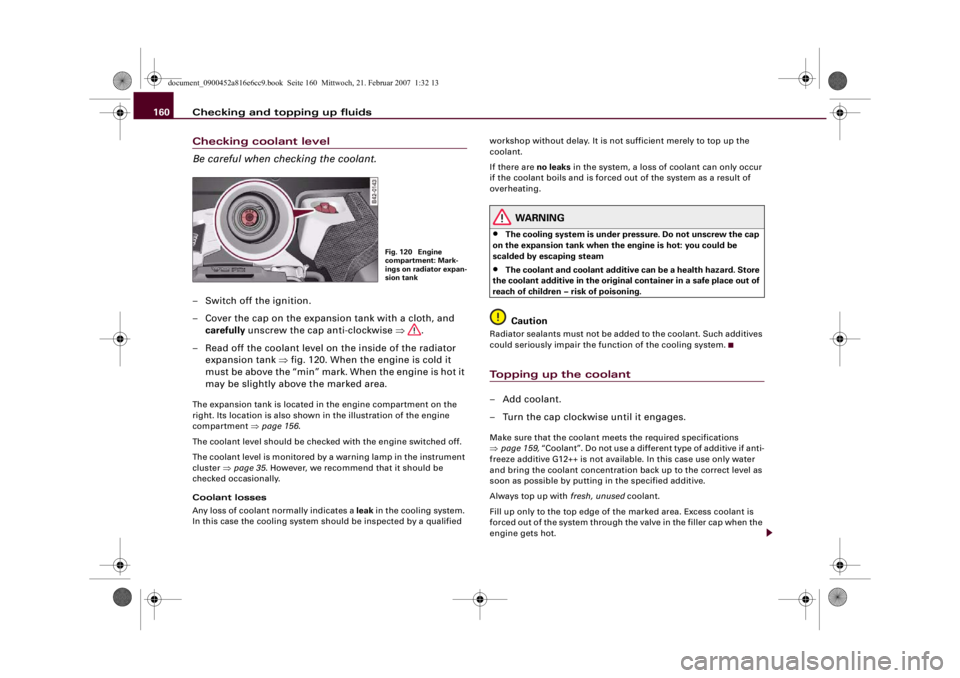
expansion tank ⇒fig. 120. When the engine is cold it
must be above the “min” mark. When the engine is hot it
may be slightly above the marked area.The expansion tank is located in the engine compartment on the
right. Its location is also shown in the illustration of the engine
compartment ⇒page 156.
The coolant level should be checked with the engine switched off.
The coolant level is monitored by a warning lamp in the instrument
cluster ⇒page 35. However, we recommend that it should be
checked occasionally.
Coolant losses
Any loss of coolant normally indicates a leak in the cooling system.
In this case the cooling system should be inspected by a qualified workshop without delay. It is not sufficient merely to top up the
coolant.
If there are no leaks in the system, a loss of coolant can only occur
if the coolant boils and is forced out of the system as a result of
overheating.
WARNING
•
The cooling system is under pressure. Do not unscrew the cap
on the expansion tank when the engine is hot: you could be
scalded by escaping steam
•
The coolant and coolant additive can be a health hazard. Store
the coolant additive in the original container in a safe place out of
reach of children – risk of poisoning.Caution
Radiator sealants must not be added to the coolant. Such additives
could seriously impair the function of the cooling system.Topping up the coolant– Add coolant.
– Turn the cap clockwise until it engages.Make sure that the coolant meets the required specifications
⇒page 159, “Coolant”. Do not use a different type of additive if anti-
freeze additive G12++ is not available. In this case use only water
and bring the coolant concentration back up to the correct level as
soon as possible by putting in the specified additive.
Always top up with fresh, unused coolant.
Fill up only to the top edge of the marked area. Excess coolant is
forced out of the system through the valve in the filler cap when the
engine gets hot.
Fig. 120 Engine
compartment: Mark-
ings on radiator expan-
sion tank
document_0900452a816e6cc9.book Seite 160 Mittwoch, 21. Februar 2007 1:32 13
Page 194 of 210
Fuses and bulbs 192
Some of the items listed are only fitted on certain models or are
optional extras.
The electric windows and electric seat adjusters are protected by
circuit breakers. These reset automatically after a few seconds
when the overload (caused for example by frozen windows) has
been corrected.
Note
Please note that the above list, while correct at the time of printing,
is subject to alterations.
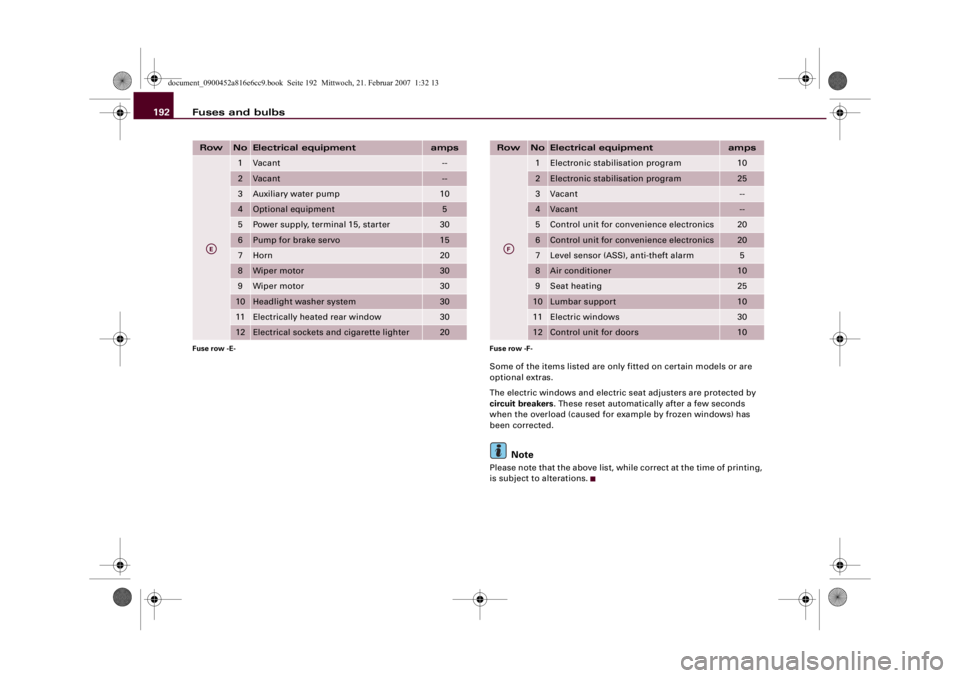
Row
No
Electrical equipment
amps
1
Vacant
--
2
Vacant
--
3
Auxiliary water pump
10
4
Optional equipment
5
5
Power supply, terminal 15, starter
30
6
Pump for brake servo
15
7
Horn
20
8
Wiper motor
30
9
Wiper motor
30
10
Headlight washer system
30
11
Electrically heated rear window
30
12
Electrical sockets and cigarette lighter
20
Fuse row -E-
AE
Row
No
Electrical equipment
amps
1
Electronic stabilisation program
10
2
Electronic stabilisation program
25
3
Vacant
--
4
Vacant
--
5
Control unit for convenience electronics
20
6
Control unit for convenience electronics
20
7
Level sensor (ASS), anti-theft alarm
5
8
Air conditioner
10
9
Seat heating
25
10
Lumbar support
10
11
Electric windows
30
12
Control unit for doors
10
Fuse row -F-
AF
document_0900452a816e6cc9.book Seite 192 Mittwoch, 21. Februar 2007 1:32 13
Page 204 of 210

Index 202AABS
SeeAnti-lock brake system . . . . . . . . 132
AC mode
Air conditioner . . . . . . . . . . . . . . . . . . . 79
Acceleration figures
SeePerformance, weights and
dimensions . . . . . . . . . . . . . . . . . . . . 198
Accessories . . . . . . . . . . . . . . . . . . . . . . . . 174
acoustic parking system
SeeParking aid . . . . . . . . . . . . . . . . . . . 85
Air conditioner . . . . . . . . . . . . . . . . . . . . . . 75
AC mode . . . . . . . . . . . . . . . . . . . . . . . . . 79
Air distribution . . . . . . . . . . . . . . . . . . . 77
Air recirculation mode . . . . . . . . . . . . . 78
Automatic mode . . . . . . . . . . . . . . . . . . 78
Blower . . . . . . . . . . . . . . . . . . . . . . . . . . 77
Controls . . . . . . . . . . . . . . . . . . . . . . . . . 75
Defrosting . . . . . . . . . . . . . . . . . . . . . . . 78
Dust filter . . . . . . . . . . . . . . . . . . . . . . . . 75
Heating . . . . . . . . . . . . . . . . . . . . . . . . . . 75
Pollen filter . . . . . . . . . . . . . . . . . . . . . . 75
Rear window heating . . . . . . . . . . . . . . 79
Seat heating . . . . . . . . . . . . . . . . . . . . . 80
Switching on/off . . . . . . . . . . . . . . . . . . 77
Temperature . . . . . . . . . . . . . . . . . . . . . 76
Ventilation . . . . . . . . . . . . . . . . . . . . . . . 75
Air distribution
Air conditioner . . . . . . . . . . . . . . . . . . . 77
Air recirculation mode
Vehicles with air conditioner . . . . . . . . 78Airbag . . . . . . . . . . . . . . . . . . . . . . . . . . . . 115
Deactivating . . . . . . . . . . . . . . . . . . . . . 120
Front airbags . . . . . . . . . . . . . . . . . . . . 116
Key-operated switch for front passenger's
airbag . . . . . . . . . . . . . . . . . . . . . . . . . 120
Side airbags . . . . . . . . . . . . . . . . . . . . . 118
Triggering . . . . . . . . . . . . . . . . . . . . . . 116
Warning lamp . . . . . . . . . . . . . . . . . . . . 17
Alterations to the vehicle . . . . . . . . . . . . . 174
Alternator . . . . . . . . . . . . . . . . . . . . . . . . . . 18
Warning lamp . . . . . . . . . . . . . . . . . . . . 18
Anti-dazzle interior mirror . . . . . . . . . . . . . 63
Anti-freeze additive . . . . . . . . . . . . . . . . . 159
Anti-knock properties of petrol . . . . . . . . 152
Anti-lock brake system . . . . . . . . . . . . . . . 132
Warning lamp . . . . . . . . . . . . . . . . . . . . 19
Anti-theft alarm . . . . . . . . . . . . . . . . . . . . . . 48
Interior monitor . . . . . . . . . . . . . . . . . . . 49
Tow-away protection . . . . . . . . . . . . . . 49
Anti-theft wheel bolts . . . . . . . . . . . . . . . . 182
Ashtray . . . . . . . . . . . . . . . . . . . . . . . . . . . . . 72
Audi magnetic ride . . . . . . . . . . . . . . . . 16, 88
Description . . . . . . . . . . . . . . . . . . . . . . . 88
Warning lamp . . . . . . . . . . . . . . . . . . . . 16
Audi parking system . . . . . . . . . . . . . . . . . 85
Automatic car washes
SeeWashing . . . . . . . . . . . . . . . . . . . . 144
Automatic headlight control . . . . . . . . . . . 63
Automatic headlights . . . . . . . . . . . . . . . . . 53
Defective . . . . . . . . . . . . . . . . . . . . . . . . 38
Average fuel consumption . . . . . . . . . . . . 22
Average speed . . . . . . . . . . . . . . . . . . . . . . 22Axle weights
SeePerformance, weights and
dimensions . . . . . . . . . . . . . . . . . . . . 198
BBattery . . . . . . . . . . . . . . . . . . . . . . . . . . . . 162
Charging . . . . . . . . . . . . . . . . . . . . . . . . 164
Disconnecting and connecting . . . . . 162
Long periods of non-use . . . . . . . . . . 162
Replacing . . . . . . . . . . . . . . . . . . . . . . . 162
Testing . . . . . . . . . . . . . . . . . . . . . . . . . 162
Winter conditions . . . . . . . . . . . . . . . . 162
Winter operation . . . . . . . . . . . . . . . . . 162
Battery voltage . . . . . . . . . . . . . . . . . . . . . . 37
Belt tensioners . . . . . . . . . . . . . . . . . . . . . 114
Bioethanol fuel . . . . . . . . . . . . . . . . . . . . . 152
Blower . . . . . . . . . . . . . . . . . . . . . . . . . . . . . 77
Brake system
Brake fluid . . . . . . . . . . . . . . . . . . . . . . 161
Brake light failure . . . . . . . . . . . . . . . . . 38
Brake pads worn . . . . . . . . . . . . . . . . . . 37
Brake servo . . . . . . . . . . . . . . . . . . . . . . 134
Brakes . . . . . . . . . . . . . . . . . . . . . . . . . . 134
Malfunction . . . . . . . . . . . . . . . . . . . . . . 35
Warning lamp . . . . . . . . . . . . . . . . . . . . 18
Bulb monitor . . . . . . . . . . . . . . . . . . . . . . . . 37
Bulbs . . . . . . . . . . . . . . . . . . . . . . . . . . . . . 193
Business equipment . . . . . . . . . . . . . . . . . 175CCapacities . . . . . . . . . . . . . . . . . . . . . . . . . 199
document_0900452a816e6cc9.book Seite 202 Mittwoch, 21. Februar 2007 1:32 13
Page 205 of 210

Index203
Controls
Safety
Driving tips
General maintenance
Self-help
Technical data Car keys . . . . . . . . . . . . . . . . . . . . . . . . . . . . 40
Carbon parts
Exterior . . . . . . . . . . . . . . . . . . . . . . . . . 146
Interior . . . . . . . . . . . . . . . . . . . . . . . . . 147
Care of vehicle . . . . . . . . . . . . . . . . . . . . . . 144
Catalytic converter . . . . . . . . . . . . . . . . . . 138
Central locking system . . . . . . . . . . . . . . . . 42
Deadlock mechanism . . . . . . . . . . . . . . 44
Locking . . . . . . . . . . . . . . . . . . . . . . . . . . 44
Locking and unlocking the vehicle from
inside . . . . . . . . . . . . . . . . . . . . . . . . . . 45
Locking doors manually . . . . . . . . . . . . 46
Luggage lid . . . . . . . . . . . . . . . . . . . . . . . 47
Opening and closing windows . . . . . . . 43
Security central locking . . . . . . . . . . . . 46
Switches . . . . . . . . . . . . . . . . . . . . . . . . . 45
Unlocking . . . . . . . . . . . . . . . . . . . . . . . . 44
Ceramic brake discs
Changing a wheel . . . . . . . . . . . . . . . . 184
Changing a wheel . . . . . . . . . . . . . . . . . . . 182
Changing bulbs . . . . . . . . . . . . . . . . . . . . . 193
Chassis number . . . . . . . . . . . . . . . . . . . . . 196
Child safety . . . . . . . . . . . . . . . . . . . . . . . . 122
Child safety seat . . . . . . . . . . . . . . . . . . . . 123
Child seat categories . . . . . . . . . . . . . . 123
Fitting . . . . . . . . . . . . . . . . . . . . . . . . . . 126
ISOFIX system . . . . . . . . . . . . . . . . . . . 128
Safety notes . . . . . . . . . . . . . . . . . . . . . 122
Cigarette lighter . . . . . . . . . . . . . . . . . . . . . 72
Cleaning . . . . . . . . . . . . . . . . . . . . . . . . . . . 144
Cleaning Alcantara . . . . . . . . . . . . . . . . . . 150Cleaning seat covers
Alcantara . . . . . . . . . . . . . . . . . . . . . . . . 150
Natural leather . . . . . . . . . . . . . . . . . . . 149
Textile covers . . . . . . . . . . . . . . . . . . . . 147
Cleaning textile covers and trim parts . . 147
Closing
Engine lid . . . . . . . . . . . . . . . . . . . . . . . 156
Clutch overheating . . . . . . . . . . . . . . . . . . . 38
Colour code . . . . . . . . . . . . . . . . . . . . . . . . 196
Coming home function . . . . . . . . . . . . . . . . 54
Compartment for (sun)glasses . . . . . . . . . 73
Compass in mirror . . . . . . . . . . . . . . . . . . . 65
Conformity certification . . . . . . . . . . . . . . . 98
Controls and displays
Overview . . . . . . . . . . . . . . . . . . . . . . . . . . 9
Convenience close . . . . . . . . . . . . . . . . . . . 43
Convenience open . . . . . . . . . . . . . . . . . . . . 43
Cooling system
Anti-freeze additive . . . . . . . . . . . . . . . 159
Checking coolant level . . . . . . . . . . . . 160
Coolant . . . . . . . . . . . . . . . . . . . . . . . . . 159
Coolant temperature gauge . . . . . . . . . 12
Malfunction . . . . . . . . . . . . . . . . . . . . . . 35
Radiator fan . . . . . . . . . . . . . . . . . . . . . 161
Topping up coolant . . . . . . . . . . . . . . . 160
Cruise control system . . . . . . . . . . . . . . . . . 86
Adjusting stored speed . . . . . . . . . . . . . 87
Indicator lamp . . . . . . . . . . . . . . . . . . . . 17
Setting speed . . . . . . . . . . . . . . . . . . . . . 87
Switching off . . . . . . . . . . . . . . . . . . . . . 88
Switching off temporarily . . . . . . . . . . . 88
Cup holders . . . . . . . . . . . . . . . . . . . . . . . . . 72
Current fuel consumption . . . . . . . . . . . . . 22
DDashboard lighting
SeeInstrument lighting . . . . . . . . . . . . . 55
Date display . . . . . . . . . . . . . . . . . . . . . . . . . 12
Daytime running lights . . . . . . . . . . . . . . . . 52
Deactivating front passenger's airbag . . 120
Deadlock mechanism . . . . . . . . . . . . . . . . . 44
Defrosting windows . . . . . . . . . . . . . . . . . . 78
Deluxe automatic air conditioner
Economical operation . . . . . . . . . . . . . . 79
Description of R tronic . . . . . . . . . . . . . . . . 90
Digital clock . . . . . . . . . . . . . . . . . . . . . . . . . 12
Digital compass . . . . . . . . . . . . . . . . . . . . . . 65
Dimensions . . . . . . . . . . . . . . . . . . . . . . . . 198
Dipped headlights . . . . . . . . . . . . . . . . . . . . 52
Defective . . . . . . . . . . . . . . . . . . . . . . . . . 37
Distance covered . . . . . . . . . . . . . . . . . . . . . 23
Door catches, engine lid and front lid
warning . . . . . . . . . . . . . . . . . . . . . . . . 20
Doors
Locking doors manually . . . . . . . . . . . . 46
Driver
SeeSitting position . . . . . . . . . . . . . . . 104
Driver information system
CD and radio display . . . . . . . . . . . . . . . 20
Door catches, engine lid and front lid
warning . . . . . . . . . . . . . . . . . . . . . . . . 20
Help . . . . . . . . . . . . . . . . . . . . . . . . . . . . . 25
Menu button . . . . . . . . . . . . . . . . . . . . . . 25
Menu display . . . . . . . . . . . . . . . . . . . . . 24
On-board computer . . . . . . . . . . . . . . . . 22
Outside temperature display . . . . . . . . 20
document_0900452a816e6cc9.book Seite 203 Mittwoch, 21. Februar 2007 1:32 13
Page 207 of 210
Index205
Controls
Safety
Driving tips
General maintenance
Self-help
Technical data
GGarage door opener . . . . . . . . . . . . . . . . . . 95
Gearbox (R tronic) . . . . . . . . . . . . . . . . . . . . 90
Glove box . . . . . . . . . . . . . . . . . . . . . . . . . . . 73HHandbrake . . . . . . . . . . . . . . . . . . . . . . . . . . 83
Handbrake warning lamp . . . . . . . . . . . . . . 35
Hazard warning lights . . . . . . . . . . . . . . . . 56
Indicator lamp . . . . . . . . . . . . . . . . . . . . 17
Head restraints . . . . . . . . . . . . . . . . . . . . . . 71
Headlight flasher . . . . . . . . . . . . . . . . . . . . . 57
Headlight range control
Malfunction . . . . . . . . . . . . . . . . . . . . . . 37
Headlight switch (automatic) . . . . . . . . . . . 53
Headlights
Changing dip settings . . . . . . . . . . . . . 138
Washer system . . . . . . . . . . . . . . . . . . . . 60
Heated
Exterior mirrors . . . . . . . . . . . . . . . . . . . 64
Washer jets . . . . . . . . . . . . . . . . . . . . . . . 59
Heating . . . . . . . . . . . . . . . . . . . . . . . . . . . . . 75
Front seats (air conditioner) . . . . . . . . . 80
Rear window . . . . . . . . . . . . . . . . . . . . . 79
Seats . . . . . . . . . . . . . . . . . . . . . . . . . . . . 80
hill hold assist
Driving away on a slope . . . . . . . . . . . . 84
HomeLink . . . . . . . . . . . . . . . . . . . . . . . . . . . 95
Horn . . . . . . . . . . . . . . . . . . . . . . . . . . . . . . . . 9
IIgnition lock . . . . . . . . . . . . . . . . . . . . . . . . . 81
Immobiliser . . . . . . . . . . . . . . . . . . . . . . . . . 42
Indicator lamps . . . . . . . . . . . . . . . . . . . . . . 15
Cruise control system . . . . . . . . . . . . . . 17
Main beam headlights . . . . . . . . . . . . . 17
Turn signals . . . . . . . . . . . . . . . . . . . . . . 17
Inflation pressures (tyres) . . . . . . . . 167, 172
Inspection intervals . . . . . . . . . . . . . . . . . . . 21
Instrument cluster . . . . . . . . . . . . . . . . . . . . 10
Instrument lighting . . . . . . . . . . . . . . . . . . . 55
Interior lights . . . . . . . . . . . . . . . . . . . . . . . . 57
Engine compartment . . . . . . . . . . . . . . . 58
Luggage compartment . . . . . . . . . . . . . 58
Interior mirrors
SeeMirrors . . . . . . . . . . . . . . . . . . . . . . . 63
Interior monitor . . . . . . . . . . . . . . . . . . . . . . 49
Intermittent wipe . . . . . . . . . . . . . . . . . . . . . 59
ISOFIX . . . . . . . . . . . . . . . . . . . . . . . . . . . . . 128JJack . . . . . . . . . . . . . . . . . . . . . . . . . . . . . . . 183
Jacking points . . . . . . . . . . . . . . . . . . . . . . 183
Journey distances . . . . . . . . . . . . . . . . . . . . 13
Jump-starting . . . . . . . . . . . . . . . . . . . . . . 185KKey-operated switch for front passenger's
airbag . . . . . . . . . . . . . . . . . . . . . . . . . 120Keys . . . . . . . . . . . . . . . . . . . . . . . . . . . . . . . . 40
Remote control key . . . . . . . . . . . . . . . . 40
Replacement keys . . . . . . . . . . . . . . . . . 40
Replacing the battery . . . . . . . . . . . . . . 41
Spare key . . . . . . . . . . . . . . . . . . . . . . . . 40
Kick-down feature
R tronic . . . . . . . . . . . . . . . . . . . . . . . . . . 92
LLap timer
Calling up . . . . . . . . . . . . . . . . . . . . . . . . 28
Clearing overall results . . . . . . . . . . . . . 30
Displaying split times . . . . . . . . . . . . . . 29
Evaluating lap times . . . . . . . . . . . . . . . 30
Finishing the session . . . . . . . . . . . . . . . 30
Interrupting . . . . . . . . . . . . . . . . . . . . . . 29
Introduction . . . . . . . . . . . . . . . . . . . . . . 27
Resuming the session . . . . . . . . . . . . . . 31
Starting . . . . . . . . . . . . . . . . . . . . . . . . . . 28
Switching to on-board computer . . . . . 30
Launch control programme
R tronic . . . . . . . . . . . . . . . . . . . . . . . . . . 93
Leather care
Alcantara . . . . . . . . . . . . . . . . . . . . . . . . 150
Natural leather . . . . . . . . . . . . . . . . . . . 149
Leaving home function . . . . . . . . . . . . . . . . 54
Light . . . . . . . . . . . . . . . . . . . . . . . . . . . . . . . 58
Light sensor/rain sensor
Automatic headlights . . . . . . . . . . . . . . 63
Defective . . . . . . . . . . . . . . . . . . . . . . . . . 38
Headlight switch (automatic) . . . . . . . . 53
Windscreen wipers (intermittent wipe) . .
59
document_0900452a816e6cc9.book Seite 205 Mittwoch, 21. Februar 2007 1:32 13