maintenance AUDI R8 2007 Manual Online
[x] Cancel search | Manufacturer: AUDI, Model Year: 2007, Model line: R8, Model: AUDI R8 2007Pages: 210, PDF Size: 8.1 MB
Page 167 of 210

Checking and topping up fluids165
Controls
Safety
Driving tips
General maintenance
Self-help
Technical data wax solvent) to the water. A washer fluid with freeze-resistant addi-
tive should be used in winter.
Caution
•
Never put in radiator anti-freeze or other additives.
•
Never use washer fluid which contains paint thinners or solvents
as it can damage the paintwork.
document_0900452a816e6cc9.book Seite 165 Mittwoch, 21. Februar 2007 1:32 13
Page 169 of 210
Wheels and tyres167
Controls
Safety
Driving tips
General maintenance
Self-help
Technical data
Tyre service life
Correct inflation pressures and sensible driving habits
will increase the service life of your tyres.– Check the tyre pressures at least once a month.
– The tyre pressures should only be checked when the
tyres are cold. The slightly raised pressures of warm tyres
must not be reduced.
– The pressures must be altered to suit major changes in
the load being carried.
– Avoid fast cornering and hard acceleration.
– Inspect the tyres for irregular wear from time to time.The service life of your tyres depends on the following factors:
Tyre pressure
Under-inflation or over-inflation will reduce the life of the tyres
considerably and also impair the car's handling. The inflation pres-
sures are listed on a sticker on the driver's door pillar.
Correct inflation pressures are very important, especially at high
speeds. The pressures should therefore be checked at least once a
month and before starting a journey.
Driving habits
Fast cornering, heavy acceleration and hard braking (squealing
tyres) all increase tyre wear.
Wheel balancing
The wheels on new vehicles are balanced. However, various factors
encountered in normal driving can cause them to become unbal-
anced, which results in steering vibration.Unbalanced wheels should be rebalanced, as they otherwise cause
excessive wear on steering, suspension and tyres. A wheel must
also be rebalanced when a new tyre is fitted or if a tyre is repaired.
Incorrect wheel alignment
Incorrect wheel alignment causes excessive tyre wear, impairing the
safety of the vehicle. If you notice excessive tyre wear, contact your
Audi R8 dealer.
WARNING
•
Always adapt the tyre pressure accordingly when the vehicle
load changes.
•
Under-inflated tyres flex more and can overheat at continuous
high speeds. This can cause tread separation and tyre blow-out,
which could result in an accident. Always observe the recom-
mended tyre pressures.For the sake of the environment
Under-inflated tyres will increase the fuel consumption.
document_0900452a816e6cc9.book Seite 167 Mittwoch, 21. Februar 2007 1:32 13
Page 171 of 210
Wheels and tyres169
Controls
Safety
Driving tips
General maintenance
Self-help
Technical data Understanding the tyre designations makes it easier to choose the
correct tyres. For example, radial ply tyres have the following tyre
designations marked on the sidewall:
235 / 35 R 18 91 Y
This contains the following information:
The manufacturing date is also indicated on the tyre sidewall
(possibly only on the inner side of the wheel):
DOT ... 1010...
means, for example, that the tyre was produced in the 10th week of
2010.
Please note that with some types of tyres, the actual tyre size can
differ from the nominal size marked on the tyre (for instance 235/35
R 18 91 Y), and there may be significant differences in the contours
of the tyres, even though the tyres are marked with the same
nominal size designation. When replacing the tyres, it is therefore
important to make sure that the actual size of the new tyres does
not exceed the dimensions of the factory-approved makes of tyre.
Failure to observe this requirement can affect the clearance needed
for the tyres. This could result in contact between the tyres and
suspension components or bodywork. The brake lines could also be
damaged and the vehicle's safety could be severely impaired ⇒.
When using tyres with the maximum permitted nominal dimen-
sions, this can also void the vehicle's registration.If you use tyres that are approved by Audi you can be sure that the
actual tyre dimensions will be correct for your vehicle. If you decide
to fit a different type of tyre, you must obtain the appropriate manu-
facturer's certificate from the tyre retailer to confirm that the tyres
are suitable for your vehicle. Keep this certificate in a safe place.
Your local Audi R8 dealer will be able to advise you on which tyres
may be fitted to your vehicle.
On vehicles with four-wheel drive, all four tyres must always be
fitted with tyres of the same type, make and tread pattern, as other-
wise the driveline can be damaged by continuous variations in the
wheel speeds. For the same reason, only use a spare wheel with the
same tyre dimensions as the normal road wheels.
It is not permissible to use a wheel which is of a type different to
those already fitted on the vehicle (for instance when using winter
tyres) - even if you have a puncture.
It is best to have all servicing of wheels and tyres performed by a
qualified workshop. They have the necessary special tools and
replacement parts, trained personnel and facilities for disposing of
the old tyres.
WARNING
•
It is very important to ensure that the tyres you have chosen
have adequate clearance. When selecting replacement tyres, do
not rely entirely on the nominal tyre size marked on the tyre; with
some makes of tyre the effective tyre size can differ significantly
from the nominal dimensions, even though the tyres have the
same size designation. Inadequate tyre clearance can result in
damage to the tyres or the vehicle, causing a serious safety risk. It
may also invalidate the vehicle's type approval for use on public
roads.
•
Avoid running the car on tyres that are more than 6 years old.
If you have no alternative, you should drive slowly and with extra
care at all times.
235
Tyre width in mm
35
Height/width ratio in %
R
Tyre construction: Radial
18
Rim diameter in inches
91
Load rating code
Y
Speed rating code letter
document_0900452a816e6cc9.book Seite 169 Mittwoch, 21. Februar 2007 1:32 13
Page 173 of 210
Wheels and tyres171
Controls
Safety
Driving tips
General maintenance
Self-help
Technical data The performance of winter tyres is also severely impaired by ageing,
even if the tread is still much deeper than 4 mm.
Winter tyres are subject to the following maximum speed limits
according to speed rating code letter: ⇒
In Germany vehicles capable of exceeding these speeds must have
an appropriate sticker attached so it is visible to the driver. Suitable
stickers are available from Audi R8 dealers and specialist retailers.
Please note regulations to this effect in your country.
Using winter tyres with V-rating
Please note that the generally applicable 240 km/h speed rating for
winter tyres with the letter "V" is subject to technical restrictions;
the maximum permissible speed for your vehicle may be signifi-
cantly lower. The maximum speed limit for tyres with a V-rating
depends directly on the maximum axle weights for your car and on
the listed weight rating of the tyres being used.
It is best to contact an Audi R8 dealer to check the maximum speed
which is permissible for the V-rated tyres fitted on your car on the
basis of this information.
WARNING
Exceeding the maximum speed permitted for the winter tyres
fitted on your car can cause tyre failure, resulting in a loss of
control of the vehicle – risk of accident.
For the sake of the environment
Summer tyres should be fitted again as soon as possible; they give
better handling on roads which are free of snow and ice. Summer
tyres produce less rolling noise, do not wear down as quickly and,
most importantly, reduce fuel consumption.Snow chains
Snow chains will improve the vehicle's handling on snow-
covered roads.– Snow chains can be used on the rear wheels only.
– Keep your speed below 50 km/h.Snow chains will improve braking ability as well as traction in winter
conditions.
For technical reasons snow chains may only be used on tyres with
certain wheel rim/tyre combinations.
Only use snow chains with fine-pitch links. The links must not
protrude more than 13,5 mm from the tyres (including tensioner).
Speed rating code letter
⇒page 168
Maximum speed limit
Q
160 km/h
S
180 km/h
T
190 km/h
H
210 km/h
V
240 km/h
(please note relevant restrictions)
Rim size
Rim offset
Tyre size
8.5Jx18
42 mm
235/40
8.5Jx19
42 mm
235/35
10.5Jx18
55 mm
285/35
10.5Jx19
55 mm
295/30
document_0900452a816e6cc9.book Seite 171 Mittwoch, 21. Februar 2007 1:32 13
Page 175 of 210

Wheels and tyres173
Controls
Safety
Driving tips
General maintenance
Self-help
Technical data
Note
•
Responsibility for ensuring that the tyres are correctly inflated
remains with the driver; the system can only provide assistance.
•
Only adjust the inflation pressure of the tyres when they are at
approximately ambient temperature.
•
The sensors and valves do not have to be detached or changed
round when fitting new tyres. Only the valve core needs to be
replaced, and if necessary the valve and the electronic components
in the wheel.
•
After using the Tyre Mobility System* the tyre pressure moni-
toring system may malfunction. The sensor for the tyre pressure
monitoring system must therefore be renewed by a qualified
workshop.
Applies to vehicles: with tyre pressure monitoring systemMalfunctionsIf the tyre pressure monitoring system is inoperative, the tyre
symbol or “TPMS” will appear on the display. This can have various
causes:•
One of the wheel sensors or other related components may not
be working.
•
Snow chains can interfere with the signals emitted by the
sensors so that the system cannot function properly.
•
The tyre pressure monitoring system may be inoperative due to
radio interference.
•
Radio systems operating on the same frequency, such as radio
headphones or two-way radios inside the vehicle, produce strong
electromagnetic fields which can cause temporary interference.
•
If the fault persists, take the vehicle to a qualified workshop.
document_0900452a816e6cc9.book Seite 173 Mittwoch, 21. Februar 2007 1:32 13
Page 177 of 210
Accessories and modifications to the vehicle175
Controls
Safety
Driving tips
General maintenance
Self-help
Technical data You will appreciate that your Audi R8 dealer cannot be held liable
for any damage caused by modifications and/or work performed
incorrectly.
We recommend that all work should be performed by an Audi R8
workshop using Audi Genuine Parts®.
WARNING
Incorrectly performed modifications or other work on your vehicle
can lead to malfunctions and cause accidents.Radio transmitters and business equipmentRadio transmitters (fixed installation)
Retrofit installations of radio transmitters in the vehicle are subject
to official approval. Audi generally authorises in-vehicle installa-
tions of approved types of radio transmitters provided that:•
the aerial is installed correctly,
•
the aerial is not installed in the interior of the vehicle (and
screened cables are used together with non-reflective aerial trim-
ming),
•
the effective transmitting power does not exceed 10 Watts at the
aerial base.
Audi R8 dealers and specialist retailers will be able to inform you
about options for installing and operating radio transmitters with a
higher transmitting power.
Mobile radio transmitters
When using commercial mobile telephones or radio equipment it is
possible that they might interfere with the electronics of your
vehicle and cause malfunctions. The reasons could be:
•
no external aerial
•
external aerial incorrectly installed
•
transmitting power more than 10 W.
Therefore you must not operate portable mobile telephones or radio
equipment inside the vehicle without a correctly installed external
aerial ⇒.
Please note also that the maximum range of the equipment can only
be achieved with an external aerial.
Business equipment
Retrofit installation of business or other equipment in the vehicle is
permitted, provided the equipment cannot interfere with the
driver's immediate control of the vehicle. Any such equipment must
carry the CE mark. Any retrofit equipment that could influence the
driver's control of the vehicle must have a type approval for your
vehicle and must carry the e mark.
WARNING
Mobile telephones or radio equipment which are operated inside
the vehicle without a correctly installed external aerial can create
excessive magnetic fields that could cause a health hazard.
Note
•
Any retrofit installation of electrical or electronic equipment in
the vehicle will affect its type approval. In extreme cases this could
mean that you might lose the type approval for your vehicle.
•
Please refer to the mobile telephone/radio operating
instructions.
document_0900452a816e6cc9.book Seite 175 Mittwoch, 21. Februar 2007 1:32 13
Page 181 of 210

Self-help179
Controls
Safety
Driving tips
General maintenance
Self-help
Technical data Your vehicle is equipped with a tyre repair kit: the Tyre Mobility
System (TMS).
In the event of a puncture you will find the TMS, which consists of a
sealing compound and an electric compressor, located under the
floor panel in the luggage compartment.
The TMS will reliably seal tyres damaged by foreign bodies,
provided that the cuts or punctures are no larger than approx. 4 mm
in diameter.
It is not necessary to remove the foreign body from the tyre.
The sealing compound must not be used:
•
on cuts and punctures larger than 4 mm ⇒page 178, fig. 124
•
if the wheel rim has been damaged
•
if you have been driving with very low pressure or a completely
flat tyre .
How to use the TMS is described in the section Repairing a tyre
⇒page 180.
The TMS can be used at outside temperatures down to – 20 °C.
WARNING
After repairing a tyre please note the following points:•
Do not drive faster than 80 km/h.
•
Avoid heavy acceleration, hard braking and fast cornering.
•
Vehicle handling could be impaired.
•
Tyres which have been sealed using the TMS are only suitable
for temporary use. Damaged tyres must be renewed. Therefore,
please drive carefully to the next available qualified workshop.
•
The TMS must NOT be used,
−on cuts and punctures larger than 4 mm
−if the wheel rim has been damaged
−if you have been driving with very low pressure or a
completely flat tyre
•
Seek professional assistance if the repair of a tyre puncture is
not possible with the sealing compound.
•
Do not allow the sealant to come into contact with your eyes,
skin or clothing.
•
If you do come into contact with the sealant immediately rinse
the eyes or skin affected with clean water.
•
Change clothing immediately if it becomes soiled with the tyre
sealant.
•
Make sure you do not breathe in the fumes!
•
If any of the tyre sealant is accidentally ingested, immediately
rinse the mouth thoroughly and drink lots of water.
−Do not induce vomiting. Immediately contact a doctor!
•
If any allergic reactions should occur get medical help immedi-
ately.
•
Keep the sealant away from children.For the sake of the environment
Used sealing compound cans should be disposed of at a proper
facility.
Note
•
If sealant should leak out, leave it to dry. When it has dried, you
can pull it off like a piece of foil.
•
Observe the expiry date stated on the sealing compound can.
Have the sealing compound exchanged by a qualified workshop.
A1
A2
A3
WARNING (continued)
document_0900452a816e6cc9.book Seite 179 Mittwoch, 21. Februar 2007 1:32 13
Page 183 of 210
Self-help181
Controls
Safety
Driving tips
General maintenance
Self-help
Technical data
– Unscrew the dust cap from the valve of the damaged
tyre.
– Screw the filler hose onto the valve ⇒page 180,
fig. 126.
– Insert the connector ⇒page 180, fig. 125 into the
cigarette lighter socket.
Inflating the tyre
–Move the switch ⇒page 180, fig. 126 on the
compressor
4) to position I. After 5 minutes tyre pressure
should be at least 1.8 bar.
– Switch off the compressor by moving switch to
position0. If the necessary tyre pressure of at least 1.8
bar is not reached please follow the instructions given in
the section Re-inflating the tyre.
Re-inflating the tyre
– Remove the filler hose from the valve and pull the
connector out of the socket.
– Slowly move the vehicle forwards and backwards about
10 metres. This enables the sealant to be distributed
more evenly.
– Remove the empty tyre sealant can and screw the
compressor hose ⇒page 180, fig. 125 directly onto
the valve.
– Insert the connector into the cigarette lighter socket.– Move the switch ⇒page 180, fig. 126 on the
compressor to position I. After 5 minutes tyre pressure
should be at least 1.8 bar.
– Switch off the compressor by moving switch to
position0. If the necessary tyre pressure of at least 1.8
bar is not reached this means that the tyre cannot be
repaired using the tyre sealant. You should obtain profes-
sional assistance.
Dismantling the Tyre Mobility System
– Remove the filler hose from the valve and pull the
connector out of the socket.
– Screw the dust cap onto the valve.
– Put the empty tyre sealant can back into its original pack-
aging and then secure it in the holder under the floor
panel in such a way that it will not leak.
– Then drive away immediately so that the tyre sealant can
spread evenly in the tyre.
WARNING
•
Please observe the manufacturers' safety notes on the stickers
on the compressor and the tyre sealant can.
•
If it was not possible to build up a tyre pressure of 1.8 bar
within 5 minutes this means that the tyre is too badly damaged.
Do not drive on.
•
Seek professional assistance if the repair of a tyre puncture is
not possible with the sealing compound.
4)The compressor should never be used for longer than 8 minutes.
A10
A7
A4
A8A5A4
A8
document_0900452a816e6cc9.book Seite 181 Mittwoch, 21. Februar 2007 1:32 13
Page 185 of 210
Self-help183
Controls
Safety
Driving tips
General maintenance
Self-help
Technical data It is advisable to carry the wheel bolt adapter in the vehicle. It should
be stored with the tool kit.
The code number of the anti-theft wheel bolt is stamped on the front
of the adapter. Your Audi R8 dealer will need this number to replace
the adapter if lost.
Note
Note the code number of the anti-theft wheel bolt and keep it in a
safe place – not in your vehicle.Applies to vehicles: with jackRaising the vehicle
The vehicle must be raised with a jack to remove the
wheel.
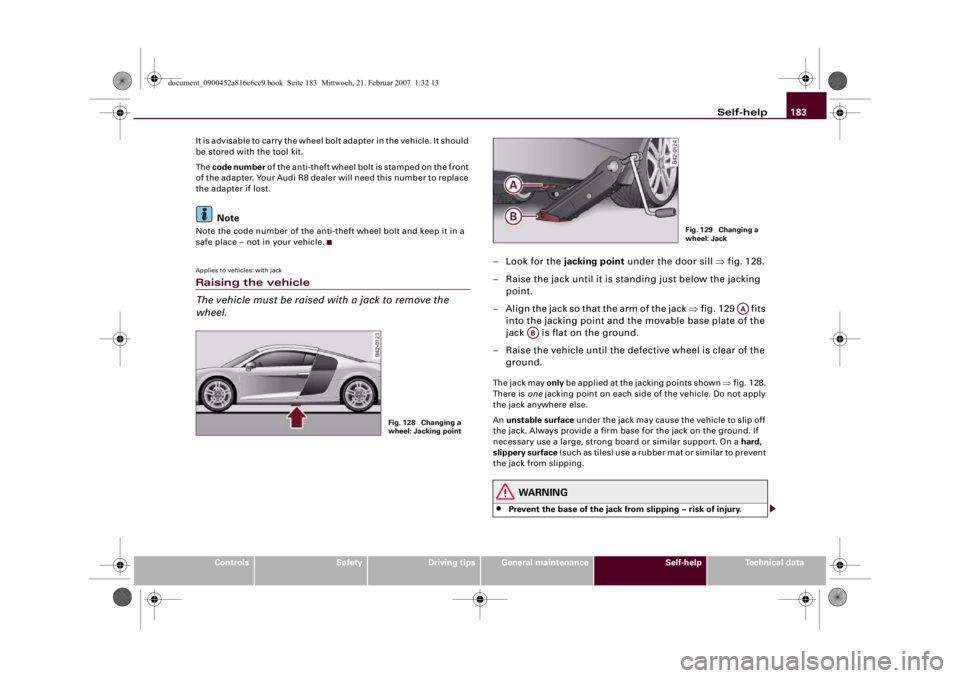
–Look for the jacking point under the door sill ⇒fig. 128.
– Raise the jack until it is standing just below the jacking
point.
– Align the jack so that the arm of the jack ⇒fig. 129 fits
into the jacking point and the movable base plate of the
jack is flat on the ground.
– Raise the vehicle until the defective wheel is clear of the
ground.The jack may only be applied at the jacking points shown ⇒fig. 128.
There is one jacking point on each side of the vehicle. Do not apply
the jack anywhere else.
An unstable surface under the jack may cause the vehicle to slip off
the jack. Always provide a firm base for the jack on the ground. If
necessary use a large, strong board or similar support. On a hard,
slippery surface (such as tiles) use a rubber mat or similar to prevent
the jack from slipping.
WARNING
•
Prevent the base of the jack from slipping – risk of injury.
Fig. 128 Changing a
wheel: Jacking point
Fig. 129 Changing a
wheel: Jack
AA
AB
document_0900452a816e6cc9.book Seite 183 Mittwoch, 21. Februar 2007 1:32 13
Page 187 of 210
Self-help185
Controls
Safety
Driving tips
General maintenance
Self-help
Technical data
Tightening wheel bolts– Fit the box spanner as far as it will go over the wheel
bolt
5).
– Grip the box spanner as close to the end as possible and
tighten the bolt firmly by turning clockwise.
Have the tightening torque of the wheel bolts checked as soon as
possible with a torque wrench. The correct tightening torque is
120 Nm.
The inflation pressure must be checked as soon as possible.
Put the tools and jack back in the luggage compartment.
WARNING
The wheel bolts must not be loosened – this would cause a safety
risk.
Note
•
Do not use the hexagonal socket in the screwdriver handle to
loosen or tighten the wheel bolts.
•
If you notice that the wheel bolts are corroded and difficult to
turn, they must be replaced before having the tightening torque
checked.
•
In the interest of safety, drive at moderate speeds until the tight-
ening torque of the wheel bolts has been checked.
Jump-startingBefore starting the engine
If necessary, the engine can be started by connecting it to
the battery of another vehicle.If the engine should ever fail to start because of a discharged
battery, the battery can be connected to the battery of another
vehicle to start the engine. Suitable jump leads are required.
Both batteries must be rated at 12 Volts. The capacity (Ah) of the
booster battery should not be significantly lower than that of the
discharged battery.
Jump leads
The jump leads must be heavy enough to carry the starter current.
Refer to the details given by the manufacturer.
Only use jump leads with insulated battery clamps.
Positive cable – usually red
Negative cable – usually black
WARNING
•
When it is discharged the battery can freeze at temperatures
around 0°C. A frozen battery must first be thawed out before
connecting the jump leads, as it could otherwise explode.
•
Please note the safety warnings referring to working in the
engine compartment ⇒page 155.Note
•
There must be no contact between the two vehicles as otherwise
current could flow as soon as the positive terminals are connected.
•
The discharged battery must be properly connected to the
vehicle's electrical system.
5)An adapter is required to tighten the anti-theft wheel bolts ⇒page 182.
document_0900452a816e6cc9.book Seite 185 Mittwoch, 21. Februar 2007 1:32 13