light AUDI R8 SPYDER 2011 Owners Manual
[x] Cancel search | Manufacturer: AUDI, Model Year: 2011, Model line: R8 SPYDER, Model: AUDI R8 SPYDER 2011Pages: 244, PDF Size: 59.74 MB
Page 167 of 244
stickers on the inside of the rear window
over the wires.
- To he lp prevent dirt from scratching the
window, always scrape in a forward di
rection -pus hing the scraper away from
you -never back and forth.
Weatherstrips
To seal properly, the weatherstrips around the
front lid, doors, eng ine compartment lid, etc .
must remain pliable . Spray the weatherstrips
with silicone or coat them with talcum pow
de r or glyce rine to retain the flexibility of t he
r u bber and to protect them against free zing
in the winte r.
A WARNING
Always read and heed a ll WARNINGS and
the information
¢page 161.
@ Tips
Keep silicone sprays off the windsh ield to
avoid wiper smear in rain.
Wheels
Regular care is required to preserve the deco
rative appearance of the wheels . Road sa lt
and brake dust must be washed off regularly
or the wheels w ill be damaged .
Use only special acid-free cleaning agents. Yo u
can find proper wheel cleaner at authorized
Aud i dea lers and specialty stores. Do not leave
the cleaner on the wheels longer than speci
fied. Wheel cleaners containing acid can dam
age the surface of the wheel bolts .
Paint polish or other abras ive materials must
not be used when caring for wheels. If the
protective coating has been damaged, from
stones for example, touch up the damage as
soon as possible .
A WARNING
-Moisture and ice on brakes may affect
braking efficiency-
¢page 153, Braking.
-
Cleaning and protec tion 165
Test the brakes carefully after each vehi
cle wash.
- Always read and heed all WARNINGS and
the information
c:;, page 161.
Exhaust tail pipes
Road salt and other corrosive materials wi ll
damage the material in the exhaust tail pipes
if they are not cleaned regularly. Do not clean
the tail pipes with wheel cleaner, pa int polish,
ch rome polish or other ab ras ive cleaners.
Clean the tail pipes with car ca re p roducts
that are suitable fo r sta inless steel.
Your authorized Audi dea ler can provide clean
ing products that have been tested and ap
proved for your vehicle.
Care of interior
· Radio and navigation display
The display may be cleaned with a soft cloth
and commercially-ava ilable "LCD cleaner".
The cloth should be coated lightly when the clean ing solution when cleaning the display .
(D Note
To prevent scratches, only clean the dis
play when it is dry.
Plastic parts and imitation leather
You can clean p lastic parts and imitation
leather with a damp cloth. If this does not re
move the d irt, you can t reat these parts only
with special
so lvent-fr ee pl astic cl eaning and
care produ ct s.
A WARNING
""' ~
Solvents can change the properties of
some p lastics and make it harder for the
a irbag to deploy.
- Never clean the instrument panel or the
surface of Airbag modu les with cleaning
products that conta in solvents.
- Products containing solvents will make
the surface of this part poro us.
•
•
Page 169 of 244
been left in a re latively natural condition. This
l eather offers particularly good comfort and
breathes well. F ine veins, closed grains, insect
b ites, skin folds, and subtle variations in color
remain visible. These characteristics demon
strate that the mater ial is natural.
Natural nappa leather is not covered by a col
or finish. It is therefore more sensitive to soil ing and wear, wh ich is something you need to
consider if children, animals or other factors
might prove to be particularly hard on the
leather.
By contrast, leather types that are covered by
a co lored finish layer are more durab le. This
has a posit ive effect on the leather's resist
ance to wear and soiling in daily use. On the
other hand, the typical cha racte rist ics of natu
r a l lea ther a re ba re ly or no t apparent. Howev
er, this does not mean that the leather itself
is of in ferior quality .
Care and handling
Because of the exclusive nature of the types of
leather that Audi uses and the ir unique prop
er ties (such as sensitivity to o ils, grease, so il
ing, etc.), you will need to be somewhat care
fu l with these leathers, and a certain type of
care is required . For examp le, dark clot hing
materials can discolor leather seats (especial
ly if such cloth ing is damp and was not dyed
correctly). Dust and d irt part icles in pores,
folds, and seams can have an abras ive effect
and can damage the leathe r su rface as well as
weaken seams.
The leather should be cleaned regularly as
needed . After having been used for a relatively
long t ime, your leather seats will acquire a
r ich aged finish. This is a characteristic of nat
ura l leather and a sign of true quality.
In order to ma intain the va lue of th is natural
p roduct ove r the life of your vehicle, you
should follow the recommendations below :
«I) Note
- To keep your leather from bleaching out,
do not allow it to be exposed to bright
Cleaning and protec tion 167
sunlight for long periods of time . If you
have to leave the vehicle parke d outside
for long per iods, cover the leather to
protect it from direct exposure to s un
light.
- Sharp objects on clothing, such as zip pers, rivets or sharp pieces on belts can
leave permanent scratches or scrape
marks on the surface of t he leather.
@ Tips
- After each time you clean the leather and
at regular intervals, use a leather preser
vative creme that contains UV-blockers
and that works into the leathe r. Th is
creme w ill nour is h and mo istu riz e the
lea ther, helping it to breathe and s tay
s u pple. It also helps to build up a protec
t ive coating on the sur face.
- Clean t he leather every 2 -3 mon ths,
and clean any areas that get soi led.
- Remove fresh marks made by ballpo int
pens, ink, lipstick, shoe pol ish, etc. as
soon as poss ible .
- P rese rve the color of the leather as need
ed by using a specia l co lore d lea the r ca re
creme to touch up areas of uneven color .
Cleaning and caring for leather
upholstery and trim
Applies to vehicles : wit h natural leather
Natural leather requires special care and at
tention .
Normal cl eaning
.,. Clean soiled areas with a slightly moistened
cotton o r woo len cloth .
More stubborn dirt
.,. More stubbor n di rt ca n be removed us ing a
cloth satu rated with a mild soap solut ion (2
t ablespoons mild liq uid soap).
.,. Never allow t he soap sol ution to saturate
t he leather, and make ce rtain that no water
soaks into the seams .
.,. Wipe
off the soap so lution with a soft, dry
cloth. ..,_ •
•
Page 170 of 244
168 Cleaning and protection
Cl ean ing spot s
.. Remove fresh w ater-b ased spots (such as
coffee, tea, juices, blood) w ith an absorbent
cloth or paper towel.
.. Remove fresh
grease or oil -b as ed spot s
(such as butter, mayonnaise, chocolate) with
an absorbent cloth or paper towe l, or use
the cleaner from the leather care kit if the
spot has not yet penetrated into the surface
of the leather .
.. Use an oil/grease dissolv ing sp ray, if
o il/
g rea se s pots have d ried on .
.. Remove spec ific kinds of spots (ballpoin t
pen, felt ma rker, fingernai l polish, water
based paint, shoe polish, etc .) with a spot
remover specifically formulated for leather.
Leather ca re
.. Every ha lf yea r use an approved leather care
product (available from your authorized Au
di dealer) to care for the leather.
.. Apply the prod uct very sparing ly .
.. Wipe it off with a damp cloth.
I f you have any questions abo ut cleaning and
caring for the leather in your vehicle, it is best
to contact your authorized A udi dealer, who
will be glad to he lp you and tell you about our
full range of leather care products, such as:
- Leather cleaning and care kit
- Cremes to care for colored leathe r
- Spot remove rs for ballpo int pe ns, shoe pol-
ish, etc.
- Oil/grease dissolving spray
- New and upcoming products.
A WARNING
Always read and heed all WARNINGS and
the information
~page 161.
@ Note
- Never use chemical solvents (e.g. lighter fluid, turpentine), waxes, shoe pol ish or
similar products on the leather surfaces
i n your Audi. - To avoid damage, have stubbo
rn sta ins
removed by a commercial cleaning spe
cialist .
Cleaning Alcantara ® (synthetic suede)
App lies to vehicles: wit h Alca nta ra upho lste ry
Remo ving dust and dirt
.. Moisten a cloth, squeeze out excess water
and wipe down the seat surfaces.
Removing stain s
.. Moisten a cloth with lukewarm water o r
with di luted
ethyl (rubbi ng) alcohol.
.. Dab at the stain. Start at the outside and
work inwards .
.. Once the sta in is no longer visible, use a soft
dry cloth or tissue to soak up the moisture .
Do not use leather cleaning prod ucts on A l
cantara.
You may use a suitable shampoo for removing dust and dirt .
D ust and grit in the po res and seams can
scratch and damage the surface.
If the ca r is
left stand ing in the sun for long per iods, the
Alcantara covers should be protected against direct sunlight to prevent it from fading.
Slight co lor variations will develop in normal
use and are not an indication of material dete
rioration .
([) Note
- Never use chemical so lvents (e.g. lighter
fluid, turpentine), waxes, shoe polish or
simi lar products on A lcantara ® surfaces.
- To avoid damage, have stubborn sta ins
removed by a commercial clean ing spe·
cialist.
- Do not use brushes, stiff sponges or sim·
ilarly abrasive cleaning a ids.
Safety belts
Heavily so iled safety belts may not retract
properly .
.. Keep belts clean.
Page 171 of 244
~ For cleaning, use a mild soap and water sol
u tion . Let be lts dry thoroughly and away
from direct sunlight.
~ Do not allow inertia reel safety be lts to re
tract before they are completely dry.
~ Check the condition of your safety belts reg
ularly .
A WARNING
Damaged safety belts can break in a crash.
- Anything that might damage your safety
belts could mean that you and your pas
sengers would not be adequately pro
tected in an accident.
- Safety belt performance depends on cor
rect installation. Never remove belts
from the vehicle to clean them.
- Do not use chemical cleaning agents,
bleach or dyes. They have corrosive prop
erties which weaken the webbing.
- When cleaning your safety belts, inspect
them for damage . If you discover dam
age, see your authorized Audi dealer.
- Always read and heed all WARNINGS and
the information
<=? page 161.
Engine compartment
Be especially careful when cleaning the en
gine compartment.
Corrosion protection
The engine compartment and transmission
have been corrosion -protected at the factory .
Good anti-corrosion treatment is very impor
tant, particularly in the winter. If the vehicle
is frequently driven on salt treated roads, the
entire engine compartment and plenum panel
should be thoroughly cleaned at the end of
winter and retreated to prevent salt damage. At the same time, the underside of the vehicle
should be washed as well.
If the engine compartment is cleaned at any
time with grease removing solutions
1>, or if
l) Use only the correc t cleaning sol utio ns. Never use gas
oline or diesel fuel.
Cleaning and protection 169
you have the engine washed, the anti-corro
sion treatment is almost always removed as
well. It is therefore essential to have a long
lasting corrosion protection reapplied to all
surfaces, seams, joints and components in the
engine compartment.
A WARNING
Be aware: The engine compartment of any
motor vehicle is a potentially hazardous
area.
- Before working in the engine compart
ment, be sure to read the information
<=? page 175.
-Before reaching into the front plenum
panel, always remove the ignition key.
Otherwise, the windshield wiper system
could unintentionally be switched on,
possibly causing persona l injury from the
moving wiper linkage.
- Never reach into the area around or
touch the radiator fan. The auxiliary fan is temperature controlled and can switch
on suddenly -even when the ignition is
off.
- Do not wash, wax or dry the engine with
the engine running. Moving or hot parts
could injure you.
- Do not clean the underside of the chas
sis, fenders, wheel covers, or other hard
to reach parts without protecting your
hands and arms . You may cut yourself on
sharp-edged metal parts.
- Always read and heed all WARNINGS and
other information
<=?page 161.
•
•
Page 172 of 244
170 Fuel supply and filli ng your fuel tank
Fuel supply and filling
your fuel tank
Gasoline
Fuel supply
Using the right fuel helps keep the environ
ment clean and prevents engine damage .
Fuel re co mm endation
The fuel recommended for your vehicle is un
lead ed pr emium
grade gasoline . See also
¢ page 228, Data . Audi recommends using
TOP TIER Detergent Gasol ine with a minimum
octane rating of 91 AK I (95 RON). For more
information on TOP TI ER Detergent Gasoline,
p lease go to the officia l website (www.toptier
gas.com).
The recommended gasoline octane rating for
your engine can a lso be found on a label locat
ed on the inside of the fuel filler flap . This rat
ing may be specified as AKI or RON.
Your veh icle may also be operated using un
leaded regular gasoline with a minimum oc
tane rating of 87 AKI/91 RON . However, using
87 AKI/91 RON octane fuel wi ll slightly re
duce engine performance.
U se unl ead ed gasolin e onl y. Unleaded gaso
line is available throughout the USA, Canada ,
and in most European countries . We recom
mend that you do not take your vehicle to
areas or countries where unleaded gasoline may not be available.
F or more informat ion on refue ling your vehi
cle, see
¢ page 171.
Octane rat ing
Octane rating ind icates a gasoline's ability to
resist engine damaging "knock" caused by
premature ign ition and detonation. Therefore,
buying the correct grade of gasoline is very
important to help prevent possible engine
damage and a loss of engine performance.
Gasoline most commonly used in the United
States and Canada has the following octane ratings that can usually be found on the fi
ller
pump:
- Premium Grade: 91 -96 AKI
- Regular Grade: 87 - 90 AKI Explanation of the abbreviations:
AKI = Anti Knock Index = (R+M)/2 = (RON
+ MON)/2
RON= Research Octane Number
MON = Motor Octane Number .
(D Note
-Do not use any fuel w ith octane rat ings
lower than 87 AKI or 91 RON otherwise
expensive engine damage w ill occur.
- Do
not use leaded gasoline! The use of
leaded gasoline w ill severely damage
your vehicle's catalytic converter and its
ability to control exhaust emissions .
Blended gasoline
Use of gaso line co ntainin g alc ohol or
MTBE (m ethyl tertia ry butyl eth er)
You may use unleaded gasoline blended with
alcohol or MTBE (commonly referred to as
oxygenates) if the blended mixture meets the
fo llowing criteria:
Blend of gaso line m ethanol (wood alc ohol or
methyl alcohol )
-Anti -knoc k index must be 87 A KI or h igher.
- Blend must contain no more than 3% meth-
anol.
- Blend must contain more than 2% co-sol-
vents .
Blend of g asoline and etha nol (gra in alcohol
or eth yl alcohol )
-Anti -knock index must be 87 AKI or higher .
- Blend must not contain more than 10% ethanol.
Blend of g asoline a nd MTBE
-Anti-knock index must be 87 AKI or h igher . ll-
Page 177 of 244
Checking and filling Engine compartment
lid
Relea sing the engine compartment lid
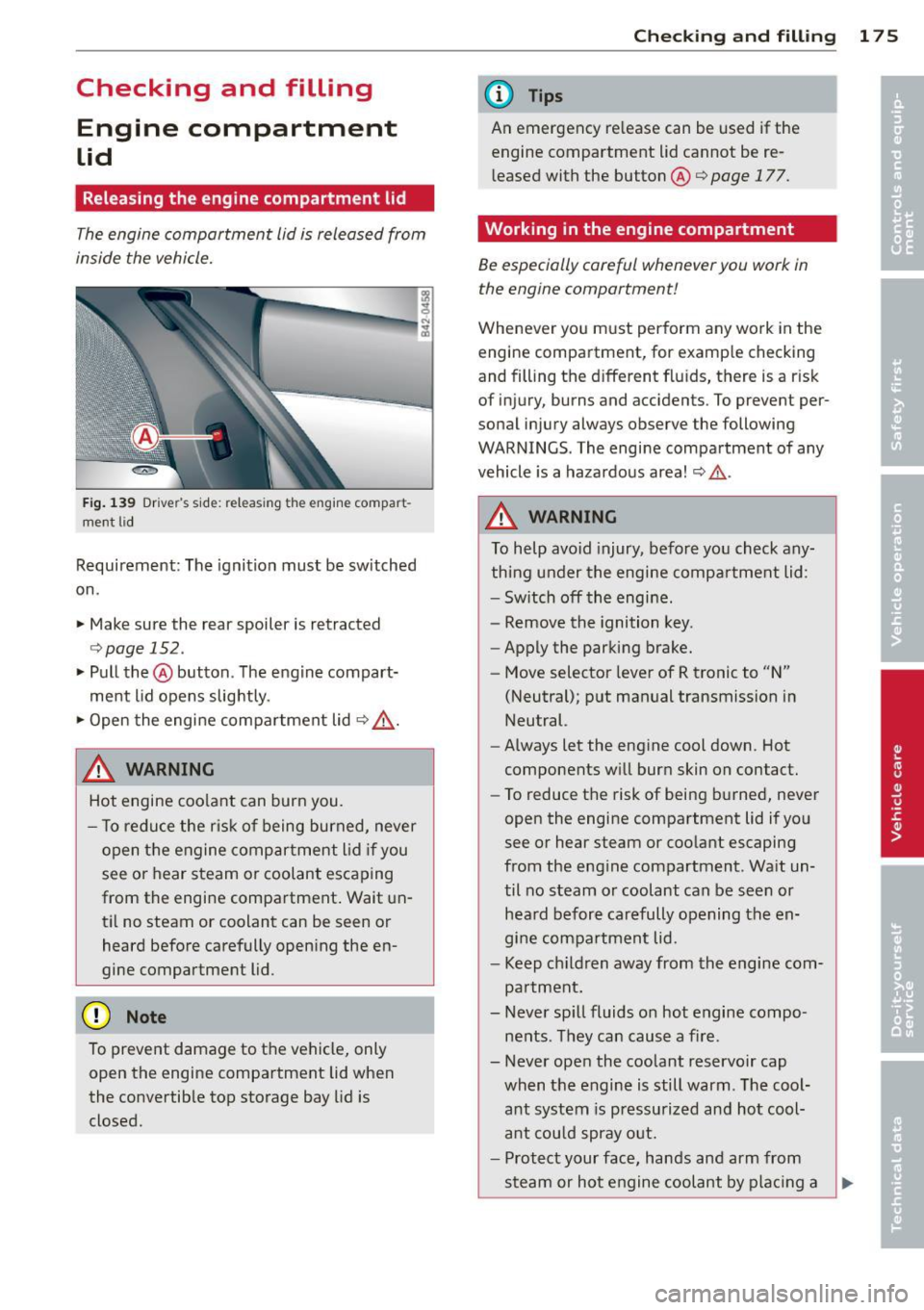
The engi ne compartment lid is released from
inside the vehicle.
F ig . 139 Dr ive r's side: releasing the engine compart
ment lid
Requi rement: The ignition must be switched
on.
• Make sure the rear spoiler is retracted
9page 152.
• Pull the@ button. The engine compart
ment lid opens slightly.
• Open the engine compartment lid
9 .&,.
_& WARNING
Hot engine coolant can burn you.
- To redu ce the r isk of being burned, never
open the engine compartment lid if you
see or hear steam or coolant escaping
from the engine compartment . Wait un
ti l no steam or coolant can be seen or
heard before carefully opening the en
gine compartment lid .
(D Note
To prevent damage to t he vehicle, only
open the engine compartment lid when
the convertib le top storage bay lid is
closed.
Checkin g and fillin g 175
@ Tips
An emergency release can be used if the
engine compartment lid cannot be re- l eased with the button @
i:> page 177.
Working in the engine compartment
Be especially careful whenever you work in
the engine compartment!
Whenever you must perform any work in the
engine compartment, for example checking
and filling the d ifferent flu ids, there is a risk
of in jury, burns and accidents . To prevent per
sonal injury always observe the following
WARNINGS . The engine compartment of any
vehicle is a hazardous area'
i:> A .
_& WARNING ,.;;
To help avoid injury, before you check any
thing under the engine compa rtment lid:
- Sw itch off the engine.
- Remove the ignition key.
- Apply the parking brake.
- Move selector lever of R tronic to "N"
(Neutral); p ut manual transmission in
Neutral.
- Always let the eng ine cool down. Hot
components w ill burn skin on contact.
- To reduce the risk of being b urned, never
open the engine compartment lid if you
see or hear steam or coo lant escaping
from the eng ine compartment. Wa it un
til no steam or coolant can be seen or
hea rd before carefully opening the en
gine compa rtment lid.
- Keep ch ild ren away from the engine com
pa rtment.
- Never sp ill fluids o n hot engine compo
nents. T hey can cause a fi re .
- Never open the coolant reservoir cap
when the engine is still warm. The cool
ant system is pressurized and hot cool
ant cou ld spray o ut.
- Protect your face, hands and arm from
steam or hot e ngine coolant by plac ing a ""
Page 181 of 244
The engine oil and oil filter must be changed
according to the mi leage (kilometers) and
time interva ls specified in your vehicle's War
ranty & Maintenance booklet. Do not exceed
these intervals -harmful deposits from old
engine o il can reduce engine performance and
can lead to expensive engine repairs.
Changing the o il at the recommended inter
vals is so very important because the lubricat
ing properties of oil decrease gradually during
normal vehicle use . If you are not sure when
you have your oi l changed, ask your author
i zed A udi Service Advisor.
Under some circumstances the engine o il
should even be changed more frequently.
Change o il more often if you drive mostly
short distances, ope ra te the vehicle in dusty
areas or mostly under s top-and-go traffic con
d itions, or when yo u use your vehicle whe re
temperatures stay below freezing point for
l ong periods.
D etergen t additives i n the o il w il l make fresh
oil look dark after the eng ine has been run
ning for a short time . This is norma l and is not
a reason to change the oi l more often than
recommended.
Damage or malfunction s due t o lack of
m aintenance
It is essen tial that you change your oil at the
r ecommended inte rva ls using only engine o il
that complies with A udi oil standard
VW 502 00. Yo ur Limited New Vehicle War
ranty does not cover damage or malfunctions
d ue to fai lure to fo llow recommended mainte
nance and use req uirements as set forth in
the Audi Owner's Manua l and Warranty&
Ma intenance book let . Your autho rized Aud i
deale r will have to deny warranty coverage un
l ess you present to the dealer p roof in the
fo rm of Se rvice o r Repair Orde rs t hat all
sched uled main tenance w as performed in a
time ly manner .
Checkin g and fillin g 179
Engine oil consumption
The engine in your vehicle depends on an ade
quate amount of oil to lubricate and cool all
of its moving parts .
In order to provide effective lubrication and
cooling of interna l eng ine components, all in
te rnal combust io n engines consume a certain
amount of oil. Oil consumpt io n va ries from
engine to e ngine and may change sig nifican tly
ove r the life of the engine. Typically, engines
with a spec ified break -in pe riod (see
c::> page 158) consume more oil d uri ng the
break-in pe riod than they consume afte r oi l
consumption has stabilized.
U nder normal cond itions, the rate of oi l con
s u mption depends on t he q uality and viscos ity
of the oil, the RP M (revolut ions per minute) at
which the engine is operated, the ambient
temperature and road conditions. Further fac
tors are the amount of oil dilut ion from water
condensa tion or fue l residue a nd the oxida
tion level of the oil. As any eng ine is subject to
wear as m ileage builds up, t he oil co nsump
t ion may increase over time until repla cement
of wo rn components may be come necessary.
Wi th a ll these va riab les coming into p lay, no
standard rate of oil consumpt io n can be es
t a bl is h ed o r spec ified . There is no alte rnative
to regular and frequent chec king of the o il lev
el, see
Note.
If the yellow engine o il level wa rning symbo l
i n the instrument cluster
1\11 lights up, yo u
sho uld check the oil leve l as soon as possib le
c::> page 180 . Top off the oil at your ear liest
convenience
c::> page 180 .
A WARNING
-Before you check anything in the engine
compartment, always read and heed a ll
WARNINGS
c::> & in Working in the engine
compartment on pag e 175.
(D Note
Driving w ith an insufficient o il level is like-
-
ly to cause severe damage to the engine. .,.
•
•
Page 185 of 244
In a se ale d system, losses can occur only if
the boiling point of the coolant is exceeded as
a result of overheat ing.
A WARNING
- The cooling system is under press ure. Do
not open the cap of the coolant expan
sion tank when the eng ine is hot. You
risk being scalded .
- The coo lant add itive, and therefore the
coolant itse lf, is hazardous to health.
Keep the coolant additive in the origina l
co nta iner out of the reach of children.
It
is a poison hazard.
CD Note
Do not add any type of rad iator leak seal
ant to your vehicle's eng ine coolant. Add
ing radiator repair f luid may adve rsely af
fect the fu nction and performance of your
coo ling system and could res ult in damage
not covere d by your New Vehicle Limited
Warranty .
Adding coolant
Before you check anything in the engine com
partment,
always read and heed all WARN
INGS ¢ & in Working in the engine compart
ment on page 175 .
.. Add coolant .
.. Tw ist the cap on again
t ightly.
.. Tighte n the cap (D ¢ page 182, fig. 146
again .
Replacement engine coolant must conform to
exact specifications ¢
page 181, Coolant. If
the coolant additive Gl2++ is not available in
an emergency, you must not add any other ad
d itive . In th is case, use only water and restore
the co rrec t mix ratio wi th the specified cool
ant add itive as soon as possib le.
Always use
new engine coolant when ref illing .
Do not fill coolant above the " MAX" mark. Ex
cess coolant will be forced out through the p ressure relief valve i n the cap when the en
g ine becomes hot .
Checking and fillin g 183
With a major loss of coolant, you shou ld add
the coolant only when the engine has
cooled.
In this way you prevent engine damage.
A WARNING
- The cooling system is unde r pressure and
can get very hot. Reduce the risk of
scalding from hot coolant by followi ng
these steps .
- Turn off t he engine and allow it to coo l
down.
- Protect you r fa ce, hands and arms from
escaping fluid and steam by covering
the cap with a large, th ic k rag.
- Turn the cap s lowly and very carefully
in a counter -clockwise direction while
applying light, downward pressure on
the top
of the cap.
- To avoid being bu rned, do not spill an
tifreeze or coolant on the ex haust sys
tem or hot engine pa rts. Under certain
cond itions, the ethylene glycol in en
gine coolant can catch fire .
- Antifreeze is poisonous . Always store an
tifreeze in its origina l container and well
out of the reach of children .
- If you dra in the coo lant, it m ust be
caught and safely stored in a proper con
taine r clearly marked " poison" .
CD Note
- Coolant pollutes the environment and
cou ld cause an engine fire. Excess cool
ant will be forced out through the pres
sure relief valve in the cap w hen the en
gine becomes hot .
- If, in an eme rgency, o nly wate r can be
added, the co rrec t ratio between wa ter
and antifreez e
¢page 181 must be re
stored as soon as poss ible.
@) For the sake of the environment
D ra ined coola nt sho uld not be reused. Al
ways d ispose of used coolant while observ
i ng a ll environmental regula tions. •
•
Page 187 of 244
disconnect the battery negative terminal. Oc
casionally charge a disconnected battery.
Winter operation
The cold time of year places a special strain on
the battery, resulting in reduced starting pow
er. So before the cold weather starts, have the battery inspected and charged as necessary.
A WARNING
- All work on the battery requires technical
knowledge. Please contact an authorized
Audi dealer or another authorized facility
for questions about the battery - danger of acid burns and explosion hazard!
- The battery must not be opened! Do not
try to change the battery's liquid level,
otherwise detonating gas will escape
from the battery - explosion hazard!
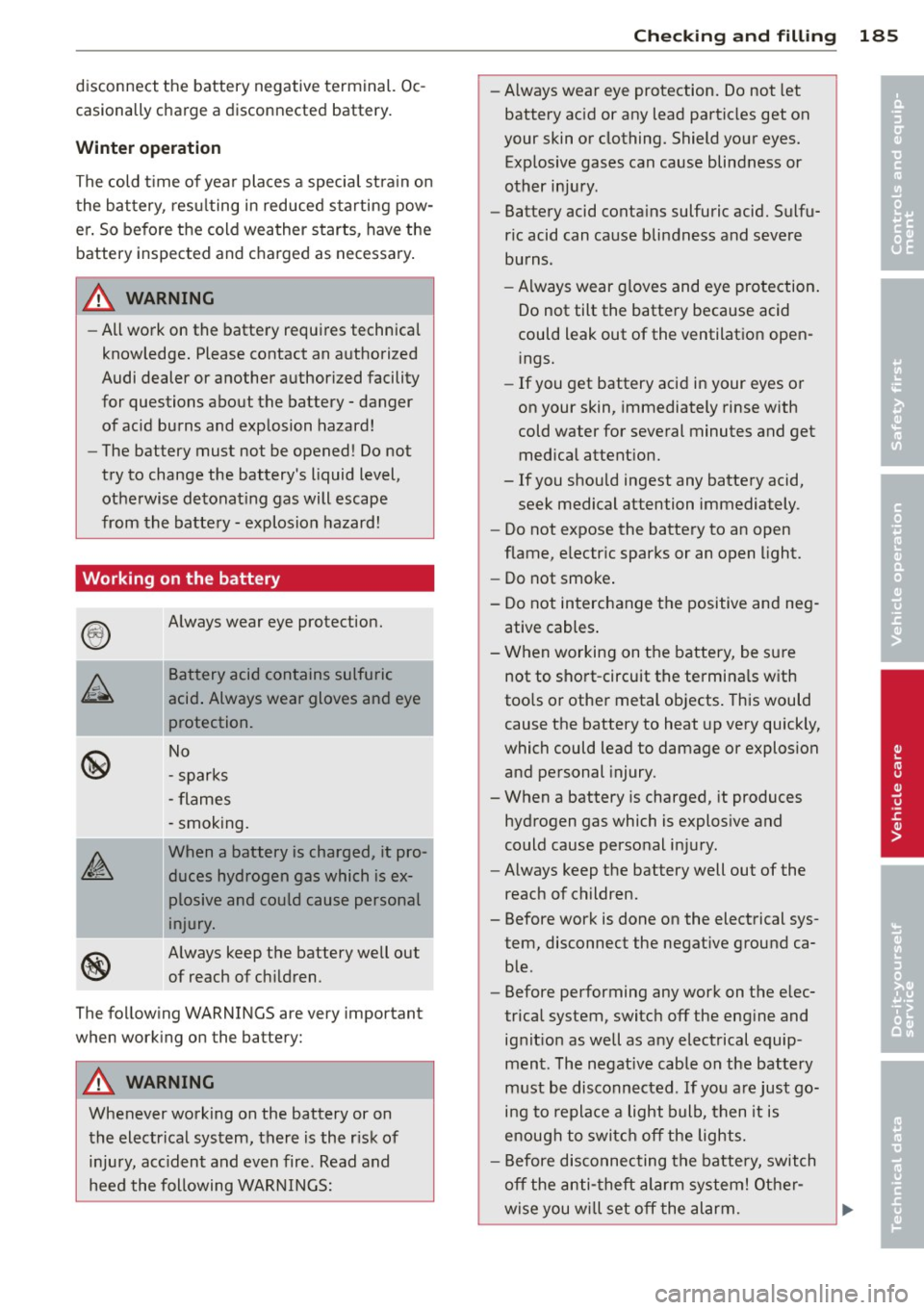
Working on the battery
Always wear eye protection.
Battery acid contains sulfuric
acid. Always wear gloves and eye
protection.
No
- sparks
- flames
- smoking.
When a battery is charged, it pro
duces hydrogen gas which is ex plosive and could cause personal
injury.
Always keep the battery well out
of reach of children.
The following WARNINGS are very important
when working on the battery:
A WARNING
Whenever working on the battery or on
the electrical system, there is the risk of
injury, accident and even fire. Read and
heed the following WARNINGS:
-
Checking and filling 185
- Always wear eye protection. Do not let
battery acid or any lead particles get on
your skin or clothing. Shield your eyes. Explosive gases can cause blindness or
other injury.
- Battery acid contains sulfuric acid. Sulfu
ric acid can cause blindness and severe
burns.
- Always wear gloves and eye protection.
Do not tilt the battery because acid
could leak out of the ventilation open
ings.
- If you get battery acid in your eyes or
on your skin, immediately rinse with
cold water for several minutes and get
medical attention.
- If you should ingest any battery acid,
seek medical attention immediately.
- Do not expose the battery to an open
flame, electric sparks or an open light.
- Do not smoke.
- Do not interchange the positive and neg- ative cables.
- When working on the battery, be sure
not to short-circuit the terminals with
tools or other metal objects. This would cause the battery to heat up very quickly,
which could lead to damage or explosion and personal injury.
- When a battery is charged, it produces
hydrogen gas which is explosive and
could cause personal injury.
- Always keep the battery well out of the
reach of children.
- Before work is done on the electrical sys
tem, disconnect the negative ground ca
ble.
- Before performing any work on the elec
trical system, switch off the engine and
ignition as well as any electrical equip
ment. The negative cable on the battery
must be disconnected.
If you are just go
ing to replace a light bulb, then it is
enough to switch off the lights.
- Before disconnecting the battery, switch
off the anti-theft alarm system! Other
wise you will set off the alarm. •
•
Page 189 of 244
~ Install the battery cover.
~ Close the luggage compartment lid
¢page 42.
When charging at low voltages (e.g. with a
trickle charger), the battery cables do not
have to be disconnected first. Before charging
at
high voltages, i.e. "fast charging", you
must disconnect both cables. In either case,
follow the instructions from the manufacturer
of the charger .
Fastcharging a battery is
dangerous ¢.&. in
Working on the battery on page 185 .
It re
quires special charging equipment and the knowledge to go with it. We recommend hav
ing your battery fast charged only by a quali
fied workshop.
A discharged battery can
freeze at tempera
tures of only 32 °F (0 °C) . Allow a frozen bat
tery to thaw completely before attempting to
charge it¢ ,&. . However, we recommend not
using a thawed battery again because the bat
tery casing can be cracked due to ice forma
tion and can leak battery acid.
Do not open the battery caps when charging
the battery.
_& WARNING
-
Charging a battery can be dangerous.
- Never charge a frozen battery .
It may ex
plode because of gas trapped in the ice.
Allow a frozen battery to thaw out first.
- Do not reuse batteries which were fro
zen. The battery housing may have
cracked and weakened when the battery
froze.
- Charge the battery in a well ventilated
area. Keep away from open flame or elec
trical spark. Do not smoke. Hydrogen gas
generated by the battery is explosive.
- To reduce the danger of explosion , never
connect or disconnect charger cables
while the charger is operating.
- Fast charging a battery is dangerous and
should only be attempted by a compe
tent technician with the proper equip ment.
Checking and filling 187
- Battery acid that may spill during charg
ing should be washed off with a solution
of warm water and baking soda to neu
tralize the acid .
@ Note
Never use a fast charger as a booster to
start the engine. This will seriously dam
age sensitive electronic components, such
as control units, relays, radio, etc ., as well
as the battery charger .
(D Tips
-The vehicle battery must not be charged
with a standard small charger that plugs
into the cigarette lighter or outlet .
- Only charge the battery through the con
nections in the luggage compartment.
Replacing the battery
The new battery must have the same specifi
cations as the old one.
Your vehicle is equipped with an intelligent
energy management system for distributing
electricity ¢
page 155. The battery charges
better in vehicles with the energy manage
ment system than in vehicles without the sys
tem. To ensure that the additional power is
available after replacing the battery , replacing
with the same type of battery from the same
manufacturer (like the battery that was deliv
ered with the vehicle) is recommended. An au
thori zed dealer mus t code the battery in the
energy management control module .
T he new battery must have the same capacity,
voltage (12 volts), current and design and it
must be sealed with plugs. The battery must
conform to the standards TL 825 06 (from Oc
tober 2006) and VW 7 50 73 (from August 2001).
Since the vehicle battery is difficult to reach,
we recommend having the battery replaced by
an authorized Audi R8 dealer or other quali-
fied workshop . ..,. •
•