light AUDI R8 SPYDER 2011 Owners Manual
[x] Cancel search | Manufacturer: AUDI, Model Year: 2011, Model line: R8 SPYDER, Model: AUDI R8 SPYDER 2011Pages: 244, PDF Size: 59.74 MB
Page 195 of 244
Tires and wheels 193
Cold tire inflation pressure
Tire pressure affects the overall handling, performance and safety of a vehicle.
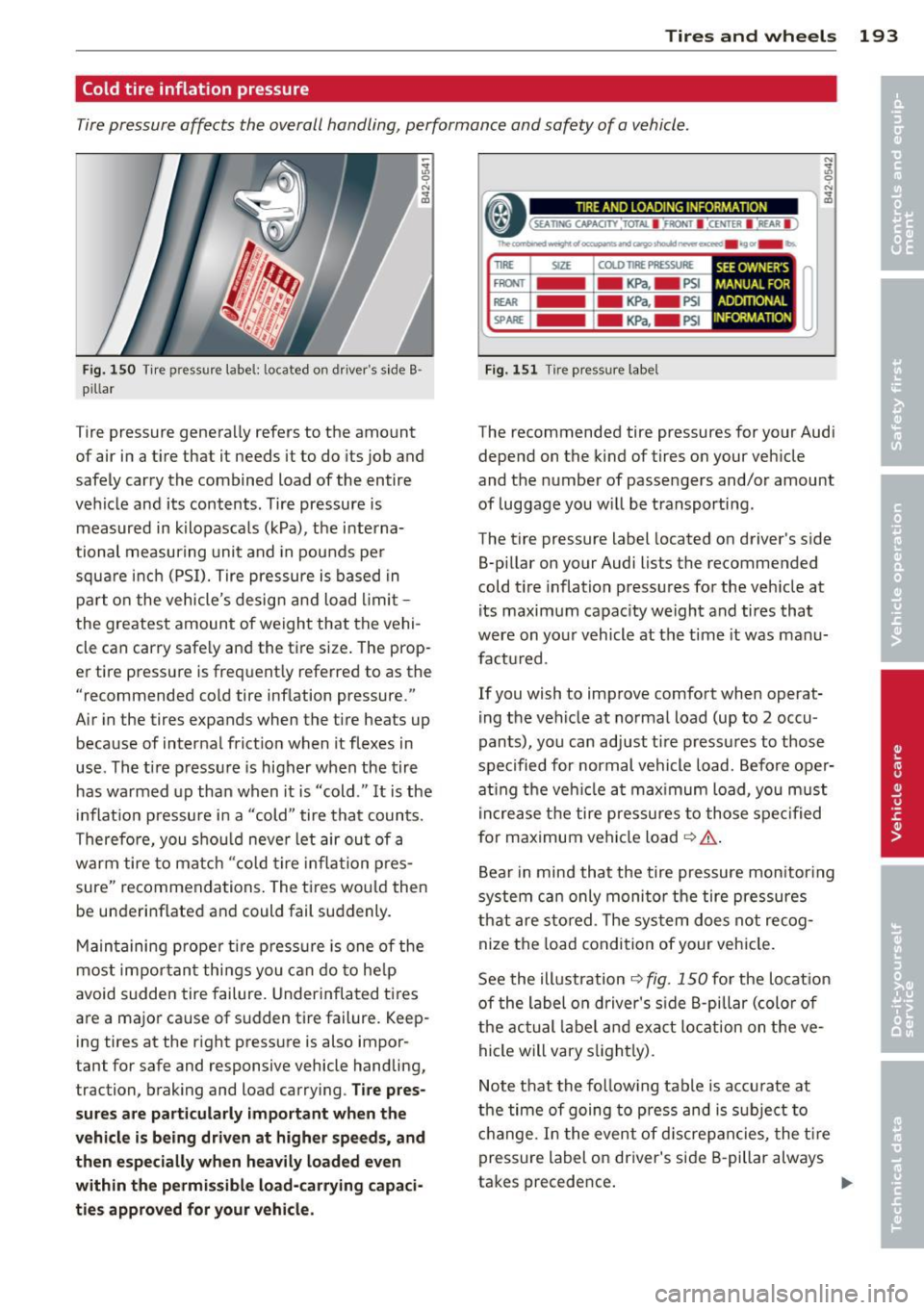
Fig. 150 Tire pressure label: located on driver's side B·
pillar
Tire pressure generally refers to the amount
of air in a tire that it needs it to do its job and
safely carry the combined load of the entire
vehicle and its contents. Tire pressure is measured in kilopascals (kPa), the interna
tional measuring unit and in pounds per
square inch (PSI). Tire pressure is based in
part on the vehicle's design and load limit
the greatest amount of weight that the vehi
cle can carry safely and the tire size. The prop
er tire pressure is frequently referred to as the
"recommended cold tire inflation pressure."
Air in the tires expands when the tire heats up
because of internal friction when it flexes in
use. The tire pressure is higher when the tire
has warmed up than when it is "cold." It is the
inflation pressure in a "cold" tire that counts.
Therefore, you should never let air out of a
warm tire to match "cold tire inflation pres
sure" recommendations. The tires would then be underinflated and could fail suddenly.
Maintaining proper tire pressure is one of the
most important things you can do to help
avoid sudden tire failure. Underinflated tires
are a major cause of sudden tire failure. Keep
ing tires at the right pressure is also impor
tant for safe and responsive vehicle handling,
traction, braking and load carrying .
Tire pres
sures are particularly important when the
vehicle is being driven at higher speeds, and
then especially when heavily loaded even
within the permissible load-carrying capaci
ties approved for your vehicle.
"' ..,
-~ --------------- ~ a ;l!; TIRE AND LOADING INFORMATION
• (SfATING CAPAOTY JOTAI. I }ROHT I :CUITTR I :R£AR I)
l'hl!o combned~c:loo:upain.sanoatg0,sbo&AdnM'fexeeC1 •"'.gcw -b.
COI.O TIRE PRESSURE
- KPa.- PSI
- KPa,- PSI
_ KPa,. PSI
Fig. 151 Tire pressure label
SEE OWNER'S
MANUA L FOR
ADDITTONAL
INFOl
u
The recommended tire pressures for your Audi
depend on the kind of tires on your vehicle
and the number of passe ngers and/or amount
of luggage you will be transporting.
The tire pressure label located on driver's side
B-pillar on your Audi lists the recommended
cold tire inflation pressures for the vehicle at
its maximum capacity weight and tires that
were on your vehicle at the time it was manu
factured.
If you wish to improve comfort when operat
ing the vehicle at normal load (up to 2 occu
pants), you can adjust tire pressures to those
specified for normal vehicle load. Before oper
ating the vehicle at maximum load, you must
increase the tire pressures to those specified
for maximum vehicle load
9 .&.
Bear in mind that the tire pressure monitoring
system can only monitor the tire pressures
that are stored. The system does not recog
nize the load condition of your vehicle.
See the illustration,:;,
fig. 150 for the location
of the label on driver's side B-pillar (color of
the actual label and exact location on the ve
hicle will vary slightly).
Note that the following table is accurate at
the time of going to press and is subject to
change. In the event of discrepancies, the tire
pressure label on driver's side B-pillar always
ta kes precedence. ..,.
Page 197 of 244
Checking tire pressure
The correct tire pressure for the tires original
ly installed on your vehicle is listed on the tire
pressure label located on driver's side 8-pil lar.
The recommended t ire pressures are on the
tire pressure label and in the table
r=> page 193, Cold tire inflation pressure . T his
means that the pressure must be checked and
a d ju sted when the tire has not been driven for
mo re than a couple of mi les (kilometers) at
l ow speeds during the p revious three hours.
Air in the tires expands when the tire heats up
as a result of internal fr iction as it flexes in
use. The tire pressure is higher when the tire
h as warmed up than when it is "cold".
It is the inflation pressure in a "cold" tire that
counts. Therefore, you shou ld never let air out
of a warm tire to match "Cold tire inflation pressure" recommendations
c> page 193 . The
tires would then be under infla ted and could
fa il suddenly.
The tire pressure label on yo ur Audi lists t he
recommended cold t ire inflat ion pressures for
the new, or igina l equipment tires that were
on you r vehicle at the t ime it was manufac
tured. For the location of the label
r=> page 193, fig. 150.
Most tires lose a ir natu rally over time. They
can also lose some a ir if you dr ive ove r a pot
hole o r hit a curb wh ile pa rking.
It is usua lly
not poss ib le to see whether the radial t ires
used today a re underin flated j ust by looking
at them.
Therefore, be sure to check tire pressures at
least o nce a month and always before going
on a long trip. Make sure to take the number
of people and the amount of luggage into ac
count when adjusting tire pressure for a trip -
even one that you would not consider to be
"long". See r:=>page 196, Tires and vehicle
load limits for more important information.
Always use an accurate tire pressure gauge
when check ing and adjusting inflation pres
sures . Check all of the t ires. If the pressure in
Tire s an d wheel s 195
any tire is too high when the tire is "cold", let
air out of the tire slowly with the edge of the
tire ga uge and keep checking the pressure un
ti l yo u reach the pressure that is correct for
the load (passengers and luggage) and kind of
driv ing you plan to do .
If the pressure in any ti re is too low, note the
difference between the pressure in the cold
tire and the pressure you need and add the air
that you need to reach the correct pressure for
t h e ve hicle load (passenge rs and luggage) for
t h e tires on your vehicle as l isted on the o n
you r vehicle and in this ma nual a nd the k ind
of d riving you plan to do .
Never exceed the max imum inflation pres
sure li sted on the tire sidewall for any rea
s on.
Remember that the vehicle manufacturer, not
t h e tire manufactu rer, determines t he cor rect
ti re p ressu re fo r the tires on your ve hicl e.
It is important to check the t ire pressure when
the tires are co ld .
- Read the required tire pressure from the t ire
pressure labe l located on driver's side B-pil
lar.
- T urn the va lve stem cap counter-clockw ise
to remove it from the tire va lve.
- Place t he air pressure gauge on the va lve.
- The tire pressures should o nly be checked
and ad justed when the tires are co ld . The
slightly raised pressures of warm tires must
not be reduced.
- Adj ust the tire pressure to the load you are
carrying.
- Reinstall the valve stem cap on the va lve.
When should I check the tire pr essu re?
T he co rrect tire pressu re is especially impor
t a nt a t high speeds. The pressure should
therefore be checked at least once a month
and always before starting a jo urney .
When should I adjust the tire pressures ?
Adjust the tire pressure to the load you a re
ca rrying. After chang ing a wheel
or rep lacing .,..
•
•
Page 209 of 244
soon as possible, and inflate them to the
proper pressure. Driving on a significant ly un
der-inflated tire causes the tire to overheat
and can lead to tire failure. Under-inflation a l
so reduces fuel efficiency and tire tread l ife,
and may affect the veh icle 's handling and
stopping ab ility.
Please note that the TPMS is not a substitute
for proper t ire maintenance, and it is the dr iv
er's responsib ility to ma inta in correct t ire
p ress ure , even if under- inflation has not
reached the leve l to t rigger illumination of the
TPMS low tire pressure telltale .
Your veh icle has also been equ ipped with a
TPMS malfunction indicato r to indicate when
the system is not ope rating properly. The
TPMS malfunc tion indica to r i s combined wi th
the low t ire p ressu re tell ta le. When the sys
tem detec ts a malf unct ion, the te lltale will
flash for approximately one minute and then remain continuo usly ill uminated . This se
q uence will cont inue upon subsequent vehicle
start-ups as long as the ma lfunction ex ists.
When the malfunction indicator is ill uminat
ed, the system may not be able to detect or
signa l low t ire pressure as intended . TPMS
malfunct ions may occ ur for a variety of rea
sons, including the ins talla tion of replace
ment or alternate tires o r whee ls on the veh i
cle that prevent the TPMS from funct io ni ng
p roperly . Always check the TPMS malfunct ion
t ellta le afte r replacing one o r more t ires or
wheels o n your veh icle to ensure tha t the re
p lacemen t or a lternate tires and wheels allow
the TPMS to continue to function properly .
Introduction
The tire pressure monitoring system monitors
air pressure in all four road wheels while the
vehicle is moving .
As soon as the tire pressu re mo nitor ing sys
tem senses a s ignificant loss o f air pressure in
one or severa l ti res, text messages and yellow
symbo ls appear in the instr ument cluster dis
p lay to alert the driver. The
[al warning light
Tire s an d wheel s 207
in the instrument cluster comes on when the
ti re is significant ly underinflated
Q page 34.
The wa rni ng lig ht [al also illu minates i n the
case of a system mal fun ct io n.
Be aware that t ire pressure is a lso dependent
o n the tempe ratu re of the t ire. For eve ry 18 ° F
(10 °C) incre ase in tir e te mper ature, tire pres
s u re inc reases by about 1.5 psi (0 .1 bar). The
ti re warms up while the vehicle is moving and
ti re p ress ure rises . So you sho uld ad just tire
pressure only when they a re
cold, when the
temperature of the tires is roughly the same
as the ambient a ir temperature.
In order to keep the tire press ure monitoring
system p roperly ca librated, t ire press ure on
all four tires sho uld be checked at regu lar in
terva ls.
The tire pressure is shown on the label located
on the dr iver's side B-pillar (v is ib le when the
door is open) .
A WARNING
When the tire pressure mo nitoring system
war ning light is lit , one o r more of your
tires is s ignificantly under-infla ted . You
shou ld stop and check your tires as soon as
pos sib le, and in flate t hem to the proper
p ress ure a s in dic ate d on the ve hicle's ti re
p ress ure lab el
¢page 19 3. D riving on a
significantly under -inflated ti re causes t he
tire to over heat and can lead to tire failure .
Under-inflat ion also is like ly to impair the
vehicle's handling and stopping ab ility.
@ For the sake of the environment
D riving wit h un der -inflated tires red uces
fuel efficiency an d tire t read life.
(D Tips
- E ach tire should be chec ked monthly
w hen the tem perature of the tires is
about the same as amb ient a ir tempera
t u re and set to the recommended infla
tion pressure as specified on the tire
pressure label
¢ pag e 193.
•
•
Page 210 of 244
208 Tir es and whee ls
- The tire pressure monitoring system
helps the driver to keep an eye on tire
pressures. But the driver st ill has the re
sponsibility for maintaining the correct
tire pressure.
- Tire pressure must only be adjusted
when the temperature of the tires is
about the same as ambient air tempera
ture.
- When tires are replaced, the sensors and
valves should not be exchanged . The
valve core, nut, valve sealing and seal
washer (rep lacement kit) needs to be re
placed. If necessary, the valve and the
whee l electronics have to be rep laced.
- The tire pressure monitoring system on
your Audi was calibrated us ing tires w ith
"RO" identification. We recommend us
i ng these tires.
- If you should put different whee ls and
ti res on yo ur vehicle (e.g. w inter wheels
and tires), yo u m ust be certain that the
whee ls and tires are compatible with the
tire pressure monitoring system . Other
wise the system w ill reg ister a ma lfunc
tion and a fault message will be d is
played . For more information, contact
your authorized Audi dealer .
- For Declaration of Compliance to United
States FCC and Industry Canada regula
tions
~ page 212 .
Programming a new set of tires
App lies to vehicles: with tire pressure monitor ing system
When driving with a new set of ti res, you can
p rogram them to the t ire pres sure monitoring
system using the menu disp lay.
"' Turn the ign ition on .
"' Se lect the menu :
Set > Tir e pr ess ure >
Wheel chang e.
"' Confirm that you wo uld like to begin the
programming p rocess. The message
Wheel
s ens ors are being in it iali sed. Thi s m ay ta ke
a fe w minute s .. .
appears in the instrument
cluster disp lay. You can switch between programmed tire sets
at any time without reinitializing the system .
(D Tips
If the programming process was not com
pleted successfully, the message
Wheel
s en sor s could not be initi alised
appea rs in
the disp lay and the
11118' indicator light
turns on. If this happens, repeat the pro
cedure .
Page 217 of 244
.. Remove the "max. 50 mph" (80 km/h) stick
er from the sealant bottle and affix it to the
instrument cluster in the driver's v iew .
A WARNING
-Turn the hazard flashers on if you have a
flat tire in moving traffic. In this way you
protect yourself and other road users.
- Make sure that all passengers are in a
safe place, out of the dange r zone (fo r
example, behind a guard ra il).
(D Note
Part icular care is necessary if you are mak
ing a t ire repair on a steep incline.
@ Tips
Obey all laws.
Making a tire repair
Tire repair consists of the following sections.
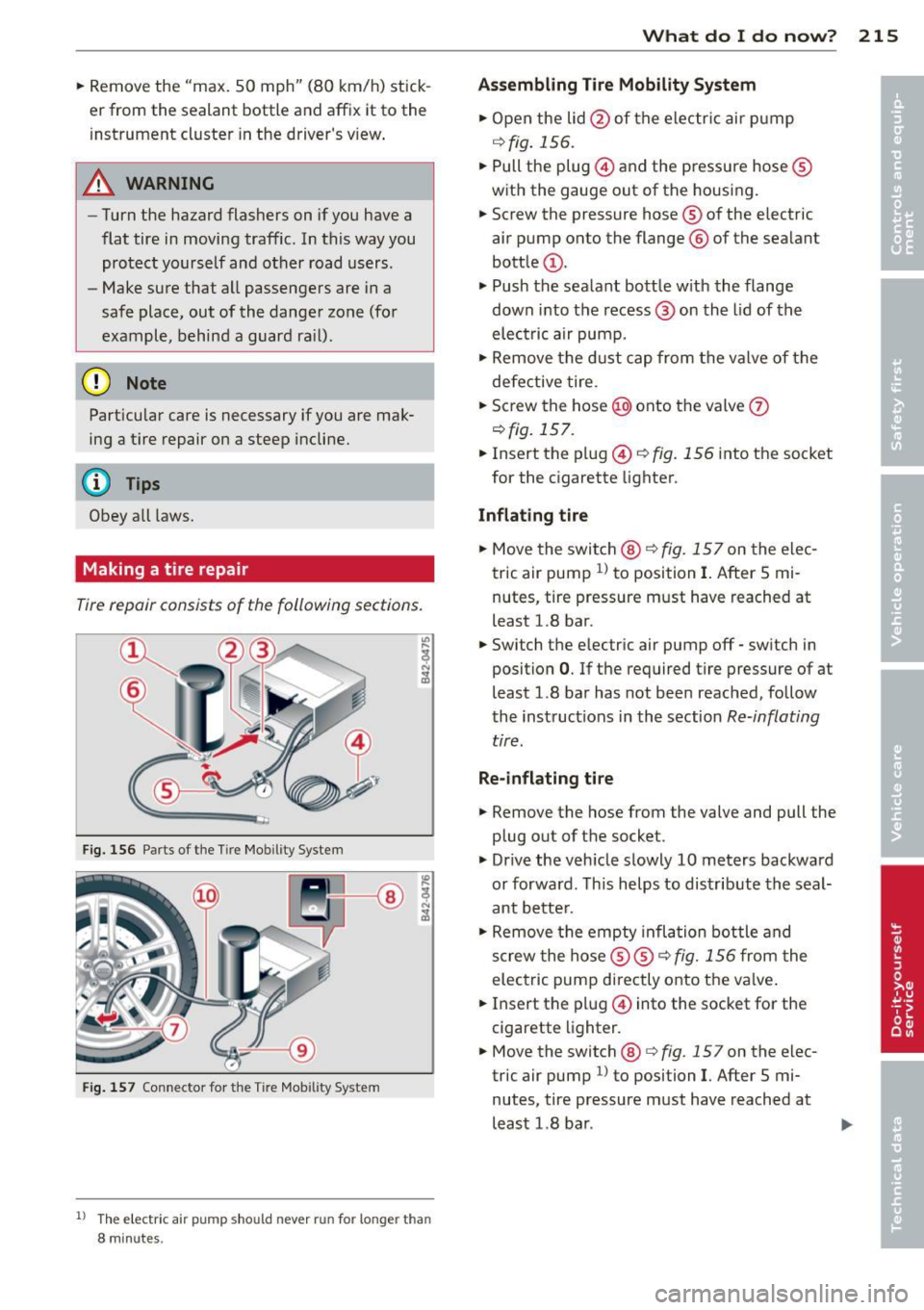
F ig. 156 Parts of the Tir e Mob ility System
F ig . 1 57 Con nector for the Ti re Mob ility System
l) The e lectr ic a ir pump s houl d never r un for long er than
8 m inutes.
What do I d o now ? 215
Assembling Ti re Mobility System
.. Open the lid @of the ele ctr ic air p ump
<:!) fig. 156 .
.. Pull the plug @and the pressure hose®
w ith the gauge out of the housing .
.. Screw the pressure hose® of the electric
air pump onto the flange @ of the sealant
bott le @ .
.,. Push the sea lant bottle w ith the flange
down into the recess @ on the lid of the
electric a ir pump.
.. Remove the dust cap from the valve of the
defe ctive tire .
.. Screw the hose @onto the valve (?)
c::> fig. 157.
.. Insert the plug@<::> fig. 156 into t he socket
for the c igarette lighte r.
Inf lating tire
.. Move the switch @ .::!)fig. 15 7 on the elec
tric air pump
l} to position I. After 5 mi
nutes, tire pressure m ust have reached at
least 1.8 bar .
.. Switch t he e lectr ic air pump off -sw itch in
position
0 . If the required tire pressure of at
least 1.8 bar has not been reached, follow
th e instruct ions in the section
Re-inflating
tire .
Re-inflating tire
.. Remove the hose from the valve and pull the
plug out of t he socket .
.. Dr ive the veh icle slowly 10 meters backward
or forward . T his helps to distribute the seal
ant bette r .
.. Remove the empty infla tion bottle and
s crew the hose ®®
c::> fig. 156 from the
electric pump directly onto the va lve .
.. Insert the plug@ into the socket for the
cigarette lighter .
.. Move the switch
@ Q fig. 15 7 on the elec
tric air pump
l} to position I. After S mi
nutes, tire pressure must have reached at
least 1.8 bar.
Page 220 of 244
218 What do I do n ow ?
-On hard, slippery sur face (such as tiles)
use a rubber mat or similar to prevent
the jack from slipping.
- To help prevent injury to yourself and
your passenge rs:
- Do not raise the vehicle unti l you a re
sure the ja ck is sec urely engaged.
- Passenge rs must not rema in i n the ve
h icl e when it is ja cked up.
- Make sure t hat passengers wait in a
safe p lace away from the vehicle and
well away from the road and traffi c.
- Make sure jack position is correct , ad
just as necessary and then continue to ra ise the jack.
CD Note
A floo r jack or the pads on the hoist arms
m ust
n ot be posit ioned at the points
shown
-arrows-.
Remov ing the wheel
Follow these instructions step-by-step for
changing the wheel.
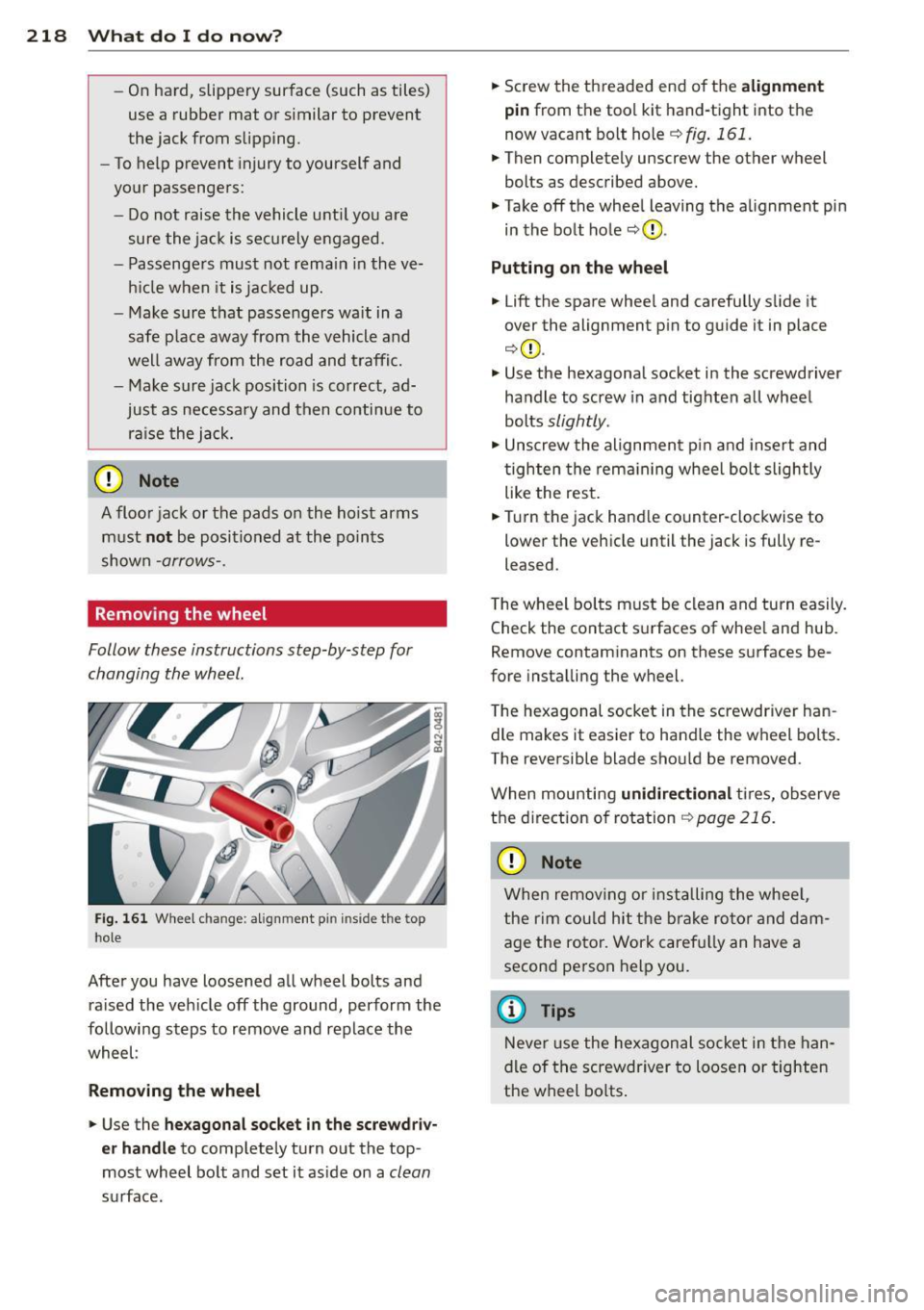
F ig . 161 Wh eel ch an ge : alignment pin in side the t op
hole
After you have loosened all wheel bolts and
ra ised the vehicle off the ground, perform the
following steps to remove and rep lace the
wheel :
Removing the wheel
" Use the
hexagon al socke t in the screwdri v
e r handle
to comp letely turn out the top
most wheel bolt and set it as ide on a
clean
surface . "
Sc rew the threaded end of the
al ignment
pin
from t he tool kit hand-tight into the
now vacant bolt ho le
c::> fig . 161.
" Then completely unscrew the other wheel
bolts as described above.
" Take off the whee l leaving the a lignment pin
in the bolt hole
c::> (D .
Putting on the wheel
"Lift the spare whee l and carefully s lide it
over the alignment p in to guide it in place
c::> (D .
" Use the hexagonal socket in the screwdriver
ha ndle to screw in and tighten a ll whee l
bolts
slightly .
"Unscrew the alignment p in and inse rt and
tighten the rema ining wheel bolt slightly
like the rest.
" Turn the jack hand le counter-clockwise to
lower the vehicle until the jack is fully re
leased.
T he wheel bo lts must be clean and turn easily.
Check the contact s urfaces of whee l and hub .
Remove contaminants on these surfaces be
fore insta lling the wheel.
T he hexagonal socket in the screwdriver han
dle makes it easier to handle the w heel bo lts.
The reversible blade shou ld be removed .
When mounting
u nidire ctional ti res, observe
the d irection o f rotation
c::> page 216.
CD Note
When remov ing or inst alling the whee l,
t he r im cou ld hi t the b ra ke ro tor and dam
age the rotor . Work caref ully an have a
second person help you.
(D Tips
Never use the he xagonal socket in the han
dle of t he screwdriver to loosen or tighten
the wheel bo lts .
Page 222 of 244
220 What do I do now?
connected to the battery of another vehicle,
using a pair of jumper cables to start the en
gine.
Both batteries must be rated at 12 volts. The
capacity (Ah) of the booster battery must not
be substantially less than the capacity of the
discharged battery.
Jumper cables Use
only jumper cables of sufficiently large
cross section to safely carry the starter cur
rent. Refer to the manufacturer's specifica
tions.
Use only jumper cables which have
insulated
terminal clamps and are properly marked for
distinction :
plus(+) cable: in most cases colored red
minus(-) cable: in most cases colored black
A WARNING
Batteries contain electricity, acid, and gas .
Any of these can cause very serious or fatal
injury. Follow the instructions below for
safe handling of your vehicle's battery.
- Always shield your eyes and avoid lean
ing over the battery whenever possible.
- A discharged battery can already freeze
at temperatures just below 32 °F (0 °C).
Before connecting a jumper cable, the
frozen battery must be thawed com
pletely, otherwise it could explode.
- Do not allow battery acid to contact eyes
or skin. Flush any contacted area with
water immediately.
- Improper use of a booster battery to
start a vehicle may cause an explosion.
- Vehicle batteries generate explosive gas
es. Keep sparks, flame and lighted ciga
rettes away from batteries.
- Do not try to jump start any vehicle with
a low acid level in the battery.
- The voltage of the booster battery must
also have a 12-Volt rating. The capacity
(Ah) of the booster battery should not be
lower than that of the discharged bat
tery. Use of batteries of different voltage or substantially different
"Ah" rating
may cause an explosion and personal in
jury.
- Never charge a frozen battery. Gas trap
ped in the ice may cause an explosion.
- Never charge or use a battery that has
been frozen . The battery case may have
be weakened .
- Use of batteries of different voltage or
substantially different capacity (Ah) rat
ing may cause an explosion and injury.
The capacity (Ah) of the booster battery should not be lower than that of the dis
charged battery.
- Before you check anything in the engine compartment, always read and heed all
WARNINGS
9 page 175, Working in the
engine comportment.
(!) Note
-Applying a higher voltage booster bat
tery will cause expensive damage to sen
sitive electronic components, such as
control units, relays, radio, etc.
- There must be no electrical contact be
tween the vehicles as otherwise current
could already start to flow as soon as the
positive(+) terminals are connected.
(D Tips
- The discharged battery must be properly
connected to the vehicle's electrical sys
tem.
- Switch off any car phone, or follow the
car phone instructions for this situation.
Page 225 of 244
Fuses and bulbs
Electrical fuses
Replacing fuses
Fuses that have blown will have metal strips
that have burned through.
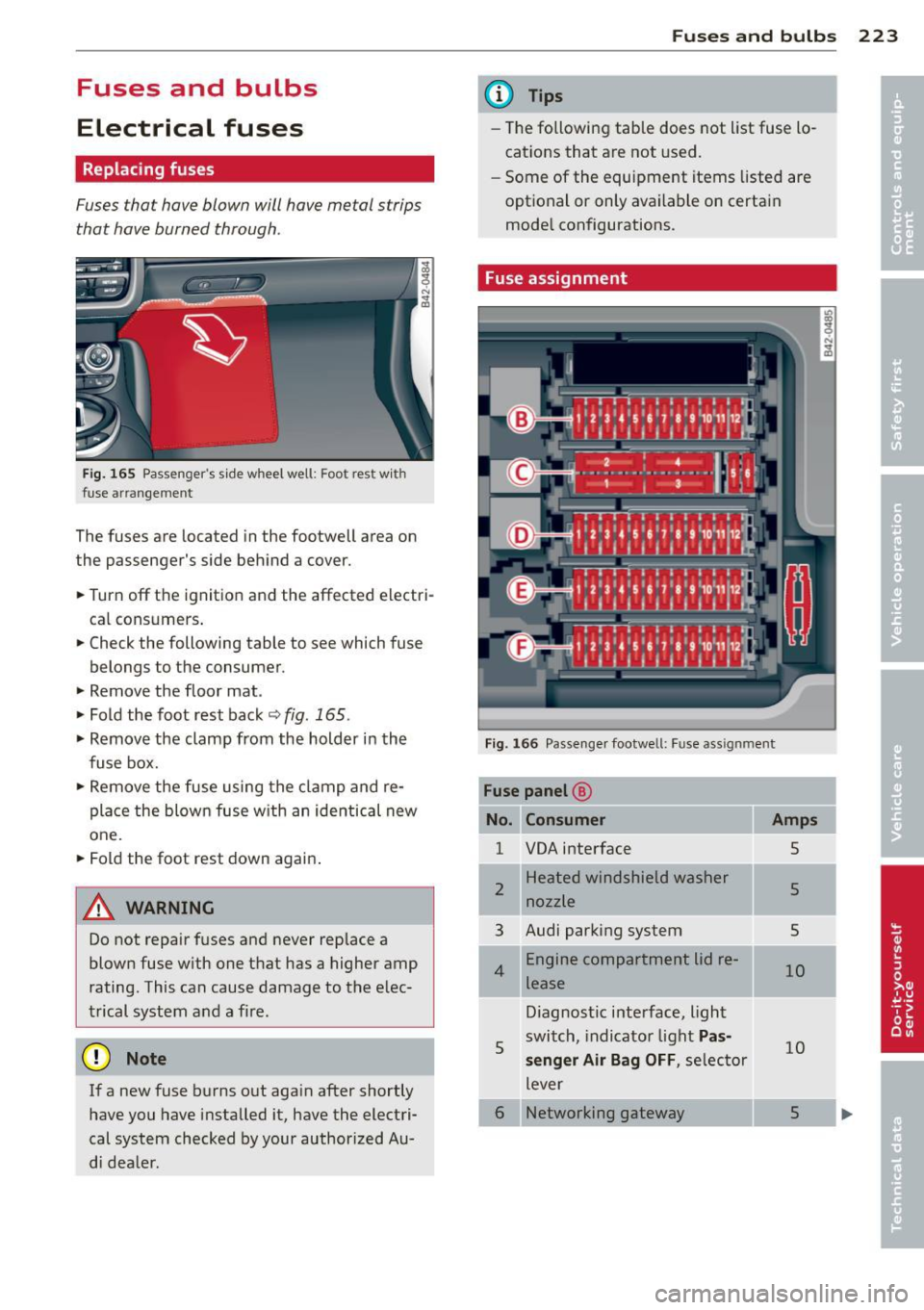
Fig. 165 Passenger's s ide wheel well: Foot rest with
fuse arrangement
The fuses are located in the footwell area on
the passenger's side behind a cover.
• Turnoff the ignition and the affected electri
cal consumers .
• Check the following table to see which fuse
belongs to the consumer.
• Remove the floor mat .
• Fold the foot rest back
c::> fig. 165.
• Remove the clamp from the holder in the
fuse box.
• Remove the fuse using the clamp and re
place the blown fuse w ith an identical new
one.
• Fold the foot rest down again .
A WARNING
Do not repair fuses and never replace a
blown fuse with one that has a higher amp
rating. This can cause damage to the elec
trical system and a fire.
(D Note
If a new fuse burns out again after shortly
have you have installed it, have the electri
cal system checked by your authorized Au
d i dealer.
Fuse s and bulbs 223
@ Tips
-The following table does not list fuse lo
cations that are not used.
- Some of the equipment items listed are
optional or only available on certain
mode l configurations.
Fuse assignment
Fig. 166 Passenge r footwe ll: Fuse assignment
Fuse panel @
Consumer
1 VOA interface
2
3
4
5
Heated windshield washer
nozzle
Audi parking system Engine compartment lid re
lease
Diagnostic interface, light
switch, indicator light
Pas
senger Air Bag OFF ,
selector
lever
6 Networking gateway
Amps
5
5
5
10
10
5
Page 226 of 244
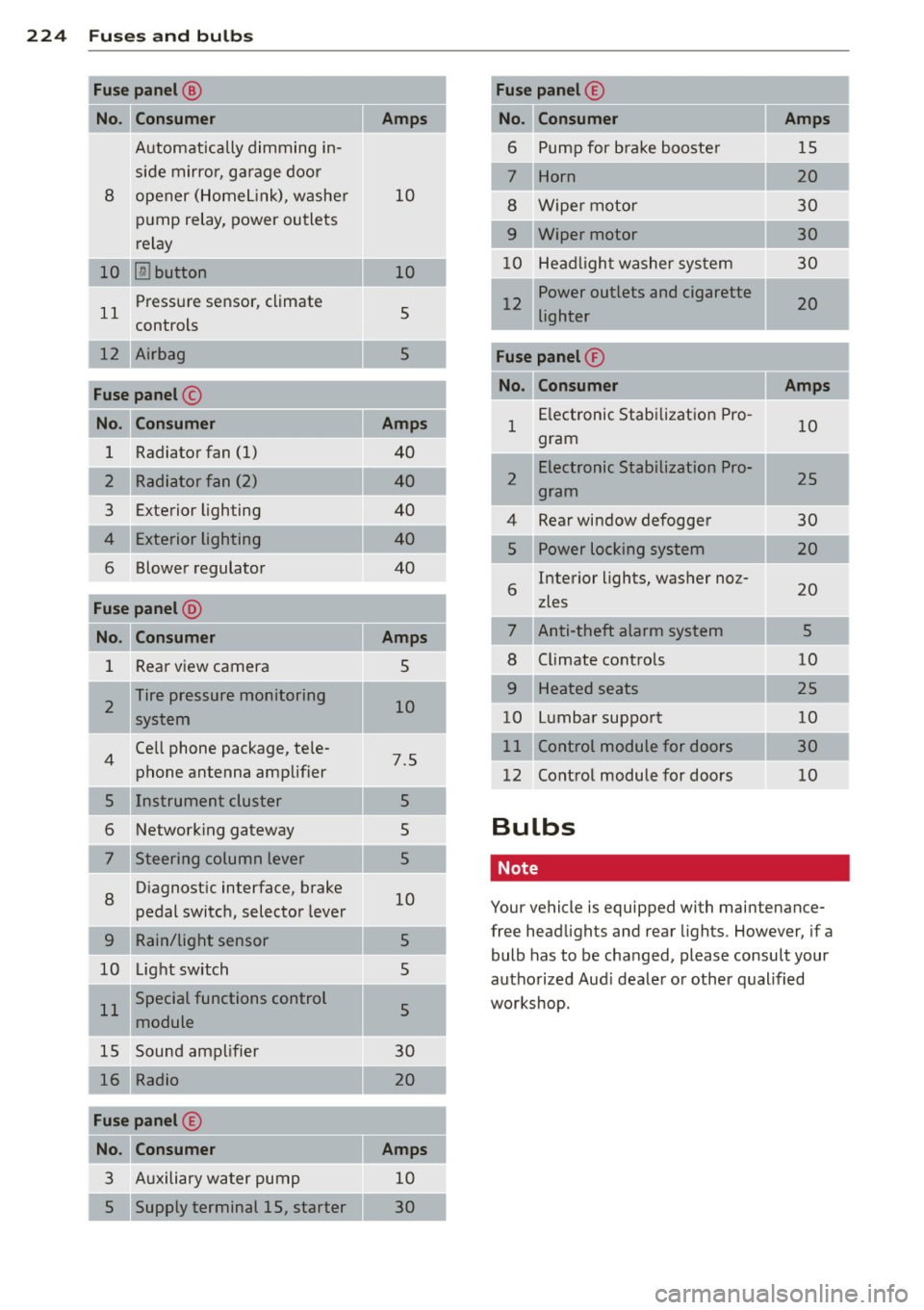
224 Fuses and bulbs
Fuse panel@
Consumer
Automatically dimming in-
side mirror, ga rage door
8 opener (Homel ink), washer
pump relay, power outlets
relay
10
~ button
11 Pressure sensor, climate
controls
12 Airbag
Fuse panel @
No . II Consumer
1 Radiator fan (1)
2 Radia tor fan (2)
3 Exterior lighting
4 Exterior lighting
6 Blower regulator
Fuse panel @
No . II Consumer
1 Rear view camera
2
Tire pressure monitoring
system
4
Cell phone package, te le-
phone antenna amplifier
5 Instrument cluster
6 Networking gateway
7 Steering column lever
8
Diagnostic interface, brake
pedal switch, selector lever
9 Rain/light sensor
10 Light switch
11 Special functions control
module
15 Sound amplifier
Radio
Fuse panel E
No. Consumer
3 Auxiliary water pump
5 Supply terminal 15, starter
Amps
10
10 5
5
II Amps
40 40
40
40
40
II Amps
5
10
7.5 5
5
5
10 5
5
5
30
20
Amps
10
30
Fuse panel @
No. Consumer
6 Pump for brake booster
7 Horn
8 Wiper motor
9 Wiper motor
10 Headlight washer system
12 Power outlets and cigarette
lighter
Fuse panel
®
No. !!Consumer
1
2
4
6
7
8
~~·
E lectronic Stabilization Pro
gram
Electronic Stabilization Pro
gram
Rear window defogger
Power locking system
Interior lights, washer noz
zles
Anti-theft alarm sys tem
Climate controls
Heated seats
Lumbar support
11 Control module for doors
12 Control module for doors
Bulbs
Note
Amps
15
20
30
30
30
20
ll Amps ,
10
25
30
20
20
5
10
25 10
30 10
Your vehicle is equipped with maintenance
free headlights and rear lights. However, if a
bulb has to be changed, please consult your
authorized Aud i dealer or other qualified
workshop .
Page 232 of 244

230 Index
A
A/C operation ................. .... .. 75
ABS
refer to Anti-Lock Brake System . .. .. . 150
A cces sories . . . . . . . . . . . . . . . . . . . . . . . . 211
Active rollover protection system . .. ... 107
Retracting rollover protection ... .. ... 107
Adding
Eng ine coolant ... ..... ... .. .. .. .. .
183
Eng ine oil .. .. . ... ... .. .. .. .. .. .. . 180
Addit ional accessories .. .... .... .. .. . 211
Additives .................. ... .... . 180
Adjustable steering column ...... .. .... 77
Adju sting front sea ts ....... .. .. .. .. . .
66
Advanced Airbag System
Children ... ............... .. .... .
139
Compon ents ................ ..... . 124
Front ai rbags . . . . . . . . . . . . . . . . . . . . . 122
How the component s work togethe r .. 125
Mon ito ring . .... .. ... .. .. .. .. .. .. . 128
Weight-sen sing mat .. .... .. .. .. .. . 139
Airbag system . . . . . . . . . . . . . . . . . 117, 136
Car e ... .. .. ................ ..... . 130
Child restraints .. .. ... ...... .. .. .. .
140
Components (fron t air bags) .. .. .... . 124
Danger of fitting a child safety seat on
the front passenger seat . . . . . . . . . . . .
119
Disposal ............. ........ .... 130
Front airbags ... .. ... .... .. .. .. .. . 121
H ow do the front airbags work? . .... . 126
How many airbags does my vehicle
have? .................... .. .... .
124
Important safety instructions on the
knee airbag system ....... .. .. .. .. .
134
Important things to know . . . . . . . . . . . 117
Indica tor ligh t .... .... ..... .. .. .. . 128
Knee airbags ... ... .... ..... .. .. .. . 132
Monitoring ................. ... ... 128
PASSENGER AIR BAG OFF light . . . . . . . 128
Service .. ...... .. ... .... .. .. .. .. . 130
Side airbags ..... .. .. .... .. .. .. .. . 135
Warning/indicator light ..... ... .... .. 17
When must the system be inspected? . 128
Air cond itioning
A/C operation . .... .... ..... .. .. .. .. 75
A ir distribution .... ....... .. .. .. .. ..
74
Air recirculation mode ......... .... .. 75 Automatic mode
.............. .... . 75
Controls . . . . . . . . . . . . . . . . . . . . . . . . . .
72
Defrost ..... .. .. .. .............. .. 75
E conomi cal use .. ....... ..... ..... .
76
Fan .. .... .. .. .. ...... ... .... .... . 74
Rear window defogger . . . . . . . . . . . . . . . 76
Switching on and off .... ......... .. . 74
Temperature ... ............ ........ 73
Air d istribution . . . . . . . . . . . . . . . . . . . . . . 7 4
Air recirculation mode Air condit ioning . ................. .. 75
All-wheel drive .. ............ .......
155
Winter tires . .. .. ... .. ..... ... .... 203
Anti-free ze
refer to Engine cool ant system ... .. .. 181
Anti-Lock Brake System .......... .... 150
Warning/indicator light ............ .. 18
Anti-Slip Regulation System .. .... .... 150
Anti- theft alarm system ... .... ... .... . 43
Anti-theft whee l bolts .............. . 216
Ashtray ........... .... ........... .. 69
ASR
refer to An ti-Slip Regulation System .. 150
Asterisk .... .. .. .. .. ................ . 6
Audi magnetic ride ................. ..
82
Description . . . . . . . . . . . . . . . . . . . . . . . . 82
Wa rning/ind icator light ... .. .. .. .. .. . 15
Aud i Servi ce Repa ir Manuals and Li te ra-
ture ........ ... .. .. ... ....... .... .
209
Automated manua l transmission
ref er to R tronic . ................. .. 85
Automat ic be lt retractor ...... .. ... .. 112
Autom atic car w ash
refer to Washing ........... ....... 16 1
Automatic headlight ................. 55
Automat ic headl ight control ...... .. .. .
62
Automatic headlight s
Defective . . . . . . . . . . . . . . . . . . . . . . . . . 3 5
Auto Safety Hotline ............. ....
105
Average fuel mileage . . . . . . . . . . . . . . . . . 23
Aver age speed . .. .. .. ..... .. .. .. .... . 23
B
Battery ..... ..... .. ............... 184
Cha rging .. .. .. .. ...... .. .. ... .... 186
Checking . . . . . . . . . . . . . . . . . . . . . . . . . 184