fuel AUDI R8 SPYDER 2011 Owner's Manual
[x] Cancel search | Manufacturer: AUDI, Model Year: 2011, Model line: R8 SPYDER, Model: AUDI R8 SPYDER 2011Pages: 244, PDF Size: 59.74 MB
Page 178 of 244
176 Checking and filling
thick rag over the cap when you open the coolant reservoir .
-If work on the fuel system or the electri
cal system is necessary:
- Always disconnect the battery .
- Never smoke or work near heaters or
open flames. Fluids in the engine com partment could start a fire .
- Keep an approved fire extinguisher im
mediately available.
- To avoid electrical shock and personal in
jury while the engine is running or being
started, never touch:
- Ignition cables
- Other components of the high voltage
electronic ignition system.
- If you must perform a check or repair
with the engine running:
- First, fully apply the parking brake,
move selector lever of R tronic to "N"
(Neutral); put manual transmission in
Neutral.
- Always use extreme caution to prevent
clothing, jewelry, or long hair from get
ting caught in the radiator fan, V-belts
or other moving parts, or from contact
ing hot parts . Tie back hair before
starting, and wear no clothing that will
hang or droop into the engine.
- Minimize exposure to emission and
chemical hazards~&. .
.&_ WARNING
California Proposition 65 Warning:
- Engine exhaust, some of its constituents,
and certain vehicle components contain
or emit chemicals known to the State of
California to cause cancer and birth de
fects and reproductive harm. In addition,
certain fluids contained in vehicles and
certain products of component wear con
tain or emit chemicals known to the
State of California to cause cancer and
birth defects or other reproductive harm .
- Battery posts, terminals and related ac cessories contain lead and lead com
pounds, chemicals known to the State of California to cause cancer and
reproduc
tive harms. Wash hands after handling.
@ Note
When adding fluids, always make sure that
they are poured into the proper container
or filler opening, otherwise serious dam
age to vehicle systems will occur.
@ For the sake of the environment
To detect leaks in time, inspect the vehicle
floor pan from underneath regularly. If
you see spots from oil or other vehicle flu
ids, have your vehicle inspected by an au
thorized Audi dealer.
Closing the engine compartment lid
... Make sure that the rear spoiler is retracted
~page 152.
""Pull the engine compartment lid down until
the pressure from the struts is reduced.
.., Press the engine compartment lid closed
c::>& .
A WARNING ,_
A engine compartment lid that is not com
pletely latched could fly up and block your
view while driving.
- When you close the engine compartment lid, check it to make sure the safety catch
has properly engaged . The engine com
partment lid should be flush with the
surrounding vehicle body parts .
- If you notice while driving that the en
gine compartment lid is not secured properly, stop at once and close it.
Page 192 of 244
190 Tire s and wheel s
-Never mount used tires on yo ur vehicle if
yo u are not sure of their "previous histo
ry." Old used tires may have been dam
aged even though the damage cannot be
seen that can lead to sudden tire failure
and loss of vehicle control.
Glossary of tire and loading terminology
Accessory weight
means t he comb ined we ight (in excess of
those standard items which may be rep laced)
of R t ron ic, powe r stee ring, powe r brakes,
power w indows , power sea ts, r ad io , a nd hea t
e r, to the extent that these i tems are available
as facto ry -in stalled equipment (whether in
stalled or not).
Aspect ratio
means t he ratio o f the heigh t to the w idth of
the tire in percen t. Numbers of 55 or lower in
d icate a low sidewall fo r improved s teer ing re
sponse and better overall handling on dry
pavement.
Bead
means t he pa rt of the t ire that is made o f
steel wires, wrapped o r reinforce d by p ly cor ds
and that is shaped to fi t the r im.
Bead separation
means a b reakdown of the bond between
components in the bead.
Cord
means the s trands forming the plies in the
tire .
Cold tire inflation pre ssure
means t he tire pressure recommended by the
ve hicle manufacture r for a tire of a designated
si ze that has not been dr iven for more than a
couple of miles (kilometers) at low speeds in
the three hour period before the tire pressure i s measu red or adjusted. -
If you notice un usua l vibration or if the
veh icle pulls to one side when driv ing, a l
ways stop as soon as it is safe to do so and check the wheels and tires for dam
age.
Curb weight
means the we ight of a motor ve hicle w ith
standard equipment includ ing the max imum
capa city of fuel, o il, and coolant, a ir cond i
ti on ing and addi tional weig ht o f option al
equipmen t.
Extra load tire
means a tire designed to operate at higher
loads and at highe r inflat ion p ress ures tha n
the cor responding standard tire . Extr a load
t ir es my be i dent ified as "XL", "xl", "E X T RA
LO AD", or "RF" on t he sidewall.
Gross Axle Weight Rating ( "GAWR ")
means the load-carry ing capacity of a s ingle
axle system , measured at the tire-ground in
te rfaces .
Gross Vehicle Weight Rating ( "GVWR ")
means the maximum total loaded we ight of
the vehicle.
Groove
means the space between two adjacent tread
ribs .
Load rat ing (code )
means the maximum load that a tire is rated
to carry fo r a given inflation press ure. Yo u
may not fi nd this information on all tires be
ca use it is not required by law.
Maximum load rating
me ans the lo ad r ati ng for a tire a t the m axi
mum perm issib le inf lation pressure for that
ti re .
Page 198 of 244
196 Tires and wheels
wheels you have to adjust the tire pressures
on all wheels.
A WARNING
Incorrect tire pressures and/or underinfla
tion can lead sudden tire failure, loss of
control, collision, serious personal injury
or even death.
- When the warning symbol
RI] appears in
the instrument cluster, stop and inspect
the tires .
- Incorrect tire pressure and/or underinfla
tion can cause increased tire wear and
can affect the handling of the vehicle and
stopping ability .
- Incorrect tire pressures and/or underin flation can also lead to sudden tire fail
ure, including a blowout and sudden de
flation, causing loss of vehicle control.
- The driver is responsible for the correct
tire pressures for all tires on the vehicle .
The applicable pressure values are locat
ed on a sticker on the driver's side 8-pil
lar.
- Only when all tires on the vehicle are fil
led to the correct pressure, the tire pres
sure monitoring system can work cor
rectly.
- The use of incorrect tire pressure values
can lead to accidents or other damage.
Therefore it is essential that the driver
observe the specified tire pressure values
for the tires and the correct pressures for
the function of the tire pressure monitor
ing system .
- Always inflate tires to the recommended
and correct tire pressure before driving
off .
- Driving with underinflated tires bend
more, letting them get too hot resulting
in tread separation, sudden tire failure
and loss of control.
- Excessive speed and/overloading can
cause heat build-up, sudden tire failure
and loss of control.
- If the tire pressure is too low or too high,
the tires will wear prematurely and the
vehicle will not handle well. -
If the tire is not flat and you do not have
to change a wheel immediately, drive at
reduced speed to the nearest service sta
tion to check the tire pressure and add
air as required .
(D Note
Driving without valve stem caps can cause
damage to the tire valves. To prevent this,
always make sure that factory installed
valve stem caps on all wheels are securely mounted on the valve.
@ For the sake of the environment
Underinflated tires will also increase the
fuel consumption .
Tires and vehicle load limits
There are limits to the amount of load or
weight that any vehicle and any tire can carry .
A vehicle that is overloaded will not handle
well and is more difficult to stop. Overloading
can not only lead to loss of vehicle control,
but can also damage important parts of the
vehicle and can lead to sudden tire failure, in cluding a blowout and sudden deflation that
can cause the vehicle to crash.
Your safety and that of your passengers also depends on making sure that load limits are
not exceeded. Vehicle load includes everybody
and everything in and on the vehicle . These
load limits are technically referred to as the
vehicle 's
Gross Vehicle Weight Rating
("GVWR").
The "GVWR" includes the weight of the basic
vehicle, all factory installed accessories, a full
tank of fuel, oil, coolant and other fluids plus
maximum load. The maximum load includes
the number of passengers that the vehicle is
intended to carry ("seating capacity") with an
assumed weight of 150 lbs. (68 kg) for each
passenger at a designated seating position
and the total weight of any luggage in the ve-
hicle. ..,_
Page 206 of 244
204 Tir es and whe els
eq uip all four wheels on your vehicle with cor
rectly fitted winter tires or all-season tires,
when winter road conditions are expected. This a lso improves the vehicle's braking per
formance and reduces stopping distances.
Summer tires provide less grip on ice and
snow.
W inter t ires (snow t ires) must always be fitted
on all four wheels.
Compat ible tire pressure mon itor ing sensors
must be installed on all fou r winter tires for
the tire pressure monitoring system to func
tion proper ly ~
page 201 .
Ask your authorized Aud i dea ler or qualified
wo rkshop for permitted
winter tir e sizes. Use
only radia l winter tires .
W inter t ires lose the ir effectiveness when the
tread is worn down to a depth of 0.157 inch
(4 mm) .
Only drive with winter tires under winter con
d itions . Summer tires handle better when
there is no snow or ice on the roads and the
temperature is above 45 °F (7 °C).
Please always remember that w inte r tires may
have a lower speed rating than the t ires origi
na lly installed on your veh icle at the t ime i t
was manufactured. Please see
r:!> page 200 ,
Speed roting (letter code) for a list ing of the
speed rating letter codes and the maximum
speed at which the tires can be driven.
The speed ra ting letter code
(~ page 191) is
on the s ide wall of the tire
r::!> poge 199.
A WARNING
Winter tires have maximum speed limits
that may be lower than your vehicle's max
im um speed . Always know the maxim um
speed before driving off. Never drive faster
than the speed permitted for your specific
w inte r tires . This will cause damage to the
tires leading to an accident and serious
personal in ju ry to you and your passen
gers.
A WARNING
Driving faster than the maximum speed
for which the winter tires on your veh icle
were designed can cause t ire failure in
cluding a blowout and sudden deflation,
l oss of cont ro l, crashes and ser ious per
sonal injuries. Have wo rn o r damaged ti res
r eplaced immediately.
- W inte r ti res have maxim um speed rating
that may be lower than your vehicle 's
maximum speed.
- Never drive fas ter than the speed for
which the win ter or othe r ti res installed
on yo ur vehicle are rated.
A WARNING ~
A lways ad just your driving to the road and
traffic condit ions. Never let the good ac
celeration of the winter tires and all-wheel
drive tempt you into taking extra risks. Al
ways remember:
- When braking, an all-wheel drive veh icle
handles in the same way as a front drive
veh icle.
- Drive carefully and reduce your speed on
icy and slippery roads, even w inter t ires
cannot help under black ice conditions .
~ For the sake of the environment
Use summer tires when weather condi
tions permit. They are qu ieter, do not wear
as quickly and reduce fuel consumpt ion.
Snow chains
-
S now cha ins may be fitted only to the rea r
whee ls, and o nly to certa in tire sizes . Ask your
autho rized Aud i dea le r o n whi ch tire sizes
snow c hains ca n be used.
T he snow chains must have low-profile links
and must not be t hicker than 0 .53 inch
(13 .5 mm), in cl ud ing the lock.
Remove wheel center covers before putt ing
snow c ha ins on your vehicle~@ . For safety
reasons cover caps must then be f itted over
Page 209 of 244
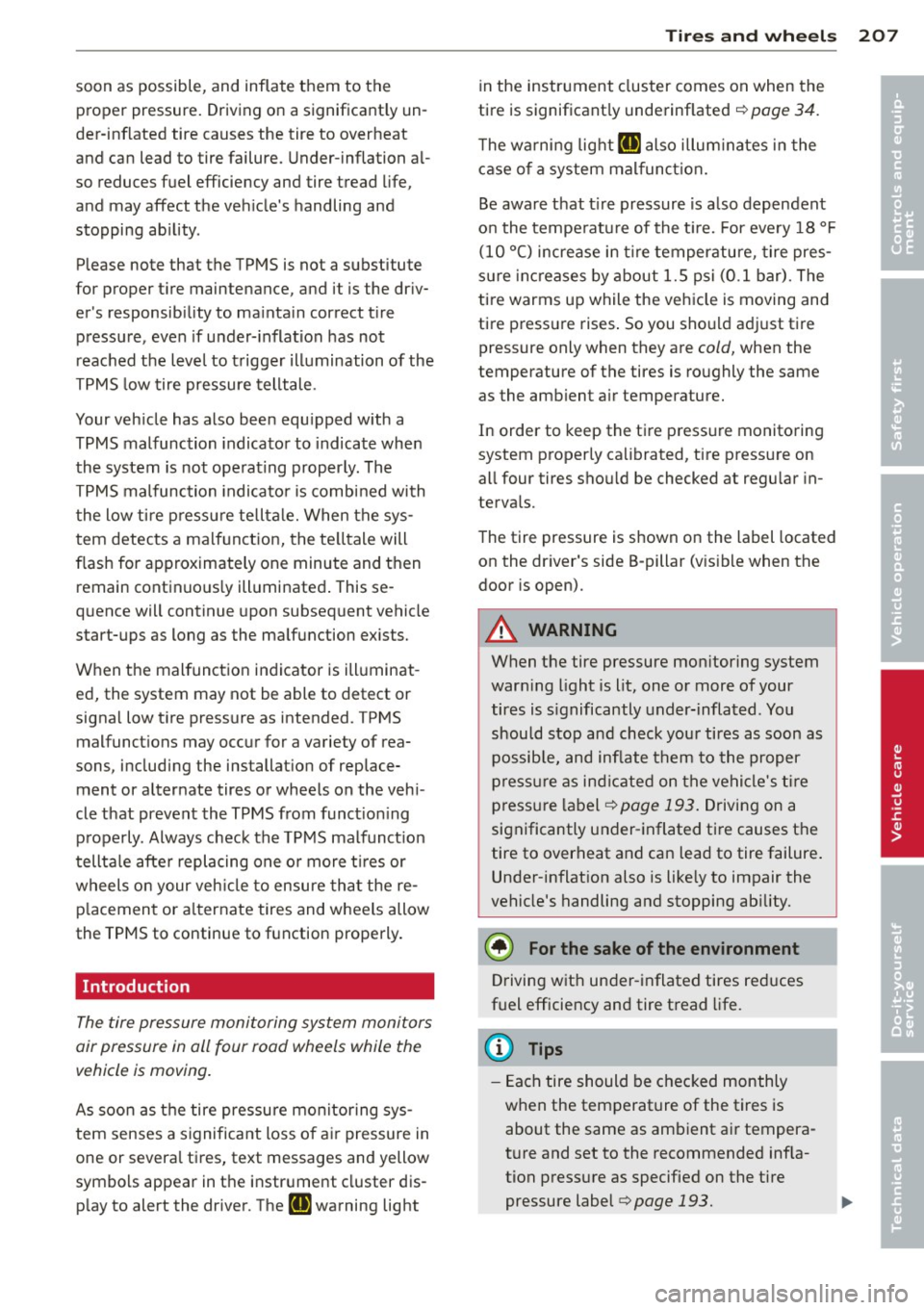
soon as possible, and inflate them to the
proper pressure. Driving on a significant ly un
der-inflated tire causes the tire to overheat
and can lead to tire failure. Under-inflation a l
so reduces fuel efficiency and tire tread l ife,
and may affect the veh icle 's handling and
stopping ab ility.
Please note that the TPMS is not a substitute
for proper t ire maintenance, and it is the dr iv
er's responsib ility to ma inta in correct t ire
p ress ure , even if under- inflation has not
reached the leve l to t rigger illumination of the
TPMS low tire pressure telltale .
Your veh icle has also been equ ipped with a
TPMS malfunction indicato r to indicate when
the system is not ope rating properly. The
TPMS malfunc tion indica to r i s combined wi th
the low t ire p ressu re tell ta le. When the sys
tem detec ts a malf unct ion, the te lltale will
flash for approximately one minute and then remain continuo usly ill uminated . This se
q uence will cont inue upon subsequent vehicle
start-ups as long as the ma lfunction ex ists.
When the malfunction indicator is ill uminat
ed, the system may not be able to detect or
signa l low t ire pressure as intended . TPMS
malfunct ions may occ ur for a variety of rea
sons, including the ins talla tion of replace
ment or alternate tires o r whee ls on the veh i
cle that prevent the TPMS from funct io ni ng
p roperly . Always check the TPMS malfunct ion
t ellta le afte r replacing one o r more t ires or
wheels o n your veh icle to ensure tha t the re
p lacemen t or a lternate tires and wheels allow
the TPMS to continue to function properly .
Introduction
The tire pressure monitoring system monitors
air pressure in all four road wheels while the
vehicle is moving .
As soon as the tire pressu re mo nitor ing sys
tem senses a s ignificant loss o f air pressure in
one or severa l ti res, text messages and yellow
symbo ls appear in the instr ument cluster dis
p lay to alert the driver. The
[al warning light
Tire s an d wheel s 207
in the instrument cluster comes on when the
ti re is significant ly underinflated
Q page 34.
The wa rni ng lig ht [al also illu minates i n the
case of a system mal fun ct io n.
Be aware that t ire pressure is a lso dependent
o n the tempe ratu re of the t ire. For eve ry 18 ° F
(10 °C) incre ase in tir e te mper ature, tire pres
s u re inc reases by about 1.5 psi (0 .1 bar). The
ti re warms up while the vehicle is moving and
ti re p ress ure rises . So you sho uld ad just tire
pressure only when they a re
cold, when the
temperature of the tires is roughly the same
as the ambient a ir temperature.
In order to keep the tire press ure monitoring
system p roperly ca librated, t ire press ure on
all four tires sho uld be checked at regu lar in
terva ls.
The tire pressure is shown on the label located
on the dr iver's side B-pillar (v is ib le when the
door is open) .
A WARNING
When the tire pressure mo nitoring system
war ning light is lit , one o r more of your
tires is s ignificantly under-infla ted . You
shou ld stop and check your tires as soon as
pos sib le, and in flate t hem to the proper
p ress ure a s in dic ate d on the ve hicle's ti re
p ress ure lab el
¢page 19 3. D riving on a
significantly under -inflated ti re causes t he
tire to over heat and can lead to tire failure .
Under-inflat ion also is like ly to impair the
vehicle's handling and stopping ab ility.
@ For the sake of the environment
D riving wit h un der -inflated tires red uces
fuel efficiency an d tire t read life.
(D Tips
- E ach tire should be chec ked monthly
w hen the tem perature of the tires is
about the same as amb ient a ir tempera
t u re and set to the recommended infla
tion pressure as specified on the tire
pressure label
¢ pag e 193.
•
•
Page 211 of 244
Consumer Information
Warranty coverages
Your Audi is covered by the following war
ranties :
-New Vehicle Limited Warranty
- Limited Warranty Against Corrosion Perfo-
ration
- Emissions Control System Warranty
- Emissions Performance Warranty
- California Emissions Control Warranty (USA
vehicles only)
- California Emissions Performance Warranty
(USA vehicles only)
Detailed information regarding yo ur warran
ties can be found in your
Warranty & Mainte
nance booklet .
Operating your vehicle
outside the U.S.A. or
Canada
Government regulations in the United States
and Canada require that automobiles meet
specific emission regulations and safety
standards. Therefore, veh icles built for the
U.S.A. and Canada differ from vehicles sold in
other countries .
I f you p lan to take your vehicle outside the
continental limits of the United States or Can
ada, there is the possibility that
- unleaded fuels for vehicles with cata lytic
converter may not be available;
- fuel may have a considerably lower octane
rating . Improper fuel may cause engine
damage;
- service may be inadequate due to lack of
proper service facilities, tools or testing
equipment;
- replacement parts may not be readily availa
ble.
- Navigation systems for vehicles built for the
U.S.A. and Canada will not necessari ly work
in Europe, and may not work in other coun
tries outside of North America.
Consumer Information 209
@ Note
Audi cannot be responsible for mechanical
damage that could result from inadequate
fuel, serv ice or parts availab ility.
Audi Service Repair
Manuals and Literature
Audi Offic ial Factory Service Manuals and Lit
erature are published as soon as possible after
model introduct ion. Service Manuals and liter
at ure are available to order from the Audi
T echnical Literature Ordering Center at:
https: //www. audi.techliterature.com
Maintenance
' General
Your vehicle has been designed to help keep
maintenance requirements to a minimum.
However, a certain amount of regular mainte
nance is still necessary to assure your vehicle's
safety, economy and reliability . For detailed
vehicle maintenance consult your Warranty& Maintenance booklet.
Under difficult operating conditions , for ex
ample at extremely low outside temperatures,
in very dusty regions, etc., some service work
shou ld be pe rformed between the intervals
specified. This applies particularly to:
- oil changes, and
- cleaning or replacing the air fi lter.
@ For the sake of the environment
By regu larly maintaining your vehicle, you
help make sure that emission standards
are maintained, thus minimizing adverse
effects on the environment.
Important considerations for you and
your vehicle
T he increasing use of electron ics, soph isticat
ed fuel injection and emission control sys
tems, and the genera lly increasing technica l
complexity of today's automobiles, have ..,_
•
•
Page 212 of 244
210 Consum er Inf orm ati on
steadi ly reduced the scope of maintenance
and repairs which can be carried out by vehicle
owners.
Als o, sa fe ty a nd en vir onm ent al con
cerns p lace very strict limits on the nature of
repairs and adjustments to engine and trans
miss ion parts which an owner can perform .
Maintenance, adjustments and repa irs usua lly
require special tools, testing devices and oth
er equipment available to specially trained
workshop personnel in order to assure proper pe rformance, reliab ility and safety of the vehi
cle and its many systems .
Improper maintenance, adjustments and re pa irs can impair the operation and reliab ility
of your vehicle and even void your vehicle war
ranty. Therefore , proof of servic ing in accord
ance w ith the ma intenance schedule may be a
condition for upholding a poss ible warranty
claim made within the warranty period.
Above all, operational safety can be adversely
affected, c reating unnecessary risks for you
and your passengers .
If in doubt about any se rv icing, have it done
by your author ized Audi dealer or any other
p roperly equipped and qualified workshop .
We strong ly urge you to give yo ur a utho rized
Aud i dealer the opportunity to perfo rm all
schedu led maintenance and necessary repairs.
Your dea ler has the facilities, original parts
and trained spec ialists to keep your vehicle
running properly .
Performing limit ed ma int enance your self
The following pages describe a limited num
ber of proced ures which can be performed on
your ve hicle with ordinary too ls, shou ld the
need arise and trained personnel be unavaila
ble. Before performing any of these proce
dures, always thoroughly read all of the app li
cable text and carefully follow the instruc
tions given . Always rigorously observe the
WARNINGS p rovided.
Before you ch eck a nything in th e eng ine
co mpartm ent , alwa ys re ad and h eed all
WA RNINGS
c::> .&. and c::> ..&. in Working in the
engine compartment on page 175.
A WARNING
- Serious personal injury may occur as a re
sult of improperly performed mainte
nance, adjustments or repa irs .
- Always be extremely careful when work
ing on the vehicle . Always follow com
monly accepted safety pract ices and gen
eral common sense. Never r is k personal
injury.
- Do not attempt any of the maintenance ,
checks or repairs descr ibed on the fol
lowing pages if you are not fu lly fam iliar
with these or other procedures with re
spect to the vehicle, or are uncertain how
to proceed .
- Do not do any work without the proper
too ls and equipment. Have the necessa ry
work done by your authorized A udi deal
er or another proper ly equipped and
qualified workshop.
- Always remove the ignition key before
anyone gets under the veh icle.
- Always support your veh icle with safety
stands if it is necessary to work under neath the vehicle . The jack* is not ade
quate for this purpose and cou ld collapse
causing ser ious personal inju ry.
- If you must work underneath the vehicle
with the wheels on the ground, a lways
make sure the vehicle is on level ground,
that the wheels a re a lways secure ly
b locked and that t he engine cannot be
started.
- Always make sure the transmission se
lec to r l ever is in "N" (Neut ral) (R t ron ic)
or Neutral (manual transmission) and
the hand bra ke is f irmly app lied.
@ For the sake of the environment
- Changing the engine sett ings will ad
verse ly affect emission leve ls. Th is is det
r imental to the environment and increas
es fuel consumpt ion .
- Always observe environmenta l regu la
tions when disposing of old eng ine oil,
used brake flu id, dirty engine coo lant,
spent batte ries o r worn out tires.
Page 228 of 244

226 General information
General information
Explanation of
technical data
Some of the techn ical data listed in this man
ual require further explanation.
The technical data for your vehicle are listed in
the charts starting on
¢ page 228 . This chap·
ter prov ides general information, notes and
r estrictions wh ich app ly to these data .
Vehicle identification
The key data are given on the vehicle identifi·
ca tion number (VIN) plate and the vehicle da
ta sticker.
©+-wAuzzz XXx XXXXXXXX
XXX XXX
xxxxxxx
xx x.x xx
XXXKW XXX XX/XX
®t-XXX
@-t-LY7X/LY7X
---xxx
N2M/ NQ
EOA ?AO 4UE 6XC 5SL 6TS
!KP .J1L !LT !BA
JFA SMU 7X1 4RS
FOA 8GR OG1 OYK 0.JG
TOL 3NZ 88B U2A
XOA 1N1
2PG 801 902 825 07G
700 C7A 7K0 4X3 2Kl
3L3 4KC JY0 4K4 501
lSA OGG 0lA 4GF
@-I= xx.x
®
X.X X.X XXX
® © @__,
Fi g. 1 67 The ve hicle ident ific ation labe l
The Vehicle Identification Number (VlN)
You can find t he Vehicle Ident if icat io n N um
be r (V IN) beh ind the windshie ld on t he lowe r
l eft side . You can a lso display the Vehicle
I dentification N umbe r of your vehicle in the
Driver Information display ~
page 24.
The vehicle identification label
The vehicle iden tification la bel ~fig. 167 is
located wi th the fuses in the footwe ll on the
passenger's side ¢
page 223.
The label s hows the following vehicle data :
(D Vehicle Ident ificat io n Number (chassis
num ber)
@ . Vehicle model/eng ine output/transmis-
sion
@ Engine and transm iss ion codes
@ Pa int a nd inte rior equipment numbe rs
® Optional equipment numbers
@ Fuel economy and emissions data
Vehicle data a re a lso fo und in your Wa rra nty
& Ma intenance booklet .
The safety compliance st icker
The safety compliance sticker is your assur
ance that yo ur new vehicle complies with all
applicable Federal Motor Vehicle Safety
Standards which we re in effect at the t ime the
vehicle was manufactured . You can find this
st icker on the left door jamb.
It s h ows the
mon th and ye ar of product io n and the veh icle
iden tification numbe r of your vehi cle (pe rfora
tio n) as well as t he Gross Vehicle Weight Rat
ing (GVWR) and the G ross Ax le Weight Rating
(GAWR).
The high voltage warning label
T he high vol tage warning label is lo cate d on
the lo ck car rier .
The spark ignition system meets all require
ment s of the Canadian Interferen ce -Causing
Equipment Regulation s.
Weights
Gross Vehicle Weight Rating
T he Gross Vehicle We ight Rat ing (GVWR), and
t h e Gross Axle Weight Rat ing (GAWR) for
fron t and rear are listed on a sticker on the
le ft doo r jamb.
The Gross Vehicle We ight Rat ing includes the
weight of the bas ic vehicle plus fu ll fuel ta nk,
o il a nd coo lant, plus max imum load , which in
cl udes p assenger we igh t (150 lbs./68 kg per
designate d seating posit ion) and luggage
weight .
IJ>,
Page 230 of 244
228 Data
Data
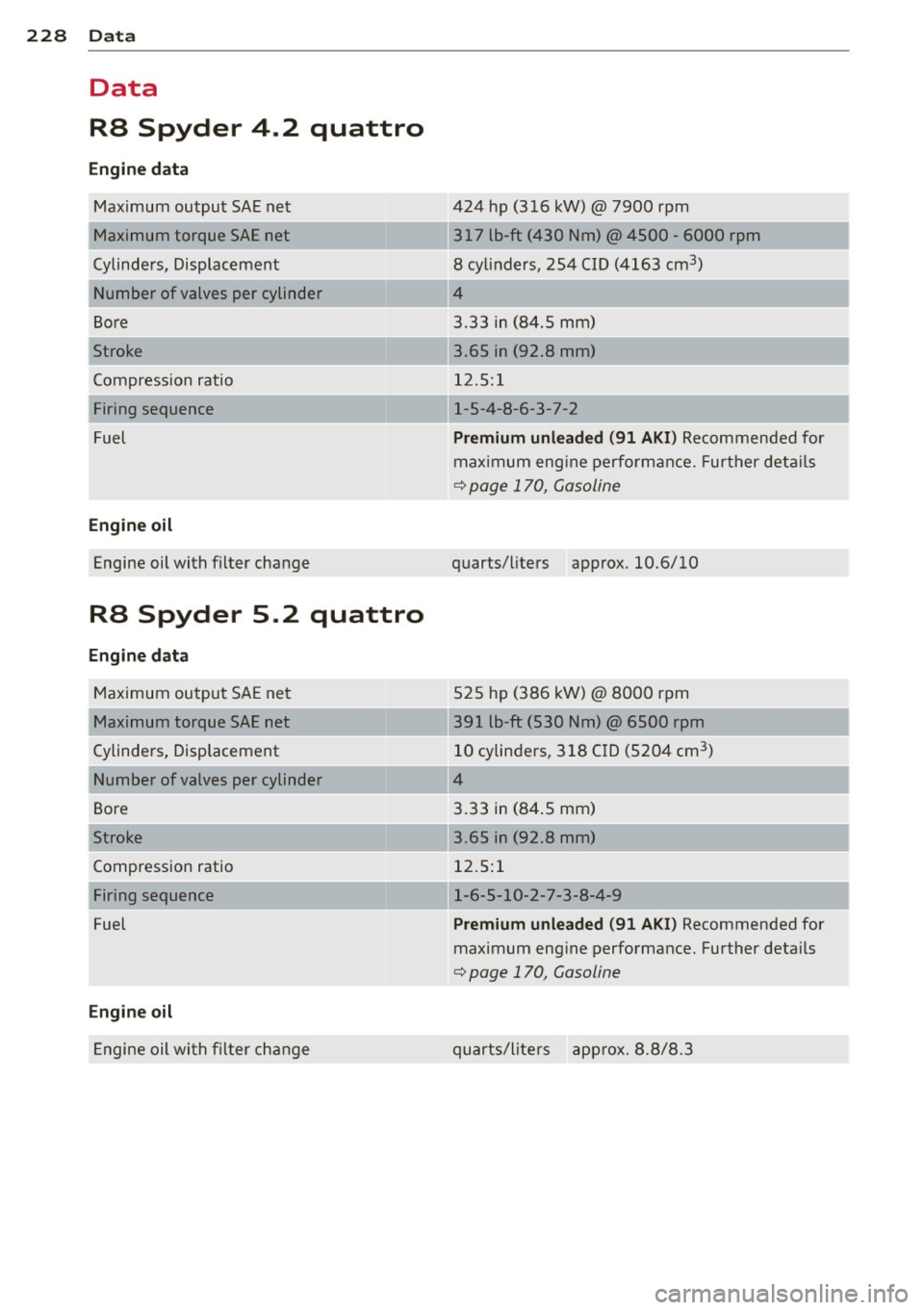
RB Spyder 4.2 quattro
Engine data
424 hp (316 kW)@ 7900 rpm
------,..--
Maximum output SAE net
Maximum torque SAE net
Cylinders, Displacement
Number of valves per cylinder
Bore
317 lb-ft (430 Nm) @ 4500 - 6000 rpm
8 cylinders, 254 CID (4163 cm3)
----~--
4
3.33 in (84 .5 mm)
3.65 in (92 .8 mm)
Stroke
Compression ratio
---------·
12.5:1
1-5-4-8-6-3-7-2
Firing sequence
Fuel _________ ...
Engine oil
Engine oil with filter change
RB Spyder 5.2 quattro
Engine data
Maximum output SAE net
Maximum torque SAE net
Cylinders, Displacement
Number of valves per cylinder
Bore
Stroke
Compression ratio
Firing sequence
Fuel
Engine oil Engine oil with filter change
Premium unleaded (91 AKI) Recommended for
maximum eng ine performance. Further details
¢ page 170, Gasoline
q1Uarts/liters approx.
10.6/10
525
hp (386 kW)@ 8000 rpm
391 lb-ft (530 Nm)@ 6500 rpm
10 cylinders, 318 CID (5204 cm3 )
4
3.33 in (84 .5 mm)
3.65 in (92.8 mm)
12.5:1
1-6-5-10-2-7-3-8-4-9
Premium unleaded (91 AKI) Recommended for
maximum engine performance. Further details
¢ page 170, Gasoline
quarts/l iters approx.
8.8/8.3
Page 231 of 244
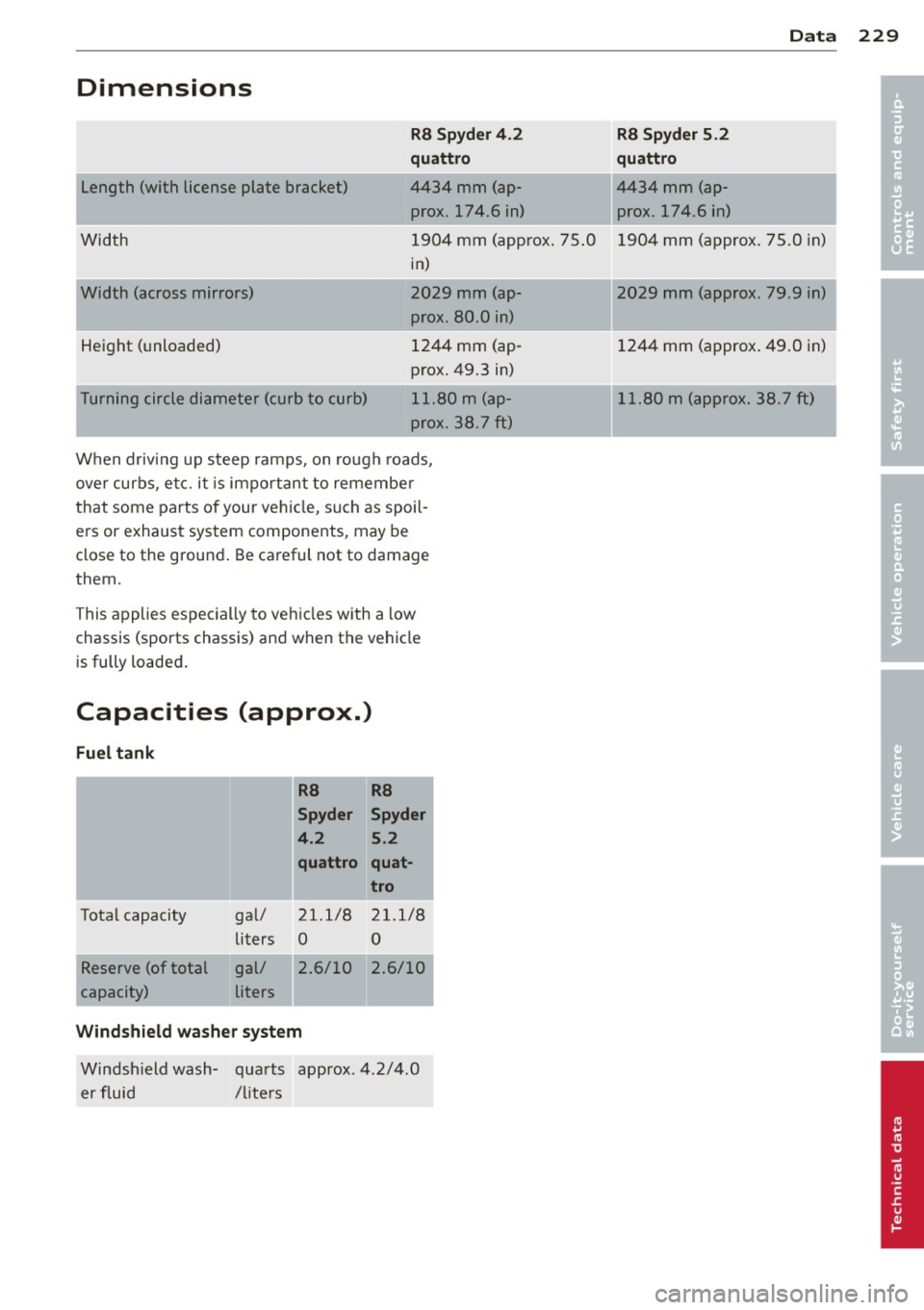
Dimensions
!Length (with license plate bracket)
Width
Width (across mirrors)
Height (unloaded)
T urning circle diameter (curb to curb) R8 Sp
yd er 4. 2
quattro
4434 mm (ap prox. 174.6 in)
1904 mm (approx . 75 .0
in)
2029 mm (ap prox. 80.0 in)
1244 mm (ap
prox. 49.3 in)
11.80
m (ap
prox. 3 8. 7
ft)
When driving up steep ramps, on rough roads,
over curbs, etc. it is important to remembe r
that some parts of your vehicle, such as spoil
ers or exhaust system components, may be
close to the ground . Be careful not to damage
them.
This applies especially to vehicles with a low chassis (sports chassis) and when the vehicle
is fully loaded .
Capacities (approx.)
Fuel tank
R8 R8
Spyder Spyder
4 .2 5.2
quattro quat -
tro
Total capacity gal/ 21.1/8 21.1/8
liters 0 0
Reserve (of total gal/ 2.6/10 2 .6/10
capacity) liters
Windshield wa she r sys tem
Windsh ield wash- quarts approx. 4.2/4.0
er fluid /liters
D ata 229
R8 Spyder 5.2
qu attro
4434 mm (ap prox. 174.6 in)
1904 mm (approx. 75.0 in)
2029 mm (approx. 79.9 in)
1
1244 mm (approx. 49.0 in)
11.80 m (approx. 38. 7
ft)
•
•