lock AUDI R8 SPYDER 2011 Workshop Manual
[x] Cancel search | Manufacturer: AUDI, Model Year: 2011, Model line: R8 SPYDER, Model: AUDI R8 SPYDER 2011Pages: 244, PDF Size: 59.74 MB
Page 178 of 244
176 Checking and filling
thick rag over the cap when you open the coolant reservoir .
-If work on the fuel system or the electri
cal system is necessary:
- Always disconnect the battery .
- Never smoke or work near heaters or
open flames. Fluids in the engine com partment could start a fire .
- Keep an approved fire extinguisher im
mediately available.
- To avoid electrical shock and personal in
jury while the engine is running or being
started, never touch:
- Ignition cables
- Other components of the high voltage
electronic ignition system.
- If you must perform a check or repair
with the engine running:
- First, fully apply the parking brake,
move selector lever of R tronic to "N"
(Neutral); put manual transmission in
Neutral.
- Always use extreme caution to prevent
clothing, jewelry, or long hair from get
ting caught in the radiator fan, V-belts
or other moving parts, or from contact
ing hot parts . Tie back hair before
starting, and wear no clothing that will
hang or droop into the engine.
- Minimize exposure to emission and
chemical hazards~&. .
.&_ WARNING
California Proposition 65 Warning:
- Engine exhaust, some of its constituents,
and certain vehicle components contain
or emit chemicals known to the State of
California to cause cancer and birth de
fects and reproductive harm. In addition,
certain fluids contained in vehicles and
certain products of component wear con
tain or emit chemicals known to the
State of California to cause cancer and
birth defects or other reproductive harm .
- Battery posts, terminals and related ac cessories contain lead and lead com
pounds, chemicals known to the State of California to cause cancer and
reproduc
tive harms. Wash hands after handling.
@ Note
When adding fluids, always make sure that
they are poured into the proper container
or filler opening, otherwise serious dam
age to vehicle systems will occur.
@ For the sake of the environment
To detect leaks in time, inspect the vehicle
floor pan from underneath regularly. If
you see spots from oil or other vehicle flu
ids, have your vehicle inspected by an au
thorized Audi dealer.
Closing the engine compartment lid
... Make sure that the rear spoiler is retracted
~page 152.
""Pull the engine compartment lid down until
the pressure from the struts is reduced.
.., Press the engine compartment lid closed
c::>& .
A WARNING ,_
A engine compartment lid that is not com
pletely latched could fly up and block your
view while driving.
- When you close the engine compartment lid, check it to make sure the safety catch
has properly engaged . The engine com
partment lid should be flush with the
surrounding vehicle body parts .
- If you notice while driving that the en
gine compartment lid is not secured properly, stop at once and close it.
Page 185 of 244
In a se ale d system, losses can occur only if
the boiling point of the coolant is exceeded as
a result of overheat ing.
A WARNING
- The cooling system is under press ure. Do
not open the cap of the coolant expan
sion tank when the eng ine is hot. You
risk being scalded .
- The coo lant add itive, and therefore the
coolant itse lf, is hazardous to health.
Keep the coolant additive in the origina l
co nta iner out of the reach of children.
It
is a poison hazard.
CD Note
Do not add any type of rad iator leak seal
ant to your vehicle's eng ine coolant. Add
ing radiator repair f luid may adve rsely af
fect the fu nction and performance of your
coo ling system and could res ult in damage
not covere d by your New Vehicle Limited
Warranty .
Adding coolant
Before you check anything in the engine com
partment,
always read and heed all WARN
INGS ¢ & in Working in the engine compart
ment on page 175 .
.. Add coolant .
.. Tw ist the cap on again
t ightly.
.. Tighte n the cap (D ¢ page 182, fig. 146
again .
Replacement engine coolant must conform to
exact specifications ¢
page 181, Coolant. If
the coolant additive Gl2++ is not available in
an emergency, you must not add any other ad
d itive . In th is case, use only water and restore
the co rrec t mix ratio wi th the specified cool
ant add itive as soon as possib le.
Always use
new engine coolant when ref illing .
Do not fill coolant above the " MAX" mark. Ex
cess coolant will be forced out through the p ressure relief valve i n the cap when the en
g ine becomes hot .
Checking and fillin g 183
With a major loss of coolant, you shou ld add
the coolant only when the engine has
cooled.
In this way you prevent engine damage.
A WARNING
- The cooling system is unde r pressure and
can get very hot. Reduce the risk of
scalding from hot coolant by followi ng
these steps .
- Turn off t he engine and allow it to coo l
down.
- Protect you r fa ce, hands and arms from
escaping fluid and steam by covering
the cap with a large, th ic k rag.
- Turn the cap s lowly and very carefully
in a counter -clockwise direction while
applying light, downward pressure on
the top
of the cap.
- To avoid being bu rned, do not spill an
tifreeze or coolant on the ex haust sys
tem or hot engine pa rts. Under certain
cond itions, the ethylene glycol in en
gine coolant can catch fire .
- Antifreeze is poisonous . Always store an
tifreeze in its origina l container and well
out of the reach of children .
- If you dra in the coo lant, it m ust be
caught and safely stored in a proper con
taine r clearly marked " poison" .
CD Note
- Coolant pollutes the environment and
cou ld cause an engine fire. Excess cool
ant will be forced out through the pres
sure relief valve in the cap w hen the en
gine becomes hot .
- If, in an eme rgency, o nly wate r can be
added, the co rrec t ratio between wa ter
and antifreez e
¢page 181 must be re
stored as soon as poss ible.
@) For the sake of the environment
D ra ined coola nt sho uld not be reused. Al
ways d ispose of used coolant while observ
i ng a ll environmental regula tions. •
•
Page 186 of 244
184 Checking and filling
Brake fluid
Notice
Have the brake fluid changed by an experi
enc ed technician .
Brake fluid abso rbs moisture from t he a ir. If
the water content in the brake fluid is t oo
high, corrosion in the brake system may result
after a per iod of t ime . The bo iling po int of the
brake fluid w ill also decrease considerably and
dec rease b rak ing performance.
Therefore, the brake flu id must be changed
e ver y two y ear s. Always use new brake fluid
which confo rms to Fede ral Motor Vehicle
Standa rd "FMVSS 1 16 DO T 4".
Brake fluid is rep laced according to the Audi
maintena nce service schedule . Your author
ized Audi dealer is equipped with the necessa
ry special tools and rep lacement parts , has
the necessary expe rtise, and c an d ispose of
the used fluid .
& WARNING
-Brake fluid is po isonous. It must be sto r
ed on ly in the closed orig inal container
o ut o f the reach of children!
- Brake fa ilure can result from old or inap
propriate b rake fluid . Observe these pre
caut ions:
- Use only bra ke fluid that meets SAE
specifi cation
J 1 703 and co nfo rms to
F ederal Motor Vehicle St andard 116 .
A lways check with you r a uthorized Aud i
dea ler to make s ure you are using the
correct brake fl uid. T he correct type of
brake fluid is a lso indicated on the
brake fluid reservoir.
- The brake fluid must be new. Heavy use
of the brakes can cause a vapor lock if
the brake fl uid is left in the system too
long . This can ser ious ly affect the effi
cie ncy of the bra kes as well as yo ur
safety. This could result in an acc ident .
(D Note
Brake fluid will damage the paint of you r
vehicle .
@ For the sake of the environment
Because o f the prob lem of p rope r disposal
of brake fluid as well as the spec ial too ls
r equired and the necessary expertise, we
recommend that yo u have the brake fl uid
changed by yo ur authorized Aud i dea le r.
Battery
General information
All work on the battery requires technical
knowledge.
The battery is located behind the cover i n the
l uggage compa rtme nt. Remove the cover by
pushing it to the left and lift ing it o ut.
The battery is practically maintenance-free
and is checked as pa rt of your ve hicle's main
tenance se rv ices .
You are we ll advised to replace a battery that
is older than S years .
Disconnecting the battery terminal s
Some vehicle functions (power window reg u
lators, for example) are lost if the battery te r
mina ls are disconnected . T hese functions have
to be relearned after the battery termina ls are
connected again . To prevent th is, the battery
shou ld only be disco nnected from the ve hicle
electrica l system when abso lutely necessary
f o r repai rs.
Vehicles not driven for long periods
The battery becomes d ischarged due to quies
cent current consume rs even when the vehicle
i s not used . With extended pe riods of non-use
i n the
cold season, you should have the ve hi
cl e battery removed by an autho rized Aud i
de aler or qu alified workshop and stored in an
frost -free place. This preven ts the battery
from "freezing" and thereby being dest royed.
D uring the
warmer seasons it is eno ugh to liJ>
Page 197 of 244
Checking tire pressure
The correct tire pressure for the tires original
ly installed on your vehicle is listed on the tire
pressure label located on driver's side 8-pil lar.
The recommended t ire pressures are on the
tire pressure label and in the table
r=> page 193, Cold tire inflation pressure . T his
means that the pressure must be checked and
a d ju sted when the tire has not been driven for
mo re than a couple of mi les (kilometers) at
l ow speeds during the p revious three hours.
Air in the tires expands when the tire heats up
as a result of internal fr iction as it flexes in
use. The tire pressure is higher when the tire
h as warmed up than when it is "cold".
It is the inflation pressure in a "cold" tire that
counts. Therefore, you shou ld never let air out
of a warm tire to match "Cold tire inflation pressure" recommendations
c> page 193 . The
tires would then be under infla ted and could
fa il suddenly.
The tire pressure label on yo ur Audi lists t he
recommended cold t ire inflat ion pressures for
the new, or igina l equipment tires that were
on you r vehicle at the t ime it was manufac
tured. For the location of the label
r=> page 193, fig. 150.
Most tires lose a ir natu rally over time. They
can also lose some a ir if you dr ive ove r a pot
hole o r hit a curb wh ile pa rking.
It is usua lly
not poss ib le to see whether the radial t ires
used today a re underin flated j ust by looking
at them.
Therefore, be sure to check tire pressures at
least o nce a month and always before going
on a long trip. Make sure to take the number
of people and the amount of luggage into ac
count when adjusting tire pressure for a trip -
even one that you would not consider to be
"long". See r:=>page 196, Tires and vehicle
load limits for more important information.
Always use an accurate tire pressure gauge
when check ing and adjusting inflation pres
sures . Check all of the t ires. If the pressure in
Tire s an d wheel s 195
any tire is too high when the tire is "cold", let
air out of the tire slowly with the edge of the
tire ga uge and keep checking the pressure un
ti l yo u reach the pressure that is correct for
the load (passengers and luggage) and kind of
driv ing you plan to do .
If the pressure in any ti re is too low, note the
difference between the pressure in the cold
tire and the pressure you need and add the air
that you need to reach the correct pressure for
t h e ve hicle load (passenge rs and luggage) for
t h e tires on your vehicle as l isted on the o n
you r vehicle and in this ma nual a nd the k ind
of d riving you plan to do .
Never exceed the max imum inflation pres
sure li sted on the tire sidewall for any rea
s on.
Remember that the vehicle manufacturer, not
t h e tire manufactu rer, determines t he cor rect
ti re p ressu re fo r the tires on your ve hicl e.
It is important to check the t ire pressure when
the tires are co ld .
- Read the required tire pressure from the t ire
pressure labe l located on driver's side B-pil
lar.
- T urn the va lve stem cap counter-clockw ise
to remove it from the tire va lve.
- Place t he air pressure gauge on the va lve.
- The tire pressures should o nly be checked
and ad justed when the tires are co ld . The
slightly raised pressures of warm tires must
not be reduced.
- Adj ust the tire pressure to the load you are
carrying.
- Reinstall the valve stem cap on the va lve.
When should I check the tire pr essu re?
T he co rrect tire pressu re is especially impor
t a nt a t high speeds. The pressure should
therefore be checked at least once a month
and always before starting a jo urney .
When should I adjust the tire pressures ?
Adjust the tire pressure to the load you a re
ca rrying. After chang ing a wheel
or rep lacing .,..
•
•
Page 206 of 244
204 Tir es and whe els
eq uip all four wheels on your vehicle with cor
rectly fitted winter tires or all-season tires,
when winter road conditions are expected. This a lso improves the vehicle's braking per
formance and reduces stopping distances.
Summer tires provide less grip on ice and
snow.
W inter t ires (snow t ires) must always be fitted
on all four wheels.
Compat ible tire pressure mon itor ing sensors
must be installed on all fou r winter tires for
the tire pressure monitoring system to func
tion proper ly ~
page 201 .
Ask your authorized Aud i dea ler or qualified
wo rkshop for permitted
winter tir e sizes. Use
only radia l winter tires .
W inter t ires lose the ir effectiveness when the
tread is worn down to a depth of 0.157 inch
(4 mm) .
Only drive with winter tires under winter con
d itions . Summer tires handle better when
there is no snow or ice on the roads and the
temperature is above 45 °F (7 °C).
Please always remember that w inte r tires may
have a lower speed rating than the t ires origi
na lly installed on your veh icle at the t ime i t
was manufactured. Please see
r:!> page 200 ,
Speed roting (letter code) for a list ing of the
speed rating letter codes and the maximum
speed at which the tires can be driven.
The speed ra ting letter code
(~ page 191) is
on the s ide wall of the tire
r::!> poge 199.
A WARNING
Winter tires have maximum speed limits
that may be lower than your vehicle's max
im um speed . Always know the maxim um
speed before driving off. Never drive faster
than the speed permitted for your specific
w inte r tires . This will cause damage to the
tires leading to an accident and serious
personal in ju ry to you and your passen
gers.
A WARNING
Driving faster than the maximum speed
for which the winter tires on your veh icle
were designed can cause t ire failure in
cluding a blowout and sudden deflation,
l oss of cont ro l, crashes and ser ious per
sonal injuries. Have wo rn o r damaged ti res
r eplaced immediately.
- W inte r ti res have maxim um speed rating
that may be lower than your vehicle 's
maximum speed.
- Never drive fas ter than the speed for
which the win ter or othe r ti res installed
on yo ur vehicle are rated.
A WARNING ~
A lways ad just your driving to the road and
traffic condit ions. Never let the good ac
celeration of the winter tires and all-wheel
drive tempt you into taking extra risks. Al
ways remember:
- When braking, an all-wheel drive veh icle
handles in the same way as a front drive
veh icle.
- Drive carefully and reduce your speed on
icy and slippery roads, even w inter t ires
cannot help under black ice conditions .
~ For the sake of the environment
Use summer tires when weather condi
tions permit. They are qu ieter, do not wear
as quickly and reduce fuel consumpt ion.
Snow chains
-
S now cha ins may be fitted only to the rea r
whee ls, and o nly to certa in tire sizes . Ask your
autho rized Aud i dea le r o n whi ch tire sizes
snow c hains ca n be used.
T he snow chains must have low-profile links
and must not be t hicker than 0 .53 inch
(13 .5 mm), in cl ud ing the lock.
Remove wheel center covers before putt ing
snow c ha ins on your vehicle~@ . For safety
reasons cover caps must then be f itted over
Page 212 of 244
210 Consum er Inf orm ati on
steadi ly reduced the scope of maintenance
and repairs which can be carried out by vehicle
owners.
Als o, sa fe ty a nd en vir onm ent al con
cerns p lace very strict limits on the nature of
repairs and adjustments to engine and trans
miss ion parts which an owner can perform .
Maintenance, adjustments and repa irs usua lly
require special tools, testing devices and oth
er equipment available to specially trained
workshop personnel in order to assure proper pe rformance, reliab ility and safety of the vehi
cle and its many systems .
Improper maintenance, adjustments and re pa irs can impair the operation and reliab ility
of your vehicle and even void your vehicle war
ranty. Therefore , proof of servic ing in accord
ance w ith the ma intenance schedule may be a
condition for upholding a poss ible warranty
claim made within the warranty period.
Above all, operational safety can be adversely
affected, c reating unnecessary risks for you
and your passengers .
If in doubt about any se rv icing, have it done
by your author ized Audi dealer or any other
p roperly equipped and qualified workshop .
We strong ly urge you to give yo ur a utho rized
Aud i dealer the opportunity to perfo rm all
schedu led maintenance and necessary repairs.
Your dea ler has the facilities, original parts
and trained spec ialists to keep your vehicle
running properly .
Performing limit ed ma int enance your self
The following pages describe a limited num
ber of proced ures which can be performed on
your ve hicle with ordinary too ls, shou ld the
need arise and trained personnel be unavaila
ble. Before performing any of these proce
dures, always thoroughly read all of the app li
cable text and carefully follow the instruc
tions given . Always rigorously observe the
WARNINGS p rovided.
Before you ch eck a nything in th e eng ine
co mpartm ent , alwa ys re ad and h eed all
WA RNINGS
c::> .&. and c::> ..&. in Working in the
engine compartment on page 175.
A WARNING
- Serious personal injury may occur as a re
sult of improperly performed mainte
nance, adjustments or repa irs .
- Always be extremely careful when work
ing on the vehicle . Always follow com
monly accepted safety pract ices and gen
eral common sense. Never r is k personal
injury.
- Do not attempt any of the maintenance ,
checks or repairs descr ibed on the fol
lowing pages if you are not fu lly fam iliar
with these or other procedures with re
spect to the vehicle, or are uncertain how
to proceed .
- Do not do any work without the proper
too ls and equipment. Have the necessa ry
work done by your authorized A udi deal
er or another proper ly equipped and
qualified workshop.
- Always remove the ignition key before
anyone gets under the veh icle.
- Always support your veh icle with safety
stands if it is necessary to work under neath the vehicle . The jack* is not ade
quate for this purpose and cou ld collapse
causing ser ious personal inju ry.
- If you must work underneath the vehicle
with the wheels on the ground, a lways
make sure the vehicle is on level ground,
that the wheels a re a lways secure ly
b locked and that t he engine cannot be
started.
- Always make sure the transmission se
lec to r l ever is in "N" (Neut ral) (R t ron ic)
or Neutral (manual transmission) and
the hand bra ke is f irmly app lied.
@ For the sake of the environment
- Changing the engine sett ings will ad
verse ly affect emission leve ls. Th is is det
r imental to the environment and increas
es fuel consumpt ion .
- Always observe environmenta l regu la
tions when disposing of old eng ine oil,
used brake flu id, dirty engine coo lant,
spent batte ries o r worn out tires.
Page 219 of 244
.. Install the adapter @as far as it wi ll go on
to the anti-theft wheel bolt
(D .
.. Push the wheel wrench over the adapter @
as far as it will go .
.. Loosen or t ighten the wheel bolt
c:> page 219.
We recommend a lways keeping the wheel
bolt adapter with you in the vehicle . It should
be stored in the vehicle tool k it.
There is a
co de number for the wheel bolt
l ocking device, stamped on the face of the
adapter . You can use th is number to obtain a
replacement adapter at an authorized Aud i
dealership, if necessa ry .
{!) Tips
Write down the wheel bolt locking dev ice
code number and store it in a safe place ,
away from the vehicle .
Raising the vehicle
Applies to vehicles: with origina l Audi jack
The vehicle must be li~ed with the jack* first
before the wheel can be removed .
•
Fig. 159 Ch ang ing a w hee l: mou nting po int fo r th e
j ack
F ig. 160 Close -up: proper pos it ioning of lift ing jack
What do I d o now ? 217
The descr iption for using the vehicle jack only
applies to the origina l jack * (not a vehicle
component; contact your author ized Audi
dealer if needed) .
.. Engage the
parking brake to prevent your
vehicle from rolling unintentionally .
.. Shift into 1st gear.
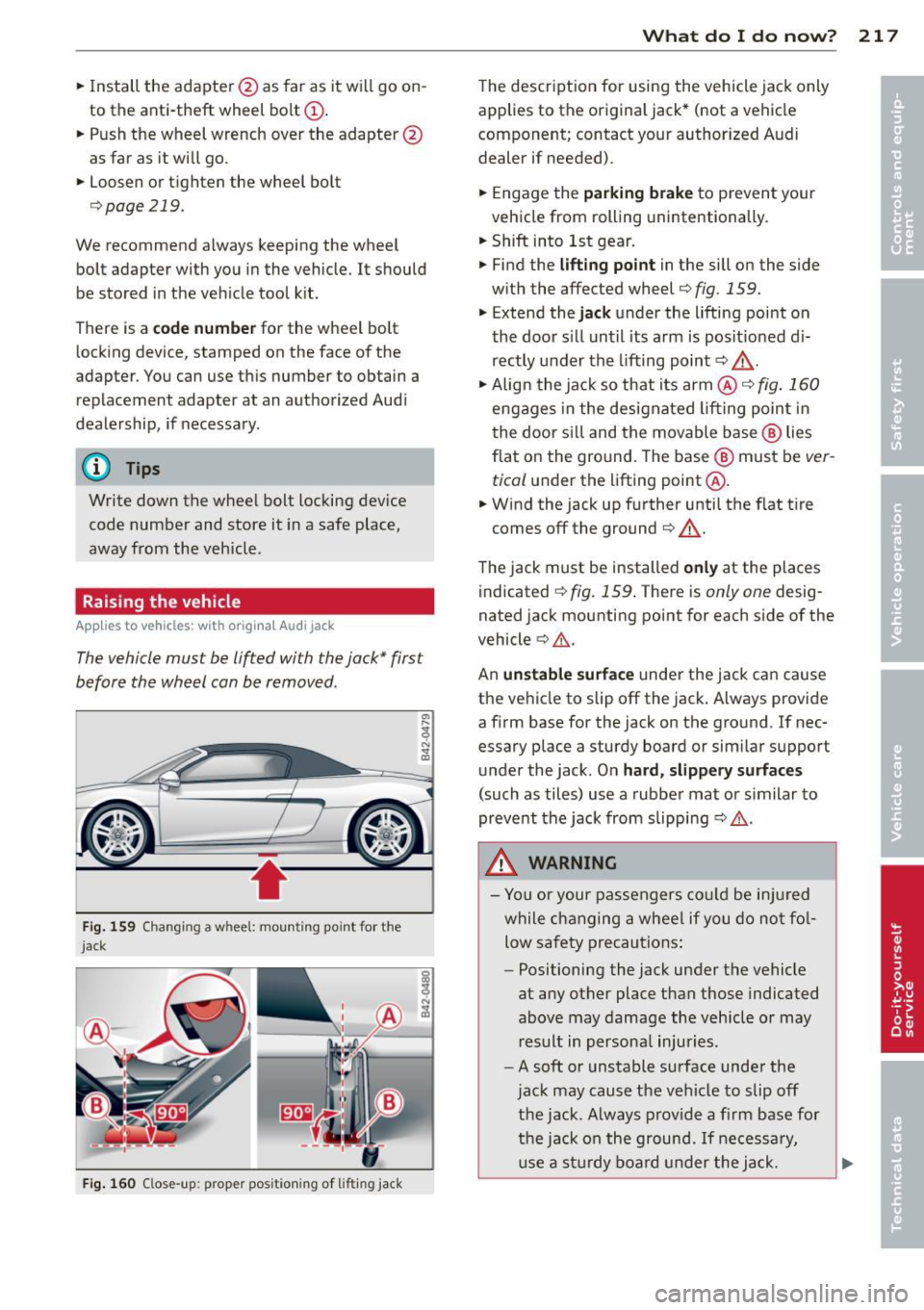
.. Find the
lifting po int in the sill on the side
w ith the affected wheel
c:> fig. 159.
.,. Extend the jack under the lifting point on
the doo r sil l unt il its arm is posit ioned d i
rectly under the lifting point ~,&. .
.. Alig n the ja ck so that its arm@
c::> fig. 160
engages in the designated lifting poin t in
t he door s ill and the movable base ® lies
flat on the ground. The base @ must be
ver
tical
under the lifting point @.
.. Wind the jack up further until the flat t ire
comes off the ground
c::> ,&. .
The jack must be installed
only at the places
indicated
c:> fig. 159 . There is only one desig
nated jack mou nting point for each side of the
vehicle
c:> ,& .
An
unstable surface under the jack ca n cause
the vehicle to slip off the jack . Always provide
a f irm base for the jack on the ground . If nec
essary place a sturdy board or sim ilar support
under the jack . On
hard, slippery surfaces
(such as tiles) use a rubbe r mat or similar to
pr event the jack from slippi ng
c:;, ,& .
A WARNING
-You or your passengers co ul d be inju red
while changing a whee l if you do no t fo l
low safety precau tions :
- Positioning the jack under the vehicle
at any other place than those indicated
above may damage the vehicle or may
r esult in persona l injur ies.
- A soft or unstable surface under the
jac k may cause the ve hicle to slip off
the jack . A lways prov ide a firm base for
the jack on the ground. If necessa ry,
u se a st urdy boa rd under the jack. .,_
Page 220 of 244
218 What do I do n ow ?
-On hard, slippery sur face (such as tiles)
use a rubber mat or similar to prevent
the jack from slipping.
- To help prevent injury to yourself and
your passenge rs:
- Do not raise the vehicle unti l you a re
sure the ja ck is sec urely engaged.
- Passenge rs must not rema in i n the ve
h icl e when it is ja cked up.
- Make sure t hat passengers wait in a
safe p lace away from the vehicle and
well away from the road and traffi c.
- Make sure jack position is correct , ad
just as necessary and then continue to ra ise the jack.
CD Note
A floo r jack or the pads on the hoist arms
m ust
n ot be posit ioned at the points
shown
-arrows-.
Remov ing the wheel
Follow these instructions step-by-step for
changing the wheel.
F ig . 161 Wh eel ch an ge : alignment pin in side the t op
hole
After you have loosened all wheel bolts and
ra ised the vehicle off the ground, perform the
following steps to remove and rep lace the
wheel :
Removing the wheel
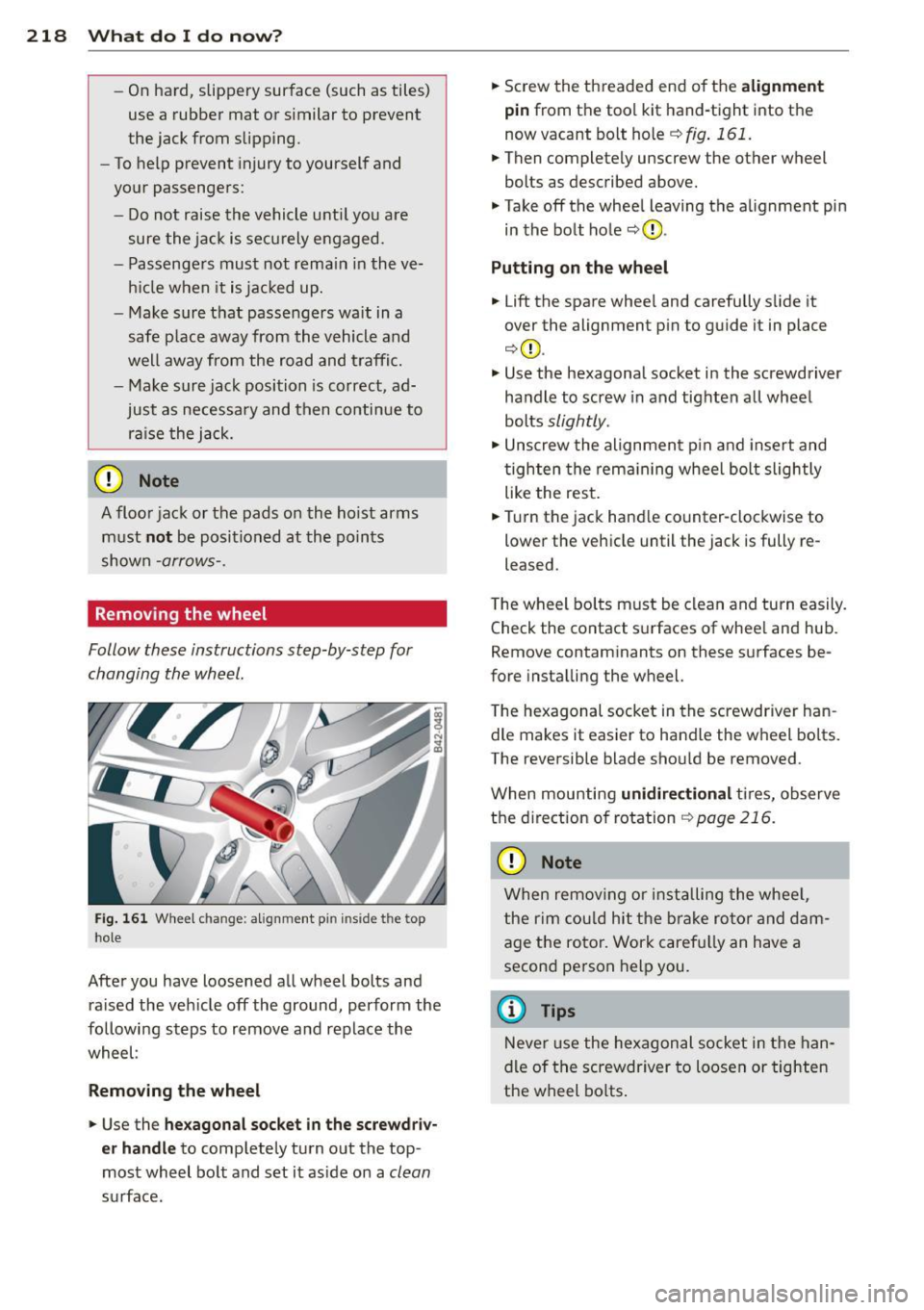
" Use the
hexagon al socke t in the screwdri v
e r handle
to comp letely turn out the top
most wheel bolt and set it as ide on a
clean
surface . "
Sc rew the threaded end of the
al ignment
pin
from t he tool kit hand-tight into the
now vacant bolt ho le
c::> fig . 161.
" Then completely unscrew the other wheel
bolts as described above.
" Take off the whee l leaving the a lignment pin
in the bolt hole
c::> (D .
Putting on the wheel
"Lift the spare whee l and carefully s lide it
over the alignment p in to guide it in place
c::> (D .
" Use the hexagonal socket in the screwdriver
ha ndle to screw in and tighten a ll whee l
bolts
slightly .
"Unscrew the alignment p in and inse rt and
tighten the rema ining wheel bolt slightly
like the rest.
" Turn the jack hand le counter-clockwise to
lower the vehicle until the jack is fully re
leased.
T he wheel bo lts must be clean and turn easily.
Check the contact s urfaces of whee l and hub .
Remove contaminants on these surfaces be
fore insta lling the wheel.
T he hexagonal socket in the screwdriver han
dle makes it easier to handle the w heel bo lts.
The reversible blade shou ld be removed .
When mounting
u nidire ctional ti res, observe
the d irection o f rotation
c::> page 216.
CD Note
When remov ing or inst alling the whee l,
t he r im cou ld hi t the b ra ke ro tor and dam
age the rotor . Work caref ully an have a
second person help you.
(D Tips
Never use the he xagonal socket in the han
dle of t he screwdriver to loosen or tighten
the wheel bo lts .
Page 221 of 244
Tightening wheel bolts
.,. Fit the wh eel b olt wrench ove r the wheel
bolt and push it down as far as it will go
1l.
.,. Close your grip around the
end of the
wrenc h handle fo r maximum torque and
turn each wheel bolt
clockwi se u nti l it sits
t ight.
H ave the
tightening torque of the whee l bolts
checked as soon as possible with a torque
wrench . It shou ld be 120 Nm.
Chec k the
tire pre ssure as soon as possible.
Return the vehicle tool kit to its proper place.
A WARNING
Loose ning t he wheel bo lts is prohib ited;
da nger of an accident!
@ Tips
- Never try and use the hexagona l socke t
i n the handle of the screwdr iver to loos
en or tighten the w heel bolts.
- If yo u have dete rm ined t hat wheel bolts
a re cor roded and difficult to t urn, the
bo lts must be rep laced befo re checking
the to rque.
- Unti l the tig hte ning torque is checked,
d rive at redu ced speeds as a pre caution.
Notes on wheel change
Pl ease read the information¢ page 199, New
tires and replacing tires and wheels,
if you are
going to use a spare tire which is different
from the tires on your veh icle.
Afte r you change a tire:
- Check the tire pressure on the spare imme
dia tely after mounting.
- Have the whee l bolt t ightening torque
chec ked w ith a torq ue wrench as soon as
poss ible by your author ized A udi dealer or a
qu alified service sta tion.
1 ) You need th e appropr iate adapter to tighte n the a nti
t h eft wheel bolts
c:, page 216.
What do I do now? 219
- With stee l and alloy whee l rims, the whee l
bolts are correctly tightened at a torque of
90 ft lb (120 Nm) .
- If you notice while changing a tire that the
wheel bo lts are corroded and difficu lt to
turn, then they should be rep laced before
you check the tightening torque.
- Replace the flat tire with a new one and
have it installed on your vehicle as soon as
possible. Remount the wheel cover.
Until then , d riv e with e xtra care and at re
duced speeds.
A WARNING
- If you are going to equ ip your vehicle
with tires or rims which differ from those
which were facto ry installed, then be
sure to read the information ¢
page 199,
New tires and replacing tir es and
wheels.
- Always sto re the tools secu rely in lug
gage compartment. Othe rwise, in a n ac
cident o r su dden maneuver they cou ld fly
forwdrd, CciU5ing injury to pd55enger5 in
the vehicle.
(D Note
Do not use comme rcially avai lab le tire
sea lants. Otherwise, the e le ctr ic al com po
nen ts of t he tire p ressu re monitoring sys
tem * wi ll no longe r work proper ly an d the
sensor fo r the tire pressure mon itor ing
system will have to be rep laced by a quali
fied wor kshop.
Jump-starting
General
If necessary, the engine can be started by
connecting it ta the battery of another vehi
cle.
If the engi ne should fail to start because of a
discharged or weak battery, the battery ca n be.,.. •
•
Page 224 of 244
222 What do I do now ?
-Please note that the procedure for con
necting a jumper cable as described
above applies spec ifically to the case of
your vehicle be ing jump started. When
you are giving a jump start to another ve
hicle, do
not connect the negative( -) ca
ble to the negat ive( -) terminal on the
discharged battery ©-Instead, securely
connect the negative (- ) cable to either a
solid metal component that is firmly
bo lted to the engine b lock or to the en
gine block itself . If the battery that is be
ing charged does not vent to the outside,
escaping battery gas cou ld ign ite and ex
plode!
Emergency towing
with commercial tow
truck
General hints
Your Audi requires special handling for tow
ing.
The following information is to be used by
commercia l tow truck operators who know
how to operate their equipment safely.
- Never tow your Audi, towing will cause dam
age to the engine and transmission .
- Never wrap the safety chains or winch cables
around the brake lines.
- To prevent unnecessary damage, your Audi
must be transported with a car carrier (flat
bed truck).
- To load the vehicle on to the flat bed, use
the towing loop found in the vehicle tools
and attach to the front anchorage
~ page 222.
A WARNING
A vehicle being towed is not safe for pas
sengers. Never allow anyone to ride in a
vehicle being towed, for any reason.
(D Note
The vehicle has very low ground clearance.
Make sure that no damage is caused to the
-
underside of the vehicle when it is being
loaded onto a f lat bed truck .
Front towing loop
Do not install the front towing loop until it is
needed.
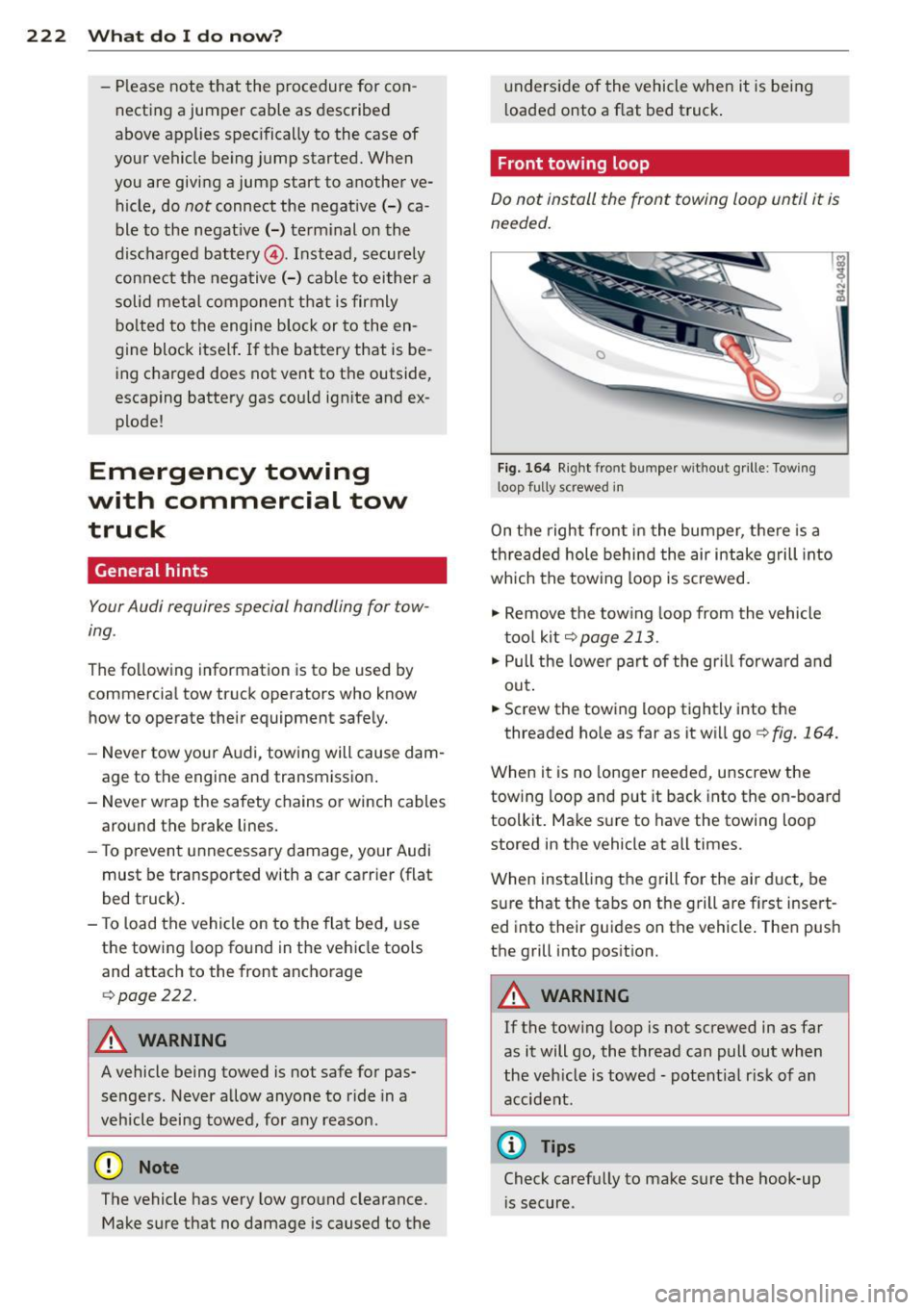
Fig. 164 Right front bumper without grille : Tow ing
loop
fully screwed in
On the right front in the bumper, there is a
threaded hole behind the air intake grill into
which the towing loop is screwed.
"' Remove the towing loop from the vehicle
tool kit~
page 213.
"'Pull the lower part of the grill forwa rd and
out .
"' Screw the towing loop tightly into the
threaded ho le as far as it wi ll go ¢
fig. 164.
When it is no longer needed, unscrew the
towing loop and put it back into the on-board
toolkit. Make sure to have the towing loop stored in the vehicle at all times.
When installing the grill for the air duct, be
sure that the tabs on the grill are first insert ed into their guides on the vehicle. Then push
the grill into position.
A WARNING
= If the towing loop is not screwed in as far
as it will go, the thread can pull out when
the veh icle is towed -potential r isk of an
accident.
@ Tips
Check carefully to make sure the hook-up i s secure.