ignition AUDI R8 SPYDER 2011 Repair Manual
[x] Cancel search | Manufacturer: AUDI, Model Year: 2011, Model line: R8 SPYDER, Model: AUDI R8 SPYDER 2011Pages: 244, PDF Size: 59.74 MB
Page 177 of 244
Checking and filling Engine compartment
lid
Relea sing the engine compartment lid
The engi ne compartment lid is released from
inside the vehicle.
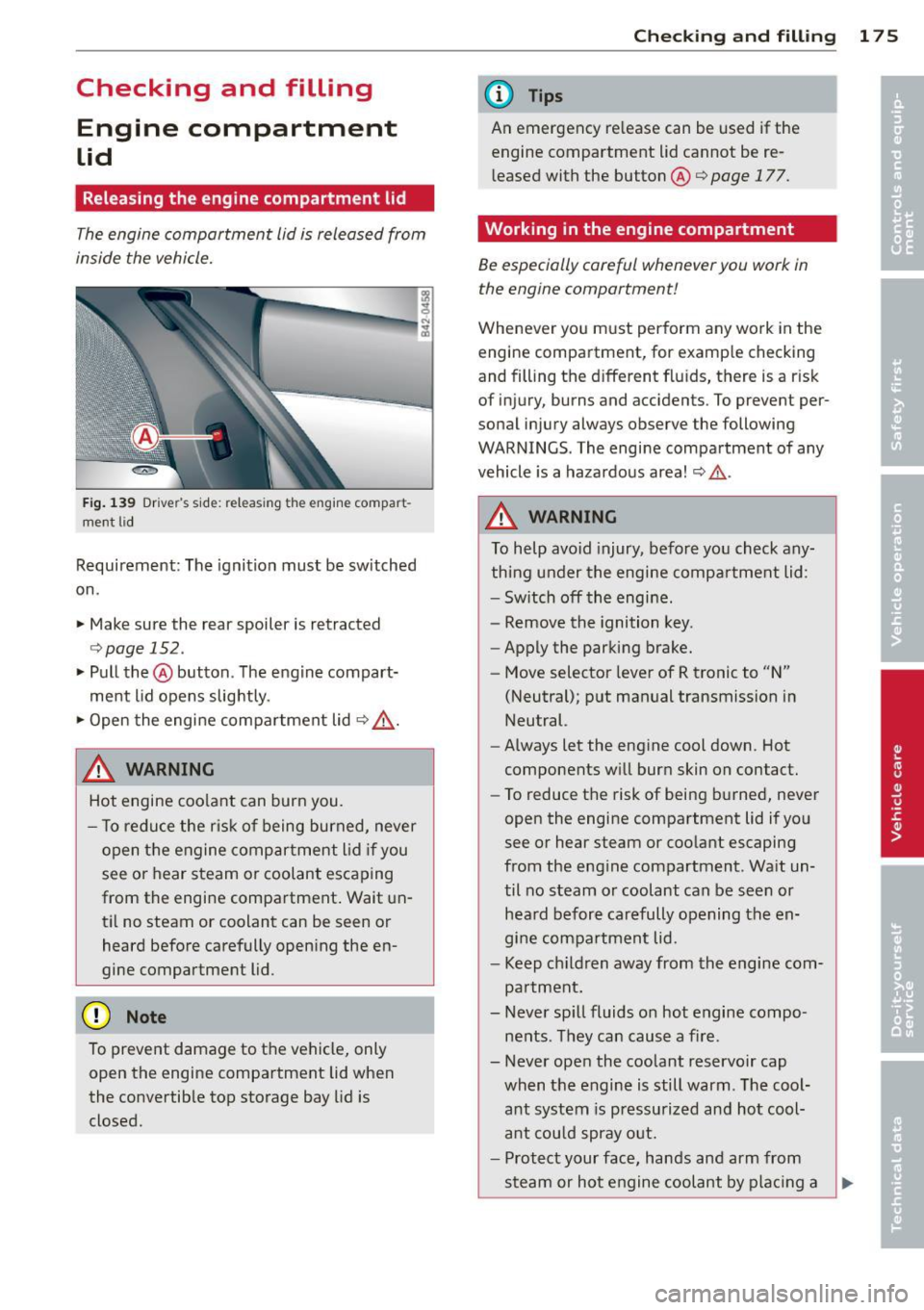
F ig . 139 Dr ive r's side: releasing the engine compart
ment lid
Requi rement: The ignition must be switched
on.
• Make sure the rear spoiler is retracted
9page 152.
• Pull the@ button. The engine compart
ment lid opens slightly.
• Open the engine compartment lid
9 .&,.
_& WARNING
Hot engine coolant can burn you.
- To redu ce the r isk of being burned, never
open the engine compartment lid if you
see or hear steam or coolant escaping
from the engine compartment . Wait un
ti l no steam or coolant can be seen or
heard before carefully opening the en
gine compartment lid .
(D Note
To prevent damage to t he vehicle, only
open the engine compartment lid when
the convertib le top storage bay lid is
closed.
Checkin g and fillin g 175
@ Tips
An emergency release can be used if the
engine compartment lid cannot be re- l eased with the button @
i:> page 177.
Working in the engine compartment
Be especially careful whenever you work in
the engine compartment!
Whenever you must perform any work in the
engine compartment, for example checking
and filling the d ifferent flu ids, there is a risk
of in jury, burns and accidents . To prevent per
sonal injury always observe the following
WARNINGS . The engine compartment of any
vehicle is a hazardous area'
i:> A .
_& WARNING ,.;;
To help avoid injury, before you check any
thing under the engine compa rtment lid:
- Sw itch off the engine.
- Remove the ignition key.
- Apply the parking brake.
- Move selector lever of R tronic to "N"
(Neutral); p ut manual transmission in
Neutral.
- Always let the eng ine cool down. Hot
components w ill burn skin on contact.
- To reduce the risk of being b urned, never
open the engine compartment lid if you
see or hear steam or coo lant escaping
from the eng ine compartment. Wa it un
til no steam or coolant can be seen or
hea rd before carefully opening the en
gine compa rtment lid.
- Keep ch ild ren away from the engine com
pa rtment.
- Never sp ill fluids o n hot engine compo
nents. T hey can cause a fi re .
- Never open the coolant reservoir cap
when the engine is still warm. The cool
ant system is pressurized and hot cool
ant cou ld spray o ut.
- Protect your face, hands and arm from
steam or hot e ngine coolant by plac ing a ""
Page 178 of 244
176 Checking and filling
thick rag over the cap when you open the coolant reservoir .
-If work on the fuel system or the electri
cal system is necessary:
- Always disconnect the battery .
- Never smoke or work near heaters or
open flames. Fluids in the engine com partment could start a fire .
- Keep an approved fire extinguisher im
mediately available.
- To avoid electrical shock and personal in
jury while the engine is running or being
started, never touch:
- Ignition cables
- Other components of the high voltage
electronic ignition system.
- If you must perform a check or repair
with the engine running:
- First, fully apply the parking brake,
move selector lever of R tronic to "N"
(Neutral); put manual transmission in
Neutral.
- Always use extreme caution to prevent
clothing, jewelry, or long hair from get
ting caught in the radiator fan, V-belts
or other moving parts, or from contact
ing hot parts . Tie back hair before
starting, and wear no clothing that will
hang or droop into the engine.
- Minimize exposure to emission and
chemical hazards~&. .
.&_ WARNING
California Proposition 65 Warning:
- Engine exhaust, some of its constituents,
and certain vehicle components contain
or emit chemicals known to the State of
California to cause cancer and birth de
fects and reproductive harm. In addition,
certain fluids contained in vehicles and
certain products of component wear con
tain or emit chemicals known to the
State of California to cause cancer and
birth defects or other reproductive harm .
- Battery posts, terminals and related ac cessories contain lead and lead com
pounds, chemicals known to the State of California to cause cancer and
reproduc
tive harms. Wash hands after handling.
@ Note
When adding fluids, always make sure that
they are poured into the proper container
or filler opening, otherwise serious dam
age to vehicle systems will occur.
@ For the sake of the environment
To detect leaks in time, inspect the vehicle
floor pan from underneath regularly. If
you see spots from oil or other vehicle flu
ids, have your vehicle inspected by an au
thorized Audi dealer.
Closing the engine compartment lid
... Make sure that the rear spoiler is retracted
~page 152.
""Pull the engine compartment lid down until
the pressure from the struts is reduced.
.., Press the engine compartment lid closed
c::>& .
A WARNING ,_
A engine compartment lid that is not com
pletely latched could fly up and block your
view while driving.
- When you close the engine compartment lid, check it to make sure the safety catch
has properly engaged . The engine com
partment lid should be flush with the
surrounding vehicle body parts .
- If you notice while driving that the en
gine compartment lid is not secured properly, stop at once and close it.
Page 184 of 244
182 Checking and filling
may seriously degrade the corros ion pro
tection. The resu lting damage can cause
l oss of coo lant and subsequent ly lead to
se rious engine damage.
- The coolant additive
Gl2++ must not be
mixed w it h other coo lant add itives.
- Do not add any type of radiator leak sea l
ant to your ve hicle's engine coo lant.
Adding rad iator repair fluid may adve rse
ly affect the function and performance of
your cooling system and could result in
damage not covered by your New Vehicle
Limited Wa rranty.
Checking the engine coolant level
Proceed carefully when checking the coolant .
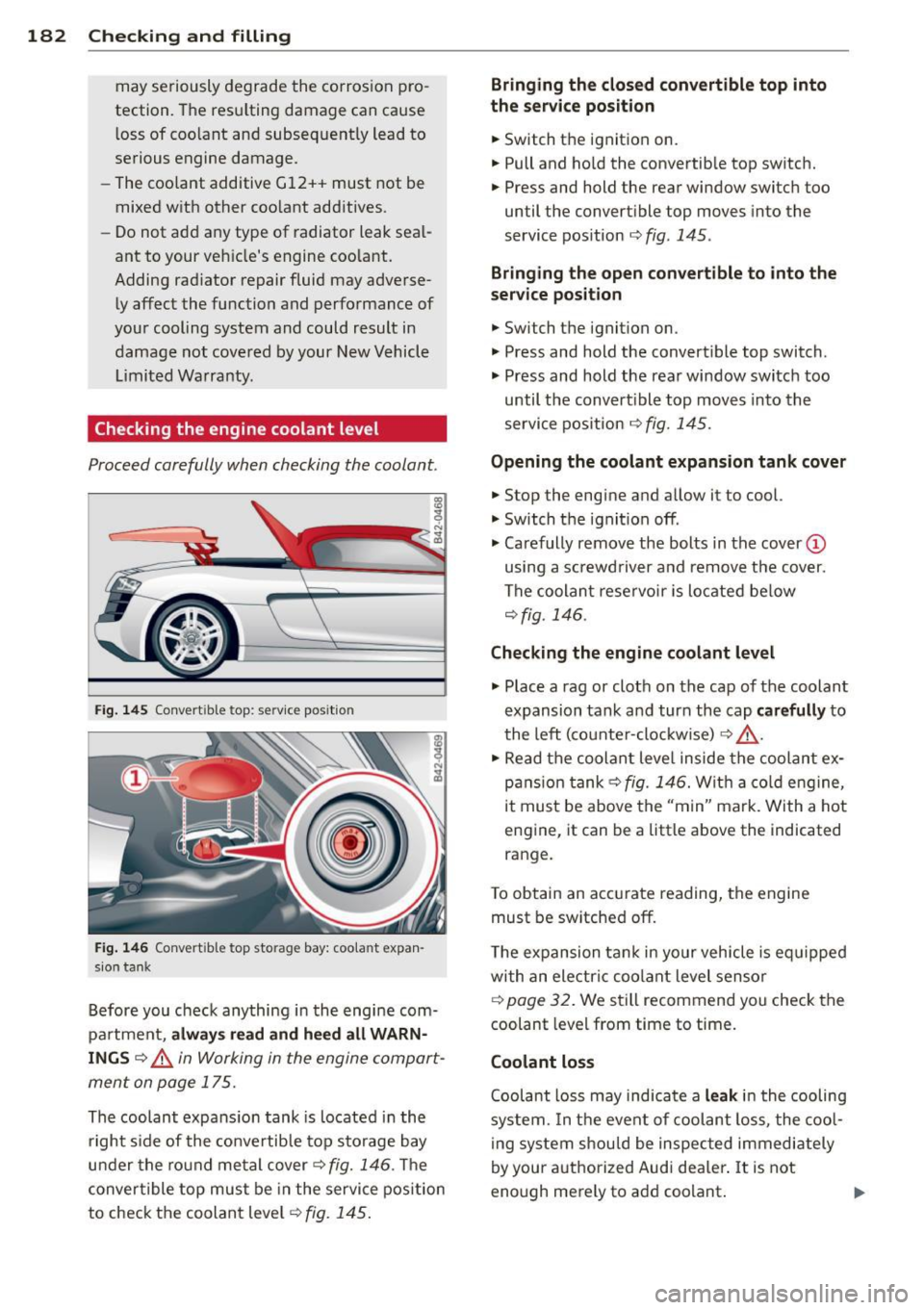
Fig. 145 Convert ible top: serv ice pos iti on
Fig. 146 Convert ible top storage bay: coo la n t expa n
s ion tank
Before you check anything i n the eng ine com
pa rtment,
alway s read and heed all WARN
INGS c:::> ,&. in Working in the engine compart
ment on page 175.
T he coolant expa nsion tank is located i n the
r ight s ide of the co nvertib le top s to rage bay
under the ro und metal cover
c::>fig. 146. The
conver tible top must be in the servi ce position
to check the coolan t leve l
c:::> fig. 145 .
Bringing the closed convertible top into
the service position
.,. Switch t he ignition on.
.,. Pull and ho ld the convertib le top switch.
.,. Press and hold the rear window switc h too
until the convert ible top moves into the
service pos ition
c:::> fig. 145 .
Bringing th e open convertible to into the
service position
.,. Switch th e ignit ion on.
.,. Press and hold the convert ible top switch.
.,. Press and hold the rea r window switc h too
until t he convert ible top moves into the
service pos it ion
c:::> fig. 145.
Opening the coolant expansion tank cover
.,. Stop the engine a nd a llow it to cool.
.,. Switch t he ignit ion off .
.,. Carefully remove the bolts in the cover
(D
using a sc rewd river and remov e th e cover.
The coolan t rese rvo ir i s located be low
c:::> fig. 146 .
Checking the engine coolant level
.,. Place a rag or cloth on the cap of the coolant
e xpansion tank a nd turn the cap
carefully to
the left ( counte r-cloc kw ise)
c:::> .&_ .
.,. Read the coolan t leve l inside the coolan t ex
pa nsion tank
c:::> fig. 1 46. W it h a co ld eng ine,
it must be above the "min" mark . With a hot
engine, it can be a litt le above the indicated
range.
T o obtain an acc urate reading, the engine
must be sw itched off.
T he e xpansion ta nk in your vehicle is eq uipped
with an electr ic coo lant level senso r
c::> page 32. We s till rec om mend you check the
coolant leve l from time to time.
Coolant loss
Coolant loss may indicate a leak in the cooling
system. In t he eve nt of cool ant los s, the cool
ing system should be inspec ted immedi ately
by your a uthorized Audi dea ler . I t is not
eno ugh mere ly to a dd coo lant .
ll-
Page 187 of 244
disconnect the battery negative terminal. Oc
casionally charge a disconnected battery.
Winter operation
The cold time of year places a special strain on
the battery, resulting in reduced starting pow
er. So before the cold weather starts, have the battery inspected and charged as necessary.
A WARNING
- All work on the battery requires technical
knowledge. Please contact an authorized
Audi dealer or another authorized facility
for questions about the battery - danger of acid burns and explosion hazard!
- The battery must not be opened! Do not
try to change the battery's liquid level,
otherwise detonating gas will escape
from the battery - explosion hazard!
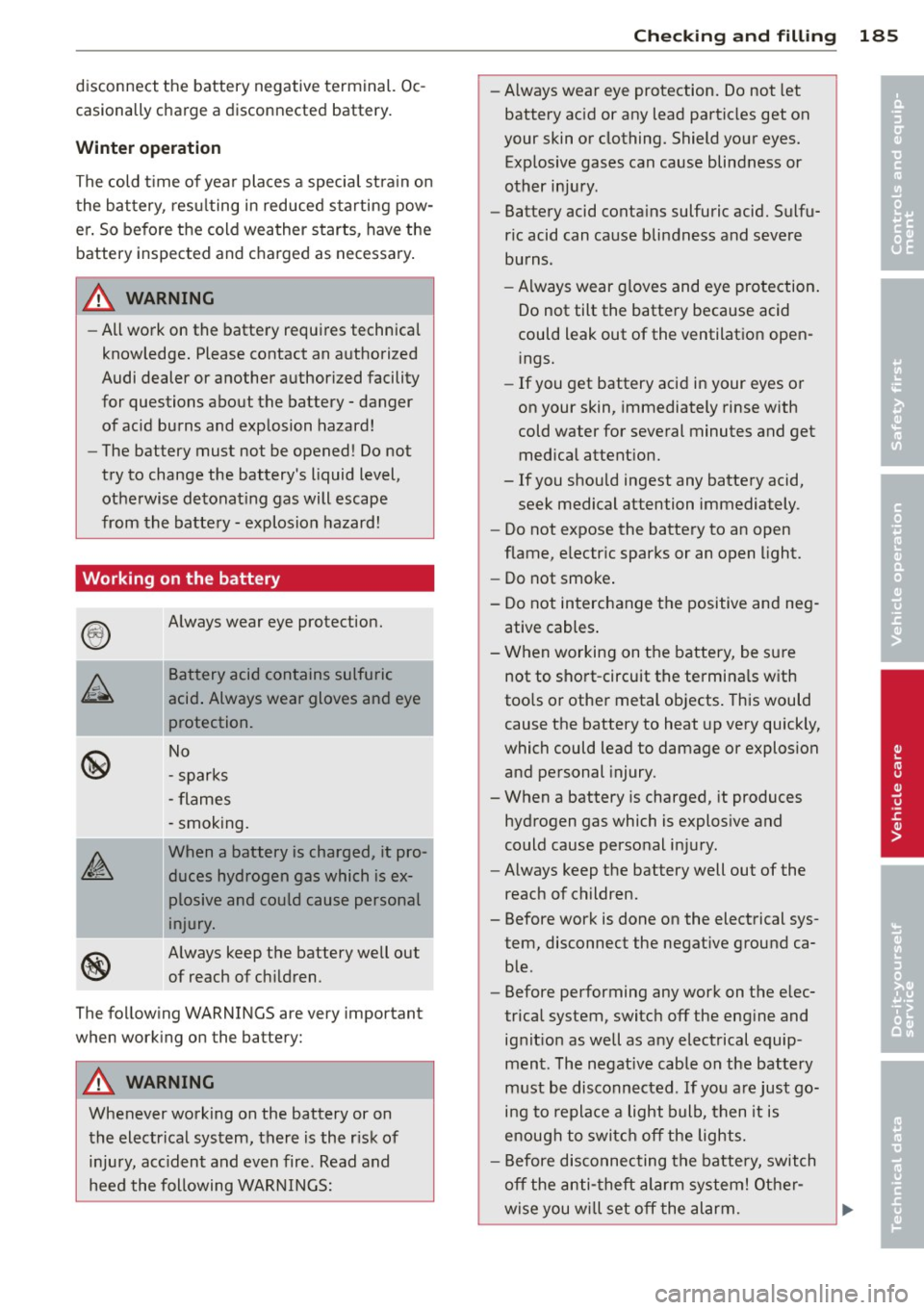
Working on the battery
Always wear eye protection.
Battery acid contains sulfuric
acid. Always wear gloves and eye
protection.
No
- sparks
- flames
- smoking.
When a battery is charged, it pro
duces hydrogen gas which is ex plosive and could cause personal
injury.
Always keep the battery well out
of reach of children.
The following WARNINGS are very important
when working on the battery:
A WARNING
Whenever working on the battery or on
the electrical system, there is the risk of
injury, accident and even fire. Read and
heed the following WARNINGS:
-
Checking and filling 185
- Always wear eye protection. Do not let
battery acid or any lead particles get on
your skin or clothing. Shield your eyes. Explosive gases can cause blindness or
other injury.
- Battery acid contains sulfuric acid. Sulfu
ric acid can cause blindness and severe
burns.
- Always wear gloves and eye protection.
Do not tilt the battery because acid
could leak out of the ventilation open
ings.
- If you get battery acid in your eyes or
on your skin, immediately rinse with
cold water for several minutes and get
medical attention.
- If you should ingest any battery acid,
seek medical attention immediately.
- Do not expose the battery to an open
flame, electric sparks or an open light.
- Do not smoke.
- Do not interchange the positive and neg- ative cables.
- When working on the battery, be sure
not to short-circuit the terminals with
tools or other metal objects. This would cause the battery to heat up very quickly,
which could lead to damage or explosion and personal injury.
- When a battery is charged, it produces
hydrogen gas which is explosive and
could cause personal injury.
- Always keep the battery well out of the
reach of children.
- Before work is done on the electrical sys
tem, disconnect the negative ground ca
ble.
- Before performing any work on the elec
trical system, switch off the engine and
ignition as well as any electrical equip
ment. The negative cable on the battery
must be disconnected.
If you are just go
ing to replace a light bulb, then it is
enough to switch off the lights.
- Before disconnecting the battery, switch
off the anti-theft alarm system! Other
wise you will set off the alarm. •
•
Page 188 of 244
186 Checking and filling
-When disconnecting the battery, first
disconnect the negative cable and then
the positive cable.
- Before reconnecting the battery, make
sure all electrical consumers are switch ed off. Reconnect the positive cable first
and then the negative cable. Never inter
change the cables -this could start a fire!
- Never charge a frozen or a thawed-out
battery. It could explode!
If a battery has
frozen, then it must be replaced. A dis
charged battery can freeze over at 32 °F
(0 °C).
-Make sure the vent hose is always attach
ed to the opening on the side of the bat
tery.
- Never use batteries which are damaged.
Danger of explosion! Always replace a
damaged battery .
.&, WARNING
California Proposition
65 Warning:
- Battery posts, terminals and related ac
cessories contain lead and lead com
pounds, chemicals known to the State of
California to cause cancer and reproduc
tive problems. Wash hands after han
dling.
(D Note
- Do not disconnect the vehicle battery
when the ignition is switched on or when
the engine is running, otherwise, you will
damage electronic components in the
electrical system.
- If your vehicle is going to stand for a
long period of time without being driven,
protect the battery from "freezing", oth
erwise it will be damaged and will then have to be replaced. Charging the battery
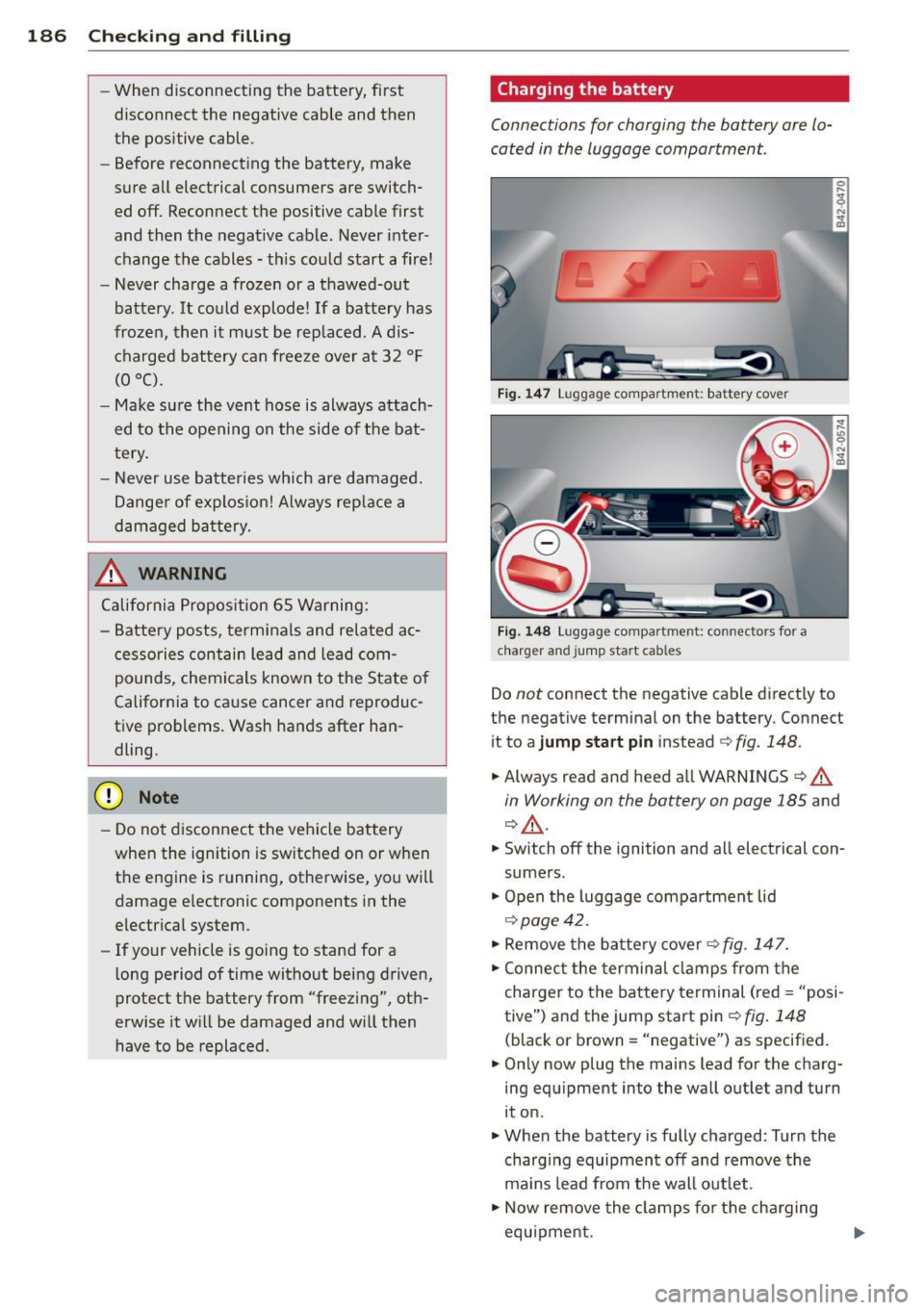
Connections for
charging the battery are lo
cated in the luggage compartment.
Fig. 147 L uggage compartment: battery cover
Fig. 148 Luggage compartment: connectors for a
charger and jump start cables
Do not connect the negative cable directly to
the negative terminal on the battery. Connect
it to a
jump start pin instead c:, fig. 148.
.,. Always read and heed all WARNINGS c:, A
in Working on the battery on page 185 and
¢ A -
... Switch off the ignition and all electrical con
sumers .
.,. Open the luggage compartment lid
c:>page42 .
.,. Remove the battery cover c:, fig. 147.
.,. Connect the terminal clamps from the
charger to the battery terminal (red= "posi
tive") and the jump start pin
c:, fig. 148
(black or brown= "negative") as specified.
.,. Only now plug the mains lead for the charg
ing equipment into the wall outlet and turn
it on .
.,. When the battery is fully charged: Turn the
charging equipment off and remove the
mains lead from the wall outlet .
.,. Now remove the clamps for the charging
equipment.
Page 212 of 244
210 Consum er Inf orm ati on
steadi ly reduced the scope of maintenance
and repairs which can be carried out by vehicle
owners.
Als o, sa fe ty a nd en vir onm ent al con
cerns p lace very strict limits on the nature of
repairs and adjustments to engine and trans
miss ion parts which an owner can perform .
Maintenance, adjustments and repa irs usua lly
require special tools, testing devices and oth
er equipment available to specially trained
workshop personnel in order to assure proper pe rformance, reliab ility and safety of the vehi
cle and its many systems .
Improper maintenance, adjustments and re pa irs can impair the operation and reliab ility
of your vehicle and even void your vehicle war
ranty. Therefore , proof of servic ing in accord
ance w ith the ma intenance schedule may be a
condition for upholding a poss ible warranty
claim made within the warranty period.
Above all, operational safety can be adversely
affected, c reating unnecessary risks for you
and your passengers .
If in doubt about any se rv icing, have it done
by your author ized Audi dealer or any other
p roperly equipped and qualified workshop .
We strong ly urge you to give yo ur a utho rized
Aud i dealer the opportunity to perfo rm all
schedu led maintenance and necessary repairs.
Your dea ler has the facilities, original parts
and trained spec ialists to keep your vehicle
running properly .
Performing limit ed ma int enance your self
The following pages describe a limited num
ber of proced ures which can be performed on
your ve hicle with ordinary too ls, shou ld the
need arise and trained personnel be unavaila
ble. Before performing any of these proce
dures, always thoroughly read all of the app li
cable text and carefully follow the instruc
tions given . Always rigorously observe the
WARNINGS p rovided.
Before you ch eck a nything in th e eng ine
co mpartm ent , alwa ys re ad and h eed all
WA RNINGS
c::> .&. and c::> ..&. in Working in the
engine compartment on page 175.
A WARNING
- Serious personal injury may occur as a re
sult of improperly performed mainte
nance, adjustments or repa irs .
- Always be extremely careful when work
ing on the vehicle . Always follow com
monly accepted safety pract ices and gen
eral common sense. Never r is k personal
injury.
- Do not attempt any of the maintenance ,
checks or repairs descr ibed on the fol
lowing pages if you are not fu lly fam iliar
with these or other procedures with re
spect to the vehicle, or are uncertain how
to proceed .
- Do not do any work without the proper
too ls and equipment. Have the necessa ry
work done by your authorized A udi deal
er or another proper ly equipped and
qualified workshop.
- Always remove the ignition key before
anyone gets under the veh icle.
- Always support your veh icle with safety
stands if it is necessary to work under neath the vehicle . The jack* is not ade
quate for this purpose and cou ld collapse
causing ser ious personal inju ry.
- If you must work underneath the vehicle
with the wheels on the ground, a lways
make sure the vehicle is on level ground,
that the wheels a re a lways secure ly
b locked and that t he engine cannot be
started.
- Always make sure the transmission se
lec to r l ever is in "N" (Neut ral) (R t ron ic)
or Neutral (manual transmission) and
the hand bra ke is f irmly app lied.
@ For the sake of the environment
- Changing the engine sett ings will ad
verse ly affect emission leve ls. Th is is det
r imental to the environment and increas
es fuel consumpt ion .
- Always observe environmenta l regu la
tions when disposing of old eng ine oil,
used brake flu id, dirty engine coo lant,
spent batte ries o r worn out tires.
Page 225 of 244
Fuses and bulbs
Electrical fuses
Replacing fuses
Fuses that have blown will have metal strips
that have burned through.
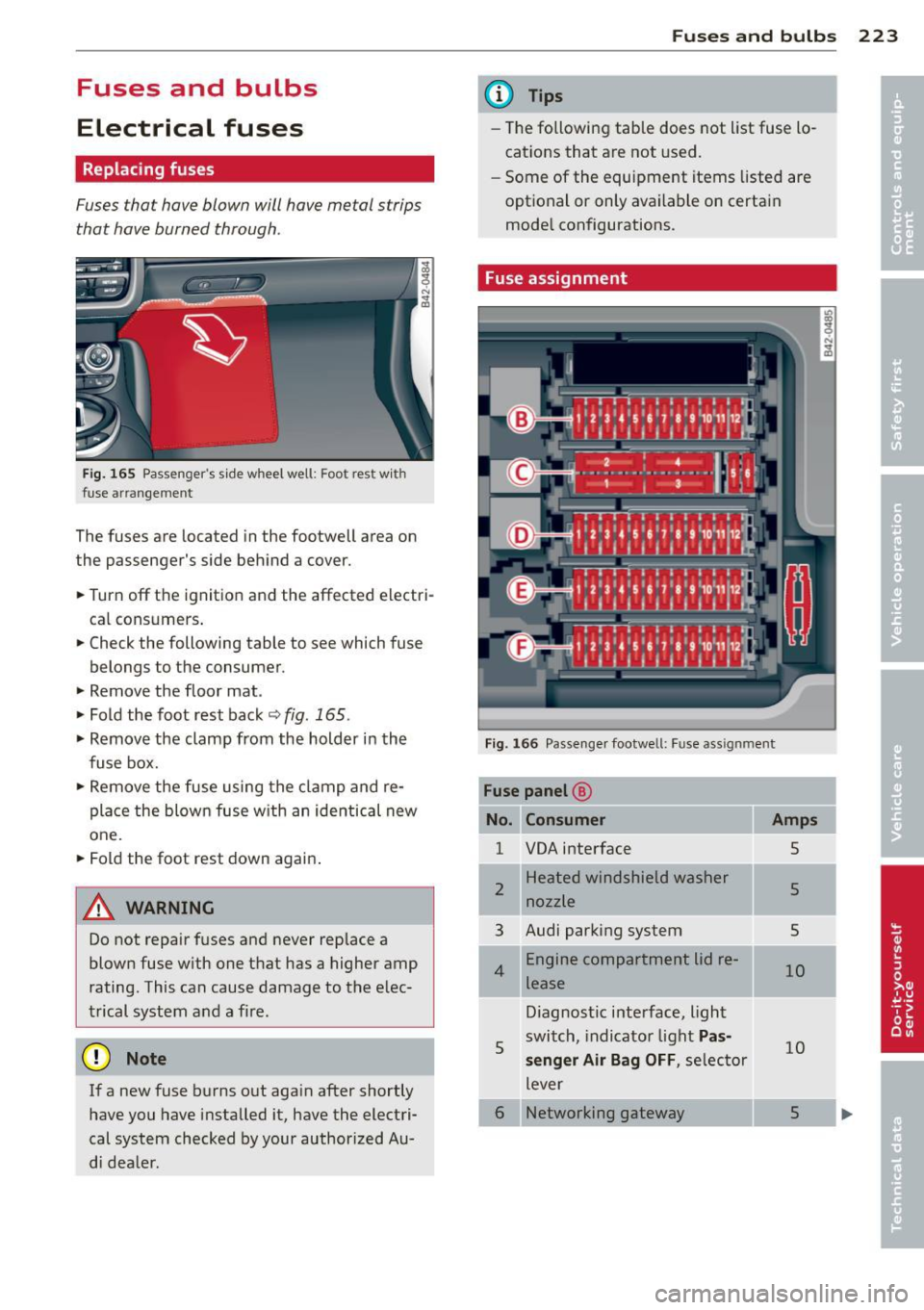
Fig. 165 Passenger's s ide wheel well: Foot rest with
fuse arrangement
The fuses are located in the footwell area on
the passenger's side behind a cover.
• Turnoff the ignition and the affected electri
cal consumers .
• Check the following table to see which fuse
belongs to the consumer.
• Remove the floor mat .
• Fold the foot rest back
c::> fig. 165.
• Remove the clamp from the holder in the
fuse box.
• Remove the fuse using the clamp and re
place the blown fuse w ith an identical new
one.
• Fold the foot rest down again .
A WARNING
Do not repair fuses and never replace a
blown fuse with one that has a higher amp
rating. This can cause damage to the elec
trical system and a fire.
(D Note
If a new fuse burns out again after shortly
have you have installed it, have the electri
cal system checked by your authorized Au
d i dealer.
Fuse s and bulbs 223
@ Tips
-The following table does not list fuse lo
cations that are not used.
- Some of the equipment items listed are
optional or only available on certain
mode l configurations.
Fuse assignment
Fig. 166 Passenge r footwe ll: Fuse assignment
Fuse panel @
Consumer
1 VOA interface
2
3
4
5
Heated windshield washer
nozzle
Audi parking system Engine compartment lid re
lease
Diagnostic interface, light
switch, indicator light
Pas
senger Air Bag OFF ,
selector
lever
6 Networking gateway
Amps
5
5
5
10
10
5
Page 228 of 244

226 General information
General information
Explanation of
technical data
Some of the techn ical data listed in this man
ual require further explanation.
The technical data for your vehicle are listed in
the charts starting on
¢ page 228 . This chap·
ter prov ides general information, notes and
r estrictions wh ich app ly to these data .
Vehicle identification
The key data are given on the vehicle identifi·
ca tion number (VIN) plate and the vehicle da
ta sticker.
©+-wAuzzz XXx XXXXXXXX
XXX XXX
xxxxxxx
xx x.x xx
XXXKW XXX XX/XX
®t-XXX
@-t-LY7X/LY7X
---xxx
N2M/ NQ
EOA ?AO 4UE 6XC 5SL 6TS
!KP .J1L !LT !BA
JFA SMU 7X1 4RS
FOA 8GR OG1 OYK 0.JG
TOL 3NZ 88B U2A
XOA 1N1
2PG 801 902 825 07G
700 C7A 7K0 4X3 2Kl
3L3 4KC JY0 4K4 501
lSA OGG 0lA 4GF
@-I= xx.x
®
X.X X.X XXX
® © @__,
Fi g. 1 67 The ve hicle ident ific ation labe l
The Vehicle Identification Number (VlN)
You can find t he Vehicle Ident if icat io n N um
be r (V IN) beh ind the windshie ld on t he lowe r
l eft side . You can a lso display the Vehicle
I dentification N umbe r of your vehicle in the
Driver Information display ~
page 24.
The vehicle identification label
The vehicle iden tification la bel ~fig. 167 is
located wi th the fuses in the footwe ll on the
passenger's side ¢
page 223.
The label s hows the following vehicle data :
(D Vehicle Ident ificat io n Number (chassis
num ber)
@ . Vehicle model/eng ine output/transmis-
sion
@ Engine and transm iss ion codes
@ Pa int a nd inte rior equipment numbe rs
® Optional equipment numbers
@ Fuel economy and emissions data
Vehicle data a re a lso fo und in your Wa rra nty
& Ma intenance booklet .
The safety compliance st icker
The safety compliance sticker is your assur
ance that yo ur new vehicle complies with all
applicable Federal Motor Vehicle Safety
Standards which we re in effect at the t ime the
vehicle was manufactured . You can find this
st icker on the left door jamb.
It s h ows the
mon th and ye ar of product io n and the veh icle
iden tification numbe r of your vehi cle (pe rfora
tio n) as well as t he Gross Vehicle Weight Rat
ing (GVWR) and the G ross Ax le Weight Rating
(GAWR).
The high voltage warning label
T he high vol tage warning label is lo cate d on
the lo ck car rier .
The spark ignition system meets all require
ment s of the Canadian Interferen ce -Causing
Equipment Regulation s.
Weights
Gross Vehicle Weight Rating
T he Gross Vehicle We ight Rat ing (GVWR), and
t h e Gross Axle Weight Rat ing (GAWR) for
fron t and rear are listed on a sticker on the
le ft doo r jamb.
The Gross Vehicle We ight Rat ing includes the
weight of the bas ic vehicle plus fu ll fuel ta nk,
o il a nd coo lant, plus max imum load , which in
cl udes p assenger we igh t (150 lbs./68 kg per
designate d seating posit ion) and luggage
weight .
IJ>,
Page 236 of 244
234 Index
Fuel gauge . . . . . . . . . . . . . . . . . . . . . . . . . 12
Fue l ra nge . . . . . . . . . . . . . . . . . . . . . . . . . . 22
Fuses Assig nment ................. .... . 223
Replacing ............... ...... .. . 223
G
Garage door opener . . . . . . . . . . . . . . . . . . 95
Genera to r
Warn ing/ indicato r ligh t .. .. .. .. .... .. 17
Glossary of t ire and load ing te rm ino logy 190
Glove compartment . . . . . . . . . . . . . . . . . . 70
Gross Veh icle Weight Ra ting (GVWR) ... 226
H
Headlig ht
D efect ive . . . . . . . . . . . . . . . . . . . . . . . . . 3 5
H eadlig ht flasher . . . . . . . . . . . . . . . . . . . . 58
Headlights . . . . . . . . . . . . . . . . . . . . . . . . . 55
H ead restraints . . . . . . . . . . . . . . . . . 68, 102
Ad justing ........................ 102
Heated Outside mirrors . . . . . . . . . . . . . . . . . . . . 63
Rear window defogger . . . . . . . . . . . . . . . 76
Seats .. .. .. ... .... ...... ... ... .. .. 76
Washer jets . . . . . . . . . . . . . . . . . . . . . . . 59
Heating . .... .. . .......... .. .. .... .. 72
H igh beam . . . . . . . . . . . . . . . . . . . . . . 5 5, 58
War ning/indicato r lights ... .. .. .... .. 16
H igh voltage wa rn ing la bel ....... .... 226
Hill hold assist
Starting on hills .......... .... .... .. 80
H ome link ® .. ... .. ..... ... .. .. .... .. 95
H orn ... .. .. ... .... ...... ... ... .. .. . 8
How many airbags does my vehicle have? 124
H ow often s houl d I check my t ire pres-
sures? .... .. ... ... .... ... .. .. .... . 195
H ow safety belt pretensioners work . ... 115
H ydroplaning . .. . ...... ... .. .. .... . 199
I
Ignition . . . . . . . . . . . . . . . . . . . . . . . . . . . . 77
Immobilizer .... .... ...... ... ... .. .. 1 2
Important things to do before driving . . . 99 Improperly worn sa
fety belts . . . . . . . . . . 11 4
Ind icator lig ht
Airbag system ................ .... 1 28
Cl ut ch overheat ing ............. .. .. . 36
C onvertib le top ................... . 16
No reve rse gear .. .. ... ..... ... .. .. . 35
PASSENGER AIR BAG OF F ..... ... . .. 128
Se lector lever defective . ..... ... .. .. . 35
In dic ator lights ...................... 14
Re d symbo ls in the ce nte r display . . . . . . 30
Ye llow symbo ls in the center display . .. 30
Infant seats ....................... 143
Installing child safety seats
Safety belts . . . . . . . . . . . . . . . . . . . . . . 146
Instrument clus ter and con trols ... .. .. . 10
Instr ument panel ill umination ...... .. . 56
Instr uments and controls
Genera l illustration . . . . . . . . . . . . . . . . . . 8
Interior ligh ts . . . . . . . . . . . . . . . . . . . . . . . 58
L uggage compartment . . . . . . . . . . . . . . 59
Intermittent wiping . . . . . . . . . . . . . . . . . . 59
J
Jump-start ing . ... . ... ... .... ... .. .. 219
K
Key ................................ 37
Battery replacement ........... ..... 38
Emergency key . . . . . . . . . . . . . . . . . . . . . 3 7
K ey replacemen t ................. .. 37
Remote maste r key . . . . . . . . . . . . . . . . . 3 7
K ick-down
R tronic ....... .. ................. . 87
K nee a irbags . ..... ... .. ..... ... .. .. 132
Desc ription .... .. .. ... ..... ... .. .. 132
How they wor k ... ... .. ..... .... . .. 134
Important sa fety instructions ........ 134
L
Lap timer
Delet ing total resu lts . ... .... ... .. .. . 28
Display ing split time ................ 27
Ending timing . . . . . . . . . . . . . . . . . . . . . 28
Eva luating times . . . . . . . . . . . . . . . . . . . 28
Interrupting timing ................. 27
Introduction ... .. .. ... ....... ... .. . 26