ABS AUDI R8 SPYDER 2012 User Guide
[x] Cancel search | Manufacturer: AUDI, Model Year: 2012, Model line: R8 SPYDER, Model: AUDI R8 SPYDER 2012Pages: 236, PDF Size: 59.24 MB
Page 126 of 236
124 Airbag system
Other things that can affect Advanced
Airbag performance
Changing the vehicle's suspension system can
change the way that the Advanced Airbag Sys
tem performs in a crash. For example, using
tire-r im combinations not approved by Audi,
lowering the vehicle, changing the stiffness of
the suspension, including the springs, suspen
sion strut s, shock absorbers etc. can change
the forces that are measured by the airbag sensors and sent to the electronic control
unit. Some suspension changes can, for example, increase the force levels measured by the
sensors and make the airbag system deploy in
crashes in which it would not deploy if the
changes had not been made. Other kinds of
changes may reduce the force levels meas
ured by the sensors and prevent the airbag
from deploying when it should .
The sensors in the safety belt buckle for the
driver and front passenger seat tell the elec
tronic control module if the safety belt is
latched or not .
If the safety belt is being used,
the front airbag will deploy at a slightly high er rate of vehicle deceleration than if the safe
ty belt is not being used. Therefore, in a par
ticular collision, it is possible that an airbag
will not deploy at a seating position where the
safety belt is being used but will inflate at the
position where the safety belt is not being
used.
It is important that nothing interfere
with the safety belt buckles so that the sen
sors can send the correct information about
safety belt use to the electronic control unit .
A WARNING
Changing the vehicle's suspension includ
ing use of unapproved tire-rim combina
tions can change Advanced Airbag per
formance and increase the risk of serious
personal injury in a crash.
- Never install suspension components
that do not have the same performance
characteristics as the components origi
nally installed on your vehicle.
- Never use tire-rim combinations that
have not been approved by Audi.
A WARNING
-Items stored between the safety belt
buckle and the center console can cause
the sensors in the buckle to send the
wrong information to the electronic con
trol module and prevent the Advanced Air
bag System from working properly.
- Always make sure that nothing can inter
fere with the safety belt buckles and that
they are not obstructed.
Knee airbags
· Description of knee airbags
The knee airbag system con provide supple
mental protection to properly restrained
front seat occupants.
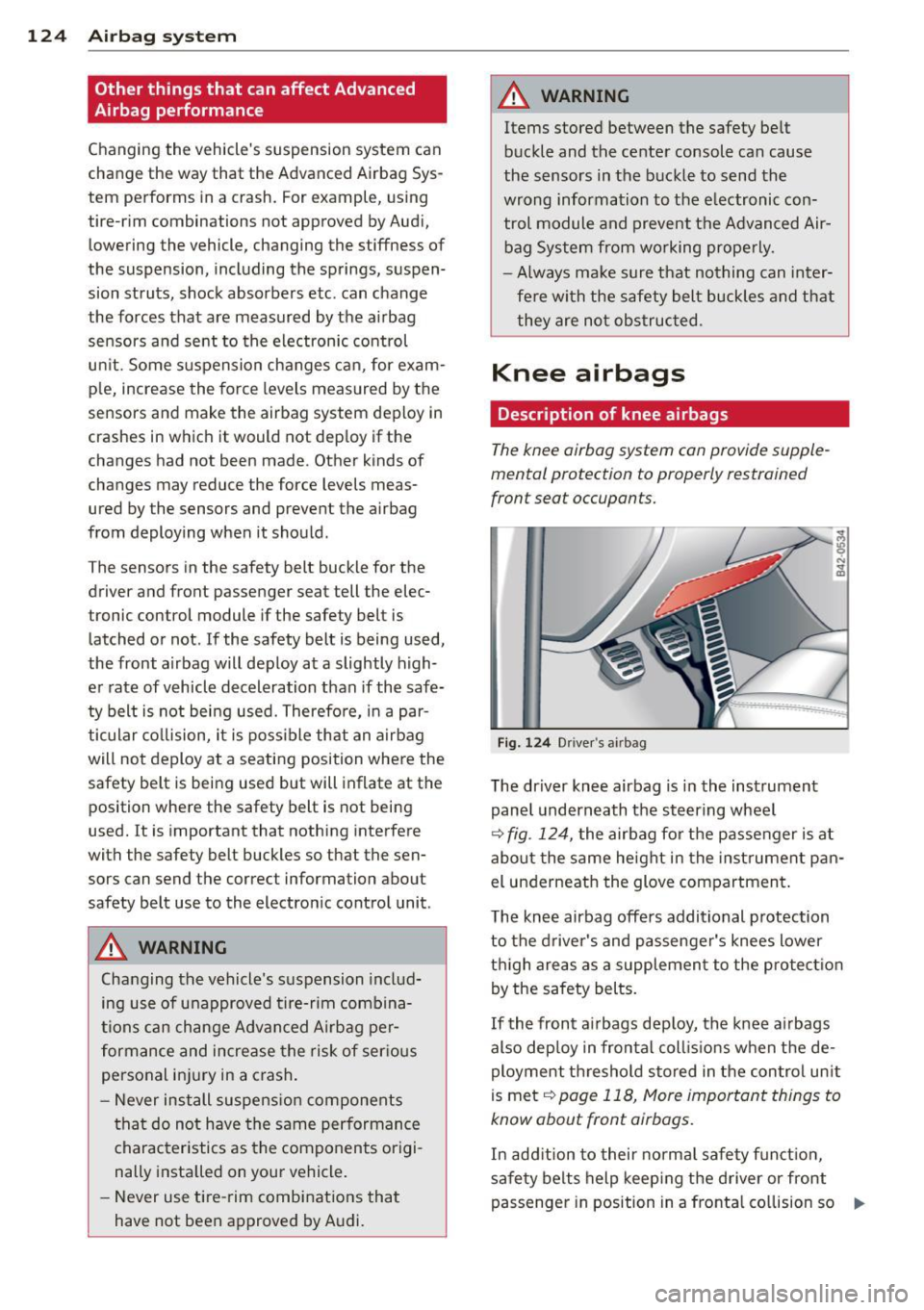
Fig. 124 Drive r's airbag
The driver knee airbag is in the instrument
panel underneath the steering wheel
~ fig . 124, the airbag for the passenger is at
about the same height in the instrument pan
el underneath the glove compartment.
The knee airbag offers additional protection
to the driver's and passenger's knees lower
thigh areas as a supplement to the protection
by the safety belts.
If the front airbags deploy, the knee airbags
also deploy in frontal collisions when the de
ployment threshold stored in the control unit
is met
~ page 118, More important things to
know about front airbags.
In addition to their normal safety function,
safety belts help keeping the driver or front
passenger in position in a frontal collision so ..,.
Page 144 of 236
142 Intelligent technology
Intelligent technology
Notice about data
recorded by vehicle
control modules
Your veh icle is not equipped with an Event Da
ta Recorder (EDR), installed by some manu
facture rs fo r the express p urpose o f capturing
data for retrieval after an accident or cras h
event. EDR's are sometimes called "crash re
corders".
Some state laws res trict the retrieval or down
loading of data stored by EDR's that were in
stalled in a vehicle for the express purpose of retrieving data after an accident or crash
event without the owner's consent.
A lthough yo ur vehicle is not equ ipped wit h an
EDR, it is equipped with a number of elect ron
ic control modules for various vehicle systems
such as, for examp le, eng ine function, emis
sion control, as well as for the airbags and
safety belts.
These electron ic control modules also record
vehicle-re lated data during norma l vehicle op
eration for diagnostic and repa ir purposes.
The recording capacity of the electronic con
trol modules is limited to data (no sound is re
corded) and only a small amount of data is ac
tually recorded ove r a ve ry limited pe riod of
time and stored when a sys tem fault or other
condition is sensed by a cont ro l u nit. Some of
the data then stored may re late to vehicle
speed, direction, braking as we ll as restraint
system use and performance in the event of a
crash or other condition. Stored data can only be read and downloaded w ith special equip
ment .
Electronic Stability
Control (ESC)
The Electronic Stability Control increases driv
ing stability.
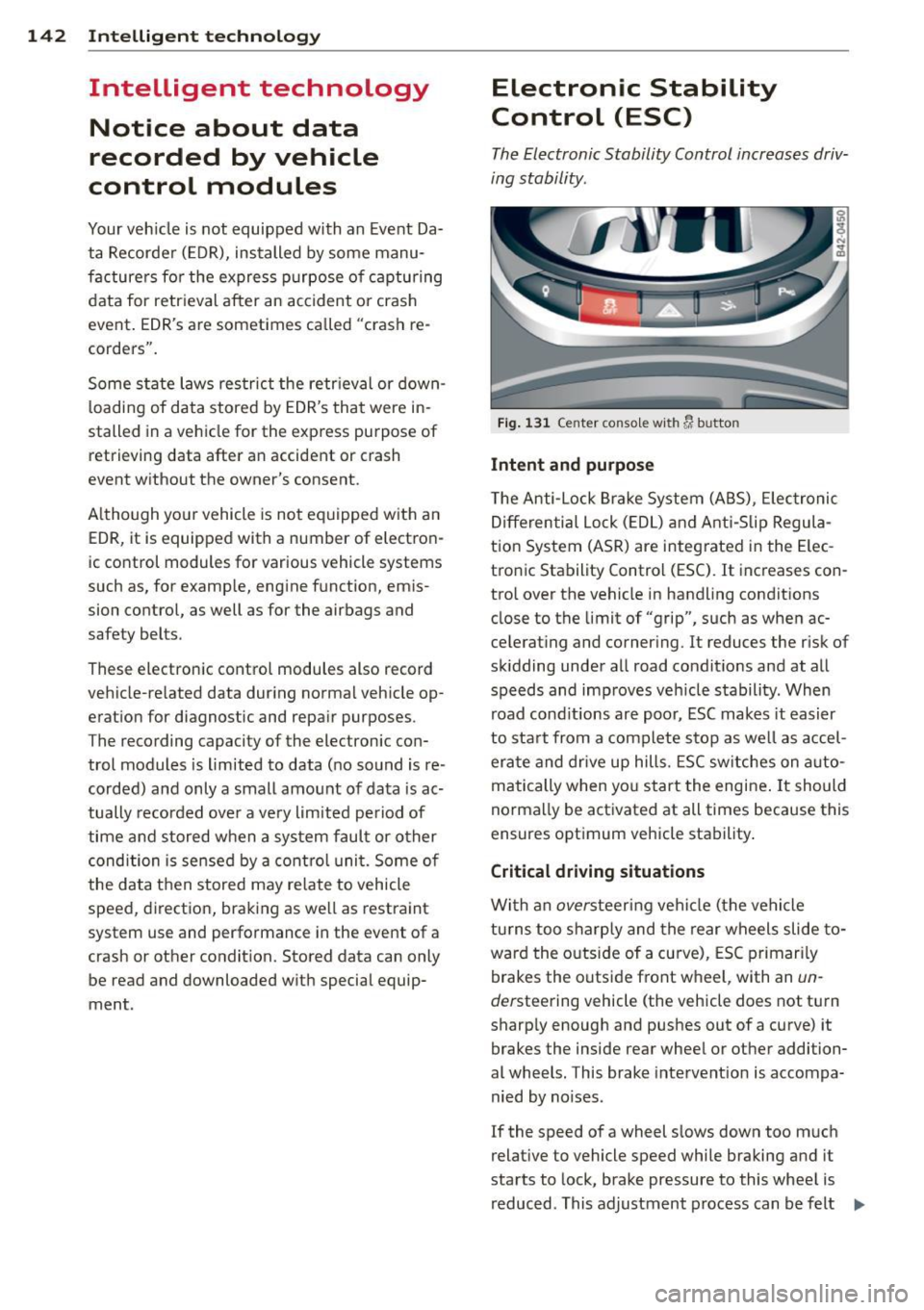
F ig . 1 31 Center console with~ button
Intent and purpose
The Anti-Lock B ra ke System (ABS), Elec tronic
Differential Lo ck (EDL) and Anti-Slip Regula
tion System (ASR) are integrated i n the Elec
tronic Stability Control (ESC). It increases con
tro l over the vehicle in handling conditions
close to the limit of "grip", such as when ac
celerating and corner ing. It reduces the risk of
skidding under all road condit ions and at all
speeds and improves veh icle stability. When
road cond itions are poor, ESC makes it easier
to sta rt from a comp lete s top as we ll as accel
era te and drive up hills. ESC sw itches on auto
matically when yo u start the engine . It should
norma lly be activated at all times because this
ensures optimum vehicle stability .
Critical driving situations
With an overs teering vehicle ( the vehicle
tu rns too s harply and the rear wheels slide to
ward the o utsi de of a curve), ESC primarily
brakes the outside front wheel, with an
un
dersteering vehicle (the vehicle does not turn
sharp ly enough and pushes out of a curve) it
brakes the inside rear whee l or other addition
al wheels. This brake inte rvent ion is accompa
nied by noises.
If the speed of a wheel s lows down too much
relat ive to vehicle speed while braking and it
starts to lock, brake pressure to this whee l is
reduced . This adjustment process can be felt ..,.
Page 145 of 236
as a pulsing mo tio n of the brake pe dal, ac
companied by some noises. I n order for ABS
to be a ble to operate optimally in th is range,
you must keep the brake pedal depressed -
never "pump the brakes" . You should not ex
pect that braking d is tances w ill be
shortened
under all circumstances w ith ABS . Braking dis
tance may even be slightly
longer , for exam
p le on gravel or wi th fresh snow on a slippery
surface .
If a sign ificant
speed differential between the
d rive w heels on one axle is determined (for
examp le, on a su rface that is s lippery
on one
side),
t he EDS brakes the spinn ing whee l and
transfers power to the other drive whee ls.
This is done up to a speed of about 60 mph (100 km/h) . Noises from the brake system
signal that whee l spin is being controlled.
I f one wheel spins when s tarting from a com
p lete stop because o f a different grip (for ex
ample , one wheel o n ice), keep your foot
hard
on the acce lerator until the veh icle starts to
move.
If the wheels spin , ASR wi ll automatically re
duce engine torque and match power to road
su rface condit ions .
Switching on Sport mode
In specific drivi ng situa tions (e.g. La unch Con
trol), you switch ASR and ESC to Sport mode
by pressing the
[!I button once . The indicator
light
11 illuminates and ESP sport -Warning!
Restricted stability
appears . "Slip" is matched
to the speed. You should do this only if your
driving skill a nd traffic cond it ions permit .
Switching ASR /ESC off
In certain sit uat ions (e .g . in deep snow, on a
l oose surface, o r when rocking the vehicle
free), switch ASR and ESC off by pressing the
[ill button for more than 3 seconds. The ind ica
tor light
II i lluminates and E SP swit ched off -
Warning! Re stricted stability appea rs . You
should do th is only if your driving skill and
traffic cond it io ns pe rmit .
Int ellig ent technolog y 143
Switching ASR /ESC on
Activate ASR/ ESC by pre ssing the [!I bu tton
again. The message
ESP on appears in the dis
play briefly.
Brake overheating
So that the disc b rake on a b raked wheel does
not over heat, the EDS switche s off au toma ti
ca lly if there is un usua lly severe loa ding a t
th is wheel. The vehicle is st ill drivable and has
the same properties as a vehicle without EDS .
As soon as the brake has coo le d down, EDS
swi tches on aga in automatically .
A WARNING
- Even ESC, ABS, EDS and AS R cannot over
come the laws of physics . You should
keep t his in m ind in particular on an icy
or wet road. If the systems intervene,
you shou ld ad just your speed immediate
ly to road and traff ic conditions . Do not
be tempted by the increased safety pro
vided to take risks -you risk having an
accide nt.
- Please keep in mind that the risk of an
accident is i ncreased by d riving too fast,
pa rti cularly in corners and on icy or wet
ro ads, and by drivi ng too close to the ve
hicle ahead . Even ESC, ABS, E DS and A SR
cannot eliminate the increased risk of
having an accident.
-Apply the throttle ca re fully when accel
erating on a consistently s lippery sur
face, e .g. on ice and snow . The drive
wheels can spin in spite of the EDS and thereby affect vehicle stability -you risk
having an accide nt.
- Please note that when ASR or ESC/ASR is
deactivated , the drive wheels can spin on
icy and sl ippery roads a nd the veh icle can
break away -the re is a risk of skidd ing!
(D Tips
- In the event of a defect in the rear spoil-
er system or in Audi magnet ic ride, it can
happen that ASR and ASR/ESC cannot be .,.
•
•
Page 161 of 236
Plastic parts and imitation leather
You can clean plastic parts and imitation
leather with a damp cloth . If this does not re
move the dirt, you can treat these parts only
with specia l
solvent-free plastic cleaning and
care products.
A WARNING
So lvents can change the properties of
some plast ics and make it harder for the
airbag to dep loy.
-
- Never clean the instrument panel or the
surface of Airbag modules with cleaning
products that contain solvents.
- Products containing solvents w ill make
the surface of this part porous.
- Serious injur ies can result if plastic parts
come loose when the airbag is deployed.
- Always read and heed all WARNINGS and
the informat ion
c::;,page 153.
(D Note
Clean ing agents containing solvents will
attack the material and can change the
way it behaves.
Carbon-fiber parts
Applies to vehicles: with carbo n-fiber parts
The carbon-fiber parts of your vehicle have a
pa inted surface. They do not require any spe
cial care and are cleaned like plast ic parts
¢pag e 159.
Fabrics and fabric coverings
Fabrics and fabr ic coverings (e.g. seats, door
trim panels, etc.) should be cleaned at regular
intervals with a vacu um cleaner. This removes
surface dirt particles which could become em
bedded in the fabric through use. Steam
cleaners shou ld not be used, because the
steam tends to push the dirt deeper into the
fabric and lock it there.
Cleaning and protection 159
Normal cleaning
Generally, we recommend using a soft sponge
or a lint-free microfiber cloth to the clean fab
ric. Brushes shou ld only be used for carpets
and floor mats, since other fabric surfaces could be harmed by brushes.
Normal surface stains can be cleaned using a
commercially available foam cleaner . Spread
the foam on the s urface of the fabric with a
soft sponge and work it in gently. Do not satu
rate the fabric. Then pat the foam dry using
absorbent, dry cloths (e.g. m icrofiber cloth)
and vacuum it after it has dried completely.
Cleaning stains
Stains caused by beverages (e.g. coffee, fruit
juice , etc.) can be treated with a mild deter
gent solution. Apply the detergent solution
with a sponge . In the case of stubborn stains,
a detergent paste can be applied directly to
the stain and worked into the fabric. After
wards, use copious amounts of clean water to
remove the remaining deterge nt. Apply the
water with a damp doth or sponge and pat
the fabric dry with an absorbent, dry cloth .
Stains from chocolate or makeup should have
detergent paste (e.g. ox-gall soap) rubbed in
to them. Afterwards, remove the soap with
water (damp sponge) .
Alcohol can be used to treat stains from
grease, oil, lipstick or a ballpoint pen. Melted
grease or dye must be patted off using ab
sorbent materia l.
It may be necessary to re
treat the areas with detergent paste and wa
ter.
In the case of general soiling of the upho ls
tery and cover material, we recommend hiring
a specia list t hat has the equipment to clean
the seat covers and other fabr ic surfaces by
shampooing and spray extraction.
A WARNING
Always read and heed all WARNINGS and
the information
c::;, page 153.
•
•
Page 163 of 236
Cleaning and caring for leather
upholstery and trim
Applies to vehicles: with natu ral leather
Natural leather requires special care and at
tention.
Norm al cleaning
.,. Cle an soiled areas w it h a slightly mo istened
cotton or woolen cloth .
More stubb orn d irt
.,. More stubborn dirt can b e re moved using a
cloth saturated with a m ild soap so lution (2
tablespoons m ild liquid soap).
.,. Never allow the soap solution to saturate
the leather, and make certa in that no water
soaks into the seams .
.,. Wipe off the soap solut ion with a soft, dry
clo th .
Cl eaning spots
.,. Remove fresh wa ter-b ased spots (such as
coffee, tea, ju ices, blood) w ith an absorbent
cloth or paper towel.
.,. Remove fresh
gr ease or o il-based spot s
(such as b utter, mayonnaise , chocolate) wi th
an absorbent cloth or paper towe l, or use
the cleaner from the leather care kit if the
spot has not yet p enetrated into the surface
of the leathe r.
.,. Use an oil/grease dissolv ing spray, if
oil /
gr ease spot s hav e dr ied on.
.,. Remove spec ific kinds of spots (ballpo int
pen, felt marker, fingernail polish , water
based paint, shoe polish, etc.) with a spot
remove r spec ifi cally formulated for leather .
Leather care
.,. Every half year use an approved leather care
product (ava ilable from your authorized Au
di dealer) to care for the leather .
.,. Apply the p roduct very spa ring ly.
.,. Wipe it off wi th a damp cloth .
If you have any questions about cleaning and
car ing for the leather in your vehicle, it is best
to contact your author ized Audi dealer, who
will be glad to help you and tell you about our
fu ll range of leather care products, s uch as:
Cleaning and protec tion 16 1
-Leather cleaning and care kit
- Cremes to care for colored leather
- Spot removers for ballpoint pens, shoe pol-
ish, etc.
- Oi l/grease d issolving spray
- New and upcom ing products .
A WARNING
Always read and heed all WARNINGS and
the information
r:!vpage 153.
@ Note
- Never use chemical so lvents (e .g . lighter
fluid, tu rpentine), waxes, shoe polish or
sim ilar products on the leather surfaces
in your Audi.
- To avoid damage, have stubbo rn sta ins
removed by a comme rcial clean ing spe
c ialist.
Cleaning Alcantara ® (synthetic suede)
App lies to vehicles: wit h Alcantara upholstery
Removing dust and dirt
.,. Mois ten a cloth , squeeze out excess water
and wipe down the seat surfaces.
Removing stains
.,. Moisten a cloth with lukewarm wate r or
w ith d iluted
e th yl (rubbing ) alcohol.
.,. Dab at the stain . Start at the outs ide and
work i nwards .
.,. Once the sta in is no longer v is ible , use a
soft dry cloth or tissue to soak up the mo is
ture.
Do no t use leather cleaning prod ucts on A l
cantara .
You may use a suitab le shampoo for remov ing
dust and di rt.
Dust and gr it in the pores and seams can
scratch and damage the surface .
If the car is
left stand ing in the sun for long per iods, the
Alcanta ra covers should be protected aga inst
direc t sun light to prevent it from fad ing.
Slight co lor va riations will develop in normal .,.. •
•
Page 180 of 236
178 Checking and filling
Brake fluid
Hove the brake fluid changed by an experi
enced technician .
Brake fluid absorbs moisture from the air. If
the water content in the brake fluid is too
h igh, corrosion in the brake system may result
after a per iod of t ime . The bo iling po int of the
brake fluid w ill also decrease considerably and
decrease b rak ing performance .
Therefore, the brake f lu id must be changed
every two years . Always use new brake fluid
which conforms to Federal Motor Vehicle
Standard "FMVSS 1 16 DOT 4".
Brake fl uid is rep laced according to the Audi
maintenance service schedule. Your author
ized Audi dealer is equipped with the necessa
ry special tools and replacement parts, has
the necessary expe rtise, and can d ispose of
the used fluid .
.&_ WARNING
- Brake fluid is po iso nous. It mus t be s to r
ed on ly in the closed orig inal con taine r
o ut o f th e reac h of children!
- Br ake f ailure can resul t from old o r in ap
propr iate brake fluid. Observe these pre
caut ions:
- Use o nly brake fluid that meets SAE
specification
J 1703 and co nfo rms to
Federal Motor Vehicle Sta ndard 116 .
A lways check wi th you r a uthori zed Aud i
dealer to m ake sur e you are u sing the
correct br ake f luid. The co rrec t type of
b rake fluid is a lso indica ted on the
b rake fluid reservoir .
- The brake flui d must be new. Heavy use
of the brakes can ca use a vapor loc k if
the brake fl uid is left in t he system too
l o ng. This can ser io usly affect the effi
ciency of the brakes as well as yo ur
safety. This could result in an acc ident.
Brake fluid will damage the paint of your
veh icle.
{® For the sake of the environment
Because of the p rob lem of proper disposal
of brake fluid as well as the spec ia l too ls
required and the necessary expertise, we
recommend that you have the brake flu id
cha nged by yo ur autho rized Aud i dea le r.
Battery
General information
All work on the ba ttery requires technical
knowledge.
The battery is located be hind the cov er in the
l u ggage compa rtment. Remove the cover by
pu shing i t to the left an d lift ing it o ut.
The battery is practically maintenance-free
and is checked as pa rt of your ve hicle's main
tenance se rv ices .
You are we ll advised to replace a battery that
i s older tha n 5 yea rs .
Disconnecting the battery terminals
Some vehicle f unctions (power window reg u
l ators, for example) are lost if the battery te r
mina ls are disconnected. T hese functions have
to be relearned after the battery termina ls are
co nn ected aga in . T o p revent th is, t he battery
shou ld only be disconnected from the ve hicle
elect ric al sy stem w hen abso lutely ne cessary
f or rep airs.
Vehicles not driven for long periods
The battery becomes d ischarged due to quies
cent current consume rs even when the vehicle
is not used. With extended pe riods of non-use
in t he
cold season, yo u should have t he ve hi
cle b attery removed by an autho riz ed Aud i
dealer or qualif ied workshop and stored in an
frost-free place. T his prevents the battery
from "freezing" and thereby being destroyed.
D uring the
warme r seasons it is enough to
disco nnect the battery negat ive terminal. Oc-
cas ionally charge a disconnected battery.
II>
Page 214 of 236
212 What do I do now ?
-Please note that the procedure for con
necting a jumper cable as described
above applies spec ifically to the case of
your vehicle be ing jump started. When
you are giving a jump start to another ve
hicle, do
not connect the negative( -) ca
ble to the negat ive( -) terminal on the
discharged bat tery ©-Instead, securely
con nect the negative( -) cable to either a
solid meta l comp onent that i s firmly
bo lted to the engine b lock or to the en
gine block itself . If the battery that is be
ing charged does not vent to the outside,
escaping battery gas cou ld ign ite and ex
plode!
Emergency towing
with commercial tow
truck
General hints
Your Audi requires special handling for tow
ing.
The following information is to be used by
commercia l tow truck operators who know
how to operate their equipment safe ly.
- Never tow your A udi, towing will cause dam
age to the engine and transmission .
- Never wrap the safety chains or winch cables
around the brake lines.
- To preven t unnecessary damage, your Audi
must be transported with a ca r carr ie r (flat
bed truck).
- To load the vehicle on to the flat bed, use
the towing loop fo und in the veh icle tools
and attach to the front anchorage
~ page 212.
A WARNING
A vehicle being towed is not safe for pas
senge rs. Never allow anyone to r ide in a
veh icle being towed, for any reason.
(D Note
The vehicle has very low gro und clea rance.
Make sure that no damage is caused to the
-
u nderside of the vehicle when it is being
l oaded onto a f lat bed t ruck .
Front towing loop
Do not install the front towing loop until it is
needed.
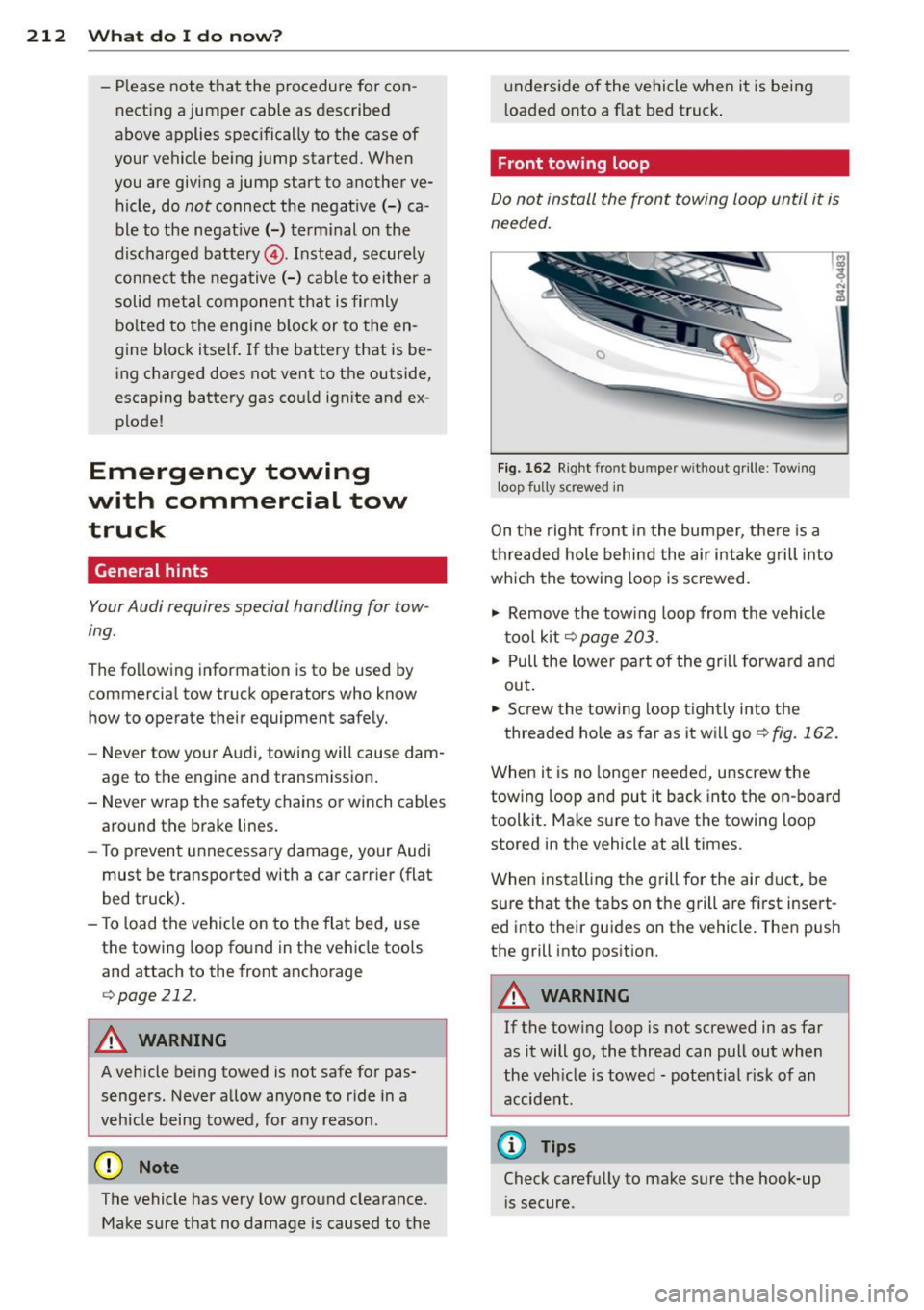
Fi g. 162 Righ t front bumper witho ut g rille : Tow ing
l oop
fully screwed in
On t he right fron t in the bumper, there is a
th readed hole behind the air in take grill into
which the towing loop is screwed.
"' Remove the tow ing loop from the vehicle
t oo l kit
~page 203.
"' Pull the lower part of the gr ill forward and
out .
"' Sc rew the towing loop tightly into the
threaded ho le as far as it wi ll go ¢
fig. 162.
When it is no longer needed, unscrew the
towing loop and put it back into the on -board
toolkit . Make su re to have the towing loop
stored in the vehicle at all times.
When installing t he grill for the air d uct, be
s u re that the tabs on the grill are f irst inse rt
ed into their guides on the vehicle . Then push
the grill into pos ition.
A WARNING
= If the tow ing loop is not screwed in as far
as it will go, the thread can pull out when
the veh icle is towed -potent ial r is k of an
a ccident.
@ Tips
Check caref ully to make sure the hook-up
i s secure.
Page 233 of 236
Index 231
Temperature . . . . . . . . . . . . . . . . . . . . . . . . 66 Trip comp ute r . .... .. . .. .. ..... ... .. . 23
Tire mobility system ............. .... 203 Tr ip odomete r .. ... .. ................ 10 •
Tire pressure . ............. .... .. .. . 189 Turn signals . .. .. .. ............... .. . 51 •
Tire pressure monitor ing system .. .. .. . 200 Warning/ind icator lights ........ .... . 20
Sensors .... .... .. .... ... .. .. .. ... 195
Tires and whee ls . ..... ... .. .. .. .. . 195 U
Valves ..... .. .. .. .. .... ... .. .. ... 195
Warn ing/ indicator light .... .. .. .. .. .. 20
T ire repai r kit ............. .... .. .. . 203
Tires ....... ... ................ .... 183
Pressu re ... ... .. .. ...... .. .. .. .. . 200
Replacing . . . . . . . . . . . . . . . . . . . 193, 195
Service life . ............. .. .. .. .. . 19 2
Speed rating let ter code ... .. .. .. .. . 194
Tire manufacturing date ... .. .. .. .. . 194
Tire pressure monitoring system . ... . 200
Tire specifications ..... ... .. .. .. .. . 194
Tread depth .. ........... .. .. .. ... 192
Uniform t ire quality grading .. .. .. .. . 197
W inter t ires ............. .... .. ... 197
Tires/Whee ls
L ow aspect ratio tires ... ... .. .. .. .. .
199
Tires and vehicle load lim its .. .. .. .. .. . 190
Tires and whee ls
Checking tire pressure ..... .. .. .. .. . 189
Cold tire i nflat ion pressure ..... ... .. 187
D . . 1mens1ons
........... ...... .... . . 193
Gener al notes ............ .... .. .. . 183
Glossa ry of t ire and load ing te rm inolo-
gy ...... .. .... ........... .. .. .. .
184
N ew tires and wheels ... ... .. .. .. .. . 193
Replacing .. ... .. ..... ... .. .. .. ... 194
Snow chains . . . . . . . . . . . . . . . . . . . . . . 198
Tire pressure monitoring system .. .. . 195
Tires and vehicle load lim its .. .. .. .. . 190
Wheel bolts ..... .. ...... .. .. .. .. . 199
W inte r tires .......... ...... .... .. 197
Tire serv ice life . . . . . . . . . . . . . . . . . . . . . 192
Tool kit ... .. ................. .. ... 203
Touch-up paint ............ .... .. ... 157
Towing
Tow truck procedures ... ... .. .. .. .. .
2 12
Tow ing loop .. ............. .... .. .. . 2 12
Transm ission
Manual transmission ...... .. .. .. .. ..
77
Transport Canada ... .... ... .. .. .. .... 98
Tread Wear Indicato r (TWI) .. .. .. .. .. . 19 2
Unfastening safety belts 106
Uni directional tires . .. ........... .. .. 183
Uni form tire quality grading ...... .. .. 197
U niversa l Radio-Frequency Remo te Control
(Homelink ®) . ... .. .. . ... ...... ... .. .
88
Unl ocking .. .. .. .. ................. . 35
Power locking system .......... .. .. . 35
V
Vanity mir ro r . . . . . . . . . . . . . . . . . . . . . . . . 53
Vehicle-care products ............ .. .. 153
Vehicle electri ca l sys tem . . . . . . . . . . . . . . 14
Vehicle Identificat ion Number (VIN) .... 215
Vehicle jack ... .. .... . ... ...... ... .. 207
Vehicle lite ratu re .. ................. .. 4
Vehicle tool kit .. .. ............. ....
203
Ventilation . . . . . . . . . . . . . . . . . . . . . . . . . 65
Voltmete r display . . . . . . . . . . . . . . . . . . . . 11
w
Warning/indicator lights . . . . . . . . . . . . . . . 8
Airbag system . . . . . . . . . . . . . . . . . . . . .
14
Anti- lock b rake system (ABS) ....... .. 16
B ra ke system .. .. ................. . 13
Cruise control . . . . . . . . . . . . . . . . . . . . . . 20
Elec tronic power con trol . . . . . . . . . . . . . 17
Electronic Stability Control (ESC) ... .. . 16
Generator . . . . . . . . . . . . . . . . . . . . . . . . . 14
Malfunction Ind icator Lamp (MIL) .. .. . 17
Parking brake .. .. ................. . 13
Safety belt . . . . . . . . . . . . . . . . . . . . . . . . 14
Safety systems . . . . . . . . . . . . . . . . . . . . . 14
Tire pressure mon itoring system . . . . . . 20
Turn signals . .. .. .. ... ....... ...... 20
Warning/Indicator lights
Rear spo iler . .. .. ................. .
19
Warning lights . . . . . . . . . . . . . . . . . . . . . . 11
Red symbo ls in the center display ... .. . 11
Ye llow symbo ls in the center display ... 12