battery AUDI R8 SPYDER 2012 User Guide
[x] Cancel search | Manufacturer: AUDI, Model Year: 2012, Model line: R8 SPYDER, Model: AUDI R8 SPYDER 2012Pages: 236, PDF Size: 59.24 MB
Page 43 of 236
(D Note
To p reve nt damage t o the conve rtible top:
- do no t s tore any objects in the converti
ble top storage bay .
- make sure there is enough space above
the veh icle when opening or closing the
convertible top.
@ Tips
- When the indica to r l amp iii blinks,
there is a system malfunc tion
c> page 15 .
-The one-touch openi ng fun ction is not
ava ilable when the vehicle is traveling
below 4 mph (6 km/h) or above 31 mph
(SO km/h).
If this is the case, a wa rning
tone w ill sound and a message will ap
pear in the instrument cluster
c> page 41.
Error message in the instrument cluster
display
An error message appears if the convertible
top cannot open or close.
Severa l conditions must be met for the con
ve rtible top to open or close automatically .
An error message in the inst rument cluste r
d isp lay ind icates if one of the condit ions is not
met or there is a malfunct ion.
Soft top: Please clo se engine lid!
The engine compa rtment lid must be closed
when opening or closing the convertible top .
T his message appears in the instrument clus
ter d isp lay if the engine compartment lid is
not closed.
Soft top : Cannot be used!
This error message appears if the convertib le
cannot open or close because of safety rea
sons or if there is a malfunction . The follow
ing causes are poss ible:
- The vehicle is t ra veling too fa st: Converti
ble top operation is deactivated for safety
reasons if the vehicle is traveling too fast . A
message w ill appear . Reduce the vehicle
Con vertible top 41
speed and pu ll or press the sw itch again to
open or close the convertible top.
- The battery voltage i s too low: Th e conver
tible top cannot open or close if the battery
voltage is too low. This ens ures there will be
enough battery vo ltage left to start the ve
hicle . The convertible top can be operated
aga in after the engi ne is started.
- Ove rload protect ion is acti ve: Operating the
convert ible top continuously for a long peri
od of time p laces stress on the hydraulic
un it. Over load protect io n is act ivated to p re
vent damage to the system . This protective
fu nction preve nts t he conver tible top from
open ing or close fo r approximate ly 15 to 30
m inu tes.
It will f unct io n a gain a fter tha t
c:::> &..
-Malfun ction : Failure of system components
is one possib le cause fo r malfunction. If this
happens, you can a lso operate the converti
ble top by hand
c:> page 43 .
-The exterior temperature is too low: The
converti ble top will not o pen in tempera
t u res below (S °F) (-15 QC).
Soft top not secure
If the conve rtib le to p is not complet ely open
or closed and the vehi cle is t raveling too fast,
the error message above appears and a warn
ing tone sounds. Reduce the vehicle speed
and pull or press the switch again to open or close t he convertible top.
A WARNING
N eve r drive when the c onvertible top is not
locked correctly . The wind from driving
could cause the co nvertib le top to open.
T his ca n resu lt in i nju ries and damage to
the vehicle.
Page 54 of 236
52 Clear vis ion
Interior lights
Interior lights
The interior lights include the reading lights
for the driver and the front passenger .
-
,-i.-,-,n--;)
"' "' "' 0
•
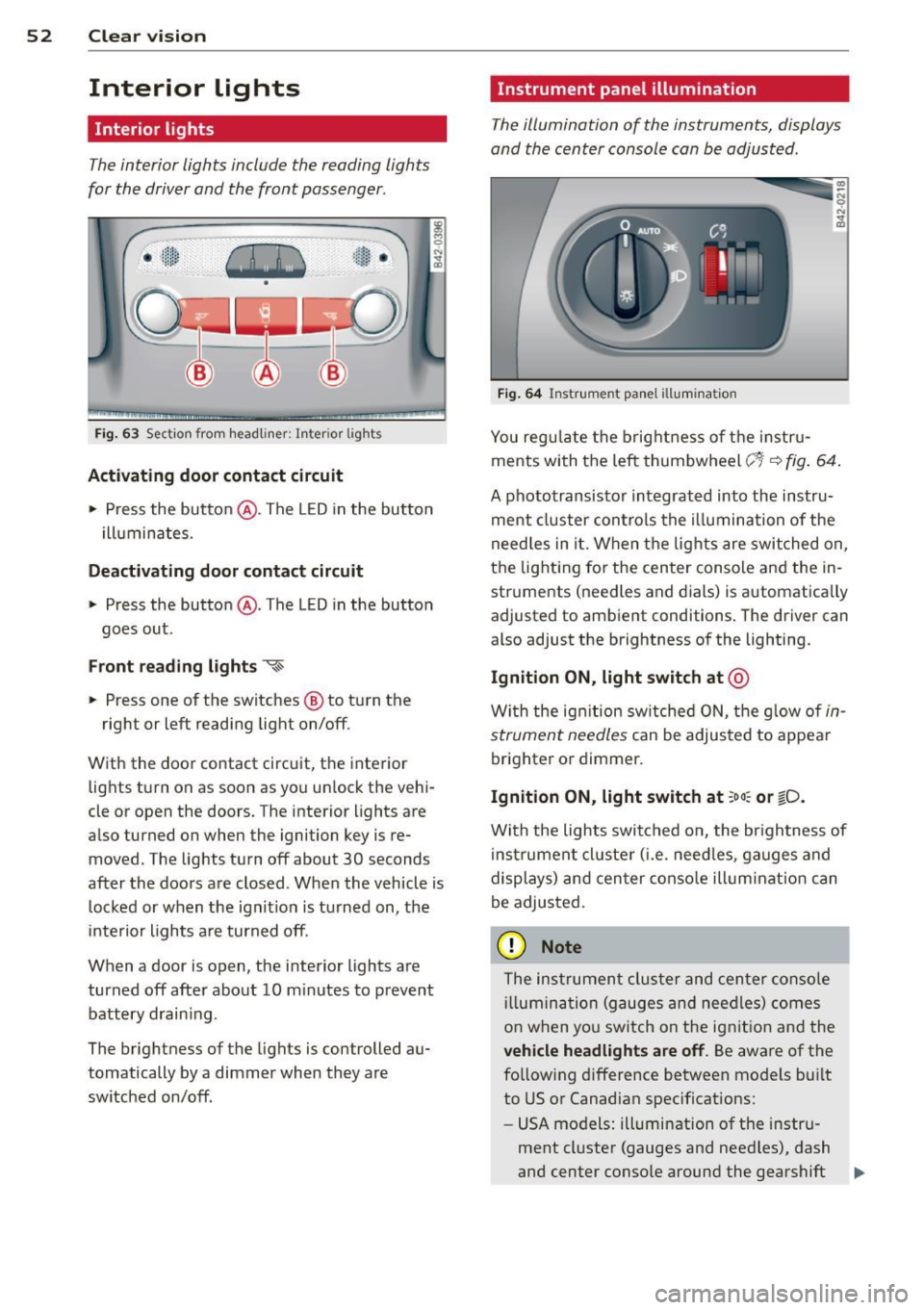
Fi g. 63 Section from headliner: I nterior l ights
Acti vating door contact circuit
• Press the button @. The LED in the button
i lluminates.
Deactivating door c ontact circu it
• Press the button @. The LED in the button
goes out .
Front re ad ing lights ~
• Press one of the switches @ to turn the
right or left reading light on/off.
With the door contact circuit, the interior lights turn on as soon as you unlock the vehi
cle or open the doors. The interior lights are
also turned on when the ignition key is re moved. The lights turn off about 30 seconds
after the doors are closed . When the vehicle is
locked or when the ignit io n is tu rned on, the
inte rior lights a re turned off.
When a door is open, the interior lights are
turned off after about 10 m inutes to prevent
battery drain ing.
The brightness of the lights is controlled au
tomatically by a dimmer when they are
switched on/off .
Instrument panel illumination
The illumination of the instruments, displays
and the center console can be adjusted .
Fig . 6 4 Instrument pa nel illuminat ion
You reg ulate the brightness of t he instr u
ments with the left thumbwheel
c;~-~ fig . 64 .
A phototransisto r integrated into the instru
ment cluster controls the illumina tion of the
need les in it. When the lights are switched on,
the lighting for the center conso le and the in
struments (needles and dials) is automatically
adjusted to ambient conditions . The driver can
also adjust the brightness of the lighting.
Ignition ON, light switch at @
With the ign ition sw itched O N, the g low of in
strument needles
can be adjusted to appear
brighter or dimmer.
Ignition ON, light switch at ;oo : or ~D.
With the lights switched o n, the br ightness of
instrumen t cluster ( i.e . need les, ga uges and
displays) and cen ter conso le illum inat ion can
be adjusted.
(D Note
The instrumen t cluster and cen ter conso le
ill umin ation (gauges and nee dles) comes
o n when yo u sw itch on the ignit io n and the
veh icle headlights are off . Be aware of the
fo llowing difference between models bui lt
to US or Canadian specifications:
- USA models: illumination of the instru
ment cl uster (gauges and need les), dash
and center conso le around the gearshift .,.
Page 64 of 236
62 Seats and storage
- Never use the cupho lder or adapter as an
ashtray- risk of f ire.
CD Note
On ly drink containe rs with lids should be
carried in the cupho lder. Liquid could spill
out and damage your vehicle's e lectronic
equ ipment or sta in the upholstery, etc.
Ashtray
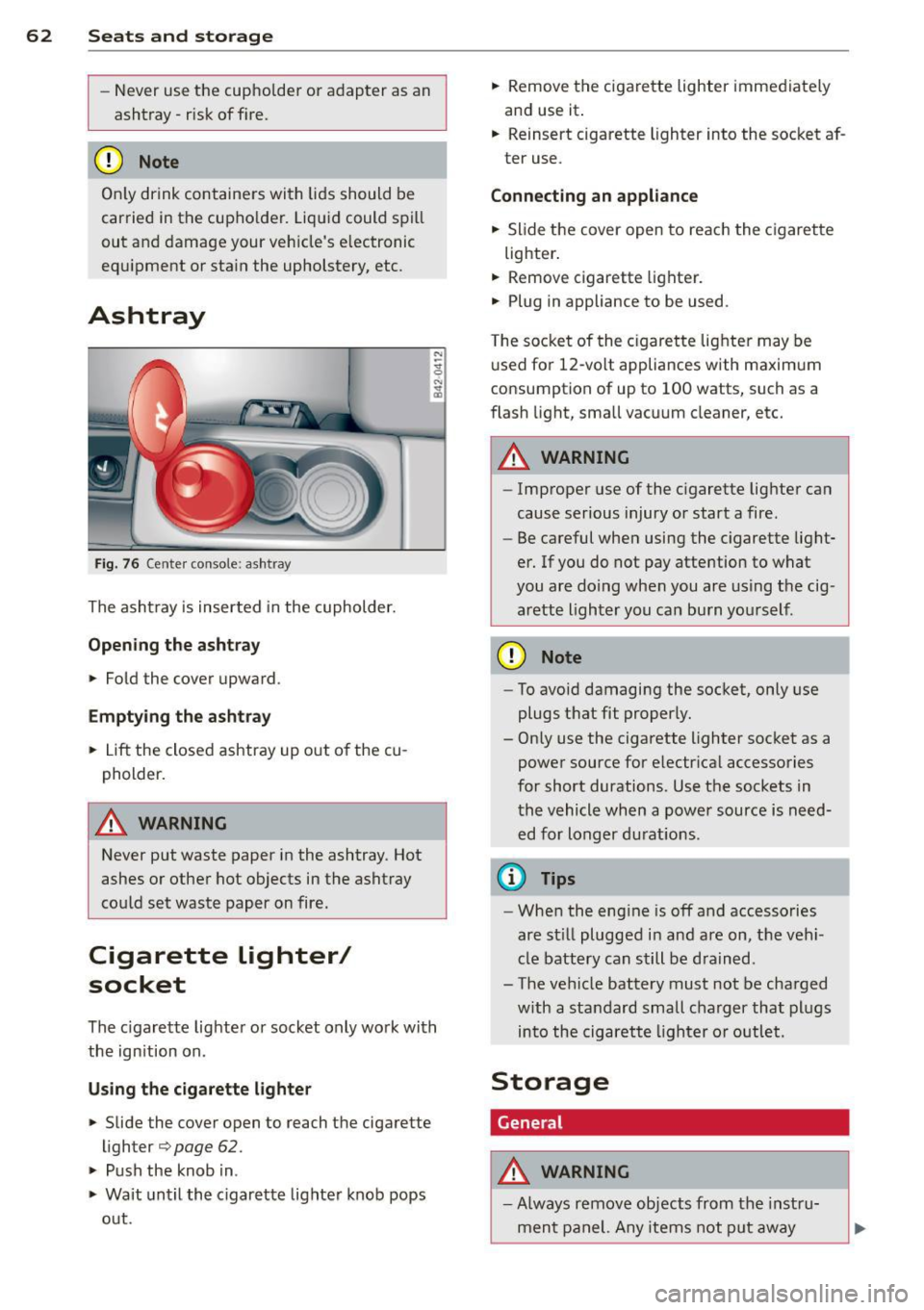
Fig . 76 Center console: ashtray
The asht ray is inserted in the cupholder.
Opening the ashtray
.,. Fold the cover upward .
Emptying the ashtray
.,. Lift the closed ashtray up o ut o f the cu
pholder.
A WARNING
Never put waste paper in the ashtray. Hot
ashes or other hot objects in the ashtray
could set waste paper on fire.
Cigarette Lighter/
socket
N
-"' 0 ..:. ... m
The c igarette lig hte r or socket only wo rk with
the ign ition on.
Using the cigarette lighter
.,. Slide the cover open to reach th e cigarette
lighter
qpage 62.
.,. Push the knob in.
.,. Wait un til the c igarette lighte r knob pops
out. .,.
Remove the cigarette lighter immediately
and use it.
.,. Reinsert cigarette lighter into the socket af
ter use.
Connecting an appliance
.,. Slide the cover open to reach the c igarette
lighter .
.,. Remove cigarette lighter .
.,. Plug in appliance to be used.
T he socket of the c igarette lighter may be
u sed for 12-volt appliances with maximum
consumption of up to 100 watts, such as a
flash light, small vacuum cleaner, etc.
A WARNING
--Improper use of the c igarette lig hter can
cause serious injury or start a fire .
- Be careful when using the c igarette light
er. If you do not pay attention to what
you are doing when you are us ing t he cig
arette lighter you can burn yo urself.
CD Note
-To avoid damaging the socket, only use
plugs that fit properly.
- Only use the cigarette lighter socket as a
powe r source for e lectr ica l accessories
for short durations . Use t he sockets in
the vehicle when a power source is need ed for longer du rat ions .
(0 Tips
-When the eng ine is off and accessories
are st ill plugged in and are on, t he vehi
cle battery can still be d ra in ed.
- The ve hicle battery must not be charged
w ith a standard small charger that pl ugs
into the cigarette lighter or outlet .
Storage
, General
A WARNING
- Always remove objects from the instr u
men t pa nel. A ny items not put away
-
Page 68 of 236
66 Warm and cold
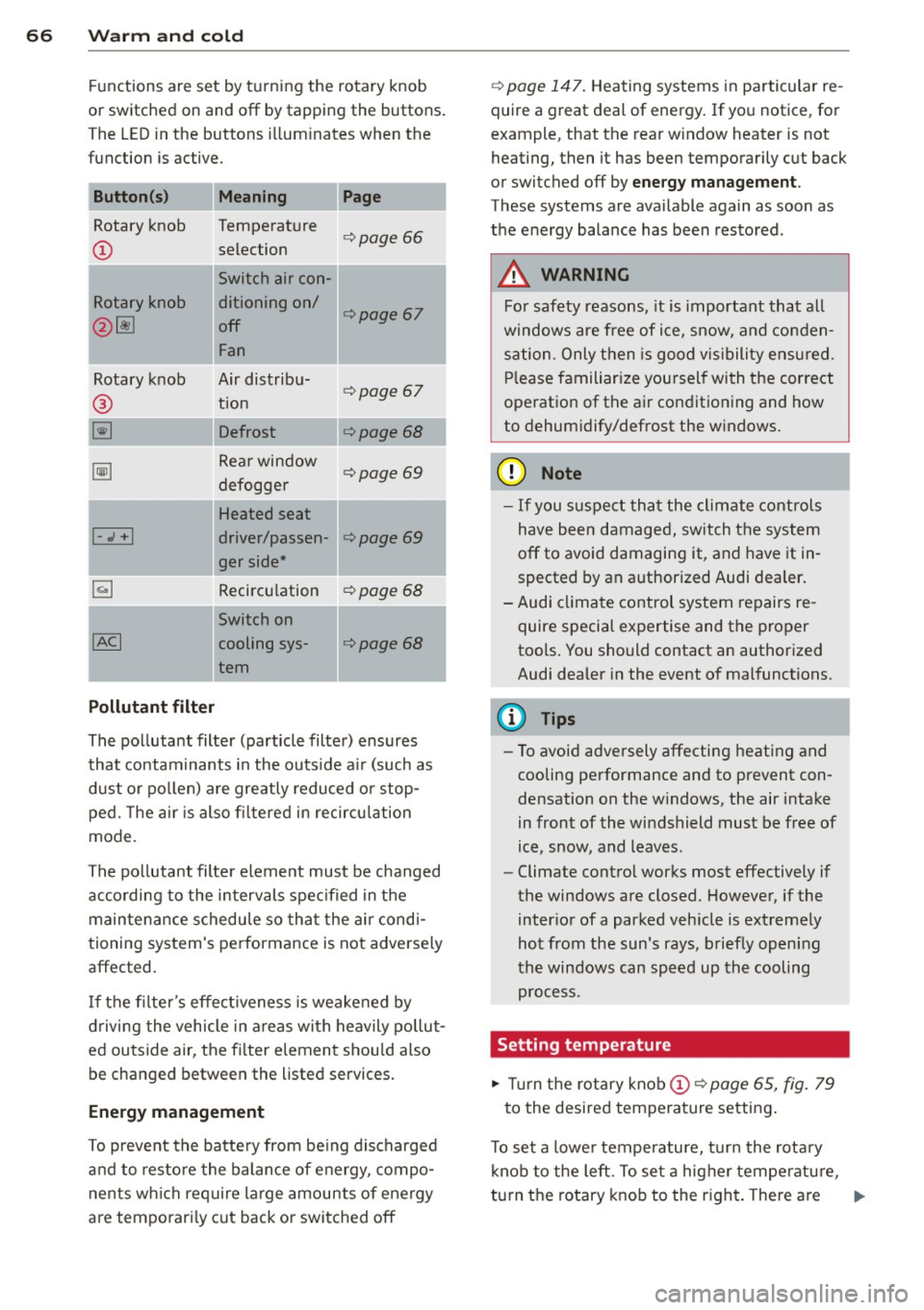
Functions are set by turning the rotary knob
or switched on and
off by tapping the buttons.
The LED in the buttons illuminates when the
function is active.
Button(s) Meaning Page
Rotary knob Temperature ¢ page 66
CD selection
Switch air con-
Rotary knob ditioning on/
¢page 67
@ ~ off
Fan
Rotary knob Air distribu-
¢ page 67
® tion
~ Defrost ¢page 68
~
Rear window ¢page 69
defogger
I Heated seat
I-"' +I driver/passen-¢page 69
ger side*
~ Recirculation ¢ page 68
l(g]
Switch on
cooling sys-
¢page 68
I tern
Pollutant filter
The pollutant filter (particle filter) ensures
that contaminants in the outside air (such as
dust or pollen) are greatly reduced or stop
ped. The air is also filtered in recirculation
mode.
The pollutant filter element must be changed
according to the intervals specified in the maintenance schedule so that the air condi
tioning system's performance is not adversely
affected.
If the filter 's effectiveness is weakened by
driving the vehicle in areas with heavily pollut
ed outside air, the filter element should also
be changed between the listed services.
Energy management
To prevent the battery from being discharged
and to restore the balance of energy, compo
nents which require large amounts of energy
are temporarily cut back or switched
off
¢ page 147. Heating systems in particular re
quire a great deal of energy. If you notice , for
example, that the rear window heater is not
heating, then it has been temporarily cut back
or switched
off by energy management.
These systems are available again as soon as
the energy balance has been restored.
A WARNING ,..__
For safety reasons, it is important that all
windows are free of ice, snow, and conden
sation. Only then is good visibility ensured.
Please familiarize yourself with the correct
operation of the air conditioning and how
to dehumidify/defrost the windows.
@ Note
- If
you suspect that the climate controls
have been damaged, switch the system
off to avoid damaging it , and have it in
spected by an authorized Audi dealer.
- Audi climate control system repairs re
quire special expertise and the proper
tools. You should contact an authorized
Audi dealer in the event of malfunctions.
(D Tips
-To avoid adversely affecting heating and
cooling performance and to prevent con
densation on the windows, the air intake
in front of the windshield must be free of
ice, snow, and leaves .
- Climate control works most effectively if
the windows are closed. However, if the interior of a parked vehicle is extremely
hot from the sun's rays, briefly opening
the windows can speed up the cooling
process.
Setting temperature
.,. Turn the rotary knob CD¢ page 65, fig. 79
to the desired temperature setting.
To set a lower temperature, turn the rotary
knob to the left. To set a higher temperature,
turn the rotary knob to the right. There are .,..
Page 73 of 236
Ignition on @
Afte r switch ing the ignition on, the needles
move all the way up and then down .
I f it is difficult to turn the key afte r you have
i nse rted it into the ignit ion lo ck, tur n the
steer ing whee l back and forth. This will take
the load off the steering lock mechanism and
you will be able to turn the key freely and start the engine .
Starting the engin e@
In th is position the engine starts. While the
engine is start ing, the power s upply to the
headlights and other e lectrica l consumers is
temporari ly interrupted to conserve battery
pow er. Aft er the engine has started, release
the key and it will return to posit ion @.
Before the starter can be operated again the
key must be turned back to position@. The
non -repe at lock prevents you from damaging
the starter when the engine is runn ing .
A WARNING
-Never remove the key from the ign ition
lock whi le the vehicle is moving. The
steering wheel will lock causing loss of control.
- If you have to leave your veh icle -even
for just a m in ute - always remove the ig
nition key and take it with you. This is es
pecially important if you a re going to
leave c hildren behind in the vehicle. The
children co uld start the engine or use
other vehicle controls . Unsupervised use
of vehicle controls (for example, power
windows) can cause serious personal in
jur ies .
If the vehicle battery has been disconnect
ed and then reconnected, then you m ust
leave the key in pos ition @for abo ut 5
seconds before you can start the engine.
On th e ro ad 71
Starting the engine
The engine can only be started with your orig
inal Audi key.
On vehicles with R tronic *, the engine can be
start ed in the ne utra l position N and in each
gea r (1 - 6 and R).
.. Set the park ing brake ¢,&. .
.. On vehicles with man ua l transmission *,
fu lly depress the clutch pedal.
.. Press and hold the brake pedal.
.. Turn the ignition key to pos it ion ®
¢ page 70, fig. 82 - do not depress the gas
pedal when starting the engine .
.. Let go of the key as soon as the engine
starts - the sta rter must not cont inue to
r u n. On ve hicles w ith R t ro ni c, selec t gea r
posi tion N .
A cold engine may at first be loud afte r it has
been sta rted. This is due to the hydraulic
valves bu ild ing up the oil press ure . Thi s is nor
mal and no need for concern.
If the engine does not start immediately, stop
tryi ng after 10 seconds and then try to restart
the engine abou t 30 seconds later.
A WARNING
- Never start or let the eng ine run in a con
fined or enclosed area . Exha ust fumes
from the engine contain carbon monox
ide, a co lor less and odorless gas. Carbon
mo nox ide ca n be fatal if inhaled.
- Never leave the engine idling unattend
ed. An unattended veh icle with a runn ing
engine poses a danger of personal injury
or theft .
- With the engine r unning and a gear en
gaged, you have to hold the veh icle w ith
the foot brake .
(D Note
- Avoid h igh engine speeds, fast accelera
tion or heavy engine loads while the en
gine is still cold. This could damage the
eng ine .
Page 125 of 236
A WARNING
1
Improper care, servicing and repair proce
dures can increase the risk of personal in
jury and death by preventing an airbag from deploying when needed or deploying an airbag unexpectedly:
- Never cover, obstruct, or change the
steering wheel horn pad or airbag cover
or the instrument panel or modify them
in any way .
- Never attach any objects such as cup
holders or telephone mountings to the
surfaces covering the airbag units.
- For cleaning the horn pad or instrument
panel, use only a soft , dry cloth or one
moistened with plain water. Solvents or
cleaners could damage the airbag cover
or change the stiffness or strength of the
material so that the airbag cannot de
ploy and protect properly.
- Never repair, adjust, or change any parts
of the airbag system.
- All work on the steering wheel, instru
ment panel, front seats or electrical sys
tem (including the installation of audio
equipment, cellular telephones and CB
radios, etc .) must be performed by a
qualified technician who has the training
and special equipment necessary.
- For any work on the airbag system, we
strongly recommend that you see your
authorized Audi dealer or qualified work
shop.
- Never modify the front bumper or parts
of the vehicle body .
- Always make sure that the side airbag
can inflate without interference:
- Never install seat covers or replace
ment upholstery over the front seat
backs that have not been specifically
approved by Audi.
- Never use additional seat cushions that
cover the areas where the side airbags
inflate.
- Damage to the original seat covers or
to the seam in the area of the side air bag module must always be repaired
Airbag system 123
immediately by an authorized Audi
dealer.
- The airbag system can be activated only
once . After an airbag has inflated, it
must be replaced by an authori zed Audi
dealer or qualified technician who has
the technical information, training and
special equipment necessary.
- The airbag system can be deployed only
once . After an airbag has been deployed,
it must be replaced with new replace
ment parts designed and approved espe
cially for your Audi model version . Re
placement of complete airbag systems
or airbag components must be per
formed by qualified workshops only. Make sure that any airbag service action
is entered in your Audi Warranty
& Main
t enance booklet under
AIRBAG REPLACE
MENT RECORD .
-For safety reasons in severe accidents,
the alternator and s tarter are separa ted
from the vehicle battery with a pyrotech
nic circuit interrupter .
- Work on the pyrotechnic circuit inter
rupter must only be performed by a
qualified dealer - risk of an accident!
- If the vehicle or the circuit interrupter
is scrapped , all applicable safety pre
cautions must be followed.
@ For the sake of the environment
Undeployed airbag modules and preten
sioners might be classified as Perchlorate
Material - special handling may apply, see
www .dtsc .ca. gov/hazard o u swaste/ per-
ch [orate . When the vehicle or parts of the
restraint system including airbag modules
and safety belts with pretensioners are
scrapped, all applicable laws and regula
tions must be observed. Your authorized
Audi dealer is familiar with these require
ments and we recommend that you have
your dealer perform this service for you.
•
•
•
•
Page 149 of 236
Driving with your
quattro ®
With all-wheel drive, all four wheels are driv
en .
Gene ral inform ation
W ith all-wheel dr ive, power is distributed to
all four wheels . This happens automatically
depending on your driving style and the road
conditions at the t ime . See also <::;>
page 142.
Winter t ires
When driving in the winter, your vehicle with
all-wheel drive has an advantage, even with
regular tires. In winter road conditions it may
be advisable to mount winter tires (or all -sea
son t ires) for improved driveability and brak
ing: these tires must be mounted on
a ll f our
wheel s.
Snow chain s
Where snow chains are mandatory on certain
roads, th is normally also applies to vehicles
with all-wheel drive
Qpage 198, Snow
chains.
Replacing wheel s/tire s
Only the wheel/tire sizes specified by the
manufacturer may be used on vehicles with
all-wheel drive
<=> page 193 .
A WARNING
-Always adjust your driving to road and
traffic conditions. Do not let the extra
safety affo rded by a ll-wheel d rive tempt
you into taking extra risks .
- Although a ll-wheel drive is ve ry effect ive,
always remember that braking capacity
is limited by tire traction . You should
therefore not drive at excessive speeds
on icy or slippery road surfaces.
- On wet road surfaces, be careful not to drive too fast because the front wheels
cou ld begin to slide on top of the water
(aquaplaning). If this should occur, you
will have no warning from a sudden in crease in engine speed as with a front-
-
Int ellig ent technolog y 147
wheel drive vehicle. Always drive at
speeds which are su ited to the road con
ditions. -risk of crash.
Energy management
Starting ability is optimized
Energy management controls the distribution
of electrical energy and thus optimizes the
availability of electrical energy for starting the engine.
If a vehicle with a conventional energy system
is not driven for a long per iod of t ime, the bat
te ry is d ischarged by idling current consumers
(e .g. immobi lizer). In certain circumstances it
can resu lt in the re being insufficient energy
available to start the engine.
Intelligent energy management in your vehi
cle handles the distribution of e lectr ica l ene r
gy. Starting ability is markedly improved and
the life of the battery is extended .
Bas ica lly, energy management consists of
b atte ry diag nosis, idling current m an age
m ent
and dy namic energ y manag ement .
Batte ry diagno sis
Battery diagnosis continuously determines
the state of the batte ry. Sensors determine
battery voltage, battery current and batte ry
temperature . This determines the current
state of charge and the power of the battery.
Idling current manag ement
Idling current management reduces energy
consumption while the vehicle is standing.
Wi th the ign ition switched off, it controls the
energy supply to the various electrica l compo
nents. Data from battery diagnosis is consid
ered.
Depend ing on the ba ttery's state of charge,
individual cons umers are gradually turned off
to prevent excessive discharge of the battery
and thus maintain starting capability. .,..
•
•
Page 150 of 236
148 Intelligent technology
Dynamic energy management
While th e veh icle is be ing dr iven , dynamic en
e rgy management distributes the energy gen
erated according to the needs of the individu
a l components . It reg ulates cons umption, so
that more electrical energy is not being used
t han is being generated and ensures an opti
mal state of charge for the battery .
(D Tips
- But even energy management cannot
negate the limits of physics. Consider
that the power and life of a battery are li mited .
- If starting ab ility is threatened, you are
i nformed by a warn ing
<=> page 148,
Driver notification in the instrument
cluster display .
What you should know
The highest priority is given to maintaining
starting capability.
The battery is severely taxed in short-distance
d riving, in city traffic and duri ng the co ld time
of year. Abu ndant e lectr ica l energy is re
qu ired, but only a little is g ene rated . It is also
cr itica l if t he engine is not run ning and ele ct ri
cal componen ts ar e turned on. In th is in
stance energy is being consumed but none is
being generate d.
It is in precisely these si tua tions that you w ill
notice energy management actively regula t
ing the distrib ution o f energy .
Vehicle stands for an extended period
If you do not drive you r vehicle over a period
of severa l days or weeks, elect rical compo
n ents are grad ually cu t back o r swi tched off .
This redu ce s energy cons umption and mai n
tains s ta rting cap abili ty over a longer period .
T a ke into considerat ion tha t when you u nlock
your ve hicle, some co nvenience func tions,
such as the remote key or power sea t adj ust
men t, may not be available. The convenience
f u nctions will be avai lable again when you
turn on th e ignition and start the engine. With the engine turned off
If you
listen to the radio, for examp le, w it h
t h e engine t urned off, the battery is being dis
c h arged .
If starti ng capab il ity is jeopard ized d ue to en
ergy consu mptio n, a mess age a ppea rs in the
drive r informa tion d isplay .
You have to start t he engine to charge the
ba tte ry.
With the engine running
Althoug h electrical energy is generated when
the vehicle is being d riven, the battery can be
come discharged. This happens mostly when
li ttle energy is being ge ne rated and a g reat
deal consumed a nd t he battery's state of
c h arge is not opt imal.
To b ring the energy bala nce back into equ ili
br iu m , consume rs wh ich req uire espe cially
l ar ge amounts of ene rgy a re temporar ily cu t
ba ck or sw itched o ff. H ea ting systems in par
t icu lar require a grea t deal of energy . If you
not ice, for examp le, that the heated seatsat or
the heated rear window are not heating, they have been temporarily cut back or switched
off . These systems w ill be available again as
soon as the e ne rgy balance has been restored.
You w ill also notice that engine id le speed has
been increased slightly . T hi s is normal and not
a cause for concern. By increasing engine id le
speed the additional energy required is gener
ated and the battery is charged .
Driver notification in the instrument
cluster display
If bat tery power drops in to the range where i t
can limit the ability of the engi ne to start, this
is shown in the instrument cluster display
with the following driver message:
(•] Low battery charge: battery will be
charged while driving
T h is not ifi cat io n r eminds yo u that t he start ing
ca pabili ty of the engi ne may be lim ite d. As
soon as you s tart dr iv ing again, the battery .,..
Page 151 of 236
will be recharged and the notification will go
out.
Driver notification appears and goes out
again
If this driver notification appears after the ig
nition is turned on or while driving and it goes
out again after a wh ile, the battery has been
adequately recharged.
Driver notification appears and does not
go out again
If this driver notification appears after the ig
nition is turned on or while driv ing and does
not go out again, the battery's state of charge
is not in the optimal range. Starting ability is
restricted. Have the battery checked as soon
as poss ible by an author ized Audi dealer or
qualified workshop.
Dry sump lubrication
H igh lateral and long itud inal forces affect the
engine and the vehicle during sporty driving.
Dr y sump l ubr ica tion ensures that your engine
i s supplied w ith oil and properly lub ricated
even under these conditions.
I n a "normal" veh icle the oi l pump sends the
oil from the oil pan to the lubrication points in
the engine. The oil then returns to the oil pan .
I n extreme situations, the oil pump may draw
in air, which results in insufficient oil pressure.
With dry sump lubrication, the oil is not in the
oil pan (it is "d ry"), but in a separate oi l tank.
While one pump supplies the engine with oi l,
a second pump suctions the oi l out of the en
g ine and returns it to the oil tank . Because the
oil tank is ta ll and narrow, o il pressure is con
stant even under extreme conditions.
In addition, the oil pan in vehicles with dry
sump lubrication is noticeably sha llower. Th is
allows the engine to be installed lower in the
vehicle, bringing down the center of gravity .
This improves your vehicle's handling .
Intelligent technology 149
•
•
Page 171 of 236
Checking and filling Engine compartment
lid
Working in the engine compartment
Be especially careful whenever you work in the engine compartment!
Whenever you must perform any work in the
engine compartment, for example checking
and filling the different fluids, there is a risk
of injury, burns and accidents. To prevent per
sonal injury always observe the following
WARNINGS. The engine compartment of any
vehicle is a ha zardous area!
¢ &. .
_&. WARNING
To help avoid injury, before you check any
thing under the engine compartment lid:
- Switch off the engine.
- Remove the ignition key.
- Apply the parking brake.
- Move selector lever of R tronic to "N"
(Neutral); put manual transmission in
Neutral.
- Always let the engine cool down. Hot
components will burn skin on contact.
- To reduce the risk of being burned, never
open the engine compartment lid if you
see or hear steam or coolant escaping
from the engine compartment. Wait un
til no steam or coolant can be seen or heard before carefully opening the en
gine compartment lid.
- Keep children away from the engine com
partment .
- Never spill fluids on hot engine compo
nents. They can cause a fire.
- Never open the coolant reservoir cap
when the engine is still warm. The cool
ant system is pressurized and hot cool
ant could spray out .
- Protect your face, hands and arm from
steam or hot engine coolant by placing a
thick rag over the cap when you open the
coolant reservoir .
Checking and filling 169
-If work on the fuel system or the electri
cal system is necessary:
- Always disconnect the battery.
- Never smoke or work near heaters or open flames . Fluids in the engine com
partment could start a fire.
- Keep an approved fire extinguisher im
mediately available .
- To avoid electrical shock and personal in
jury while the engine is running or being started, never touch:
- Ignition cables
- Other components of the high voltage
electronic ignition system.
- If you must perform a check or repair
with the engine running:
- First, fully apply the parking brake,
move selector lever of R tronic to "N"
(Neutral); put manual transmission in
Neutral.
- Always use extreme caution to prevent clothing, jewelry, or long hair from get
ting caught in the radiator fan, V-belts
or other moving parts, or from contact
ing hot parts. Tie back hair before
starting, and wear no clothing that will
hang or droop into the engine.
- Minimize exposure to emission and
chemical hazards¢& .
A WARNING
California Proposition 65 Warning:
- Engine exhaust, some of its constituents,
and certain vehicle components contain
or emit chemicals known to the State of
California to cause cancer and birth de
fects and reproductive harm. In addition,
certain fluids contained in vehicles and
certain products of component wear con
tain or emit chemicals known to the State of California to cause cancer and birth defects or other reproductive harm.
- Battery posts, terminals and related ac
cessories contain lead and lead com
pounds, chemicals known to the State of
California to cause cancer and reproduc
tive harms. Wash hands after handling.
•
•