engine oil AUDI R8 SPYDER 2012 User Guide
[x] Cancel search | Manufacturer: AUDI, Model Year: 2012, Model line: R8 SPYDER, Model: AUDI R8 SPYDER 2012Pages: 236, PDF Size: 59.24 MB
Page 73 of 236
Ignition on @
Afte r switch ing the ignition on, the needles
move all the way up and then down .
I f it is difficult to turn the key afte r you have
i nse rted it into the ignit ion lo ck, tur n the
steer ing whee l back and forth. This will take
the load off the steering lock mechanism and
you will be able to turn the key freely and start the engine .
Starting the engin e@
In th is position the engine starts. While the
engine is start ing, the power s upply to the
headlights and other e lectrica l consumers is
temporari ly interrupted to conserve battery
pow er. Aft er the engine has started, release
the key and it will return to posit ion @.
Before the starter can be operated again the
key must be turned back to position@. The
non -repe at lock prevents you from damaging
the starter when the engine is runn ing .
A WARNING
-Never remove the key from the ign ition
lock whi le the vehicle is moving. The
steering wheel will lock causing loss of control.
- If you have to leave your veh icle -even
for just a m in ute - always remove the ig
nition key and take it with you. This is es
pecially important if you a re going to
leave c hildren behind in the vehicle. The
children co uld start the engine or use
other vehicle controls . Unsupervised use
of vehicle controls (for example, power
windows) can cause serious personal in
jur ies .
If the vehicle battery has been disconnect
ed and then reconnected, then you m ust
leave the key in pos ition @for abo ut 5
seconds before you can start the engine.
On th e ro ad 71
Starting the engine
The engine can only be started with your orig
inal Audi key.
On vehicles with R tronic *, the engine can be
start ed in the ne utra l position N and in each
gea r (1 - 6 and R).
.. Set the park ing brake ¢,&. .
.. On vehicles with man ua l transmission *,
fu lly depress the clutch pedal.
.. Press and hold the brake pedal.
.. Turn the ignition key to pos it ion ®
¢ page 70, fig. 82 - do not depress the gas
pedal when starting the engine .
.. Let go of the key as soon as the engine
starts - the sta rter must not cont inue to
r u n. On ve hicles w ith R t ro ni c, selec t gea r
posi tion N .
A cold engine may at first be loud afte r it has
been sta rted. This is due to the hydraulic
valves bu ild ing up the oil press ure . Thi s is nor
mal and no need for concern.
If the engine does not start immediately, stop
tryi ng after 10 seconds and then try to restart
the engine abou t 30 seconds later.
A WARNING
- Never start or let the eng ine run in a con
fined or enclosed area . Exha ust fumes
from the engine contain carbon monox
ide, a co lor less and odorless gas. Carbon
mo nox ide ca n be fatal if inhaled.
- Never leave the engine idling unattend
ed. An unattended veh icle with a runn ing
engine poses a danger of personal injury
or theft .
- With the engine r unning and a gear en
gaged, you have to hold the veh icle w ith
the foot brake .
(D Note
- Avoid h igh engine speeds, fast accelera
tion or heavy engine loads while the en
gine is still cold. This could damage the
eng ine .
Page 145 of 236
as a pulsing mo tio n of the brake pe dal, ac
companied by some noises. I n order for ABS
to be a ble to operate optimally in th is range,
you must keep the brake pedal depressed -
never "pump the brakes" . You should not ex
pect that braking d is tances w ill be
shortened
under all circumstances w ith ABS . Braking dis
tance may even be slightly
longer , for exam
p le on gravel or wi th fresh snow on a slippery
surface .
If a sign ificant
speed differential between the
d rive w heels on one axle is determined (for
examp le, on a su rface that is s lippery
on one
side),
t he EDS brakes the spinn ing whee l and
transfers power to the other drive whee ls.
This is done up to a speed of about 60 mph (100 km/h) . Noises from the brake system
signal that whee l spin is being controlled.
I f one wheel spins when s tarting from a com
p lete stop because o f a different grip (for ex
ample , one wheel o n ice), keep your foot
hard
on the acce lerator until the veh icle starts to
move.
If the wheels spin , ASR wi ll automatically re
duce engine torque and match power to road
su rface condit ions .
Switching on Sport mode
In specific drivi ng situa tions (e.g. La unch Con
trol), you switch ASR and ESC to Sport mode
by pressing the
[!I button once . The indicator
light
11 illuminates and ESP sport -Warning!
Restricted stability
appears . "Slip" is matched
to the speed. You should do this only if your
driving skill a nd traffic cond it ions permit .
Switching ASR /ESC off
In certain sit uat ions (e .g . in deep snow, on a
l oose surface, o r when rocking the vehicle
free), switch ASR and ESC off by pressing the
[ill button for more than 3 seconds. The ind ica
tor light
II i lluminates and E SP swit ched off -
Warning! Re stricted stability appea rs . You
should do th is only if your driving skill and
traffic cond it io ns pe rmit .
Int ellig ent technolog y 143
Switching ASR /ESC on
Activate ASR/ ESC by pre ssing the [!I bu tton
again. The message
ESP on appears in the dis
play briefly.
Brake overheating
So that the disc b rake on a b raked wheel does
not over heat, the EDS switche s off au toma ti
ca lly if there is un usua lly severe loa ding a t
th is wheel. The vehicle is st ill drivable and has
the same properties as a vehicle without EDS .
As soon as the brake has coo le d down, EDS
swi tches on aga in automatically .
A WARNING
- Even ESC, ABS, EDS and AS R cannot over
come the laws of physics . You should
keep t his in m ind in particular on an icy
or wet road. If the systems intervene,
you shou ld ad just your speed immediate
ly to road and traff ic conditions . Do not
be tempted by the increased safety pro
vided to take risks -you risk having an
accide nt.
- Please keep in mind that the risk of an
accident is i ncreased by d riving too fast,
pa rti cularly in corners and on icy or wet
ro ads, and by drivi ng too close to the ve
hicle ahead . Even ESC, ABS, E DS and A SR
cannot eliminate the increased risk of
having an accident.
-Apply the throttle ca re fully when accel
erating on a consistently s lippery sur
face, e .g. on ice and snow . The drive
wheels can spin in spite of the EDS and thereby affect vehicle stability -you risk
having an accide nt.
- Please note that when ASR or ESC/ASR is
deactivated , the drive wheels can spin on
icy and sl ippery roads a nd the veh icle can
break away -the re is a risk of skidd ing!
(D Tips
- In the event of a defect in the rear spoil-
er system or in Audi magnet ic ride, it can
happen that ASR and ASR/ESC cannot be .,.
•
•
Page 146 of 236
144 Intelligent technology
deactivated, or they are activated auto
matically in the deactivated state.
- If a malfunction occurs in the E DS, this is
signaled by an indicator light, see
~ page 16.
- Some tracks (e.g . steeply banked turns)
may affect ESC response .
Rear spoiler
The rear spoiler improves vehicle handling
and enhances driver control.
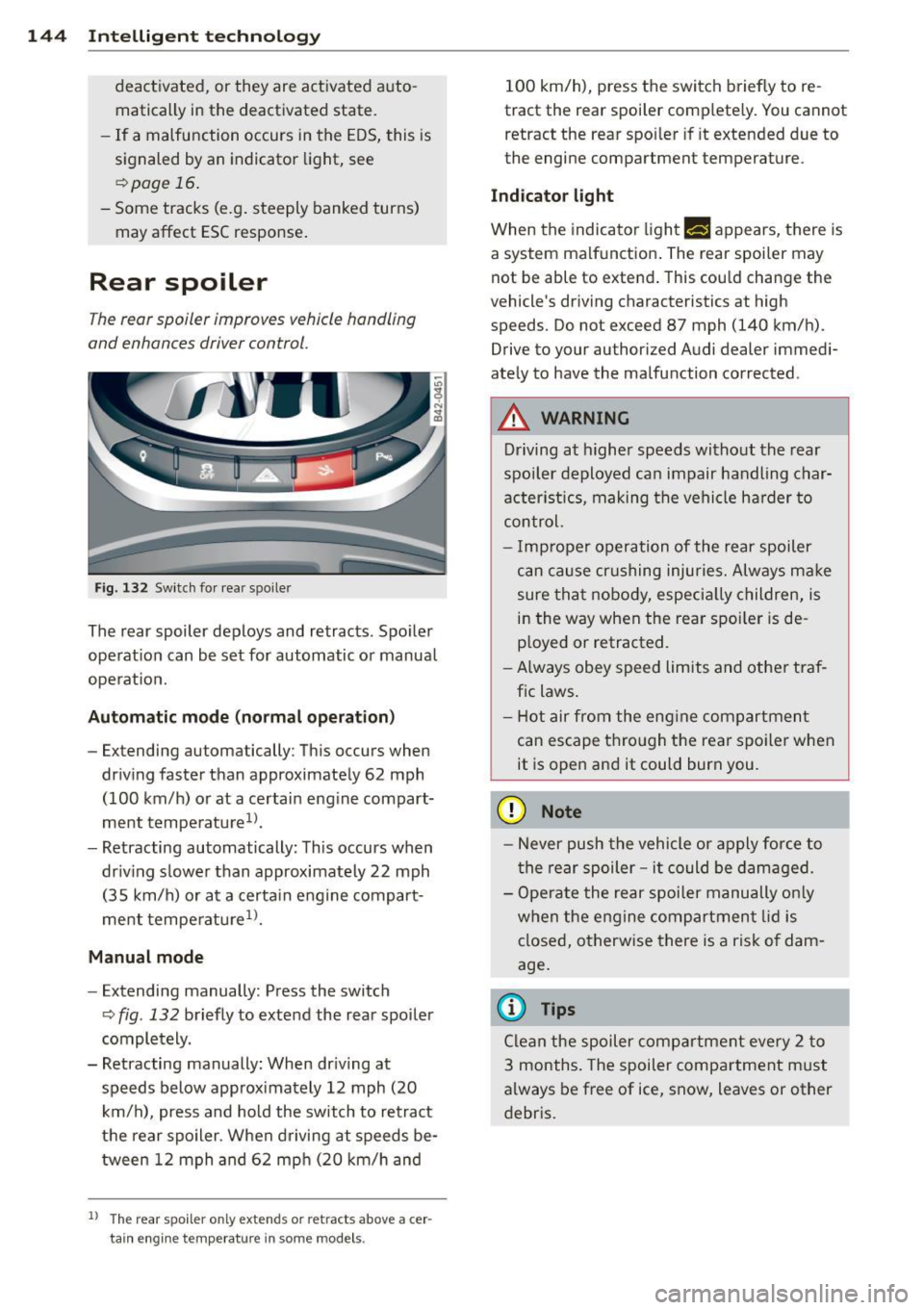
Fig. 132 Switch for rear spoile r
The rear spoiler deploys and retracts . Spo ile r
ope rat ion can be set for automatic or manual
operat ion.
Automatic mode (no rmal operation )
-Extending automatically: This occurs when
dr iv ing faster than approximately 62 mph
(100 km/h) or at a certain eng ine compart
ment temperature
1>.
- Retracting automatically: This occurs when
dr iv ing s lower than approximately 22 mph
(35 km/h) o r at a certa in engine compart
ment temperatu re
1>.
Manual mode
- Extending manually: Press the switch
~ fig. 132 briefly to exte nd the rear spoiler
completely .
- Retracting manually : When dr iv ing at
speeds below approx imately 12 mph (20
km/h), press and hold the switch to retract
the rear spo iler. When driving at speeds be
tween 12 mph and 62 mph (20 km/h and
l ) The rear s poiler only extends or retracts above acer
ta in eng in e te mpe rature in some models.
100 km/h), press the switch briefly to re
tract the rear spoiler complete ly. You cannot
retract the rear spo iler if it extended due to
the engine compartment temperature.
Indicator light
When the indicato r light f.-j appears, there is
a system malfunction . The rear spoiler may
not be able to extend . This cou ld change the
vehicle's dr iving characteristics at high
speeds. Do not exceed 87 mph (140 km/h).
Drive to your authorized Audi dealer immed i
ately to have the malfunction corrected .
A WARNING
Driving at higher speeds without the rear
spoiler deployed can impair handling char
acteristic s, making the ve hicle ha rder to
control.
- I mp rope r operation of the rear spoiler
c a n cau se crushing injuries . Always ma ke
sure tha t nobo dy, espec ia lly children, is
i n the way when the rear spoi ler is de
p loyed or retracted.
- Always obey speed limits and other traf
fic laws .
- H ot air from the eng ine compartmen t
can escape thro ugh the rear spo iler when
it is open and it could burn you.
(D Note
- N ever push the vehicle or apply force to
t he rear spoiler -it co uld be damaged.
- Ope rate the rear spoiler manually on ly
w hen the eng ine compartmen t lid is
closed, o therwise there is a r is k of dam
age .
(D Tips
Clean the spoiler comp artme nt eve ry 2 to
3 months . The spoiler compa rtment m ust
a lway s be free of ice, snow, leaves or other
debr is.
Page 148 of 236
146 Intellig ent technolog y
Other road users must not be put at risk -
yo u may cause an acc ident!
- Before descending a steep grade, reduce
speed and shift transmission into a lower
gear or lower driving position . Do not
ride the brakes or ho ld the pedal down
too long or too often . This cou ld cause
the brakes to get hot and d iminish brak
ing efficiency .
- Do not "ride the brakes" by resting your
foot on the pedal when you do not intend
to brake . Thi s may cause the b rakes to
overheat, premature wea r and inc reased
stopp ing distance.
- Under certain climat ic and operating
condit ions such as passing through wa
ter, driving in heavy ra in or after wash ing
the vehicle, the effectiveness of the
brakes can be reduced . In winter, ice can
accumulate on the brake pads, linings,
discs and drums. Cautiously apply brakes
for a test . Brakes will dry and ice coat
ings w ill be cleaned off after a few cau
t ious brake applications .
- Driv ing for an extended period of time on
salt-covered roads w ithout us ing your
brakes can also affect braking efficiency .
Clean off accumulated salt coating from
brake discs and pads w ith a few cautious
brake applicat ions.
- If you damage the front spoiler, or if you
ins tall a different spoiler, be su re the air
flow to the front brakes is not obstruct
ed. Otherwise the brake system co uld
overheat red ucing the effectiveness of
the ent ire brake system.
- Failure of one brake circuit will impair
braking capab ility, resulting in increased
stopp ing distance. Avoid driv ing the vehi
cle and have it towed to the nearest au
thorized Aud i dealer or qualified work
shop .
- Never let the vehicle roll to a stop w ith
the engine shut off .
- If the brake booster is not working, for
example when tow ing your vehicle, or
because the b rake booste r has somehow
been damaged, the brake pedal must be pressed considerably harder to make up
for the lack of booster assistance .
Power steering
When the engine is running, power steering
makes i t easier for the driver to s teer .
Power steering helps the driv er steer the vehi
cle with litt le physica l effort.
If the engine is not running, the power steer
ing system is also not working . In this case ,
you wi ll find it extremely d ifficu lt to turn the
steering wheel.
If you turn the steering fully to the left or
rig ht when the vehicle is stationary, you p lace
a very heavy load on the power steering sys
tem. Turning the steering wheel fully to the left or right will cause noise in the system. It
also reduces engine id le speed.
(D Note
Do not hold the steering t urned fu lly to
the left or r ight for more than 10 seconds
when the engine is running . There is a r isk
of damage to the power steering system .
(D Tips
-In the event of a power steering system
failure, or if the engine is not running
(while being towed), you will still be ab le
to steer the vehicle. However, you will re
quire more effort to do so .
- If the powe r stee ring system has a leak
or is defect ive , you should immediately
contact a qualified wor kshop .
- The power steer ing system req uires a
special hydraulic fl uid. The power steer
ing fluid reservoir is located in t he en
gine comp artment. The co rrect hydrauli c
fluid level is important for proper opera
tion of the power steering system. The
power steering fluid level is checked ac
cording to the Audi maintenance service
schedule.
Page 151 of 236
will be recharged and the notification will go
out.
Driver notification appears and goes out
again
If this driver notification appears after the ig
nition is turned on or while driving and it goes
out again after a wh ile, the battery has been
adequately recharged.
Driver notification appears and does not
go out again
If this driver notification appears after the ig
nition is turned on or while driv ing and does
not go out again, the battery's state of charge
is not in the optimal range. Starting ability is
restricted. Have the battery checked as soon
as poss ible by an author ized Audi dealer or
qualified workshop.
Dry sump lubrication
H igh lateral and long itud inal forces affect the
engine and the vehicle during sporty driving.
Dr y sump l ubr ica tion ensures that your engine
i s supplied w ith oil and properly lub ricated
even under these conditions.
I n a "normal" veh icle the oi l pump sends the
oil from the oil pan to the lubrication points in
the engine. The oil then returns to the oil pan .
I n extreme situations, the oil pump may draw
in air, which results in insufficient oil pressure.
With dry sump lubrication, the oil is not in the
oil pan (it is "d ry"), but in a separate oi l tank.
While one pump supplies the engine with oi l,
a second pump suctions the oi l out of the en
g ine and returns it to the oil tank . Because the
oil tank is ta ll and narrow, o il pressure is con
stant even under extreme conditions.
In addition, the oil pan in vehicles with dry
sump lubrication is noticeably sha llower. Th is
allows the engine to be installed lower in the
vehicle, bringing down the center of gravity .
This improves your vehicle's handling .
Intelligent technology 149
•
•
Page 153 of 236
-Have you r vehicle maintained properly
and in accordance with the service rec
ommendat ions in your Warranty
& Main
tenance booklet.
- Lack of proper maintenance as well as
improper use of the vehicle will impair
the function of the Emission Control Sys
tem and could lead to damage.
Sporty driving
Warming up and cooling down
By carefully warming up and cooling down
your vehicle, you can he lp ensure that it is not
overstressed unnecessarily during sporty driv
ing.
When warming up, the vehicle is driven at a maximum engine speed of 6000 RPM
(Vl0 engine) or 7000 RPM (V8 engine) in or
der to raise the engine oil temperature to a minimum of 140 °F (60 °(). The tires also on
ly reach their full road holding capability once
they have warmed up.
The cooling fan can continue to run in your ve hicle after the engine is switched
off. H owev
er, driving the vehicle to cool it down is part ic
ularly important. During sporty driving, the
engine and brakes, the exhaust system, and
the t ransm ission all become extreme ly hot.
Before you park the vehicle, you shou ld d rive
it for a few mi les/kilometers at light load in
the low rpm range to allow it to coo l down .
Driving on a track
Before you take your vehicle out on a track,
ensure that it is in perfect condition. For ex
ample, you should check the tire tread and the brake pads . It is best to increase t ire pressure
by about 0 .3 bar .
When driving on a track, oil consumption may be somewhat higher than in "normal" opera
tion
¢ page 17 4 .
You shou ld definitely inspect your vehicle af
ter subjecting it to severe condit ions. Are the
brake pads OK? Is there anything unusual
Dri vin g and en vironm ent 151
about the ti res, including the inner and outer
sidewa lls (e.g . tread, blistering)? Are the air
intakes free of leaves and tire dust? Is the o il
l evel OK?
Your authorized Audi dea ler or qua lified work
shop will be happy to undertake an inspection
before and after use on the race track.
_& WARNING
-
Some race tracks (e.g. steeply banked
turns) may affect the response of the ESC.
(D Tips
- Review the track requirements and con
ditions before you start driving.
- When driven on a race track, all vehicle
parts are severe ly stressed. This can re
sult in increased wear.
Operation and maintenance
Fuel economy, env ironmenta l impact, and
wear on your eng ine, brakes and tires la rgely
depend on three facto rs:
- your personal driving style
- operating conditions
- technical limitations
By havi ng your ve hicle reg ularly se rviced by an
a uthorized Aud i dea le r helps to ens ure that i t
runs properly and economica lly. The condition
of your vehicle not only affects its safety and
ability to ho ld its va lue, it a lso affects
f u el
consumption .
The amount of oi l used is re lated to engine
load and speed .
It is normal for the oil consump tion of a new
engine to reach its lowest value after a certa in
mileage has been driven.
You must drive your veh icle about 3,000 m iles
(5,000 kilometers) before yo u can p rope rly
assess oil consumpt io n.
Th is also app lies to fue l consumption and en-
gine o utp ut.
IJll>
•
•
Page 164 of 236
162 Cleaning and protection
use and are not an indication of material
deterioration.
(U;) Note
- Never use chemical solvents (e.g. lighter
fluid , turpentine), waxes, shoe polish or
similar products on Alcantara ® surfaces.
- To avoid damage, have stubborn stains
removed by a commercial cleaning spe
cialist.
- Do not use brushes, stiff sponges or sim ilarly abrasive cleaning aids.
Safety belts
Heavily soiled safety belts may not retract
properly.
• Keep belts clean.
• For cleaning, use a mild soap and water sol
ution. Let belts dry thoroughly and away
from direct sunlight.
• Do not allow inertia reel safety bel ts to re
tract before they are completely dry.
• Check the condition of your safety belts
reg
ularly .
_& WARNING
Damaged safety belts can break in a crash.
- Anything that might damage your safety
belts could mean that you and your pas
sengers would not be adequately pro
tected in an accident.
- Safety belt performance depends on cor
rect installation. Never remove belts
from the vehicle to clean them.
- Do not use chemical cleaning agents,
bleach or dyes. They have corrosive prop
erties which weaken the webbing.
- When cleaning your safety belts, inspect
them for damage. If you discover dam
age, see your authorized Audi dealer.
- Always read and heed all WARNINGS and
the information
¢page 153.
1) Use o nly the co rrect cle anin g so lu ti on s. Never use gas
o lin e or die se l fuel.
Engine compartment
Be especially careful when cleaning the en
gine compartment.
Corrosion protection
The engine compartment and transmission
have been corrosion-protected at the factory.
Good anti-corrosion treatment is very impor
tant, particularly in the winter.
If the vehicle
is frequently driven on salt treated roads, the
entire engine compartment and plenum panel
should be thoroughly cleaned at the end of
winter and retreated to prevent salt damage .
At the same time, the underside of the vehicle should be washed as well.
If the engine compartment is cleaned at any
time with grease removing solutions
1> , or if
you have the engine washed, the anti-corro sion treatment is almost always removed as
well.
It is therefore essential to have a long
lasting corrosion protection reapplied to all
surfaces, seams, joints and components in the
engine compartment.
A WARNING
Be aware: The engine compartment of any
motor vehicle is a potentially hazardous
area.
- Before working in the engine compart
ment, be sure to read the information
¢page 169.
-Before reaching into the front plenum
panel, always remove the ignition key .
Otherwise, the windshield wiper system
could unintentionally be switched on,
possibly causing personal injury from the
moving wiper linkage.
- Never reach into the area around or
touch the radiator fan. The auxiliary fan
is temperature controlled and can switch
on suddenly- even when the ignition is
off.
Page 172 of 236
1 7 0 Che cking and filling
(D Note
When adding fluids, a lways make sure that
they are poured into the proper container or filler opening, otherwise serious dam
age to veh icle systems will occur.
@ For the sake of the environment
To detect leaks in time, inspect the vehicle
floor pan from underneath regu larly . If
you see spots from oil or other vehicle flu ids, have your vehicle inspected by an au
thorized Audi dealer.
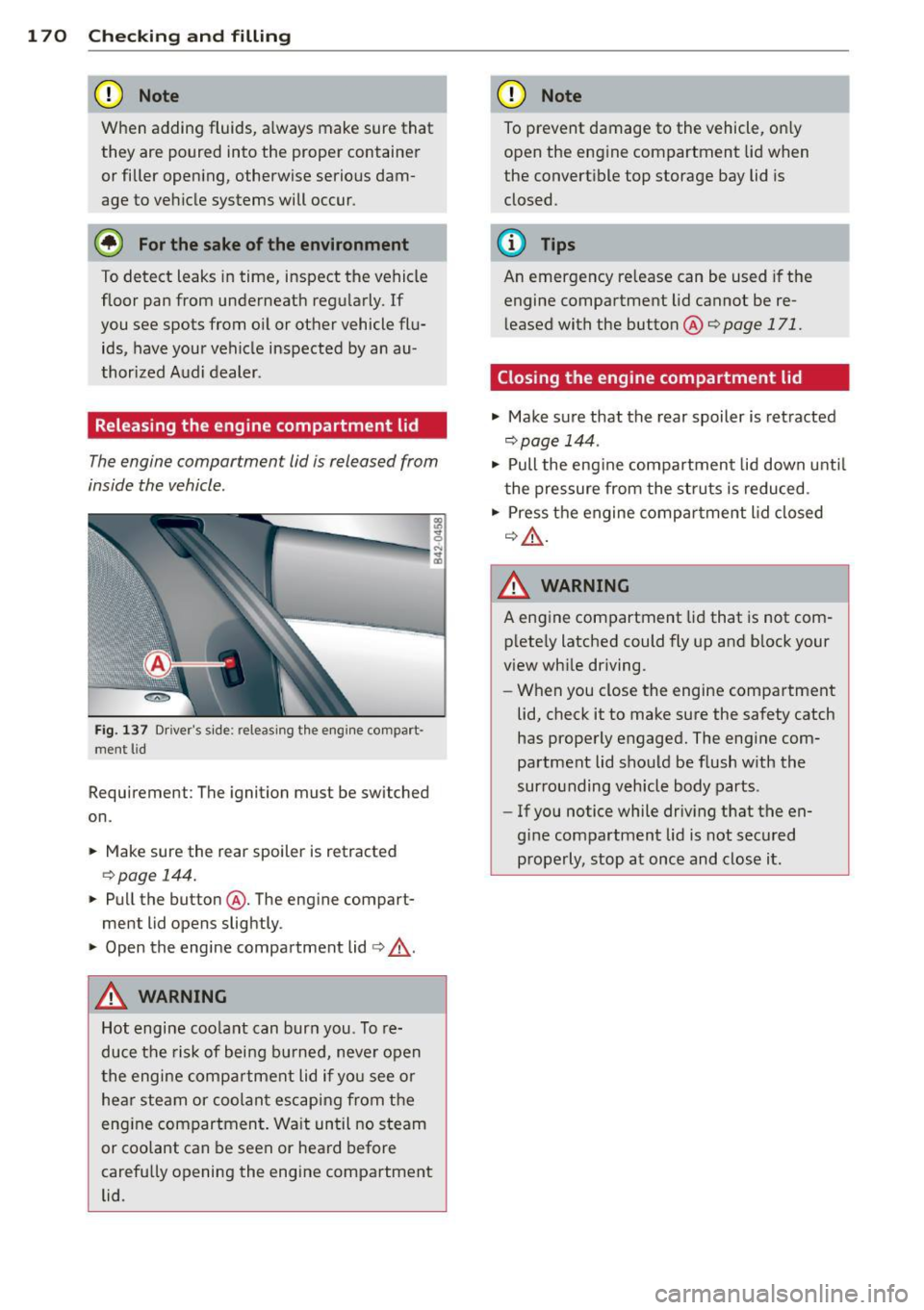
Releasing the engine compartment lid
The engine compartment lid is released from
inside the vehicle .
Fig. 137 Driver's side: releasing t he engine co mpart
ment lid
Requirement : The ignition must be switched
on.
... Make sure the rear spoiler is retracted
¢page 144 .
... Pull the button @. The eng ine compart
ment lid opens slightly .
... Open the engine compartment lid
c> ,& .
A WARNING
-
Hot engine coo lant can burn you . To re
duce the risk of being bu rned, never open
the engine compartment lid if yo u see or
hear steam or coolant escaping from the
eng ine compartment. Wait until no steam
or coolant can be seen or heard before
carefully opening the engine compartment
lid.
(D Note
To prevent damage to the vehicle, on ly
open the engine compartment lid when
the convert ible top storage bay lid is
closed.
(D Tips
An emergency re lease can be used if the
engine compartment lid cannot be re
leased with the button
® ¢ page 171.
Closing the engine compartment lid
... Make sure that the rear spoiler is retracted
Qpage 144.
.,. Pull the eng ine compartment lid down unti l
the pressure from the struts is reduced .
... Press the engine compartment lid closed
Q&. .
A WARNING
A engine compartment lid that is not com
plete ly latched could fly up and b lock your
view wh ile driving.
- When you close the engine compartment
lid, check it to make sure the safety catch
has properly engaged. The engine com
partment lid should be flush with the
surrounding vehicle body parts.
- If you notice while driving that the en
gine compartment lid is not secured
properly, stop at once and close it.
Page 173 of 236
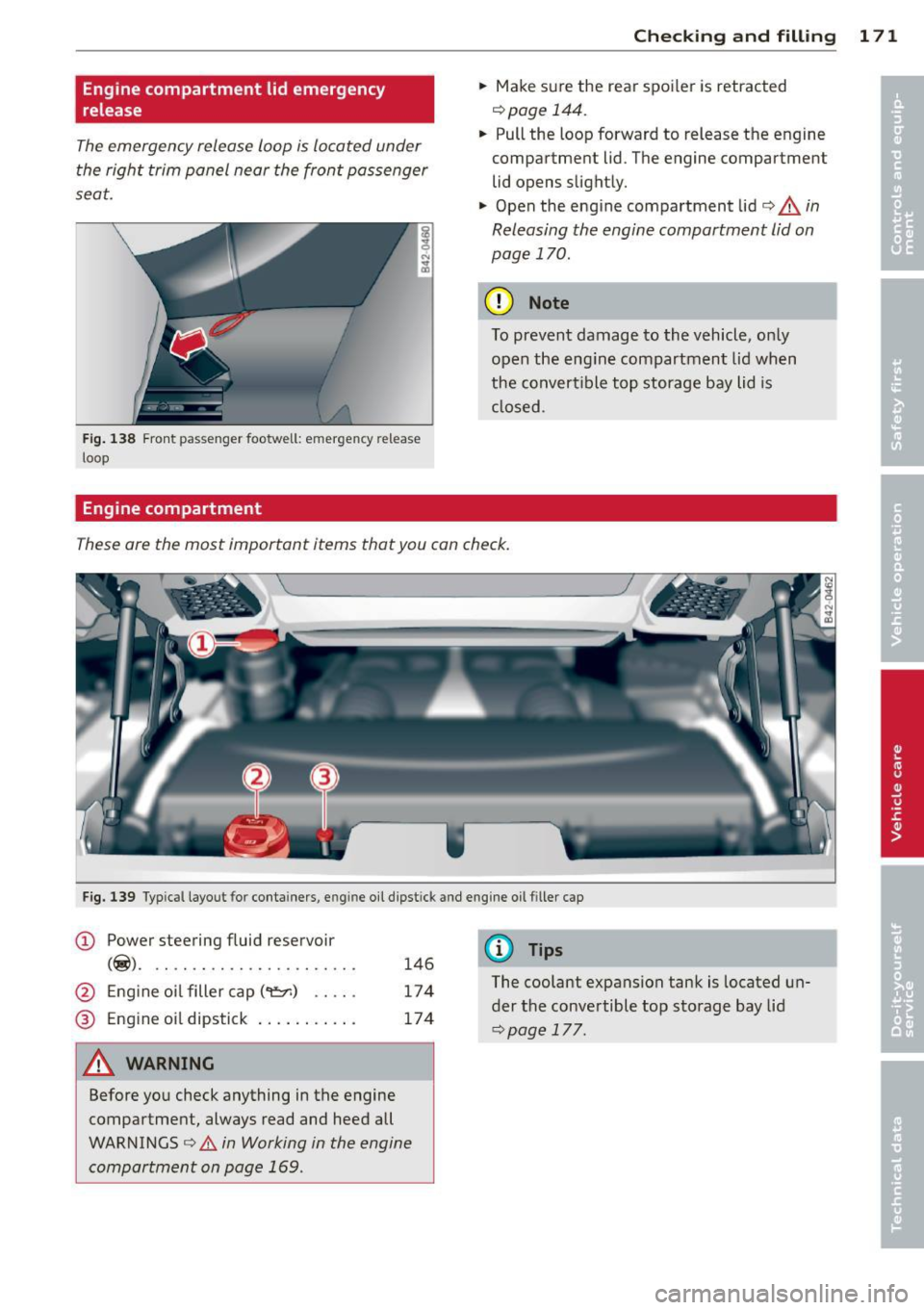
Engine compartment lid emergency
release
The emergency release loop is located under
the right trim panel near the front passenger
seat.
F ig . 138 Front pas se n ge r footwe ll: emer gen cy re lease
l oo p
Engine compartment
Checkin g and fillin g 171
.. Make su re the rear spoiler is retracted
¢ page 144 .
.. Pull the loop forward to release the engine
compartment lid . The engine compartment
lid opens sligh tly.
.. Open the engine compartment lid¢.&.
in
Releasing the engine compartment lid on
page 170.
(D Note
To prevent damage to the vehicle, only
open the eng ine compartment lid when
the convertible top storage bay lid is
closed .
Th es e ar e th e most important it ems that you can ch eck.
Fig. 139 Ty pical layout for containers , en gin e oil dipst ick and eng ine o il filler cap
(D Power steering fluid reservoir
(@) ... .. .... .... ... ...... .
@ Eng ine oi l filler cap ('l=r.) .. ...
® Engin e oi l dipstick
146
174
174
A WARNING
Before you check anything in the engine
compartment, always read and heed all
WARNINGS ¢.&. in Working in the engine
compartment on page 169 .
-
{!) Tips
The coolant expansion tank is located un
der the convertible top storage bay lid
¢ page 177.
Page 174 of 236
172 Checking and filling
Engine oil
Engine oil specifications
The engine oil used in your Audi needs the
right kind of oil.
The engine in your Audi is a sophisticated
powerplant that was built to exacting specifi
cations. This engine needs the right kind of
engine oil that meets specifications regarding
quality and viscosity so that it can run
smoothly and reliably. Choosing the right oil
and changing oil within the time and mileage intervals printed in your vehicle's Warranty
&
Maintenance booklet matters a lot more to
day than it did years ago. Audi has developed
a special quality standard for engine oil that
will help assure that your vehicle's engine will
get the lubrication it needs for proper opera
tion .
Modern engine lubrication has taken a quan
tum leap in the last few years. Many synthetic
oils available today provide better engine lu brication that can outlast traditional petrole
um-based oils, making them a smart choice
for use throughout the life of your Audi .
Whether you use synthetic or petroleum based engine oil, the oil that you use must
conform to Audi's oil quality standard
VW 502 00 to help keep your vehicle's engine running smoothly and help prevent the for
mation of harmful deposits, sometimes called
"sludge," that over time can lead to expensive
repairs.
At the time of printing, engine oils available in
the U.S. and Canada that meet the exacting
specifications of Audi oil standard VW 502 00
are synthetic engine oils. This does not mean,
however, that every synthetic engine oil will
meet Audi oil standard VW 502 00 . So always
be sure that you use an approved oil.
To help prevent the formation of harmful de posits use only oil with the following specifi
cations printed on the oil container :
Audi oil standard VW 502 00
Oil container labels may carry the specifica
tion singly or in combination with other desig nations and oil quality standards.
Viscosity
Engine oils are graded according to their vis
cosity . The proper viscosity grade oil for your
engine depends on climactic or seasonal con
ditions where you drive. You can use oil with a
viscosity grade of SAE SW40 across all tem
perature ranges for normal driving conditions.
However, if engine oil viscosity grade SAE
SW40 is not available, you can also use viscos
ity grade SAE SW-30 or SAE OW-40 as long as
it meets Audi oil quality standard VW 502 00
specifications.
Because engine oil that meets the Audi oil
standard may not be available everywhere
when you need it, we strongly recommend
that you always carry with you an extra quart (liter) of oil that expressly conforms to the
VW 502 00 specification, in case you have to
top off the oil while on the road.
Only if the level of the oil is at or below the
minimum mark on the oil dipstick - and no oil
that expressly conforms to Audi oil standard
VW 502 00 specifications is available -may
you top off with a high quality engine oil, pref
erably synthetic-based, that meets ACEA A3
or API SM specifications, but even then, only
in viscosity grades SAE SW-40, SAE SW-30, or
SAE OW-40. However, during the entire time
between oil change intervals, never top off
with more than a total of 1 qt/liter engine oil
that does not conform to Audi oil specification
vw 502 00.
For more information about engine oil that
has been approved for your vehicle, please
contact either your authorized Audi dealer or
Audi Customer Relations at 1 (800) 822-2834 or visit our web site at www.audiusa.com or
www .audicanada .ca. Here you will also find a
current list of oils (manufacturers, brand
names etc.) that conform to Audi oil standard
vw 502 00.
Changing the engine oil