steering AUDI R8 SPYDER 2012 Owner's Manual
[x] Cancel search | Manufacturer: AUDI, Model Year: 2012, Model line: R8 SPYDER, Model: AUDI R8 SPYDER 2012Pages: 236, PDF Size: 59.24 MB
Page 112 of 236
110 Airbag sys te m
Since the cir cumstances will vary considerab ly
between one collision and anot her, it is not
possib le to def ine a range of vehicle speeds
that will cover every possible k ind and angle
of impact t hat will always trigger the airbags.
Important factors include, for example, the
nature (hard or soft) of the object which the
car h its, the ang le of impact, vehicle speed,
etc. The front airbags will also not inflate in
side or rea r collisions, or in ro ll-overs.
Al ways rememb er: Airbags will deploy only
once, and only in certa in k inds of co llisions.
Your safety belts are always there to offer pro
tection in those s ituations in which airbags
a re not supposed to deploy, or when they have
a lready deployed; for example, when your ve
hicle strikes or is struck by another vehicle af
ter the first co llision.
This is just one of the reasons why an airbag is
a supplementary restraint and is not a substi
tute for a safety belt . The airbag system
works most effect ively when used with the
safety belts. Therefore, always wear your safe
ty belts properly¢
page 101.
A WARNING
Sitting too close to the steer ing wheel or
instrument panel will dec rease the effec
tiveness of the airbags and will increase
t he risk of personal injury in a co llision.
- Never sit closer than 10 inches (2S cm)
to the stee ring wheel or instrument pan
el.
- If you cannot sit more than 10 inches
( 2 5 cm) from the steer ing whee l, investi
ga te whethe r adaptive equipmen t may
be available to help you reach the pedals
and increase your seating distance from
the steering wheel.
- If you are unrestrained, lean ing fo rward,
sitting sideways or out of position in any
way, your risk of in jury is much higher.
- You will also receive serio us inj uries and
cou ld even be killed if you are up against
the airbag or too close to it when it in
flates - even with an Advanced Airbag. -
To reduce the risk of injury when an a ir
bag inflates, always wear safety be lts
properly¢
page 104, How are safety
belts worn correctly? .
-Never let children ride unrestrained or
improperly restrained in the vehicle. Ad
just the front seats properly . If children
are not p roperly restrained, they may be
seve rely in ju red or killed when an a irbag
infla tes.
- Never ride with the back rest reclined.
-Always sit as far as possible from the steer ing whee l or the instrument pane l
¢ page 92, Proper occupant seating po
sitions.
- Always sit up right with your back against
the backres t of your seat.
- Never p lace your feet on the instrument
panel or on the seat. Always keep both
feet on the f loor in front of the sea t to
he lp preven t serio us in juries to the legs
and h ips if the airbag infla tes .
- Never re cline the front passenger 's sea t
to tra nspor t ob jec ts. Items c an al so
move into the a rea of the s ide airbag or
the front airbag during braking or in a
sudden maneuver . Objects near the air
bags can become projectiles and cause
in ju ry when an airbag inflates.
A WARNING
Airbags that have deployed in a crash must
be replaced.
- Use on ly orig inal equipment airbags ap
proved by Aud i and installed by a trained
technician who has the necessary tools and d iagnost ic equipment to properly re
p lace any airbag in your vehicle and as
sure sy stem effe ctive ness in a crash.
- Never permit salvaged or recycled air
bags to be installed in you r vehicle.
Page 115 of 236
- Improper installation of child restraints can reduce the ir effectiveness or even
prevent them from prov iding any protec
t ion.
- An improperly installed child restraint can interfere with the airbag as it de
ploys a nd serio usly injure or even kill the
child -even with an Advanced Airbag
System.
-Always follow the manufacturer's in
struct ions provided with the child saf ety
seat or car rier carefully.
- Never place additional items on the seat
that can increase the to tal weight regis
tered by the weight-sens ing mat a nd can
c a use i nju ry in a c rash.
Front airbags
Descript ion of front airbags
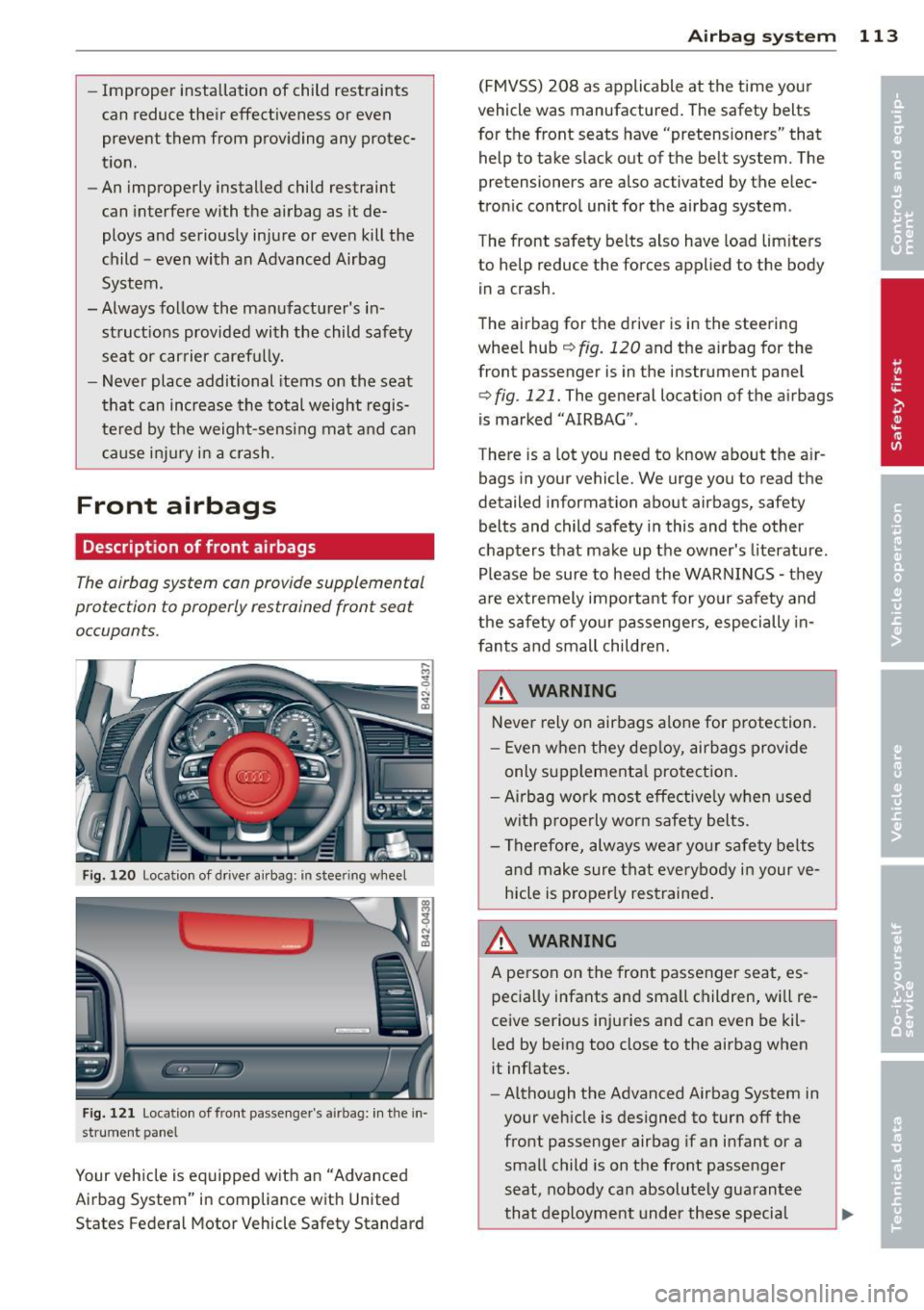
The airbag system con provide supplemental
protection to properly restrained front seat occupants.
Fig. 120 Locatio n of drive r air bag: in steer ing wheel
F ig. 121 Location of fro nt passe nger 's a irbag: in th e in
strument panel
Your veh icle is equipped w ith an "Advanced
Airbag System" in compliance with United
States Federal Motor Vehicle Safety Standard
A irba g sy stem 113
(FMVSS) 208 as applicable at the time you r
vehicle was manufactured . The safety belts
for the front seats have "pretensioners" that help to take slack out of the be lt system. The
pretensioners are also activated by the e lec
tron ic contro l unit for the airbag system .
The front safety belts a lso have load lim iters
to help reduce the forces applied to the body
in a crash.
The airbag for the driver is in the steering
whee l hub
c> fig. 120 and the airbag for the
front passenger is in the instr ument panel
c> fig . 121. The general locat ion of the a irbags
is marked "AIRBAG" .
There is a lot you need to know about the a ir
bags in your vehicle. We urge you to read the
detailed information about airbags, safety
belts and child safety in this and the other
c hapters that make up t he owner's literature.
Please be sure to heed the WARNINGS - they
a re extremely important for your safety and
the safety of yo ur passengers, especially in
fants and small children .
& WARNING
=
Neve r rely on airbags alone for protection.
- Even w hen they deploy, airbags provide
only s upp lementa l protect ion .
- Airbag work most effe ctive ly w hen used
with p roperly worn safety belts.
- Therefore, alw ays wea r yo ur safety belts
an d make sure that eve ry bo dy in y our
ve
hicle is p roperly restrained .
A WARNING
A person on the fron t passenger seat, es
pec ia lly infants and sma ll children, will re
ceive serio us injuries and can even be kil
led by being too close to the airbag when
it inflates.
- Altho ugh the Advanced Airbag System in
your veh icle is designed to tur n off the
front passenger airbag if an infant or a small child is on the front passenger
seat, nobody can absolutely gua ran tee
-
-
that deployment under these specia l 11-
Page 116 of 236
114 Airbag sys te m
conditio ns is impossible in a ll conceiva
ble situations t hat may happen during
t h e usef ul lif e of your vehicle.
- The Adva nced Airbag System can deploy
in accor dance with the "low risk" opt ion
under the U.S. Federal Sta ndard if a child
that is heavier than the typical one-year old child is on the front passenger seat
and the othe r cond itions for airbag de
ployment are met.
- For their own safety, all children, espe
cially 1 2 yea rs and younger, should a l
ways ride p roperly rest rained for their
age and size.
Advanced front airbag system
Your veh icle is equipped wit h a front Advanced
Airbag System in compliance with United
States Federal Motor Vehicle Safety Standard
208 as applicab le at the time your vehicle was
manufactured.
The front Advanced Airbag System supp le
ments the safety belts to provide addit iona l
protection for the driver's and front passeng
er's heads and upper bodies in frontal crashes.
The airbags inflate only in frontal impacts
when the vehicle decelerat io n is high enough .
The front Advanced Airbag System for the
front seat occupants is not a substitute for
your safety belts. Rather, it is part of t he over
all occupant restraint system in your ve hicle.
A lways remember that the airbag system can
on ly help to protect you, if you are s itting up
r ight, wearing yo ur safety belt and wea ring it
p roperly. This is w hy you and yo ur passenge rs
must always be properly restrained , not just
beca use the law requires you to be.
The Advanced Airbag System in your veh icle
has been cer tified to meet the " low r is k " re
qu irements for 3 and 6 year -o ld children on
the passenger side and very small adu lts on
the driver side. The low risk deployment crite
ria are intended to he lp red uce the risk of in
jury through interaction with the front airbag that can occur, fo r example, by be ing too close to the steering wheel and instrument
pane
l when the airbag inflates .
In add ition, the system has been certified to
comply wi th the "s uppression" re qu iremen ts
of the Sa fe ty Standard, to turn off the front
airbag for infants 12 months o ld and younger
who are restrained on the front passenger
seat in child restraints that are listed in the
Standard
¢ page 132, Child restraints and
Advanced Airbags .
"Suppression" requires the front a irbag on the
passenger side to be turned off if:
- a child up to abo ut one year o f age is re
strained on the front passenger seat i n one
of the rear-fac ing or forward -facing infant
restraints listed in Federal Motor Vehicle
Safety Standard
208 with which the Ad
vanced Airbag System in your vehicle was
cert ified . For a listing of the ch ild res traints
that were used to certify your vehicle 's com
plia nce w it h t he US Safety Standa rd
¢ page 132,
-we ight less than a threshold level stored in
the co ntrol uni t is de te cted on the fron t pas
senger seat.
When a person is detected on the front pas senger seat, weighing more than t he total
we ight of a ch ild that is about 1 year old re
stra ined in one of the rear-fac ing o r forward
f acing infant res traints ( listed in Fede ral Mo
tor Vehicle Safety Standar d
208 with which
the Advanced Airbag System in yo ur vehicle
was certif ied), the front airbag on the passen
ger side may or may not deploy.
The
PASSENGER AIR BAG OFF light comes on
when the electronic contro l unit detects a to
ta l we ight on the front passenger seat that re
quires t he front airbag to be t urned off. If the
PASSENGER AIR BAG OFF light does not
come on, the front a irbag on the passenger
s ide has not been t urned off by the cont ro l
u ni t and ca n dep loy if the control un it senses
an impact that meets the cond itions store d in
i ts memory.
If the total weight on the fro nt passenge r
seat is more than that of a typ ical 1 yea r-old , .,.
Page 118 of 236
116 Airbag sys te m
- Always move the passenger seat into its
rearmost position in the seat's fore and
aft adjustment range, as far away from
the a irbag as poss ible, before insta lling
the forward-facing child restraint. The backrest must be adjusted to an upr ight
posit ion.
- Make sure that the
PASSENGER AIR BAG
OFF
light comes on and stays on all the
t ime w henever the ignition is switched
on.
Advanced Airbag System components
The fron t passenger sea t in your vehicle h as a
lot of very important par ts of the Advanced
Airbag System in it. These parts include t he
weight -sensing mat, sensors, wiring, brack
ets, and more. The function of the system in
the front passenger seat is checked by the
e lectronic control un it when the ignit ion is on.
The control unit mon itors the Advanced Air
bag System and turns the airbag indicator
l ight on when a ma lfunction in t he system
components is detected. The func tion of the
a ir bag ind icator light is described in greater
detai l be low . Because the front passenger
seat contains important parts of the Ad
vanced A irbag System, you m ust take care to
prevent it from be ing damaged. Damage to
the seat may prevent the Advanced Airbag for
the front passenger seat from doing its job in
a crash .
The front Advanced Airb ag Sy stem
consists of the following:
- Crash sensors in the front of the veh icle that
measure veh icle acceleration/deceleration
to provide information to the Advanced Air
bag System abou t the seve rity of the crash.
- An electron ic co ntrol unit, with integ rated
crash sensors for front and side impacts .
T he cont ro l unit "dec ides " w het her to fire
the front airbags based on the information
received from the crash senso rs . The contro l
unit a lso "decides" whethe r the safety be lt
pretensioners should be activated . -
An Advanced A irbag w ith gas generator for
the driver inside the steering w heel hub.
- An Advanced A irbag w ith gas generato r in
side the inst rument panel for the front pas
senger.
- A we ight -sensing mat unde r th e upho ls tery
pa dding of the front passenger seat cushion
that measures the total weight on the seat .
The informat ion registered is sent continu
ously to the electronic control unit to regu late deployment of the front Advanced Air
bag on the passenger side .
- An airbag monitoring sys tem and indicator
light in t he instrument cluster
c::> page 120.
- The PASSENGER AIR BAG OFF light comes
on and stays on in the center of the instru
ment panel
c::> page 120, fig. 123 and tells
you when the front Advanced Airbag on the passe nger side has been tu rned off.
- A senso r below the safety be lt latch fo r the
front seat passenger to measure the tension on t he safety be lt. The tension on the safety
be lt a nd the weight regis tered by the
weight-sensing mat he lp the cont rol uni t
"decide" whether the front airbag fo r the
front passenger seat should be turned off or
not
c> page 111, Child restraints on the
fron t seat -some important things to
know.
-A sensor in the safety belt latch fo r the driv
er and for the front seat passenger that
senses whether t hat safety belt is latched or
not and transmits this information to t he
elect ronic control un it .
,&. WARNING
D amage to the fron t passenger seat can
p revent the fro nt airbag from wor king
properly.
- I mp roper repai r or d isassembly of the
front passenge r and dr ive r sea t will pre
vent the Advanced Air bag System from
functioning p roperly.
- Repairs to the front passenge r seat m ust
be pe rformed by qualifie d and p roperly
trained workshop personnel.
- Never remove the front passenger o r
d river seat from t he vehicle .
-
Page 125 of 236
A WARNING
1
Improper care, servicing and repair proce
dures can increase the risk of personal in
jury and death by preventing an airbag from deploying when needed or deploying an airbag unexpectedly:
- Never cover, obstruct, or change the
steering wheel horn pad or airbag cover
or the instrument panel or modify them
in any way .
- Never attach any objects such as cup
holders or telephone mountings to the
surfaces covering the airbag units.
- For cleaning the horn pad or instrument
panel, use only a soft , dry cloth or one
moistened with plain water. Solvents or
cleaners could damage the airbag cover
or change the stiffness or strength of the
material so that the airbag cannot de
ploy and protect properly.
- Never repair, adjust, or change any parts
of the airbag system.
- All work on the steering wheel, instru
ment panel, front seats or electrical sys
tem (including the installation of audio
equipment, cellular telephones and CB
radios, etc .) must be performed by a
qualified technician who has the training
and special equipment necessary.
- For any work on the airbag system, we
strongly recommend that you see your
authorized Audi dealer or qualified work
shop.
- Never modify the front bumper or parts
of the vehicle body .
- Always make sure that the side airbag
can inflate without interference:
- Never install seat covers or replace
ment upholstery over the front seat
backs that have not been specifically
approved by Audi.
- Never use additional seat cushions that
cover the areas where the side airbags
inflate.
- Damage to the original seat covers or
to the seam in the area of the side air bag module must always be repaired
Airbag system 123
immediately by an authorized Audi
dealer.
- The airbag system can be activated only
once . After an airbag has inflated, it
must be replaced by an authori zed Audi
dealer or qualified technician who has
the technical information, training and
special equipment necessary.
- The airbag system can be deployed only
once . After an airbag has been deployed,
it must be replaced with new replace
ment parts designed and approved espe
cially for your Audi model version . Re
placement of complete airbag systems
or airbag components must be per
formed by qualified workshops only. Make sure that any airbag service action
is entered in your Audi Warranty
& Main
t enance booklet under
AIRBAG REPLACE
MENT RECORD .
-For safety reasons in severe accidents,
the alternator and s tarter are separa ted
from the vehicle battery with a pyrotech
nic circuit interrupter .
- Work on the pyrotechnic circuit inter
rupter must only be performed by a
qualified dealer - risk of an accident!
- If the vehicle or the circuit interrupter
is scrapped , all applicable safety pre
cautions must be followed.
@ For the sake of the environment
Undeployed airbag modules and preten
sioners might be classified as Perchlorate
Material - special handling may apply, see
www .dtsc .ca. gov/hazard o u swaste/ per-
ch [orate . When the vehicle or parts of the
restraint system including airbag modules
and safety belts with pretensioners are
scrapped, all applicable laws and regula
tions must be observed. Your authorized
Audi dealer is familiar with these require
ments and we recommend that you have
your dealer perform this service for you.
•
•
•
•
Page 126 of 236
124 Airbag system
Other things that can affect Advanced
Airbag performance
Changing the vehicle's suspension system can
change the way that the Advanced Airbag Sys
tem performs in a crash. For example, using
tire-r im combinations not approved by Audi,
lowering the vehicle, changing the stiffness of
the suspension, including the springs, suspen
sion strut s, shock absorbers etc. can change
the forces that are measured by the airbag sensors and sent to the electronic control
unit. Some suspension changes can, for example, increase the force levels measured by the
sensors and make the airbag system deploy in
crashes in which it would not deploy if the
changes had not been made. Other kinds of
changes may reduce the force levels meas
ured by the sensors and prevent the airbag
from deploying when it should .
The sensors in the safety belt buckle for the
driver and front passenger seat tell the elec
tronic control module if the safety belt is
latched or not .
If the safety belt is being used,
the front airbag will deploy at a slightly high er rate of vehicle deceleration than if the safe
ty belt is not being used. Therefore, in a par
ticular collision, it is possible that an airbag
will not deploy at a seating position where the
safety belt is being used but will inflate at the
position where the safety belt is not being
used.
It is important that nothing interfere
with the safety belt buckles so that the sen
sors can send the correct information about
safety belt use to the electronic control unit .
A WARNING
Changing the vehicle's suspension includ
ing use of unapproved tire-rim combina
tions can change Advanced Airbag per
formance and increase the risk of serious
personal injury in a crash.
- Never install suspension components
that do not have the same performance
characteristics as the components origi
nally installed on your vehicle.
- Never use tire-rim combinations that
have not been approved by Audi.
A WARNING
-Items stored between the safety belt
buckle and the center console can cause
the sensors in the buckle to send the
wrong information to the electronic con
trol module and prevent the Advanced Air
bag System from working properly.
- Always make sure that nothing can inter
fere with the safety belt buckles and that
they are not obstructed.
Knee airbags
· Description of knee airbags
The knee airbag system con provide supple
mental protection to properly restrained
front seat occupants.
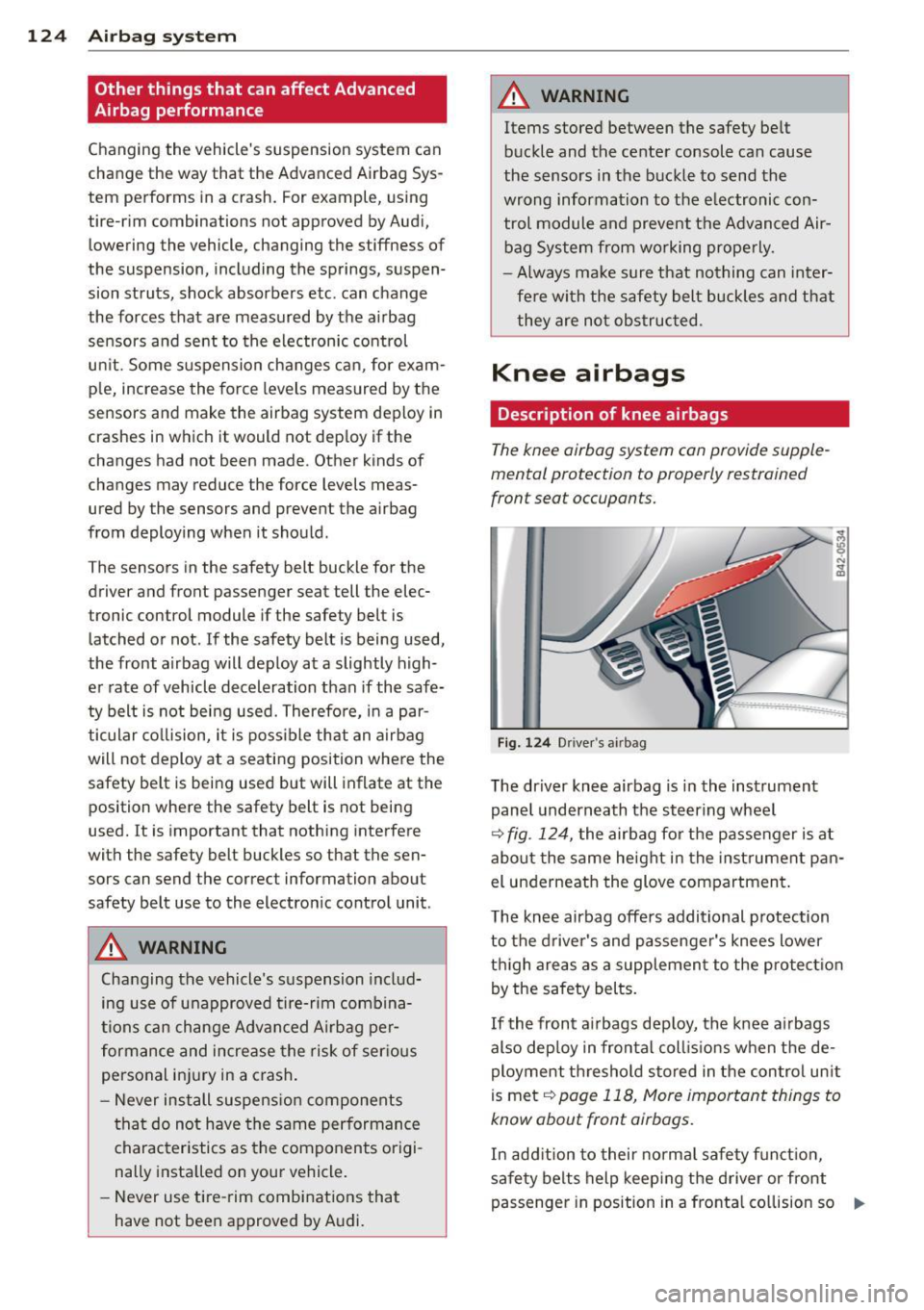
Fig. 124 Drive r's airbag
The driver knee airbag is in the instrument
panel underneath the steering wheel
~ fig . 124, the airbag for the passenger is at
about the same height in the instrument pan
el underneath the glove compartment.
The knee airbag offers additional protection
to the driver's and passenger's knees lower
thigh areas as a supplement to the protection
by the safety belts.
If the front airbags deploy, the knee airbags
also deploy in frontal collisions when the de
ployment threshold stored in the control unit
is met
~ page 118, More important things to
know about front airbags.
In addition to their normal safety function,
safety belts help keeping the driver or front
passenger in position in a frontal collision so ..,.
Page 133 of 236
A WARNING
-=
If, in exceptional circumstances, you must
install a forward-facing child restraint on
the front passenger's seat:
- Always make sure the forward-facing
seat has been designed and certified by
its manufacturer for use on a front seat
with a passenger front and side airbag.
-Always follow the manufacturer's in
structions provided with the child safety
seat or carrier.
- Always move the passenger seat into its
rearmost position in the seat's fore and
aft adjustment range, as far away from
the airbag as possible before installing
the child restraint. The backrest must be
adjusted to an upright position.
- Always make sure that the
PASSENGER
AIR BAG OFF light comes on and stays
on all the time whenever the ignition is
switched on.
(D Tips
Always replace child restraints that were
installed in a vehicle during a crash. Dam
age to a child restraint that is not visible
could cause it to fail in another collision
situation.
Advanced front airbag system and children
Your vehicle is equipped with an "Advanced
Airbag System" in compliance with United
States Federal Motor Vehicle Safety Standard
(FMVSS) 208 as applicable at the time your
vehicle was manufactured.
The Advanced Airbag system in your vehicle
has been certified to meet the "low-risk " re
quirements for 3- and 6- year-old children on
the passenger side and small adults on the
driver side. The low risk deployment criteria
are intended to reduce the risk of injury
through interaction with the airbag that can
occur, for example, by being too close to the
steering wheel and instrument panel when
the airbag inflates. In addition, the system
Child Safety 131
has been certified to comply with the "sup
pression" requirements of the Safety Stand
ard, to turn off the front airbag for infants up
to 12 months who are restrained on the front passenger seat in child restraints that are list
ed in the Standard .
Even though your vehicle is equipped with an
Advanced Airbag system, a child should al
ways ride in the seat properly restrained for
its age and size . The airbag on the passenger
side makes the front seat a potentially dan
gerous place for a child to ride. The front seat
is not the safest place for a child in a forward
facing child safety seat .
It can be a very dan
gerous place for an infant or a larger child in a
rearward-facing seat.
Advanced Airbags and the weight
sensing mat in the front seat
The Advanced Airbag System in your vehicle
detects the presence of an infant or child in a
child restraint on the front passenger seat us
ing the weight-sensing mat in the seat cush
ion and the sensor below the safety belt latch
on the front passenger seat that measures the
tension on the safety belt.
The weight-sensing mat measures total
weight of the child and the child safety seat
and a child blanket on the front passenger
seat. The weight on the front passenger seat
is related to the design of the child restraint
and its "footprint", the size and shape of the
bottom of the child restraint as it sits on the
seat. The weight of a child restraint and its
"footprint" vary for different kinds of child re
straints and for the different models of the
same kind of child restraint offered by child restraint manufacturers.
The weight ranges for the individual types,
makes and models of child restraints that the
NHTSA has specified in the Safety Standard
together with the weight ranges of typical in
fants and typical 1 year-old child have been
stored in the control unit of the Advanced Air
bag System. When a child restraint is being
used on the front passenger seat with a
ll-
•
•
Page 144 of 236
142 Intelligent technology
Intelligent technology
Notice about data
recorded by vehicle
control modules
Your veh icle is not equipped with an Event Da
ta Recorder (EDR), installed by some manu
facture rs fo r the express p urpose o f capturing
data for retrieval after an accident or cras h
event. EDR's are sometimes called "crash re
corders".
Some state laws res trict the retrieval or down
loading of data stored by EDR's that were in
stalled in a vehicle for the express purpose of retrieving data after an accident or crash
event without the owner's consent.
A lthough yo ur vehicle is not equ ipped wit h an
EDR, it is equipped with a number of elect ron
ic control modules for various vehicle systems
such as, for examp le, eng ine function, emis
sion control, as well as for the airbags and
safety belts.
These electron ic control modules also record
vehicle-re lated data during norma l vehicle op
eration for diagnostic and repa ir purposes.
The recording capacity of the electronic con
trol modules is limited to data (no sound is re
corded) and only a small amount of data is ac
tually recorded ove r a ve ry limited pe riod of
time and stored when a sys tem fault or other
condition is sensed by a cont ro l u nit. Some of
the data then stored may re late to vehicle
speed, direction, braking as we ll as restraint
system use and performance in the event of a
crash or other condition. Stored data can only be read and downloaded w ith special equip
ment .
Electronic Stability
Control (ESC)
The Electronic Stability Control increases driv
ing stability.
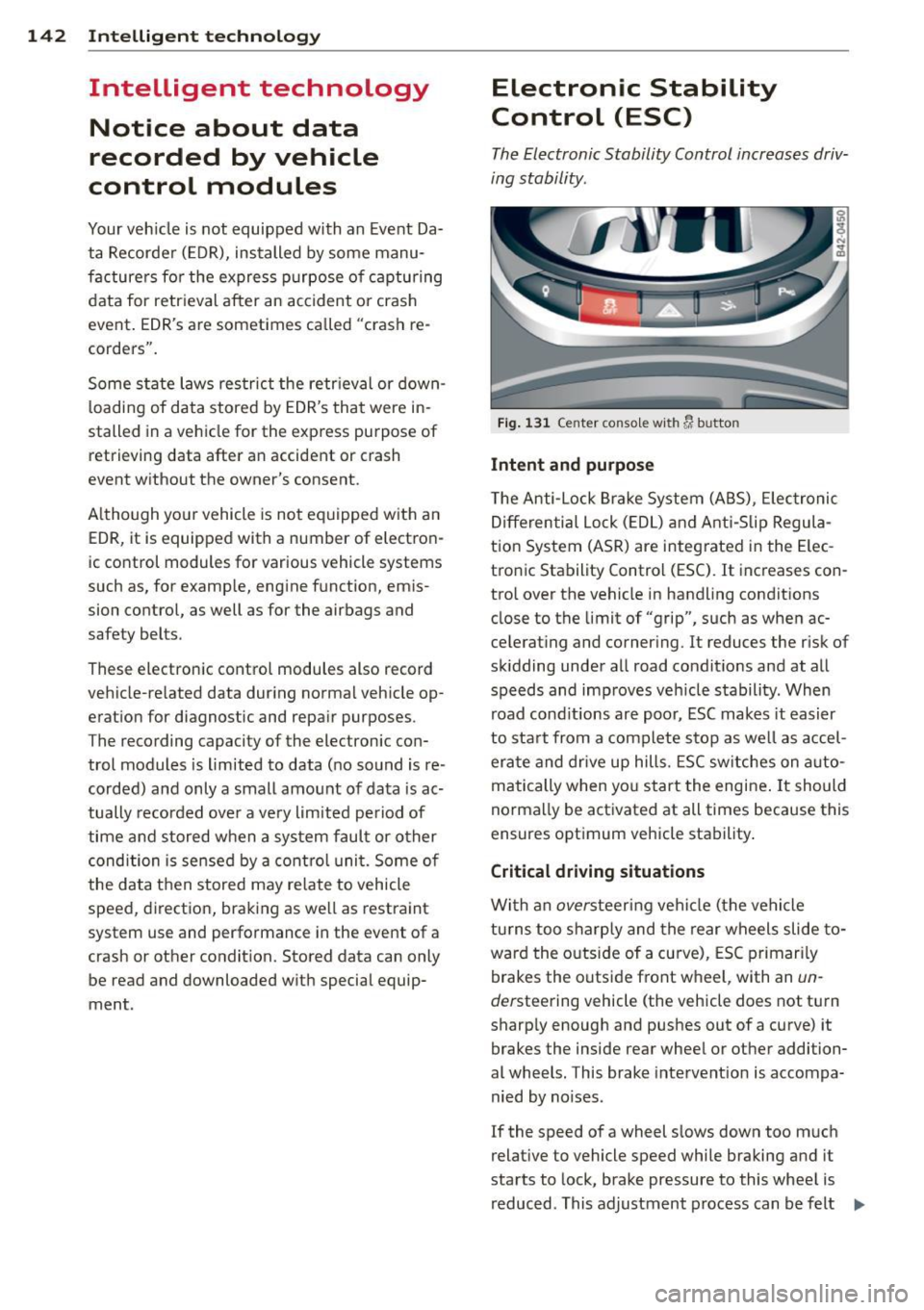
F ig . 1 31 Center console with~ button
Intent and purpose
The Anti-Lock B ra ke System (ABS), Elec tronic
Differential Lo ck (EDL) and Anti-Slip Regula
tion System (ASR) are integrated i n the Elec
tronic Stability Control (ESC). It increases con
tro l over the vehicle in handling conditions
close to the limit of "grip", such as when ac
celerating and corner ing. It reduces the risk of
skidding under all road condit ions and at all
speeds and improves veh icle stability. When
road cond itions are poor, ESC makes it easier
to sta rt from a comp lete s top as we ll as accel
era te and drive up hills. ESC sw itches on auto
matically when yo u start the engine . It should
norma lly be activated at all times because this
ensures optimum vehicle stability .
Critical driving situations
With an overs teering vehicle ( the vehicle
tu rns too s harply and the rear wheels slide to
ward the o utsi de of a curve), ESC primarily
brakes the outside front wheel, with an
un
dersteering vehicle (the vehicle does not turn
sharp ly enough and pushes out of a curve) it
brakes the inside rear whee l or other addition
al wheels. This brake inte rvent ion is accompa
nied by noises.
If the speed of a wheel s lows down too much
relat ive to vehicle speed while braking and it
starts to lock, brake pressure to this whee l is
reduced . This adjustment process can be felt ..,.
Page 148 of 236
146 Intellig ent technolog y
Other road users must not be put at risk -
yo u may cause an acc ident!
- Before descending a steep grade, reduce
speed and shift transmission into a lower
gear or lower driving position . Do not
ride the brakes or ho ld the pedal down
too long or too often . This cou ld cause
the brakes to get hot and d iminish brak
ing efficiency .
- Do not "ride the brakes" by resting your
foot on the pedal when you do not intend
to brake . Thi s may cause the b rakes to
overheat, premature wea r and inc reased
stopp ing distance.
- Under certain climat ic and operating
condit ions such as passing through wa
ter, driving in heavy ra in or after wash ing
the vehicle, the effectiveness of the
brakes can be reduced . In winter, ice can
accumulate on the brake pads, linings,
discs and drums. Cautiously apply brakes
for a test . Brakes will dry and ice coat
ings w ill be cleaned off after a few cau
t ious brake applications .
- Driv ing for an extended period of time on
salt-covered roads w ithout us ing your
brakes can also affect braking efficiency .
Clean off accumulated salt coating from
brake discs and pads w ith a few cautious
brake applicat ions.
- If you damage the front spoiler, or if you
ins tall a different spoiler, be su re the air
flow to the front brakes is not obstruct
ed. Otherwise the brake system co uld
overheat red ucing the effectiveness of
the ent ire brake system.
- Failure of one brake circuit will impair
braking capab ility, resulting in increased
stopp ing distance. Avoid driv ing the vehi
cle and have it towed to the nearest au
thorized Aud i dealer or qualified work
shop .
- Never let the vehicle roll to a stop w ith
the engine shut off .
- If the brake booster is not working, for
example when tow ing your vehicle, or
because the b rake booste r has somehow
been damaged, the brake pedal must be pressed considerably harder to make up
for the lack of booster assistance .
Power steering
When the engine is running, power steering
makes i t easier for the driver to s teer .
Power steering helps the driv er steer the vehi
cle with litt le physica l effort.
If the engine is not running, the power steer
ing system is also not working . In this case ,
you wi ll find it extremely d ifficu lt to turn the
steering wheel.
If you turn the steering fully to the left or
rig ht when the vehicle is stationary, you p lace
a very heavy load on the power steering sys
tem. Turning the steering wheel fully to the left or right will cause noise in the system. It
also reduces engine id le speed.
(D Note
Do not hold the steering t urned fu lly to
the left or r ight for more than 10 seconds
when the engine is running . There is a r isk
of damage to the power steering system .
(D Tips
-In the event of a power steering system
failure, or if the engine is not running
(while being towed), you will still be ab le
to steer the vehicle. However, you will re
quire more effort to do so .
- If the powe r stee ring system has a leak
or is defect ive , you should immediately
contact a qualified wor kshop .
- The power steer ing system req uires a
special hydraulic fl uid. The power steer
ing fluid reservoir is located in t he en
gine comp artment. The co rrect hydrauli c
fluid level is important for proper opera
tion of the power steering system. The
power steering fluid level is checked ac
cording to the Audi maintenance service
schedule.
Page 173 of 236
Engine compartment lid emergency
release
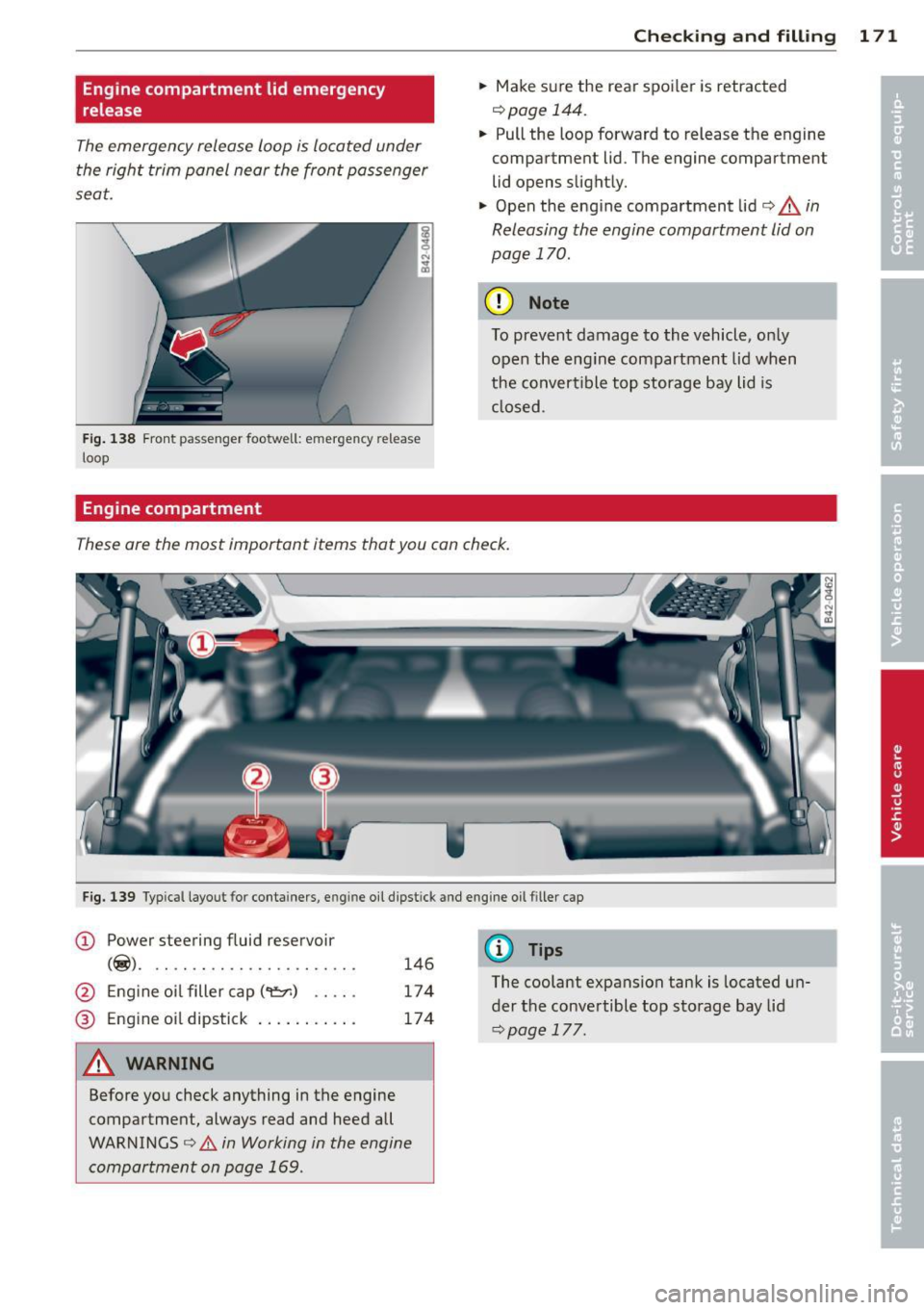
The emergency release loop is located under
the right trim panel near the front passenger
seat.
F ig . 138 Front pas se n ge r footwe ll: emer gen cy re lease
l oo p
Engine compartment
Checkin g and fillin g 171
.. Make su re the rear spoiler is retracted
¢ page 144 .
.. Pull the loop forward to release the engine
compartment lid . The engine compartment
lid opens sligh tly.
.. Open the engine compartment lid¢.&.
in
Releasing the engine compartment lid on
page 170.
(D Note
To prevent damage to the vehicle, only
open the eng ine compartment lid when
the convertible top storage bay lid is
closed .
Th es e ar e th e most important it ems that you can ch eck.
Fig. 139 Ty pical layout for containers , en gin e oil dipst ick and eng ine o il filler cap
(D Power steering fluid reservoir
(@) ... .. .... .... ... ...... .
@ Eng ine oi l filler cap ('l=r.) .. ...
® Engin e oi l dipstick
146
174
174
A WARNING
Before you check anything in the engine
compartment, always read and heed all
WARNINGS ¢.&. in Working in the engine
compartment on page 169 .
-
{!) Tips
The coolant expansion tank is located un
der the convertible top storage bay lid
¢ page 177.