wheel AUDI R8 SPYDER 2012 Owner's Manual
[x] Cancel search | Manufacturer: AUDI, Model Year: 2012, Model line: R8 SPYDER, Model: AUDI R8 SPYDER 2012Pages: 236, PDF Size: 59.24 MB
Page 94 of 236
92 Driving Safel y
• Fasten your safety belt and wear it proper ly.
Also instruct your passengers to fasten their
safety belts proper ly
¢ page 101.
What impairs driving safety?
Safe driving is directly related to the condi
tion of the vehicle, the driver as well as the
driver's ability to concentrate on the rood
without being distracted.
The driver is responsible for the safety of the
vehicle and all of its occupants. If your ability
to drive is impaired, safety risks for everybody
in the vehicle increase and you also become a
hazard to everyone else on the road
¢ .&, .
Therefore:
• Do not let yourself be distracted by passen
gers or by using a cellular telephone.
• NEVER drive when your dr iving ability is im
paired (by medicat ions, alcohol, drugs, etc.) .
• Observe all traffic laws, rules of the road
and speed limits and plain common sense .
• ALWAYS adjust your speed to road, traff ic
and weather condit ions.
• Take frequent breaks on long trips . Do not
drive for more than two hours at a stretch .
• Do NOT drive when you are tired , under
pressure or when you are stressed.
A WARNING , .
Impaired driving safety increases the risk
of serious personal injury and death when
ever a vehicle is being used .
Proper occupant
seating positions
Proper seating position for the driver
The proper driver seating position is impor
tant for safe, relaxed driving.
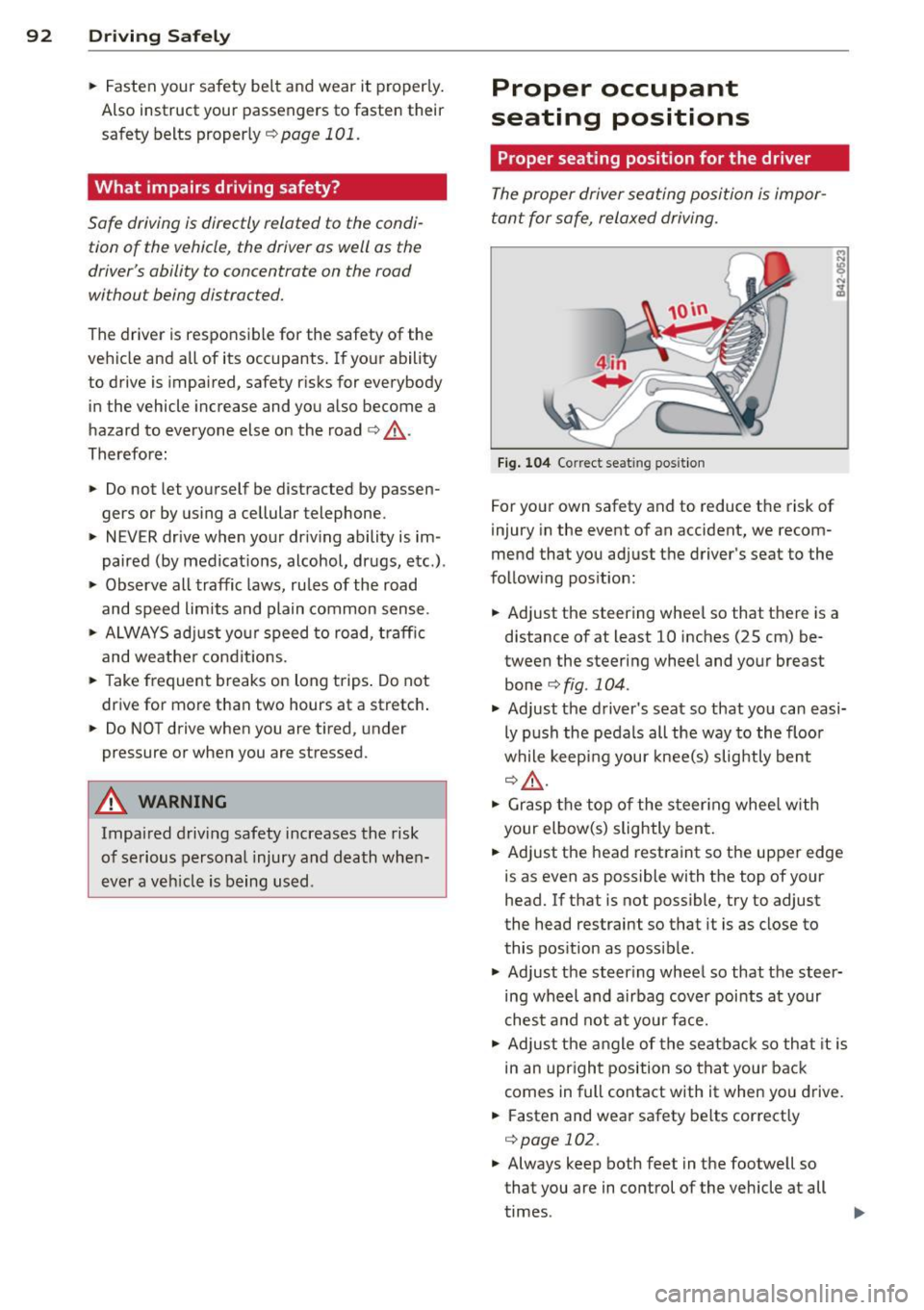
Fig. 104 Correct seat ing posit ion
For your own safety and to reduce the risk of
injury in the event of an accident, we recom
mend that you adjust the driver's seat to the
following position:
• Adjust the steering wheel so that there is a
distance of at least 10 inches (25 cm) be
tween the steering wheel and your breast
bone¢
fig . 104 .
• Adjust the driver's seat so that you can easi
ly push the pedals all the way to the floor
while keeping your knee(s) slightly bent
¢.&, .
• Grasp the top of the steer ing whee l with
your elbow(s) slightly bent.
• Adjust the head restraint so the upper edge
is as even as possible with the top of your
head. If that is not possible, try to adjust
the head restraint so that it is as close to
this position as possible .
• Adjust the steering wheel so that the steer
ing wheel and airbag cover points at your
chest and not at your face.
• Adjust the angle of the seatback so that it is
in an upright position so that your back
comes in full contact with it when yo u drive.
• Fasten and wear safety be lts correctly
¢ page 102.
• Always keep both feet in the footwell so
that you are in control of the vehicle at all
times .
Page 95 of 236
For detailed information on how to adjust the
dr iver's seat, see
¢ page 59, Seats and stor
age.
A WARNING
Drivers who are unbelted, out of position
or too close to the airbag can be seriously
injured by an airbag as it deploys. To help
reduce the risk of serious personal injury:
- Always adjust the driver's seat and the
steering wheel so that there are at least
10 inches (25 cm) between your breast
bone and the steering wheel.
- Always adjust the driver's seat and the
steering wheel so that there are at least
4 inches (10 cm) between the knees and
the lower part of the instrument panel.
- Always hold the steering wheel on the
outside of the steering wheel rim with
your hands at the 9 o'clock and 3 o'clock positions to help reduce the risk of per
sonal injury if the driver's airbag inflates.
- Never hold the steering wheel at the
12 o'clock position or with your hands at
other positions inside the steering wheel
rim or on the steering wheel hub. Hold
ing the steering wheel the wrong way
can cause serious injuries to the hands,
arms and head if the driver's airbag in
flates
- Pointing the steering wheel toward your
face decreases the ability of the supple
mental driver's airbag to protect you in a
collision .
- Always sit in an upright position and nev
er lean against or place any part of your
body too close to the area where the air
bags are located.
- Before driving, always adjust the front
seats and head restraints properly and
make sure that all passengers are prop
erly restrained.
- Never adjust the seats while the vehicle
is moving. Your seat may move unexpect
edly and you could lose control of the ve
hicle.
- Never drive with the backrest reclined or
tilted far back! The farther the backrests
Driving Safely 93
are tilted back, the greater the risk of in
jury due to incorrect positioning of the
safety belt and improper seating posi
tion .
- Children must always ride in child seats
¢ page 130. Special precautions apply
when installing a child seat on the front
passenger seat
¢ page 109.
Proper seating position for the front
passenger
The proper front passenger seating position
is important for safe, relaxed driving.
For your own safety and to reduce the risk of
injury in the event of an accident, we recom
mend that you adjust the seat for the front
passenger to the following position :
"' Adjust the angle of the seatback so that it is
in an upright position and your back comes
in full contact with it whenever the vehicle is
moving.
"' Adjust the head restraint so the upper edge
is as even as possible with the top of your
head. If that is not possible, try to adjust
the head restraint so that it is as close to
this position as possible
¢ page 94.
"' Keep both feet flat on the floor in front of
the front passenger seat .
"' Fasten and wear safety belts correctly
¢ page 104.
For detailed information on how to adjust the
front passenger's seat, see
¢ page 59, Seats
and storage.
A WARNING
Front seat passengers who are unbelted,
out of position or too close to the airbag
can be seriously injured or killed by the air
bag as it deploys. To help reduce the risk of
serious personal injury:
- Passengers must always sit in an upright
position and never lean against or place
any part of their body too close to the
area where the airbags are located.
•
•
Page 106 of 236
104 Safet y belt s
moving just before the crash, unti l something
stops them· here, the wall
r::!;> fig. 113.
The same pr inc iples apply to people sitting in
a veh icle that is involved in a fronta l co llision .
Even at city speeds of 20 to 30 mph (30 to 50
km/h), the forces acting on the body can
reach one ton (2,000 lbs., or 1,000 kg) or
more. At higher speeds, these forces are even
greater .
People who do not use safety be lts are a lso
not attached to their vehicle. In a fronta l co lli
sion they will also keep mov ing forward at the
speed their vehicle was trave lling just before
the crash . Of course, the laws of physics don't
just apply to frontal coll is io ns, they determ ine
what happens in all kinds of accidents and col·
lisions.
What happens to occupants not wearing
safety belts?
In crashes, unbelted occupants cannot stop themselves from flying forward and being in
jured or killed. Always wear your safety belts!
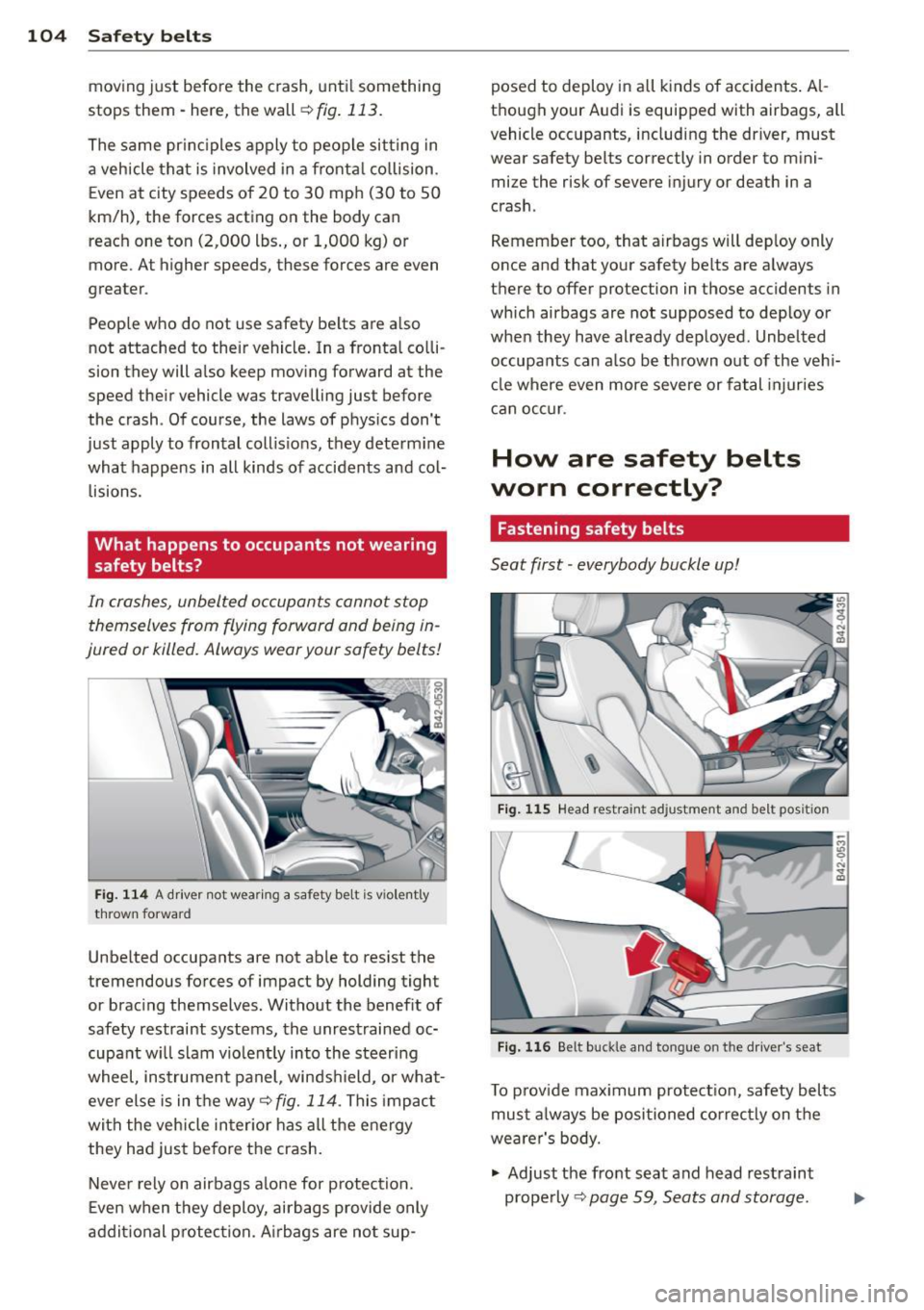
Fi g. 114 A driver not wear ing a safety belt is violently
t h rown forward
Unbe lted occupants are not able to res ist the
tremendous fo rces of impact by holding tight
or brac ing themselves. Without the benef it of
safety restraint systems, the unrestrained oc·
cupant w ill slam vio lent ly into the steering
wheel, instrument panel, winds hield, or what
eve r else is in the way¢
fig. 114. This impac t
with the veh icle inter ior has all the energy
they had just befo re the crash.
Neve r rely on airbags a lone for p rotection.
E ven when they deploy, airbags provide only
a d dit ional p rotec tion. A irbags are no t sup- posed to deploy
in all k inds of accidents . Al
though your Audi is equipped with airbags, all
vehicle occupants, includ ing the driver, must
wear safety belts correctly in order to mini
mize the risk of severe injury or death in a
crash .
Remember too, that airbags will dep loy only
o nce and that your safety belts are always
there to offer protection in those accidents in
which airbags are not supposed to dep loy or
when they have already dep loyed. Unbelted
occupa nts can a lso be th rown out of the veh i
cl e where even more severe or fatal injuries
ca n occ ur.
How are safety belts
worn correctly?
Fastening safety belts
Seat first · everybody buckle up!
Fig . 115 Head restraint adjustment and belt position
Fig. 116 Be lt buck le an d tongue on the dri ver's seat
To p rov ide max imum protect ion, safety belts
mus t always be posi tioned co rrec tly on the
wea rer's body.
.. Adjust the fro nt seat and head rest raint
p rope rly
r::!;> page 59, Seats and storage.
Page 111 of 236
Airbag system Important things to know
Importance of wearing safety belts and
sitting properly
Airbags are only supplemental restraints. For
airbags to do their job , occupants must al
ways wear their safety belts properly and be
in a proper seating position.
For your safety and the safety of your passen
gers, before driving off, always:
"" Adjust the driver's seat and steering wheel
properly
q page 92,
"" Adjust the front passenger's seat properly
¢page 93,
"" Wear safety be lts properly ¢ page 102,
"" Always use the proper child restraint to pro-
tect children properlyq
page 130.
In a collision, airbags must inflate within the
blink of an eye and with considerable force.
The supplemental airbags can cause injuries
if
the driver or the front seat passenger is not
seated properly . Therefore in order to help the
a ir bag to do its job, it is important, both as a
driver and as a passenge r to s it properly at all
times.
By keeping room between your body and the
steer ing whee l and the front of the passenger
compartment, the airbag can inflate fully and
comp letely and provide supplemental protec
tion in certain frontal collisions
q page 92,
Proper occupant seating positions. For details
on the operation of the seat adjustment con
trols
q page 60.
It's especially important that children are
properly restrained
q page 130.
There is a lot that the driver and the passen
gers can and must do to help the individual
safety features installed in your Aud i work to
gether as a system.
Proper seating pos ition is important so that
the front airbag on the driver side can do its
job. If you have a physical impairment or con-
Airbag system 109
dition that prevents you from sitting properly
on the driver s eat with the safety belt properly
fastened and reaching the peda ls, or if you
have concerns with regard to the function or
operation o f the airbag system, please con
tact your authorized Audi dealer or qualified
workshop , or call Audi Customer Relations at
1-800-822-2834 for possible modification to
your vehicle.
When the airbag system dep loys, a gas gener
ator will f ill the a irbags, break open the pad
ded covers, and inflate between the steer ing
whee l and the driver and between the instru
ment panel and the front passenger. The air
bags will deflate immediately after deploy
ment so that the front occupants can see
through the windshie ld again without inter
ruption .
A ll of th is takes place in the blink of an eye, so
fast that many people don't even realize that
the airbags have deployed. The airbags a lso
inflate with a great dea l of force and nothing
should be in their way when they deploy.
Front airbags in comb ination with properly
worn safety belts slow down and lim it the oc
cupant's forward movement . Together they
help to prevent the driver and front seat pas
senger from hitting parts of the inside of the
vehicle while reducing the forces acting on the
occupant during the crash. In this way they
help to reduce the risk of injury to the head
and upper body in the crash. Airbags do not
protect the arms or the lower parts of the
body.
Both front airbags wi ll not inflate in all fronta l
collisions . The triggering of the airbag system
depends on the vehicle de ce lerat ion rate
caused by the collision and regis te red by the
elec tron ic control uni t. If th is rate is below
the reference value programmed into the con
trol unit, the airbags will not be trigge red ,
even though the car may be badly damaged as
a result of the collision . Ve hicl e damage, re
pair costs or even the lack of ve hicle dama ge
is not necessarily an indication of whether an
airbag should inflate or not . •
•
...
Page 112 of 236
110 Airbag sys te m
Since the cir cumstances will vary considerab ly
between one collision and anot her, it is not
possib le to def ine a range of vehicle speeds
that will cover every possible k ind and angle
of impact t hat will always trigger the airbags.
Important factors include, for example, the
nature (hard or soft) of the object which the
car h its, the ang le of impact, vehicle speed,
etc. The front airbags will also not inflate in
side or rea r collisions, or in ro ll-overs.
Al ways rememb er: Airbags will deploy only
once, and only in certa in k inds of co llisions.
Your safety belts are always there to offer pro
tection in those s ituations in which airbags
a re not supposed to deploy, or when they have
a lready deployed; for example, when your ve
hicle strikes or is struck by another vehicle af
ter the first co llision.
This is just one of the reasons why an airbag is
a supplementary restraint and is not a substi
tute for a safety belt . The airbag system
works most effect ively when used with the
safety belts. Therefore, always wear your safe
ty belts properly¢
page 101.
A WARNING
Sitting too close to the steer ing wheel or
instrument panel will dec rease the effec
tiveness of the airbags and will increase
t he risk of personal injury in a co llision.
- Never sit closer than 10 inches (2S cm)
to the stee ring wheel or instrument pan
el.
- If you cannot sit more than 10 inches
( 2 5 cm) from the steer ing whee l, investi
ga te whethe r adaptive equipmen t may
be available to help you reach the pedals
and increase your seating distance from
the steering wheel.
- If you are unrestrained, lean ing fo rward,
sitting sideways or out of position in any
way, your risk of in jury is much higher.
- You will also receive serio us inj uries and
cou ld even be killed if you are up against
the airbag or too close to it when it in
flates - even with an Advanced Airbag. -
To reduce the risk of injury when an a ir
bag inflates, always wear safety be lts
properly¢
page 104, How are safety
belts worn correctly? .
-Never let children ride unrestrained or
improperly restrained in the vehicle. Ad
just the front seats properly . If children
are not p roperly restrained, they may be
seve rely in ju red or killed when an a irbag
infla tes.
- Never ride with the back rest reclined.
-Always sit as far as possible from the steer ing whee l or the instrument pane l
¢ page 92, Proper occupant seating po
sitions.
- Always sit up right with your back against
the backres t of your seat.
- Never p lace your feet on the instrument
panel or on the seat. Always keep both
feet on the f loor in front of the sea t to
he lp preven t serio us in juries to the legs
and h ips if the airbag infla tes .
- Never re cline the front passenger 's sea t
to tra nspor t ob jec ts. Items c an al so
move into the a rea of the s ide airbag or
the front airbag during braking or in a
sudden maneuver . Objects near the air
bags can become projectiles and cause
in ju ry when an airbag inflates.
A WARNING
Airbags that have deployed in a crash must
be replaced.
- Use on ly orig inal equipment airbags ap
proved by Aud i and installed by a trained
technician who has the necessary tools and d iagnost ic equipment to properly re
p lace any airbag in your vehicle and as
sure sy stem effe ctive ness in a crash.
- Never permit salvaged or recycled air
bags to be installed in you r vehicle.
Page 115 of 236
- Improper installation of child restraints can reduce the ir effectiveness or even
prevent them from prov iding any protec
t ion.
- An improperly installed child restraint can interfere with the airbag as it de
ploys a nd serio usly injure or even kill the
child -even with an Advanced Airbag
System.
-Always follow the manufacturer's in
struct ions provided with the child saf ety
seat or car rier carefully.
- Never place additional items on the seat
that can increase the to tal weight regis
tered by the weight-sens ing mat a nd can
c a use i nju ry in a c rash.
Front airbags
Descript ion of front airbags
The airbag system con provide supplemental
protection to properly restrained front seat occupants.
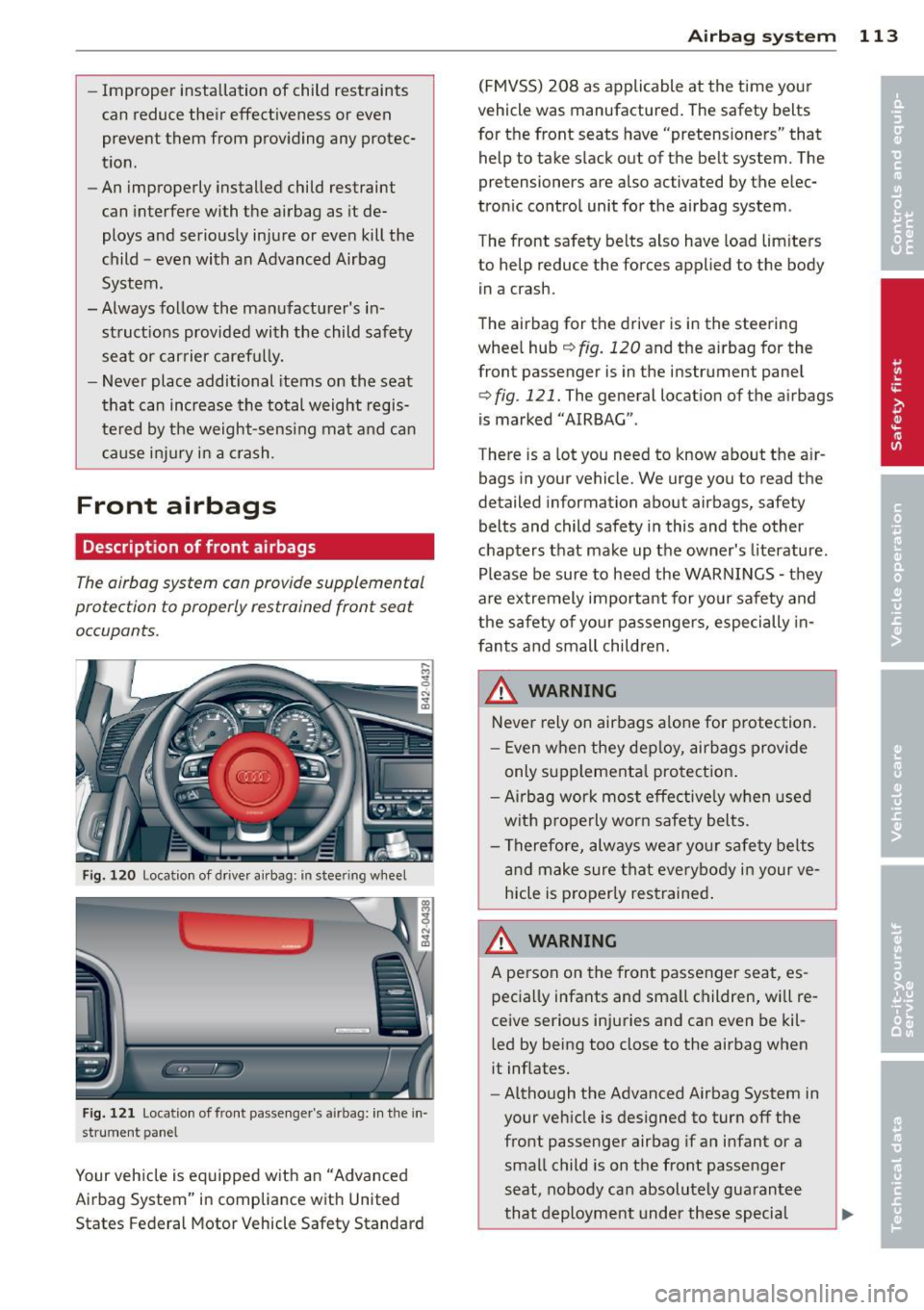
Fig. 120 Locatio n of drive r air bag: in steer ing wheel
F ig. 121 Location of fro nt passe nger 's a irbag: in th e in
strument panel
Your veh icle is equipped w ith an "Advanced
Airbag System" in compliance with United
States Federal Motor Vehicle Safety Standard
A irba g sy stem 113
(FMVSS) 208 as applicable at the time you r
vehicle was manufactured . The safety belts
for the front seats have "pretensioners" that help to take slack out of the be lt system. The
pretensioners are also activated by the e lec
tron ic contro l unit for the airbag system .
The front safety belts a lso have load lim iters
to help reduce the forces applied to the body
in a crash.
The airbag for the driver is in the steering
whee l hub
c> fig. 120 and the airbag for the
front passenger is in the instr ument panel
c> fig . 121. The general locat ion of the a irbags
is marked "AIRBAG" .
There is a lot you need to know about the a ir
bags in your vehicle. We urge you to read the
detailed information about airbags, safety
belts and child safety in this and the other
c hapters that make up t he owner's literature.
Please be sure to heed the WARNINGS - they
a re extremely important for your safety and
the safety of yo ur passengers, especially in
fants and small children .
& WARNING
=
Neve r rely on airbags alone for protection.
- Even w hen they deploy, airbags provide
only s upp lementa l protect ion .
- Airbag work most effe ctive ly w hen used
with p roperly worn safety belts.
- Therefore, alw ays wea r yo ur safety belts
an d make sure that eve ry bo dy in y our
ve
hicle is p roperly restrained .
A WARNING
A person on the fron t passenger seat, es
pec ia lly infants and sma ll children, will re
ceive serio us injuries and can even be kil
led by being too close to the airbag when
it inflates.
- Altho ugh the Advanced Airbag System in
your veh icle is designed to tur n off the
front passenger airbag if an infant or a small child is on the front passenger
seat, nobody can absolutely gua ran tee
-
-
that deployment under these specia l 11-
Page 116 of 236
114 Airbag sys te m
conditio ns is impossible in a ll conceiva
ble situations t hat may happen during
t h e usef ul lif e of your vehicle.
- The Adva nced Airbag System can deploy
in accor dance with the "low risk" opt ion
under the U.S. Federal Sta ndard if a child
that is heavier than the typical one-year old child is on the front passenger seat
and the othe r cond itions for airbag de
ployment are met.
- For their own safety, all children, espe
cially 1 2 yea rs and younger, should a l
ways ride p roperly rest rained for their
age and size.
Advanced front airbag system
Your veh icle is equipped wit h a front Advanced
Airbag System in compliance with United
States Federal Motor Vehicle Safety Standard
208 as applicab le at the time your vehicle was
manufactured.
The front Advanced Airbag System supp le
ments the safety belts to provide addit iona l
protection for the driver's and front passeng
er's heads and upper bodies in frontal crashes.
The airbags inflate only in frontal impacts
when the vehicle decelerat io n is high enough .
The front Advanced Airbag System for the
front seat occupants is not a substitute for
your safety belts. Rather, it is part of t he over
all occupant restraint system in your ve hicle.
A lways remember that the airbag system can
on ly help to protect you, if you are s itting up
r ight, wearing yo ur safety belt and wea ring it
p roperly. This is w hy you and yo ur passenge rs
must always be properly restrained , not just
beca use the law requires you to be.
The Advanced Airbag System in your veh icle
has been cer tified to meet the " low r is k " re
qu irements for 3 and 6 year -o ld children on
the passenger side and very small adu lts on
the driver side. The low risk deployment crite
ria are intended to he lp red uce the risk of in
jury through interaction with the front airbag that can occur, fo r example, by be ing too close to the steering wheel and instrument
pane
l when the airbag inflates .
In add ition, the system has been certified to
comply wi th the "s uppression" re qu iremen ts
of the Sa fe ty Standard, to turn off the front
airbag for infants 12 months o ld and younger
who are restrained on the front passenger
seat in child restraints that are listed in the
Standard
¢ page 132, Child restraints and
Advanced Airbags .
"Suppression" requires the front a irbag on the
passenger side to be turned off if:
- a child up to abo ut one year o f age is re
strained on the front passenger seat i n one
of the rear-fac ing or forward -facing infant
restraints listed in Federal Motor Vehicle
Safety Standard
208 with which the Ad
vanced Airbag System in your vehicle was
cert ified . For a listing of the ch ild res traints
that were used to certify your vehicle 's com
plia nce w it h t he US Safety Standa rd
¢ page 132,
-we ight less than a threshold level stored in
the co ntrol uni t is de te cted on the fron t pas
senger seat.
When a person is detected on the front pas senger seat, weighing more than t he total
we ight of a ch ild that is about 1 year old re
stra ined in one of the rear-fac ing o r forward
f acing infant res traints ( listed in Fede ral Mo
tor Vehicle Safety Standar d
208 with which
the Advanced Airbag System in yo ur vehicle
was certif ied), the front airbag on the passen
ger side may or may not deploy.
The
PASSENGER AIR BAG OFF light comes on
when the electronic contro l unit detects a to
ta l we ight on the front passenger seat that re
quires t he front airbag to be t urned off. If the
PASSENGER AIR BAG OFF light does not
come on, the front a irbag on the passenger
s ide has not been t urned off by the cont ro l
u ni t and ca n dep loy if the control un it senses
an impact that meets the cond itions store d in
i ts memory.
If the total weight on the fro nt passenge r
seat is more than that of a typ ical 1 yea r-old , .,.
Page 121 of 236
electronic control unit (the PA SS ENGE R AIR
BAG OFF
light comes on and stays on).
A WARNING
Sitting in the wrong position can increase
the risk of serious injury in crashes.
- To reduce the risk of injury when the air
bags inflate, the driver and passengers
must always sit in an upright posit ion,
must not lean against or place any part
of the ir body too close to the area where
the a irbags are located .
- Occupants who are unbelted, out of posi
t ion or too close to the airbag can be se
riously injured by an airbag as it unfolds
with great force in the blin k of an eye
¢page 111.
A WARNING
A child in a rearward-facing child sa fety
sea t insta lled on the front passenger seat
wi ll be seriously injured and can be k illed if
the front ai rbag inflates -even with an Ad
vanced Airbag System.
-
-The inflating airbag will hit the child
safety seat or infant carrier w ith great
force and w ill smash the ch ild safety seat
and child against the backrest, center
armrest , door or roof.
- Never install a rearward facing child
safety seat on the front passenger seat
unless the
PASSENGER A IR BAG OFF
light comes on and stays on . If the PAS
SENGER AIR BAG OFF
light does not
c ome o n and stay on, the inflating airbag
will hit the child safety seat o r infant car
rier wi th great force and will smash the
child safety seat and child against the
backrest, door or roof . Have the airbag
system inspected immediately by your
authorized Audi dealer .
A WARNING
Objects between you and the a irbag will
increase the risk of in jury in a c rash by in
terfering with the way the airbag unfolds
A irbag system 119
or by be ing p ushed into you as the airbag
inflates.
- Never hold things in you r hands o r on
your lap when the veh icle is in use.
- Never transport items on or in the area
of the front passenger seat . Objects
could move into the a rea of the front air
bags during braking or other sudden ma
neuvers and become dangerous projec
tiles that can cause ser ious personal in
jury if t he a irbags inflate .
- Never p lace or attach accessories or oth
er objects (such as cup holders, te le
phone b rac kets, large, heavy or bulky ob
jects) on the doors, ove r o r near the area
marked "AIRBAG " on the s teering wheel,
instrument panel, seat bac krests or be
tween those areas and yo urself. These
objects could cause inju ry in a c rash, es
pecially when the airbags inflate.
- Never recline the front passenger's seat
to transport objects . Items can a lso
move into the area of the s ide a irbag or
the front a irbag during braking or in a
sudden maneuver. Objects near the air bags can become projec tiles a nd cause
in ju ry, partic ula rly when the seat is re
clined.
A WARNING
T he fine dus t created when airbags deploy
can cause breathing prob lems fo r people
wi th a history of as thma or other breath
ing cond itions.
- T o reduce t he risk of bre ath ing problems,
those wi th asthma o r other respiratory
conditions s hou ld get fresh air r ight
away by getting o ut of the veh icle or
open ing windows or doors.
- If you are in a collision in which airbags
deploy, wash your hands and face with
mild soap and water before eating .
- Be ca reful not to get the dust into your
eyes, or into any c uts or scratches.
- If the resi due should get into your eyes,
f lush them w ith wate r.
•
•
Page 125 of 236
A WARNING
1
Improper care, servicing and repair proce
dures can increase the risk of personal in
jury and death by preventing an airbag from deploying when needed or deploying an airbag unexpectedly:
- Never cover, obstruct, or change the
steering wheel horn pad or airbag cover
or the instrument panel or modify them
in any way .
- Never attach any objects such as cup
holders or telephone mountings to the
surfaces covering the airbag units.
- For cleaning the horn pad or instrument
panel, use only a soft , dry cloth or one
moistened with plain water. Solvents or
cleaners could damage the airbag cover
or change the stiffness or strength of the
material so that the airbag cannot de
ploy and protect properly.
- Never repair, adjust, or change any parts
of the airbag system.
- All work on the steering wheel, instru
ment panel, front seats or electrical sys
tem (including the installation of audio
equipment, cellular telephones and CB
radios, etc .) must be performed by a
qualified technician who has the training
and special equipment necessary.
- For any work on the airbag system, we
strongly recommend that you see your
authorized Audi dealer or qualified work
shop.
- Never modify the front bumper or parts
of the vehicle body .
- Always make sure that the side airbag
can inflate without interference:
- Never install seat covers or replace
ment upholstery over the front seat
backs that have not been specifically
approved by Audi.
- Never use additional seat cushions that
cover the areas where the side airbags
inflate.
- Damage to the original seat covers or
to the seam in the area of the side air bag module must always be repaired
Airbag system 123
immediately by an authorized Audi
dealer.
- The airbag system can be activated only
once . After an airbag has inflated, it
must be replaced by an authori zed Audi
dealer or qualified technician who has
the technical information, training and
special equipment necessary.
- The airbag system can be deployed only
once . After an airbag has been deployed,
it must be replaced with new replace
ment parts designed and approved espe
cially for your Audi model version . Re
placement of complete airbag systems
or airbag components must be per
formed by qualified workshops only. Make sure that any airbag service action
is entered in your Audi Warranty
& Main
t enance booklet under
AIRBAG REPLACE
MENT RECORD .
-For safety reasons in severe accidents,
the alternator and s tarter are separa ted
from the vehicle battery with a pyrotech
nic circuit interrupter .
- Work on the pyrotechnic circuit inter
rupter must only be performed by a
qualified dealer - risk of an accident!
- If the vehicle or the circuit interrupter
is scrapped , all applicable safety pre
cautions must be followed.
@ For the sake of the environment
Undeployed airbag modules and preten
sioners might be classified as Perchlorate
Material - special handling may apply, see
www .dtsc .ca. gov/hazard o u swaste/ per-
ch [orate . When the vehicle or parts of the
restraint system including airbag modules
and safety belts with pretensioners are
scrapped, all applicable laws and regula
tions must be observed. Your authorized
Audi dealer is familiar with these require
ments and we recommend that you have
your dealer perform this service for you.
•
•
•
•
Page 126 of 236
124 Airbag system
Other things that can affect Advanced
Airbag performance
Changing the vehicle's suspension system can
change the way that the Advanced Airbag Sys
tem performs in a crash. For example, using
tire-r im combinations not approved by Audi,
lowering the vehicle, changing the stiffness of
the suspension, including the springs, suspen
sion strut s, shock absorbers etc. can change
the forces that are measured by the airbag sensors and sent to the electronic control
unit. Some suspension changes can, for example, increase the force levels measured by the
sensors and make the airbag system deploy in
crashes in which it would not deploy if the
changes had not been made. Other kinds of
changes may reduce the force levels meas
ured by the sensors and prevent the airbag
from deploying when it should .
The sensors in the safety belt buckle for the
driver and front passenger seat tell the elec
tronic control module if the safety belt is
latched or not .
If the safety belt is being used,
the front airbag will deploy at a slightly high er rate of vehicle deceleration than if the safe
ty belt is not being used. Therefore, in a par
ticular collision, it is possible that an airbag
will not deploy at a seating position where the
safety belt is being used but will inflate at the
position where the safety belt is not being
used.
It is important that nothing interfere
with the safety belt buckles so that the sen
sors can send the correct information about
safety belt use to the electronic control unit .
A WARNING
Changing the vehicle's suspension includ
ing use of unapproved tire-rim combina
tions can change Advanced Airbag per
formance and increase the risk of serious
personal injury in a crash.
- Never install suspension components
that do not have the same performance
characteristics as the components origi
nally installed on your vehicle.
- Never use tire-rim combinations that
have not been approved by Audi.
A WARNING
-Items stored between the safety belt
buckle and the center console can cause
the sensors in the buckle to send the
wrong information to the electronic con
trol module and prevent the Advanced Air
bag System from working properly.
- Always make sure that nothing can inter
fere with the safety belt buckles and that
they are not obstructed.
Knee airbags
· Description of knee airbags
The knee airbag system con provide supple
mental protection to properly restrained
front seat occupants.
Fig. 124 Drive r's airbag
The driver knee airbag is in the instrument
panel underneath the steering wheel
~ fig . 124, the airbag for the passenger is at
about the same height in the instrument pan
el underneath the glove compartment.
The knee airbag offers additional protection
to the driver's and passenger's knees lower
thigh areas as a supplement to the protection
by the safety belts.
If the front airbags deploy, the knee airbags
also deploy in frontal collisions when the de
ployment threshold stored in the control unit
is met
~ page 118, More important things to
know about front airbags.
In addition to their normal safety function,
safety belts help keeping the driver or front
passenger in position in a frontal collision so ..,.