light AUDI R8 SPYDER 2012 Manual Online
[x] Cancel search | Manufacturer: AUDI, Model Year: 2012, Model line: R8 SPYDER, Model: AUDI R8 SPYDER 2012Pages: 236, PDF Size: 59.24 MB
Page 146 of 236
144 Intelligent technology
deactivated, or they are activated auto
matically in the deactivated state.
- If a malfunction occurs in the E DS, this is
signaled by an indicator light, see
~ page 16.
- Some tracks (e.g . steeply banked turns)
may affect ESC response .
Rear spoiler
The rear spoiler improves vehicle handling
and enhances driver control.
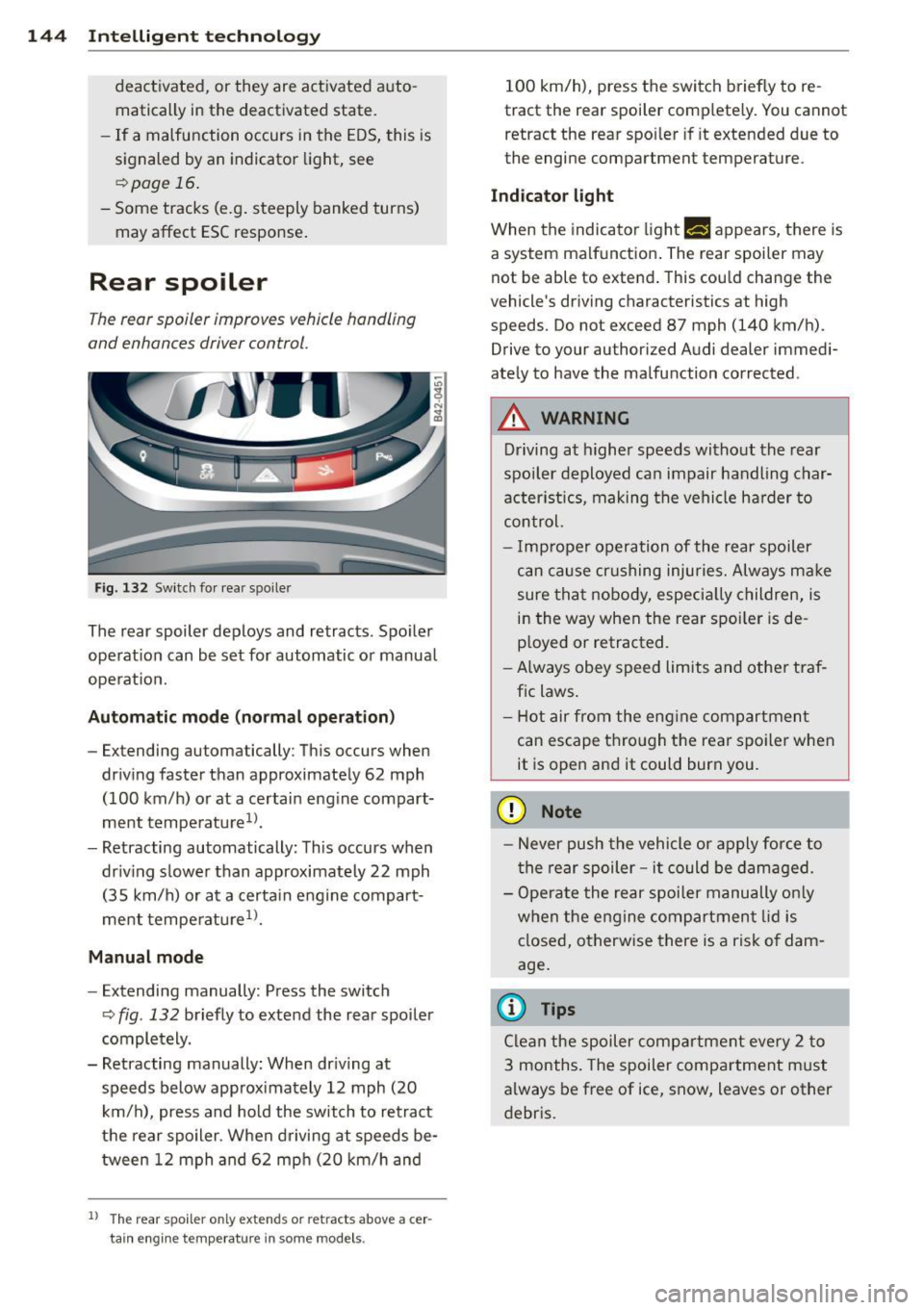
Fig. 132 Switch for rear spoile r
The rear spoiler deploys and retracts . Spo ile r
ope rat ion can be set for automatic or manual
operat ion.
Automatic mode (no rmal operation )
-Extending automatically: This occurs when
dr iv ing faster than approximately 62 mph
(100 km/h) or at a certain eng ine compart
ment temperature
1>.
- Retracting automatically: This occurs when
dr iv ing s lower than approximately 22 mph
(35 km/h) o r at a certa in engine compart
ment temperatu re
1>.
Manual mode
- Extending manually: Press the switch
~ fig. 132 briefly to exte nd the rear spoiler
completely .
- Retracting manually : When dr iv ing at
speeds below approx imately 12 mph (20
km/h), press and hold the switch to retract
the rear spo iler. When driving at speeds be
tween 12 mph and 62 mph (20 km/h and
l ) The rear s poiler only extends or retracts above acer
ta in eng in e te mpe rature in some models.
100 km/h), press the switch briefly to re
tract the rear spoiler complete ly. You cannot
retract the rear spo iler if it extended due to
the engine compartment temperature.
Indicator light
When the indicato r light f.-j appears, there is
a system malfunction . The rear spoiler may
not be able to extend . This cou ld change the
vehicle's dr iving characteristics at high
speeds. Do not exceed 87 mph (140 km/h).
Drive to your authorized Audi dealer immed i
ately to have the malfunction corrected .
A WARNING
Driving at higher speeds without the rear
spoiler deployed can impair handling char
acteristic s, making the ve hicle ha rder to
control.
- I mp rope r operation of the rear spoiler
c a n cau se crushing injuries . Always ma ke
sure tha t nobo dy, espec ia lly children, is
i n the way when the rear spoi ler is de
p loyed or retracted.
- Always obey speed limits and other traf
fic laws .
- H ot air from the eng ine compartmen t
can escape thro ugh the rear spo iler when
it is open and it could burn you.
(D Note
- N ever push the vehicle or apply force to
t he rear spoiler -it co uld be damaged.
- Ope rate the rear spoiler manually on ly
w hen the eng ine compartmen t lid is
closed, o therwise there is a r is k of dam
age .
(D Tips
Clean the spoiler comp artme nt eve ry 2 to
3 months . The spoiler compa rtment m ust
a lway s be free of ice, snow, leaves or other
debr is.
Page 147 of 236
Braking
New brake pads
During the first 250 miles (400 km), new
b rake pads do not possess their full braking
effect, they have to be "broken in" first. The
distance can be ten times longer in veh icles
with ceramic brakes*. You can compensate for
this slightly reduced brak ing power by push
ing harder on the brake pedal. Avoid heavy
braking loads during the break-in period.
Operating conditions and driving habits
The brakes on today's automobi les are sti ll
subject to wear, depending largely on operat
ing conditions and dr iv ing habits
c:> & . On ve
hicles that are either driven mostly in stop
and-go city traffic or a re driven hard, the
brake pads should be checked by your author
ized Audi dealer more often than specified in
the
Warranty & Maintenan ce booklet . Failure
to have your b rake pads inspected can result
in reduced brake performance.
On steep slopes, you shou ld use the brak ing
effect of the engine. This way, you prevent un
necessary wear on the brake system . If you
must use your brakes, do not hold the brakes
down continuously. Pump the brakes at inter
va ls.
Moisture or road salt
Under ce rta in conditions, for example, when
d riving through water or very heavy rain, or
even after washing your vehicle, the braking
effect can be reduced due to moisture (or in
freezing conditions ice) on the brake pads. A
few cautious brake applicat ions should dry
off
the brake pads or remove any ice coatings.
When you are driving at higher speeds with
the windshield wipers on, the brake pads will
briefly touch the brake d iscs in regular inter
vals so as to improve reaction t ime when brak
ing on wet surfaces. You, the driver, will not
notice anything.
The effectiveness of the brakes can be reduced
when the vehicle is dr iven on a salt-covered
road and the brakes are not used . Likewise,
Intelligent technology 145
you clean off accumulated salt coating from
brake discs and pads with a few cautious ap
plications of the brake
c:> & .
Corrosion
The re may be a tendency for dirt to build up
on the brake pads and corros ion to form on
the discs if the car is not driven regularly or
on ly for short trips with litt le use of the
brakes.
If the brakes are not used frequently, o r if cor
rosion has formed on the discs, it is advisable
to clean
off the pads and discs by braking
firmly a few times from a moderately high
speed
c:> & .
Faults in the brake system
If you shou ld notice a sudden increase in
brake pedal travel, then one of the two brake
circuits may have fai led . Drive immediately to
the nearest qualified workshop to have the
damage repaired. Drive at reduced speed on
the way there and anticipate longer stopping
distances and higher pedal pressure c:> &,.
Low brake fluid level
Malfunctions can occur in the brake system if
the brake fluid level is too low. The brake flu id
level is monitored electronically.
Brake power assist unit
T he brake power assist unit increases the
pressure that you generate with the brake
pedal. It works only when the engine is run
ning.
Brake lining wear status
Brake lining wear may be checked by visual in
spection of t he condition of the brake pads
thro ugh the openings in the wheel. If neces
sary, the whee l may be removed for this in
spection
c:> page 206 .
A WARNING
--You should perform braking maneuvers
for the purpose of cleaning the brake
system only if road conditions permit.
•
•
Page 150 of 236
148 Intelligent technology
Dynamic energy management
While th e veh icle is be ing dr iven , dynamic en
e rgy management distributes the energy gen
erated according to the needs of the individu
a l components . It reg ulates cons umption, so
that more electrical energy is not being used
t han is being generated and ensures an opti
mal state of charge for the battery .
(D Tips
- But even energy management cannot
negate the limits of physics. Consider
that the power and life of a battery are li mited .
- If starting ab ility is threatened, you are
i nformed by a warn ing
<=> page 148,
Driver notification in the instrument
cluster display .
What you should know
The highest priority is given to maintaining
starting capability.
The battery is severely taxed in short-distance
d riving, in city traffic and duri ng the co ld time
of year. Abu ndant e lectr ica l energy is re
qu ired, but only a little is g ene rated . It is also
cr itica l if t he engine is not run ning and ele ct ri
cal componen ts ar e turned on. In th is in
stance energy is being consumed but none is
being generate d.
It is in precisely these si tua tions that you w ill
notice energy management actively regula t
ing the distrib ution o f energy .
Vehicle stands for an extended period
If you do not drive you r vehicle over a period
of severa l days or weeks, elect rical compo
n ents are grad ually cu t back o r swi tched off .
This redu ce s energy cons umption and mai n
tains s ta rting cap abili ty over a longer period .
T a ke into considerat ion tha t when you u nlock
your ve hicle, some co nvenience func tions,
such as the remote key or power sea t adj ust
men t, may not be available. The convenience
f u nctions will be avai lable again when you
turn on th e ignition and start the engine. With the engine turned off
If you
listen to the radio, for examp le, w it h
t h e engine t urned off, the battery is being dis
c h arged .
If starti ng capab il ity is jeopard ized d ue to en
ergy consu mptio n, a mess age a ppea rs in the
drive r informa tion d isplay .
You have to start t he engine to charge the
ba tte ry.
With the engine running
Althoug h electrical energy is generated when
the vehicle is being d riven, the battery can be
come discharged. This happens mostly when
li ttle energy is being ge ne rated and a g reat
deal consumed a nd t he battery's state of
c h arge is not opt imal.
To b ring the energy bala nce back into equ ili
br iu m , consume rs wh ich req uire espe cially
l ar ge amounts of ene rgy a re temporar ily cu t
ba ck or sw itched o ff. H ea ting systems in par
t icu lar require a grea t deal of energy . If you
not ice, for examp le, that the heated seatsat or
the heated rear window are not heating, they have been temporarily cut back or switched
off . These systems w ill be available again as
soon as the e ne rgy balance has been restored.
You w ill also notice that engine id le speed has
been increased slightly . T hi s is normal and not
a cause for concern. By increasing engine id le
speed the additional energy required is gener
ated and the battery is charged .
Driver notification in the instrument
cluster display
If bat tery power drops in to the range where i t
can limit the ability of the engi ne to start, this
is shown in the instrument cluster display
with the following driver message:
(•] Low battery charge: battery will be
charged while driving
T h is not ifi cat io n r eminds yo u that t he start ing
ca pabili ty of the engi ne may be lim ite d. As
soon as you s tart dr iv ing again, the battery .,..
Page 153 of 236
-Have you r vehicle maintained properly
and in accordance with the service rec
ommendat ions in your Warranty
& Main
tenance booklet.
- Lack of proper maintenance as well as
improper use of the vehicle will impair
the function of the Emission Control Sys
tem and could lead to damage.
Sporty driving
Warming up and cooling down
By carefully warming up and cooling down
your vehicle, you can he lp ensure that it is not
overstressed unnecessarily during sporty driv
ing.
When warming up, the vehicle is driven at a maximum engine speed of 6000 RPM
(Vl0 engine) or 7000 RPM (V8 engine) in or
der to raise the engine oil temperature to a minimum of 140 °F (60 °(). The tires also on
ly reach their full road holding capability once
they have warmed up.
The cooling fan can continue to run in your ve hicle after the engine is switched
off. H owev
er, driving the vehicle to cool it down is part ic
ularly important. During sporty driving, the
engine and brakes, the exhaust system, and
the t ransm ission all become extreme ly hot.
Before you park the vehicle, you shou ld d rive
it for a few mi les/kilometers at light load in
the low rpm range to allow it to coo l down .
Driving on a track
Before you take your vehicle out on a track,
ensure that it is in perfect condition. For ex
ample, you should check the tire tread and the brake pads . It is best to increase t ire pressure
by about 0 .3 bar .
When driving on a track, oil consumption may be somewhat higher than in "normal" opera
tion
¢ page 17 4 .
You shou ld definitely inspect your vehicle af
ter subjecting it to severe condit ions. Are the
brake pads OK? Is there anything unusual
Dri vin g and en vironm ent 151
about the ti res, including the inner and outer
sidewa lls (e.g . tread, blistering)? Are the air
intakes free of leaves and tire dust? Is the o il
l evel OK?
Your authorized Audi dea ler or qua lified work
shop will be happy to undertake an inspection
before and after use on the race track.
_& WARNING
-
Some race tracks (e.g. steeply banked
turns) may affect the response of the ESC.
(D Tips
- Review the track requirements and con
ditions before you start driving.
- When driven on a race track, all vehicle
parts are severe ly stressed. This can re
sult in increased wear.
Operation and maintenance
Fuel economy, env ironmenta l impact, and
wear on your eng ine, brakes and tires la rgely
depend on three facto rs:
- your personal driving style
- operating conditions
- technical limitations
By havi ng your ve hicle reg ularly se rviced by an
a uthorized Aud i dea le r helps to ens ure that i t
runs properly and economica lly. The condition
of your vehicle not only affects its safety and
ability to ho ld its va lue, it a lso affects
f u el
consumption .
The amount of oi l used is re lated to engine
load and speed .
It is normal for the oil consump tion of a new
engine to reach its lowest value after a certa in
mileage has been driven.
You must drive your veh icle about 3,000 m iles
(5,000 kilometers) before yo u can p rope rly
assess oil consumpt io n.
Th is also app lies to fue l consumption and en-
gine o utp ut.
IJll>
•
•
Page 155 of 236
Cleaning and protect ion
General information
Regular core preserves vehicle value.
Regular and correct care will contribute to
maintaining the beauty and value of your Au
d i. Furthermore, good care may be a condition
for substantiating a warranty cla im should
corrosion damage or paint defects occur.
Your authorized Audi R8 dealer has a variety
of
d edicat ed ve hicl e-car e produ ct s. Please
make sure you apply them correctly .
A WARNING
-Cleaning agents may be poisonous. Keep
them out of the reach of children.
- Heed all caution labels .
- Always read directions on the container before using any product. Follow the di
rect ions carefu lly.
- Most chemical cleaners are concentrated and have to be diluted .
- Use spot removing fluids only in well
ventilated areas .
- Do not use gasoline, kerosene, d iesel
fuel, nail polis h remover or other volatile
fluids . They may be toxic, flammab le or
haza rdous i n other ways. Do not wash,
wa x or d ry the vehicle wi th the ign it ion
on or the eng ine running.
- Do not clean the undersides of chassis,
fenders, wheel covers, e tc. wit h out pro
tecting your hands a nd arms . You may
c u t yourself on sharp -edged metal parts .
- Mois ture and ice on brakes may imp air
braking efficiency
c:> page 145, Broking.
T est the brakes ca refully each time you
wash the vehicle.
@) For the sake of the environment
Select only environmenta lly fr iend ly clean
ing prod ucts . Leftover clean ing products
should not disposed of in the household
waste .
Cleaning and protec tion 153
Care of exterior
Washing your vehicle
T he longer i nsect rema ins, bird dropp ings,
t ree res in, road and indust rial d ust, tar , soo t
part icles, road salt, and o ther aggressive de
pos its remain on the vehicle su rface, the more
lasting their destructive effect will be . High
temperatures, for example from intense sun light, intensify the corrosive effect.
After the end of winter road salting, the un derside of the vehicle shou ld be thoroughly
washed .
Automatic car washes
You must t ake the necessary precautions s uch
as clos ing t he windows and convert ible top
before using an automatic car wash.
If yo ur
vehicle has specia l accessories - e.g . spoilers,
radio antenna -it is best to speak to the oper
ator of the car wash c:>(D .
Only use car washes where the vehicle re
mains stationary and the cleaning equipment
moves aro und the veh icle while washing and
drying. It is not possib le to use car washes
where the vehicle is moved forward on a con
veyer
c:> ,& .
It is preferab le to wash your vehicle in a
brush less carwash .
Washing with a pow er wa sher
When was hing yo ur vehicle with a power
washe r, be sure to follow the operating in
structions for the power washer. This applies particu larly to the
p ressure and the spra ying
distance .
Mainta in sufficient distance from
soft materials such as rubber hoses, sound
deade ning mater ial, and the park ing aid sen
sors* that are located i n the front or rear
bumper.
Do not use washers with
a ro tating jet or a
nozzle spraying
a h igh pressur e je t of wate r in
any case.
IJl,-
•
•
Page 156 of 236
154 Cleaning and protection
Hand washing
When washing your vehicle by hand, first soft
en the dirt with copious amounts of water and rinse it
off as best you can.
Then clean the vehicle using a soft
sponge, an
auto glove or a low-pressure wash brush.
Work from the top down to the bottom, start
ing with the convertible top
¢ page 156. Use
a
shampoo only for very stubborn dirt.
Rinse the sponge or auto glove thoroughly at
frequent intervals.
Clean the wheels, door sills and similar areas last . Use a separate sponge for this.
_& WARNING
- Car washes with conveyors can damage
the vehicle tires, which could cause the tire to lose pressure suddenly while driv
ing and put you at risk for an accident.
Do not use car washes with conveyors.
- Switch
off the ignition when you wash
your vehicle to avoid an accident.
- Protect your hands and arms from sharp
metal edges when you clean the under
body, the inside of the wheel wells or the
wheel covers to avoid cutting yourself.
- When washing your vehicle in the winter:
Moisture and ice in the brake system can
affect the brakes.
- Never wash tires with a jet that sprays
water in a direct stream. This could cause invisible damage to the tires and weaken
them, even if the spray is from a relative ly long distance and for a short time.
Damaged and weakened tires can fail
and cause accidents and personal injury.
(D Note
- Never drive your vehicle through any au tomatic car wash that fails to provide ei
ther sufficient clearance for your vehicle
or sufficient track width for your tires. Risk of expensive damage to the vehicle's
underbody , tires, and rims!
- As described in your Warranty
& Mainte
nance booklet, damage or malfunction due to misuse of the vehicle or failure to
operate the vehicle in accordance with
the
instructions of this Owner's Manual
will not be covered under warranty.
- Fold the exterior mirrors flat - there is a
risk of damaging the exterior mirrors.
Power folding exterior mirrors must not
be folded in or out by hand. Use the pow
er function!
- Do not wash the vehicle in direct sun
light. You may damage the paint.
- Do not use sponges designed to remove
insects, rough kitchen sponges, or simi
lar products. You risk damaging the
paint surface.
- You should remove debris (such as in
sects) from the headlight lenses on a
regular basis, for example when refuel
ing your vehicle. Never clean the head
lights with a dry cloth or sponge . Use a
wet cloth or sponge.
It is best to use
soapy water.
- Never clean tires using a nozzle that
sprays water in a direct stream. Damage
can occur even with a relatively long
spraying distance and for a very short
time.
- To avoid damaging your vehicle, always
make sure that there is sufficient dis
tance between the spray head and soft materials like rubber hoses, plastic parts
and sound-deadening materials. Never
aim the spray head at the same point for
a long time. This also applies to cleaning
headlights and painted bumpers. Re
member: the closer the nozzle is to the
surface of the material, the greater the
stress on the material.
- Never clean the convertible top using a
power washer.
@) For the sake of the environment
Wash your vehicle only at specially de
signed facilities. They can prevent any dirty
water contaminated by oil from entering
the waste water. In certain areas washing
a car outside of such facilities is not per mitted.
Page 158 of 236
156 Cleaning and protec tio n
-To prevent pa int damage, do not wash
the vehicle in direct sunlight .
- To prevent damage to the paint surface, do not use insect removal sponges,
rough kitchen sponges or similar items.
- You should remove debris (such as in
sects) from the headlight lenses on a
regular basis, for example when refue l
i ng your vehicle. Only clean the head
li ghts using a wet cloth or sponge, never
a dry one . Cleaning w ith soapy water is
recommended.
@ For the sake of the environment
On ly wash the vehicle in facilit ies specially
designed for that purpose. Th is w ill reduce
the risk of d irty water contaminated with
oil from entering the sewer system. In
some areas, washing vehi cles outs ide of
t hese facilities is prohib ited.
(D Tips
For more informat ion on special cleaning
p roducts designed for matte fin is h pa int,
seeyourAudiRBdeale~
Convertible top care
The convertible top requires special care .
Keeping your top looking great and making
certain that it lasts a long t ime depend to a
great extent on proper use and care . Remove
b ir d droppings as soon as possib le, since t he
cor rosive chemi cals in them w ill cau se the
r u bber impregnat ion in your top to swell and
possib ly allow the fabric to leak .
W ith
normal soiling, a ll yo u n eed to do is
clear the top with a soft brush and clear wa
ter . Always brush in the direction of the fabric
from fron t to rear.
I f the top is
very dirty and has spotted areas
clean it wi th a brush using a convert ible top
cleane r. Always brush in the direction of the
fabric from front to rear . Rinse with plenty of
clear water , and a llow the top to air-dry.
C hamois a re not s uitable fo r dry ing the top. Never use gasoline, spot remover, benzene,
paint thinner or solvents to remove spots
. We
recommend that you only use cleaners espe
c ially formulated for use on convertib le tops,
and that you fo llow the produce use d irections
carefully . Authorized Audi deals can prov ide
detailed informat ion.
A WARNING ,..__
A lways read and heed all WARNINGS and
the information on
¢ page 153.
(D Note
Never use a high-pressure power washer to
clean the convertib le top .
Wind deflector
Clear the wind deflector w ith wate r o r, if it is
heavily soi led, a chemically neut ral cleaning
solution .
A WARNING
Always read and heed all WARNINGS and
the information on
¢page 153.
Waxing and polishing
Wa xing
A good wax coating protects the vehicle paint
to a large extent against the envi ronmental
factors listed under¢
page 153, Washing
your vehicle
and even against slight scratches.
You can use a liquid car wax to protect your
paint as soon as one week afte r yo ur vehicle
has been delivered.
E ven if you regu larly use a
wa xing process in
automa tic car washes, we recommend that
you manually apply a coat of wax to give the
paint extra protection, part icu larly if water no
l onger beads on the clean paint.
Protect plastic body parts with car wax in the
same way as the ve hicle body. .,..
Page 159 of 236
During warm weather dead insects tend to
collect on the front bumper and on the for
ward area of the hood. They are much easier
to remove from paint that is waxed
often.
Poli shing
P olish your vehicle on ly if the pa int has lost its
shine and the gloss cannot be brought back
with wax.
If the polish used does not contain preserva
tive compounds, the paint must be waxed af
terwa rds .
A WARNING
Always read and heed a ll WARNING and
other Information¢
page 153.
([) Note
Do not use car wax on
- ma tte or anod ized metal trim
-
- rubbe r or rubber-like tr im .
Trim strips
For e nvironmenta l reasons, Aud i fabricates
the br igh t tr im strips and t rim pieces from
pure chromium-free a luminum .
D irt and mar ks on the tr im str ips should be
removed with a
pH -balanc ed cl eaning agent
(do no t use a chrome cleaner). Paint po lishes
are a lso not suitable for the care o f decorative
parts and trim strips. A lkaline cleaners which
are often used before entering car washes can
cause dull or mi lky spots when they dry.
Author ized Audi dealers carry cleaning prod
ucts which have been tested for use on your
vehicle and are not harmful to the environ
ment.
A WARNING
Always read and heed a ll WARNING and
other Informat ion
¢page 153.
Plastic and vinyl
-
Use a clean, damp cloth or sponge to remove
dust and light surface dirt. For other soil, use
Cleaning and protec tion 157
a lukewarm all-p urpose cleaning so lution o r a
mild saddle soap for vinyl trim. Paint care
products are not suitab le for plastic and viny l.
A WARNING
Always read and observe all WARNINGS
and other information
¢page 153.
Carbon-fiber parts
Applies to vehicles : with carbo n-fiber parts
The carbon-fiber parts of your vehicle have a
painted surface. They do not requ ire special
ca re and are cleaned like other painted parts
¢ page 153.
Touch-up paint -
You
r authorized Audi dea ler has to uch-up
paint fo r minor scratches and stone chips. Mi
nor paint damages such as scratches or stone
c h ips should be touched up immed iate ly to
prevent corrosion.
T he number for the origi nal veh icle paint can
be fo und on the vehicle identification label
¢ page 215.
However, if cor rosion h as formed, you must
have th is thoro ughly removed by you a uthor
ized Audi dea ler or other qualified workshop .
A WARNING
Always read and heed all WAR NINGS and
the information
c:> page 153.
Windows
Clear vision improves traffic safety.
In order to maintain the performan ce of the
winds hield wiper blades, neve r clean the win
dow glass with insect remove r or wax .
Rubber, o il, g rease, or silicone residue can be
removed using a
glas s cl eaner o r a silic one re
m over .
Wax residue, howeve r, can only be re
moved using a spec ial cleane r. You can obta in
more information from your authorized Audi
dealer.
ll-
•
•
Page 160 of 236
158 Cleaning and protection
You shou ld also clean the inside of the win
dow g lass at regular intervals.
The cloth or chamois used on paint surfaces
con tains wax res idue. Use a separa te cloth or
chamois to d ry the window glass.
Cl eaning the rear window
Aud i recommends cleaning the window us ing
a soft cotton clot h and water m ixed wi th
clean ing solution or window cleaner (1:1 mix
ture) . To avoid streaks, do not wipe the win
dow dry with paper towels.
D o not use any clea ning so lutions that conta in
ammonia, acids , si licone or fl uo ride or clean
ers that are abrasive or co uld cause sc ratches.
Do not use any alkaline cleaning solutions.
A WARNING
- The windshie ld m ust not be treated with
water-repe llent materials. They can in
crease glare under poor visib ility condi
tions such as wetness, darkness, or when
the sun is low on the horizon. In addi
t ion, they can cause the windshield wip
ers to chatte r.
- Always read and heed all WARNINGS and
other information
¢ page 153.
(D Note
-Never use warm or hot water to remove
snow and ice from windows and mirrors.
This could cause the glass to crack .
- To prevent damage to the wires of the
rear defogger, do not place any adhesive
sticke rs on the inside of the rear window
over the wires.
- To help prevent d irt from scratch ing the
window, always scrape in a forward d i
r ection - pushing the scraper away from
you - never back and forth .
Wheels
Regular care is required to preserve the deco
rative appearance of the wheels . Road sa lt
and brake dust must be washed off regu larly
or the wheels wi ll be damaged. Use only special acid-free cleaning agents
. You
can find proper wheel cleaner at authorized
Audi dealers and specia lty stores . Do not leave
the cleaner on the wheels longer than speci
fied. Wheel cleaners contain ing acid can dam
age the surface of the wheel bolts .
Pa int polish or other abrasive materials must
not be used when caring for wheels . If the
protective coat ing has been damaged, from
stones for example, touch up the damage as
soon as possible.
A WARNING ,__
- Moisture and ice on b rakes may affect
b rak ing eff ic iency -
¢ page 145, Braking.
Test the b rakes carefully after each veh i
cle wash.
- Always read and heed a ll WARNI NGS and
the informa tion
¢page 153.
Exhaust tail pipes
-
Road salt and other corrosive materials will
damage the material in the exhaust tail pipes
if they are not cleaned regularly. Do not clean
the tail pipes with wheel cleaner, pa int polish,
chrome polish or other abrasive cleaners.
Clean the tail pipes with car care products
that are suitable for sta inless steel.
Your authorized Audi dea ler can provide clean
ing products that have been tested and ap
proved for your vehicle.
Care of interior
Radio and navigation display
T he display may be cleaned with a soft cloth
and commercially-avai lab le "LCD cleaner".
The cloth should be coated lightly when the
cleaning solution when cleaning the display.
(D Note
To prevent scratches, only clean the display when it is dry.
Page 162 of 236
160 Cleaning and protection
Open Velcro fasteners on your clothing can
damage the seat cover. Please make sure
that Velcro fasteners are closed.
Natural leather
App lies to vehicles: with natura l leather
Audi makes great efforts to maintain the
properties, natural look and feel of interior leather.
General
We offer many different types of leather on
our vehicles. Most are different types of nappa
leather, which has a smooth surface and
comes in various colors.
The intensity of the color determines the visu
al characteristics and appearance . If the sur
face of the leather has a typical natural look,
then the leather is a nappa leather that has
been left in a relatively natural condition. This
leather offers particularly good comfort and
breathes well. Fine veins, closed grains, insect
bites, skin folds, and subtle variations in color
remain visible. These characteristics demon
strate that the material is natural.
Natural nappa leather is not covered by a col
or finish.
It is therefore more sensitive to soil
ing and wear, which is something you need to
consider if children, animals or other factors
might prove to be particularly hard on the
l eather.
By contrast, leather types that are covered by
a colored finish layer are more durable. This
has a positive effect on the leather's resist
ance to wear and soiling in daily use. On the
other hand, the typical characteristics of natu
ral leather are barely or not apparent. Howev
er, this does not mean that the leather itself is of inferior quality.
Care and handling
Because of the exclusive nature of the types of
leather that Audi uses and their unique prop
erties (such as sensitivity to oils, grease, soil ing, etc.), you will need to be somewhat care- ful
with these leathers, and a certain type of
care is required . For example, dark clothing
materials can discolor leather seats (especial
ly if such clothing is damp and was not dyed
correctly). Dust and dirt particles in pores,
folds, and seams can have an abrasive effect and can damage the leather surface as well as
weaken seams .
The leather should be cleaned regularly as needed. After having been used for a relatively
long time, your leather seats will acquire a
rich aged finish. This is a characteristic of nat
ural leather and a sign of true quality.
In order to maintain the value of this natural
product over the life of your vehicle, you
should follow the recommendat ions below:
(D Note
- To keep your leather from bleaching out,
do not allow it to be exposed to bright
sunlight for long periods of time. If you
have to leave the vehicle parked outside
for long periods, cover the leather to protect it from direct exposure to sun
light.
- Sharp objects on clothing, such as zip
pers, rivets or sharp pieces on belts can
leave permanent scratches or scrape
marks on the surface of the leather .
(D Tips
-After each time you clean the leather and
at regular intervals, use a leather preser
vative creme that contains UV-blockers
and that works into the leather. This
creme will nourish and moisturize the
leather, helping it to breathe and stay
supple .
It also helps to build up a protec
tive coating on the surface.
- Clean the leather every 2 -3 months,
and clean any areas that get soiled .
- Remove fresh marks made by ballpoint
pens, ink, lipstick, shoe polish, etc. as
soon as possible.
- Preserve the color of the leather as need
ed by using a spec ial colored leather care
creme to touch up areas of uneven color .